How a Republic Dies

ROME (Vorenus)


by Diane Rufino, December 30, 2013

One of my all-time favorite HBO series is ROME, starring Kevin McKidd and Ray Stevenson.  Borrowing on a theme similar to Forrest Gump, the series follows the journey of two men in Julius Caesar’s Roman legion who seem to find themselves making history wherever they go. The soldiers are Lucius Vorenus (McKidd) and Titus Pullo (Stevenson).  Although Vorenus and Pullo are real centurions who displayed outstanding bravery and valor in battle and were included in Caesar’s war journals, their journeys and experiences in the series are the creation of the writers. ROME chronicles the period in Roman history when the people lost their republic. Aside from the entertainment provided by Vorenus and Pullo, who are often violent and crude, the story showed how the Senate tried to stand up to the ambitions of men like Julius Caesar and Octavian (who renamed himself Augustus Caesar) to protect the people’s hand and voice in government.

Perhaps I am drawn to the series because of my Italian heritage or perhaps it is because of Rome’s history as a republic and its impact on our Founding Fathers when they sat down to fashion a government to serve the people and protect their inalienable sovereign rights.

Rome was established as a republic in 509 B.C. when it was a mere city-state.  It was easy to manage and government was responsive to the people. Originally established as an advisory board composed of the heads of patrician families (wealthy landowners), the Senate soon became the most powerful organ of republican government and the only body of state that could develop consistent long-term policy. It was involved in virtually all public matters, but its most important responsibilities were in foreign policy and financial administration.  Roman citizens had a voice in government by electing Senators who represented them and were accountable to them.

After the second Punic War (218 – 201 B.C.), when Rome defeated Carthage, Rome’s economy soared and trade grew.  Rich landowners and merchants were able to buy up most of the land in the county.  Eventually, they would begin to have more and more political power.  Under Roman law, only landowners could serve in the military, but as it happened, the rich wouldn’t serve in the army. The number of soldiers dwindled and this caused instability in the Roman military.

In 133 B.C., Tiberius Gracchus, who was elected to the position of tribune, proposed several laws to reshape Rome into the republic that it had been intended and that it had once been. The proposed laws included giving an equal share of land to all citizens, limiting the amount of land one person could have, and allowing every free Roman citizen to vote (at the time, only residents of Rome could vote).  Gracchus’ ideas were very controversial for the time and when Romans began to riot, he was killed. His brother Gaius took the position of tribune in 123 B.C. and he attempted to pass the same laws.  He too was murdered.

General Marius ushered in more reforms in 104 B.C.  He established a new law which stated that people did not have to own land to be a soldier. This served to benefit the military.  However, in return for their service, soldiers began to demand that they be given land.  This required Marius to use his influence on the Senate, for at the time, there was no provision to grant soldiers land.  It was General Marius versus the Senate.  The result was that soldiers became very loyal to Marius; they trusted him.  In fact, they were more loyal to him than to the Senate. It was from this point on that generals began to gain significant political power in Rome. Generals who commanded the legions and who were popular with them could become quite powerful.

By about 79-78 B.C., Rome was temporarily back to being ruled by the Senate. Meanwhile, Pompey, the most distinguished general of the time, was gaining public favor from his many military victories. At the same time, Crassus, the wealthiest man in Rome, also gained much popularity from the common people, for defeating a large slave uprising. Both Pompey and Crassus were ambitious and had designs on ruling Rome.  But still another prominent general was also gaining much popularity.  That was Julius Caesar.  Pompey, Crassus, and Caesar would make a secret alliance to work together to gain control over the Senate. This alliance would become known as the First Triumvirate.

But soon ambition, politics, and battle would destroy that union. Caesar was elected consul in 60 B.C.  He proposed laws that would gain the triumvirate even more power.  When the Senate tried to oppose these laws, Crassus and Caesar resorted to intimidation and violence in order to get them passed.  When Crassus was killed in battle in 53 B.C., the triumvirate was destroyed and only two were left – Caesar and Pompey, who were good friends. (Caesar even betrothed his beautiful daughter Julia to Pompey in order to strengthen the political alliance between them).  Julius Caesar left Rome after his term as consul ended to take up a governorship he demanded in southern France.  Ignoring the orders of the Senate, he raised his own army, and led a path of conquest throughout all of Gaul. Marc Antony, another brilliant general, was with Caesar at this time in Gaul and was making a name for himself.

After eight years, word grew that Julius Caesar was returning home. The Senate was afraid that he would bring his army and march on Rome and pleaded with Pompey to organize resistance. But Pompey was torn.  Caesar was his friend.  His wife was Caesar’s daughter and he loved her deeply.  But Pompey did as asked and began to build an army. Unfortunately he could not do so in time and when Caesar marched into Rome, Pompey was forced to flee.  Caesar eventually bought off, threatened, or intimidated members of the Senate, and at his command, they crowned him Emperor and gave him concentrated powers for a period of ten years.  The people began to call him a tyrant.  Senators called him a tyrant.  Caesar countered by assuring them that he needed the power “to save the republic” and that after the ten years was up he would turn control back to the Senate.  He didn’t trust the Senate to rule; instead, he thought he knew what was best for the people… and for Rome.

Julius Caesar was assassinated on March 15 – the “Ides of March” – by senators Brutus and Cassius, among many others, who plotted among each other to rid Rome of the tyrant.  They descended upon him in the Senate, stabbing him twenty-three times.  Second-in-command, Marc Antony, was also supposed to be assassinated, from what I read.  As the ROME series was able to convey, the conspirators believed that the assassination was a noble act because they were rescuing the empire from the designs of a dictator and delivering power back to the people. The Senate would once again regain control of Rome. The People would once again have their government back.

Well, what followed was not much better.

Immediately, civil war broke out between two factions – the assassins (republicans), including Brutus and Cassius, and the Caesarians, led by Marc Antony and Octavian. Antony and another strong general, Marcus Lepidus, unofficially established their power by intimidation through their armies. Octavian, the son of a noble Roman family, and nephew to Julius Caesar, was named as Caesar’s sole heir in his will. The ROME series spent considerable time portraying the mindset and ambitions of Octavian after Caesar’s demise.  Young Octavian (a mere teen) approached the Senate leader Marcus Tullius Cicero, the foremost lawyer of the day and the greatest defender of the republic (and the man whose writings taught our Founders about “Natural Law”) and struck up a deal.  Unknown to Cicero, the deal would have disastrous consequences.  An astute Octavian told Cicero that the people loved Caesar and harbored great anger over his death. As Caesar’s appointed heir, he could easily manipulate the people against the treacherous murderous Senate.  Furthermore, Caesar who was a good friend of Cicero’s, had appointed him and others in their leadership roles in the Senate. If the Senate was to officially declare Caesar a tyrant, as they planned to do, in order to justify the assassination and to undo his commands, then that would mean their appointments would be undone as well.  So, Cicero made a deal and appointed Octavian consul of the Senate in return for Cicero and the others keeping their positions.  Octavian then began to hatch plans for revenge against those who assassinated his uncle (now adoptive ‘father’).  Brutus and Cassius and a few of the other conspirators had already fled Rome; they left when they found out that Marc Antony survived.

In the two years that followed, Antony and Octavian each amassed great armies and consolidated power in various parts of the empire – Antony in the east and Octavian in the west.  Each would have plans to consolidate power and take over Rome.  Antony understood that the conspirators, many from powerful and noble Roman families, would have to be killed so they could not return to Rome, reclaim their power, and try to turn the people again him and Octavian just wanted them killed out of revenge. And so both Antony and Octavian joined together to go after them. Some of the conspirators committed suicide but the last ones to remain were defeated at Philippi in 42 B.C.  Brutus and Cassius, the last to survive, watched this defeat and then killed themselves as well.

The victors returned to Rome and the Second Triumvirate was formed, consisting of Mark Antony, Lepidus, and Octavian. This triumvirate was formally constituted. In effect, it sidelined the consuls and the Senate and effectively signaled the death of the Republic. The three men, Antony, Lepidus, and Octavian used the force of the army and swept the Senate with terror, killing Cicero and others.  They chopped off the great Cicero’s hands and nailed them to the Senate door.  In fact, they used a Roman law known as “proscription” as an incentive to kill Cicero and the others.  “Proscription” was a Roman policy that was revived by the Second Triumvirate to label political enemies as “enemies of the state” which would then allow them to confiscate their money and property to pay the soldiers.

[NOTE:  Proscription was developed by Sulla (a general who ruled from about 82-79 B.C.)  as a way to dispose of the property of those who were ‘condemned.’  By “condemned,” they meant marked for assassination (as “enemies of the state”). The proscribed individuals were called proscripti. The law the Romans passed to grant Sulla this extraordinary power was called lex Cornelia de proscriptione et proscriptis and was known as the lex Cornelia. In 82 B.C. Sulla created proscription as a means of disposing of his enemies — the supporters of Marius. He posted a list of those he wanted killed (like the “Wanted Dead or Alive” posters of the Old West) and upon their death, their property was confiscated and sold. Proscription was adopted again under the second triumvirate in 43 B.C. Again, Cicero was a victim of this second proscription.  Supposedly, Octavian said: “We should concentrate on the rich, especially some of the fabulously rich. If enough men are proscribed, the amount of cash will add up quickly.”]

Initially, Marc Antony took Caesar’s place, but Octavian, who somehow held the upper hand (perhaps because he was hand-picked by Julius Caesar as his heir), was suspicious of him and wanted him out of Rome.  There is one account that Octavian forced Antony to marry his sister, Octavia, and Antony did not honor her properly.  There is also another account that Octavian was resentful that Antony was so completely adored and beloved by the people of Rome and fearful of the intense loyalty that Antony’s men had for him. They thought of him as a god.  And so, Octavian forced him to accept an appointment to govern eastern Rome, which included Egypt (conquered by Julius Caesar).  This is where the famous story of Antony and Cleopatra comes from.  Antony quickly became the lover of Cleopatra, the exotic Ptolemeic queen of Egypt (meaning that she is a descendent of General Ptolemy, who served under Alexander the Great of Macedonia, and then became the ruler of Egypt – 323-283 B.C.), even though he was still married to Octavia.  Antony and Cleopatra had children together. He also supposedly promised her roman land (an act of treason at the time).  Octavian used all that information to make the case to the Roman people and to the Senate that Antony had switched his allegiance and dishonored Rome.  Octavian would declare battle against him to assume sole power over Rome, which he did.  He defeated Antony at the naval Battle of Actium in 31 B.C. and when he and Cleopatra were trapped and besieged at Alexandria, they both committed suicide.  (Who can forget Elizabeth Taylor and Richard Burton as Cleopatra and Antony in the epic MGM production).

Also around this time, Octavian accused of Lepidus of attempted rebellion, stripped him of his title, and forced him into exile. With Antony and Lepidus aside and removed from power, Octavian assumed sole power and became Emperor. Rome’s republic was officially dead.  Octavian insisted on being called Caesar – Augustus Caesar – and would go on to rule for 40 years. [“Augustus” was a new title to be given to him, meaning “supreme ruler; holy, dignified or majestic]. The reign of the “Caesars” and those leaders that followed would continue to keep power concentrated in a single ruler.  The power was never returned to the people.  While the intentions of the leaders in the beginning for usurping power may have been to serve the “general welfare” of Rome, for example, by giving needy families sums of money from the national treasury or giving farm land to “deserving” people or giving grain to the people who could not find jobs or providing Gladiator games and other spectacular games for entertainment, the fact is that it was never returned properly to the people.  The people seeing that they had no say in what their leaders were doing – that the Emperors were going to do what they wanted anyway – lost interest in keeping their government honest and decent and effective.  And so the republic died.  It died from within.  Because of apathy.

As the power of the emperors grew stronger and stronger, the Roman republic became but a distant memory. The once proud Senate that had witnessed the splendid orations of Cato and Cicero became dominated and weakened year after year by the succession of dictators. It atrophied into a mere figurehead of an institution. And the people themselves became disengaged. They took the duties of citizenship far more seriously during the days of the Republic than in the dictatorships of the Caesars.  In the waning years of the republic and then into the reign of the Caesars, the populace no longer respected civic virtues and virtue in public life. Civic duty was treated as a triviality.

In these final days of the Roman republic, the empire was faced with a changing social structure and culture. There once was a time when Rome enjoyed a very ordered society. But in those final days, at the height of its conquests, its social order began to break down.

It was at this time that the mighty Roman Empire began to reach its geographical limits. It was a massive empire. As a result of its vast conquests, Rome acquired many slaves, who were then used to build most of its bridges, roads, and aqueducts.  Then they went on to take jobs in farming, mining and construction. As this cheaper labor replaced Roman citizens, unemployment grew.  Idle, unemployed, hungry people filled the capital. They were called “plebs” (or plebeians), a term originally referring to free land-owning Roman citizens, who historically had representative power in government (called Tribunes, which had the power to veto the laws of the Senate).  Later the term was used to refer to the lower, poor, common class of Roman citizens. They were apathetic and cared nothing for the governing of the empire.  As the number of plebs grew, they became a more problematic class and the dynamics in the empire changed dramatically. In the eyes of the elite, this lower class lacked morality and were typified by “their stupidity, laziness, and time-wasting.”  They were characterized as being motivated by pleasure, excess, loss of control, and a closing of the gap between genders.  The Roman satirist and poet, Juvenal, referred to them as the mob.  He said they consisted of “idlers, the dregs of every nation.”

To appease and distract the plebs, Roman emperors handed out free distributions of corn and amused them with violent gladiatorial and other contests that were held in the Coliseum and chariot races at the Circus Maximus (stadium).  The more Romans became addicted to the corn distributions and the mindless self-gratification, the more they lost the capacity to govern themselves.

Juvanal wrote: “What of the plebs?  They follow fortune, as always. Nowadays, with no vote to sell, their motto is ‘Couldn’t care less.’  There was a time when they elected generals, heads of state, commanders of legions. But now there’s only two things that concern them: bread and circuses.”  E.G. Hardy put it more bluntly: “The distribution of corn and the attractions of the games had long been drawing to Rome a host of idlers and loungers, ready for any distribution and willing to do anything but work for their own support.”  (Sound familiar?)  The Emperor, in an attempt to please and pamper the plebs, was forced to extend corn distribution and to increase the number of “festivals, holidays, and shows, which were already too numerous.”

The Roman theatre was another popular activity associated with the lower classes (unlike in Greece, where it was the center of intellectual thinking and politics).  In Rome, the theatre was counter-productive of social order, self-control, values, and morality.  It taught “the wrong things, including idleness, inactivity, corruption, and all sorts of indecency.”  Its main objective was to mock personal responsibility and productive family and social values.  (Sounds like American TV !!)

The threat posed by the plebs – that is, the decayed values and resulting social tensions – led to societal structural decline.  This is how the late Roman republic came to be characterized. Social order began to quickly erode. Roman culture was forced to accommodate a new social order.  “The decayed values of the plebs acted as the lowest common denominator in that they began to attract people of all statuses.”  In fact, that’s when the threat to social order and morality became its greatest. The people became so distracted with entertainment and personal pleasures that they no longer valued civic virtues and bowed to civil authority with unquestioned obedience.

It is this moral decay – this civic decay – that Juvenal was referring to when he sarcastically wrote that “the people that once bestowed commands, consulships, legions, and all else, now meddle no more and longs eagerly for just two things — bread and circuses.”

Those scornful words “bread and circuses,” panem et circenses in Latin, were used to describe what would become the Roman formula for the happiness and well-being of its population. In fact, it would become a political strategy unto itself.  As we can see here in the United States, it is a policy that seeks to create public approval, not through exemplary or excellent public service or public policy, but rather, through diversion, distraction, hand-outs, and/or the mere satisfaction of the immediate, shallow requirements of a populace.

In the end, Rome collapsed because the people were morally corrupted and civically unfit and irresponsible. They were simply no longer fit to guard over their government, their liberties, and their own destinies.

I wanted to tell this tale of Rome’s republic because our Founding Fathers were great students of history.  Maybe this is what our Founder’s understood all along – that republics can wither and die from apathy, willful neglect, and most importantly from human decay.  Maybe they understood that while power must always remain in the people’s hands and government must be limited, the people themselves, as the rightful guardians of that sovereign power, must be worthy of that challenge. And so, we see their frequent warnings to remain “moral and religious.”  It was not to require that government be entangled with religion, but rather to help the American people to remain fit and of proper character to be faithful stewards of the republic they’ve been entrusted with.

Posted in Uncategorized | Tagged , , , , , , , , , , , , , , , , , , , , , , , , , | Leave a comment

Two Ways of Educating

Education - Indoctrination Center


by  Diane Rufino, December 24, 2013

At some schools, usually independent (not accepting federal dollars) and religious, students read old books, including Plato’s Republic.  In the Republic, they read the story of Gyges’ ring that makes the wearer of it invisible.  One of Socrates’ conversants in the Republic, a young man named Glaucon (who happened to be Plato’s older brother; both were students of Socrates), raises the question: ‘Why would a man in possession of such a ring not use it to do and obtain whatever he wishes?  Why would he not use the ring’s powers, for instance, to become a tyrant?’  In response, Socrates turns the discussion to another question: ‘What is the right way for a man to live?  What is just by nature and what is unjust?’

In parochial schools, such as John Paul II Catholic High School (where I teach), students are also regularly guided by the teachings of the Bible. With respect to the teachings of Jesus, it was Jesus himself who boiled the lessons down to two commandments. When asked by a teacher of law which of God’s laws are most important (Mark 12:28-31), Jesus replied: “Love the Lord your God with all your heart, all your soul, all your mind and all your strength” and “Love your neighbor as yourself.”  As with books like the Republic, the teachings of the Bible emphasize the proper way for a man to live.  They establish a value system of love, compassion, and charity.  They teach that individuals should use their talents, their abilities, their powers to do good, and not just for themselves but for others as well.

These Socratic questions were once at the center or core of education. But in American education as a whole, and thanks in great part to policies directed by the federal government, these questions have been abandoned. Teaching ‘morality,’ as it turns out, is too offensive.  Even sadder is the tacit denial that such a focus in education serves no sound social purpose.  Thankfully, these Socratic and Socratic-type questions remain at the center or core of education at many institutions that believe that a proper education includes an emphasis on morality and ethics.

At John Paul II Catholic High School, St. Peter’s, and other parochial schools, and perhaps some charter schools as well, there is often a core group of course that all students, regardless of their path, are required to take. This core has a unifying principle, as explained above, such as the idea that there is a right way to live.

Compare this to the “core” that defines the latest bright idea of the education establishment – Common Core.  At its core is the imposition of national one-size-fits-all, copyrighted and licensed educational standards on American public schools all across the country for top-down universal control over the teaching of our children. When one looks into Common Core, it becomes clear that it has no unifying principle, such as I have described above.

Absent the kind of questions posed by Socrates in the Republic or the lessons of community found in the Bible, or in the plays of Shakespeare that pit good versus evil/right versus wrong, modern educators treat students chiefly as factors of production, as moldable young adults to be trained for productive jobs, as dictated by the economy at the time.  And although we all wish productive jobs for our children, as parents we know that they are not chiefly job-seekers or factors of production. “After all, how many of us, if we were given the choice between having our children earn a lot of money and being bad, or struggling economically and being good, would choose the former?”

Another example of the turn taken by modern education is exemplified by a passage from the Teacher’s Guide for Advanced Placement English Literature and Composition, published in 1991 by the College Board – the influential organization that, among other things, administers the SAT exam. It was written by an English professor from Agnes Scott College in Georgia:

“AP teachers are implementing the best of the new pedagogies that have influenced leading institutions of higher learning. Perhaps most importantly, as Arthur Applebee explains, ‘objectivity’ and ‘factuality’ have lost preeminence.  Instruction has become ‘less a matter of transmittal of an objective and culturally sanctioned body of knowledge,’ and more a matter of helping individuals learn to construct their own realities.  This moves English courses away from the concept of subject matter to be memorized and toward ‘a body of knowledge, skills, and strategies that must be constructed by the learner out of experiences and interactions within the social context of the classroom.’  Emphasis is on the processes of language and thought, ‘processes that are shaped by a given cultural community and which also help students become part of the cultural community.’  Contemporary educators no doubt hope students will shape values and ethical systems as they engage in these interactions, acquiring principles that will help them live in a mad, mad world.”

Thomas Jefferson, perhaps one of our more prolific Founding Fathers, wrote or had his hand directly in at least four of the five organic laws that provide the ideological and legal foundation of our country. He wrote the Declaration of Independence, the Northwest Ordinance, gave direction to James Madison in his drafting of the US Constitution, and provided the voice of reason and conscience to Madison again when it came time to add a Bill of Rights.  The Northwest Ordinance, adopted in 1787, and passed again in 1789, contains the following beautiful sentence: “Religion, morality, and knowledge, being necessary for good government and the happiness of mankind, the means of education shall forever be encouraged.”  Accordingly, Congress proceeded to give 1/36th of the land in the vast Northwest Territory – including Michigan and four other states – as an endowment, controlled by the states, to support education in each township.

Consider the current text of the North Carolina state constitution (the constitution of 1971; see below), which sets forth government’s obligations in the state. Article I, Sec. 15 (Education”) provides:  “The people have a right to the privilege of education, and it is the duty of the State to guard and maintain that right.”  Article IX, Sec. 1 deals specifically with Education in the state.  That section (“Education encouraged”) reads: “Religion, morality, and knowledge being necessary to good government and the happiness of mankind, schools, libraries, and the means of education shall forever be encouraged.”

Could the difference be more stark between the older and newer goals of education?  Between leading students toward an understanding of the right way to live in a comprehensible world, and telling them they must shape their own values and make their own reality in a world gone mad?  And why aren’t more states, like my state of North Carolina which has vowed to guard and maintain its right to provide education to its citizens (and to promote morality), rejecting Common Core?

So, what is the right way for a man and a woman to live?

Do we trust that question to a government that has vowed to remain neutral on religion and on morality (tipping clearly towards immorality) and conducts itself in every instance without ethics?  Or do we reflect on that question in our own states and ask ourselves what we would like to expect from our own citizens?  Ultimately, parents want to be proud of their children.


[Note: The NC state constitution has been amended several times. The original constitution, adopted in 1776 by the general assembly (no input from the people) created the government for the new state; the constitution of 1868 was adopted and submitted to the US Congress for approval as required for re-admission to the Union after the Civil War (later amended to end discrimination against African Americans); and the constitution of 1971, which reorganized the entire state government in light of the requirements of the modern economy and society (more of a reorganization rather than adding anything new)].


**  [This short article is based on an article by Larry P. Arnn, Hillsdale College, Dec. 2013, Vol. 42, No. 12.]


Posted in Uncategorized | Tagged , , , , , , , , , , , , , , , , , , , , , , , , , , , | Leave a comment

A Review of Federalism: The Significance of James Madison’s Report of 1800

States Rights - States Have Rights Too

A Review of Federalism:  The significance of James Madison’s Report of 1800 in Transforming the 10th Amendment into the Predominant Provision Recognized by the Courts in Protecting Federalism
by Diane Rufino, December 8, 2013

**  This article is taken almost exclusively from a 2005 paper by Professor Kurt Lash, Univ. of Illinois School of Law), published in the Loyola School of Law Report

In a speech opposing the chartering of a national bank in 1791, James Madison argued that only an unduly broad interpretation of federal power would allow Congress to create the Bank of the United States. He would have to remind those in power, which were the Federalists, of the great lengths they went through to create a Constitution of limited powers and to satisfy the States that they would not be giving up any sovereign power that they did not agree to.  Indeed, in their efforts to secure votes in favor of the Constitution, Federalists had assured the State Ratifying Conventions that the Constitution would not be construed in such an expansive manner, and the ratifying states themselves had issued declarations and proposed amendments which established their understanding that the Constitution would not be so construed.  The adoption of the pending Ninth and Tenth Amendments would make this assumed limited construction of federal power an express constitutional mandate.  In that speech, Madison argued:

The explanations in the State Ratifying Conventions all turned on the same fundamental principle, and on the principle that the terms necessary and proper gave no additional powers to those enumerated. (At this point, he read several passages from the debates of the Pennsylvania, Virginia and North Carolina Ratifying Conventions), showing the grounds on which the Constitution had been vindicated by its principal advocates against a dangerous latitude of its powers, charged on it by its opponents.)

     The explanatory declarations and amendments accompanying the ratifications of the several states formed a striking evidence wearing the same complexion.

     And these explanatory (and restrictive) amendments, proposed by Congress itself, should be good authority along with the debates in the State Conventions; all these renunciations of power proceeded on a rule of construction excluding the latitude (the scope) now contended for. These explanations are the more to be respected, as they had not only been proposed by Congress, but ratified by nearly three-fourths of the states. (He then read several of the articles proposed, remarking particularly on the 11th and 12th, which would eventually become our 9th and 10th amendments).  The eleventh amendment was intended to guard against a latitude of interpretation while the twelfth would excluding every source of power not within the Constitution itself.

     With all this evidence of the sense in which the Constitution was understood and adopted, the bill should not pass. If the bill should pass, then it will be said that the adoption of the Constitution was brought about by one set of arguments and but it is administered under another set and this will give the People cause for concern. 

     If the power were in the Constitution, Congress could exercise it, but it is not and therefore the exercise of it involves the guilt of usurpation, and establishes a precedent of interpretation that levels all the barriers which limit the powers of the general government and protect those of the state governments.     

      In conclusion, it appears on the whole, that the power exercised by the bill was condemned by the silence of the Constitution; was condemned by the rule of interpretation arising out of the Constitution; was condemned by its tendency to destroy the main characteristic of the Constitution; was condemned by the expositions of the friends of the Constitution whilst depending before the public; was condemned by the apparent intention of the parties which ratified the Constitution; was condemned by the explanatory amendments proposed by Congress themselves to the Constitution; and I hope it will receive its final condemnation, by the vote of this house.”

A few months after Madison gave this speech, Virginia voted in favor of the last 10 of the 12 proposed amendments and the Bill of Rights became part of the Constitution.  This Bill, like the Constitution itself, begins with a preamble: 

THE Conventions of a number of the States, having at the time of their adopting the Constitution, expressed a desire, in order to prevent misconstruction or abuse of its powers, that further declaratory and restrictive clauses should be added: And as extending the ground of public confidence in the Government, will best ensure the beneficent ends of its institutions.

As suggested by the Preamble, some amendments are declaratory clauses while others are restrictive clauses.

A restrictive modifying clause is an adjective clause that is essential to the meaning of a sentence because it limits the thing it refers to.  A declaratory clause, on the other hand, merely re-states or re-emphasizes a particular principle.  With that in mind, the Ninth Amendment acts as a restrictive clause while the Tenth stands as a declaration of principle.  The Ninth Amendment reads: “The enumeration in the Constitution, of certain rights, shall not be construed to deny or disparage others retained by the people.”  The Tenth Amendment reads: “The powers not delegated to the United States by the Constitution, nor prohibited by it to the states, are reserved to the states respectively, or to the people.”  Specifically, as Madison wrote and as he articulated in his speech opposing the chartering of a National Bank, the Ninth Amendment was submitted by the States to “guard against a latitude of construction,” while the Tenth would “exclude every power not within the Constitution itself.”  As a restrictive clause, the Ninth preserves the principle enshrined in the Tenth.  Without such a rule preventing “misconstruction,” of the Constitution, the declaratory Tenth Amendment risks becoming an empty promise.  Together, however, the two amendments prevent the “misconstruction or abuse” of federal power. This was the express intent of the States in adopting the Constitution. Nothing could be clearer.  And again, if this message wasn’t clear, the preamble to the Bill of Rights provided a bold, unambiguous, statement of the like.

The proper construction of federal power soon became an issue during the debate over the first Bank of the United States.  In his opinion opposing the creation of the Bank, Thomas Jefferson argued that the “latitude of construction” adopted by the Bank’s proponents would destroy the principle of enumerated powers declared in the Tenth Amendment.  “I consider the foundation of the Constitution as laid on this ground:  that all powers not delegated to the United States, by the Constitution, nor prohibited by it to the States, are reserved to the States or to the people.” [XIIth amendment.] To take a single step beyond the boundaries thus specially drawn around the powers of Congress, is to take possession of a boundless field of power, no longer susceptible of any definition.”

Echoing Jefferson’s concerns, Attorney General Edmund Randolph concluded:  “A similar construction on every specified federal power, will stretch the arm of Congress into the whole circle of state legislation. . . . Let it be propounded as an eternal question to those who build new powers on this clause, whether the latitude of construction which they arrogate will not terminate in an unlimited power in Congress?”

Both Jefferson and Randolph read the Tenth Amendment as confirming the establishment of a federal government of enumerated powers, with all nondelegated powers reserved to the states. Unduly broad constructions of enumerated federal power threatened to undermine this arrangement by creating, in essence, a government of unlimited power.  Accordingly, Randolph and Jefferson advocated a rule of strict construction in order to preserve the principle announced by the Tenth Amendment.  The rule preserved the principle.

Madison, of course, read the Ninth Amendment to express just such a rule, and early constitutional commentators agreed.  In the very first Supreme Court opinion discussing the Ninth Amendment, Justice Joseph Story followed the Madisonian reading of the Ninth and used it to support a limited construction of federal power.  In the 1820 case Houston v. Moore, Justice Story wrote that federal power to discipline the militia should not be read as exclusive of the concurrent power of individual states to establish their own rules of militia discipline, so long as those rules did not conflict with any federal statute.  Story declared that, “In all other cases not falling within the classes already mentioned, it seems unquestionable that the States retain concurrent authority with Congress, not only upon the letter and spirit of the eleventh amendment of the constitution, but upon the soundest principles of general reasoning.”

Madison and Story were not alone in their reading of the Ninth as a federalist rule of interpretation.  In his 1803 View of the Constitution, St. George Tucker likewise presented the Ninth Amendment as supporting a federalist rule of strict construction of federal power, as did constitutional commentator John Taylor. [Tucker wrote: “As a federal compact, it is to be construed strictly, in all cases where the antecedent rights of a state may be drawn in question (citing the Tenth Amendment).  As a social compact, it ought likewise to receive the same strict construction, wherever the right of personal liberty, of personal security, or of private property may become the subject of dispute; because every person whose liberty or property was thereby rendered subject to the new government, was antecedently a member of a civil society to whose regulations he had submitted himself, and under whose authority and protection he still remains, in all cases not expressly submitted to the new government (citing the Ninth and Tenth Amendments).”  John Taylor wrote, with respect to the Ninth and Tenth Amendments: “The precision of these expressions is happily contrived to defeat a construction, by which the origin of the union, or the sovereignty of the states, could be rendered at all doubtful.”]

Unlike Madison, Jefferson and Randolph, who believed that preserving the Tenth required the addition of a rule of construction, St. George Tucker believed that the Tenth Amendment itself expressed a rule of strict construction. According to Tucker, under the Tenth Amendment, the Constitution “is to be construed strictly, in all cases where the antecedent rights of state may be drawn in question.”  This reading of the Tenth Amendment seems somewhat awkward.  The text of the Tenth simply declares that Congress is granted only those powers enumerated in the Constitution.  The text says nothing about how broadly those delegated powers are to be construed.  Nevertheless, after 1800 and for the next one hundred and fifty years, courts and commentators cited both the Ninth and Tenth Amendments as expressing rules of strict construction of federal power.

This fact may surprise readers used to reading the Ninth and Tenth Amendments in opposition to one another or in reading them as having no real force of constitutional construction.  Since Griswold v. Connecticut, the Court has often read the Ninth Amendment as support for its judicial invalidation of state laws, while the Tenth is most commonly associated with “states’ rights.”  Historically, however, the two amendments were read in pari materia, meaning “acting on the same matter.”  They both represented a limitation on the power of the federal government to interfere with the states. As late as 1948, the Supreme Court continued to apply both amendments as twin guardians of federalism. In Bute v. Illinois, the Supreme Court considered whether allowing a defendant in a non-capital criminal prosecution to represent himself, without inquiring into whether he desired or could afford an attorney, violated his rights under the Fourteenth Amendment.  Because the Sixth Amendment required such an inquiry in federal court, the issue was whether this rule was incorporated against the states.  In a 5-4 decision, Justice Harold Burton rejected the claim and provided an extended analysis of the Ninth and Tenth Amendments and their roles in interpreting the scope of the Fourteenth Amendment’s Due Process Clause. According to Justice Burton:

One of the major contributions to the science of government that was made by the Constitution of the United States was its division of powers between the states and the Federal Government. The compromise between state rights and those of a central government was fully considered in securing the ratification of the Constitution in 1787 and 1788.  It was emphasized in the “Bill of Rights,” ratified in 1791.  In the ten Amendments constituting such Bill, additional restrictions were placed upon the Federal Government and particularly upon procedure in the federal courts.  None were placed upon the states.  On the contrary, the reserved powers of the states and of the people were emphasized in the Ninth and Tenth Amendments.  This point of view is material in the instant cases in interpreting the limitation which the Fourteenth Amendment places upon the processes of law that may be practiced by the several states, including Illinois. In our opinion this limitation is descriptive of a broad regulatory power over each state and not of a major transfer by the states to the United States of the primary and pre-existing power of the states over court procedures in state criminal cases.”

In Bute, Justice Burton linked the Ninth and Tenth Amendments to the need to preserve “Home Rule,” or, as earlier courts had phrased it, the right of a state “to determine for itself its own political machinery and its own domestic policies.”  Preserving that right required a rule of construction.  The Court in Bute applied such a rule, noting that the principles underlying the Ninth and Tenth Amendments are “material in the instant cases in interpreting the limitation which the Fourteenth Amendment places upon the processes of law that may be practiced by the several states.”

In limiting the scope of the Fourteenth Amendment, the Court’s decision in Bute echoes similar reasoning in the 2000 United States v. Morrison decision, which narrowly interpreted the reach of Congress’s Section 5 powers under the Fourteenth Amendment in order to preserve state autonomy. Specifically, the Court cited the Tenth Amendment in support of its limited reading of federal power.  By the time the Court decided Morrison, however, the Ninth Amendment had already disappeared from the judicial debate (and perhaps civil debate) on federal powers.  In the majority decision authored by Chief Justice William Rehnquist, it was the Tenth Amendment alone that provided the basis for the Court’s rule of strict construction.

This disappearance of the Ninth presents us with a mystery and should give us cause for concern.  Given that it is the Ninth, not the Tenth, which literally expresses a rule of construction, how did the Tenth Amendment come to share an equal role with the Ninth as a rule of limited construction of federal power?

More directly, how did the Tenth come to replace the Ninth Amendment as a limiting rule of construction?  Madison’s public description of the Ninth and Tenth Amendments compounds this mystery.  As Madison drafted both amendments, participated in the Congressional debates, and is considered the “Father of the Constitution, one would think Madison’s description of the Ninth as the relevant rule of construction would carry particular weight.

Ironically, it appears that Madison himself may have played a key, if unintentional, role in refocusing attention away from the Ninth and onto the Tenth Amendment as the textual basis for a rule of strict construction.  In one of the most influential documents Madison ever produced, The Report on the Alien and Sedition Acts, (also known as Madison’s “Report of 1800”), Madison presented the Tenth Amendment as the central constitutional text for constraining the interpretation of federal power.  Although Madison’s reliance on the Tenth Amendment in his Report corresponds to his interpretation of the Ninth and Tenth Amendments in his speech on the Bank of the United States, his “Report of 1800” took on a life of its own – as would the Tenth Amendment.

The Tenth Amendment would undergo this transformation in light of the passage of the Alien and Sedition Acts.  This transformation would also serve to remind states of their obligation when faced with unconstitutional federal legislation. (The terms “Nullification” and “Interposition” would be coined at this time to define that obligation).

In the aftermath of the so-called XYZ Affair, in which French officials demanded bribes from an American peace delegation, and in the midst of heightening tensions with France, Congress enacted the Alien and Sedition Acts (which were actually a series of four statutes: the Alien Act, the Alien Enemies Act, the Naturalization Act, and the Sedition Act).  The Sedition Act made the common law offense of seditious libel a federal crime, and inflaming an already politically charged atmosphere, Federalist judges enforced the Act against critics of the Adams Administration. Defenders of the Sedition Act came dangerously close to claiming that Congress had an unenumerated power to enforce the common law. The author of the “Report of the Minority on the Virginia Resolutions,” commonly believed to be John Marshall, argued that there was a “common or unwritten law which pervades all America, and which declares libels against government to be a punishable offence.”  According to the Report, “to contend that there does not exist a power to punish writings coming within the description of this law, would be to assert the inability of our nation to preserve its own peace.”

As far as seditious libel and free speech were concerned, according to John Marshall, the Federalists, and even President John Adams himself, the freedom guaranteed by the First Amendment did not extend to such “licentious” acts as libeling the government.

By appearing to embrace the unwritten power to enforce the common law, the defenders of the Sedition Act seemed to reject the principle of enumerated federal power.  Although the Ninth Amendment guarded against explansive constructions of delegated powers, it was the Tenth Amendment which declared that all non-enumerated powers are reserved to the States. Accordingly, James Madison and Thomas Jefferson raised the hue and cry that Congress had transgressed the boundaries of federal power established by the Tenth Amendment. They communicated aggressively during this time and contemplated what the proper response would be when the federal government exceeds its constitutional limitations and imposes a palpable violation on the people.  In his Kentucky Resolutions of 1798 (Nov. 10, 1798), Thomas Jefferson wrote:

That it is true, as a general principle, and is also expressly declared by one of the amendments to the Constitution, that “the powers not delegated to the United States by the Constitution, nor prohibited by it to the states, are reserved to the states respectively, or to the people”; and that, no power over the freedom of religion, freedom of speech, or freedom of the press, being delegated to the United States by the Constitution, nor prohibited by it to the states, all lawful powers respecting the same did of right remain, and were reserved to the states or to the people.”

In his Virginia Resolutions of 1798, Madison called on the states to join with Virginia and Kentucky in declaring, “That the acts aforesaid are unconstitutional; and that the necessary and proper measures will be taken by each, for cooperating with this state, in maintaining unimpaired the authorities, rights, and liberties, reserved to the states respectively, or to the people.”  He would go on to explain that the proper measure would be Interposition, which is the right of the states to “interpose” – or intervene – between the federal government and the people of the state to protect their rights and liberties and preserve the proper balance of government.

“That this Assembly doth explicitly and peremptorily declare, that it views the powers of the federal government, as resulting from the compact, to which the states are parties; as limited by the plain sense and intention of the instrument constituting the compact; as no further valid that they are authorized by the grants enumerated in that compact; and that in case of a deliberate, palpable, and dangerous exercise of other powers, not granted by the said compact, the states who are parties thereto, have the right, and are in duty bound, to interpose for arresting the progress of the evil, and for maintaining within their respective limits, the authorities, rights and liberties appertaining to them.”

A year later, Thomas Jefferson authored another set of resolutions so that Kentucky could re-affirm its position.  In the Kentucky Resolutions of 1799, Jefferson wrote:

RESOLVED, That this commonwealth considers the federal union, upon the terms and for the purposes specified in the late compact, as conducive to the liberty and happiness of the several states: That it does now unequivocally declare its attachment to the Union, and to that compact, agreeable to its obvious and real intention, and will be among the last to seek its dissolution: That if those who administer the general government be permitted to transgress the limits fixed by that compact, by a total disregard to the special delegations of power therein contained, annihilation of the state governments, and the erection upon their ruins, of a general consolidated government, will be the inevitable consequence: That the principle and construction contended for by sundry of the state legislatures, that the general government is the exclusive judge of the extent of the powers delegated to it, stop nothing short of despotism; since the discretion of those who administer the government, and not the constitution, would be the measure of their powers: That the several states who formed that instrument, being sovereign and independent, have the unquestionable right to judge of its infraction; and that a NULLIFICATION, by those sovereignties, of all unauthorized acts done under color of that instrument, is the rightful remedy: That this commonwealth does upon the most deliberate reconsideration declare, that the said Alien and Sedition laws, are in their opinion, palpable violations of the said constitution; and however cheerfully it may be disposed to surrender its opinion to a majority of its sister states in matters of ordinary or doubtful policy; yet, in momentous regulations like the present, which so vitally wound the best rights of the citizen, it would consider a silent acquiescence as highly criminal…

Madison defended the positions taken in the Virginia Resolutions in his Report on the Alien and Sedition Acts (aka, “Madison’s Report of 1800”)  In his Report, Madison further explained that Congress’s attempt to exercise unenumerated common law powers violated the constitutional principle that “powers not given to the government, were withheld from it,” and that “if any doubt could have existed on this subject, under the original text of the Constitution, it is removed as far as words could remove it, by the 12th amendment, now a part of the Constitution (as the Tenth Amendment), which expressly declares, “that the powers not delegated to the United States by the Constitution, nor prohibited by it to the states, are reserved to the states respectively, or to the people.”

Ultimately, the Democratic-Republican Party of Thomas Jefferson and James Madison defeated the Federalists in the election of 1800, due in no small part to popular reaction against the Alien and Sedition Acts.  Madison’s celebrated “Report of 1800,” which Spencer Roane referred to as the Magna Charta of the Republicans, became a foundational document for 19th century advocates of states’ rights.  The Report was so influential that Madison’s Tenth Amendment-based argument against the Acts had the effect of eclipsing the Ninth as the core constitutional provision requiring the strict construction of federal power.

It is difficult to overstate the influence of Madison’s Report of 1800 among states’ rights theorists in the decades between Jefferson’s election and the Civil War.  St. George Tucker referred to Madison’s Report numerous times in his 1803 constitutional treatise, A View of the Constitution of the United States, repeating in particular Madison’s claim that Congress had exceeded the bounds established by the Tenth Amendment. When Jonathan Elliot compiled the materials for his great compilation (1836), The Debates in the Several State Conventions on the Adoption of the Federal Constitution, among the few post-adoption sources that he added was “The Report on the Virginia Resolutions, by Mr. Madison.”  It was not unusual for nineteenth century courts to refer to what was known as Madison’s “Celebrated Report” in discussing the scope of federal law.

In fact, courts in later decades viewed the struggle over the Alien and Sedition Acts and the election of 1800 as a referendum on the proper interpretation of the Constitution.  Writing in the 1860’s, Judge Bell of the Texas Supreme Court described the event as a titanic struggle over an unduly expansive interpretation of federal power:

I take it for granted that we will not . . . go back to that latitude of construction, and to the reasoning by which the federalists of 1798 claimed for the congress of the United States the power to exercise a censorship over the press, as a means necessary and proper to carry into effect the power to suppress insurrections. We have been accustomed to read, with the interest that attaches to the drama, the history of the great struggle which elevated Mr. Jefferson to the presidency. It is the first conspicuous landmark in the history of the government of the United States under the constitution. It has always been claimed that the republican party performed a patriotic service in resisting the tendency to a rapid consolidation of powers in the general government, and that their illustrious leader was the faithful sentinel who saw the danger to the constitution, and met it with a noble devotion to the cause of liberty. . . . and in every step which has been made towards a strict construction of the constitution, the people have hailed the triumph of sound principles and felt renewed confidence in the stability of republican institutions.”

States’ rights advocates in particular relied on Madison’s Report of 1800 as a critical guide to state autonomy and proper interpretation of the Constitution.  Virginia Chief Judge Spencer Roane cited Madison’s Report in support of his contention that the Supreme Court had no authority to reverse the decision of Virginia’s highest court.  When Chief Justice John Marshall upheld the Second Bank of the United States in McCulloch v. Maryland (1819), Roane published a series of essays critical of the McCulloch decision in the Richmond Enquirer under the pseudonym “Hampden.” Repeatedly referring to the odious precedent of the Alien and Sedition Acts and Madison’s “celebrated Report” of 1800, Roane argued that Congress and the Supreme Court had once again invaded the reserved powers of the States:

It has been our happiness to believe, that in the partition of powers between the general and state governments, the former possessed only such as were expressly granted . . . while all residuary powers were retained by the latter. . . . This, it is believed, was done by the constitution, in its original shape; but such were the natural fears and jealousies of our citizens, in relation to this all important subject, that it was deemed necessary to quiet those fears, by the 10th amendment to the Constitution.”

Tying the hated Sedition Acts to Marshall’s opinion in McCulloch, Roane argued that “the latitude of construction now favored by the Supreme Court, is precisely that which brought the memorable Sedition Act into our code.”  In a famous paragraph, Roane declared, “that man must be a deplorable idiot who does not see that there is no earthly difference between an unlimited grant of power, and a grant limited in its terms, but accompanied with unlimited means of carrying it into execution.”

Consider this question:  Has the Supreme Court’s application of the Tenth Amendment rendered it particularly vulnerable to criticism?   In 1941, in a case defining the boundaries of the federal Commerce Clause, United States v. Darby, the Supreme Court declared that it would uphold federal regulation of purely intrastate commerce if Congress reasonably concluded that the activity in question affected interstate commerce.  In doing so, the Court gave the federal government great latitude in defining the scope of its powers.  The Court rejected the idea that the Tenth Amendment required strict construction of federal power. According to Justice Harlan Stone, who authored the majority opinion:

Our conclusion is unaffected by the Tenth Amendment . . . . The amendment states but a truism that all is retained which has not been surrendered.  There is nothing in the history of its adoption to suggest that it was more than declaratory of the relationship between the national and state governments as it had been established by the Constitution before the amendment or that its purpose was other than to allay fears that the new national government might seek to exercise powers not granted, and that the states might not be able to exercise fully their reserved powers.  From the beginning and for many years the amendment has been construed as not depriving the national government of authority to resort to all means for the exercise of a granted power which are appropriate and plainly adapted to the permitted end.”

Indeed, even at the moment of its adoption, Madison acknowledged that the Tenth Amendment was unnecessary and the Clause was criticized in the State Ratification Conventions as having no “real effect.”  As one can imagine, this disclosure is quite popular with those most interested in an energetic and concentrated federal government and those interested in restricting federal power.

Despite these criticisms, however, current federal jurisprudence (current rule of constitutional construction), holds that the Tenth Amendment has both a textual basis and historic application.  The accidents of history that led to the rise of the Tenth Amendment and the fall of the Ninth have resulted in the invocation of the right principles in the wrong context.  Originally, the Ninth and Tenth Amendments were meant to work together: The Tenth declaring the principle of reserved non-enumerated power, and the Ninth ensuring that the powers reserved to the states would not become a null set through the overly broad construction of enumerated federal authority.  Both principles were thought necessary in order to guarantee the people’s retained right to local self-government.  In other words, without the Ninth Amendment, the Tenth Amendment does indeed become a mere truism.

Understanding the proper source of this rule of construction and how it became associated with the Tenth Amendment vindicates the jurisprudence of the Tenth even as it refocuses attention back to the Ninth Amendment.  Absent this refocusing, the Tenth Amendment and its attendant federalist jurisprudence remains vulnerable to criticism and, ultimately, reversal.

In other words, understanding the history of the Ninth and Tenth Amendments is necessary, if only to save the Tenth Amendment from itself.  A renewed appreciation of the textual (contextual) roots of federalism seems particularly relevant as both sides of the political spectrum now have come to embrace the value of state autonomy and as the doctrine of Nullification becomes more popular.

Refocusing the rule of construction back to the Ninth Amendment does not reduce the Tenth to a mere truism. The Tenth Amendment not only denies unenumerated powers to the federal government, it also forbids placing any unenumerated restrictions on the states.  According to the text, “the powers not delegated to the United States by the Constitution, nor prohibited by it to the States, are reserved to the States respectively, or to the people.”  Just as the first portion of the Tenth Amendment limits the powers of the federal government to no more than those enumerated in the text, the second portion limits restrictions on the states to no more than those enumerated in the text; all other powers are reserved to the states or to the people.

The Tenth Amendment, just as the Ninth Amendment, establishes “further declaratory and restrictive clauses, in order to prevent misconstruction or abuse of its (federal government) powers.”  (Preamble to the Bill of Rights).  Not only is the federal government further limited in its powers under Constitution, but it is expressly limited from stepping into the sphere of reserved rights held by the People and the States.  

Restoring the Tenth Amendment to its proper place in the arena of constitutional interpretation does nothing to endanger federalism.  Rather, it places federalism – as well as liberty, and the guarantees in the Declaration of Independence – on firmer ground.

The key, clearly, to restoring the proper balance of government power and restoring power to the parties from which it rightfully originated and to which it rightfully belongs is to return to the critical jurisprudence of original intent and strict construction. Unfortunately, big government proponents and liberal law school professors like to demonize judges who adopt this approach and indoctrinate both law school students and low-information and uneducated Americans. They like to declare that the US Constitution is outdated and incapable of addressing the issues of today’s America and in direct contradiction and willful disregard of the men who wrote and defined the document and the duly-assembled institutions that debated and ratified it, they classify it incorrectly as “a living breathing document.”  The longer we allow the indoctrination to take place, the more firmly the notion will become entrenched with a people who no longer knows what their rights are or how, procedurally and ideologically, they are secured and protected.

The task we face is EDUCATION, EDUCATION, and more EDUCATION.  We need to take on the liberals and progressives at every turn and debate them on the merits, with the ultimate goal being the preservation of a government system so properly divided among sovereigns and so richly pitted with reliable checks and balances that the rights and liberties of mankind, so forcibly asserted and fiercely defended throughout the ages, will be secured for the ages and will not begin that dark descent into oppression that robs them of that divine spark and that exercise in freedom that moves civilization forward and makes us a more successful and exemplary nation.

Reference:  The article above is almost exclusively comprised of Professor Kurt Lash’s 2005 Loyola Law School article on James Madison’s Report of 1800:

Kurt T. Lash, “James Madison’s Celebrated Report of 1800: The Transformation of the Tenth Amendment,” Loyola School of Law, Legal Studies Paper No. 2005-30, November 2005.  [Kurt T. Lash is a professor at the University of Illinois School of Law]


Posted in Uncategorized | Tagged , , , , , , , , , , , , , , , , , , , , , | Leave a comment

Keep the Federal Government in Check with NULLIFICATION – Not Liberty Amendments

Nullification - Mark Levin v. Thomas Jefferson

by Diane Rufino, October 10, 2013

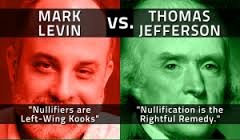
Mark Levin, who wrote an excellent book “The Liberty Amendments” to urge states to call for an Article V Convention to propose constitutional amendments to restore the federal government back to some sort of constitutional limits, calls Nullifiers “kooks.”  His solution is to keep the federal government in check by a series of constitutional amendments.

My question to Mr. Levin is this:  Why do we need to AMEND the Constitution? The Constitution has never been legally altered from its original meaning. What we need to do is FINALLY ENFORCE the Constitution that was ratified by the States in 1787-1788. The government represents the CONSENT of the GOVERNED and has never been delegated any authority to autonomously expand or enlarge its powers. The Declaration of Independence, which provides the framework for our common intent and understanding of government, assures that government is a creature of the people to SERVE the people. Only the people have the power to “alter or abolish” government. The scope of government is at the will of the people. Government has no power to alter itself or to abolish any rights of the people. What does this mean?  It means that every time the government oversteps its limited authority under the Constitution, it takes sovereign power away from the People and the States. Our Founders warned about this when they included the Ninth and Tenth Amendments and that’s why those amendments are included… They remind us that any step beyond the authority in the Constitution is an infringement on the natural rights of the Individual or the sovereign rights of the States.

For the past 200 years, the government has steadily stepped beyond its constitutional authority and stepped on the rights of others. It’s time those who have had their rights trampled upon step up and say NO MORE.  Nullification is the rightful remedy, based precisely on the ideals laid out in the Declaration of Independence.  As long as it is understood that government derives from the people, is accountable to them, serves them, and is at all times subject to their right to alter or abolish it, then it should not be expected that People have to go through great pains and efforts to ask it to abide by its charter.  The Constitution is a limit on the government to hold it accountable to the People and NOT a limit on the People to demand such accountability.

The Rightful Remedy is Nullification and NOT constitutional amendments. Don’t get me wrong. When the people want to knowingly and intentionally alter their Constitution and change their form of government, then amendments are the proper remedy.  But when government oversteps the bounds of authority that the PEOPLE have set on it in the Constitution and tramples on the rights of other parties, the proper remedy to stop that usurpation and to reign in the power and scope of government is not through amendments but through Nullification. Nullification recognizes the founding American government principle that any power not expressly delegated to the government by the People (for their benefit) cannot be assumed by it. Therefore, when government attempts to overstep its (constitutional) boundaries, those laws are without legal authority, are null and void, and are unenforceable on the People.  Requiring the People to go through a series of seemingly insurmountable hoops (ie, constitutional amendments) to try to control their government seems is akin to having them beg the federal government to “Please, please, please try to respect the Constitution.”

It seems the great majority of people, including Mr. Levin, have forgotten what a Constitution is, at its core.  John Jay, who wrote five of the essays compiled in The Federalist Papers and who went on to be appointed Chief Justice of the US Supreme Court by President George Washington, wrote: “What is a Constitution? It is the form of government, delineated by the mighty hand of the people, in which certain first principles of fundamental laws are established. The Constitution is certain and fixed; it contains the permanent will of the people and is the supreme law of the land…  It is stable and permanent, not to be worked upon by the temper of the times.. It remains firm and immovable, as a mountain amidst the raging of the waves.”  Thomas Paine, in his Rights of Man, wrote: “A constitution is not the act of a government, but of a people constituting a government; and government without a constitution is power without a right. All power exercised over a nation, must have some beginning. It must be either delegated, or assumed. There are not other sources. All delegated power is trust, and all assumed power is usurpation. Time does not alter the nature and quality of either.”  And in 1782, in his Notes on Virginia, Thomas Jefferson explained: “The purpose of a written constitution is to bind up the several branches of government by certain laws, which, when they transgress, their acts shall become nullities; to render unnecessary an appeal to the people, or in other words a rebellion, on every infraction of their rights, on the peril that their acquiescence shall be construed into an intention to surrender those rights.”

I believe Mark Levin is dead wrong in attacking the Nullification movement.  I respect him immensely, but if he truly believes that we must amend the Constitution in order to restore the Constitution – when the Constitution was never legally amended to get us in the predicament that we are in – then he has a flawed understanding of our founding principles and the American founding philosophy of government.

He presupposes that only the People and the States need to abide by Constitutional limits.  It doesn’t matter to him that the federal government, the one party that IS supposed to be limited by the Constitution, has repeatedly, defiantly, and grossly misinterpreted and abused its terms.  Mr. Levin is so hung up on “what the People and the States can constitutionally do” to bring the government back in line (and by that, I mean that he wants the remedy to be expressly articulated in the Constitution) that he forgets that even as he is out on his book tour to promote “The Liberty Amendments,” the federal government continues to willfully ignore its constitutional limitations and obligations. The Rightful Remedy should be the one that most effectively and immediately puts the government back in check and restores the proper balance of power between the government, People, and the States. The amendment process will take many years and will most likely fall through. And even if an Article V Convention of the States is able to move forward, the amendments produced will most likely be more symbolic than effectual.  A government that is supposed to serve the People (“that to secure these rights, Governments are instituted among Men, deriving their just powers from the consent of the governed…”) should be accessible by the People and a Constitution that is supposed to protect the People from government should NOT effectively shut the People out from “altering” their government so that it isn’t “becoming destructive of its ends.” Nullification, on the other hand, checks the government at every instance.  It puts sovereign power in the hands of those who were the intended depositories – the People.

Nullification is the magic bullet.  As government hemorrhages and our nation dies of toxic ideological poisoning, Nullification is the treatment that patriots can use to get our system healthy again.

Opponents of Nullification want to take this remedy away.  They want to take the one true remedy that is based on the principles our nation was founded upon and discredit it by associating it with themes that the average uninformed American has been brainwashed on.  First, they try to dismiss it by claiming that the government trumps any action of the State on account of the Supremacy Clause.  They believe that since the government has the exclusive right and power to define the extent of its powers and to twist and bend the Constitution to serve its purposes, the Supremacy Clause is the enforcement “badge” that allows it to push any and all laws on the States. By extension, they believe that the Supremacy Clause should be a restraining order on the States so that they don’t get the urge to second-guess the actions and intentions of the federal government.

Second, they discredit Nullification by claiming that the Supreme Court has ruled it unconstitutional. They say that the theory of nullification has been rejected repeatedly by the courts (in particular by the Supreme Court in Ableman v. Booth, 1859 and in Cooper v. Aaron, 1958), and it has never been legally upheld.  Furthermore, they claim that under Article III of the Constitution, the federal judiciary has the exclusive and final power to interpret the Constitution (Marbury v. Madison, 1803). Therefore, the exclusive power to make final decisions about the constitutionality of federal laws lies with the federal courts, not the States.  Consequently, the States have no power to challenge any decision the federal government makes with respect to the laws it passes or the decisions it hands down, and they have no power to nullify federal laws.  Opponents of nullification claim this is the constitutional.

They neglect, of course, to mention that it was the federal government itself that delegated that exclusive power to itself.

Contrary to what the opponents claim, the Supremacy Clause does NOT foreclose Nullification, as most opponents of Nullification claim.  The two principles actually work hand-in-hand.  The Supremacy Clause states that “This Constitution, and the Laws of the United States which shall be made in Pursuance thereof, shall be the supreme Law of the Land; and the Judges in every State shall be bound thereby.” The Supremacy Clause acknowledges that the Constitution provides legal authority to make certain laws and only laws enacted pursuant to that authority shall be considered supreme law. What it doesn’t say is what happens when the government makes laws NOT in pursuance of legitimate constitutional authority.  And that’s where Nullification steps in. Nullification reaffirms the point of the Supremacy Clause. It acknowledges that government has certain powers to legislate but that the power is not plenary. When the government acts pursuant to its constitutional power, its laws are supreme. But when it acts in abuse or violation of those powers, or assumes power not granted, Nullification provides the remedy. It provides that the States can challenge the government when it passes an unconstitutional law by refusing to enforce it upon the People.  A free people should never have to suffer the enforcement of unconstitutional laws on them.

Unfortunately, the government doesn’t want to recognize the inherent limitation in the Supremacy Clause – that only those laws made “in pursuance” to the Constitution are supreme.  It wants to continue along the self-serving path that allows it to make laws for whatever purpose it wants and to interpret the Constitution to suit it best and to claim it all under the Supremacy Clause.  People want Liberty.  Governments want concentrated power.  These are competing goals.  Our Founders understood that.  And for that very reason, the States were designated as a co-equal Sovereign. The States would forever be an antagonistic force (much like the prosecutor and defense attorney are in a criminal case) that keeps the federal government confined to its exclusive and particular sphere of authority and out of their sphere of government.  “Reserved” powers meant exactly that.  Those powers not expressly delegated to the federal government are reserved by the People and the States.

In Ableman v. Booth, the Supreme Court held that the state of Wisconsin didn’t have the right to nullify the Fugitive Slave law because of the right of the Court to exclusively determine what the Constitution says and means (Marbury v. Madison, 1803).

It should not be forgotten, however, that Ableman decision was written by Justice Roger Taney who also authored the absolute most heinous Supreme Court decision in US history – the Dred Scott decision. That alone should demonstrate how fallible the federal courts are and how tainted, skewed, politically-motivated, academically-limited, and intellectually-dishonest Supreme Court justices are.

In Cooper v. Aaron, Chief Justice Earl Warren wrote the majority opinion.  That opinion held: “The constitutional rights of children not to be discriminated against in school admission on grounds of race or color declared by this Court in the Brown case can neither be nullified openly and directly by state legislators or state executive or judicial officers nor nullified indirectly by them through evasive schemes for segregation whether attempted ingeniously or ingenuously.”

Chief Justice Warren continued: “It is necessary only to recall some basic constitutional propositions which are settled doctrine.  Article VI of the Constitution makes the Constitution the ‘supreme Law of the Land.’ In 1803, Chief Justice Marshall, speaking for a unanimous Court, referring to the Constitution as “the fundamental and paramount law of the nation,’ declared in the notable case of Marbury v. Madison,  that ‘It is emphatically the province and duty of the judicial department to say what the law is.’ This decision declared the basic principle that the federal judiciary is supreme in the exposition of the law of the Constitution, and that principle has ever since been respected by this Court and the Country as a permanent and indispensable feature of our constitutional system.  It follows that the interpretation of the Fourteenth Amendment enunciated by this Court in the Brown case is the supreme law of the land, and Article VI of the Constitution makes it of binding effect on the States ‘any Thing in the Constitution or Laws of any State to the Contrary notwithstanding.’ Every state legislator and executive and judicial officer is solemnly committed by oath taken pursuant to Article VI, clause 3 “to support this Constitution…..  If the legislatures of the several states may, at will, annul the judgments of the courts of the United States, and destroy the rights acquired under those judgments, the constitution itself becomes a solemn mockery.”

Justice Frankfurter, concurring in the opinion, wrote separately: “The States must yield to an authority that is paramount to the State.”

Of course, Chief Justice Earl Warren also wrote the opinion in Brown v. Board of Education, the case upon which the Cooper case was based.  Is it any wonder that he would try to deny states the opportunity to challenge the merits of that decision?

The Supreme Court likes to cite its early decision in Marbury v Madison (1803).  Opponents of Nullification like to cite Marbury v. Madison. They say that this case definitively establishes the principle that the Supreme Court has the exclusive power to interpret and define the Constitution.  And it’s no wonder why this case is a favorite of the Court, of government in general, and of those who favor our current bloated, energetic centralized government.  Since this decision was an enlargement of government powers by giving the federal judiciary plenary power to interpret the Constitution and proclaim what the law of the land is (without being subject to any check or balance under the Constitution), it put the government in a further position to hold a monopoly on the meaning and scope of its powers.  Nullification doesn’t ask us what the Supreme Court says on a particular matter.  Nullification applies regardless of what the Court has said because it, like every other branch, is capable of acting outside of Constitutional authority.  Nullification is an implied principle.  It is the implied (enforcement) power behind the Tenth Amendment just as the federal government has the implied power to enforce its laws and policies under the Supremacy Clause. If the States are truly to be co-sovereigns as our system was intended and designed, under the Constitution and especially with the Bill of Rights (Ninth and Tenth Amendments), then the States must have an equal opportunity to assert their rights under the Tenth Amendment, as well as the Peoples’ rights under the Ninth Amendment. To say that the government alone can assert its sovereignty (under the Supremacy Clause) would be to absolutely deny the concept of Dual Sovereignty and to severely jeopardize the precious balance of sovereign (government) power that uniquely defines our American system of government and which most strongly protects our individual liberty.

As we all know, We the People are vested, under Natural Law and God’s Law, with fundamental rights. The Declaration of Independence acknowledges this and further states that People, in order to organize into productive societies and in order not to sacrifice any of their rights, establish governments (by the “consent of the governed,” by a temporary delegation of their right to exercise and defend their rights, and for the primary purpose of protecting and securing individual rights).  The People, because they are sovereign and have the Natural right to determine their form of government and also because they have the right to take their sovereign power back from government, have the right to “alter or abolish” their government when it becomes destructive of its ends.  As we know, the Declaration provides the foundation for the Constitution. It establishes the philosophy or ideology of Individual Rights, Sovereignty, and Government. The Constitution then created or established a limited government based on that philosophy/ideology and on those principles.  The States, fearing that the Constitution drafted and adopted at the Convention in 1787 might try to step on the rights and powers of the People and the States, insisted that the Constitution be amended with certain “declaratory and limiting phrases” – which would be our Bill of Rights.  Two of those amendments were the Ninth and Tenth Amendments which guarantee that those powers not expressly delegated from the People/States to the federal government are reserved to the People and States, respectively.  This is precisely the type of government referred to and envisioned in our Declaration…  one that only gives to a government those powers that the People are knowingly, intelligently, and voluntarily willing to give it.  But if the Ninth and Tenth Amendments are to MEAN anything, then there has to be an implied enforcement power.  That power to keep the federal government limited is what federalism is all about. It is all about acknowledging the power of the States to forcibly assert its dominance on those reserve powers. Nullification is an implied power.  Just like the Supremacy Clause has an associated enforcement power which the government is so fond of asserting, the States have Nullification.

It should be noted that Marbury v. Madison was a powerful decision in a few very important aspects.  In particular, the decision emphasized and reinforced two key constitutional themes:

(1)  Justices on the Supreme Court are bound to interpret the Constitution strictly and according to the intention of the Founders and those who ratified it (at the time it was ratified).  Justices are bound by ORIGINAL INTENT and STRICT RULES of CONSTRUCTION (words don’t magically change definition as the times change and the Constitution doesn’t evolve with evolving times. Only through the Amendment process (which is how the People declare their intent to alter their form of government and its terms) can the Constitution be altered or amended to reflect changing times. “That the people have an original right to establish for their future government such principles as, in their opinion, shall most conduce to their own happiness is the basis on which the whole American fabric has been erected. The exercise of this original right is a very great exertion; nor can it nor ought it to be frequently repeated. The principles, therefore, so established are deemed fundamental. And as the authority from which they proceed, is supreme, and can seldom act, they are designed to be permanent. This original and supreme will organizes the government and assigns to different departments their respective powers. It may either stop here or establish certain limits not to be transcended by those departments. The Government of the United States is of the latter description. The powers of the Legislature are defined and limited; and that those limits may not be mistaken or forgotten, the Constitution is written. To what purpose are powers limited, and to what purpose is that limitation committed to writing, if these limits may at any time be passed by those intended to be restrained? The distinction between a government with limited and unlimited powers is abolished if those limits do not confine the persons on whom they are imposed, and if acts prohibited and acts allowed are of equal obligation. It is a proposition too plain to be contested that the Constitution controls any legislative act repugnant to it, or that the Legislature may alter the Constitution by an ordinary act. Between these alternatives there is no middle ground. The Constitution is either a superior, paramount law, unchangeable by ordinary means, or it is on a level with ordinary legislative acts, and, like other acts, is alterable when the legislature shall please to alter it.”

(2)  Justices must adhere strictly to their oath, which is to the Constitution (as ratified) and not to any administration or political party.  Anytime a justice veers from his oath and doesn’t interpret the Constitution according to strict construction and original intent he commits TREASON.  “The framers of the Constitution contemplated that the Constitution would serve as a rule for the courts, as well as of the Legislature. Why otherwise does it direct the judges to take an oath to support it? This oath certainly applies in an especial manner to their conduct in their official character. How immoral to impose it on them if they were to be used as the instruments, and the knowing instruments, for violating what they swear to support! Why does a judge swear to discharge his duties agreeably to the Constitution of the United States if that Constitution forms no rule for his government?  If such be the real state of things, this is worse than solemn mockery. To prescribe or to take this oath becomes equally a crime.”

On the other hand, Jefferson disagreed with Marshall’s reasoning with respect to judicial review, the doctrine the case is known for establishing.  In Marbury, Chief Justice Marshall declared that it is emphatically the duty of the federal judiciary to say what the law is. “Those who apply the rule to particular cases must, of necessity, expound and interpret the rule. If two laws conflict with each other, the Court must decide on the operation of each.  If courts are to regard the Constitution, and the Constitution is superior to any ordinary act of the legislature, the Constitution, and not such ordinary act, must govern the case to which they both apply.”

Marshall continued: “An act of the legislature repugnant to the constitution is void.  This theory is essentially attached to a written Constitution.”  In other words, when the Constitution – the nation’s highest law – conflicts with an act of the legislature, that act is invalid.  Jefferson criticized the decision by arguing that “the Constitution has erected no such tribunal” with such power.  He argued that “to consider the judges as the ultimate arbiters of all constitutional questions would be a very dangerous doctrine that which would place us under the despotism of an oligarchy.”

It’s worth noting that the Constitution lacks a clear statement authorizing the federal courts to nullify the acts of co-equal branches, yet the Supreme Court went ahead and assumed that power for itself (under the guise of “judicial review”).  There is also no statement in the Constitution that prohibits States from nullifying acts of the federal government (yet it is strongly implied in the Tenth Amendment and the Supremacy Clause), but the Supreme Court went ahead and denied that power to the States.

As one lawyer and opponent of Nullification writes: “Anyone who believes that Nullification is legitimate either 1) Hasn’t read relevant Supreme Court opinions, or 2) believes that centuries of Constitutional precedent should simply be thrown aside.”  Obviously this lawyer hasn’t read Thomas Jefferson, the author of our Declaration and consultant to James Madison, the author of our Constitution, or James Madison himself.  Both warned about putting too much power in the federal judiciary.

Thomas Jefferson wrote to William C Jarvis in 1820: “To consider the Judges of the Superior Court as the ultimate arbiters of constitutional questions would be a dangerous doctrine which would place us under the despotism of an oligarchy. They have with others, the same passion for party, for power, and for the privileges of their corps – and their power is the most dangerous as they are in office for life, and not responsible, as the other functionaries are, to the Elective control. The Constitution has elected no single tribunal.  I know no safe depository of the ultimate powers of society but the people themselves.”   

Jefferson wrote to Charles Hammond in 1821: “The germ of dissolution of our federal government is in the constitution of the federal judiciary: an irresponsible body, working like gravity by night and by day, gaining a little today and a little tomorrow, and advancing its noiseless step like a thief, over the field of jurisdiction until all shall be usurped from the States, and the government of all be consolidated into one. To this I am opposed; because, when all government, domestic and foreign, in little as in great things, shall be drawn to Washington as the center of all it will render powerless the checks provided of one government on another and will become as venal and oppressive as the government from which we separated.”

And Abraham Lincoln, in criticizing the Dred Scott decision, said: “If the policy of government, upon vital questions affecting the whole people, is to be irrevocably fixed by decisions of the Supreme Court, the instant they are made, in ordinary litigation between parties, in personal actions, the people will have ceased to be their own rulers, having, to that extent, practically resigned their government into the hands of that eminent tribunal.”

I have read what our Founders wrote about Nullification.  I believe it to be as legitimate a doctrine as any other check and balance doctrine on which our government was based.  I believe it to be as foundational a principle as limited government and “government of the People.”  I will never place the opinions of any federal court judge over the very words of those who defined our American notion of ordered liberty and our system of government. I know what the intentions were of our Founders – to honor the spirit of our American Revolution and to secure individual liberty.  I always question the intentions and judgment of federal court judges.

Justice Felix Frankurter, who served on the Supreme Court from 1939-1962, once said this about the high Court’s decisions: “The ultimate touchstone of constitutionality is the Constitution itself and not what we have said about it.”  And we should take his advice and disregard the Court’s opinion in Cooper – and in Ableman too!

Attorney General Edwin Meese, III (Attorney General under President Ronald Reagan), a constitutional scholar, was highly critical of the Cooper v. Aaron decision, and in fact delivered these words to Tulane University Law in 1986:

      “A decision by the Supreme Court does not establish a ‘supreme Law of the Land’ that is binding on all persons and parts of government, henceforth and forevermore.  Obviously it does have binding quality: It binds the parties in a case and also the executive branch for whatever enforcement is necessary.  But there is a necessary distinction between the Constitution and constitutional law.  The two are not synonymous. The Constitution is a document of our most fundamental law.  It begins ‘We the People of the United States, in Order to form a more perfect Union…’ and ends up, some 6,000 words later, with the 26th Amendment. It creates the institutions of our government, it enumerates the powers those institutions may wield, and it cordons off certain areas into which government may not enter. It prohibits the national authority, for example, from passing ex post facto laws while it prohibits the states from violating the obligations of contracts. The Constitution is, in brief, the instrument by which the consent of the governed – the fundamental requirement of any legitimate government – is transformed into a government complete with ‘the powers to act and a structure designed to make it act wisely or responsibly.’ Among its various ‘internal contrivances’ (as James Madison called them) we find federalism, separation of powers, bicameralism, representation, an extended commercial republic, an energetic executive, and an independent judiciary. Together, these devices form the machinery of our popular form of government and secure the rights of the people. The Constitution, then, is the Constitution, and as such it is, in its own words, ‘the supreme Law of the Land.’

      Constitutional law, on the other hand, is that body of law which has resulted from the Supreme Court’s adjudications involving disputes over constitutional provisions or doctrines. To put it a bit more simply, constitutional law is what the Supreme Court says about the Constitution in its decisions resolving the cases and controversies that come before it.

      The Supreme Court is not the only interpreter of the Constitution. Each of the three coordinate branches of government created and empowered by the Constitution – the executive and legislative no less than the judicial – has a duty to interpret the Constitution in the performance of its official functions. In fact, every official takes an oath precisely to that effect.  For the same reason that the Constitution cannot be reduced to constitutional law, the Constitution cannot simply be reduced to what Congress or the President say it is either. Quite the contrary. The Constitution, the original document of 1787 plus its amendments, is and must be understood to be the standard against which all laws, policies and interpretations must be measured.

     But in their task of interpreting the Constitution, the courts have on occasion been tempted to think that the law of their decisions is on a par with the Constitution. That is, they have reduced the Constitution to constitutional law.

     Some thirty years ago, in the midst of great racial turmoil, our highest Court succumbed to this very temptation. By a flawed reading of our Constitution and Marbury v. Madison, and an even more faulty syllogism of legal reasoning, the Court in a 1958 case called Cooper v. Aaron appeared to arrive at conclusions about its own power that would have shocked men like John Marshall and Joseph Story.  In this case the Court proclaimed that the constitutional decision it had reached that day was nothing less than ‘the supreme law of the land.’ Obviously the decision was binding on the parties in the case; but the implication that everyone would have to accept its judgments uncritically, that it was a decision from which there could be no appeal, was astonishing; the language recalled what Stephen Douglas said about Dred Scott. In one fell swoop, the Court seemed to reduce the Constitution to the status of ordinary constitutional law, and to equate the judge with the lawgiver. Such logic assumes, as Charles Evans Hughes once quipped, that the Constitution is ‘what the judges say it is.’ The logic of Cooper v. Aaron was, and is, at war with the Constitution, at war with the basic principles of democratic government, and at war with the very meaning of the rule of law.

     Just as Dred Scott had its partisans a century ago, so does Cooper v. Aaron today. For example, a U.S. Senator criticized a recent nominee of the President’s to the bench for his sponsorship while a state legislator of a bill that responded to a Supreme Court decision with which he disagreed. The decision was Stone v. Graham, a 1980 case in which the Court held unconstitutional a Kentucky statute that required the posting of the Ten Commandments in the schools of that state. The bill co-sponsored by the judicial nominee – which, by the way, passed his state’s Senate by a vote of 39 to 9 – would have permitted the posting of the Ten Commandments in the schools of his state. In this, the nominee was acting on the principle Lincoln well understood – that legislators have an independent duty to consider the constitutionality of proposed legislation. Nonetheless, the nominee was faulted for not appreciating that under Cooper v. Aaron, Supreme Court decisions are the law of the land – just like the Constitution.  He was faulted, in other words, for failing to agree with an idea that would put the Court’s constitutional interpretations in the unique position of meaning the same as the Constitution itself.

     My message today is that such interpretations are not and must not be placed in such a position. To understand the distinction between the Constitution and constitutional law is to grasp, as John Marshall observed in Marbury, ‘that the framers of the Constitution contemplated that instrument as a rule for the government of courts, as well as of the legislature.’ This was the reason, in Marshall’s view, that a ‘written Constitution is one of the greatest improvements on political institutions.’

     Likewise, James Madison, expressing his mature view of the subject, wrote that as the three branches of government are coordinate and equally bound to support the Constitution, ‘each must in the exercise of its functions be guided by the text of the Constitution according to its own interpretation of it.’ And, as his lifelong friend and collaborator, Jefferson, once said, the written Constitution is ‘our peculiar security.’

     Once again, we must understand that the Constitution is, and must be understood to be, superior to ordinary constitutional law. This distinction must be respected. To do otherwise, as Lincoln once said, ‘is to submit to government by judiciary.’”

It is amazing to me how far we as a nation, as a collective people, have strayed from the principles of individual liberty. Too many people believe they must check with the federal government to see what their rights are and what their Constitution means. Sadly, Mark Levin is one of those Americans.

Here is my biggest problem with Mr. Levin’s promotion of his “Liberty Amendments” – aside from his outright rejection of Nullification: The government has consistently and unabashedly overstepped its authority in the Constitution when it has suited its purposes. In fact, there has rarely been a time when it confined itself to the articles which were delegated to it by the People and the States. Yet Mr. Levin is adamant that the People, in order to try and regain the rights they are entitled to and the proper (and limited) scope of government in their lives, MUST abide strictly by what the Constitution allows them to do.  Again, never mind that the People nor the States ever assented to the changes that the federal government assumed for itself under the Constitution that SHOULD HAVE BEEN made legally through the Article V amendment process….. Mr. Levin still is steadfast that the People need to go through the arduous amendment process in order to get the government to do what it is/ was constitutionally REQUIRED to do.

Being the Deputy Director of the North Carolina Tenth Amendment Center, I naturally am disappointed that Levin has publicly rejected Nullification.  Mr. Levin says that Nullification is not a viable option in limiting the size and scope of the federal government.  When considering how to restore the government to its constitutional limits, he takes the position that Nullification should never be a remedy that is on the table.  In other words, he believes that the People should be carefully, strictly, and narrowly limited in their ability to define and constrain their government. He believes that the only options available should be those both expressly provided in the Constitution and NOT foreclosed by any decision, determination, or proclamation by the government itself.

Michael Maharrey, with the Tenth Amendment Center, defines Nullification as, “those of us with the authority to say no to the federal government executing that authority.”  As every supporter of Nullification knows, the individual states pre-existed the federal government.  While there were some founders (Nationalists) who wanted a national government with a general veto power over any and all legislative acts of the states which it disagreed with, this position was flatly rejected by the majority of delegates (Federalists) to the Constitutional Convention who thought it was the States that needed to be the parties with the veto power over the federal government. These Founders included James Madison and Thomas Jefferson (who may not have been at the Convention but was in constant contact with Madison regarding the task at hand).  As Maharrey explains: “The states created the federal government and enumerated power to it.”  In his writings and when he presents, he is quick to cite Madison’s famous Federalist No. 45 to emphasize the limits of such power enumerated by the states to the federal government, particularly in Article I, Section 8:

The powers delegated by the proposed Constitution to the federal government are few and defined. Those which are to remain in the State governments are numerous and indefinite. The former will be exercised principally on external objects, as war, peace, negotiation, and foreign commerce; with which last the power of taxation will, for the most part, be connected. The powers reserved to the several States will extend to all the objects which, in the ordinary course of affairs, concern the lives, liberties, and properties of the people, and the internal order, improvement, and prosperity of the State.

      The operations of the federal government will be most extensive and important in times of war and danger; those of the State governments, in times of peace and security. As the former periods will probably bear a small proportion to the latter, the State governments will here enjoy another advantage over the federal government. The more adequate, indeed, the federal powers may be rendered to the national defense, the less frequent will be those scenes of danger which might favor their ascendancy over the governments of the particular States.”

Nullification - Michael Maharrey 2013

Maharrey explained that outside of those few and defined powers, everything else, all other power, is reserved and resides in the sovereignty of the individual people and in the states, in accordance to the Ninth and Tenth Amendments to the Constitution.  Nullification, in short, stands for the proposition that the federal government CANNOT be permitted to hold a monopoly over the interpretation of the Constitution and the definition of its powers and scope of government.  Government is a “creation” of the People and not its ruler.

If our Founding Fathers and founding revolutionaries had taken Mark Levin’s approach towards government, the colonies would never have had any legal ground to sever ties with Great Britain and the Articles of Confederation would still be the legally operable constitution that unites our states (since the people themselves were never apprised of the real purpose of the Convention – to scrap the government created by the Articles of Confederation, to start from scratch, and to draft a new Constitution and create a new government – and hence the delegates were without proper authority to do what they did).

Thomas Jefferson wrote: “That if those who administer the general government be permitted to transgress the limits fixed by the federal compact (ie, the US Constitution), but a total disregard to the special delegations of powers therein contained, an annihilation of the state governments, and the creation, upon their ruins, of a general consolidated government, will be the inevitable consequence: That the principle and construction, contended by the state legislatures, that the general government is the exclusive judge of the extent of the powers delegated to it, stop nothing short of despotism – since the discretion of those who administer the government, and not the Constitution, would be the measure of their powers. That the several states who formed that instrument, being sovereign and independent, have the unquestionable right to judge of its infraction; and that a Nullification, by those sovereignties, of all unauthorized acts done under color of that instrument, is the RIGHTFUL REMEDY.”   [Kentucky Resolutions of 1799]

James Madison, in his Notes on Nullification (1834), explained: “…when powers are assumed which have not been delegated, a nullification of the act” is “the natural right, which all admit to be a remedy against insupportable oppression…”

In the Virginia Resolutions of 1798, Madison wrote: “That this Assembly doth explicitly and peremptorily declare, that it views the powers of the Federal Government, as resulting from the compact, to which the states (alone) are the parties, as limited by the plain sense and intention of the instrument constituting that compact; as no farther valid than they are authorized by the grants (of power) enumerated in that compact; and that in case of a deliberate, palpable, and dangerous exercise of other powers, not granted by said compact, the states who are parties thereto have the right, and are duty-bound, to INTERPOSE for arresting the progress of the evil, and for maintaining within their respective limits, the authorities, rights, and liberties appertaining to them…”

At North Carolina’s ratifying convention, James Iredell told the delegates that when ‘Congress passes a law consistent with the Constitution, it is to be binding on the people. If Congress, under pretense of executing one power, should, in fact, usurp another, they will violate the Constitution.’  In December 1787, Roger Sherman of Connecticut observed that an ‘excellency of the constitution’ was that ‘when the government of the united States acts within its proper bounds it will be the interest of the legislatures of the particular States to Support it, but when it leaps over those bounds and interferes with the rights of the State governments they will be powerful enough to check it.’”

I’ll take James Madison and Thomas Jefferson and even James Iredell, the men who defined our liberty, as authorities on what is constitutional or not over Mr. Levin.

Constitutional attorney, Publius Huldah, recently wrote: “Resistance to tyranny is a natural right – and it is a duty.”   I’ll support Ms. Huldah’s position anyday over those attorneys who oppose Nullification.  Ms. Huldah sides with the People and their Natural Rights.  Those other attorneys side with a centralized, all-powerful and all-knowing government – the very thing we fought a Revolution to rid ourselves of.

In the United States, natural rights are protected by government and not violated by it.  At least that was the American ideal.

Nullification is the Rightful Remedy when you understand the simple truth – that anytime the federal government oversteps its constitutional bounds, it is taking away OUR liberty and our right to govern ourselves.  The federal government is not just stepping on the States’ rights, but it is a usurpation of INDIVIDUAL liberty.  Nullification is our immediate remedy to re-assert and reclaim those rights.  Read the Declaration of Independence again.  All government power comes from the individual.  “We hold these truths to be self-evident, that all men are created equal, that they are endowed by their Creator with certain unalienable Rights, that among these are Life, Liberty and the pursuit of Happiness.  That to secure these rights, Governments are instituted among Men, deriving their just powers from the consent of the governed….”  Constitutions are written to define what powers the people have consented to give government. Constitutions are a permanent and fixed manifestation of the will of the people as to what inherent powers of self-government they agree to delegate to a common government for their behalf.   They are to be strictly construed and always read in a light most favorable to the individual since it is the individual from whom the power arises and the individual who has the most to lose.  Constitutions are not to be re-interpreted, misconstrued, re-labeled, or diminished in any way, shape, or form. They are not supposed to be “worked upon by the temper of the times.”  All power not expressly delegated resides in the People. Any attempt by a government to assume more powers than it was delegated naturally is a usurpation of the inherent rights and liberties of the People.

Again, as Thomas Paine wrote in his Rights of Man (1791): “A constitution is not the act of a government, but of a people constituting a government; and government without a constitution is power without a right. All power exercised over a nation, must have some beginning. It must be either delegated, or assumed. There are not other sources. All delegated power is trust, and all assumed power is usurpation.”  For anyone who wishes to dismiss Thomas Paine in any discussion of our founding government principles, consider this. It was Thomas Paine that George Washington had his men read as they pressed on in tattered clothes and bloodied bare feet and without pay to fight the Revolutionary War.  Washington wanted his men to understand full well what they were fighting for in America’s quest for independence and the right to govern as they saw fit in order to secure their God-given rights. No man would rightfully sacrifice his life to substitute one tyrant government for another.

When any government continues to usurp the powers of the People, or believes its powers to be more important than the rights of the People to limit their government, or to continue to redefine its powers, it becomes tyrannical. Our Constitution explicitly empowered every American with the right to limit their government. “

That whenever any Form of Government becomes destructive of these ends, it is the right of the People to alter or to abolish it, and to institute new Government…”   The federal government has no right or power to interfere with the right of the People to do so.  Similarly, it has no right to take away the remedy of Nullifcation.

Thomas Woods, author of the best-selling book Nullification: How to Resist Federal Tyranny in the 21st Century asks: “How can the Supreme Court, part of an agent of the states, have the absolutely final say, even above the sovereign entities that created it?” As Madison explained in his Report of 1800, the courts have their role, but the parties to the Constitution naturally have to have some kind of defense mechanism in the last resort.

The Tenth Amendment was added, along with the rest of the Bill of Rights, as an express “further limitation” on the federal government. In other words, the federal government would be limited by the recognition and assertion of States’ Rights and States’ powers.  The preamble to the Bill of Rights states clearly that “a number of the States, having at the time of their adopting the Constitution, expressed a desire, in order to prevent misconstruction or abuse of its powers, that further declaratory and restrictive clauses should be added…”  In other words, the parties that created and signed the Constitution (which then created the federal government) insisted that the Ninth and Tenth Amendments be added in order to more emphatically limit the federal government (all branches) through an emphasis on States’ rights and People’s rights. As such, the Supreme Court has no power to limit the power of the States in its ability to hold the federal government in check. The Bill of Rights is supposed to limit the government; the courts can’t limit the Bill of Rights.  After all, the Bill of Rights is also a limit on the federal courts !!

In conclusion, one only has to look at the enormity of the constitutional crisis we currently face and then look at the likely chance that Mr. Levin’s Article V Convention will offer any real relief.  It is very unlikely that our constitutional republic can be properly restored under that scenario – at least not in the near future. The American people are growing too restless and frustrated to wait.  In his article about a Nullification event in Wisconsin, Christian Gomez wrote: “As Washington continues to show no signs of retreating from its expansionist federal polices, encroachment in the lives of individuals, interference in healthcare, the free market, and violating the Constitution, the battle is not lost. Nor is it far from over, but it could be: ‘All it takes for evil to succeed is for a few good men to do nothing,’ Edmund Burke once said. In the case of the Restoring the Republic gathering in Pewaukee, Wisconsin, it is clear that more than just a few good men and women have no intention of doing nothing. So long as the people can be educated about Nullification, then hope is not fleeting.”

References:

Thomas Woods, “Is Nullification Unconstitutional?,” February 5, 2013.  Referenced at:  http://www.tomwoods.com/blog/is-nullification-unconstitutional/

Christian Gomez, “’Restoring the Republic’ Event in Wisconsin Addresses Nullification,” The New American, September 25, 2013.  Referenced at: http://www.thenewamerican.com/usnews/constitution/item/16619-restoring-the-republic-event-in-wisconsin-addresses-nullification

Publius Huldah, “Mark Levin Refuted: Keep the Feds in Check with Nullification,” Freedom Outpost, September 14, 2013.  Referenced at:  http://freedomoutpost.com/2013/09/mark-levin-refuted-keep-feds-check-nullification-amendments/

Cooper v. Aaron, 358 U.S. 1 (1958)

Ableman v. Booth, 62 U.S. 506 (1859)

Marbury v. Madison, 5 U.S. 137 (1803),

Edwin Meese III, “The Law of the Constitution.”  A Speech delivered to Tulane University on October 21, 1986.  Referenced at:  http://www.justice.gov/ag/aghistory/meese/1986/10-21-1986.pdf

Federalist No 45.  http://avalon.law.yale.edu/18th_century/fed45.asp

James Madison, Report of 1800.  http://oll.libertyfund.org/?option=com_staticxt&staticfile=show.php%3Ftitle=875&chapter=63986&layout=html&Itemid=27

APPENDIX:

Ableman v. Booth (1859)  –

The Court noted:  “It appears that the State court has not only claimed and exercised this jurisdiction, but has also determined that its decision is final and conclusive upon all the courts of the United States, and ordered their clerk to disregard and refuse obedience to the writ of error issued by this court, pursuant to the act of Congress of 1789, to bring here for examination and revision the judgment of the State court.”

It went on to explain why the federal government and the Supreme Court must be supreme in their particular spheres of authority:

The Constitution was not formed merely to guard the States against danger from foreign nations, but mainly to secure union and harmony at home, for if this object could be attained, there would be but little danger from abroad, and, to accomplish this purpose, it was felt by the statesmen who framed the Constitution and by the people who adopted it that it was necessary that many of the rights of sovereignty which the States then possessed should be ceded to the General Government, and that, in the sphere of action assigned to it, it should be supreme, and strong enough to execute its own laws by its own tribunals, without interruption from a State or from State authorities. And it was evident that anything short of this would be inadequate to the main objects for which the Government was established, and that local interests, local passions or prejudices, incited and fostered by individuals for sinister purposes, would lead to acts of aggression and injustice by one State upon the rights of another, which would ultimately terminate in violence and force unless there was a common arbiter between them, armed with power enough to protect and guard the rights of all by appropriate laws to be carried into execution peacefully by its judicial tribunals.

The language of the Constitution by which this power is granted is too plain to admit of doubt or to need comment. It declares that:

This Constitution, and the laws of the United States which shall be passed in pursuance thereof, and all treaties made, or which shall be made, under the authority of the United States, shall be the supreme law of the land, and the judges in every State shall be bound thereby, anything in the Constitution or laws of any State to the contrary notwithstanding.’

But the supremacy thus conferred on this Government could not peacefully be maintained unless it was clothed with judicial power equally paramount in authority to carry it into execution, for if left to the courts of justice of the several States, conflicting decisions would unavoidably take place, and the local tribunals could hardly be expected to be always free from the local influences of which we have spoken. And the Constitution and laws and treaties of the United States, and the powers granted to the Federal Government, would soon receive different interpretations in different States, and the Government of the United States would soon become one thing in one State and another thing in another. It was essential, therefore, to its very existence as a Government that it should have the power of establishing courts of justice, altogether independent of State power, to carry into effect its own laws, and that a tribunal should be established in which all cases which might arise under the Constitution and laws and treaties of the United States, whether in a State court or a court of the United States, should be finally and conclusively decided. Without such a tribunal, it is obvious that there would be no uniformity of judicial decision, and that the supremacy, (which is but another name for independence) so carefully provided in the clause of the Constitution above referred to could not possibly be maintained peacefully unless it was associated with this paramount judicial authority.

The same purposes are clearly indicated by the different language employed when conferring supremacy upon the laws of the United States, and jurisdiction upon its courts. In the first case, it provides that this Constitution, and the laws of the United States which shall be made in pursuance thereof, shall be the supreme law of the land, and obligatory upon the judges in every State.

The words in italics show the precision and foresight which marks every clause in the instrument. The sovereignty to be created was to be limited in its powers of legislation, and if it passed a law not authorized by its enumerated powers, it was not to be regarded as the supreme law of the land, nor were the State judges bound to carry it into execution. And as the courts of a State, and the courts of the United States, might, and indeed certainly would, often differ as to the extent of the powers conferred by the General Government, it was manifest that serious controversies would arise between the authorities of the United States and of the States, which must be settled by force of arms unless some tribunal was created to decide between them finally and without appeal.

This judicial power was justly regarded as indispensable not merely to maintain the supremacy of the laws of the United States, but also to guard the States from any encroachment upon their reserved rights by the General Government. And as the Constitution is the fundamental and supreme law, if it appears that an act of Congress is not pursuant to and within the limits of the power assigned to the Federal Government, it is the duty of the courts of the United States to declare it unconstitutional and void. The grant of judicial power is not confined to the administration of laws passed in pursuance to the provisions of the Constitution, nor confined to the interpretation of such laws, but, by the very terms of the grant, the Constitution is under their view when any act of Congress is brought before them, and it is their duty to declare the law void, and refuse to execute it, if it is not pursuant to the legislative powers conferred upon Congress. And as the final appellate power in all such questions is given to this court, controversies as to the respective powers of the United States and the States, instead of being determined by military and physical force, are heard, investigated, and finally settled with the calmness and deliberation of judicial inquiry. And no one can fail to see that, if such an arbiter had not been provided in our complicated system of government, internal tranquillity could not have been preserved, and if such controversies were left to arbitrament of physical force, our Government, State and National, would soon cease to be Governments of laws, and revolutions by force of arms would take the place of courts of justice and judicial decisions.

We do not question the authority of State court or judge who is authorized by the laws of the State to issue the writ of habeas corpus to issue it in any case where the party is imprisoned within its territorial limits, provided it does not appear, when the application is made, that the person imprisoned is in custody under the authority of the United States…..

No State judge or court, after they are judicially informed that the party is imprisoned under the authority of the United States, has any right to interfere with him or to require him to be brought before them…..   Now, it certainly can be no humiliation to the citizen of a republic to yield a ready obedience to the laws as administered by the constituted authorities. On the contrary, it is among his first and highest duties as a citizen, because free government cannot exist without it. Nor can it be inconsistent with the dignity of a sovereign State to observe faithfully, and in the spirit of sincerity and truth, the compact into which it voluntarily entered when it became a State of this Union. On the contrary, the highest honor of sovereignty is untarnished faith. And certainly no faith could be more deliberately and solemnly pledged than that which every State has plighted to the other States to support the Constitution as it is, in all its provisions, until they shall be altered in the manner which the Constitution itself prescribes. In the emphatic language of the pledge required, it is to support this Constitution.  And no power is more clearly conferred by the Constitution and laws of the United States than the power of this court to decide, ultimately and finally, all cases arising under such Constitution and laws, and for that purpose to bring here for revision, by writ of error, the judgment of a State court, where such questions have arisen, and the right claimed under them denied by the highest judicial tribunal in the State.

The Fugitive Slave Act is fully authorized by the Constitution of the United States.”  [pp. 516-525]

Is Nullification Unconstitutional

By Thomas Woods, February 5, 2013

These days we’re seeing a lot of newspaper columns condemning the idea of state nullification of unconstitutional federal laws. A common claim is that nullification is “unconstitutional.” I’ve addressed this claim in bits and pieces elsewhere, but I figured I’d write up one post I can use to counter this argument once and for all.

The most common claim, which one hears quite a bit from law professors (this is not meant as a compliment), is that the Supremacy Clause precludes nullification. “Federal law trumps state law” is the (rather inane) way we hear the principle expressed these days.

What the Supremacy Clause actually says is: “This Constitution, and the Laws of the United States which shall be made in pursuance thereof…shall be the supreme law of the land.”

In other words, the standard law-school response deletes the most significant words of the whole clause.  It’s safe to assume that Thomas Jefferson was not unaware of, and did not deny, the Supremacy Clause.  His point was that only the Constitution and laws which shall be made in pursuance thereof shall be the supreme law of the land.  Citing the Supremacy Clause merely begs the question.  A nullifying state maintains that a given law is not “in pursuance thereof” and therefore that the Supremacy Clause does not apply in the first place.

Such critics are expecting us to believe that the states would have ratified a Constitution with a Supremacy Clause that said, in effect, “This Constitution, and the Laws of the United States which shall be made in pursuance thereof, plus any old laws we may choose to pass, whether constitutional or not, shall be the supreme law of the land.”

Hamilton himself explained at New York’s ratifying convention that while on the one hand “acts of the United States … will be absolutely obligatory as to all the proper objects and powers of the general government,” at the same time “the laws of Congress are restricted to a certain sphere, and when they depart from this sphere, they are no longer supreme or binding.” In Federalist 33, Hamilton noted that the clause “expressly confines this supremacy to laws made pursuant to the Constitution.”

At North Carolina’s ratifying convention, James Iredell told the delegates that when “Congress passes a law consistent with the Constitution, it is to be binding on the people. If Congress, under pretense of executing one power, should, in fact, usurp another, they will violate the Constitution.” In December 1787 Roger Sherman observed that an “excellency of the constitution” was that “when the government of the united States acts within its proper bounds it will be the interest of the legislatures of the particular States to Support it, but when it leaps over those bounds and interferes with the rights of the State governments they will be powerful enough to check it.”

Another argument against the constitutionality of nullification is that the Constitution nowhere mentions it.

This is an odd complaint, coming as it usually does from those who in any other circumstance do not seem especially concerned to find express constitutional sanction for particular government policies.

The mere fact that a state’s reserved right to obstruct the enforcement of an unconstitutional law is not expressly stated in the Constitution does not mean the right does not exist.  The Constitution is supposed to establish a federal government of enumerated powers, with the remainder reserved to the states or the people.  Essentially nothing the states do is authorized in the federal Constitution, since enumerating the states’ powers is not the purpose of and is alien to the structure of that document.

James Madison urged that the true meaning of the Constitution was to be found in the state ratifying conventions, for it was there that the people, assembled in convention, were instructed with regard to what the new document meant.  Jefferson spoke likewise: should you wish to know the meaning of the Constitution, consult the words of its friends.

Federalist supporters of the Constitution at the Virginia ratifying convention of 1788 assured Virginians that they would be “exonerated” should the federal government attempt to impose “any supplementary condition” upon them – in other words, if it tried to exercise a power over and above the ones the states had delegated to it. Virginians were given this interpretation of the Constitution by members of the five-man commission that was to draft Virginia’s ratification instrument.  Patrick Henry, John Taylor, and later Jefferson himself elaborated on these safeguards that Virginians had been assured of at their ratifying convention.

Nullification derives from the (surely correct) “compact theory” of the Union, to which no full-fledged alternative appears to have been offered until as late as the 1830s. That compact theory, in turn, derives from and implies the following:

1) The states preceded the Union.  The Declaration of Independence speaks of “free and independent states” (and by “states” it means places like Spain and France) that “have full power to levy war, conclude peace, contract alliances, establish commerce, and to do all other acts and things which independent states may of right do.” The British acknowledged the independence not of a single blob, but of a group of states, which they proceeded to list one by one.

The states performed activities that we associate with sovereignty. Massachusetts, Connecticut, and South Carolina outfitted ships to cruise against the British. It was the troops of Connecticut that took Ticonderoga. In New Hampshire, the executive was authorized to issue letters of marque and reprisal. In 1776 it was declared that the crime of treason would be thought of as being perpetrated not against the states united into an indivisible blob, but against the states individually.

Article II of the Articles of Confederation says the states “retain their sovereignty, freedom, and independence”; they must have enjoyed that sovereignty in the past in order for them to “retain” it in 1781 when the Articles were officially adopted.  The ratification of the Constitution was accomplished not by a single, national vote, but by the individual ratifications of the various states, each assembled in convention.

2) In the American system no government is sovereign, not the federal government and not the states.  The peoples of the states are the sovereigns.  It is they who apportion powers between themselves, their state governments, and the federal government.  In doing so they are not impairing their sovereignty in any way. To the contrary, they are exercising it.

3) Since the peoples of the states are the sovereigns, then when the federal government exercises a power of dubious constitutionality on a matter of great importance, it is they themselves who are the proper disputants, as they review whether their agent was intended to hold such a power.  No other arrangement makes sense.  No one asks his agent whether the agent has or should have such-and-such power.  In other words, the very nature of sovereignty, and of the American system itself, is such that the sovereigns must retain the power to restrain the agent they themselves created.  James Madison explains this clearly in the famous Virginia Report of 1800:

The resolution [of 1798] of the General Assembly [of Virginia] relates to those great and extraordinary cases, in which all the forms of the Constitution may prove ineffectual against infractions dangerous to the essential right of the parties to it. The resolution supposes that dangerous powers not delegated, may not only be usurped and executed by the other departments, but that the Judicial Department also may exercise or sanction dangerous powers beyond the grant of the Constitution; and consequently that the ultimate right of the parties to the Constitution, to judge whether the compact has been dangerously violated, must extend to violations by one delegated authority, as well as by another, by the judiciary, as well as by the executive, or the legislature.

In other words, the courts have their role, but in “great and extraordinary cases” it would be absurd for the states, the fundamental building blocks of the United States, not to be able to defend themselves against the exercise of usurped power. The logic of sovereignty and the American Union demand it.

And as for “but Madison later claimed he never supported nullification!” see my article: “Nullification: Answering the Objections,” by Tom Woods, Liberty Classroom [http://www.libertyclassroom.com/objections/ ] and/or pages 288-290 of my book Nullification.

Posted in Uncategorized | Tagged , , , , , , , , , , , , , , , , , , , , , , , , , , , , , , , , , , , , , , , , , , , | 10 Comments

Constitution Day 2013

Declaration of Independence - signing


by Diane Rufino

Last Tuesday was Constitution Day – September 17.  It marks the day that the Convention in Philadelphia in 1787 concluded and the final draft of Constitution was signed by the delegates who attended.  It is fitting that this is the day we choose to honor the US Constitution.  As we all probably know, the Convention was called in a somewhat devious and misleading manner.  James Madison and others from Virginia called the Convention (after securing a promise that the most beloved man in America would serve as its president – George Washington) for the express purpose of AMENDING the Articles of Confederation and tweaking the Continental Congress (the government at the time) to make it more effective. The most glaring defect of the common government was its ability to raise the revenue it needed to carry out its functions.

All the states sent delegates except Rhode Island.  And so 12 of our original 13 states participated in Philadelphia. Collectively they appointed 70 individuals to the Constitutional Convention.  But a number of our most important Founding Fathers did not accept or could not attend. These included Richard Henry Lee (of VA), Patrick Henry, Thomas Jefferson, John Adams, Samuel Adams, and John Hancock. Jefferson, who authored the Declaration, was overseas at the time, acting as Minister to France. And Patrick Henry did not trust the intentions of some of the delegates.  He found out the real intention of the Convention – to scratch the Articles entirely and to write a new Constitution and design a new government.  Patrick Henry suspected that New York’s delegate, Alexander Hamilton, a strong monarchist, would try to get his way and fashion our new government after the British Monarchy. And so Henry declined to go to Philadelphia, claiming: “I smell a rat.”

And so when a total of 55 delegates from the states met in Philadelphia, they soon found out the real purpose of the gathering. Some did not take the news very well and argued that they did not have the proper authority to abandon the Articles of Confederation.  James Madison, George Mason and Edmond Randolph, all of Virginia, arrived in Philadelphia well-prepared. In fact, Madison was the first to arrive.  He arrived in February, three months before the convention began, with a Plan already prepared and a blueprint for the new Constitution and government in place. Although he authored the Plan, it was Randolph, who was Governor of Virginia at the time, who proposed it at the Convention – in the form of 15 resolutions. It was known as the Virginia Plan. It called for a strong NATIONAL government with many centralized functions and also with a UNIVERSAL VETO power over the States.  Madison called it a “universal negative.” Under Madison’s Virginia’s Plan, the government would have the power to veto any state law “for any case whatsoever.”

Luckily, the Virginia delegation couldn’t sell all of their plan to the other states and the Convention turned out to be a 4-month exercise in compromise and well-intentioned debate.  In the end, on September 17th, we got a constitution that created a limited FEDERAL government.  It was quite different in many respects from the government that the Virginians proposed. Luckily, the overwhelming number of delegates at the Convention that year did not believe in concentrating too much power in a common government; they believed that government is most responsive when it is closest to the People and so they remained steadfast that the bulk of government power must remain with the States.  A government that is closest to the People can serve them best and can be “altered or abolished” by them when circumstances demand it.

The delegates ranged in age from Jonathan Dayton (of NJ), aged 26, to Benjamin Franklin, aged 81, who was so infirm that he had to be carried to sessions in a chair. They brought with them the interests of their States and their people. They brought with them a wealth of knowledge and a keen eye on the prize they fought for in the American Revolution (which Patrick Henry would later describe as “that precious jewel – Liberty”).  They brought with them their understanding of what a common government should do to serve them and also to serve a common good for all States.  Not one State intended to surrender its sovereignty or its influence.  Not one state intended to surrender its individual identity for a “national” identity.

In the close of the Convention, only 39 delegates would feel compelled to sign the Constitution.  Many refused to sign because there was no Bill of Rights.  More than half of the Virginia delegation wouldn’t sign, including Mr. Randolph himself and George Mason (who wrote Virginia’s Bill of Rights). Elbridge Gerry, of Massachusetts was another powerhouse that refused to sign it.  A Bill of Rights, they argued, was an absolute necessity to limit any government.

The particular opposition by George Mason is most compelling.  While Elbridge Gerry was, by most accounts, cantankerous, irritable, and most disagreeable to many things and Randolph was likely sulking since his Plan was rejected in good part and believing that the States would ultimately reject a new constitution anyway, it was Mason who refused to sign based on pure principle.

George Mason didn’t trust a large republican government…  not without a Bill of Rights, that’s for certain.  He believed certain stipulations were necessary to protect the liberties of the People from the reaches of government.  James Madison, on the other hand, argued against a Bill of Rights. It was his position that such stipulations weren’t necessary due to the nature of the Constitution. He argued that the Constitution specifically enumerated the powers that were delegated to the federal government. That is, the document explained what the government COULD do and not what it COULD NOT do.  He feared if a Bill of Rights was included, it could ultimately backfire on the People. He feared that if a Bill of Rights was added to prohibit the government from intruding on rights A, B, and C, then it could be inferred that the government could intrude on rights D, E, and F. Madison explained that if you listed some individual rights, you must list them all and that would necessarily change the Constitution from forbidding the federal government from doing anything not enumerated to something that allows the government do whatever it wants as long as it is not listed in a Bill of Rights.

But Mason wasn’t convinced by fellow his fellow Virginian’s rationale.  For Mason, it came down to principal, basic human nature, and the enormity of history that taught us what happens when government has the ability to concentrate power. In early 1776, before Jefferson drafted the Declaration of Independence, Mason drafted the Virginia Declaration of Rights and helped frame Virginia’s constitution. George Mason was exceedingly proud of Virginia’s Declaration of Rights, and was pleased that it became a model for other states. In part, the Declaration of Rights provided:

SEC.1 That all men are by nature equally free and independent and have certain inherent rights, of which, when they enter into a state of society, they cannot, by any compact, deprive or divest their posterity; namely, the enjoyment of life and liberty, with the means of acquiring and possessing property, and pursuing and obtaining happiness and safety.

SEC. 2. That all power is vested in, and consequently derived from, the people; that magistrates are their trustees and servants and at all times amenable to them.

SEC.3.  Government is, or ought to be instituted for the common benefit, protection, and security of the people, nation, or community; of all the various modes and forms of government, that is best which is capable of producing the greatest degree of happiness and safety, and is most effectually secured against the danger of maladministration and […] when any government shall be found inadequate or contrary to these purposes, a majority of the community hath an indubitable, inalienable, and indefeasible right to reform, alter, or abolish it, in such manner as shall be judged most conducive to the public weal.

The document had sixteen sections, but it’s quite clear that these short paragraphs encompassed America’s Founding Principles, which Thomas Jefferson would later incorporate into the second paragraph of the Declaration of Independence. Mason simply did not trust a government to police itself.

Even Thomas Jefferson agreed.  He wrote James Madison from his post in France that a Bill of Rights should be added: “A Bill of Rights is what the people are entitled to against every government, and what no just government should refuse, or rest on inference.”

The decision of whether to add a Bill of Rights ultimately came down to the States in their Ratifying Conventions. And George Mason, along with Patrick Henry, would do all they could to derail the ratification of the Constitution until proper assurances and restraints were added.

At the Virginia Ratifying Convention in June 4, 1788, Mason took the floor and addressed the delegates:  “Does any man suppose that one general national government can exist in so extensive a country as this? I hope that a government may be framed which may suit us, by drawing a line between the general and state governments, and prevent that dangerous clashing of interest and power, which must, as it now stands, terminate in the destruction of one or the other. When we come to the judiciary, we shall be more convinced that this government will terminate in the annihilation of the state governments: the question then will be, whether a consolidated government can preserve the freedom and secure the rights of the people.  If such amendments be introduced as shall exclude danger, I shall most gladly put my hand to it. When such amendments as shall, from the best information, secure the great essential rights of the people, shall be agreed to by gentlemen, I shall most heartily make the greatest concessions, and concur in any reasonable measure to obtain the desirable end of conciliation and unanimity…”

Patrick Henry accused the Virginia delegation of abandoning the spirit of the Revolution by taking the Constitution at face value and trusting a common government to respect the sovereign powers of the States and limit itself to expressly-delegated objects.  On June 5, 1788, he addressed the members of the Ratifying Convention with these words:

“When the American spirit was in its youth, the language of America was different.  Liberty, sir, was then the primary object.

      We are descended from a people whose government was founded on liberty; our glorious forefathers of Great Britain made liberty the foundation of everything. That country is become a great, mighty, and splendid nation; not because their government is strong and energetic, but, sir, because liberty is its direct end and foundation. We drew the spirit of liberty from our British ancestors; by that spirit we have triumphed over every difficulty. But now, sir, the American spirit, assisted by the ropes and chains of consolidation, is about to convert this country into a powerful and mighty empire. If you make the citizens of this country agree to become the subjects of one great consolidated empire of America, your government will not have sufficient energy to keep them together. Such a government is incompatible with the genius of republicanism. There will be no checks, no real balances, in this government.

      Consider our situation, sir; go to the poor man and ask him what he does. He will inform you that he enjoys the fruits of his labor, under his own fig tree, with his wife and children around him, in peace and security. Go to every other member of society; you will find the same tranquil ease and content; you will find no alarms or disturbances. Why, then, tell us of danger, to terrify us into an adoption of this new form of government? And yet who knows the dangers that this new system may produce? They are out of sight of the common people; they cannot foresee latent consequences. I dread the operation of it on the middling and lower classes of people; it is for them I fear the adoption of this system. I fear I tire the patience of the committee, but I beg to be indulged with a few more observations.

 I profess myself an advocate for the liberty of the people. I have said that I thought this a consolidated government; I will now prove it. Will the great rights of the people be secured by this government?  Suppose it should prove oppressive, how can it be altered?  Our Bill of Rights (Virginia’s) declares that ‘a majority of the community hath an indubitable, unalienable, and indefeasible right to reform, alter, or abolish it, in such manner as shall be judged most conducive to the public weal.’ 

      The voice of tradition, I trust, will inform posterity of our struggles for freedom. If our descendants be worthy the name of Americans they will preserve and hand down to their latest posterity the transactions of the present times……

      Liberty, the greatest of all earthly blessings…  Give us that precious jewel, and you may take everything else!   Guard it with jealous attention. Suspect everyone who approaches that jewel…

At this point, the adoption of the Constitution seemed unlikely. Virginia would likely not ratify and neither would New York, and North Carolina clearly would not ratify. Without Virginia, Madison realized, there could be no hope of ever building a coalition to adopt it.  Madison needed Virginia. And so he began working tirelessly for ratification. He teamed up with Alexander Hamilton and John Jay on a series of articles (collectively called “The Federalist Papers”) that were published in newspapers all throughout the States making the case for ratification. And then he changed his stance on a Bill of Rights. He promised to include a bill of rights as the first order of business for the new federal congress. This finally brought George Mason around, which then helped tip Virginia towards ratification.

In the end, as we know, the Constitution was ratified by the States and we became a “more perfect Union” in 1788.  On June 21, 1788, New Hampshire became the ninth and last necessary state to ratify the Constitution of the United States, thereby making it the Law of the Land.  Virginia and New York ratified it within a month and North Carolina wouldn’t ratify it until over a year later (November 1789).

The Federalist Papers, the debates in the various State Ratifying Conventions, and the Bill of Rights itself continue to be a lasting testament to the limited nature of the US Constitution.

In past years, Tea Parties, Constitutional groups, and other conservative organizations honored Constitution Day by passing out pocket Constitutions.  We have asked people to take the time to read it and become familiar with it.  But perhaps the real message we need to send is how all our Founding documents fit together and why the Constitution still matters.

First, let’s ask what IS a Constitution?  Our Founders gave us that answer.

The Supreme Court, with John Jay (author of some of the Federalist Papers) as the Chief Justice, told us in 1795:

What is a Constitution? It is the form of government, delineated by the mighty hand of the people, in which certain first principles of fundamental laws are established. The Constitution is certain and fixed; it contains the permanent will of the people and is the supreme law of the land…
       It is stable and permanent, not to be worked upon by the temper of the times, nor to rise and fall with the tide of events; notwithstanding the competition of opposing interests, and the violence of contending parties, it remains firm and immovable, as a mountain amidst the raging of the waves.”   [Opinion in Vanhorne’s Lessee v. Dorance, 2 U.S. 304, 308 (1795)]

A constitution is not the act of a government, but of a people constituting a government; and government without a constitution is power without a right. All power exercised over a nation, must have some beginning. It must be either delegated, or assumed. There are not other sources. All delegated power is trust, and all assumed power is usurpation. Time does not alter the nature and quality of either.”   — Thomas PaineRights of Man (1791-1792)

The purpose of a written constitution is to bind up the several branches of government by certain laws, which, when they transgress, their acts shall become nullities; to render unnecessary an appeal to the people, or in other words a rebellion, on every infraction of their rights, on the peril that their acquiescence shall be construed into an intention to surrender those rights.” — Thomas JeffersonNotes on Virginia, 1782.

Our peculiar security is in the possession of a written Constitution. Let us not make it a blank paper by construction.” — Thomas Jefferson, in a letter to W. Nicholas (1803)

Does it sound like our Constitution was intended to become a LIVING, BREATHING DOCUMENT?

The reality is that the Constitution is not a stand-alone document.  And I think that is where our discussions have failed.  Our founding documents fit together as follows:

(i) The Declaration of Independence.  It proclaims our philosophy of sovereignty, rights, and government.  It establishes the order in our country and puts government in perspective. The individual precedes government. Government must serve the individual by protecting his rights.

(ii) The US Constitution.  It designed a government (checked by the sovereign powers of the States and the People) to embrace the philosophy set forth in the Declaration.

(iii) The Bill of Rights.  It further limits the authority of the federal government (as the preamble to the Bill of Rights states: “In order to prevent misconstruction or abuse of its powers, that further declaratory and restrictive clauses should be added…..”)

We enjoy our God-given rights because our founding documents boldly assert that only We the People have the right to determine our government, since it is only by the voluntary and temporary delegation of our rights to govern ourselves that government exists. We have the right to “alter or abolish” government when it becomes destructive of its ends (which is first and foremost to protect and preserve our rights to Life, Liberty, and Property and the right to defend them). Nowhere in any of our founding documents is government given a life of its own; it has no right or power to seek its own self-interests nor to preserve, insure, or protect its existence. Yet today, government’s interests are placed above those of the People. Government has made sure that it has the exclusive power to define its own powers.

Our creature has become our master.

Too often the Supreme Court uses a skewed perspective. Instead of asking:  ’Are citizens’ rights being violated by this law?’  the Court asks: ‘Is the violation of citizens’ rights justified because of overriding government goals and objectives?’  Too often the answer the court delivers is ‘yes.’  When your rights get in the way of a government objective, you lose.

       Government created to protect your rights should have no goal higher than the protection of those rights. When government’s own goals override your rights, government is acting unconstitutionally. Government often states that these violations of citizens’ rights are necessary ‘for the good of society.’  Society is ill served by laws which violate the rights of the citizens making up that society.

       The Constitution (and the federal government it brought into existence) was created by the states to serve the states. It sets forth the rules for how the government must behave and says, in effect (in the tenth amendment)  ’Any powers that we did not give to you are ours; we’re still the boss.’

This is like exercising parental control. You tell your child how to act, with whom he (or she) may associate and what time he must be home. You assign household chores and responsibilities. In short, you establish rules of proper conduct.

       Suppose that this works fine for a while, but as your child grows, he begins testing the boundaries you had set and breaking the rules, but you do nothing to prevent it. One day you realize that your child is making his own rules, even telling you what to do and what you cannot do. If you object that he is not acting within the rules you set down, he says that he knows better than you what your rules mean. If you try to assert your own rights, you are punished — your child is now bigger and stronger than you are. Your child’s allowance demands are ever increasing. If you don’t do something to correct the situation soon, you’ll be declared incompetent and your child will control all aspects of your life.”

The Tea Party and Constitutional groups take a lot of criticism.  The media, for example, says that the Tea Party has lost steam and has lost relevance.  And sometimes, I admit it, I wonder if it might be true. But when I celebrate Constitution Day and when I continue studying the Constitution and what our Founders intended, and when I have those “light bulb” moments when I begin to understand why certain principles were incorporated into our founding documents, I am reminded of why the Tea Party was founded in the first place and why it is so important.  And I am re-inspired to be a part of it, as well as the Tenth Amendment Center.  It’s because the Tea Party is the party of the Constitution.  We understand its relevance……   We understand why our Founders rejected that Virginia Plan in Philadelphia and why they spent four months building the consensus for a government that would be delegated only limited powers and that would be restrained by a series of checks and balances.

We understand that the problems our country faces today are all a direct consequence of the federal government’s failure to keep itself limited to the express powers delegated to it by the States back in 1791 AND the States’ failure to stand up and remind the government of its limits.

We understand – because we know that America is still defined by the Declaration of Independence – that every time the federal government oversteps its constitutional authority, it is taking sovereign power away from We the People and from the States.  And it has to stop.   We are slowly (maybe not slowly) slipping back into tyranny.

There is a lot at stake in the American experiment. Ours is a nation founded on an ideal and nothing else.  Whether that grand ideal will survive depends on whether the American experiment is successful or not. What is that ideal?  It is the notion that individuals are sovereign and that they are endowed with Natural rights that are “self-evident” and “inalienable” which are an integral part of their very humanity. Since these rights come from our Creator, they cannot be deemed to be granted by government. Hence government is powerless to take them away or violate them. In fact, governments are instituted to serve the People and to protect those rights.

It was from that ideal that our Founders understood the great challenge that would be presented:  How to keep the role of government strictly limited in order that liberty is enlarged and that government is prevented from growing into a new form of tyranny.  They studied history and were well-aware that the nature of any government is to control and gain more power from those it governs. And that in that challenge, we understand why the Constitution is still relevant.  At one time it defined a limited government and it offered numerous protections against those governmental intrusions which they knew would come eventually.  The Constitution still holds the power of limited government and still defines the proper relationship between the People, the States, and the federal government. The key is to put that document, with its original meaning and its original intent, back to work for the American people and for the protection of their inalienable rights.

The Tea Party summoned the spirit of the Revolution to resurrect the Constitution. They went back to the days of peaceful civil disobedience, ownership of their rights and destiny, engagement of their government in their civil liberties, and robust discussion of what it means to be a “free” people.

They took the name “Tea Party” because of its rich historical significance. The Boston Tea Party occurred on December 16, 1773 as a protest against the tax on tea imposed by a government in a far-off land that did not permit its representation in the legislative process (Parliament).  Earlier that year, the British government passed the Tea Act, which authorized the British East India Company to ship tea directly to colonies while the government levied a tax of three pence on each shipment. While the Tea Act actually lowered the price of tea for colonists (so that even with the tax, the colonists were still paying less for tea), many colonists were still angry at being taxed at all.

“Taxation without Representation” was a rallying cry that was particularly significant. The taxes the British tried to collect were modest and the revenue collected was to be spent entirely in the colonies for their benefit and protection. It wasn’t even going to be sent back to the mother country. So why all the fuss and cry of “tyranny”?  It was because the real reason for American Revolution was the lack of political machinery to protect the colonists’ rights.  In short, our founding agitators and revolutionaries weren’t as concerned about the insignificant tax on tea as they were with the underlying violations of their basic human rights.

The American experiment will continue to be successful only as long as we continue to be as vigilante and protective of our rights and as long as we continue to demand that government keep its distance. And so, as we recognize Constitution Day each year on September 17, we should re-commit to our Revolutionary spirit as Americans and read our founding documents in that light. As Jefferson warned, we shouldn’t render our government one of general and unlimited power because we’ve tacitly allowed it the exclusive domain to interpret the Constitution as it sees fit.  We can all know the meaning and intention of the Constitution simply by doing our homework and reading what words of wisdom our Founders left. We don’t need government officials or judges to tell us.  Government wants power.  People want liberty.

As Patrick Henry warned on June 5, 1788 when he addressed the Virginia Ratifying Convention: (paraphrasing) “When we lose the American spirit and our mental powers have decayed, then our liberty will be gone forever.”

Posted in Uncategorized | Tagged , , , , , , , , , , , , , , , | 1 Comment

In Honor of Constitution Day 2013

Constitution - Destroying the Constitution


by Diane Rufino

Today is Constitution Day. Please take the time to reflect upon the principles that inspired our independence from Great Britain, united independent sovereign states, and inspired generations of Americans to put themselves in harm’s way to promote the same to those who have been and continue to be oppressed all over the world.  The most important of these principles is the inherent freedom and sovereignty of the individual, which is the cornerstone of the document which lays out the moral and ideological framework on which our country established its independence and dedicated its existence, the Declaration of Independence.

Our founding documents fit together as follows:

(i) The Declaration of Independence – which proclaims our philosophy of sovereignty, rights, and government
(ii) The US Constitution – which designed a government (checked by the sovereign powers of the States and the People) to embrace the philosophy set forth in the Declaration
(iii) The Bill of Rights – to further limit the authority of the federal government (as the preamble to the Bill of Rights states: “In order to prevent misconstruction or abuse of its powers, that further declaratory and restrictive clauses should be added…..”)
(i) The Declaration of Independence – which proclaims our philosophy of sovereignty, rights, and government.
(ii) The US Constitution – which designed a government (checked by the sovereign powers of the States and the People) to embrace the philosophy set forth in the Declaratio.n
(iii) The Bill of Rights – to further limit the authority of the federal government (as the preamble to the Bill of Rights states: “In order to prevent misconstruction or abuse of its powers, that further declaratory and restrictive clauses should be added…..”)

We enjoy our God-given rights because our founding documents boldly assert that only We the People have the right to determine our government, since it is only by the voluntary and temporary delegation of our rights to government ourselves that government exists. We have the right to “alter or abolish” government when it becomes destructive of its ends (which is first and foremost to protect and preserve our rights to Life, Liberty, and Property and the right to defend those rights). Nowhere in any of our founding documents is government given a life of its own; it has no right or power to seek its own self-interests nor to preserve, insure, or protect its existence. Yet today, government’s interests are placed above those of the People. Government has made sure that it has the exclusive power to define its own powers.

I ask everyone to please take the time to read the Declaration and the Constitution and acquaint yourselves or re-acquaint yourselves with the principles that protect your liberties and define the government that our Founders created for us for that purpose. Share with family and friends. Reflect upon the quotes below and look at the QUESTIONS that I’ve listed which follow them and test your knowledge !!

“What is a Constitution? It is the form of government, delineated by the mighty hand of the people, in which certain first principles of fundamental laws are established. The Constitution is certain and fixed; it contains the permanent will of the people and is the supreme law of the land…”   — Vanhorne’s Lessee v. Dorance, 2 U.S. 304, 308 (1795)

“The Constitution of a State is stable and permanent, not to be worked upon by the temper of the times, nor to rise and fall with the tide of events; notwithstanding the competition of opposing interests, and the violence of contending parties, it remains firm and immovable, as a mountain amidst the raging of the waves.”    — Vanhorne’s Lessee v. Dorance, 2 U.S. 304, 308 (1795)

“A constitution is not the act of a government, but of a people constituting a government; and government without a constitution is power without a right. All power exercised over a nation, must have some beginning. It must be either delegated, or assumed. There are not other sources. All delegated power is trust, and all assumed power is usurpation. Time does not alter the nature and quality of either.”   — Thomas Paine, Rights of Man (1791-1792)

“The purpose of a written constitution is to bind up the several branches of government by certain laws, which, when they transgress, their acts shall become nullities; to render unnecessary an appeal to the people, or in other words a rebellion, on every infraction of their rights, on the peril that their acquiescence shall be construed into an intention to surrender those rights.”    — Thomas Jefferson, Notes on Virginia, 1782.

“Our peculiar security is in the possession of a written Constitution. Let us not make it a blank paper by construction.”    — Thomas Jefferson, in a letter to W. Nicholas (1803)

DO YOU KNOW YOUR CONSTITUTION and YOUR GOVERNMENT ??

1. What is the relationship between the Declaration of Independence and the Constitution?

2. What is the purpose of the Declaration of Independence?

3. The first paragraph of the Declaration of Independence explains the foundation of Individual Liberty. What is that foundation (2 laws)?

4. The second paragraph of the Declaration of Independence explains the relationship between We the People and government in the United States.  What is that relationship?

5. What are the first 10 amendments called?  Why were they added?

6. Where in the Constitution is the “Wall of Separation” mentioned?

7. Where in the Constitution does it require criminals be read the “Miranda” warning?

8. Where in the Constitution do we find that the Supreme Court has the power to issue binding decisions?

9. Where in the Constitution do we find the president having the power to send US troops to engage in acts of war without an official declaration of war?

10. Where in the Constitution do we find the legislative or executive branches having the power to limit or define the rights listed in the Bill of Rights?  (The preamble of the Bill of Rights is clear on this)

11. Where in the Constitution is the federal government granted the power to mandate healthcare or control education?

12. Where in the Constitution is Congress granted the power to spend taxpayer money to bailout selected businesses?

13. Where in the Constitution does it grant the Congress to tax and spend for any object other than those that are expressly listed in the Constitution?

14.What provision in the Constitution permits Congress to transfer its powers to legislate to unelected agencies?

15. Whose document is the Constitution?

16. Who does the Constitution protect?  And what does it protect from?

17. Does the government have any “rights” under the Declaration of Independence or in the Constitution? Is there any provision that permits it to engage in action or policies to further its own interests and longevity?

18. The President believes he has the right to identify American citizens as “enemy combatants” (a term invented by the Supreme Court during the era of WWII) thereby detaining them indefinitely and denying them their constitutional rights. An “enemy combatant” is a person who engages in belligerent acts (war) against the US.  Isn’t this type of person already identified in Article III, Section 3?

19. Can a treaty over-ride any provision of the US Constitution?  Can it limit any of the Bill of Rights?

20. Which provision in the Constitution is the state equivalent of the Supremacy Clause?

21. Which Article establishes the automatic nullification of unconstitutional laws?

22. What Article requires that all government officers, both state and federal, must have a working knowledge of the Constitution?

23. At whose level of understanding was the Constitution drafted?

24. Who or what does government serve?

25. When elected representatives and government officials (both federal and state) take their oath of office, what do they pledge their allegiance to??   The United States or the US Constitution?

26. In Article V, Section 2 (Supremacy Clause), it reads: “in pursuance thereof.”  What does that mean?

27. What are the citizenship requirements for a candidate seeking to be President of the United States?

ANSWERS:

1.  The Declaration is our moral compass. It establishes the relationship between the Individual and government.

2.  The Declaration of Independence had 2 purposes. First, it declared that the American states were dissolving the political bonds that connected them to Great Britain. In other words, the Declaration was a secessionist document.  Second, in explaining the reasons for their dissolution, the states proclaimed “to a candid world” the fundamental principles upon which they would declare their independence as free and sovereign states. The Declaration articulated the foundation of their societies and their government. It articulated the American blueprint for ordered liberty. The American system would be founded on the supreme sovereignty of the Individual (“We hold these truths to be self-evident, that all men are created equal, that they are endowed by their Creator with certain unalienable Rights, that among these are Life, Liberty and the pursuit of Happiness.–That to secure these rights, Governments are instituted among Men, deriving their just powers from the consent of the governed”).  In announced that there would be no divine right of Kings or any premise that rights come from government. In fact, it would be the other way around. Government would only have those powers that the people voluntarily transfer or delegate to it to make laws for and protect them. That’s why all 13 states at the time agreed to the provision that “whenever any Form of Government becomes destructive of these ends (to protect and secure the rights of the People), it is the Right of the People to alter or to abolish it, and to institute new Government, laying its foundation on such principles and organizing its powers in such form, as to them shall seem most likely to effect their Safety and Happiness.”).

3.  Nature’s Law and God’s Law

4.  Sovereign power resides in the Individual. That is, he has the rights associated with being a free person – Life, Liberty, and Property, as well as all rights associated with them – PLUS he has the right to defend them – ie, the rights of self-defense, self-determination, and self-preservation. In order to form into communities and protect those rights, governments are instituted to provide those protections en masse. Government, that is, is instituted to serve the People and has as its primary purpose, the obligation to protect the rights of the Individual.  “That to secure these rights, Governments are instituted among Men, deriving their just powers from the consent of the governed, –That whenever any Form of Government becomes destructive of these ends, it is the Right of the People to alter or to abolish it, and to institute new Government..”

5.  The Bill of Rights.  The first 10 amendments grant NO rights.  They acknowledge certain rights that are so fundamental, so essential, and so integral to the notions of liberty that the FEDERAL GOVERNMENT is absolutely prohibited from violating them.

6.  This is a legal fiction – devised by a progressive Supreme Court designed to centralize power in the federal government. The Justice who gave us the “Wall of Separation” was Hugo Black, in the 1947 case Everson v. Board of Education.  Hugo Black was a leader with the KKK, tasked with administering the Klan oath (one provision being that there is a “Wall of Separation” to prevent Catholics, one of their target groups, from gaining any political power). In the decision, Black wrote:  “The First Amendment has erected a wall between church and state. That wall must be kept high and impregnable. We could not approve the slightest breach.” Our Founders understood that the key to effective, responsible government is having a citizenry that is capable of governing themselves and conducting themselves according to certain productive guidelines. Those guidelines come from morality and religion (which are intertwined). Only a moral and religious people are capable of ensuring that government remains limited and therefore capable of preserving liberty for future generations.

7.  Another legal fiction – again devised by a progressive Supreme Court (the Earl Warren Court in 1966, in the case Miranda v. Arizona). The Warren Court was characterized as promoting the rights of criminals over victims and the ability of police (and the criminal justice system, in general) to fight crime and protect law-abiding citizens. The Miranda warning is not a constitutional right…  it is a procedural safeguard imposed by the Supreme Court to make sure criminals do not suffer any violations of their constitutional rights with respect law enforcement. The Miranda warning includes elements of the Fifth Amendment (protection against self-incrimination) and the Sixth Amendment (the right to counsel).  After Warren’s time as Chief Justice ended in the mid 1970’s, a more conservative Court appointed by President Richard Nixon set out to undermine the Miranda ruling.  For the next twenty years, the Court weakened Miranda by un-mooring it (unlinking it) to the Constitution.  The subsequent (conservative Courts), the Burger and Rehnquist Courts, later interpreted the Miranda holding as a mere prophylactic [protective] measure and made clear that a violation of Miranda does not equal a constitutional violation.” (1994).  While it was still illegal for prosecutors to use a transcript of a defendant’s coerced testimony against him or her at trial, the information gained from that testimony could still be used to build a case against an accused. The Supreme Court had the chance to re-visit Miranda warnings in 2000 (in Dickerson v. US) and overrule the Miranda decision, but it chose not to. It chose to save Miranda. In Dickerson, Chief Justice William Rehnquist explained that the Court would not address the issue of whether Miranda warnings constitute judicial overreaching (He wrote: “The Court may or may not agree”), but would stand on stare decisis (the judicial practice of relying on Supreme Court precedent, or prior decisions). In other words, the Court would not feel it was necessary to reverse the Miranda decision of 1966. Rehnquist made two points to support the decision: (1) “We do not think there is such justification for overruling Miranda. Miranda has become embedded in routine police practice to the point where the warnings have become part of our national culture,” (ie, NYPD Blue, Law & Order, etc);  and (2) The Supreme Court has already weakened Miranda sufficiently so that it no longer effectively prevents slaw enforcement from good police work.

8.  Read Article III.  It reads: “The judicial power of the United States….”   [“United States” means federal government.  When the Constitution was ratified, the nation was considered a Union of sovereign states. It’s name was NOT the “United States.”  If anything, the nation was referred to as “The united States,” meaning that the individual states have formerly decided to unite for limited and common purposes, for their ultimate protection and security].  So, the judicial power of the government was vested in one supreme court and other inferior courts (as the Congress might from time to time ordain and establish. In Section 2, the Constitution assigns jurisdiction to the Supreme Court. In certain cases, the Court has “original” jurisdiction (meaning that the first time a case is heard, it goes before the Supreme Court), but nowhere does the Constitution state that jurisdiction is also “exclusive.” So cases can be heard in State courts as well. Nowhere does the Constitution state that decisions by the Supreme Court trump decisions in a state’s highest court.

9.  Nowhere. The power to declare war is set out in Article I, Section 8.  In Article II (The Executive), it states clearly that the President only becomes the Commander-in-chief of the Army and Navy (and of the state militias) when they are called into service of the United States (again we see the term “United States.”  Again it means the federal government).  So the President becomes the Commander-in-chief of the Army and Navy when they are called into service by the federal government. In other words, only after Congress declares war are the forces of the United States called into action and only then does the President assume war powers.

NOTE:  Notice that the Constitution affirms the right of states to establish militias for their individual defense.  Most states have such forces established as state National Guards. In 2010, President Obama nationalized

nearly all National Guard Forces in various states; Georgia, Alabama, Kansas, Minnesota, Tennessee, Virginia, Louisiana, South Carolina – to name a few.  In response, the Governors of Alabama, Georgia, Louisiana, South Carolina, Tennessee, Texas, and Virginia have re-established “State Defense Forces.”  (These forces can go against federal forces should the need arise. Also important to note: There are NO federal laws prohibiting National Guard troops from also joining their State’s Defense Forces. This dilemma occurred during the Civil War with many “citizen soldiers” choosing to serve their states instead of the Federal Government).

10.  The Executive and Legislative branches have no such power. In fact, both branches are EXPRESSLY forbidden from limiting any of the rights acknowledged in the Bill of Rights. Likewise, they are forbidden, by the Ninth and Tenth Amendments, from limiting the scope of rights reserved to the People and the States, respectfully, when the Bill of Rights were adopted (1789).

On the contrary, the Bill of Rights expressly limits the power of the federal government.

The Bill of Rights does not grant us any rights. Rather it re-affirms certain rights so fundamental, so essential, and so integral to our humanity and assures, through a permanent addition to the US Constitution, that the federal government cannot violate, infringe, or even burden such rights.

The Preamble to the Bill of Rights explains exactly the nature of the first ten amendments (Bill of Rights) as it relates to the Constitution.  It reads:

     “THE Conventions of a number of the States, having at the time of their adopting the Constitution, expressed a desire, in order to prevent misconstruction or abuse of its powers, that further declaratory and restrictive clauses should be added: And as extending the ground of public confidence in the Government, will best ensure the beneficent ends of its institution.”      (Wednesday, March 4, 1789)

The government is a limited social compact.  The Constitution, when ratified by 2/3 of the states back in 1787-1789, “created” or established the federal government. By its very terms and provisions, the government created was intended to be a limited common government for the purpose of “managing” and serving the States – not to control them. The Constitution creates a government separated into 3 distinct spheres of power (Separation of Powers), it creates a series of Checks and Balances, it checks power through the federal nature of government (States v. Federal Government, each possessing sovereign power; memorialized by the Tenth Amendment), and it further limits power by incorporation of the Bill of Rights.  If anyone can look at all these safeguards and not understand that our government was intended to be one of limited powers and limited scope, then they need more formal education.

11.  Nowhere

12.  Nowhere

13.  Nowhere.  Congress is given express authority to legislate for approximately 17 enumerated objects (Article II, Section 8).

14.  Nowhere

15.  It is the People’s document. It is a permanent and binding charter (social compact or social contract) which transfers limited sovereign power from a free people to a government for the purpose of that government to serve them and to protect their God-given inalienable rights (after all, “inalienable” means non-transferable. Fundamental human rights can never be divested or deprived from human beings…  that is, under the American system of government, thanks to the Declaration of Independence and the Bill of Rights).  The Constitution limits government in our lives – at least it was supposed to. It sets boundaries on government, thereby allowing us to freely exercise our natural, God-given, inalienable rights.  It is a RESTRAINING ORDER on government.

16.  The Constitution protects We the People from unsanctioned interference in our lives and upon our liberties and property by government.  It limits government in our lives.  See answer above.

17.  Nowhere

18.  Such a person would be a traitor.  Another title was invented by the Supreme Court (in an attempt to give FDR the extra power he wanted for the federal government; See Ex Parte Quirin, 1942) solely for the purposes of giving the President of the United States extraordinary power to strip American citizens of their constitutional rights in order to interrogate them and punish them.

Article III, Section 3 defines treason and defines a traitor:  “Treason against the United States shall consist only in levying War against them, or in adhering to their enemies, giving them aid and comfort. [ie, Waging war against the United States or aiding and abetting an enemy].

19.  NO !!!!  Treaties are equivalent in stature to federal law.  They have the same force of law and status as federal laws.

20.  The Tenth Amendment

21.  Article VI, Clause 2 (the “Supremacy Clause”). If a federal bill is not passed in “pursuance”  to the Constitution, it has no constitutional or legal authority and cannot be regarded as “supreme law of the land.”  If it is supreme, then the authority to regulate falls to the States. In fact, it is the duty of the States, under our notions of ordered liberty and under the Tenth Amendment, to prevent unconstitutional laws to be enforced upon a free people.

22.  Article VI, Clause 3. “The Senators and Representatives before mentioned, and the Members of the several State Legislatures, and all executive and judicial Officers, both of the United States and of the several States, shall be bound by Oath or Affirmation, to support this Constitution…”

23.  The “average citizen” or “voters.”   See the very recent cases of District of Columbia v. Heller (2008) and McDonald v City of Chicago (2010) – both addressing the Second Amendment right to have and bear arms.

24.  Government serves We the People.”  It has no more authority to govern us, our lives, or our property than what is delegated expressly in the Constitution.  Same thing for state governments and state constitutions.  Constitutions represent the “Permanent Will of the People” in establishing the role, the scope, and the limits of government in their lives.

25.  The US Constitution

26.  It means two things. First, a federal law, for example, must comply with the procedural requirements of the Constitution such as being passed by both Houses of Congress before being signed by the President and appropriations bills must start in the House. Second, it must substantively comply with the Constitution i.e., be within the enumerated powers of the general government as spelled out in the Constitution.

27.  “No Person except a natural-born citizen, or a citizen of the United States at the adoption of this Constitution, shall be eligible for the Office of President.”

The intent of this constitutional requirement that the President be a natural born citizen can be summarized by various letters written by Justice John Jay to President George Washington:

“The intent of the United States constitutional requirement that the President of the United States be a natural born Citizen of the United States is:

(1) to reduce the likelihood that a President of the United States would have a former, or present, attachment to a foreign country (because such an attachment could influence one to make decisions that would not promote the interests of the United States); and

(2) to increase the likelihood that the interests of any President of the United States will coincide with those of the United States.

What does “natural born citizen” mean?

—  “Born” means “from birth”

—  “Natural: means “having a normal or usual character” or “conforming to a thing’s natural or essential nature, function, association, or arrangement in nature – such as the natural bond between mother and child; the natural basis for reproduction

—  “Citizen” means “a person domiciled in the United States, for whom rights, privileges and immunities are set forth in the United States Constitution.”

–>  So, the following interpretation of the phrase “natural born citizen of the United States” most likely means: Those citizens born as citizens (of the United States) of the particular expectable kind that is considered by the United States as belonging to the United States to a maximal degree.

–>  The common understanding of a “natural born citizen” is that the following necessary and sufficient conditions must be found for a candidate to be considered a natural born citizen of the United States:

(i)  The person was born in the United States;

(ii)  Both parents of the person were Citizens of the United States when that person was born, and

(iii)  The person has been a Citizen of the United States, since birth.

NULLIFICATION IS THE MOST EFFECTIVE WAY TO RESTORE CONSTITUTIONAL LIMITS !!  Thomas Jefferson called Nullification the “Rightful Remedy” to stop the federal government from enforcing unconstitutional laws, policies, and court decisions on the American people. 

 Learn more about Nullification.   Join us at NULLIFY NOW! in Raleigh on Saturday, October 19 at 9:00 am the Raleigh Convention Center, 500 S. Salisbury Street, downtown Raleigh.   SPEAKERS include Thomas Woods (author of “Nullification: How to Fight Federal Tyranny in the 21st Century”), Mike Church (conservative talk radio show host and producer), Publius Huldah (dynamo strict constitutionalist and lawyer), Michael Boldin, Dr. Greg Brannon (running for US Senate), Dr. Dan Eichenbaum (of Dr. Dan’s Freedom Forum), and others!   Get your tickets now for $10.00 – at www.nullifynow.com. 

Posted in Uncategorized | Tagged , , , , , , , , , | 2 Comments

Nullification: Comments to a Harsh Critic

Thomas Jefferson - Change We Can Believe in


by Diane Rufino

I wrote an article in support of Nullification (“Limit Federal Spending through Nullification and State Escrow Accounts”).  A man responded with this comment: “You  propose a remedy and say it’s based on Nullification… In other words, it’s based on crackpottery, along the lines of ‘sovereign citizens.’  SCOTUS has repeatedly rejected nullification and yet loons still pop out of the woodwork claiming to perform legal smoke-and-mirrors using it.”

I wrote the following to him in response:

You seem to understand very little of the most critical of the checks and balances that our Founders created in order that our government remained limited and the liberty of the American people (who had just seceded from the most powerful empire on the planet at the time because that King and Parliament refused to respect the rights of the colonists under the English Bill of Rights of 1689) remain paramount, protected, and unburdened. I’m talking about the federal nature of our government. State versus federal government. Sovereign versus Sovereign. Each acting as jealous guardians of their power in order that neither invade the sphere of power of the other. This was the unique design feature of our American government and the gemstone upon which our liberty was to be secure. I mean, the Ninth and Tenth Amendments certainly are not obscure, And that’s what Nullification is all about. It’s about recognizing this critical doctrine, giving it practical meaning, and about recognizing what Patrick Henry warned about in 1788 in the Virginia Ratifying Convention (Our eye must always be on Liberty….”give us that precious jewel and you can take everything else.”).

If you truly believe that the federal government has the exclusive right to judge the extent of its own powers, then you are unfit to preserve liberty for your grandchildren.  You are fit for a master and deserve one.

If the federal government has the exclusive right to judge the extent of its own powers, as Madison and Jefferson warned in 1798-99, it will continue to grow – regardless of elections, the separation of powers, and other limits on government power.  And then we will have a government no better than the one our forefathers fought a bloody revolution for or the ones that we fought a horrendous world war to wipe off the face of the planet.

You may trust 9 men who wear black robes and sit on the bench of the Supreme Court, but that’s all they are…. men (“motivated, as we all are, by the same passion for party, for power, for social change, and for legacy). And their power is the most dangerous because they are in office for life, and not responsible or accountable, as the other functionaries are, to Elective control. 4 members of the Court already believe that their job is to re-interpret the Constitution. How would you like it if an unaccountable group of people took a look at your mortgage agreement and decided that its terms all of a sudden don’t mean the same as when you signed the document? How would you like it if, for the good of the bank and its ability to lend more money to more people, it was going to increase your interest rate by 100% (that is, double it), or even triple it.  A free people deserve transparency. They deserve to know that the document that protects them from the reaches of government is ironclad and means today what it meant yesterday and what it will mean tomorrow. Let me ask you this. You say the Supreme Court addressed the issue of secession and nullification and decided that they are unconstitutional. (I lump them both together since that is what most critics of Nullification seem to do).  First of all, the justice who wrote the decision was a personal friend of Abraham Lincoln. He was promoted from Sec, of State to Chief Justice. He owed his career to Lincoln and the decision reads as if Lincoln himself wrote it. Second of all, Chase did not go to law school. He learned law pretty much by an apprenticeship. And you’re willing to say his decision should be worthy of being called “the law of the land”?  Third, and finally, the ONLY job of the Supreme Court is to interpret strictly the Constitution (see Marbury v. Madison). As Justice Marshall wrote in that decision: “To take one step beyond the bounds of the Constitution is to violate the oath of allegiance that one takes to that document and that amounts to treason.” (I’ve paraphrased).  Secession and Nullification are NOT addressed in the Constitution at all. Why? Because secession is a fundamental right, as explained in the Declaration of Independence. It is as fundamental to free individuals as is the inalienable rights of Life, Liberty, and Pursuit of Happiness. (Go to paragraph 2; it’s all right there). And Nullification is implied in the very nature of federalism and in the Tenth Amendment. It’s like saying to an individual… “You have the right to life but you can’t defend it.”  Well, we DO have the right to life and we DO have the right to defend it. The implied right is our right to self-defense and self-preservation, which is also in second paragraph of the Declaration.  If the issue is NOT in the Constitution, the Court has nothing to interpret. It is beyond their jurisdiction. The Declaration is not a document for the federal courts to interpret or dismiss.  Thomas Jefferson wrote: “To this I am opposed; because, when all government, domestic and foreign, in little as in great things, shall be drawn to Washington as the center of all it will render powerless the checks provided of one government on another and will become as venal and oppressive as the government from which we separated.”  This is great advice and one that no one seems to heed.

You may put your trust in SCOTUS, but it is poorly-placed trust, my friend. That Court has taken away your right to alter or abolish your government, even when it becomes destructive of your God-given rights, it has taken your money (ear-marked for “social security”) and said it is NOT your property after all and the government can do what it wants with it, it has forbidden you to express your religion in public institutions, it has said you have no right to be informed or consulted if you child wants an abortion, and it recently announced that the government can use the taxing power to coerce ordinary Americans into doing what it wants them to do,  As for me, I put my trust in Thomas Jefferson and James Madison, the very men who remember why we separated from England and who wrote our founding documents (and therefore, understood them best).

Posted in Uncategorized | Tagged , , , , , , , , , , , , | 9 Comments

Where Are Today’s Sons of Liberty?

Sons of Liberty

by Diane Rufino

We talk a lot today about how the Constitution no longer means what it used to and it no longer protects individual freedom and liberty as it used to. We say this because a government of limited and defined powers has steadily and without apology become a government of broad and undefined powers.  When a state should happen to assert its sovereignty and challenge the usurpation of power, the federal government issues a letter threatening to take them to court. The government knows that what the Constitution won’t allow it to do, the courts will.

But the situation is far more serious than what we thought.  Yes, our Constitution is and has been under attack. And yes, the relationship between the individual and the government has been fundamentally altered. But the document that perhaps may be even more significant to us as Americans, the Declaration of Independence, is also under attack. The attack, if we want to be intellectually honest, started with the man the government touts as the greatest American president Abraham Lincoln.

Just as the Constitution was fundamentally transformed as the American people slept and as they became virtual strangers to their own history and heritage, the Declaration has been eroded because of the same reason.

John Adams once said: “A constitution of government once changed from freedom, can never be restored. Liberty, once lost, is lost forever.”  The American people don’t know how close they are to losing the very gifts they have taken for granted for so long.  We here today will enjoy the last remnants of freedom, but through our actions, our neglect, our spite, and our ignorance we may condemn our children and grandchildren to repurchase it, perhaps with their lives. It may be too late.

What shame we should feel that the people we love most in this world – our children – will not be able to exercise liberty as fully and enjoy property as unconditionally as we did when we were young. The most important property of all – that which stems from our minds, our hearts, and our ambitions – has come increasingly under the control of the federal government, to be regulated for others rather than protected for the individual.

Our greatest shame should be in the reality that posterity will have to buy back a gift we were supposed to preserve for them.

The problem today is that we’ve too long forgotten what makes us uniquely American. It’s not the heritage we bring with us to add to this melting pot we call the United States.  No, it’s the very thing that Martin Luther King referred to in his “I Have a Dream” speech – the promissory note that all Americans are entitled to. “When the architects of our republic wrote the magnificent words of the Constitution and the Declaration of Independence, they were signing a promissory note to which every American was to fall heir. This note was a promise that all men would be guaranteed the unalienable rights of life, liberty, and the pursuit of happiness,” as well as the guarantee that government would be protect those rights. That promissory note attaches to us at our birth and attaches to everyone who comes to America’s shores looking for freedom and the American Dream. In the United States, individual liberty is the product of natural law and God’s law and not a token gift from a benevolent government. In the United States, government doesn’t grant rights; it protects them. Our laws apply in times of good and bad; they apply to good people and bad people. The Bill of Rights has no exemptions for “really bad people” or even non-citizens. The Bill of Rights, as prefaced in its preamble as “further declaratory and restrictive clauses” on the power delegated to the government in the Constitution – is an important check on government power against any person. That is not a weakness in our legal system; it is the very strength of our legal system. And at the core of what defines America is that grand moral proclamation so eloquently articulated in the Declaration of Independence.

For too many years, Americans have remained silent as precious liberty interests have been taken away from them. It’s been a slow, progressive erosion indeed.  We today are guilty too, if not more than any other generation. We don’t understand that our freedom and liberty is only as secure as the foundation that supports and protects it. And every bit of that foundation is being eroded or has been eroded, including the notion of individual sovereignty (as I’ve pointed out in my previous article – “What It Means to be Sovereign” –  https://forloveofgodandcountry.com/2013/07/30/what-it-means-to-be-sovereign/).

We no longer jealously guard what our Founding Fathers sought to accomplish when they pledged their lives, their fortunes, and their sacred honor for and what our forefathers fought and died for. The spirit of the American Revolution is dead. Patrick Henry warned that we should never lose that spirit. Yet, when the Constitution was written and then presented to the Virginia ratifying convention in 1788 – only one year after it was written in Philadelphia – Henry took the floor and listed a series of issues he found with the document, all “tending to re-establish a monarchy” and subjecting citizens to the type of government that they had just dissolved their bonds of allegiance with. He accused the Virginians of already losing the spirit of the Revolution and being too willing to surrender their freedoms. He warned them to guard “that precious jewel,” which is liberty.

Before the Revolution, as we all know, the British Parliament imposed the Stamp Act – a tax on documents. The colonists did everything in their power, mostly through the Sons of Liberty, to frustrate its enforcement. They protested, hung British officials in effigy, organized angry mobs, threw rocks at the homes of officials tasked with collecting the tax, and otherwise intimidated such officials so that most resigned. In short, the Stamp Act could not be enforced. The colonists stood up for their rights (the right NOT to have a government in some far off land legislate for them and tax them without their representation).  As Benjamin Franklin (who was acting as the ambassador to England from Massachusetts at the time) tried to explain to Parliament: “The Stamp Act says we shall have no commerce, make no exchange of property with each other, neither purchase nor grant, nor recover debts; we shall neither marry nor make our wills, unless we pay such and such sums; and thus it is intended to extort our money from us or ruin us by the consequence of refusing to pay it…. They (the colonists) think it extremely hard and unjust that a body of men in which they have no representatives should make a merit to itself of giving and granting what is not its own but theirs, and deprive them of a right they esteem of the utmost value and importance, as it is the security of all their other rights.” A member of Parliament then asked Franklin if the colonists know their rights, and Franklin responded that they know them very well indeed. Franklin went on to warn Parliament that if the Stamp Act was not repealed, the colonies would likely revolt.

Next came the tax on tea. The King and Parliament were mindful of the rising passions of the colonists and their “revolutionary spirit.” In order to impose a tax yet not burden the colonists, Parliament secured a great surplus of tea from the East India Company. Because it was a surplus, it would be sold to the colonies at a lower price. On top of that, there would be a tax imposed of 3 pence per pound. It was no doubt, a minute tax on the tea. With the reduced price plus the tax, colonists would still be paying less for tea than they had paid before. There was no burden. Yet, we know what happened. We know that about 100 members of the Sons of Liberty dressed up as Mohawk Indians and dumped 342 chests of tea into the Boston Harbor to protest that minute tax. They protested, not because the tax imposed a hardship, but because they were smart enough and liberty-minded enough to recognize the violation of their rights which was at the core of that tax. They would not submit.

Today, we stand idly by even while the government destroys chunks of our liberties. When the 2011-2012 National Defense Authorization Act (NDAA) was passed, the Obama administration added a new clause (to the original Authorization of Military Force, AUMF, which Bush requested to hunt down and prosecute the perpetrators of 9/11). Instead of targeting the perpetrators of 9/11, the federal government added a clause to target US citizens, on American soil, who are engaged in hostilities against the United States (undefined terms, of course). Once targeted, they are stripped of their Bill of Rights and can be interrogated, tortured, and held indefinitely without a formal charge or without a trial. The Supreme Court created a special term for these Americans (reviving a term used by FDR in WWII) – “enemy combatants.” The US Constitution already addresses these types of people – they are called “traitors” – and appropriate action is clearly spelled out, so as not to punish without recognizing inherent human rights. But our government needed a way to by-pass constitutional rights and so, we have the NDAA and the ability of the Executive Department to unilaterally attach the label of “enemy-combatant” to an American citizen. But what did the American people do when their rights were taken away? Most said: “Well, the government needs to do what it needs to do to keep us safe.” And where was the outrage when the Supreme Court found that Obamacare was constitutional and the federal government can use the taxing power to compel human behavior in ways that in and of itself are unconstitutional (federal government has NO right to get involved in healthcare; it’s not an enumerated function). Again, too many people were just happy to know the government will be ensuring that they have healthcare coverage than to appreciate the enormity of the violation of fundamental rights that underlies that decision. The debate over whether the government needs to restrain gun rights in order to stem violence in our schools is another issue. Sustainable development policies are another. The “Wall of Separation” and growing hostility of government against religion is another….

The list goes on and on. We just sit back. We don’t protest, we don’t do all we can to frustrate the enforcement of unconstitutional federal laws or policies or even court decisions….  We’ve lost the Revolutionary spirit. We’ve lost the spirit in our hearts and minds that compels us to stand up for our precious liberties.

And the sad thing, we’ve already lost so much.

So the question is this: Why don’t we care?  Why aren’t we doing more?  And where are today’s Sons of Liberty?


Posted in Uncategorized | Tagged , , , , , , , , , , , , , , , , , , , , , , , , , , , , | 4 Comments

What it Means to be Sovereign

Declaration of Independence - with Jefferson statue

by Diane Rufino

Government in the United States includes the understanding of three terms: Self-government, sovereignty, and social compact. Sovereignty is the inherent and independent right to do all that is necessary to govern oneself.  In the United States, the People are sovereign. In fact, only the Individual is truly sovereign because only the people, and not government, have inherent rights to Life, Liberty, and Property which they also have the right to protect and preserve. In the United States, we enjoy self-government; that is, government originates from the people, for the people – “of the people, by the people, and for the people.” Government arises out of social compact. In other words, because Man is a social creature, he forms together into communities. And in order that communities run smoothly and common services be provided to protect everyone’s rights and property, governments are instituted.  And so, individuals delegate some of their sovereign power of self-defense and self-preservation to a government. That is why the bulk of government is always supposed to be closest to the individual, where it is most responsible and most accountable. Our rights and liberties are most protected when people have the frequent opportunity to see their elected officials and look them in the eye and when those officials see a personal story behind acts of legislation, etc.

This is exactly what our Declaration of Independence tells us about our Individual Sovereignty. In the first paragraph, we are told that our sovereignty is based on Natural Law and God’s Law – “to assume among the powers of the earth, the separate and equal station to which the Laws of Nature and of Nature’s God entitle them.”  The only rightful power our government has is the power that the People – by the consent of the governed and according to the precise language and intent of our Constitution – have temporarily delegated to it.  In that grant of power, in a system based on the Sovereignty of the Individual, there is always a mechanism to that power back. That is why the Declaration explicitly states that the People have the right to “alter or abolish” their government (when it become destructive of its aims). In fact, that right is so important and so fundamental, it is listed with the other inherent rights that individuals possess. In other words, what the Declaration is saying is that the People of the “united States” have the right to reclaim the sovereign power that they temporarily delegated to that government to govern and protect their liberties.

Again, this is because our system was premised on the Sovereignty of the Individual.

If, on the other hand, in that grant of power there is no longer a mechanism to take it back, then the People are no longer sovereign. If the government tells us that we don’t have the right, or the power, to take it back, then we have already lost our freedom and our system of government is no longer based on the sovereignty of the individual.

In 1868, the Supreme Court ruled that there is no right to secession. (Texas v. White). It concluded that when the Constitution was signed, a permanent, perpetual Union was created.  (However, Justice Salmon Chase did acknowledge that secession might be permitted if ALL states decided together to dissolve the Constitution and the Union or if the people revolted…  In other words, only if people are willing to lay down their lives might they be permitted to wrestle sovereign power from the government).  In a letter he wrote in 2006, Justice Scalia also opined that there is no right of secession. And in 1958, the Supreme Court ruled that States have no right to try to remind the federal government of its constitutional limits and to prevent its encroachments upon the rights of the people through nullification efforts (Cooper v. Aaron).

So, next time you hear people profess the opinion that the Supreme Court has given the final word on efforts to reclaim sovereign power, ask yourself: “Are they on the side of Liberty or Tyranny” ?

Nullification is an ESSENTIAL first step in reclaiming power that the government has unilaterally and inappropriately usurped from us!

Posted in Uncategorized | Tagged , , , , , , , , , , , , , , , , , , , , , , , | 2 Comments