Esteemed Ghosts from our Past

LIBERTY - Sweet Land of Liberty


by Diane Rufino

If you are ever confused as to the order of things, the emphasis of individual rights with respect to government, the rights of States with respect to the federal government, and the states’ rights of nullification and disunion with respect to the government’s position, it helps to refresh oneself with the wisdom of the men who wrote our Founding documents and provided us with the bedrock on which our nation was established and grounded.

James Madison (the principle author of our Constitution) wrote to Thomas Jefferson (the author of our Declaration of Independence) that the Constitution was subordinate to the Principles and Rights enshrined in our Declaration. Madison noted, “On the distinctive principles of the Government … of the U. States, the best guides are to be found in … The Declaration of Independence, as the fundamental Act of Union of these States.” In other words, although the Articles of Confederation and its successor, the U.S. Constitution, were the contractual agreements binding the several states into one union – E Pluribus Unum – the innate Rights of Man identified in the Declaration are the overarching act of that union, and would never be negotiable by way of “collective agreement and compromise.”

Nor are those Rights negotiable today or tomorrow.

Similarly, the government as a political institution primarily tasked to protect the essential liberties of the people is the only grounds for allegiance by the people. Once that purpose becomes frustrated, abused, diluted, or convoluted, it is the right of the people to alter or abolish government.

Leftists and progressives refuse to acknowledge that the Rights of Man are non-negotiable, as we have seen in the debates over gun control. Leftists like Barack Obama do not believe that individuals have the inherent right to own guns. In other words, they don’t believe in the Second Amendment. Furthermore, if they don’t believe in the Second Amendment, then they fundamentally do not understand the Bill of Rights and the role of government. Rather, they subscribe to the errant notion of a “living breathing constitution” (“living breathing document”) – one which is subject to an at-will interpretation, and most conveniently, to the interpretation of the very government that the Constitution seeks to limit. A living, breathing constitution” is one that has no fixed meaning and therefore individual rights are subject to executive and legislative encroachment whenever it suits the government’s agenda. A “living breathing constitution” is one that can be judicially amendment by diktat, instead of its legally prescribed method of amendment in Article V. This enables them to undermine the Constitution’s fundamental protections of Human Rights and to transform government into whatever suits them.

Likewise, even though our Founding Fathers and indeed the drafters of our Declaration and Constitution acknowledged that the states have a right to check the power of the federal government and prevent it from encroaching on its sovereign powers and they have the right to voluntarily leave the union, and these rights supercede the Constitution, the federal government, through the voice of Presidents and the men (ie, puppets) they appoint to the Supreme Court, has attempted to deny that these rights do not exist. [see Texas v. White (1868, decision written by Lincoln’s appointee as Chief Justice, his former cabinet member and right-hand man, Salmon Chase) and Cooper v. Aaron (1958)]

At North Carolina’s first Ratifying Convention in Hillsborough in July-August 1788, attorney James Iredell explained the status of the Constitution: “When Congress passes a law consistent with the Constitution, it is to be binding on the people. If Congress, under pretense of executing one power, should, in fact, usurp another, they will violate the Constitution.” In other words, if a law is passed by the US Congress that exceeds the authority granted at the time (1787-1788), that law is null and void and therefore is no law at all. The States must not enforce it. At that Hillsborough Convention, the NC delegates voted 184-84 not to adopt the Constitution. The anti-Federalist majority concurred with delegate William Gowdy of Guilford County, when he remarked: “Power belongs originally to the people, but if rulers be not well guarded, that power may be usurped from them.” It should be noted that the Hillsborough Convention is perhaps the most insightful convention regarding the original intent of the Constitution. The transcriber of the debates in that Convention was non-partisan.

Alexander Hamilton, who co-wrote The Federalist Papers, the series of essays assuring the States that the government created under the Constitution is one of very limited powers, wrote: “The Supreme Being gave existence to man …; and invested him with an inviolable right to personal liberty and personal safety … Hence, also, the origin of all civil government, justly established, must be a voluntary compact between the rulers and the ruled; and must be liable to- such limitations, as are necessary for the security of the absolute rights of the latter: for what original title can any man, or set of men, have to govern others, except their own consent? To usurp dominion over a people, in their own despite; or to grasp at a more extensive power than they are willing to entrust; is to violate that law of nature, which gives every man a right to his personal liberty; and can, therefore, confer no obligation to obedience.”

Although Presidents and Congressmen and justices (and all other government officials as well) swear a solemn oath to “to Support and Defend” our Constitution (with some taking the oath on the Koran, a document that demands allegiance to a system that must ignore the Constitution), most politicians on the Left and too many on the Right ignore that obligation, and have trampled on the notion established by the Constitution – The Rule of Law – with reckless abandon. The implications for Liberty are dire.

The debate between right and left, of progressives/liberals and conservatives, characterizes all fundamental historical debates regarding Liberty and tyranny and begs the core question: Who endows the Rights of Man? — God (as ordained in natural law) or government (as ordained by man)?

The Left’s position has been made plainly evident by Barack Hussein Obama, who has a history of deliberately and repeatedly omitting the words “endowed by their Creator” when citing in open constituent forums the Declaration’s reference to “Rights.” He intentionally compares himself to Abraham Lincoln for a reason. Lincoln himself ignored the intent and the letter of the Constitution perhaps more than any other president and enlarged government in a way that no Founder could have envisioned (although Hamilton had hoped, and maybe even Madison too for just a brief period in time).

“Obama and other contemporary leftist protagonists seek to substitute Liberty as ensured under the Rule of Law established by our Constitution, with the rule of men in their so-called ‘living breathing constitution.’ They do so because the former is predicated on the principle that Liberty is innately ‘endowed by our Creator,’ while the latter asserts that government is the sole arbiter and grantor of Liberty. Ignorance of the true and eternal source of the Rights of Man is fertile ground for the Left’s assertion that government endows such Rights. It is also perilous ground, soaked with the blood of generations of American Patriots defending Liberty at home and around the world. Indeed, as Jefferson wrote, ‘The tree of Liberty must be refreshed from time to time with the blood of patriots and tyrants.’” [Mark Alexander, “The Inalienable Rights of Man”]

[These comments are based, in large part, on an article by Mark Alexander – See Mark Alexander, “The Inalienable Rights of Man: A Brief Civics Lesson on Liberty,”The Patriot Post, February 18, 2015. Referenced at: http://patriotpost.us/alexander/33261 ]

Posted in Uncategorized | Tagged , , , , , , , , | Leave a comment

The Rightful Remedy to Curb Federal Spending: State Escrow Accounts

Federal Spending - state grants

by Diane Rufino, Nov. 8, 2015

Federal spending is clearly out-of-control. Most everyone acknowledges it. But no one seems to want to focus on a real remedy. Rather, most spend their time blaming one political party or the other (while the truth is that they both are equally to blame) or sometimes calling for a balanced budget amendment. The latter is totally unnecessary if one is willing to simply acknowledge that the Constitution itself, by its very word and spirit, requires limited spending. Any amendment will merely ratify (memorialize) the People’s concession that the government has the exceedingly broad taxing and spending powers that it was able to get the Supreme Court to grant it. And once that amendment is added, our government will no longer be a limited one. The Constitution will be one that is incapable of reigning in the powers that be. And that is why those organizations supporting a Convention of States have conveniently used a “Balanced Budget Amendment” as the reason to call such a Convention.

Any real remedy to the out-of-control spending that plagues our nation and threatens to burden our children and grandchildren and weaken our national security must address the reason for that spending. The reason we have this problem is that the federal government has exceeded its authority when it comes to its taxing and spending powers and it has greatly over-exaggerated its purpose in people’s lives and its responsibility in the matters of this great land.

For example, there are the more than 1,100 “grants-in-aid” programs (“conditioned” federal grants, usually for a specific purpose) that spend one-sixth of the federal budget on matters that are the exclusive business of state and local governments.

According to an article by James L. Buckley in the Wall Street Journal:

“Those programs, which provide funding for Medicaid as well as everything from road and bridge construction to rural housing, job training and fighting childhood obesity—now touch virtually every activity in which state and local governments are engaged. Their direct cost has grown, according to the federal budget, to an estimated $640.8 billion in 2015 from $24.1 billion in 1970.

Their indirect costs, however, go far beyond those numbers both in terms of dollars wasted and the profound distortions they have brought about in how we govern ourselves. Because the grants come with detailed federal directives, they deprive state and local officials of the flexibility to meet their own responsibilities in the most effective ways, and undermine their citizens’ ability to ensure that their taxes will be used to meet their priorities rather than those of distant federal regulators. The irony is that the money the states and local governments receive from Washington is derived either from federal taxes paid by residents of the states or from the sale of bonds that their children will have to redeem.

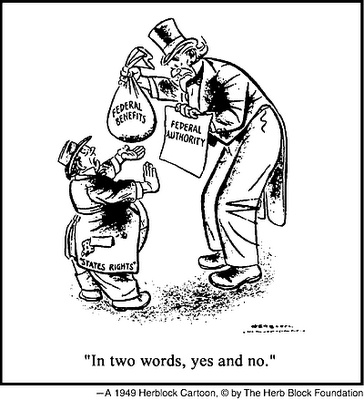
Congress finds the authority to enact those programs in the Supreme Court’s interpretation of the Constitution’s general-welfare clause in Steward Machine Co. v. Davis (1937). More recently, in the court’s 2012 NFIB v. Sebelius decision upholding the Affordable Care Act’s individual mandate, Chief Justice John Roberts wrote that Congress may use federal funds to “induce the States to adopt policies that the Federal Government itself could not impose,” so long as participation by the states is voluntary. To put it another way, Congress is licensed to dabble in areas in which it is forbidden to act, which it does by bribing the states to adopt Congress’s approaches to problems that are the states’ exclusive responsibility.

It is impossible, in this article, to detail all the costs imposed by those programs, but here are some of the most egregious ones: They add layers of federal and state administrative expenses to the cost of the subsidized projects; distort state priorities by offering lucrative grants for purposes of often trivial importance; and undermine accountability because state officials bound by federal regulations can’t be held responsible for the costs and failures of the projects they administer.

Finally, and of prime importance, those programs have subverted the Constitution’s federalism, its division of federal and state responsibilities, that was intended to prevent a concentration of power in a central government that could threaten individual liberties.

The states are free to decline to participate in the programs, but that has proved very hard to do. Money from Washington is still regarded as “free,” and state officials are delighted to accept grants, strings and all, rather than raise the extra money that would be required to pay the full cost of the projects they freely undertake with federal subsidies. What makes declining grants particularly difficult is the fact that if a state does not participate in a program, its share of the money—derived in whole or part from its own taxpayers—will go elsewhere.”

[Reference: James L. Buckley, “How Congress Bribes States to Give Up Power,” Wall Street Journal, December 25, 2014. Referenced at: http://www.wsj.com/articles/james-l-buckley-how-congress-bribes-states-to-give-up-power-1419541292. Mr. Buckley is a retired federal appellate judge and a former U.S. senator]

I have proposed a remedy. I like to call it the “Rightful Remedy” for curbing federal spending. The remedy relies on the sovereignty of the states, on the federal nature of our government system, and on the Tenth Amendment.

In short, the remedy summons the states to step up to their unique and historical responsibility to act as the last safeguard of their citizen’s individual’s liberty. The remedy would have each state, through their Treasury Department, establish an “Escrow Account” or “Escrow Fund” into which it would deposit its citizens’ federal income tax withholdings or funds. To be clear, citizens of each state will direct their federal income tax withholdings to go to the state Escrow Account rather than to the IRS. Similarly, citizens who don’t receive a salary but have other assets that the government taxes will send their federal income tax check to the same state Escrow Account instead of to the IRS. The funds will remain in the Account while the State Treasurer (either as a solo effort or in collaboration with other state treasurers) evaluates the federal budget for constitutionality. The Treasurer will review each item of spending and evaluate it according to the original meaning and intent of the Constitution (as it was debated, understood, and adopted by the People of each state, acting in convention in the years 1787-1790 to establish the Union of states) to see if it consistent or inconsistent with Article I, Section 8. After reviewing each item, the NC Department of State Treasurer will determine the percentage of the federal budget that is constitutional (as opposed to that portion that is unconstitutional and should rightfully be reserved to the states). The State Treasurer will then re-calculate each individual’s federal income tax burden according to its determination of constitutionality.

The State Treasurer will then forward to the IRS that portion of each individual’s tax burden that corresponds to the constitutional purposes of the budget and the remainder will remain in the State Escrow Account. The state can then determine what it should do with the amount remaining in the Account. It may choose to keep it there (“just in case”). Preferably, it will return a good portion to the individual on account that he/she was overtaxed in the first place. It may also choose to keep a portion of the amount to fund state projects that normally would have required federal funding, including “conditioned” grants.

The State could also have its citizens direct their FICA withholdings to a state Escrow Account (a different one, perhaps – a state “Social Security Escrow Account”) rather than to the IRS in order to protect their interests when they enter their retirement years. The State Treasurer could research the best investment scheme to invest the funds for the citizen so that when he or she reaches the age of retirement, the retirement funds that he or she receives will be secure and plentiful.

This remedy, in general, achieves several goals:

• It reminds Congress that not all of its spending is constitutional.

• It divests Congress of the broad interpretation of its taxing (and spending) powers that the Supreme Court has generously provided over the many years.

• It puts an important check on the scope of the federal government by the sovereign that was always intended to provide that check – the states (under the Tenth Amendment and under Compact and Agency theories).

• It helps States break free of their dependency on the federal government and hence resume their sovereign responsibilities and sovereign status.

• It forces government to divest itself of the functions and agencies that it can no longer ‘pay for.’

• It forces government to “exist within its means” (just as ordinary people are required to do).

• It provides an element of transparency and accountability in government.

• It reduces the individual federal income tax burden and allows citizens to keep more of their own money, or at least to have it spent in their “own back yard” (in their own state, to accomplish goals that benefit them more directly).

• The reduced federal income tax burden allows the states to tax according to their own schemes in order to fund directly their own projects, as they themselves see fit for their people.

• The scheme introduces a degree of innovation and creativity on the part of the state (“50 independent laboratories of innovation”) which will serve to make our government system most efficient.

• If the federal government becomes too abusive and continues to usurp reserved state powers or if it threatens individual liberty, it is much easier to shut it down and effect the remedies provided to the People in the Declaration of Independence (“to alter or abolish” government) by withholding tax funds completely.

I have written my proposal in Resolution form, and in a particularly detailed form, in order to clearly state or establish the foundations for the proposal. I believe the foundations have been lost on Americans for many generations now and it is probably for that reason that we have are in the situation we now find ourselves.

If our country doesn’t get its finances in order, and if we, as a People, don’t get our government back to work for us instead of for itself and its longevity and get it back within reasonable boundaries in our lives, in our livelihoods, and on our property (all forms), then we will lose everything good about the experiment that was started by those who reached our shores to escape various types of persecution from their own governments and who instigated for independence.

Looking at history I am reminded of countries that take different views of the role of government. There are strikingly essential differences between the governments of different countries. Most striking are those between the western nations and communism. Communism exalts the state over the individual and the family while western societies value the rights of the individual. With our federal government attempting to take care (“control”) of the individual from cradle to grave, with its massive schemes to redistribute wealth and property, with its funding of Planned Parenthood (the unborn can be sacrificed for higher goals), and its latest schemes, Obamacare (forcing the young and healthy into the health insurance market to help pay the healthcare fees for those who can’t afford it) and Common Core (uniform “programmed” education), one has to wonder what our government exalts, or promotes – the state, and what is best “for the state,” or the individual.


RESOLUTION – THE USE OF STATE ESCROW ACCOUNTS to CURB FEDERAL SPENDING

Whereas, “The Creator has made the earth for the living, not for the dead. Rights and powers can only belong to persons, not to things.” (Thomas Jefferson). Rights and powers do not originate or belong to a government, unless that power is exercised for the People – on behalf of them – and NOT against them;

Whereas, the several States, by a compact under the style and title “Constitution for the United States,” and of amendments thereto, voluntarily constituted a general government for special common purposes;

Whereas, the several States are parties to the compact (Constitution), with the people of said States acting in their own conventions to consider, debate, deliberate, and ratify it;

Whereas, our government structure is predicated on separation of powers between the States, as sovereigns, and the federal government, which is sovereign with respect to only certain responsibilities (Article I, Section 8; express language, as re-affirmed in the state ratifying conventions and the Federalist Papers, the leading authority on the meaning and intent of the Constitution);

Whereas, this separation of powers, known as federalism, is a critical feature of our government system, intended to safeguard the “precious gem” of individual liberty by limiting government overreach;

Whereas, there is no provision in the Constitution nor any grant of delegated power by which the States can be said to have (willingly or intentionally) surrendered their sovereignty, for it is clear that no State would have ratified the document and the Union would not have been established;

Whereas, the States were too watchful to leave the opportunity open to chance and using an abundance of caution, insisted that a series of amendments be added, including the Tenth Amendment, as a condition of ratification and formation of the Union;

Whereas, the Preamble to the Bill of Rights expressed the unambiguous intention of those amendments, and reads: “The Conventions of a number of the States having at the time of their adopting the Constitution, expressed a desire, in order to prevent misconstruction or abuse of its powers, that further declaratory and restrictive clauses should be added: And as extending the ground of public confidence in the Government, will best insure the beneficent ends of its institution”;

Whereas, that relationship between the states and the federal government is defined by the Tenth Amendment, which reads: “The powers not delegated to the United States by the Constitution, nor prohibited by it to the states, are reserved to the states respectively, or to the people”;

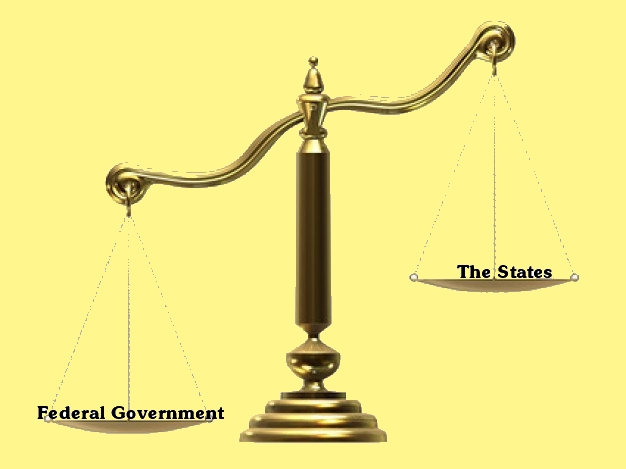
Whereas, the critical relationship has been eroded through the many Supreme Court decisions which have transferred power from the States to the federal government in order to enlarge its sphere of influence;

Whereas, the relationship has been further eroded by the dependence that States have on the federal government for funding;

Whereas, the Supreme Court has upheld the notion that the government “has the power to fix the terms upon which its money allotments to states shall be disbursed” (South Dakota v. Dole, 1987) and therefore has upheld its conditioned funds to the states as permissible (as a matter of contract law);

Whereas, with the blessing of the Supreme Court, the government can achieve through conditioned spending that which it cannot achieve constitutionally, thereby allowing it to do an end-run on the Constitution and to avoid its limitations under the Tenth Amendment;

Whereas, while the decision in Dole has noted that the conditioned spending must be for the General Welfare, it incorrectly interpreted the Constitution’s “General Welfare” Clause (“to provide for the General Welfare”) as vesting the federal government with an independent grant of power rather than recognizing that the clause merely serves as a qualifier for the 17 enumerated objects of legislation that follow;

Whereas, the federal government is not the sovereign body vested with the responsibility to address all the nation’s concerns, including local issues, which is what the “General Welfare” clause could easy be used to do;

Whereas, the federal government has made itself the exclusive and final judge of the extent of the powers delegated to itself, and as such, its need for power and its discretion – and not the Constitution – have been guiding those decisions.

Whereas, the federal government has created for itself an absolute monopoly over the nature and scope of its powers and has consistently assumed powers it wasn’t meant to have – misappropriating them from the States and from the People;

Whereas, the federal government has used said monopoly to change the nature of the Constitution, to redefine its terms, and to re-establish boundaries of government on the individual without using the lawful route, Article V;

Whereas, the particular security of the people is in the possession of a written and stable Constitution. The branches of the federal government, acting in unison rather than apprehension, have made it a blank piece of paper by construction;

Whereas, the government, once populated by representatives who were primarily beholden to the interests of the people and the States, is now populated by representatives who are primarily beholden to the interests of the government;

Whereas, through the consolidation and concerted action of its branches and said monopoly, the federal government has transformed itself into a strongly centralized, bloated national government, vested with illegitimate powers and barely recognizable as the government intended by our creators and adopted by the States in the years of our founding. This bloated central government is coercive, wasteful, corrupt, and out of touch with the People. Less than one quarter of the people trust it, most are afraid of it, and those who are required to support it by paying federal income taxes believe they are paying too much and question the legitimacy of the purposes for which it taxes and spends. Most importantly, the government is one that poses serious threats to the exercise of the freedoms that Americans are deemed to be endowed with;

Whereas, the direct consequence of a government that has enlarged its powers and functions is that it requires a larger budget and therefore has to tax its citizens more;

Whereas, with respect to federal grants and other forms of funding, if the government’s budget includes funds to “bribe” the states and otherwise attempt to influence state policy or planning, then it clearly overtaxes its citizens. Bribing the states or otherwise paying for any of its internal functions or projects is not one of the objects for which Congress can tax and spend under the Constitution, even if said bribe is cloaked in contract terms. The states are so financially strapped that there is effectively no “choice” involved in accepting grants of funding from the federal government and essentially, the offer amounts to an act of coercion. The government is absolutely forbidden to coerce a state government or its agents;

Whereas, the power to prevent the further consolidation of powers in the central government and the right of judging on infractions of inherent powers is a fundamental attribute of sovereignty which cannot be denied to the States, and therefore they must be allowed to do so;

Therefore, in order to reverse the unintended concentration of power in the federal government and in order to divest it of powers it has misappropriated and assumed for the past 200 years, and perhaps even to provide an additional check on the federal government by the People themselves (for whom the government is to serve and be accountable, according to the Declaration of Independence, lest they find the need to “alter or abolish”), the State of North Carolina will adopt the following scheme:

• The citizens of the state of North Carolina will have federal income taxes withheld from their paychecks but instead of those withholdings going to the federal government, they will be ear-marked to a state “Escrow Account” or “Escrow Fund” established by the NC Department of the State Treasurer.

• Likewise, citizens of the state of North Carolina will have FICA taxes withheld from their paychecks and also ear-marked to the state “Escrow Account/ Fund.”

• Citizens of North Carolina who receive no salary (that is taxable) but who have other assets that the federal government is able to tax under the federal Income Tax laws will send their federal income tax burden to the State (NC Department of the State Treasurer) to be deposited in the “Escrow Account/ Fund” rather than send the check to the IRS.

• The NC Department of the State Treasurer will evaluate the federal budget for constitutionality. It will review each item of spending and evaluate it according to the original meaning and intent of the Constitution (as it was debated, understood, and adopted by the People of each state, acting in convention in the years 1787-1790 to establish the Union of states) to see if it consistent or inconsistent with Article I, Section 8.

• After reviewing each item, the NC Department of State Treasurer will determine the percentage of the federal budget that is constitutional (as opposed to that portion that is unconstitutional and should rightfully be reserved to the states).

• The State Treasurer will then re-calculate each individual’s federal income tax burden according to its determination of constitutionality.

• The State Treasurer will then forward to the IRS that portion of each individual’s tax burden that will fund constitutional (legitimate) objects of the government’s authority. The remainder will remain in the State Escrow Account/ Fund.

• Of the remaining funds, the State Treasurer will return a major portion of the individual’s federal income tax withholdings to him or her. It will have the option of keeping a portion of those withholdings to fund state projects that normally would have required federal funding, including “conditioned” grants.

• With respect to the FICA funds, the NC Department of State Treasurer will establish a separate state Escrow Account/ Fund (a state Social Security Escrow Account/ Fund) for which to deposit them. The NC State Treasurer will research the best investment scheme to invest the funds for the citizen so that when he or she reaches the age of retirement, the funds that he or she will receive to make up for the loss of wages will be secure and plentiful.

The state Escrow Account/ Fund scheme, in general, achieves several goals:

• It reminds Congress that not all of its spending is constitutional.

• It divests Congress of the broad interpretation of its taxing (and spending) powers that the Supreme Court has generously provided over the many years.

• It puts an important check on the scope of the federal government by the sovereign that was always intended to provide that check – the states (under the Tenth Amendment and under Compact and Agency theories).

• It forces government to divest itself of the functions and agencies that it can no longer ‘pay for.’

• It forces government to “exist within its means” (just as ordinary people are required to do).

• It provides an element of transparency and accountability in government.

• It reduces the individual federal income tax burden and allows citizens to keep more of their own money, or at least to have it spent in their “own back yard” (in their own state, to accomplish goals that benefit them more directly).

• The reduced federal income tax burden allows the states to tax according to their own schemes in order to fund directly their own projects, as they themselves see fit for their people.

• The scheme introduces a degree of innovation and creativity on the part of the state (“50 independent laboratories of innovation”) which will serve to make our government system most efficient.

• If the federal government becomes too abusive and continues to usurp reserved state powers or if it threatens individual liberty, it is much easier to shut it down and effect the remedies provided to the People in the Declaration of Independence (“to alter or abolish” government) by withholding tax funds completely.

Posted in Uncategorized | Tagged , , , , , , , , , , , , , , , , , , , , , , , | 26 Comments

Impending Federal Gun Control Laws or Confiscation: States Don’t Fail Us Now !

NULLIFICATION - Gun Control (Clint Eastwood)

by Diane Rufino, October 4, 2015

Obama Wants our Guns and It’s Time for the States to Make Clear: “We Will Not Comply…. We Will Nullify!”

Obama appears to be intent on burdening the second amendment – a fundamental and essential right of a free people.

The States need to decide where they stand: Either they will protect its people or the country is exactly what Abraham Lincoln envisioned – a country where the states are irrelevant and the federal government reigns absolutely supreme.

The States (and the local sheriffs) are the last line of defense between a rogue federal government and the People. The federal government appears to become more unhinged from the Constitution with each passing day and this should scare everyone. The need to erect lines of protection becomes ever more urgent. And this is where the States and sheriffs need to step in. They need to make clear that they will NULLIFY and INTERPOSE should the federal government attempt to infringe the right of the people to have and bear arms. We know what will be right around the corner should that happen… We only need to look at what happened to the unfortunate people of totalitarian regimes whose leaders confiscated guns. In this country, Patrick Henry explained it better than anyone else. A people who can’t defend themselves cannot assert their rights against the government and are therefore doomed to surrender them.

In 1775, after the British Crown and Parliament set out to punish the colonies for their “rebellious spirit” in frustrating its taxation schemes and its conduct in tossing tea overboard in Boston Harbor in protest of the monopoly established by the Tea Act by imposing the series of laws known as the Coercive Acts (unaffectionately referred to as the “Intolerable Acts” by the colonists), the colonies sought to appeal King George III to interpose on their behalf and end the arbitrary and oppressive treatment of them.

In September 1774, the First Continental Congress met in Philadelphia to address the colonies’ collective response to the Intolerable Acts. On October 25, it drafted a respectful response to the King, which would be known as the “Declarations and Resolves” and delegates were then dispatched to present them to him in person. Despite the anger that the colonies felt towards Great Britain after Parliament enacted the Coercive Acts, our first Congress was still willing to assert its loyalty to the king. In return for this loyalty, Congress asked the king to address and resolve the specific grievances of the colonies; in particular, it asked that the Acts be repealed. The petition, written by Continental Congressman John Dickinson, laid out what Congress felt was undo oppression of the colonies by the British Parliament. King George would ignore the Declarations and Resolves and rather, he would use them to mock the colonies. He laughed, claiming that while they publicly pledged their loyalty to him, they were probably preparing for armed revolution. He found them ingenuous and not very clever.

[Approximately eight months after the Declarations were presented to King George and without any response, on July 6, 1775, the Second Continental Congress adopted a resolution entitled “Declaration of the Causes and Necessity of Taking Up Arms.” On October 27, 1775 that King George appeared before both houses of the Parliament to address his concern about the increased rebellious nature of the colonies. He described the colonies as being in a state of rebellion, which he viewed as a traitorous action against himself and Britain. He began his speech by reading a “Proclamation of Rebellion” and urged Parliament to move quickly to end the revolt and bring order to the colonies. With that, he gave Parliament his consent to dispatch troops to use against his own subjects – the very people who looked to him for respect and protection].

On March 23, 1775, Patrick Henry attended a meeting of the Second Virginia Convention, with a very important issue he intended to address. It would be the second convention held after the Royal Governor of Virginia dissolved the colonial legislature, the House of Burgesses, for its solidarity with Massachusetts (after Parliament closed the port of Boston as punishment for the Boston Tea Party). The House of Burgesses would continue to meet, albeit in secret, but would operate in convention (These would serve as Virginia’s revolutionary provisional government).

While he knew the King had ignored the respectful petition by the First Continental Congress and had continued to treat them without the reserved rights afforded all English subjects, Henry could not know for sure that he would authorize military action against them. But he certainly saw it coming.

As tensions were mounting between Great Britain and the colonies, the Second Virginia Convention convened in secret at St. John’s Church in Richmond to discuss the Old Dominion’s strategy in negotiating with the Crown. The roughly 120 delegates who filed into Richmond’s St. John’s Church were a veritable “Who’s Who” of Virginia’s colonial leaders – George Washington, Thomas Jefferson, Richard Henry Lee, and Patrick Henry, a well-respected lawyer and orator. Henry had long held a reputation as one of Virginia’s most vocal opponents of England’s oppressive taxation schemes. During the Stamp Act controversy in 1765, he bordered on treasonous activity when he delivered a speech in which he hinted that King George risked meeting the same fate as Julius Caesar if he maintained his oppressive policies. As a recent delegate to the Continental Congress, he resounded Ben Franklin’s call for colonial solidarity by proclaiming, “The distinctions between Virginians, Pennsylvanians, New Yorkers and New Englanders are no more. I am not a Virginian; I am an American.”

Henry was convinced that war was around the corner. And he arrived at the Virginia Convention determined to persuade his fellow delegates to adopt a defensive stance against Great Britain. On that fateful evening of March 23, he put forward a resolution proposing that Virginia’s counties raise militiamen “to secure our inestimable rights and liberties, from those further violations with which they are threatened.” The suggestion of forming a colonial militia was not shocking in itself. After all, other colonies had already passed similar resolutions and had begun forming militias. And Henry himself had already taken it upon himself to raise a volunteer outfit in his home county of Hanover. Nevertheless, his proposal was not met with the approval he had hoped for. Many in the audience were skeptical at approving any measure that might be viewed as combative. Britain, after all, was the strongest military power in the world. They still held out hope for a peaceful reconciliation.

After several delegates had spoken on the issue, Patrick Henry rose from his seat in the third pew and took the floor. A Baptist minister who was present that evening would later describe him as having “an unearthly fire burning in his eye.” Just what happened next has long been a subject of debate. Henry spoke without notes, and no transcripts of his exact words have survived to today. The only known version of his remarks was reconstructed in the early 1800s by William Wirt, a biographer who corresponded with several men that attended the Convention. According to this version, Henry began by stating his intention to “speak forth my sentiments freely” before launching into an eloquent warning against appeasing the Crown.

I consider it as nothing less than a question of freedom or slavery; and in proportion to the magnitude of the subject ought to be the freedom of the debate. It is only in this way that we can hope to arrive at truth, and fulfill the great responsibility which we hold to God and our country. Should I keep back my opinions at such a time, through fear of giving offense, I should consider myself as guilty of treason towards my country, and of an act of disloyalty toward the Majesty of Heaven, which I revere above all earthly kings.

Mr. President, it is natural to man to indulge in the illusions of hope. We are apt to shut our eyes against a painful truth, and listen to the song of that siren till she transforms us into beasts. Is this the part of wise men, engaged in a great and arduous struggle for liberty? Are we disposed to be of the number of those who, having eyes, see not, and, having ears, hear not, the things which so nearly concern their temporal salvation?

I have but one lamp by which my feet are guided, and that is the lamp of experience. I know of no way of judging of the future but by the past. And judging by the past, I wish to know what there has been in the conduct of the British ministry for the last ten years to justify those hopes with which gentlemen have been pleased to solace themselves and the House. Is it that insidious smile with which our petition has been lately received? Trust it not, sir; it will prove a snare to your feet. Suffer not yourselves to be betrayed with a kiss. Ask yourselves how this gracious reception of our petition comports with those warlike preparations which cover our waters and darken our land. Are fleets and armies necessary to a work of love and reconciliation? Have we shown ourselves so unwilling to be reconciled that force must be called in to win back our love? Let us not deceive ourselves, sir. These are the implements of war and subjugation; the last arguments to which kings resort. I ask gentlemen, sir, what means this martial array, if its purpose be not to force us to submission? Can gentlemen assign any other possible motive for it? Has Great Britain any enemy, in this quarter of the world, to call for all this accumulation of navies and armies? No, sir, she has none. They are meant for us: they can be meant for no other. They are sent over to bind and rivet upon us those chains which the British ministry have been so long forging. And what have we to oppose to them? Shall we try argument? Sir, we have been trying that for the last ten years. Have we anything new to offer upon the subject? Nothing. We have held the subject up in every light of which it is capable; but it has been all in vain. Shall we resort to entreaty and humble supplication? What terms shall we find which have not been already exhausted? Let us not, I beseech you, sir, deceive ourselves. Sir, we have done everything that could be done to avert the storm which is now coming on. We have petitioned; we have remonstrated; we have supplicated; we have prostrated ourselves before the throne, and have implored its interposition to arrest the tyrannical hands of the ministry and Parliament. Our petitions have been slighted; our remonstrances have produced additional violence and insult; our supplications have been disregarded; and we have been spurned, with contempt, from the foot of the throne! In vain, after these things, may we indulge the fond hope of peace and reconciliation. There is no longer any room for hope. If we wish to be free– if we mean to preserve inviolate those inestimable privileges for which we have been so long contending–if we mean not basely to abandon the noble struggle in which we have been so long engaged, and which we have pledged ourselves never to abandon until the glorious object of our contest shall be obtained–we must fight! I repeat it, sir, we must fight! An appeal to arms and to the God of hosts is all that is left us!

They tell us, sir, that we are weak and unable to cope with so formidable an adversary. But when shall we be stronger? Will it be the next week, or the next year? Will it be when we are totally disarmed, and when a British guard shall be stationed in every house? Shall we gather strength by irresolution and inaction? Shall we acquire the means of effectual resistance by lying supinely on our backs and hugging the delusive phantom of hope, until our enemies shall have bound us hand and foot? Sir, we are not weak if we make a proper use of those means which the God of nature hath placed in our power. The millions of people, armed in the holy cause of liberty, and in such a country as that which we possess, are invincible by any force which our enemy can send against us……. There is no retreat but in submission and slavery! Our chains are forged!

It is in vain, sir, to extenuate the matter. Gentlemen may cry, Peace, Peace– but there is no peace. The war is actually begun…… Is life so dear, or peace so sweet, as to be purchased at the price of chains and slavery? Forbid it, Almighty God! I know not what course others may take; but as for me, give me liberty or give me death!

Less than a month later, shots would be fired at Lexington and Concord. The war that Henry saw coming had finally begun.

Patrick Henry had the intuition to understand that a leader “whose character is thus marked by every act which defines a tyrant” cannot be trusted to allow his people to enjoy the freedom that they petition for. And when push comes to shove, the more they demand it, the more oppressive his response would be. And thus, since that leader, King George III, was considered to be unfit to be the ruler of a free people, in the mind of Patrick Henry, if he indeed decided to use force to subjugate the people of Virginia should be prepared with a force of their own to defend their liberty. Henry would later refer to Liberty as “that precious gem.”

A leader “whose character is thus marked by every act which defines a tyrant is unfit to be the ruler of a free people.”

Americans still consider themselves a free people. And Americans still want to believe their government believes in their right to be so. But the one problem is that most Americans believe their “government” to be the federal government. A people who understand the foundations and underpinnings of liberty and freedom know that the federal government is not their government but rather their state government is their government. The federal government primarily serves the states, or at least, it was intended that way. Yet for limited objects, expressly defined in Article I, Section 8, its legislation can touch the people.

It is the state government, and not the federal government, that can protect an individual’s inalienable liberties. Which government in recent years has shown disregard for the fundamental rights of the People – federal or state? Which government has enacted the largest tax increase in our nation’s history? Which government has denied people the fundamental right to manage their healthcare? Which government has ignored immigration laws and attempted to fundamentally change the character of the nation illegally? Which government has demanded that marriage laws (based on natural criteria in place for thousands of years) be fundamentally altered? And which government has poised itself for years now to restrain the people in their right to have and bear arms? Again, a government “whose character is thus marked by every act which defines a tyrant is unfit to be the ruler of a free people.”

The American states, after fighting and winning a costly war for their independence, had to decide on the best form of government to embrace the values they proclaimed in the Declaration of Independence. They asserted the same rights that the British held dear and which they fought to defend, spanning hundreds of years, but their task was to secure them more firmly so that their posterity – “millions yet unborn and generations to come” (from the anti-Federalist paper, Brutus I) – would enjoy the same degree of freedom. They didn’t want Americans to endure the same tortured history as the British, who enjoyed freedom under benevolent kings but oppression and even death under tyrants. Freedom, according to Thomas Jefferson, including as alluded to in the Declaration of Independence, was the right to be free from an aggressive or oppressive government. To that end, the government established by the Constitution of 1787, with powers limited in DC and balanced by the bulk of powers retained by the states, with its separation of powers and elaborate system of checks and balances, with its week judicial branch, and with a Bill of Rights, was believed to provide the best system to preserve the rights they fought for. Furthermore, in America, rights are understood to be inalienable, endowed by our Creator. In Britain, on the other hand, rights are those generously granted by government. Rights were only those limitations on government that Kings recognized by a signature on a charter.

The US Bill of Rights, modeled after the English Bill of Rights of 1689, exists to protect the individual against the government. Included in our Bill of Rights are the rights to be free from a national religion, the right to the free exercise of one’s religion and the rights of conscience. It includes the right of free speech, the right of assembly, the right to a free press, the right to petition the government, the right to have and bear arms, the right to be free in one’s home, papers, and effects from unreasonable searches and seizures, the right to a jury trial, various rights of a person accused of a crime, the right not to have one’s property arbitrarily confiscated by the government, the right to be free from cruel and unusual punishment, and others.

The second amendment is currently under unrelenting attack by our current administration, with Obama leading the charge. Just two days ago, he spoke not only about the need for gun control but hinted about possible confiscation. When Obama spoke in reaction to the heinous October 1 attack on Umpqua Community College, in Oregon, he went beyond his usual calls for more gun control and suggested instead that the United States consider following the path taken by Australia and Great Britain.

In the mid-1990s Australia and Great Britain both instituted complete bans on firearm possession. And Obama referenced those bans: “We know that other countries, in response to one mass shooting, have been able to craft laws that almost eliminate mass shootings. Friends of ours, allies of ours – Great Britain, Australia, countries like ours. So we know there are ways to prevent it.”

What Obama didn’t clarify is that Australia has no constitution nor does it have a Bill of Rights. The rights of the people are not absolute. Great Britain, which also does not have a constitution, per se, does protect gun rights to some degree in its Bill of Rights of 1689. That document allowed for Protestant citizenry to “have Arms for their Defense suitable to their conditions and as allowed by law,” and restricted the right of the English Crown to have a standing army or to interfere with Protestants’ right to bear arms “when Papists were both armed and employed contrary to Law.” It also established that regulating the right to bear arms was one of the powers of Parliament and not of the monarch. Thus, the right was not absolute and it was clearly articulated as such. In fact, Sir William Blackstone wrote in his Blackstone’s Commentaries on the Laws of England (1765) about the right to have arms being auxiliary to the “natural right of resistance and self-preservation,” but subject to suitability and allowance by law.

As Mark Levin explained: “The second amendment isn’t in the Bill of Rights to protect you in your hunting rights. The second amendment isn’t there to protect you in your sports-shooting rights. The second amendment was added to the Constitution to protect you against a centralized government. The militia part of the second amendment underscores this point. The point is that the states can maintain militias to protect the states from an oppressive tyrannical central government. I don’t mean to be provocative, but that’s just history. That’s why we have the second amendment.”

What is that history? Our Founding Fathers, having just broken away from Great Britain, understood the new federal government they were ratifying might one day become just as tyrannical. If it had the authority to control citizen access to firearms, then it could disarm them, just as the British attempted to do. This would make any attempts to restore liberties futile. The second amendment was specifically included in the Bill of Rights to prevent this.

James Madison, the father of the Constitution, said in 1789 that “A well-regulated militia, composed of the body of the people, trained to arms, is the best and most natural defense of a free country.” When the Founders wrote of a “well regulated” militia, they meant that militias needed to be well-regulated through training and drilling in order to be effective in battle. It was merely common sense. This could only happen if citizens had unrestricted access to firearms.

The Second Amendment’s guarantee of an individual’s right to have and bear arms is the right which secures all other rights. The First Amendment protects the other rights by permitting the speech and the expression, and the assembly and the petition and the use of the press to call out the government when it tramples on those rights, but the Second Amendment, with its force, is able to secure them, should the government ignore the former. In other words, when the First Amendment fails, the Second is there to preserve and secure the people in their liberty.

The Preamble to the Bill of Rights expresses the States’ intention in demanding a Bill of Rights as a condition to ratification. It reads: “The Conventions of a number of the States, having at the time of their adopting the Constitution, expressed a desire, that in order to prevent misconstruction or abuse of its powers, further declaratory and restrictive clauses should be added, which shall extend the ground of public confidence in the Government, and will best ensure the beneficent ends of its institution” According to the Preamble, the federal government is PROHIBITED from even contemplating the issue of abridging the rights guaranteed in the second amendment. The liberty rights contained in the Bill of Rights demand an ABSOLUTE BAN by the federal government action in those areas. Being that the Supreme Court has been in the business of enlarging the rights contained in those amendments (ie, privacy rights, for example, rights of criminals), we can assume that our right to have and bear arms is similarly enlarged.

Although the Bill of Rights was adopted after the Constitution was ratified, it was the absolute assurance by James Madison that he would draft a Bill of Rights and have it submitted and adopted by the First US Congress (June 8, 1788) that convinced several skeptical, and important, states to finally ratify. In other words, BUT FOR the fact that a Bill of Rights would be added to the Constitution to further protect the rights of the People and the States, the Constitution would never have been adopted and the Union, as we know it, would not have been formed. After the delegates concluded their convention in Philadelphia in September 1787, it was clear that the Constitution that had been written was not very popular (particularly with the anti-Federalists). Some very important delegates refused to even sign it and some promised to do all they could to prevent its ratification by the states. Edmund Randolph and George Mason (both of VA), Elbridge Gerry (of MA), John Lansing and Robert Yates (both of NY), and Martin Luther (of DE) all refused to sign because of a lack of Bill of Rights and a deep concern that the government created would endanger the rights of the States. Yates would go on to write some of the strongest anti-Federalist essays, under the pen name Brutus, and fellow New Yorker, Governor George Clinton, would write some as well (under the name Cato). Two of our most important Founding Fathers, Patrick Henry and Richard Henry Lee, although asked to be delegates to the Convention, declined because they were suspicious of those running the Convention (namely Madison, whom they suspected to have ambitious plans for the meeting). They believed a government stronger than the Articles would compromise the sovereignty of the States.

Indeed, it was unclear whether the Constitution would be ratified by the States. The Constitution was in deep trouble in the conventions of four states – Virginia, New York, Massachusetts, and North Carolina. They were some of the biggest states. The first three were the most important and influential of the States. Without the guarantee of a Bill of Rights, those states were not going to ratify. The formation of a “more perfect union” appeared to be in jeopardy. Even with the guarantee, the votes for ratification were by a fairly slim margin. North Carolina had rejected the Constitution outright. It was not until a Bill of Rights was added that it called another ratifying convention to take another vote.

Does anyone believe that a constitution that expressly created a government as large, bloated, concentrated, oppressive, arrogant, monopolistic, and corrupt as the one in existence today would have been drafted and produced by the delegates to the Constitutional Convention of 1787? Does anyone believe that the delegates in attendance at that convention, the great leaders of our founding generation, knowing their concerns to respect the spirit of the Revolution and to protect their state sovereignty (and yield as little sovereign power as possible), would have drafted and signed such a document? And even if such a document would have been produced at the Convention, does anyone believe a single State would have ratified it and surrendered essentially all of its sovereignty? NO WAY !! There is no way that Virginia or New York or Massachusetts or North Carolina would have ratified it. NO WAY! None of them would have ratified it.

And yet we’ve allowed the government – what it’s become – to assert, unchallenged, that whatever it does and says is the supreme law of the land. Tyranny is defined as the action of an unjust and oppressive government. For a country that defines the boundaries of government on its people through a written constitution, tyranny occurs when unconstitutional laws are forced – enforced – on the people. After all, when a government assumes powers not delegated to it, it naturally has to usurp them from their rightful depository, which in the case of the United States is the States and the People.

Our government – all three branches – continue to act to mock individual liberty and states’ rights. Certainly our president does so at every given opportunity. Our government – all three branches – continues to act to ignore and frustrate the will of the People even though a democracy is their birthright. As Daniel Webster once wrote: “It is, Sir, the people’s government, made for the people, made by the people, and answerable to the people.” (note that this quote is the forerunner to Lincoln’s famous line in the Gettysburg Address).

The federal government, which was conceived as a “government of the people, by the people, for the people,” unfortunately now only rests on two of those legs. In has failed for many years now to be a government “for the people.”

Enough is enough.

Gun Rights mark a line in the sand. That line represents a tolerance of government that absolutely cannot be crossed. If government should attempt gun control that burdens or attempt confiscation, the line will have been crossed. The Supreme Court WOULD HAVE TO IMMEDIATELY STRIKE THAT ACTION DOWN. Hell, the Supreme Court has held over and over again that any action by government that should happen to burden even ever so lightly a woman’s right to have an abortion cannot be tolerated. And an abortion actually and absolutely KILLS another human being – an innocent and helpless one. The right to an abortion is NOT mentioned in the Constitution and certainly NOT in the Bill of Rights. The right to have and bear arms is. It is addressed plainly and without condition or pre-condition in the second amendment. By applying the same rational as the Court uses to ensure women their unfettered right and access to an abortion, the government MUST NOT in any way, shape, or form burden an individual’s right to have and bear arms. The right to bear arms is rooted in the natural rights of self-defense and self-preservation. The right to have an abortion is rooted in the selfish goal of convenience.

When the government crosses that line, the Declaration of Independence tells us what the Peoples’ rights are, under the theory of social compact (which the US Constitution is):

We hold these truths to be self-evident, that all men are created equal, that they are endowed by their Creator with certain unalienable Rights, that among these are Life, Liberty and the pursuit of Happiness.–That to secure these rights, Governments are instituted among Men, deriving their just powers from the consent of the governed, —That whenever any Form of Government becomes destructive of these ends, it is the Right of the People to alter or to abolish it, and to institute new Government, laying its foundation on such principles and organizing its powers in such form, as to them shall seem most likely to effect their Safety and Happiness.

Should the government attempt to burden or deny the American people of their gun rights, our natural right of self-defense (even from our own government) and self-preservation (to live free, as our Creator endowed us and as nature intended) allows us to dissolve our government – that is absolve us from allegiance to it – and establish a new government that is dedicated to the protection of our God-given liberties. Personally, I believe the Constitution is perfect; it just needs verbage that makes it absolutely clear that its very terms are its limitations, there are no elastic clauses or implied powers, there is no independent legislative power attached to the General Welfare or Necessary and Proper clauses, no object expressly delegated to the legislative branch is allowed to be delegated to an un-elected group of people, Congress is expressly forbidden to tax and spend for any reason other than what is listed expressly in Article I Section 8, a provision should be included to give the states the power to audit the spending budget of the government for strict constitutionality, a provision should be added to require Congress to balance its budget every year, the Supreme Court can only offer an opinion which is subject to an appeal to the State courts, the “Wall of Separation” is removed from federal court jurisprudence, the president’s powers must be severely limited by additional language in the Constitution, presidents will no longer be allowed to issue executive orders, the bar for impeachment of a president will be lowered and in certain cases Congress MUST issue articles of impeachment and seek to remove him, consequences will be provided for in the Constitution for representatives and officials who violate their oath of office, the 14th amendment must be clarified as not intending to include the incorporation doctrine (so that the Bill of Rights once again only applies to the actions of the federal government), the 16th and 17th amendments must be repealed, an outright prohibition and a provision should be added that states that when the federal government over-steps its authority that threatens the balance of power between federal government and the states, it shall be viewed as a fatal breach of the compact that binds the states and as such they have the option of dissolving their allegiance. However, if the Constitution cannot be amended to assure that a future government remains adherent to its limits, then James Madison has set the example for us. We don’t have to “amend” the Constitution if we believe it to be seriously flawed. We can simply start from scratch.

The second paragraph of the Declaration of Independence continues:

Prudence, indeed, will dictate that Governments long established should not be changed for light and transient causes; and accordingly all experience hath shewn, that mankind are more disposed to suffer, while evils are sufferable, than to right themselves by abolishing the forms to which they are accustomed. But when a long train of abuses and usurpations, pursuing invariably the same Object evinces a design to reduce them under absolute Despotism, it is their right, it is their duty, to throw off such Government, and to provide new Guards for their future security….”

Our government has been intent on enlarging and redefining its powers almost from the very beginning. It has done everything it has wanted to do to achieve the things it believed it needed to do or simply wanted to do (as in Barack Obama’s case). A government dependent on the separation of powers for proper functioning has become a government monopoly to ignore proper functioning in order to become what the British Kings used to be…. Supreme, domineering, coercive, and oppressive. The people’s government has been replaced by the government’s government. Liberty-loving Americans have been disposed to suffer long enough. Threats to take away our gun rights, however, would be the final straw.

Should Obama and his administration do more than simply talk about gun control and possible confiscation, it would be incumbent upon the states to NULLIFY any legislation or policy and then INTERPOSE for the protection and security of the People to have and bear arms. The next step, should the government fail to back down, would be to declare the federal action or actions to constitute a FATAL BREACH of the compact that brought the states together in the union and therefore the bonds of allegiance are severed and the Union creating the “United States” is thereby dissolved. The federal government would therefore have no jurisdiction except within the District of Columbia, I suppose.

The states need to act – NOW. Each state needs to adopt resolutions and enact legislation protecting the gun rights of its citizens. Those that respect the second amendment need to start attracting gun manufacturing and ammunition industry to their states. The states need to put the president and the administration, and including the federal courts, on notice of their intentions.

If the federal government intends to or attempts to violate the second amendment, the People need to know they can count on their government – that is, their state government. I hope their response will be clear and collective – WE WILL NOT COMPLY… WE WILL NULLIFY! Liberty will require such a response.

References:

Patrick Henry’s Speech, History.com. Referenced at: http://www.history.com/news/patrick-henrys-liberty-or-death-speech-240-years-ago

Congress Petitions English King to Address Grievances, History.com. Referenced at: http://www.history.com/this-day-in-history/congress-petitions-english-king-to-address-grievances

King George III Speaks to Parliament of American Rebellion, History.com. Referenced at: http://www.history.com/this-day-in-history/king-george-iii-speaks-to-parliament-of-american-rebellion

Declaration and Resolves of the First Continental Congress. Referenced at: http://avalon.law.yale.edu/18th_century/resolves.asp

“Obama Trashes the Constitution and No One Says a Damn Thing!”, Mark Levin Show. Referenced at: https://www.youtube.com/results?search_query=mark+levin+obama+trashes+the+constitution+and+no+one+says+a+thing Also referenced at: http://therightscoop.com/mark-levin-obama-trashes-the-constitution-and-nobody-says-a-damn-thing/

“Obama Goes Beyond Mere Gun Control; Hints at Confiscation,” Breitbart News, October 3, 2015. Referenced at: http://www.breitbart.com/big-government/2015/10/03/obama-goes-beyond-mere-gun-control-hints-confiscation/

“The Second Amendment: It’s Meaning and Purpose, The Tenth Amendment Center, September 22, 2014. Referenced at: http://tenthamendmentcenter.com/2014/09/22/2nd-amendment-original-meaning-and-purpose/

“Madison’s Introduction of the Bill of Rights,” usconstitution.net. Referenced at: http://www.usconstitution.net/madisonbor.html

Appendix:

The Intolerable Acts included the following:
(i) Boston Port Act, which closed the port of Boston to all colonists until damages from the Boston Tea Party were paid.
(ii) Massachusetts Government Act, which gave the British government total control of town meetings, taking all decisions out of the hands of the colonists.
(iii) Administration of Justice Act, which made British officials immune to criminal prosecution in America.
(iv) The Quartering Act, which required colonists to house and quarter British troops on demand, including in private homes as a last resort.

Posted in Uncategorized | Tagged , , , , , , , , , , , , , , , | Leave a comment

Obama Trashes the Constitution and No One Says a Damn Thing!

Mark Levin #2


The history of the federal government is a history of repeated injuries and usurpations, all having in direct object the establishment of an absolute Tyranny over the States and the People. To prove this, let facts be submitted to a candid world by famed constitutional lawyer, author, and conservative talk radio show host, Mark Levin…….


Posted in Uncategorized | Tagged , , , , , , , , , , , , | Leave a comment

Embracing Founding Principles to Solve the Social Security Problem

Social Security - BROKE    by Diane Rufino, August 20, 2015

Four years ago, in 2011, Social Security reached a critical tipping point. It paid out more in benefits than it took in through payroll (FICA) taxes. So, for four years, Social Security has been running a deficit.

In 1970, Social Security and Medicare made up 18.7% of the federal budget. In 2006, these two programs made up 33.3% of the federal budget. In 2010, the two programs made up 42.7% of federal budget spending. In that same year, defense spending comprised 19.7 % of the budget and welfare programs comprised 18%. Adding it all up, a full 60.7 % of the 2010 federal budget was designated to entitlement programs.

The recent economic downturn has led to a major decrease in payroll taxes and many people have opted to collect their benefits earlier. (People can retire at age 62, but payments are reduced until age 67). This has led to the Social Security system going into the red. At this point, Social Security is nothing more than a Ponzi scheme, robbing payrolls and future retirees to pay the benefits of current retirees. The enormity of the economic downturn has led to a giant decrease in revenues, and unless an immediate rebound occurs in the economy and revenues increase, benefits will have to be cut and the retirement age will be raised……  OR, Social Security will certainly go broke.  Our very own president has even told us that economic recovery will take years. So you do the math.

The point I’m try to make is that the federal government continues to force a failing system on Americans.  It continues to take payroll taxes out of everyone’s paycheck, including mine, every single pay period in order to cover Social Security benefits and Medicare. It also requires the employer to match those contributions at 6.8% (so if you are self-employed or are a small business owner, then the screwing is more intense). All the while, Social Security continues to run a deficit, continues to be in debt, and continues on the fast track to insolvency.

Social Security was signed into law by President Roosevelt in 1935, as the country was beginning to recover from the Great Depression and coming to the realization that there should be programs to provide for citizens when they can’t provide for themselves, such as the elderly, the disabled, those injured on the job, dependent mothers, etc.

Before the 1930s, support for the elderly was a matter of local, state and family rather than a Federal concern (except for veterans’ pensions). However, the widespread suffering caused by the Great Depression brought support for numerous proposals for a national old-age insurance system. On January 17, 1935, President Franklin D. Roosevelt sent a message to Congress asking for “social security” legislation. The same day, Senator Robert Wagner of New York and Representative David Lewis of Maryland introduced bills reflecting the administration’s views. The bills were met with strong opposition from those who considered the program a governmental invasion of the private sphere.  Eventually the bill passed both houses, and on August 15, 1935, President Roosevelt signed the Social Security Act into law.

The act created a uniquely American solution to the problem of old-age pensions. Unlike many European nations, U.S. social security “insurance” was supported from “contributions” in the form of taxes (payroll taxes; FICA) on individuals’ wages and employers’ payrolls rather than from government funds. The act also provided funds to assist children, the blind, and the unemployed; to institute vocational training programs; and provide family health programs. As a result, enactment of Social Security brought into existence complex administrative challenges. The Social Security Act authorized the Social Security Board to register citizens for benefits, to administer the contributions received by the Federal Government, and to send payments to recipients. Prior to Social Security, the elderly routinely faced the prospect of poverty upon retirement.

Since its inception, workers have come to view their “targeted” payroll deductions (their “contributions”) to the Social Security program’s trust fund [the OASDI fund – “Old-Age, Survivors, and Disability Insurance”] as establishing a unique connection between those tax payments and future benefits, and thereby a true entitlement. They believe that because they have paid (been forced to pay) into the system, Social Security is an “earned right” and therefore they are entitled to retirement benefits, even if the government has a more pressing need for the funds and even if it claims financial insolvency. They believe the government has certainly encouraged that belief by referring to Social Security taxes as “contributions.”  They have come to view the entitlement in terms of morality, ethics, and a contracts.  The government, on the other hand, has come to view the “contributions” as anything other than that.  Social Security is simply another form of taxation and revenue – plundering – for the government.

In the case Flemming v. Nestor (1960), the Supreme Court declined to honor Americans rightful expectations in the program, holding that there is no property or contractual right in the contributions taken from their paychecks specifically for their retirement.  Justice Harlan wrote: “To engraft upon the Social Security system a concept of ‘accrued property rights’ would deprive it [the government; Congress] of the flexibility and boldness in adjustment to ever changing conditions which it demands.” The Court went on to say, “It is apparent that the non-contractual interest of an employee covered by the [Social Security] Act cannot be soundly analogized to that of the holder of an annuity, whose right to benefits is bottomed on his contractual premium payments.”

Perhaps the Court’s decision should not have been surprising. In an earlier case, Helvering v. Davis (1937), the Court had ruled that Social Security was not a contributory insurance program, saying, “The proceeds of both the employee and employer taxes are to be paid into the Treasury like any other internal revenue generally, and are not earmarked in any way.”

As Michael Tanner put it: “Social Security is not an insurance program at all. It is simply a payroll tax on one side and a welfare program on the other. Your Social Security benefits are always subject to the whim of 535 politicians in Washington.”  Just as Congress has cut Social Security benefits in the past, it is more than likely to do so in the future. In fact, given Social Security’s financial crisis, the high unemployment rate, and the historic numbers of Americans claiming disability, benefit cuts are almost inevitable. As we all know, there are various proposals to cut benefits, from increasing the retirement age to means testing.  NJ Governor Chris Christie, realizing that workers have no right to the money religiously taken from their paychecks, has suggested that those who are well enough off in their elderly years should simply forfeit their benefits to others.

So, as a result of the Flemming case, workers have no legally binding contractual rights to their Social Security benefits.  Those benefits can be cut or even eliminated at any time.  You have worked hard all your life and have paid thousands of dollars in Social Security taxes.  Now it’s finally time to retire.  Your rightful expectation is that the government delivers on its promise.  But what can you honestly expect?  The Supreme Court, as it has always – ALWAYS – does, has given the government (Congress, in this case) the flexibility it needs to use use and direct the funds as it sees fit.  Again, the individual is a mere pawn.  He is, above all else, a mere source of tax revenue.

One of the myths of our political system is that the Supreme Court has the last word on the scope and meaning of federal law.  Chief Justice John Marshall proclaimed that view in Marbury v. Madison (1803), despite commentary by our Founders to the contrary.  But there is one remedy that can correct “mistakes” by the Supreme Court and it lies with the Peoples’ House – the US Congress.  Under the original intent of our government, the branches were to be separate and were supposed to actively check each other in order that none of them should transgress the bounds of their authority.  The federal judiciary, as assured to the state ratifying conventions in the Federalist Papers, would be the weakest branch, only being able to offer an opinion to the other branches. “The Executive not only dispenses the honors, but holds the sword of the community. The legislature not only commands the purse, but prescribes the rules by which the duties and rights of every citizen are to be regulated. The judiciary, on the contrary, has no influence over either the sword or the purse; no direction either of the strength or of the wealth of the society; and can take no active resolution whatever. It may truly be said to have neither FORCE nor WILL, but merely judgment; and must ultimately depend upon the aid of the executive arm even for the efficacy of its judgments.”  (Federalist No. 78, written by Alexander Hamilton).  The Supreme Court could offer its opinion as to the constitutionality of a law passed by Congress, but Congress (having the same capacity to read the words of the Constitution and its history), could act in accordance with that opinion or disregard it.  Since Marbury, whenever the Supreme Court reaches an opinion, any legislation that is “repugnant” to the Constitution MUST fall.  It’s their way or the highway.  And so, time and time again, Congress has dealt with the dissatisfaction of having the Supreme Court frustrate its legislative schemes. Sometimes it is for the better but sometimes not.  One way Congress has dealt with that dissatisfaction  is by amending or re-enacting the legislation to clarify its original intent and overrule a contrary Court construction.

While it’s true that Congress cannot really “overrule” its decisions on what a law means, Congress certainly has the power to pass a new or revised law that “changes” or “reverses” the meaning or scope of the law as interpreted by the Court, and the legislative history of the new law usually states that it was intended to “overrule” a specific Court decision.  The People, through their elected officials, and not at the mercy of unelected men and women in black robes, have the power to make the laws and set policy that they want to govern their country and their society.

With that in mind, I have come up with a proposal which, while not solving the debt crises that Social Security is in, will honor the reasonable and legitimate expectations of hard-working individuals who pay into the system, have paid into the system, and may not be able to enjoy its benefits when they retire. My solution addresses the frustration of individuals who know that the government has essentially stripped them of any legal right to their “contributions,” despite what the statute suggests, in order to use the funding scheme as an additional means of taxation to fund welfare and other unconstitutional programs.

Here is a Resolution proposing my solution:

RESOLUTION TO ENACT LEGISLATION TO DEFINE SOCIAL SECURITY FUNDS AS AN INDIVIDUAL’s PROPERTY/CONTRACTUAL RIGHT

    Whereas, the actions of our Founding generation proved their greater desire for freedom than for the security provided by its political association with England;

And Whereas, for that reason, the original thirteen states, acting together, adopted the Lee Resolution (or Resolution for Independence) on July 2, 1776, formally dissolving the bonds of allegiance with said country;

And Whereas, two days later, on July 4, the Second Continental Congress adopted the Declaration of Independence, which was intended to proclaim “to a candid world” the reasons the American states sought to dissolve its political association with England

Whereas, the reason the American states felt compelled to seek their independence from the most powerful nation on earth at the time was because of the collective treatment – the “history of repeated injuries and usurpations” – they received at the hands of King George III and the English Parliament, “all having in direct object the establishment of an absolute Tyranny” over them;

Whereas, leaders from our founding generation petitioned and pleaded with the King and Parliament to respect the inherent rights of its “subjects” in America, as addressed and protected by the various English charters of liberty, including the Magna Carta, the Petition of Right of 1628, and the English Bill of Rights of 1689, only to be ridiculed, punished, and oppressed further;

Whereas, the Declaration of Independence proclaims the principles of liberty that the “united” States of America collectively stand for, including the following:

• Individuals are the inherent depositories of government power. Individuals “assume among the powers of the earth, the separate and equal station to which the Laws of Nature and of Nature’s God entitle them.” When government oversteps its delegated powers and becomes destructive of liberty (denies them their freedom), power returns to the People. [First paragraph]

• People have the inherent right to dissolve their government and to assume their full rights to govern themselves (or to compact and establish another government). [First paragraph]

• All men are created equal (stemming from their equality in a state of nature) and are endowed by their Creator with certain unalienable Rights, that among these are Life, Liberty and the pursuit of Happiness… [Second paragraph]

• In order to secure these rights, Governments are instituted among Men, deriving their just powers from the consent of the governed… [Second paragraph]

• That whenever any Form of Government becomes destructive of these ends, it is the Right of the People to alter or to abolish it, and to institute new Government, laying its foundation on such principles and organizing its powers in such form, as to them shall seem most likely to affect their Safety and Happiness….. [Second paragraph]

• Governments are the product of social compact – among those agreeing to be governed (“deriving their just powers from the consent of the governed”) [Second paragraph]

Whereas, the author of the Declaration of Independence, Thomas Jefferson, as well as the other members of the committee selected to draft the document (John Adams of MA, Benjamin Franklin of PA, Roger Sherman of CT, and Robert Livingston of NY) made the conscious decision to ground American government theory on the philosophy and teachings of John Locke. To be sure, each statement written in the first and second paragraphs are taken from the writings of John Locke (see the Two Treatises of Government);

Whereas, by their votes, each of the individual states adopted the position espoused in the Declaration on the origins, purpose, and limitations of government, thereby grounding individual liberty on the natural law doctrine of Individual Sovereignty;

Whereas, John Locke wrote about the “inalienable rights” of “Life, Liberty, and Property and emphasized that the primary role of government is to secure the individual’s right of Property;

Whereas, Thomas Jefferson was not only as strong a proponent of the natural origin, and thus the inalienable character, of a personal right to property as John Locke, but believed the right to property should be enlarged to include the right to accumulate wealth (and hence changed the word “property” to “pursuit of happiness”). “I believe that a right to property is founded in our natural wants, in the means with which we are endowed to satisfy these wants, and the right to what we acquire by those means without violating the similar rights of other sensible beings.” http://www.indytruth.org/library/journals/libertarianstudies/18/18_1_2.pdf

Whereas, Thomas Jefferson understood “property” to include not only real property, but also intellectual property (the product of one’s mind), and the property that results from an individual’s use of his or her talents, energy, personality, etc etc. He believed a person has the right to the benefits (wealth, security, happiness) that result (“the Pursuit of Happiness”);

Whereas, the 16th Amendment established the federal income tax by which the government, according to a progressive system, can plunder the property of Americans for the purpose of funding the its programs and obligations;

Whereas, in 1935, President Franklin Delano Roosevelt signed the Social Security Act, as the country was finally beginning to recover from the Great Depression. Millions of people were still out of work, and there was alarming concern for the elderly and retired Americans who had lost everything. The Social Security program was intended to be – and is essentially still today – a social insurance program. It is a government-run program providing economic security to our elderly citizens. The 1935 Act, in great part, provided for “old age” or retirement benefits by having workers make contributions from their paychecks to a government-managed trust fund for the purpose of replacing lost earnings at retirement (in other words, to pay for their retirement and other benefits they might need in the further);

Whereas, the contribution by an American worker into the Social Security program’s trust fund through a dedicated payroll tax establishes a unique connection between those tax payments and future benefits;

Whereas, the design and intent of the Social Security program infers a reasonable and rightful expectation by that American worker to a “right” (an “earned right”) to the benefit at the age of retirement;

Whereas, the “earned right” to social security retirement benefits is a true entitlement in the moral and legal (contractual) sense;

Whereas, the government has encouraged that belief and expectation by referring to Social Security as a “contribution”;

Whereas, the forced contribution into the Social Security program denies individuals of using those funds – the funds they worked for and earned – to invest and save themselves, on their own terms, for their retirement;

Whereas, salary is a property right, derived from one’s employment contract which converts physical and mental skills that serve the employer into a monetary equivalent;

Whereas, salary can later be transformed into other types of property, including real and personal property, can be transformed into other types of investment, such as a college education, a business venture, or a retirement plan, and can be transformed or used for other objects all designed to enrich one’s life (“Pursuit of Happiness”);

Whereas, the social policy underlying employment is that every individual should be responsible for his or her life and his or her choices, particularly the costs involved. Everyone should be personally responsible to become educated or learn some sort of trade or skill. Everything costs money and if a person can’t pay for what he or she needs and the government is intent on providing services, that money necessarily come from the property rights of another;

Whereas, the Supreme Court, in the case Flemming v. Nestor [363 U.S. 603 (1960)], provided the federal government an additional avenue to plunder the finances of American citizens by denying them a rightful property interest in the amount deducted by the government for their retirement;

Whereas, in Flemming, the Court held that entitlement to Social Security benefits is not contractual right nor a property right. As Justice Harlan, who delivered the decision, wrote: “It is apparent that the non-contractual interest of an employee covered by the [Social Security] Act cannot be soundly analogized to that of the holder of an annuity, whose right to benefits is bottomed on his contractual premium payments.”

Whereas, indeed the Court in Flemming acknowledged the legislative intent when the law was passed. “The right to Social Security benefits is in one sense ‘earned,’ for the entire scheme rests on the legislative judgment that those who, in their productive years, were functioning members of the economy may justly call upon that economy, in their later years, for protection from ‘the rigors of the poor house as well as from the haunting fear that such a lot awaits them when journey’s end is near.” The decision then went on to state that “to engraft upon the Social Security system a concept of ‘accrued property rights’ would deprive it of the flexibility and boldness in adjustment to ever changing conditions which it demands.” The Court noted that as time has gone on and as the dynamics of the country has changed, the practicality of that “judgment” (the legislative judgment) has been questioned. As such the Court concluded that an individual who contributes to Social Security has no right (property or contractual) to his or her money or to benefit payments (as would be protected by the Due Process Clause of the 5th Amendment);

Whereas, despite the language used to sell the program to the American people, just like what happened with the Patient Protection and Affordable Care Act (PPACA, or “Obamacare”), the Supreme Court went on to characterize it in complete opposite terms;

Whereas, as a result of Flemming, Social Security is not an insurance program at all. It is simply a payroll tax on one side and a welfare program on the other. An individual’s Social Security benefits are always subject to the whim of 535 politicians in Washington;

Whereas, the American people believe that they have a rightful claim to the contributions they have made over the years into the Social Security trust fund, despite what the Supreme Court might say, and demand assurances that their money will be available to them when they retire;

Whereas, under the Separation of Powers doctrine, the wisdom of the scheme of retirement benefits set forth in the Social Security Act, as interpreted (ie, re-defined) by the Supreme Court in Fleming, must be addressed by Congress – the People’s House.

THEREFORE, the US Congress must – and should feel duty-bound – to supersede the Supreme Court’s characterization of Social Security (retirement) “contributions” and benefits in Flemming by defining said contributions legislatively as a “property” and a “contractual” right belonging to each American worker (that is, each employee who has a FICA payroll tax deducted from his or her paycheck). As such, each American worker cannot be deprived of his or her promised future benefit.

FURTHERMORE, characterization of Social Security retirement contributions and benefits in terms of a tangible property/contract right to the individual will force the federal government to control its spending. Of course, another option is to privatize Social Security. Under a privatized Social Security system, workers would have full property rights in their retirement accounts. They would own the money in them, the same way people own their IRAs or 401(k) plans. Congress would have no right to touch that money.

Diane - BLOG PIC (fall 2015) #2

References:

Michael D. Tanner, “Is There a Right to Social Security,” CATO Institute, November 25, 1998.  Referenced at:  http://www.cato.org/publications/commentary/is-there-right-social-security

Social Security Act (1935) –  http://www.ourdocuments.gov/doc.php?flash=true&doc=68

Posted in Uncategorized | Tagged , , , , , , , , , , , , , , , , , , , , , | Leave a comment

By Diane Rufino: A Sensible Solution to the Social Security Problem

Social Security - BROKE    by Diane Rufino, August 20, 2015

Four years ago, in 2011, Social Security reached a critical tipping point. It paid out more in benefits than it took in through payroll (FICA) taxes. So, for four years not, Social Security has been running a deficit.

In 1970, Social Security and Medicare made up 18.7% of the federal budget. In 2006, these two programs made up 33.3% of the federal budget. In 2010, the two programs made up 42.7% of federal budget spending. In that same year, defense spending comprised 19.7 % of the budget and welfare programs comprised 18%. Adding it all up, a full 60.7 % of the 2010 federal budget was designated to entitlement programs.

The recent economic downturn has led to a major decrease in payroll taxes and many people have opted to collect their benefits earlier. (People can retire at age 62, but payments are reduced until age 67). This has led to the Social Security system going into the red. At this point, Social Security is nothing more than a Ponzi scheme, robbing payrolls and future retirees to pay the benefits of current retirees. The enormity of the economic downturn has led to a giant decrease in revenues, and unless an immediate rebound occurs in the economy and revenues increase, benefits will have to be cut and the retirement age will be raised. Or Social Security will certainly go broke. Our very own president has even told us that economic recovery will take years. So you do the math.

The point I’m try to make is that the federal government continues to take payroll taxes out of everyone’s paycheck, including mine, every single pay period in order to cover Social Security benefits and Medicare. It also requires the employer to match those contributions at 6.8% (so if you are self-employed or are a small business owner, then the screwing is more intense). All the while, Social Security continues to run a deficit, continues to be in debt, and continues on the fast track to insolvency.

With that in mind, I have come up with a proposal which, while not solving the debt crises that Social Security is in, will honor the reasonable and legitimate expectations of hard-working individuals who pay into the system, have paid into the system, and may not be able to enjoy its benefits when they retire. My solution addresses the frustration of individuals who know that the government has essentially stripped them of any legal right to their “contributions,” despite what the statute suggests, in order to use the funding scheme as an additional means of taxation to fund welfare programs.

Here is a Resolution proposing my solution:

RESOLUTION TO ENACT LEGISLATION TO DEFINE SOCIAL SECURITY FUNDS AS AN INDIVIDUAL’s PROPERTY/CONTRACTUAL RIGHT

    Whereas, the actions of our Founding generation proved their greater desire for freedom than for the security provided by its political association with England;

And Whereas, for that reason, the original thirteen states, acting together, adopted the Lee Resolution (or Resolution for Independence) on July 2, 1776, formally dissolving the bonds of allegiance with said country;

And Whereas, two days later, on July 4, the Second Continental Congress adopted the Declaration of Independence, which was intended to proclaim “to a candid world” the reasons the American states sought to dissolve its political association with England

Whereas, the reason the American states felt compelled to seek their independence from the most powerful nation on earth at the time was because of the collective treatment – the “history of repeated injuries and usurpations” – they received at the hands of King George III and the English Parliament, “all having in direct object the establishment of an absolute Tyranny” over them;

Whereas, leaders from our founding generation petitioned and pleaded with the King and Parliament to respect the inherent rights of its “subjects” in America, as addressed and protected by the various English charters of liberty, including the Magna Carta, the Petition of Right of 1628, and the English Bill of Rights of 1689, only to be ridiculed, punished, and oppressed further;

Whereas, the Declaration of Independence proclaims the principles of liberty that the “united” States of America collectively stand for, including the following:

• Individuals are the inherent depositories of government power. Individuals “assume among the powers of the earth, the separate and equal station to which the Laws of Nature and of Nature’s God entitle them.” When government oversteps its delegated powers and becomes destructive of liberty (denies them their freedom), power returns to the People. [First paragraph]

• People have the inherent right to dissolve their government and to assume their full rights to govern themselves (or to compact and establish another government). [First paragraph]

• All men are created equal (stemming from their equality in a state of nature) and are endowed by their Creator with certain unalienable Rights, that among these are Life, Liberty and the pursuit of Happiness… [Second paragraph]

• In order to secure these rights, Governments are instituted among Men, deriving their just powers from the consent of the governed… [Second paragraph]

• That whenever any Form of Government becomes destructive of these ends, it is the Right of the People to alter or to abolish it, and to institute new Government, laying its foundation on such principles and organizing its powers in such form, as to them shall seem most likely to affect their Safety and Happiness….. [Second paragraph]

• Governments are the product of social compact – among those agreeing to be governed (“deriving their just powers from the consent of the governed”) [Second paragraph]

Whereas, the author of the Declaration of Independence, Thomas Jefferson, as well as the other members of the committee selected to draft the document (John Adams of MA, Benjamin Franklin of PA, Roger Sherman of CT, and Robert Livingston of NY) made the conscious decision to ground American government theory on the philosophy and teachings of John Locke. To be sure, each statement written in the first and second paragraphs are taken from the writings of John Locke (see the Two Treatises of Government);

Whereas, by their votes, each of the individual states adopted the position espoused in the Declaration on the origins, purpose, and limitations of government, thereby grounding individual liberty on the natural law doctrine of Individual Sovereignty;

Whereas, John Locke wrote about the “inalienable rights” of “Life, Liberty, and Property and emphasized that the primary role of government is to secure the individual’s right of Property;

Whereas, Thomas Jefferson was not only as strong a proponent of the natural origin, and thus the inalienable character, of a personal right to property as John Locke, but believed the right to property should be enlarged to include the right to accumulate wealth (and hence changed the word “property” to “pursuit of happiness”). “I believe that a right to property is founded in our natural wants, in the means with which we are endowed to satisfy these wants, and the right to what we acquire by those means without violating the similar rights of other sensible beings.” http://www.indytruth.org/library/journals/libertarianstudies/18/18_1_2.pdf

Whereas, Thomas Jefferson understood “property” to include not only real property, but also intellectual property (the product of one’s mind), and the property that results from an individual’s use of his or her talents, energy, personality, etc etc. He believed a person has the right to the benefits (wealth, security, happiness) that result (“the Pursuit of Happiness”);

Whereas, the 16th Amendment established the federal income tax by which the government, according to a progressive system, can plunder the property of Americans for the purpose of funding the its programs and obligations;

Whereas, in 1935, President Franklin Delano Roosevelt signed the Social Security Act, as the country was finally beginning to recover from the Great Depression. Millions of people were still out of work, and there was alarming concern for the elderly and retired Americans who had lost everything. The Social Security program was intended to be – and is essentially still today – a social insurance program. It is a government-run program providing economic security to our elderly citizens. The 1935 Act, in great part, provided for “old age” or retirement benefits by having workers make contributions from their paychecks to a government-managed trust fund for the purpose of replacing lost earnings at retirement (in other words, to pay for their retirement and other benefits they might need in the further);

Whereas, the contribution by an American worker into the Social Security program’s trust fund through a dedicated payroll tax establishes a unique connection between those tax payments and future benefits;

Whereas, the design and intent of the Social Security program infers a reasonable and rightful expectation by that American worker to a “right” (an “earned right”) to the benefit at the age of retirement;

Whereas, the “earned right” to social security retirement benefits is a true entitlement in the moral and legal (contractual) sense;

Whereas, the government has encouraged that belief and expectation by referring to Social Security as a “contribution”;

Whereas, the forced contribution into the Social Security program denies individuals of using those funds – the funds they worked for and earned – to invest and save themselves, on their own terms, for their retirement;

Whereas, salary is a property right, derived from one’s employment contract which converts physical and mental skills that serve the employer into a monetary equivalent;

Whereas, salary can later be transformed into other types of property, including real and personal property, can be transformed into other types of investment, such as a college education, a business venture, or a retirement plan, and can be transformed or used for other objects all designed to enrich one’s life (“Pursuit of Happiness”);

Whereas, the social policy underlying employment is that every individual should be responsible for his or her life and his or her choices, particularly the costs involved. Everyone should be personally responsible to become educated or learn some sort of trade or skill. Everything costs money and if a person can’t pay for what he or she needs and the government is intent on providing services, that money necessarily come from the property rights of another;

Whereas, the Supreme Court, in the case Flemming v. Nestor [363 U.S. 603 (1960)], provided the federal government an additional avenue to plunder the finances of American citizens by denying them a rightful property interest in the amount deducted by the government for their retirement;

Whereas, in Flemming, the Court held that entitlement to Social Security benefits is not contractual right nor a property right. As Justice Harlan, who delivered the decision, wrote: “It is apparent that the non-contractual interest of an employee covered by the [Social Security] Act cannot be soundly analogized to that of the holder of an annuity, whose right to benefits is bottomed on his contractual premium payments.”

Whereas, indeed the Court in Flemming acknowledged the legislative intent when the law was passed. “The right to Social Security benefits is in one sense ‘earned,’ for the entire scheme rests on the legislative judgment that those who, in their productive years, were functioning members of the economy may justly call upon that economy, in their later years, for protection from ‘the rigors of the poor house as well as from the haunting fear that such a lot awaits them when journey’s end is near.” The decision then went on to state that “to engraft upon the Social Security system a concept of ‘accrued property rights’ would deprive it of the flexibility and boldness in adjustment to ever changing conditions which it demands.” The Court noted that as time has gone on and as the dynamics of the country has changed, the practicality of that “judgment” (the legislative judgment) has been questioned. As such the Court concluded that an individual who contributes to Social Security has no right (property or contractual) to his or her money or to benefit payments (as would be protected by the Due Process Clause of the 5th Amendment);

Whereas, despite the language used to sell the program to the American people, just like what happened with the Patient Protection and Affordable Care Act (PPACA, or “Obamacare”), the Supreme Court went on to characterize it in complete opposite terms;

Whereas, as a result of Flemming, Social Security is not an insurance program at all. It is simply a payroll tax on one side and a welfare program on the other. An individual’s Social Security benefits are always subject to the whim of 535 politicians in Washington;

Whereas, the American people believe that they have a rightful claim to the contributions they have made over the years into the Social Security trust fund, despite what the Supreme Court might say, and demand assurances that their money will be available to them when they retire;

Whereas, under the Separation of Powers doctrine, the wisdom of the scheme of retirement benefits set forth in the Social Security Act, as interpreted (ie, re-defined) by the Supreme Court in Fleming, must be addressed by Congress – the People’s House.

THEREFORE, the US Congress must – and should feel duty-bound – to supersede the Supreme Court’s characterization of Social Security (retirement) “contributions” and benefits in Flemming by defining said contributions legislatively as a “property” and a “contractual” right belonging to each American worker (that is, each employee who has a FICA payroll tax deducted from his or her paycheck). As such, each American worker cannot be deprived of his or her promised future benefit.

FURTHERMORE, characterization of Social Security retirement contributions and benefits in terms of a tangible property/contract right to the individual will force the federal government to control its spending. Of course, another option is to privatize Social Security. Under a privatized Social Security system, workers would have full property rights in their retirement accounts. They would own the money in them, the same way people own their IRAs or 401(k) plans. Congress would have no right to touch that money.

Diane - BLOG PIC (fall 2015) #2

Posted in Uncategorized | Tagged , , , , , , , , , , , | 1 Comment

TAKE THIS MONUMENT DOWN!

Andrew Jackson statue #2


by Diane Rufino

While we’re heading down the dangerous slippery slope of government-sponsored censorship surrounding the display of the Confederate flag and certain Civil War generals and other historical figures, I have one question to ask….. Why don’t the good people of Louisiana demand that this offensive statue of Andrew Jackson (see below) be torn down. It reads: “The Union MUST and SHALL BE preserved.”

My daughter took a pic of it while she was in New Orleans recently and I noted what was inscribed on it.

This statue honors Jackson, who apparently was a hero of the Battle of New Orleans. During the Civil War, when Union soldiers occupied New Orleans, the phrase, “The Union must and shall be preserved” was inscribed into the monument’s base. At the time, the Union often used this phrase, referring to Jackson’s support of federal supremacy over state sovereignty.

I would demand the statue be taken down as an offensive reminder of the government’s violent attempt to destroy state’s rights, neuter state sovereignty, and shred the Declaration of Independence. The statue is a constant reminder of government coercion and indoctrination, all for the purpose of maintaining the all-powerful federal government.

Enough about racism. There are far bigger issues and principles at play. A “Perpetual Union” means a perpetual government. Our Founders never subscribed to that notion. There is a reason the government supports the position that the union was intended to be perpetual, and there is a reason presidents added justices to the federal courts who believe the same way — because then the government has longevity and nothing to fear from the sovereigns that were supposed to be able to hold its future in their hands.


Posted in Uncategorized | Tagged , , , , , , , , , , , , , | Leave a comment

PLANNED PARENTHOOD: Killing Fetuses and Selling Their Body Parts

ABORTION - fetus


by Diane Rufino, July 31, 2015

STEP ASIDE DR. MENGELE…  There’s a new monster in town.

PLANNED PARENTHOOD EXPOSED!  Planned Parenthood Uses Partial-Birth Abortions to Sell Baby Parts.

“It’s another boy!”, exclaims the Planned Parenthood “lab technician” who has just finished sifting through a glass pie pan filled with the remains of a second trimester baby’s body parts. “There’s an eyeball… and there’s a leg” is clearly heard and shown for the whole world to see. Those who will not watch these videos from the Center for Medical Progress are either (a) guilty of promoting, participating and condoning these murders, passed off as “choices” and wish to maintain “plausible deniability” or (b) do not want to confirm that there ARE TENS OF MILLIONS of Americans in group (a) and would rather just go back to the good ol’ days of welcoming Caitlyn Jenner to un-mutilated society.

Unless you have an emotional and/or financial interest in killing babies, you’re not buying Planned Parenthood’s excuses for the utterly devastating videos that have put abortion enthusiasts on defense. No, it’s not about “donating fetal tissue.” It’s not about “protecting women’s health.” It’s about killing people who can’t defend themselves, selling their organs, and lying about it.   [From the Mike Church Show].

A series of four undercover videos from a pro-life group have rocked Planned Parenthood – and the national debate over abortion. The tapes, which are dated April 7, 2015, show staff from Planned Parenthood’s Rocky Mountains affiliate, located in Denver, Colorado, engaging in negotiations over human fetal body parts. In all of the videos, officials from the nation’s largest abortion provider discuss compensation for extracting organs from aborted fetuses, including, in one case, over wine and salad at lunch.  The sale of fetal body parts is illegal under federal law. The punishment for such an act includes hefty fines and/or up to 10 years in prison. Much of the debate stemming from these videos, from a legal point of view, has been over whether the conduct of Planned Parenthood constitutes “sales” or “compensation.”  The fourth video, in particular, shows the actual harvesting of fetus body parts.

Let’s put the “sale or compensation” question aside.  The much larger issues concern how abortion has been sold, and what it truly is and what are the underlying social values that have given rise to this modern-day House of Horrors.

In his article on the subject, “How the Planned Parenthood Videos Expose Abortion for What It Truly Is,” Edward Morrissey explains this latest scandal:

The conversations clandestinely captured by the activist group Center for Medical Progress would sound familiar to anyone who has held negotiations with vendors and buyers over pricing. The level of compensation changes depending on the organs involved and how cleanly they can be separated. One executive claims that all Planned Parenthood clinics want is reasonable compensation, but if they “come out a little ahead,” they’re “happy to do it.” Another jokes that she wants a Lamborghini and doesn’t want to name a figure first for fear of getting “low-balled.”

In the latest video, which depicts an actual dissection of aborted material as a technician identifies the human organs for transfer, a vice president of a regional chapter of Planned Parenthood discusses the benefits of pricing the individual parts over a flat rate for each specimen. As the technician points out intact kidneys and a spinal column in a pie dish of the torn-apart remains of a first-trimester fetus, Dr. Savita Ginde tells the undercover reporter posing as a buyer that she prefers to transact as a “per-item thing.” That “works a little better,” Ginde says on hidden camera, “just because we can see how much we can get out of it.”

To many people, these conversations sound very much like Planned Parenthood is selling tissue based on market value. Even if the prices seem rather low on a “per-item thing,” the transfers reduce the costs for disposal, turning a cost into a revenue-producing action, as John McCormack notes at The Weekly Standard. If the transactions of human flesh don’t count as profit, they at least reduce cost.

Selling human organs and tissue for profit violates federal law. However, the law also allows for compensation for the costs to produce the tissue, a point that Planned Parenthood and its defenders have raised repeatedly since the videos started emerging. Does this fit within the law, or do Planned Parenthood and its buyers cross the line? The New York Times calls this “a gray zone, legally,” but does concede that the videos raise questions about “what the law allows.”

Certainly, Congress should look into how its exceptions for tissue donation have been exploited. But this isn’t the main issue seen in these videos.

Planned Parenthood wants to keep the debate on these points to deflect from the real debate – the nature of abortion itself, and the deliberate minimization in language that has allowed it. Abortion defenders claim that the procedure does not terminate life, and that it has no more moral meaning than excising a tumor or a cyst, a “clump of cells” in the most common construction. On Twitter, a young actor in Hollywood offered a more crude assessment this week. “A pile of goop should not have more rights than a human being,” Lucas Neff tweeted, “period.”

Now, though, we see that the same abortion clinics that argue for the “pile of goop” status see things very, very differently when it comes time to benefit from the results of their services. They adjust their techniques to extract and market human organs for buyers to meet demand, with the clear value attached on the basis of both their humanity and specificity. Clinic executives like Dr. Ginde want to negotiate those markets on a per-item basis because of the value that humanity and specificity provides to both parties, “just because we can see how much we can get out of it.”

The true danger to Planned Parenthood and the entire industry is the exposure of their hypocrisy. The two positions of “clumps of cells” and negotiating over human organs from abortions are mutually exclusive. One cannot extract human organs from “a pile of goop,” or from tumors or undifferentiated “clumps of cells.” Human organs come from human beings, and the only way to harvest them from unborn human beings is to kill them first. The videos cut through all of the misdirection, all of the antiseptic generalities used in defense of abortion, to expose its true nature – and that’s what has Planned Parenthood panicked over the videos.

For those who oppose abortion, the debate over sales of human organs and tissue is very tempting, and certainly should be engaged. However, the focus should be on the admitted humanity of those whose lives come to an end in those clinics rather than the legal technicalities of compensation and sales for the “products” that result from them. Expose the lie, and let’s finally have the conversation about the value of human life in all its stages that we have spent the last 42 years avoiding.  [Edward Morrissey, “How the Planned Parenthood Videos Expose Abortion for What It Truly Is,” The Week, July 29, 2015]

CONTENT WARNING:  The remainder of this article contains content material and references video footage that is offensive and shocks the conscience. The videos show Planned Parenthood staff sorting body parts such as kidney and heart from an 11-week human fetus. It includes admissions that some of the aborted fetuses are not yet dead but that they are subsequently terminated and then harvested for organs and tissue.

On July 30, the fourth video was released by The Center for Medical Progress. The video opens with a negotiation between Vice President and Medical Director of Planned Parenthood of the Rocky Mountains Dr. Savita Ginde and a potential buyer for fetal body parts. Ginde is seen saying, “I know I’ve seen livers, I’ve seen stomachs, I’ve seen plenty of neural tissue. Usually you can see the whole brain usually come out.”

To preserve the organs, Ginde says that “we’d have to do a little bit of training” to ensure staff “didn’t crush” the parts that were wanted. Ginde warned about legal risks saying “if you have someone in a really anti [abortion] state that’s going to be doing this for you, they’re probably going to get caught.” She continued that they told their lawyer that, “we don’t want to get called on selling fetal parts across states.”

Live Action News, on July 30, reported and summarized the video as follows:

The video then cuts to the laboratory where a Planned Parenthood technician can be seen sorting through parts of aborted babies. Dr. Ginde tells the prospective buyer that they would likely structure the arrangement on a “per item,” rather than a flat fee:  “I think a per-item thing works a little better, just because we can see how much we can get out of it.”

The video can be viewed on YouTube:  https://www.youtube.com/watch?v=GWQuZMvcFA8

During the parts-sorting process of child terminated in the first trimester, Ginde notes, “Here’s a stomach, kidney, heart.” She further explains that the second trimester babies are “so big” that they won’t “be as war-torn.”  An unnamed technician later exclaims, “And another boy!” after finding a body section with legs.

Live Action President Lila Rose issued a strong statement blasting the unethical and improper behavior of Planned Parenthood: “Even as more tapes emerge of top-level Planned Parenthood executives bartering and negotiating over the parts of aborted children, our nation will fund Planned Parenthood with over 1.4 million dollars today alone. As the outrage only continues to grow, Congress and the President must act immediately to stop the forced taxpayer funding of these horrific and barbaric facilities.”

In the first shocking video, which has been viewed almost 3 million times, Planned Parenthood Senior Medical Director Dr. Deborah Nucatola discusses the potential sale of fetal body parts.  This first video can be viewed on YouTube – https://www.youtube.com/watch?v=jjxwVuozMnU.

The second shocking video was released on July 22 and shows a Planned Parenthood official haggling over the price of aborted baby tissue and body parts. During the gruesome conversation, Medical Directors’ Council President, Dr. Mary Gatter, even jokes that she wishes to buy a Lamborghini with the profits.  The second video can be viewed on YouTube –  https://www.youtube.com/watch?v=OGwV4NnJoCw.

The third video is perhaps the most graphic and gruesome of all. It shows the harvesting of the unborns’ organs. The video can be viewed at:  https://www.youtube.com/watch?v=jugZUvs0-y8.

Congress is conducting an investigation into the scandal, while President Obama remains silent on the matter. A measure has been introduced in the U.S. Senate by Joni Ernst, Rand Paul, and James Lankford to defund Planned Parenthood of taxpayer support. Senator Lankford remarked that, “It is time for federal taxpayer funding for Planned Parenthood to end and let community health centers use that funding to provide health care services for those in greatest need.”

The states themselves are conducting investigations as well. To date, Planned Parenthood has refused to appear and testify.

The full-length video exposing Planned Parenthood’s use of partial birth abortions to harvest and sell baby parts is over two hours and can be viewed on YouTube –https://www.youtube.com/watch?v=H4UjIM9B9KQ.

On February 26, 2015, former director of Planned Parenthood who became a pro-life advocate, Abby Johnson, appeared on the Mike Huckabee Show. In the interview, she went into great detail on the horror that she saw during an abortion procedure and described how she watched an unborn baby fight for its life.  Her interview can be seen at:  https://www.youtube.com/watch?v=6Rx8hL4QSEs.

We cannot meaningfully address the moral blight of our time – abortion (equating it with a woman’s right of equality and choice) WITHOUT discussing its prevention: (1) shifting our social and cultural norms such that sex is not as pervasive, expressive, and cavalier as it has become;  (2) making birth control mandatory OR emphasizing/teaching abstinence;  (3) teaching in our schools what exactly happens to a fetus when a woman aborts it; and  (4)  empowering religious institutions in our communities to help raise our children with values that promote life, health, and dignity, and which further a culture of morality which our country is so sorely lacking.

National sins bring national calamities. We saw that with our first national sin – slavery.  In 1773, probably one of our most prophetic Founding Fathers, George Mason, wrote: “Slavery is that slow Poison, which is daily contaminating the Minds & Morals of our People. Every Gentlemen here is born a petty Tyrant. Practiced in Acts of Despotism & Cruelty, we become callous to the Dictates of Humanity, & all the finer feelings of the Soul. Taught to regard a part of our own Species in the most abject & contemptible Degree below us, we lose that Idea of the Dignity of Man, which the Hand of Nature had implanted in us, for great & useful purposes. Habituated from our Infancy to trample upon the Rights of Human Nature, every generous, every liberal Sentiment, if not extinguished, is enfeebled in our Minds.” At the Philadelphia Convention in 1787, he warned that the newly-organized Union of states MUST abolish slavery or face the wrath of our Creator: ““Every master of slaves is born a petty tyrant. They bring the judgment of Heaven on a country. As nations cannot be rewarded or punished in the next world, they must be in this. By an inevitable chain of causes and effects, Providence punishes national sins by national calamities.”

Mason speaks to the universal truth bespeaks the universal truth that civilizations go through a repeatable cycle which transitions from slavery to freedom and back to slavery (or other form of bondage). This is perhaps true because of the very predicable nature of man himself. It follows from the duality of human nature that man is capable both of moral greatness as well as moral degeneracy. That duality is tempered by the fact that the desire for freedom is universal in all human beings, whether they live moral lives or not, and eventually then those same human beings become complacent in that freedom and allow themselves to become too degenerate to preserve that freedom.

When a segment of society can be sacrificed for the benefit of another, then we have to question our notions of freedom and equality, and moreover, we have to fear the wrath that only a universal judge can exact.

References:

Mike Church, “The Daily Republican, July 30, 2015.  Referenced at:  http://us4.campaign-archive2.com/?u=a7c67a0257f1fe4769a31f098&id=27e248fbf7&e=b300ce6512

Edward Morrissey, “How the Planned Parenthood Videos Expose Abortion For What It Truly Is,” The Week, July 29, 2015.  Referenced at:  http://theweek.com/articles/568788/how-planned-parenthood-videos-expose-abortion-what-truly

Live Action News, July 30, 2015.  Referenced at:  http://liveactionnews.org/planned-parenthood-baby-parts-scandal-grows-as-new-tape-released

Abby Johnson on the Mike Huckabee Show –  https://www.youtube.com/watch?v=6Rx8hL4QSEs

The Planned Parenthood videos:

The first video – https://www.youtube.com/watch?v=jjxwVuozMnU

The second video –  https://www.youtube.com/watch?v=OGwV4NnJoCw

The third video –  https://www.youtube.com/watch?v=jugZUvs0-y8

The fourth video –  https://www.youtube.com/watch?v=GWQuZMvcFA8

The full-length video expose on Planned Parenthood –  https://www.youtube.com/watch?v=H4UjIM9B9KQ

Posted in Uncategorized | Tagged , , , , , , , , , , , , , , , , , , , , , , | 2 Comments

THE FEDERAL JUDICIARY HAS BECOME DANGEROUS & DESPOTIC: A CONSTITUTIONAL AMENDMENT PROPOSAL

SUPREME COURT - Judicial Supremacy

by Diane Rufino, July 11, 2015

US CONSTITUTION:  AMENDMENT PROPOSAL

An amendment to replace the States’ influence in the federal government since the 17th Amendment was adopted.

“…If no remedy of the abuse be practicable under the forms of the Constitution, I should prefer a resort to the Nation for an amendment of the Tribunal itself.”  — James Madison, in a letter to Thomas Jefferson, 1832

AMENDMENT PROPOSAL:

Whereas, “The Creator has made the earth for the living, not for the dead.  Rights and powers can only belong to persons, not to things.”  (Thomas Jefferson).  Rights and powers do not originate or belong to a government, unless that power is exercised for the People – on behalf of them – and NOT against them;

Whereas, the several States, by a compact under the style and title “Constitution for the United States,” and of amendments thereto, voluntarily constituted a general government for special common purposes;

Whereas, the several States are parties to the compact (Constitution), with the people of said States acting in their own conventions to consider, debate, deliberate, and ratify it;

Whereas, our government structure is predicated on separation of powers between the States, as sovereigns, and the federal government, which is sovereign with respect to certain responsibilities;

Whereas, this separation of powers, known as federalism, is a critical feature of our government system, intended to safeguard the “precious gem” of individual liberty by limiting government overreach;

Whereas, there is no provision in the Constitution nor any grant of delegated power by which the States can be said to have (willingly or intentionally) surrendered their sovereignty, for it is clear that no State would have ratified the document and the Union would not have been established;

Whereas, the States were too watchful to leave the opportunity open to chance and using an abundance of caution, insisted that a series of amendments be added, including the Tenth Amendment, as a condition of ratification and formation of the Union;

Whereas, the Preamble to the Bill of Rights expressed the unambiguous intention of those amendments, and reads: “The Conventions of a number of the States having at the time of their adopting the Constitution, expressed a desire, in order to prevent misconstruction or abuse of its powers, that further declaratory and restrictive clauses should be added: And as extending the ground of public confidence in the Government, will best insure the beneficent ends of its institution”;

Whereas, that relationship between the states and the federal government is defined by the Tenth Amendment, which reads:  “The powers not delegated to the United States by the Constitution, nor prohibited by it to the states, are reserved to the states respectively, or to the people”;

Whereas, the critical relationship has been eroded through the many Supreme Court decisions which have transferred power from the States to the federal government in order to enlarge its sphere of influence;

Whereas, the federal government has made itself the exclusive and final judge of the extent of the powers delegated to itself, and as such, its need for power and its discretion – and not the Constitution – have been guiding those decisions.

Whereas, the federal government has created for itself an absolute monopoly over the possession and scope of its powers and has consistently assumed powers it wasn’t meant to have – misappropriating them from the States and from the People;

Whereas, the federal government has used said monopoly to change the nature of the Constitution and redefine its terms without using the lawful route, Article V;

Whereas, the particular security of the people is in the possession of a written and stable Constitution. The branches of the federal government have made it a blank piece of paper by construction;

Whereas, the federal government, through the consolidation and concerted action of its branches and said monopoly, the government has created a government that is bloated, vested with illegitimate powers, coercive, wasteful, corrupt, and out of touch with the People, is one in which less than a quarter of the people have trust in, and most importantly, is one that poses serious threats to the exercise of the freedoms that Americans are promised;

Whereas, the right of judging on infractions of inherent powers is a fundamental attribute of sovereignty which cannot be denied to the States, and therefore they must be allowed to do so;

Whereas, the States need a voice directly in the federal government in order to break up its monopoly and to serve as the only effective check to prevent unconstitutional laws from being enforced;

Therefore, in order to reverse the unintended concentration of power in the federal government and in order to divest it of powers it has misappropriated and assumed for the past 200 years

And Therefore, in order to replace the States’ influence in the federal government since the 17th Amendment was adopted, to recognize their sovereign right to meaningfully defend their sphere of power embodied in the Tenth Amendment, and to have them, as the parties who created and adopted the Constitution and from which the government’s powers derived, be the tribunal which offers the opinions of constitutionality, the following amendment is proposed to alter the make-up of the Supreme Court:

  • The Supreme Court’s membership will increase from 9 to 50. This way, citizens don’t incur the outrage that comes from a decision handed down by a mere 9 mortals, each motivated like other politicians with politics, legacy, passions, opinions, prejudices, personal preferences, ideology, etc., or the more outrageous situation of a 5-4 decision.]
  • Justices to the Supreme Court will be assigned by the States. Each state will select one justice to the Court. That justice will be selected by the particular state legislature (or popular referendum).
  • Justices selected by each state MUST have a documented history of adherence to the original meaning and intent of the Constitution and MUST have cited supporting documentation for its meaning and intent, including the Federalist Papers and the debates in the various state ratifying conventions. [Any change to the Constitution, including to reflect “modern times,” must be in the form of an amendment].
  • Justices can serve an unlimited term, but that term can be shortened upon a showing of incompetence, disloyalty to the state, or by violating the previous provision.
  • Justices will require each law passed by Congress to be prefaced with the particular grant of delegated Constitutional power which grants legal authority for that law. [Having 50 justices will allow the Court to render an initial opinion on the constitutionality of each piece of legislation, thus giving Congress the opportunity to be more cautious and responsible with its office.]
  • The first task of the newly-seated Supreme Court will be to review the federal budget for spending that is not constitutional. The analysis will be used to remind Congress what are the constitutional objects of spending, to adjust federal taxation, and to help return policy-making and legislative power to the states.
  • The next task of the newly-seated Supreme Court will be to invalidate all federal mandates (*) and eliminate all funding the government uses or plans to give/offer the states through “conditioned” grants or other forms of funding, contractual or otherwise. [Mandates are directly in violation of the 10th Amendment to the Constitution of the United States; Congress may not commandeer the legislative and regulatory processes of the states. With respect to federal grants and other forms of funding, if the government’s budget includes funds to “bribe” the states and otherwise attempt to influence state policy or planning, then it clearly overtaxes. Bribing the states or otherwise paying for any of its internal functions or projects is not one of the objects for which Congress can tax and spend under the Constitution. Such funding will end and the reduced federal tax rate will allow the states themselves to tax according to their own schemes to fund their own projects.]
  • The Supreme Court’s new membership will establish new constitutional law jurisprudence. They not be bound by any previous court decision and will agree to establish continuity in jurisprudence only among their own decisions.
  • Congress will not attempt to limit jurisdiction on this newly-organized Supreme Court in an attempt to frustrate the intent of this amendment.
  • Because the Constitution is the peoples’ document – their shield against excessive government in their lives and affairs – the justices will honor the rightful expectation that it is firm and unambiguous in its meaning. “The Constitution of a State is stable and permanent, not to be worked upon by the temper of the times, nor to rise and fall with the tide of events; notwithstanding the competition of opposing interests, and the violence of contending parties, it remains firm and immovable, as a mountain amidst the raging of the waves.”  [Justice William Patterson, in Vanhorne’s Lessee v. Dorance (1795)]. A constitution is not the act of a government, but of a people constituting a government; and government without a constitution is power without a right. All power exercised over a nation, must have some beginning. It must be either delegated, or assumed.  The purpose of having a stable and firm constitution is so that when government transgresses its limits, the people can immediately recognize such action. [Thomas Paine].  Any change in the meaning of the US Constitution will be sought through the amendment process provided in Article V.

Diane - BLOG pic (Independence Mall) - BEST

INTRODUCTION:

There is one principle upon which the Supreme Court should most firmly stand united. It is explained, proclaimed, assured in Federalist #78: “There is no position which depends on clearer principles than that every act of a delegated authority contrary to the tenor of the commission under which it is exercised, is void. No legislative act, therefore, contrary to the constitution, can be valid.  To deny this, would be to affirm, that the deputy is greater than his principal; that the servant is above his master; that the representatives of the people are superior to the people themselves; that men acting by virtue of powers, may do not only what their powers do not authorize, but what they forbid.”

The servant has indeed become more powerful than the master.

The reason the servant has become more powerful than its master is because the Supreme Court has expanded and re-defined the authority granted to the Congress and to the Executive in the US Constitution. And in order to do so, it first had to expand and re-define its own authority, which it did in 1803 – only 12 years after it heard its very first case (in 1791).

The first question we must ask is this:  What is a constitution?  A constitution is instrument by which authority for government is delegated from its natural depository. As the Declaration of Independence makes abundantly clear, the laws of Nature and God’s Law have established that man himself is vested with this authority. There is a natural order…  First there is man, then there are communities when men join together, and finally, there is government established by social compact whereby rules and laws are established so that men can live successfully among one another, enjoying security and without surrendering their essential rights and liberties (including property). Thomas Paine, in his publication Rights of Man (1791-92), wrote:  “A constitution is not the act of a government, but of a people constituting a government; and government without a constitution is power without a right. All power exercised over a nation, must have some beginning. It must be either delegated, or assumed. There are not other sources. All delegated power is trust, and all assumed power is usurpation. Time does not alter the nature and quality of either.”  In other words, government action needs legitimate authority and that authority must be spelled out so that people know at which point power is being abused.

Justice William Patterson explained in more detail the significance of a constitution in one of the Supreme Court’s earliest cases, Vanhorne’s Lessee v. Dorance (1795):  “The Constitution of a State is stable and permanent, not to be worked upon by the temper of the times, nor to rise and fall with the tide of events; notwithstanding the competition of opposing interests, and the violence of contending parties, it remains firm and immovable, as a mountain amidst the raging of the waves.”   He continued:

“In England, the authority of the Parliament runs without limits, and rises above control. It is difficult to say what the constitution of England is; because, not being reduced to written certainty and precision, it lies entirely at the mercy of the Parliament: It bends to every governmental exigency; it varies and is blown about by every breeze of legislative humor or political caprice. Some of the judges in England have had the boldness to assert, that an act of Parliament, made against natural equity, is void; but this opinion contravenes the general position, that the validity of an act of Parliament cannot be drawn into question by the judicial department: It cannot be disputed, and must be obeyed. The power of Parliament is absolute and transcendent; it is omnipotent in the scale of political existence. Besides, in England there is no written constitution, no fundamental law, nothing visible, nothing real, nothing certain, by which a statute can be tested. In America the case is widely different: Every State in the Union has its constitution reduced to written exactitude and precision. What is a Constitution? It is the form of government, delineated by the mighty hand of the people, in which certain first principles of fundamental laws are established. The Constitution is certain and fixed; it contains the permanent will of the people, and is the supreme law of the land; it is paramount to the power of the Legislature, and can be revoked or altered only by the authority that made it. The life-giving principle and the death-doing stroke must proceed from the same hand. What are Legislatures? Creatures of the Constitution; they owe their existence to the Constitution: they derive their powers from the Constitution: It is their commission; and, therefore, all their acts must be conformable to it, or else they will be void. The Constitution is the work or will of the People themselves, in their original, sovereign, and unlimited capacity. Law is the work or will of the Legislature in their derivative and subordinate capacity. The one is the work of the Creator, and the other of the Creature. The Constitution fixes limits to the exercise of legislative authority, and prescribes the orbit within which it must move. In short, gentlemen, the Constitution is the sun of the political system, around which all Legislative, Executive and Judicial bodies must revolve. Whatever may be the case in other countries, yet in this there can be no doubt, that every act of the Legislature, repugnant to the Constitution, as absolutely void…..

      I hold it to be a position equally clear and found, that, in such case, it will be the duty of the Court to adhere to the Constitution, and to declare the act null and void. The Constitution is the basis of legislative authority; it lies at the foundation of all law, and is a rule and commission by which both Legislators and Judges are to proceed. It is an important principle, which, in the discussion of questions of the present kind, ought never to be lost sight of, that the Judiciary in this country is not a subordinate, but a co-ordinate, branch of the government.”

What makes the Constitution stable and permanent is the strict and consistent understanding of its terms and its intent.   James Madison, who is considered the author of the Constitution, advised: “If we were to look for the meaning of the instrument [Constitution] beyond the face of the instrument, we must look for it, not in the general Convention, which proposed, but in the State Conventions, which accepted and ratified the Constitution.”

BACKGROUND:

In 1776, the 13 original British colonies in America sent delegates to a general congress, who there, for the colonies they represented, made the declaration “that these united colonies are, and of right ought to be, free and independent states.”  The permeating principle pronounced and proclaimed in the Declaration of Independence was that every people had the right to alter or abolish their government when it ceased to serve the ends for which it was instituted. Each State decided to exercise that right, and all of the thirteen united (with their representatives pledging their lives, their fortunes, and their sacred honor) to seek independence from Great Britain. A long war ensued. After a heavy sacrifice of life and treasure, the Treaty of Paris was negotiated in 1783, by which Great Britain recognized the independence of the States separately, not as one body politic, but severally, each one being named in the act of recognition.

In 1777, the delegates from each of the thirteen States, met once again in the general congress and agreed to “certain articles of confederation and perpetual union between the States.”  They agreed that the union formed would be a confederation of states. That no purpose existed to consolidate the States into one body politic is manifest from the terms of the second article, which was: “Each State retains its sovereignty, freedom, and independence, and every power, jurisdiction, and right which is not by this confederation expressly delegated to the United States in congress assembled.” The meaning of this article is quite plain.  Under the Articles, representation in the Congress of the Confederation was one vote per state, irrespective of population or the number of delegates in attendance, and the powers available were only those expressly delegated, with all others being reserved to the States separately. Under the Articles of Confederation, the War for Independence (Revolutionary War) was conducted.

On October 19, 1781, British General Charles Cornwallis surrendered his troops at the battle of Yorktown, Virginia, and the colonies were finally free!  It was not until September 3, 1783, with the signing of the Treaty of Paris, that the Revolutionary War came to its final conclusion.

In the face of the Declaration of Independence, and of the Articles of Confederation, and of the Treaty of Paris, it is clear that in 1783 each State was a sovereign, free, and independent community.

After the pressure and necessity of war was removed, it became clear that the “common government” – the Congress of the Confederation – was impracticable and ineffective to administer the general affairs of the Union; it would need to possess additional powers.  In 1786, 12 delegates from 5 states (NY, NJ, PA, DE, and VA) gathered at a tavern in Annapolis MD to discuss and develop a consensus about reversing the protectionist trade barriers that each state had erected. That was the limited purpose of the convention. Other states were supposed to attend but never made it in time.  (Under the Articles of Confederation, each state was largely independent from the others and the national government had no authority to regulate trade between and among the states).  Alexander Hamilton wrote the Convention’s final report and sent it to Congress. It explained that the delegates decided not to proceed on the business of their mission on account of such a deficient representation, but believed that there was an even more compelling reason to hold another convention. The delegates noted that the Articles possessed “important defects” and lacked enough power to be effective, and if the problems were not addressed, the perceived benefits of the confederation would be unfulfilled. As conveyed in the Report, the delegates to the Annapolis Convention decided that another conference, “with more enlarged powers” should be called and should meet in Philadelphia the following summer to “take into consideration the situation of the United States, to devise such further provisions as shall appear to them necessary to render the constitution of the Federal Government adequate to the exigencies of the Union.”

And so, the following year, May 1787, delegates from 12 of the 13 states (Rhode Island refused to send delegates), met in Philadelphia for the specific purpose of amending the Articles of Confederation.  They ended up proposing a new form of government (thanks to the dubious scheming and planning by James Madison).  The newly-drafted Constitution for the United States, a voluntary compact, was to be submitted to the States, and, if ratified by 9 of them, would go into effect as between the States so ratifying it.  As it turned out, 11 states ratified and the Constitution became effective in 1788 (with Washington being chosen unanimously by the electoral college to be the first president and the first Congress meeting in March 1789).  North Carolina finally joined the Union (ratified the Constitution) in 1789 after a Bill of Rights was proposed by James Madison in Congress and Rhode Island joined in 1790.  The old union under the Articles was replaced by “a more perfect” union under the US Constitution.

The Union was made “more perfect” because the general government thus created, would be more effective to provide certain common services for all the states. Each state, in adopting the Constitution, contended, believed, and certainly articulated that the general government was one of specifically enumerated powers only and that they reserved the residuary of sovereign powers for themselves, as individual states.

So fearful and apprehensive were the states that the common government would usurp sovereign state powers and attempt to enlarge its powers that they took several steps:

1). They designed a bicameral legislative body that included a body that directly represented the States’ interests.  Before the 17th Amendment was adopted, US Senators were selected by the state legislatures, including on a rotating basis if need be, specifically to provide a check on legislation that burdened states’ sovereign interests or exceeded constitutional authority.  The intent was to include an express federal element to the government structure and to provide an additional and critical Check and Balance on government. The sovereign states would jealously guard their sphere of power directly, at the source.

2). Two of the delegates to the Constitutional Convention (James Madison and Alexander Hamilton) went on to write a series of essays to explain and clarify the language and provisions of the Constitution to assure the states assembled in their state ratifying conventions that the document is one that creates a “common” government of very specified delegated powers.  These are the Federalist Papers, which to this day is the greatest authority on the meaning and spirit of the Constitution. The essays were explanations upon which the states relied in their decision to ratify, much the same way as parties to the purchase and sale of real property rely on contract terms and covenants when they agree to sign and be bound.

3). They conditioned their adoption of the Constitution on certain definitions and assumptions.

4). They demanded a Bill of Rights

5). They included “Resumptive Clauses”

6). The repeatedly referred to the Constitution as a “compact” between the states (the parties) to create a common government

7). They asserted their right of nullification and interposition (the refusal to acknowledge the legitimacy of a federal law passed by abuse any Constitutional power or as a result of usurping power from any State or the People themselves)

Alexander Hamilton wrote in Federalist No. 32:  “An entire consolidation of the States into one complete national sovereignty would imply an entire subordination of the parts; and whatever powers might remain in them, would be altogether dependent on the general will. But as the plan of the convention aims only at a partial union or consolidation, the State governments would clearly retain all the rights of sovereignty which they before had, and which were not, by that act, EXCLUSIVELY delegated to the United States.”

And James Madison wrote in Federalist No. 45:

      “The powers delegated by the proposed Constitution to the federal government are few and defined. Those which are to remain in the State governments are numerous and indefinite. The former will be exercised principally on external objects, as war, peace, negotiation, and foreign commerce; with which last the power of taxation will, for the most part, be connected. The powers reserved to the several States will extend to all the objects which, in the ordinary course of affairs, concern the lives, liberties, and properties of the people, and the internal order, improvement, and prosperity of the State.

      The operations of the federal government will be most extensive and important in times of war and danger; those of the State governments, in times of peace and security. As the former periods will probably bear a small proportion to the latter, the State governments will here enjoy another advantage over the federal government. The more adequate, indeed, the federal powers may be rendered to the national defense, the less frequent will be those scenes of danger which might favor their ascendancy over the governments of the particular States.

And again, Hamilton write in Federalist No. 78:  “There is no position which depends on clearer principles, than that every act of a delegated authority, contrary to the tenor of the commission under which it is exercised, is void. No legislative act, therefore, contrary to the Constitution, can be valid. To deny this, would be to affirm, that the deputy is greater than his principal; that the servant is above his master; that the representatives of the people are superior to the people themselves; that men acting by virtue of powers, may do not only what their powers do not authorize, but what they forbid.”

Even though such assurances were given, there were many who still did not trust that the Constitution could effectively check consolidation of power by the federal (common) government.  Such voices were particularly loud in the state ratifying conventions.  That is why several states either refused outright to ratify (such as North Carolina) or ratified only when promised that a Bill of Rights would be added. To emphasize exactly WHY the Bill of Rights was demanded by the states and why it was added, a preamble was included. The Preamble to the Bill of Rights reads: “Congress of the United States, in the City of New York, on March 4, 1789:  The Conventions of a number of the States, having at the time of their adopting the Constitution, expressed a desire, in order to prevent misconstruction or abuse of its powers, that further declaratory and restrictive clauses should be added to extend public confidence in the Government to best ensure the beneficent ends of the institution.”  In other words, the first ten (10) amendments were demanded by the States as a condition to joining together in a new Union in order to FURTHER LIMIT the scope of government (should they not understand the limits in Articles I – III) and to REMIND and RESTATE for the purpose of the federal government (all 3 branches) that the government is predicated on federalism – the notion of the states being sovereign and vested with all reserved powers not expressly delegated under Article I, Section 8 (nor prohibited to them under Section 9).

Aside from the Preamble to the Bill of Rights which again was specifically written to explain the reason and intention of the first ten amendments, several states inserted RESUMPTIVE CLAUSES into the adoption texts when they   officially adopted the Constitution.

The RESUMPTIVE CLAUSES were intentionally inserted because of a distrust of the government that would be created under the Constitution. They were meant as express conditions on adoption and continued membership in a Union ruled by a common government.  These states included New York, Virginia, and Rhode Island.  (It is most likely that North Carolina would have included one as well but was given firm assurances that James Madison would draft and send a Bill of Rights to the States to include in the Constitution for their protection).

New York was the eleventh State to assent to the compact of union, and her ratification was particularly important because she was seen as a potential hold-out to the ratification of the Constitution. It was a state dominated by many influential anti-Federalists, including its governor. To make her ratification conditioned on the understanding that only specifically delegated powers were intended for the federal government and nothing more, her ratification text included a declaration of the principles on which her assent was given (ie, a “Resumptive Clause”), which the following language: “That the powers of government may be reassumed by the people whensoever it shall become necessary to their happiness; that every power, jurisdiction, and right which is not, by the said Constitution, clearly delegated to the Congress of the United States, or the departments of the government thereof, remains to the people of the several States, or to their respective State governments, to whom they may have granted the same…”

Rhode Island’s clause read: “That the powers of government may be reassumed by the people whensoever it shall become necessary to their happiness.”  And Virginia’s clause read: “Having fully and freely investigated and discussed the proceedings of the federal Convention, and being prepared to decide thereon, do in the name and in behalf of the People of Virginia, declare and make known that the powers granted under the Constitution being derived from the People of the United States may be resumed by them whensoever the same shall be perverted to their injury or oppression.”

Reassumption (resumption) is the correlative of delegation.

At the time the Constitution was written and then submitted to the States for ratification, most of the Founders – and most notably, most Virginians and New Yorkers – saw the Constitution as a compact.  Reference to this was made in several Federalist essays (No. 39, 43, 44, 49, for example), in many anti-Federalist essays (written to urge skepticism of the Constitution and which prompted the writing of the Federalist Papers), and in several of the state ratifying conventions.  [Dave Brenner documents the compact nature of the Constitution in detail in his book, Compact of the Republic].  In fact, the term was commonly used for at least 100 years after. [See the various articles of secession by the southern states in 1861 and commentary explaining federalism and states’ rights].

James Madison wrote: “There is one view of the subject which ought to have its influence on those who espouse doctrines which strike at the authoritative origin and efficacious operation of the Government of the United States. The Government of the U.S. like all Governments free in their principles, rests on compact; a compact, not between the Government and the parties who formed and live under it; but among the parties themselves, and the strongest of Governments are those in which the compacts were most fairly formed and most faithfully executed.”

In his Report of 1800 to the Virginia House of Delegates, expounding on the Virginia Resolutions which addressed constitutional violations with the Alien and Sedition Acts of 1798), James Madison explained: “The resolution declares, first, that ‘it views the powers of the federal government as resulting from the compact to which the states are parties;’ in other words, that the federal powers are derived from the Constitution; and that the Constitution is a compact to which the states are parties.  Clear as the position must seem, that the federal powers are derived from the Constitution, and from that alone, the committee are not unapprised of a late doctrine which opens another source of federal powers, not less extensive and important than it is new and unexpected. The examination of this doctrine will be most conveniently connected with a review of a succeeding resolution. The committee satisfy themselves here with briefly remarking that, in all the contemporary discussions and comments which the Constitution underwent, it was constantly justified and recommended on the ground that the powers not given to the government were withheld from it; and that, if any doubt could have existed on this subject, under the original text of the Constitution, it is removed, as far as words could remove it, by the 12th amendment, now a part of the Constitution, which expressly declares, “that the powers not delegated to the United States by the Constitution, nor prohibited by it to the states, are reserved to the states respectively, or to the people.”

In 1798, in Supreme Court case Calder v. Bull, Justice Samuel Chase discussed the leading doctrines of American constitutional law with respect to states’ rights prior to the Civil War – the Doctrine of Vested Rights (the 10th Amendment) and the Doctrine of Police Powers.  He wrote: “The people of the United States erected their constitutions to establish justice, to promote the general welfare, to secure the blessings of liberty, and to protect persons and property from violence. The purposes for which men enter into society will determine the nature and term of the social compact; and as they are the foundation of legislative power, they will decide the proper objects of it. The nature and ends of legislative power will limit the exercise of it….  There are acts which the federal or state legislatures cannot do without exceeding their authority. There are certain vital principles in our fee republican governments which will determine and overrule an apparent and flagrant abuse of legislative power…..  An act of the legislature (for I cannot call it a law) contrary to the great principles of the social compact cannot be considered a rightful exercise of legislative authority.  There are certain vital principles in our fee republican governments which will determine and overrule an apparent and flagrant abuse of legislative power…..  An act of the legislature (for I cannot call it a law) contrary to the great principles of the social compact cannot be considered a rightful exercise of legislative authority…”

In The Federalist Papers, James Madison addressed the question, ‘On what principle the confederation, which stands in the solemn form of a compact among the States, can be superseded without the unanimous consent of the parties to it?’ He answered: “By recurring to the absolute necessity of the case; to the great principle of self-preservation; to the transcendent law of nature and of nature’s God, which declares that the safety and happiness of society are the objects at which all political institutions aim, and to which all such institutions must be sacrificed.”

As explained, constitutions speak to the very foundation of law. They provide the authority for a governing body.  Thomas Jefferson wrote: “Every law consistent with the Constitution will have been made in pursuance of the powers granted by it. Every usurpation or law repugnant to it will be null and void.”  And Chief Justice John Marshall explained: “All laws which are repugnant to the Constitution are null and void.” (Marbury v. Madison, 1803).  Authority is not without limits, otherwise a written constitution would not be necessary. And so there are boundaries. For a government to take a step beyond such boundary would result in a nullity. Nullification is a doctrine that derives not only from the “compact theory” of the Union, but derives from the very nature of constitutions in general.  Nullification essentially states that a law made without legitimate, delegated legal authority is null and void and is not enforceable (on a State or on the People). It is a remedy to prevent government overreach and abuse.  As an effective remedy, of course, the offending law must be identified and then affirmative efforts must be made to prevent its enforcement. Nullification flows from the nature of the Constitution and as such it fundamental and foundational.  It flows from the fact that the Constitution is a compact….  an agreement by parties (the States) to be bound in a union and thereby abiding by the responsibilities (burdens, including the burden of delegating some of its sovereign powers) while benefitting by its service.

As the leading authority on Nullification, Thomas Woods, explains: “The mere fact that a state’s reserved right to obstruct the enforcement of an unconstitutional law is not expressly stated in the Constitution does not mean the right does not exist.  The Constitution is supposed to establish a federal government of enumerated powers, with the remainder reserved to the states or the people.  Essentially nothing the states do is authorized in the federal Constitution, since enumerating the states’ powers is not the purpose.”

Thomas Jefferson and James Madison were the Founders (are most influential, to be sure) who articulated Nullification most clearly.

In the Kentucky Resolutions of 1798, Jefferson wrote:

  1. Resolved, That the several States composing, the United States of America, are not united on the principle of unlimited submission to their general government; but that, by a compact under the style and title of a Constitution for the United States, and of amendments thereto, they constituted a general government for special purposes — delegated to that government certain definite powers, reserving, each State to itself, the residuary mass of right to their own self-government; and that whensoever the general government assumes undelegated powers, its acts are unauthoritative, void, and of no force: that to this compact each State acceded as a State, and is an integral part, its co-States forming, as to itself, the other party: that the government created by this compact was not made the exclusive or final judge of the extent of the powers delegated to itself; since that would have made its discretion, and not the Constitution, the measure of its powers; but that, as in all other cases of compact among powers having no common judge, each party has an equal right to judge for itself, as well of infractions as of the mode and measure of redress.

In the Kentucky Resolutions of 1799, he wrote:

RESOLVED, That this commonwealth considers the federal union, upon the terms and for the purposes specified in the late compact, as conducive to the liberty and happiness of the several states: That it does now unequivocally declare its attachment to the Union, and to that compact, agreeable to its obvious and real intention, and will be among the last to seek its dissolution: That if those who administer the general government be permitted to transgress the limits fixed by that compact, by a total disregard to the special delegations of power therein contained, annihilation of the state governments, and the erection upon their ruins, of a general consolidated government, will be the inevitable consequence: That the principle and construction contended for by sundry of the state legislatures, that the general government is the exclusive judge of the extent of the powers delegated to it, stop nothing short of despotism; since the discretion of those who administer the government, and not the constitution, would be the measure of their powers: That the several states who formed that instrument, being sovereign and independent, have the unquestionable right to judge of its infraction; and that a nullification, by those sovereignties, of all unauthorized acts done under colour of that instrument, is the rightful remedy……

In the Virginia Resolutions of 1798, James Madison wrote:

RESOLVED……. That this Assembly doth explicitly and peremptorily declare, that it views the powers of the federal government, as resulting from the compact, to which the states are parties; as limited by the plain sense and intention of the instrument constituting the compact; as no further valid that they are authorized by the grants enumerated in that compact; and that in case of a deliberate, palpable, and dangerous exercise of other powers, not granted by the said compact, the states who are parties thereto, have the right, and are in duty bound, to interpose for arresting the progress of the evil, and for maintaining within their respective limits, the authorities, rights and liberties appertaining to them.

The point is that the Constitution created a common government of limited delegated powers.  The delegation of sovereign powers had to come from somewhere, and because of the declaration of liberty proclaimed in our founding document, the Declaration of Independence, we know those powers came from the States, and the People themselves. Any delegation of sovereign individual rights is always temporary in nature and any delegation of state powers is temporary as well.  Any assumption of powers not expressly delegated to government remains with the States and People, and every time any branch of government exceeds its delegated powers, it usurps them from the rightful depositories.  The States and our Founders took every possible opportunity to ensure that the government would remain limited in size and scope.  Their goal, their vision was to use the power of the states to limit the power of the federal government. It was the unique design feature that would ensure the greatest degree of freedom and bring to life the promises in the Declaration of Independence.

THESE are the principles upon which the general government was created.  This was the common understanding of the states in forming the Union.

Supremacy Clause (cartoon - States saluting Constiution)

DISCUSSION:

As predicted and despite the numerous warnings, by such esteemed intellects as Patrick Henry, Thomas Jefferson, and George Mason (to name a few), members of the federal government have attempted, and have almost always succeeded, in concentrating power in all three branches.  They have weakened the status of the states at every turn. It began, unfortunately, when the very father of our nation, George Washington, supported the very proposition rejected at the Philadelphia Convention and in the ratifying conventions — that the Constitution is not only one of expressly enumerated powers but one of “implied” powers as well (thus enlarging at the time the federal taxing power). And then came the devastating decision by the Supreme Court in 1803 in Marbury v. Madison which proclaimed, without any provision in the Constitution as support, that its decisions on constitutional matters are binding upon the other branches of government, on the States, and on the People.

The monopoly that we see today by the federal government over the meaning and intent of the Constitution, as well as the scope of its powers, was clearly beginning to take shape in 1803.

The Civil War was an unfortunate time in our history.  While the creation of the first National Bank (1791) and then the passing of the Alien and Sedition Acts (1798) posed the scenarios of what would happen if the federal government attempted to usurp or re-define its powers and what would happen if the government passed laws violative of the Constitution, the Civil War showed us what would happen if the government refused to respect its status under the Declaration of Independence and instead decided to seek its own self-preservation rather than protect the rights of the parties which created it as the agent. In other words, the Civil War presented the case of a rogue government.  Yet, at the end of the Civil War, the Constitution essentially remained unchanged except for the addition of the Reconstruction era amendments – the 13th, 14th, and 15th amendments.  The balance of power between the States and the federal government, as embodied in the Constitution, remained intact. It was only when the Supreme Court decided to re-interpret and twist and mold the 14th amendment that federalism was significantly eroded.

But then the coup de grace….  the passage of the 17th amendment.

The 17th amendment was added to the Constitution, making Senators elected and accountable only to the people. As we all know, because of the transient nature of habitation – the ability of people to move freely from state to state – as well as the overwhelming influence of immigration, the interests and concerns of the people are most often not the interests and concerns of the state as a sovereign unit. Now Senators cannot be removed for bad voting behavior for six years and have an incredible opportunity and incentive to become not only rogue representatives but to become agents of the government rather than agents of the people.

With the passage of the 17th amendment, the monopoly was firmly established.

And from that point on, the federal government has grown by leaps and bounds, mostly at the hands of a few cloaked individuals.  The turn of the century (1900) saw the rise of the omnipotent and omniscient Supreme Court.  For that, we have Chief Justice John Marshall to thank, with his decision in the landmark case of Marbury v. Madison, as mentioned above.  Thomas Jefferson was president at the time and wrote to Abagail Adams to comment: “The opinion which gives to the judges the right to decide what laws are constitutional and what not, not only for themselves in their own sphere of action but for the Legislature and Executive also in their spheres, would make the Judiciary a despotic branch.”

Dave Brenner discusses the Marbury decision excellently in his book Compact of the Republic.  Of course, the “compact” is the Constitution itself.  In the book, Brenner writes: “John Marshall’s Supreme Court became the very representation of what the anti-Federalists feared the most – a judiciary that overstepped its own authority and ruled on state law.  Through sweeping court decisions, the Marshall Court carved out the foundations for how the Supreme Court would be perceived more than 200 years later: as a powerful, decisive oligarchy that overturned state law and bound the states to its opinions.”

The book continues:

One of the last actions of the John Adams administration was to pass the Judiciary Act of 1801. This act would become known by Adams’ political opponents as the ‘midnight appointments’ because Adams literally worked feverishly to write and sign the commissions in the last days of his presidency.  Adams hoped to methodically extend the power of the Federalists by appointing relatively large groups of (Federalist) civil officers that would serve for life. One of the commissions was written for William Marbury, an avowed Federalist who Adams wished to make Justice of the Peace for the District of Columbia. 

      The Senate confirmed the appointment of Marbury and many of the other judges. It remains clear that Jefferson, as the newly-inaugurated president, instructed James Madison, the new Secretary of State, not to deliver the remaining commissions to the ‘midnight judges.’  The Constitution did not require him to grant commissions to judges he did not appoint, and it was clear that he did not wish to extend the Federalist judiciary.  After the incredibly contentious 1800 presidential election, Jefferson clearly viewed that contest as a referendum on Federalist rule….

As a result, Marbury brought suit, seeking as his relief a writ of mandamus, an order by the court requiring Jefferson to deliver his commission and thereby allowing him to take his position.

Writing the decision, Chief Justice Marshall held that part of the Judiciary Act – the part that gave rise to Marbury’s commission – was unconstitutional, and therefore he was not entitled to the relief he sought. It would be the first time the US Supreme Court declared an act of Congress to be unconstitutional. The analysis should have ended right there. But Marshall went further. He wrote: “It is emphatically the province and duty of the Judicial Department to say what the law is. Those who apply the rule to particular cases must, of necessity, expound and interpret that rule. If two laws conflict with each other, the Courts must decide on the operation of each.”  The decision concluded by saying that “a law repugnant to the Constitution is void, and courts, as well as other departments, are bound by that instrument.” It was the first time a federal court proclaimed judicial supremacy. It was the first time a federal court proclaimed that federal courts have the final say on what the Constitution means.  In other words, this decision declared the basic principle that the federal judiciary is supreme in the exposition of the law of the Constitution, and once it has rendered its opinion, all the other branches, the States and the people are to bound by that decision. As the Supreme Court likes to remind everyone: “This principle has ever since been respected by this Court and the County as a permanent and indispensable feature of our constitutional system.”  (Cooper v. Aaron, 1958)

Marbury’s declaration of judicial supremacy ignores the opinion in Vanhorne’s Lessee v. Dorance (1795).  [See above].

It is interesting to note that the Supreme Court would not declare another act of Congress unconstitutional until 1957, when it struck down the Missouri Compromise in Dred Scott v. Sanford].  From that point until June of this year, 2016, the high court has only declared approximately 174 acts of the US Congress (whether in whole or in part) to be unconstitutional, which would amount to about 1 statute per year].

Up until this case, most Founding Fathers and many legal scholars understood that the role of the judiciary was to “render” or “offer” an opinion, to be considered by the other branches.  Indeed, when ratifying the Constitution, the understanding was that the Supreme Court would not have a monopoly over its meaning and interpretation.  Alexander Hamilton assured the state delegations in Federalist No. 78:  “Whoever attentively considers the different departments of power must perceive that in a government in which they are separated from each other, the judiciary, from the nature of its functions, will always be the least dangerous to the political rights of the Constitution because it will be least in a capacity to annoy or injure them….    “The Judicial Branch may truly be said to have neither FORCE nor WILL, but merely judgment; and must ultimately depend upon the aid of the executive arm even for the efficacy of its judgments.”

In Federalist No. 49, Hamilton wrote: “As the people are the only legitimate fountain of power, and it is from them that the constitutional charter, under which the several branches of government hold their power, is derived, it seems strictly consonant to the republican theory, to recur to the same original authority, not only whenever it may be necessary to enlarge, diminish, or new-model the powers of the government, but also whenever any one of the departments may commit encroachments on the chartered authorities of the others. The several departments being perfectly co-ordinate by the terms of their common commission, none of them, it is evident, can pretend to an exclusive or superior right of settling the boundaries between their respective powers; and how are the encroachments of the stronger to be prevented, or the wrongs of the weaker to be redressed, without an appeal to the people themselves, who, as the grantors of the commissions, can alone declare its true meaning, and enforce its observance?”

Again, in Vanhorne’s Lessee v. Dorance, Justice Patterson emphasized: “It is an important principle, which, in the discussion of questions of the present kind, ought never to be lost sight of, that the Judiciary in this country is not a subordinate, but a co-ordinate, branch of the government.”

Without authoritative language in Article III of the Constitution, it was believed that all three branches of the federal government would interpret the Constitution, and check usurpations of power by the other branches. Additionally, some believed that state courts would have the right to determine constitutionality as well.  Article III, Section 1 reads: “The judicial power of the United States shall be vested in one Supreme Court and in such inferior courts as the Congress may from time to time ordain and establish. The judges, both of the supreme and inferior courts, shall hold their offices during good behavior, and shall, at stated times, receive for their services, a compensation, which shall not be diminished during their continuance in office.”  Section 2 lists the types of cases that the courts can hear, including the Supreme Court, and whether those cases have original or appellate jurisdiction).

Indeed, the Constitution does not speak to judicial supremacy, and no one claimed that the federal courts would have a monopoly on determining the constitutionality of all government action.

What the Constitution DOES speak to is Separation of Powers and Checks and Balances.  The officials of two branches are elected by the People. If they are unpopular, the People can use their power at the ballot box. We can see where the Legislative and the Executive can check each other (although clearly, the Legislative branch was vested with the most power; Congress is the People’s house). But nothing makes sense about having a third branch, NOT elected by the people but appointed solely on political and social ideology for a term that doesn’t expire, that is supreme to the others.  What makes sense is that a branch that is not accountable to the people was intended to be exactly what Alexander Hamilton said it would be — the least dangerous branch.

James Madison, the author himself of the Constitution, asked: “I beg to know upon what principle it can be contended that any one department draws from the Constitution greater powers than another in marking out the limits of the powers of the several departments.”   Furthermore, he wrote: “Nothing has yet been offered to invalidate the doctrine that the meaning of the Constitution may as well be ascertained by the Legislative as by the judicial authority.”  Thomas Jefferson was of the same opinion. He wrote: “Each department is truly independent of the others, and has an equal right to decide for itself what is the meaning of the Constitution in the cases submitted to its action.”

These great men recognized the threat to government balance should the view be otherwise.  “As the courts are generally the last in making the decision, it results to them, by refusing or not refusing to execute a law, to stamp it with its final character. This makes the Judiciary department paramount in fact to the Legislature, which was never intended, and can never be proper,” wrote Madison.  Jefferson wrote: “The opinion which gives to the judges the right to decide what laws are constitutional and what not, not only for themselves, in their own sphere of action, but for the Legislature and Executive also in their spheres, would make the Judiciary a despotic branch.”

In 1820, after witnessing the ready willingness of men once infatuated with the simple language of Constitution and the limited nature of the government, to alter their positions once they sat in a position of power on the Supreme Court, Thomas Jefferson wrote:  “To consider the judges as the ultimate arbiters of all constitutional questions is a very dangerous doctrine indeed, and one which would place us under the despotism of an oligarchy. Our judges are as honest as other men and not more so. They have with others the same passions for party, for power, and the privilege of their corps.”

More than any other branch of government, the US Supreme Court in particular has undermined and destroyed America’s onetime democratic republic. It has chiseled away and eroded the protections promised and pledged to each American by the Declaration of Independence and the boundaries of government established by the US Constitution adopted by the states in their ratification conventions during the years 1787- 1791.  The justices to the Supreme Court are appointed by the President (approved by the Senate, and are rarely denied, except when they are “Borked”), and enjoy permanent tenure with a fixed income for life. They are selected according to ideology only, in the supreme attempt by a president to determine “policy” from the bench. That is, they want the Court to interpret the Constitution in the most liberal manner possible (according to the “Living Document” approach, which means that the Constitution means whatever they decide it means) or according to the letter and spirit under which it was adopted.  It matters not to those who wish a very liberal reading of the Constitution that there is a legitimate way to alter its meaning and interpretation – and that is according to Article V – the “amendment process.”

Speaking about the “human” nature of justices which can cloud their decisions, one often hears someone comment that President Obama “must have something very damaging on Chief Justice John Roberts” to explain why he would have written two very constitutionally tortuous decisions on the healthcare bill in order to save it for the federal government. Judge Andrew Napolitano opined publically that Roberts used tyrannical power to find ways to save Obamacare.  He said the Court “violated every grant of authority and ignored every historical and reliable treatise on the role and limitations of the Court as a branch of government, including those written by the very men who wrote and ratified the Constitution.”  The justices that look to the actual (intended) meaning and spirit of the Constitution (the “strict-constructionists) wrote dissenting opinions and essentially agree with Judge Napolitano.  Justice Scalia offered the most scathing dissent and in fact ended by simply saying “I dissent” rather than the usual “I respectfully dissent.”  Scalia accused the majority of disregarding the plain meaning of words and re-defining terms and called the decision “pure applesauce.”  He accused his colleagues of doing “somersaults of statutory interpretation” and wrote: Under all the usual rules of interpretation, in short, the Government should lose this case. But normal rules of interpretation seem always to yield to the overriding principle of the present Court: The Affordable Care Act must be saved.”  When he wrote “We should start calling this law SCOTUScare,” he was sarcastically hinting that the statute owes its existence more to the Supreme Court than to Congress.

A few weeks ago (June 26, 2015), in Obergefell v. Hodges, the Supreme Court held that the right to marry is a fundamental right inherent in the liberty of the person, and therefore protected under the Due Process and Equal Protection Clauses of the 14th Amendment, and accordingly couples of the same-sex may not be deprived of that right and that liberty. Journalist Frank Turek explained why the decision rests on a fatal flaw. Back in March, he penned an article (in anticipation of the case) and wrote: “The Supreme Court is about to decide if the 14th amendment to the United States Constitution requires the states to redefine marriage to include same sex relationships. There are several reasons why the answer is no. The most decisive of these reasons is the fact that when the 14th amendment was passed in 1868, homosexual behavior was a felony in every state in the union … If the people of the United States have ‘evolved’ on the issue, then the Constitution provides them with a very clear and fair way for the document to intelligently ‘evolve’….  They need to convince a supermajority of federal and state legislatures to amend the Constitution. That’s the very reason our Constitution has an amendment process!  If we fail to use the amendment process and permit judges to substitute their own definitions and judgments for what the people actually meant when they passed the law in the first place, then we no longer govern ourselves. Why vote or use the political process if unelected justices strike down our laws and impose their own as they go? … It’s a pretext that allows judges to invent rights and impose any moral (or immoral) position they want against the will of the people.”  Liberty interests are those enshrined in the Bill of Rights. The Bill of Rights were included in the Constitution to make sure that the federal government (only) would never violate them. The ‘incorporation doctrine’ is the legal doctrine by which the Bill of Rights, either in full or in part, is applied to the states through the 14th amendment’s Due Process clause. But the Supreme Court, even up until the 1960s, has held that not all the interests outlined in the Bill of Rights are to be incorporated. The only sections of the Bill of Rights that federal courts should apply against state action, according to the Court, are those that have been “historically fundamental to our nation’s scheme of ordered liberty.”  When a federal court reviews a case claiming an asserted right is one protected under “substantive due process” (due process involving “liberty interests”), the court usually looks first to see if there is a fundamental right by examining “if the right can be found deeply rooted in American history and traditions.”  Because the incorporation test includes the clarifiers “historically” or “deeply rooted in American history and traditions,” in making its determination, the Court must look back to the era in our country’s history beginning from our founding up until the adoption of the 14th amendment – or it SHOULD.  Just as not all proposed “new” constitutional rights are afforded judicial recognition, not all provisions of the Bill of Rights have been deemed sufficiently fundamental to warrant enforcement against the states.  Although the Supreme Court has stated in prior decisions (see Loving v. Virginia) that marriage is a fundamental right, the historical perspective is that marriage is between heterosexual couples. The idea of a “fundamental right to marry” invites controversy.  The notion of a “fundamental right” implies firm privileges which the state cannot deny, define, or disrespect unless it finds that the challenged law was passed to further a “compelling governmental interest,” and must have narrowly tailored the law to achieve that interest (ie, the “strict scrutiny” test).  But marriage rules (who can marry, health records required, what formalities are required for marriage, the legal ramifications of marriage, etc) in the United States have always been subject to almost complete state control (pursuant to its traditional police powers).  As the dissent points out: “Removing racial barriers to marriage (Loving v. Virginia) did not change what a marriage was any more than integrating schools changed what a school was. As the majority admits, the institution of “marriage” discussed in every one of these cases ‘presumed a relationship  involving opposite-sex partners.’  In short, the “right to marry” cases stand for the important but limited proposition that particular restrictions on access to marriage, as traditionally defined, violate due process. These precedents say nothing at all about a right to make a State change its definition of marriage, which is the right petitioners actually seek here. What petitioners seek is not the protection of a deeply-rooted right but the recognition of a very new right.”   Re-definition of marriage is something society decides as a whole, through the legislature.  It is not the role of a court. “This Court is not a legislature. Whether same-sex marriage is a good idea should be of no concern to us. Under the Constitution, judges have power to say what the law is, not what it should be. The people who ratified the Constitution authorized courts to exercise ‘neither force nor will but merely judgment.’”  Another dissenting opinion states: “The substance of today’s decree is not of immense personal importance to me. The law can recognize as marriage whatever sexual attachments and living arrangements it wishes, and can accord them favorable civil consequences, from tax treatment to rights of inheritance. Those civil consequences—and the public approval that conferring the name of marriage evidences—can perhaps have adverse social effects, but no more adverse than the effects of many other controversial laws. So it is not of special importance to me what the law says about marriage. It is of overwhelming importance, however, who it is that rules me. Today’s decree says that my Ruler, and the Ruler of 320 million Americans coast-to-coast, is a majority of the nine lawyers on the Supreme Court.”

On June 26, the day the ruling was released, Texas Governor Greg Abbott issued a scathing criticism: “The Supreme Court has abandoned its role as an impartial judicial arbiter and has become an unelected nine-member legislature. Five Justices on the Supreme Court have imposed on the entire country their personal views on an issue that the Constitution and the Court’s previous decisions reserve to the people of the States.”

Thomas Paine wrote:  “A constitution defines and limits the powers of the government it creates. It therefore follows, as a natural and also a logical result, that the governmental exercise of any power not authorized by the constitution is an assumed power, and therefore illegal.”  The Supreme Court, while improperly assuming the power to decide what powers the states have and what they don’t have and thereby shuffling power from the states to the federal government, has ushered in an era of a technically illegal government.

With respect to the federal judiciary, Thomas Jefferson wrote: “This member of the Government was at first considered as the most harmless and helpless of all its organs. But it has proved that the power of declaring what the law is, ad libitum, by sapping and mining slyly and without alarm the foundations of the Constitution, can do what open force would not dare to attempt.”

Furthermore, he wrote: “The Constitution on this hypothesis is a mere thing of wax in the hands of the judiciary, which they may twist and shape into any form they please.”  (in a letter to Spencer Roane, 1819)

Similarly, he wrote: “The judiciary of the United States is a subtle core of sappers and miners constantly working underground to undermine the foundations of our confederated fabric. They are construing our constitution from a coordination of a general and special government to a general and supreme one alone. The opinions are often delivered by a majority of one, by a crafty Chief Judge who sophisticates the law to his mind by the turn of his own reasoning.”   (in a letter to Thomas Ritchie, December 1820)

And again, he commented: “The germ of dissolution of our federal government is in the constitution of the federal judiciary: an irresponsible body, working like gravity by night and by day, gaining a little today and a little tomorrow, and advancing its noiseless step like a thief, over the field of jurisdiction until all shall be usurped from the States, and the government of all be consolidated into one. To this I am opposed; because, when all government, domestic and foreign, in little as in great things, shall be drawn to Washington as the centre of all it will render powerless the checks provided of one government on another and will become as venal and oppressive as the government from which we separated.”    (in a letter to Charles Hammond, August 18, 1821)

Joseph Story, in his Commentaries on the Constitution (1833), wrote: “The truth is, that, even with the most secure tenure of office, during good behavior, the danger is not, that the judges will be too firm in resisting public opinion, and in defense of private rights or public liberties; but, that they will be ready to yield themselves to the passions, and politics, and prejudices of the day.” 

US Rep. Joseph Nicholson (1770-1817) warned:  “By what authority are the judges to be raised above the law and above the Constitution? Where is the charter which places the sovereignty of this country in their hands? Give them the powers and the independence now contended for and they will require nothing more, for your government becomes a despotism and they become your rulers. They are to decide upon the lives, the liberties, and the property of your citizens; they have an absolute veto upon your laws by declaring them null and void at pleasure; they are to introduce at will the laws of a foreign country, differing essentially with us upon the great principles of government; and after being clothed with this arbitrary power, they are beyond the control of the nation, as they are not to be affected by any laws which the people by their representatives can pass. If all this be true – if this doctrine be established in the extent which is now contended for – the Constitution is not worth the time we are now spending on it. It is, as its enemies have called it, mere parchment. For these judges, thus rendered omnipotent, may overleap the Constitution and trample on your laws; they may laugh the legislature to scorn and set the nation at defiance.”

If the federal government acts outside the scope of its delegated and carefully enumerated powers, and has sanction by the Supreme Court, then it’s no better than an armed mob.  While a mob has the power of organized civil unrest and perhaps violence to coerce and strip others of rights and liberty, the government assumes a power of law to coerce and deprive.

By design, the separation of functions into separate branches (Separation of powers) and the system of checks and balances that our Founding Fathers provided has always been intended to act as a safeguard against the federal government’s potential tyranny and oppression. The history of the Supreme Court shows how, almost immediately, it began to enlarge certain clauses in the Constitution – the Necessary and Proper Clause, the Commerce Clause, and the General Welfare Clause. Patrick Henry called these “sweeping clauses” because he felt they might ultimately be used by the federal government to sweep authority away from the states.  And he was right. Not only has the Court interpreted the clauses as positive grants of power to Congress but it has also interpreted them as limitations on the States to regulate internally, for their own interests and for their citizens. The Commerce Clause, for example, has been interpreted broadly to give the government extreme powers to regulate commerce, both interstate and intrastate.  It has also been interpreted to prevent states from regulating commerce within their borders and also to prevent individual farmers, for example, from growing too much wheat on his property for fear that he may consume that which he grows and thus not engage in commerce (thus affecting commerce!)  The General Welfare clause has become an independent grant of power to Congress rather than as a statement of purpose qualifying the power to tax.

On July 9, 1868, during the Reconstruction era – the era when the US Congress radically transformed the southern states – the 14th amendment was added to the Constitution. As the nation entered the 20th century, not only did the Supreme Court have the “sweeping” or “elastic” clauses, but all of a sudden, it had this brand new tool in its arsenal to sap power from the States.  Beginning in 1925, it began to incorporate the Bill of Rights as prohibitions against the States, through the Due Process clause of the 14th amendment. In this first case, Gitlow v. New York, the 1st amendment’s Guarantee of Free Speech was applied to the states.  Through the “Incorporation Doctrine,” the Court has held if the federal government cannot burden the rights recognized in those amendments, the states may not either. And so the trend continued, particularly in the second half of the 20th century and now into the 21st century. By turning again and again to the 14th amendment, the Supreme Court has overturned state laws restricting the rights of speakers (and most recently, allowed states to censor speech), has struck down state laws permitting prayer in public schools, has forced states to remove Christian symbols from public property and forced them to censor prayer before state and local meetings, has forced them dismiss gender identify in marriage laws and required them to redefine marriage, has forced them to forcibly integrate schools and now to forcibly integrate neighborhoods, and has overturned state laws restricting the rights of criminal defendants, private property owners, gun owners, members of racial and ethnic minorities, and others.  In short, the Supreme Court has used its unchecked power at the bench to use whatever authority or non-authority it wishes in order to neuter the states, recreate the United States as a boundary-less, one-size-fits-all nation, cookie-cutter type nation, and usher in sweeping social change.  Typically today, as we have seen year after year, cases that pit the rights of states against the power of the federal government are usually decided by a closely-divided Supreme Court, with Justice Anthony Kennedy acting as the swing voter. It’s hard to imagine that a mere difference in opinion, represented by a 5-4 majority, can abolish traditional norms and dismantle historic institutions, and thus change the entire social landscape of a nation.

At one point, the clear meaning of the Bill of Rights was recognized, as stated in its Preamble: “The Conventions of a number of the states, having at the time of their adopting the Constitution, expressed a desire, in order to prevent misconstruction or abuse of its powers, that further declaratory and restrictive clauses should be added, in order to extend the ground of public confidence in the Government and will best ensure the beneficent ends of its institution.”  The Bill of Rights was clearly intended as a set of limitations on the powers of the federal government.

This point was emphasized by the Marshall Court in 1822.  In the case Barron v. Baltimore, a profitable businessman suffered losses due to the buildup of sand in the Baltimore Harbor and particularly in the area of his wharf, denying him the deep waters he needed.  He then sued the city for the losses caused by the sand-build up.  In the decision, Chief Justice Marshall found that the limitations on government articulated in the 5th amendment were specifically intended to limit the powers of the national government. Citing the intent of the framers and the development of the Bill of Rights as an exclusive check on the government in Washington D.C., Marshall argued that the Supreme Court had no jurisdiction in this case since the 5th amendment was not applicable to the states.  The decision read:

      “Had the framers of the Bill of Rights intended them to be limitations on the powers of the State governments, they would have imitated the framers of the original Constitution and have expressed that intention. Had Congress engaged in the extraordinary occupation of improving the Constitutions of the several States by affording the people additional protections from the exercise of power by their own governments in matters which concerned themselves alone, they would have declared this purpose in plain and intelligible language.”

The Bill of Rights was NEVER intended to be applicable to the States. If that was even a consideration at the time that the States were debating whether to adopt the Constitution, they never would have done so.

Despite the efforts by the Supreme Court to twist constitutional jurisprudence, the 14th amendment was not intended to make the Bill of Rights applicable to the states.  It was an amendment passed in 1868 in somewhat conjunction with the 13th amendment in order to make sure that the civil rights of the newly-freed blacks would not be infringed.  Under the original Constitution, citizens of the United States were required to be first a citizen of some State, which is something that blacks could not claim (thanks to the Dred Scott decision).  This is why it was imperative for the first section to begin with a definition of citizenship so that no State could refuse recognition of newly freed slaves as U.S. citizens and thereby leaving them with less protection and remedies under State laws of justice compared with a white citizen. The goal and function of the 14th amendment’s first section was to give legal validity to the Civil Rights Bill of 1866. The goal of both the Civil Rights Act and then the amendment was to put an end to criminal black codes established under former rebel States that at the time were being administered under policies of President Andrew Johnson.  The author of the language of the 14th amendment, Rep. John Bingham of Ohio admitted that he borrowed the language for both the Due Process and Equal Protection clauses from Chapters 39 and 40 of the Magna Charta.  He further explained:

(a)  That the privileges and immunities of citizens of the United States refer only to those privileges and immunities embraced in the original text of the Constitution, Article IV, Section II.  [See House Report No. 22, authored by Rep. Bingham on January 30, 1871]

(b)  That “citizens of the United States, and citizens of the States, as employed under the 14th amendment, did not change or modify the relations of citizens of the State and the Nation as they existed under the original Constitution.”

As Alan Mendenhall writes that any debate over the 14th amendment must address the validity of its enactment. “During Reconstruction, ratification of the amendment became a precondition for the re-admittance of former Confederate states into the Union.  [This has been termed] ‘ratification at the point of the bayonet’” because in order to end the military rule imposed by the victorious North during Reconstruction and in order to be allowed to have representatives in Congress, the southern states were required to ratify the 14th amendment. “The conditional nature of this reunification belies the claim that the Fourteenth Amendment was ratified by any mutual compact of the states.”  For this reason, and for many others that are legally, ideologically, and constitutionally sound, it should be emphasized that many learned constitutional scholars are convinced that the 14th amendment was never constitutionally – legitimately – adopted.

Just a few years after the (questionable) adoption of the 14th amendment, in 1873, the Supreme Court heard its first case addressing it, The Slaughterhouse Cases.  The cases were a consolidation of three suits challenging a Louisiana law that established the Crescent City Live-Stock Landing and Slaughtering Company and required that all butchering of animals in New Orleans be done in its facilities. The Louisiana law was enacted for health concerns; it wanted to control animal blood that was seeping into the water system.  The law seriously interfered with the businesses of individual butchers who were accustomed to slaughtering animals on their own property.  It not only required them to do their butchering away from the city at the facilities of the Crescent City Livestock Company, but also to pay a fee for doing so. The law essentially created a monopoly. Justice Samuel F. Miller, joined by four other justices, held that the 14th amendment protected the privileges and immunities of national and NOT of state citizenship. The case involved state regulations of slaughterhouses to address the health emergencies resulting from animal blood that was seeping into the water supply. In the opinion, Justice Miller wrote that the 14th amendment was designed to address racial discrimination against former slaves rather than the regulation of butchers:

      “The first section of the fourteenth article, to which our attention is more specially invited, opens with a definition of citizenship — not only citizenship of the United States, but citizenship of the States. No such definition was previously found in the Constitution . . . . But it had been held by this court, in the celebrated Dred Scott case, only a few years before the outbreak of the civil war, that a man of African descent, whether a slave or not, was not and could not be a citizen of a State or of the United States. This decision, while it met the condemnation of some of the ablest statesmen and constitutional lawyers of the country, had never been overruled.  To remove this difficulty primarily, and to establish a clear and comprehensive definition of citizenship which should declare what should constitute citizenship of the United States, and also citizenship of a State, the first clause of the first section was framed.  That its main purpose was to establish the citizenship of the negro can admit of no doubt.

       The next observation is more important in view of the arguments of counsel in the present case. It is, that the distinction between citizenship of the United States and citizenship of a State is clear recognized and established.  We think this distinction and its explicit recognition in this amendment of great weight in this argument, because the next paragraph of this same section, which is the one mainly relied on by the plaintiffs. . . speaks only of privileges and immunities of citizens of the United States, and does not speak of those of citizens of the several States.

      Was it the purpose of the fourteenth amendment, by the simple declaration that no State should make or enforce any law which shall abridge the privileges and immunities of citizens of the United States, to transfer the security and protection of all the civil rights which we have mentioned, from the States to the Federal government? And where it is declared that Congress shall have the power to enforce that article, was it intended to bring within the power of Congress the entire domain of civil rights heretofore belonging exclusively to the States?  All this and more must follow, if the proposition of the plaintiffs in error be sound. For not only are these rights subject to the control of Congress whenever in its discretion any of them are supposed to be abridged by State legislation, but that body may also pass laws in advance, limiting and restricting the exercise of legislative power by the States, in their most ordinary and usual functions, as in its judgment it may think proper on all such subjects. And still further, such a construction followed by the reversal of the judgments of the Supreme Court of Louisiana in these cases, would constitute this court a perpetual censor upon all legislation of the States, on the civil rights of their own citizens, with authority to nullify such as it did not approve as consistent with those rights, as they existed at the time of the adoption of this amendment. The argument we admit is not always the most conclusive which is drawn from the consequences urged against the adoption of a particular construction of an instrument. But when, as in the case before us, these consequences are so serious, so far-reaching and pervading, so great a departure from the structure and spirit of our institutions; when the effect is to fetter and degrade the State governments by subjecting them to the control of Congress, in the exercise of powers heretofore universally conceded to them of the most ordinary and fundamental character; when in fact it radically changes the whole theory of the relations of the State and Federal governments to each other and of both these governments to the people; the argument has a force that is irresistible, in the absence of language which expresses such a purpose too clearly to admit of doubt.

       We are convinced that no such results were intended by the Congress which proposed these amendments, nor by the legislatures of the States which ratified them.

      The war (the Civil War) being over, those who had succeeded in re-establishing the authority of the Federal government were not content to permit this great act of emancipation to rest on the actual results of the contest or the proclamation of the Executive [the Emancipation Proclamation], both of which might have been questioned in after times, and they determined to place this main and most valuable result in the Constitution of the restored union as one of its fundamental articles.’

In other words, Justice Miller’s point is that the meaning and purpose of the 14th amendment is to negate the Dred Scott decision, legally establish citizenship rights to freed slaves and to ensure the privileges and immunities of national citizenship (as provided in Article IV, Section 2 of the US Constitution].  For example, as Miller explains, “the 15th amendment declares that ‘the right of a citizen of the United States to vote shall not be denied or abridged by any State on account of race, color, or previous condition of servitude.’ The negro having, by the 14th amendment, been declared to be a citizen of the United States, is thus made a voter in every State of the Union.”  The 14th amendment does nothing to alter the relationship between the federal government and state governments, nor does it remove any sovereign state power that existed prior to the amendment.

Clearly, Justice Miller did not believe the federal government was entitled under the Constitution to interfere with authority that had always been conceded to state and local governments.

To be clear that the amendment did not include or intend the “incorporation doctrine,” another proposed amendment during the same era can confirm this.  In December 1875, Senator James Blaine of Maine (rhymes) proposed a joint resolution that would “incorporate” the 1st amendment’s guarantee of religious freedom as a limitation on the States.  It read: “

      “No State shall make any law respecting an establishment of religion, or prohibiting the free exercise thereof; and no money raised by taxation in any State for the support of public schools, or derived from any public fund therefor, nor any public lands devoted thereto, shall ever be under the control of any religious sect; nor shall any money so raised or lands so devoted be divided between religious sects or denominations.”

The amendment would become known as the Blaine Amendment. The effect was to prohibit the use of any public funds (federal or state) for any religious school. The bill passed the House but failed in the Senate. This amendment is significant (but ignored by the Supreme Court) because of this implication:  If the 14th amendment was already understood to apply the Bill of Rights against the States, then why would such an amendment even need to be proposed.  Furthermore, it was struck down by the Senate, particularly because it was seen as an improper effort to keep schools free from religion and also because it was seen as targeted religious persecution. The mid-1800s saw a great influx of Catholics into the country. They soon began establishing their own schools, where Catholic children could recite their own prayers and read from their own version of the Bible. The creation of these schools made many Protestants worry about whether the government would start funding Catholic schools and so the Blaine Amendment arose from this concern about the “Catholicization” of American education.

SUPREME COURT - government v. states

As explained above, prior to the 1890s, the Bill of Rights was held only to apply to the federal government, which was a principle solidified even further by the Supreme Court’s decision in 1922 in the case Prudential Insurance Company of America v. Cheek.  The case concerned the state of New York’s ability to restrict freedom of speech.  The decision read: “As we have stated, neither the 14th amendment nor any other provision of the Constitution of the United States imposes upon the states any restrictions about ‘freedom of speech’ or the ‘liberty of silence’; nor, we may add, does it confer any right of privacy upon either persons or corporations.”

In 1930, in the case Baldwin v. Missouri, the Supreme Court found that an inheritance tax imposed on intangible property (bonds and promissory notes) to property in Missouri held by a dying woman in Illinois violated the due process clause of the 14th amendment. Justice Oliver Wendell Holmes, a realist, was becoming worried that the Supreme Court was overstepping its boundaries with respect to the 14th amendment and scolded his fellow bench members in what would be one of his last dissents:

       “I have not yet adequately expressed the more than anxiety that I feel at the ever increasing scope given to the 14th amendment in cutting down what I believe to be the constitutional rights of the States. As the decisions now stand, I see hardly any limit but the sky to the invalidating of those rights if they happen to strike a majority of this Court as for any reason undesirable. I cannot believe that the amendment was intended to give us carte blanche to embody our economic or moral beliefs in its prohibitions. Yet I can think of no narrower reason that seems to me to justify the present and the earlier decisions to which I have referred. Of course the words due process of law, if taken in their literal meaning, have no application to this case; and while it is too late to deny that they have been given a much more extended and artificial signification, still we ought to remember the great caution shown by the Constitution in limiting the power of the States, and should be slow to construe the clause in the 14th amendment as committing to the Court, with no guide but the Court’s own discretion, the validity of whatever laws the States may pass.

Originalists (those who interpret the Constitution according to the original meaning and intent) and non-originalists alike have been skeptical over the years of the Court’s 14th Amendment substantive due process jurisprudence.  2 of the 3 current “originalist” members of the Supreme Court, Justice Antonin Scalia and Justice Clarence Thomas, reject the substantive due process doctrine, and Supreme Court Justice Antonin Scalia has called it a “judicial usurpation” and an “oxymoron.” [See Chicago v. Morales, 1999  and U.S. v. Carlton, 1994]   Many non-originalists, like Justice Byron White, have also been critical of substantive due process. As he made obvious in his dissents in Moore v. East Cleveland and in Roe v. Wade, as well as his majority opinion in Bowers v. Hardwick (the first Supreme Court sodomy case), he argued that the doctrine of substantive due process gives the judiciary too much power over the governance of the nation and takes away such power from the elected branches of government. He argued that the fact that the Court has created new substantive rights in the past should not lead it to “repeat the process at will.”  He further wrote that guaranteeing a right to sodomy would be the product of “judge-made constitutional law” and would send the Court down the road of illegitimacy.  While originalists generally do not support substantive due process rights, they do not necessarily oppose protection of the rights.  Rather, they believe in the paths that have been traditionally, and constitutionally, provided – through legislation and through the amendment process.

Yet despite the legislative history surrounding the amendment and established jurisprudence regarding the limited reach of the “Privileges and Immunities Clause” in the Slaughterhouse Cases, the Supreme Court would later turn to the Due Process and the Equal Protection clauses to strike down state laws.  As mentioned earlier, incorporation of the Bill of Rights into state law began with the case Gitlow v. New York (1925), in which the Supreme Court upheld that states must respect freedom of speech. By the last half of the 20th century, nearly all of the first 8 amendments were found to be incorporated into state law through the 14th amendment. (All except the 3rd amendment, and certain parts of the 5th, 7th, and 8th). The 9th and 10th amendments apply expressly to the federal government, and so have not been incorporated.  Despite its narrowly-intentioned purpose, the 14th amendment is cited in US litigation more than any other amendment.

The use of the 14th amendment as a sword against the States has blurred state boundaries and has all but reduced the state governments to looking after its day-to-day responsibilities. In most cases, the governments have become enforcement arms of the federal government.  What the government can’t do legislatively, judicially, or through executive action, it can accomplish through federal grants and funding (“money with strings”).

Again, the federal government is supposed to legislate only pursuant to the express powers delegated in the Constitution and for the express objects listed in Article I, Section 8.  The 10th amendment emphatically states that all remaining (reserved) sovereign powers remain with each State.  The definition of a “sovereign” includes the understanding that it has a fundamental, unquestioned right to make all necessary laws for those in its jurisdiction, as well as for its self-preservation and self-defense.  Our government system is based on the notion of Dual Sovereignty.  That is enshrined in the 10th amendment.  The federal government is sovereign when it comes to those objects that the States delegated to it under the Constitution and the states are sovereign when it comes to everything else.  In other words, when it comes to legislation and policy, the States have broad power within their individual spheres. Nothing written or originally intentioned in the Constitution (before the Court was given the chance to change things, through interpretation and judicial construction) has changed that balance.  And that is why the federal government has no “Police Powers.”  Only the states have police powers.  What are “police powers”?  In the United States, a state’s police power comes from the 10th Amendment, which gives states the rights and powers “not delegated to the United States.” States are thus granted the power to establish and enforce laws protecting the welfare, safety, health, and morality of its people.  The Supreme Court, at least until the turn of the 20th century (1905), has consistently held that the police power of a state embraces any law for such purposes that a state believes are necessary to protect and benefit its people, as long as such law does not infringe on any power delegated to the general government in the Constitution.  Morality is outside the jurisdiction of the Supreme Court because then the decision rests on the morality of the justices.  Welfare is a state issue, unless it is an issue that touches on “all Americans, in general.”  The Supreme Court must stick to an opinion based on the interpretation of the Constitution.

In 1932, Justice Brandeis, in the case New State Ice Co. v. Liebermann wrote: “It is one of the happy incidents of the federal system that a single courageous State may, if its citizens choose, serve as a laboratory and try novel social and economic experiments without risk to the rest of the country.” (dissenting opinion).  The term “states as laboratories of experimentation” is, of course, a not only a reference to federalism but a statement of one of its greatest benefits – innovation and solutions. The case concerned the constitutionality of an Oklahoma statute forbidding the manufacture and distribution of ice without a license. Under the challenged statute, the state was authorized to issue such a license only upon a showing “of the necessity for a supply of ice at the place where it is sought to establish the business.”  The plaintiff was denied a license because it was deemed that there was a sufficient supply.  A six-Justice majority invalidated the statute under the Due Process Clause of the 14th amendment as an unwarranted interference with the right to engage in private business in a lawful occupation.  In his dissent, Justice Brandeis laid out some of his growing frustrations with the Court’s substantive due process jurisprudence.  The full comment reads: “There must be power in the States and the Nation to re-mould, through experimentation, our economic practices and institutions to meet changing social and economic needs. I cannot believe that the framers of the 14th amendment, or the States which ratified it, intended to deprive us of the power to correct the evils of technological unemployment and excess productive capacity.  To stay experimentation in things social and economic is a grave responsibility. Denial of the right to experiment may be fraught with serious consequences to the nation. It is one of the happy incidents of the federal system that a single courageous State may, if its citizens choose, serve as a laboratory; and try novel social and economic experiments without risk to the rest of the country.”

In 1982, in the case Southcenter Joint Venture v. National Democratic Policy Committee, Justice Utter wrote:  “Federalism allows the states to operate as laboratories for more workable solutions to legal and constitutional problems.”  In that case, the Washington Supreme Court held that the Washington Constitution’s protection of free speech does not extend to privately owned shopping malls, thus not adopting the Supreme Court’s jurisprudence as relating the Free Speech from the federal perspective. Justice Utter criticizes the majority for borrowing heavily from federal precedents, contending that the Washington courts need not follow the Supreme Court’s lead.

In 1995, in United States v. Lopez, the Supreme Court struck down a federal law that criminalized the possession of a gun within 1000 feet of a school.  At the end of his concurrence, Justice Anthony Kennedy professed respect for areas of traditional state concern and the role of the states as “laboratories of democracy”:

       “While it is doubtful that any State, or indeed any reasonable person, would argue that it is wise policy to allow students to carry guns on school premises, considerable disagreement exists about how best to accomplish that goal. In this circumstance, the theory and utility of our federalism are revealed, for the States may perform their role as laboratories for experimentation to devise various solutions where the best solution is far from clear.

        The statute now before us forecloses the States from experimenting and exercising their own judgment in an area to which States lay claim by right of history and expertise, and it does so by regulating an activity beyond the realm of commerce in the ordinary and usual sense of that term. Justice Kennedy, in his concurrence, argued that the Commerce Clause should be read to allocate to the states exclusively the power to regulate gun use in school zones. This result, he wrote, is dictated by federalism, under which “the States may perform their role as laboratories for experimentation.”

In another case before the Supreme Court that same year, U.S. Term Limits, Inc. v. Thorton, Justice Kennedy described federalism as the Framers’ attempt to “split the atom of sovereignty.”  The case involved the (constitutional) qualifications for congressional office and the time, place, and manner of elections.

There are some state officials who urge their state legislatures to acknowledge their sovereign status and to look more to their own constitutions rather than to US Constitution. For example, Justice Bablitch of the Wisconsin Supreme Court wrote in 1991: “The Wisconsin Constitution is not and has never been intended to be a potted plant. It can serve, if this court chooses to give it life, as a bedrock of fundamental protections for all Wisconsin citizens…. Even the U.S. Supreme Court has recognized, if not encouraged, the use of state constitutions for just such a purpose. It is consistent with our deeply held notions of federalism, our notions that states should be encouraged to be the laboratories of the nation.. .. We may, in many if not most cases, reject an alternative interpretation [ie, construe the state constitution differently from the federal].  But we should at least look.”

To the Supreme Court justice, the historical record is of little importance or concern.  To be sure, the historical record hardly, if ever, mattered in their deliberations.  Rarely are the original debates and writings of the ratification conventions cited.  They have only been cited 122 times total in the over 30,000 cases they’ve ruled upon in the 225 years the high court has been deciding cases. They were only cited 30 times in the first 100 years of the Court’s existence – in the formative years. Sadly, they haven’t been consulted as the authority on the meaning and intent of the Constitution as they clearly are.  In fact, when the Supreme Court goes so far to side with Alexander Hamilton, an outlier at the Constitutional Convention (who wanted a monarchy), an outright enemy of the Constitution (wanted a consolidated government of unlimited powers), an ideological enemy of the very men who wrote the Constitution (went up against them during George Washington’s term with respect to the taxing power and the elastic clauses), and contradicted in words and actions the very assurances he wrote in the Federalist Papers, knowing that the Union would be predicted on those assurances, as opposed to James Madison, Thomas Jefferson, other Founders, and the leaders in the state conventions, there can be no other explanation than that the Court will do whatever it takes to seek the ends it desires.  If the original Convention (Philadelphia, 1787) and ratification debates were cited, they would have “served to refute every conflicting claim regarding the elastic clauses,” as Dave Brenner wrote, and would have served to refuse every illegitimate power grab they sanctioned.

With almost every decision, and certainly with decisions handed down during the Obama administration, the Supreme Court’s mantra has been: “WHERE THERE IS A WILL, THERE IS A WAY.”  It has shown that it will go through incredible lengths and legal acrobatics to save a federal law. It will distort the Constitution in ways the American people – including the intelligent ones – would never imagine.  Yet it will never do the same for the states.  While enlarging every possible delegation of power for the government, it has never once enlarged the states’ domain under the 10th amendment.  While reading every clause and every delegation in the broadest sense possible for the government, it has never once done so for the states.  And therefore, the delegate balance of power has shifted further and further towards Washington DC – a body of lawmakers and politicians who sit far away from, and secluded from, the communities where citizens live.

The shift is so striking and alarming that citizens are urging their state legislatures to assert state sovereignty and state representatives are submitting such bills and resolutions. These measures assert state sovereignty under the 10th amendment, re-assert their position that the government is one of delegated powers only, and emphasize that powers not delegated are reserved to the state.  Some of the measures go farther and announce that if the federal government continues to usurp powers, those efforts will be met with nullification and interposition.  Some states have already enacted various nullification bills. Indeed, nullification has never been such a popular topic. By mid-2009, ten states had already introduced bills and resolutions declaring and reaffirming their sovereignty, and another 14-15 states were considering it.  New Hampshire’s resolution (HCR 6) included a rather interesting and long dissertation and culminated in the statement “That any Act by the Congress of the United States, Executive Order of the President of the United States of America or Judicial Order by the Judicatories of the United States of America which assumes a power not delegated to the government of United States of America by the Constitution for the United States and which serves to diminish the liberty of the any of the several States or their citizens shall constitute a nullification of the Constitution for the United States of America by the government of the United States of America. (The resolution was not passed by the state house, as it was deemed to be not judicious to do so).  Montana’s bill was very similar and it almost passed.

The shift is also so striking and so alarming that Americans are finally beginning to imagine how the colonists felt under British rule and why they would urge for separation from the mother country.  In some states, talk of secession is a regular part of talk radio (Vermont, for example), and has been for the past several years. In 2012, after a New Orleans resident petitioned the White House to allow Louisiana to secede from the United States, 69 separate petitions, spanning all 50 states, were filed with the White House (the “We the People” online petition system).  The site was launched on November 7, 2011, the day after Obama was elected for his second term.  President Obama had promised to respond to each petition that collected at least 25,000.  As of the deadline for the petitions, 47 states easily reached the threshold and some collected significantly more.  Texas, for example, collected over 100,000 signatures.  Most petitions made an excellent case for secession and separation from the federal government. States like New York explained that it would be far better off, economically especially, if it broke legal ties.

President Obama indeed responded.  Essentially the answer was NO….  A state has no right to secede. It is stuck with the federal government, whether it likes it or not.  This is the response the White House issued on January 11, 2013:

      “Our founding fathers established the Constitution of the United States “in order to form a more perfect union” through the hard and frustrating but necessary work of self-government. They enshrined in that document the right to change our national government through the power of the ballot — a right that generations of Americans have fought to secure for all. But they did not provide a right to walk away from it. As President Abraham Lincoln explained in his first inaugural address in 1861, ‘in contemplation of universal law and of the Constitution the Union of these States is perpetual.’ In the years that followed, more than 600,000 Americans died in a long and bloody civil war that vindicated the principle that the Constitution establishes a permanent union between the States. And shortly after the Civil War ended, the Supreme Court confirmed that ‘the Constitution, in all its provisions, looks to an indestructible Union composed of indestructible States.’

        Although the founders established a perpetual union, they also provided for a government that is, as President Lincoln would later describe it, ‘of the people, by the people, and for the people’ — all of the people. Participation in, and engagement with, government is the cornerstone of our democracy. And because every American who wants to participate deserves a government that is accessible and responsive, the Obama Administration has created a host of new tools and channels to connect concerned citizens with White House. In fact, one of the most exciting aspects of the We the People platform is a chance to engage directly with our most outspoken critics.”

Essentially, the site, the initiative by the government was a ruse; a mere “feel-good” initiative.  It gave the people the illusion that they flex their muscles and their voice and have their frustrations heard and internalized.  As Commodus’ sister Lucilla told her conniving brother in the movie GLADIATOR: “Give the people their illusions.”  As we watched the freight train that is the Obama administration forge full speed ahead with his plans, we sadly note that the voices of frustration never gave our president a moment’s pause.

The people used to believe in our system of checks and balances – especially the courts – to reign in the violent swings in government from side to side (extreme left and extreme right) and restore a tolerable balance in government. The people used to believe they had a voice in their government through the ballot box. But being constrained by an aggressive two-party system where neither party offers voters any hope of reigning in the tentacles of government or divesting it of the objects of its spending. What fringe groups fail to achieve at the ballot box, they can achieve through the activism of progressive courts.  Judges no longer uphold or strike down legislation, based on their legitimacy; for quite some time now, they’ve also been in the business of legislating from the bench.  For the most part, federal courts have become the enemy of the people.  Representatives run for congressional office, and even for president, on a platform of promises, pretending that their allegiance is with their people. And then when they take their oath and assume their office, their allegiance changes. They clearly become agents for the federal government, putting its goals above those of their constituency.  Political leaders move along ideological line, even within the same party, making sure that grassroots voices and other voices of frustration can never translate into political weight. Mark Levin commented once that political leaders act like Josef Stalin, cleaning out all opposition in the Kremlin. Power corrupts.  There is a reason that Americans have never viewed the federal government with more distrust.  Since the passage of the Affordable Care Act, only about 22% of Americans feel they can trust their government.  That percentage is less for Congress alone.  Less than a quarter of Americans believe that their representatives take their concerns to heart.  Less than that believe they can change the course their government is on.  [See Pew Research].

When you have a candidate who runs not on economic promises but on a promise “to protect your phone” (that is, to protect your right not to have the government collect your messages), then you know that all is certainly not well in the United States. When people are fighting an ideological war with their government leaders over its right to censor your speech, to tell you that you can’t display a flag, to force you to violate your sacred rights of conscience, to control your healthcare decisions, to force you to purchase its insurance policies, to put you on a Homeland Security Department watch list simply because you adhere to traditional notions of government and society, to outfit the IRS with 16,000 new goons to investigate you to enforce Obamacare alone, to question your right to own and possess a gun for your safety, and to force you to live in a one-size-fits-all, borderless society that defies laws of science and human nature, then you know your government has become hostile to the reasons it was created in the first place.

Frustration with the federal monopoly is growing.  Limits need to be restored and reliable Checks and balances need to be put into place. Otherwise, our sunset years will be spent reminiscing about what it was once like to live in the greatest, freest country on Earth.

Right now, we have to ask: Who watches the watchers?  The Supreme Court is untouchable. Its decisions are final; unreviewable. They stand as precedent (stare decisis) for as long as the justices themselves, and themselves alone, decide.  The Court’s nine justices decide the fate of both federal and state law, but of course, as it is a branch of the federal government, sitting in Washington DC, immersed in its politics and in closer contact with DC officials than state players, it is impossible to see how it can be an impartial tribunal. The federal government will never divest itself of its powers, even though most of them are misappropriated, stolen from the States and the People.

As explained earlier, the three branches of government have worked to support one another rather than check one another. The US Constitution was written in plain and simple language so that every American could understand it and understand the boundaries of government on his or her life. People know when their government – this government – has transgressed limits and has overstepped its authority.  When ordinary people can figure it out and then watch as the branches do what they do to allow the conduct to go forward and affect their lives, they have no confidence in their government structure. They don’t believe there are reliable procedures in place to arrest the growing evil and tyranny that we all understand government has displayed. Liberty, which is defined as the extent to which people can exercise their freedoms, is secure when there are such procedures in place and government can be contained.  The transformation of government from that of limited powers to one of vast concentrated powers by its decisions has undermined the liberty interests of the People. The most important and powerful check on the abuse of government, as discussed above, is the separation of government powers among two sovereigns; dual sovereignty.  The 10th Amendment reminds us of the balance of power: “The powers not delegated to the United States by the Constitution, nor prohibited by it to the states, are reserved to the states respectively, or to the people.”  By pitting the two sovereigns against one another, the balance is maintained.  Each one jealously guards and protects its sphere of power.  The only problem is that one sovereign has a monopoly over the determination of its sphere. The federal government has made itself the exclusive and final judge of the extent of the powers delegated to itself.  And as such, its need for power and its discretion – and not the Constitution – have been guiding those decisions. The other sovereign, the States, have no chair at the table.  And the only way our system can work — that is, work to protect the rights of the people rather than promote its own interests and longevity – is if the states get that chair at the table.

“If it be conceded that the sovereign powers delegated are divided between the General and State Governments, it would seem impossible to deny to the States the right of deciding on the infractions of their powers, and the proper remedy to be applied for their correction. The right of judging, in such cases, is an essential attribute of sovereignty, of which the States cannot be divested without losing their sovereignty itself…. The existence of the right of judging of their powers, so clearly established from the sovereignty of States, as clearly implies a veto or control, within its limits, on the action of the General Government, on contested points of authority . . . . to arrest the encroachment.”   [John C. Calhoun, South Carolina Expositionand Protest, 1828]

In light of this mandate, and in light of the fact that it has been the Supreme Court, as the self-appointed final tribunal to decide on constitutional matters which has done the most harm to the precarious balance built into our government structure, the following amendment should be proposed and passed in order to effect meaningful change to the federal judiciary and to our government structure in general.  In short, the amendment proposes to alter the manner in which justices are appointed to the Supreme Court.  With the proposal, justices will no longer be appointed by the President but instead will be appointed by each state.  Rather than 9 justices, the membership of the Court will increase to 50, thereby giving the tribunal more credibility. The common – or federal – government will finally have a representation of the states in, to ensure fairness and equal representation of sovereign interests.

It is a moral imperative that we should seek to restore the proper balance.

How fitting, and ironic it should be to end this proposal for a constitutional amendment with a line from Chief Justice Roberts in his infamous healthcare decision (NFIB v. Sibelius, 2012):  “The States are separate and independent sovereigns. Sometimes they have to act like it.”

References:
James Madison, Report on the Virginia Resolutions, Jan. 1800; Elliot 4:546–50, 579.

House of Delegates, Session of 1799–1800. (aka, Madison’s Report of 1800).  Referenced at:  http://press-pubs.uchicago.edu/founders/documents/v1ch8s42.html

Allen Mendenhall, “Is the Fourteenth Amendment Good,” Mises Daily, January 2, 2015.  Referenced at:  https://mises.org/library/fourteenth-amendment-good

P.A. Madison, “Historical Analysis of the Meaning of the 14th Amendment’s First Section,” Federalist Blog, last updated August 2, 2010.  Referenced at:  http://www.federalistblog.us/mt/articles/14th_dummy_guide.htm

Frank Turk, “Why the 14th Amendment Can’t Possibly Require Same-Sex Marriage,” Townhall, March 17, 2015.  Referenced at:  http://townhall.com/columnists/frankturek/2015/03/17/why-the-14th-amendment-cant-possibly-require-samesex-marriage-n1971423/page/full

Prudential Ins. Co. of America v. Cheek, 259 U.S. 530 (1922)

Barron v. Baltimore, 32 U.S. 243 (1833)

Marbury v. Madison, 5 U.S. 137 (1803)

Vanhorne’s Lessee v. Dorance, 2 U.S. 304, 308 (1795).  Referenced at:  https://supreme.justia.com/cases/federal/us/2/304/case.html

The Slaughter-House Cases, 83 U.S. 36 (1873)  – The first US Supreme Court interpretation of the 14th amendment

New State Ice Co. v. Liebmann, 285 U.S. 262, 311 (1932)

Baldwin v. Missouri, 281 U.S. 586, 595 (1930)

Southcenter Joint Venture v. National Democratic Policy Comm., 780 P.2d 1282 (Wash. 1989).

United States v. Lopez, 514 U.S. 549 (1995)

State v. Seibel, 471 N.W.2d 226  (Wis. 1991) (Bablitch, J., dissenting)

US Term Limits, Inc. v. Thornton, 514 US 779 (1995)

Calder v. Bull, 3 U.S. 386 (1798)

Cooper v. Aaron, 358 U.S. 1 (1958)

Chicago v. Morales, 527 U.S. 41 (1999)

U.S. v. Carlton, 512 U.S. 26 (1994)

Moore v. East Cleveland, 431 U.S. 494 (1977)

Roe v. Wade, 410 U.S. 113 (1973)   [A woman has the fundamental right to have an abortion]

Bowers v. Hardwick, 478 U.S. 186 (1986)   [A gay man has no fundamental right to engage in sodomy and states are allowed to enact laws to prohibit the conduct. The Court will protect rights not easily identifiable in the Constitution only when those rights are “implicit in the concept of ordered liberty”]   Note: This case was overturned in Lawrence v. Texas, 2003, in which the Court said it had taken too narrow a view of substantive due process and liberty interests in the earlier case and now (that the strong voice in the Bowers case, Justice White, was no longer on the Court), the Court agreed that intimate consensual sexual conduct is a liberty interest protected by the substantive due process clause of the 14th Amendment].

Obergefell v. Hodges, June 26, 2015.  (Gay Marriage decision of 2015).    Referenced at:  http://www.supremecourt.gov/opinions/14pdf/14-556_3204.pdf

Dave Brenner, Compact of the Republic, Life and Liberty Publishing, Minneapolis, MN (2014).

The Kentucky and Virginia Resolutions, Bill of Rights Institute.  Referenced at:  http://billofrightsinstitute.org/founding-documents/primary-source-documents/virginia-and-kentucky-resolutions/

Edwin S. Corwin, “A Basic Doctrine of American Law,” Michigan Law Review, Feb. 1914; pp. 247-250.  Referenced at:  http://www.jstor.org/stable/1276027?seq=1#page_scan_tab_contents.  [Addresses the case Calder v. Bull].

Jefferson Davis  [The Abbebille Review, June 2014.  http://www.abbevilleinstitute.org/review/the-doctrine-of-states-rights/

“Quotes from the Founding Fathers,” RenewAmerica, March 13, 2009.  Referenced at:  http://www.renewamerica.com/article/090313

James A. Gardner, “The “States-as-Laboratories” Metaphor in State Constitutional Law,” Valparaiso University Law Review, Vol. 30, No. 2.  Referenced at: http://scholar.valpo.edu/cgi/viewcontent.cgi?article=1888&context=vulr

James G. Wilson, “The Supreme Court’s Use of the Federalist Papers,” Cleveland State University, 1985.  Referenced at:  http://engagedscholarship.csuohio.edu/cgi/viewcontent.cgi?article=1265&context=fac_articles

The White House Online Petition System, “Our States Remain United.  January 11, 2013.  Referenced at:  https://petitions.whitehouse.gov/response/our-states-remain-united

New Hampshire’s State Sovereignty Resolution (HCR 6 – “A Resolution Affirming States’ Rights Based on Jeffersonian Principles”)  –   http://www.gencourt.state.nh.us/legislation/2009/HCR0006.html

John C. Calhoun, South Carolina Exposition and Protest (1828).  Referenced at:  http://www2.bakersfieldcollege.edu/kfreeland/H17a/activities/Ch11docs.pdf

Texas Governor Greg Abbott, press release (June 26, 2015).  Referenced at:  http://gov.texas.gov/news/press-release/21131

Thomas Paine, Rights of Man (1791-1792).  Referenced at:  http://www.let.rug.nl/usa/documents/1786-1800/thomas-paine-the-rights-of-man/

The Federalist Papers.  Referenced at:  http://avalon.law.yale.edu/subject_menus/fed.asp

* Federal mandates:  Federal mandates include requirements imposed on state, local, or tribal governments or on entities in the private sector that are not conditions of aid or tied to participation in voluntary federal programs.]

.”

Posted in Uncategorized | Tagged , , , , , , , , , , , , , , , , , , , , , , , , , , , , , , , , , , , , , , , , , , , , , , , , , | 4 Comments

TIME TO CHANGE THE SUPREME COURT: RESOLUTION PROPOSING A CONSTITUTIONAL AMENDMENT TO CHANGE THE MEMBERSHIP OF THE SUPREME COURT

Supreme Court - caricatures

Written and Proposed by Diane Rufino

RESOLUTION PROPOSING A CONSTITUTIONAL AMENDMENT TO CHANGE THE MEMBERSHIP OF THE SUPREME COURT

An amendment to replace the States’ influence in the federal government since the 17th Amendment was adopted.

“…If no remedy of the abuse be practicable under the forms of the Constitution, I should prefer a resort to the Nation for an amendment of the Tribunal itself.”  — James Madison, in a letter to Thomas Jefferson, 1832

AMENDMENT PROPOSAL:

Whereas, “The Creator has made the earth for the living, not for the dead.  Rights and powers can only belong to persons, not to things.”  (Thomas Jefferson).  Rights and powers do not originate or belong to a government, unless that power is exercised for the People – on behalf of them – and NOT against them;

Whereas, the several States, by a compact under the style and title “Constitution for the United States,” and of amendments thereto, voluntarily constituted a general government for special common purposes;

Whereas, the several States are parties to the compact (Constitution), with the people of said States acting in their own conventions to consider, debate, deliberate, and ratify it;

Whereas, our government structure is predicated on separation of powers between the States, as sovereigns, and the federal government, which is sovereign with respect to certain responsibilities;

Whereas, this separation of powers, known as federalism, is a critical feature of our government system, intended to safeguard the “precious gem” of individual liberty by limiting government overreach;

Whereas, there is no provision in the Constitution nor any grant of delegated power by which the States can be said to have (willingly or intentionally) surrendered their sovereignty, for it is clear that no State would have ratified the document and the Union would not have been established;

Whereas, the States were too watchful to leave the opportunity open to chance and using an abundance of caution, insisted that a series of amendments be added, including the Tenth Amendment, as a condition of ratification and formation of the Union;

Whereas, the Preamble to the Bill of Rights expressed the unambiguous intention of those amendments, and reads: “The Conventions of a number of the States having at the time of their adopting the Constitution, expressed a desire, in order to prevent misconstruction or abuse of its powers, that further declaratory and restrictive clauses should be added: And as extending the ground of public confidence in the Government, will best insure the beneficent ends of its institution”;

Whereas, that relationship between the states and the federal government is defined by the Tenth Amendment, which reads:  “The powers not delegated to the United States by the Constitution, nor prohibited by it to the states, are reserved to the states respectively, or to the people”;

Whereas, the critical relationship has been eroded through the many Supreme Court decisions which have transferred power from the States to the federal government in order to enlarge its sphere of influence;

Whereas, the federal government has made itself the exclusive and final judge of the extent of the powers delegated to itself, and as such, its need for power and its discretion – and not the Constitution – have been guiding those decisions.

Whereas, the federal government has created for itself an absolute monopoly over the possession and scope of its powers and has consistently assumed powers it wasn’t meant to have – misappropriating them from the States and from the People;

Whereas, the federal government has used said monopoly to change the nature of the Constitution and redefine its terms without using the lawful route, Article V;

Whereas, the particular security of the people is in the possession of a written and stable Constitution. The branches of the federal government have made it a blank piece of paper by construction;

Whereas, the federal government, through the consolidation and concerted action of its branches and said monopoly, the government has created a government that is bloated, vested with illegitimate powers, coercive, wasteful, corrupt, and out of touch with the People, is one in which less than a quarter of the people have trust in, and most importantly, is one that poses serious threats to the exercise of the freedoms that Americans are promised;

Whereas, the right of judging on infractions of inherent powers is a fundamental attribute of sovereignty which cannot be denied to the States, and therefore they must be allowed to do so;

Whereas, the States need a voice directly in the federal government in order to break up its monopoly and to serve as the only effective check to prevent unconstitutional laws from being enforced;

Therefore, in order to reverse the unintended concentration of power in the federal government and in order to divest it of powers it has misappropriated and assumed for the past 200 years

And Therefore, in order to replace the States’ influence in the federal government since the 17th Amendment was adopted, to recognize their sovereign right to meaningfully defend their sphere of power embodied in the Tenth Amendment, and to have them, as the parties who created and adopted the Constitution and from which the government’s powers derived, be the tribunal which offers the opinions of constitutionality, the following amendment is proposed to alter the make-up of the Supreme Court:

  • The Supreme Court’s membership will increase from 9 to 50. This way, citizens don’t incur the outrage that comes from a decision handed down by a mere 9 mortals, each motivated like other politicians with politics, legacy, passions, opinions, prejudices, personal preferences, ideology, etc., or the more outrageous situation of a 5-4 decision.]
  • Justices to the Supreme Court will be assigned by the States. Each state will select one justice to the Court. That justice will be selected by the particular state legislature (or popular referendum).
  • Justices selected by each state MUST have a documented history of adherence to the original meaning and intent of the Constitution and MUST have cited supporting documentation for its meaning and intent, including the Federalist Papers and the debates in the various state ratifying conventions. [Any change to the Constitution, including to reflect “modern times,” must be in the form of an amendment].
  • Justices can serve an unlimited term, but that term can be shortened upon a showing of incompetence, disloyalty to the state, or by violating the previous provision.
  • Justices will require each law passed by Congress to be prefaced with the particular grant of delegated Constitutional power which grants legal authority for that law. [Having 50 justices will allow the Court to render an initial opinion on the constitutionality of each piece of legislation, thus giving Congress the opportunity to be more cautious and responsible with its office.]
  • The first task of the newly-seated Supreme Court will be to review the federal budget for spending that is not constitutional. The analysis will be used to remind Congress what are the constitutional objects of spending, to adjust federal taxation, and to help return policy-making and legislative power to the states.
  • The next task of the newly-seated Supreme Court will be to invalidate all federal mandates (*) and eliminate all funding the government uses or plans to give/offer the states through “conditioned” grants or other forms of funding, contractual or otherwise. [Mandates are directly in violation of the 10th Amendment to the Constitution of the United States; Congress may not commandeer the legislative and regulatory processes of the states. With respect to federal grants and other forms of funding, if the government’s budget includes funds to “bribe” the states and otherwise attempt to influence state policy or planning, then it clearly overtaxes. Bribing the states or otherwise paying for any of its internal functions or projects is not one of the objects for which Congress can tax and spend under the Constitution. Such funding will end and the reduced federal tax rate will allow the states themselves to tax according to their own schemes to fund their own projects.]
  • The Supreme Court’s new membership will establish new constitutional law jurisprudence. They not be bound by any previous court decision and will agree to establish continuity in jurisprudence only among their own decisions.
  • Congress will not attempt to limit jurisdiction on this newly-organized Supreme Court in an attempt to frustrate the intent of this amendment.
  • Because the Constitution is the peoples’ document – their shield against excessive government in their lives and affairs – the justices will honor the rightful expectation that it is firm and unambiguous in its meaning. “The Constitution of a State is stable and permanent, not to be worked upon by the temper of the times, nor to rise and fall with the tide of events; notwithstanding the competition of opposing interests, and the violence of contending parties, it remains firm and immovable, as a mountain amidst the raging of the waves.”  [Justice William Patterson, in Vanhorne’s Lessee v. Dorance (1795)]. A constitution is not the act of a government, but of a people constituting a government; and government without a constitution is power without a right. All power exercised over a nation, must have some beginning. It must be either delegated, or assumed.  The purpose of having a stable and firm constitution is so that when government transgresses its limits, the people can immediately recognize such action. [Thomas Paine].  Any change in the meaning of the US Constitution will be sought through the amendment process provided in Article V.
Posted in Uncategorized | Tagged , , , , , , , , , , , , , , , , , , , , | Leave a comment