The Right of Secession, as Reserved by the States in their Ratification of the US Constitution

SECESSION - We Did it Once Let's Do it Twice

by Diane Rufino, June 1, 2018

Louisiana voted to secede from the Union on January 26, 1861. Shortly thereafter, her senators, Judah P. Benjamin and John Slidell, resigned their positions in the US Senate. In his FAREWELL ADDRESS to the Senate, on February 5, 1861, Senator Benjamin expressed perhaps the strongest argument for the Right of Secession. He said:

“The rights of Louisiana as a sovereign state are those of Virginia – no more, no less. Let those who deny her [Louisiana’s] right to resume delegated powers try to successfully refuse the claim of Virginia to the same right, in spite of her [Virginia’s] expressed reservation made and notified to her sister states when she consented to enter the Union. And sir, permit me to say that, of all the causes which justify the action of the Southern States, I know none of greater gravity and more alarming magnitude than that now developed of the denial of the right of secession. A pretension so monstrous as that which perverts a restricted agency [federal government], constituted by sovereign states for common purposes, into the unlimited despotism of the majority, and denies all legitimate escape from such despotism, when powers not delegated are usurped, converts the whole constitutional fabric into the secure abode of lawless tyranny, and degrades sovereign states into provincial dependencies.”

To deny the Right of Secession, as President Abraham Lincoln did (although only AFTER he became president), as powerful orator Senator Daniel Webster did (although only AFTER he realized the financial ruin that secession would reap on northern states), and as too many liberal elites and too many Americans (because of indoctrination in our public school system and at our liberal universities) believe today is to condemn Americans ultimately to tyranny, to subjugation, to an existence far different from the one that the Declaration of Independence and the Bill of Rights had once promised, to the loss of liberty, to the control by political parties (not political movements, which are good and are true expressions of democracy), and to the rule by political elites. In other words, we would have to acknowledge that we are not a free nation anymore, that we are not a free people. We as a country and as a people wear the veneer of freedom and liberty.  The experiment started by those far wiser than any alive today, which established for us in America, and indeed for the rest of the world, the right of self-determination and the right of self-government, and which was predicated on the grand notion – the very revolutionary notion – that those rights were far more important than the right of any government to seek to cement its existence, would be dead. If we give up on our right to secede, then we have lost that precious system and that noble ideal. That noble ideal is what guarantees our freedom and our liberty. If we abandon that right to secede, we are no different from the system we initially separated from, Great Britain, where government was – and still is – superior to the people.

To be clear, the fundamental principle guiding our independence was the right of a people to secede from a political body, exercising the right of self-determination and the right of a people to establish their own government – one that serves their interests and concerns best. We cannot allow the proclamations of one leader, Abraham Lincoln, who did so for purely political purposes (explained historically, accurately, and in great detail in Gene Kizer Jr’s book, SLAVERY WAS NOT THE CAUSE OF THE WAR BETWEEN THE STATES, as well as in Albert Taylor Bledsoe’s book, IS JEFFERSON DAVIS A TRAITOR?; references to both provided below) to destroy this great principle of independence and freedom.

It is important to understand that secession was a right implicit with every sovereign body politic and a right expressly and explicitly reserved to the States under the terms of the ratification of the Constitution:

First of all, let’s look at these two very powerful arguments:  [Taken from Mr. Kizer’s article “The Right of Secession,” Referenced at:  http://www.bonniebluepublishing.com/The%20Right%20of%20Secession.htm ]

(1).  There had to be a specific constitutional prohibition on secession for it to be illegal. Conversely, there did not have to be a specific constitutional affirmation of the right of secession for it to be legal. Why? Because of the 10th Amendment to the United States Constitution, which states: “The powers not delegated to the United States by the Constitution, nor prohibited by it to the States, are reserved to the States respectively, or to the people.”  This amendment states nothing new, but is merely a restatement, as the Preamble to the Bill of Rights explains. It is a restatement of the fact that the federal government can govern ONLY as to the express (and that is made clear also in the Preamble) powers granted/delegated to it by the Constitution, Articles I-III, and States are prohibited from doing certain things ONLY if it states so expressly therein. The power to prevent secession is NOT granted to the federal government and the right to secede is NOT prohibited to the States under our Constitution.

Aside from the fact that there was (and is) no constitution prohibition on secession, there was (and is) also NO constitutional sanctioning of any kind of federal coercion to force a State to obey a federal law when to do so would act to perpetrate an act of war on the offending state by the other states. After all, the federal government was established as a common agent for all States, tasked with serving the interests of each equally.

While we are talking out what the federal government can and cannot do, there is also NO constitutional provision, nor any moral foundation, for the federal government to coerce one or more States to invade or otherwise inflict armed conflict against any other State or States. Again, each State is an equal beneficiary of the agency provided by the federal government.

(2).  The arguments for the right of secession are indeed unequivocal. There is the constitutional right based on the Compact Theory, and the revolutionary right based on the idea that a free people have the right to change their government anytime they see fit. Compact Theory is based on Natural Law – that people, in deciding to live together in communities, decide for themselves the form of government to establish laws for their mutual safety, security, and peace. They decide for themselves the government that will best establish laws for their ordered existence. Compacts are the vehicle by which the people form that government and delegate powers to it. It is a form of Contract. The Compact Theory views the Constitution as a legal agreement between the states – a compact – and if any one state violates the compact, then the entire agreement becomes null and void. Northern states unquestionably violated the Constitution on a number of grounds including unconstitutional Personal Liberty Laws on their books, as well as by deliberately harboring fugitives from justice by protecting the sons of John Brown who were wanted by Virginia for murder at Harpers Ferry. Northern states also made a mockery of the Constitution’s Preamble, which states clearly that the Constitution was established to “insure domestic Tranquility” and “promote the general Welfare.” Certain prominent Northern leaders with the acquiescence of states like Massachusetts were utterly at war with the South and doing everything they could to destroy the domestic tranquility of Southern states by encouraging slaves to murder white people, poison wells, destroy property and commit other acts of rapine. John Brown himself had been encouraged and financed in the North.

The revolutionary right of secession is based on the Declaration of Independence and the philosophy of Thomas Jefferson and John Locke, “that whenever any form of government becomes destructive of the ends for which it was established, it is the right of the people to alter or abolish it, and to institute new government, ….. ”

These words come directly from the Declaration of Independence. This passage was also used, verbatim, in South Carolina’s Declaration of the Immediate Causes Which Induce and Justify the Secession of South Carolina from the Federal Union. A similar sentiment was expressed by Abraham Lincoln in 1847 on the floor of the United States House of Representatives:

“Any people, anywhere, being inclined and having the power, have the right to rise up and shake off the existing government, and form a new one that suits them better. This is a most valuable, a most sacred right, a right which we hope and believe is to liberate the world.”

And now let’s look at the strongest piece of evidence, of which Senator Judah P. Benjamin referenced in his farewell speech above (“Virginia’s express reservation”):

Three of the original thirteen states were particularly skeptical of the government that the newly-drafted Constitution created and so they ratified it only conditionally. These three states were Virginia and New York, the great powerhouses of the New World, and Rhode Island (tiny, but very liberty-minded). In their ratification documents, adopted at their Ratification Conventions, they specifically and carefully reserved the right of secession. These are referred to as the “Resumption Clauses” or “Resumptive Clauses,” and they are exceedingly important to understand this topic. I attached Virginia’s ratification document at the end of this article. You will see that Virginia conditioned her ratification on several things, including the Right to Secede and on the addition of a Bill of Rights (for which she made a number of suggestions).

Since the other states, which had unconditionally ratified the Constitution, consented to Virginia’s conditional ratification, they “ostensibly assented to the principle that Virginia permissibly retained the right to secede.”  This is an essential element of contract law, of which compact theory follows. All negotiations, all conditions, all limitations, all reservations, etc become part of the compact agreement which affects all parties, as long as those negotiations, conditions, limitations, reservations, etc are not rejected by any of the other signing parties. With the additional acceptance of New York’s and Rhode Island’s conditions (their Resumption Clauses; their right to secede), the existing states of the Union clearly, albeit tacitly, accepted the doctrine of secession. Again, this is a matter of contract law, the most firmly-entrenched area of law. Furthermore, according to the Constitution, all States that joined the Union after the first thirteen also had the right of secession since new states entered on an equal footing with the exact same rights as the existing states.

Virginia was the first state to state explicitly that she would only ratify the Constitution as long as she reserved the right to leave the Union so created by it.  If Virginia didn’t ratify the Constitution, it was very likely that New York, Rhode Island, and certainly North Carolina also would not. The plan for “a more perfect Union” would be defeated. In her “Ratification of the Constitution by the State of Virginia; June 26, 1788,” the state of Virginia included this express provision:  “Do in the name and in behalf of the People of Virginia declare and make known that the powers granted under the Constitution being derived from the People of the United States may be resumed by them whensoever the same shall be perverted to their injury or oppression and that every power not granted thereby remains with them and at their will.

To reinforce how strongly Virginia valued that Clause one simply has to look at her Ordinance of Secession from the Union (April 17, 1861). She used the exact wording of her conditional ratification of the US to sever her political bonds with the federal government and to resume all her sovereign powers and rights to determine a new and more favorable government for her people.

A month later, on July 26, 1788, New York conditionally ratified the Constitution. In the ratification declaration adopted at her Convention, New York wrote:

“That the Powers of Government may be reassumed by the People, whensoever it shall become necessary to their Happiness; that every Power, Jurisdiction and right, which is not by the said Constitution clearly delegated to the Congress of the United States, or the departments of the Government thereof, remains to the People of the several States, or to their respective State Governments to whom they may have granted the same; And that those Clauses in the said Constitution, which declare, that Congress shall not have or exercise certain Powers, do not imply that Congress is entitled to any Powers not given by the said Constitution; but such Clauses are to be construed either as exceptions to certain specified Powers, or as inserted merely for greater Caution.”

And then finally, almost two years later, on May 29, 1790, Rhode Island asserted her own conditional ratification:

“That the powers of government may be reassumed by the people, whensoever it shall become necessary to their happiness:- That the rights of the States respectively, to nominate and appoint all State Officers, and every other power, jurisdiction and right, which is not by the said constitution clearly delegated to the Congress of the United States or to the departments of government thereof, remain to the people of the several states, or their respective State Governments to whom they may have granted the same; and that those clauses in the said constitution which declare that Congress shall not have or exercise certain powers, do not imply, that Congress is entitled to any powers not given by the said constitution, but such clauses are to be construed as exceptions to certain specified powers, or as inserted merely for greater caution.”

Historian Dave Benner explains in his article “Can States Secede from the United States?” (IntellectualTakeOut.org, March 7, 2017):

       During the ratification debates, many figures firmly challenged the suggestion that coercive force could be used to obligate a state’s membership in the union. Melancton Smith of New York suggested that such coercion would be an anathema to the cause of liberty: “Can it, I say, be imagined, that in such a case, they would make war on a sister state?”

       He ridiculed the notion, declaring that “the idea is preposterous and chimerical.” George Mason, known today as the “Father of the Bill of Rights,” also rejected the assumption that war would befall a seceding state. Answering an inquiry regarding whether the government could “use military force to compel the observance of a social compact,” Mason scoffed at such a prospect, declaring that it would be “destructive to the rights of the people.”

Respected professor, author, and speaker (and founder of the Abbeville Institute), Donald W. Livingston noted, in his article “The Secession Tradition in America,” the conclusion offered by famed historian and political scientist Alexis de Tocqueville, who spent several years in America studying its political system and societies and who studied the US Constitution on the right of secession. De Tocqueville wrote: “The Union was formed by the voluntary agreement of the States; and, in uniting together, they have not forfeited their nationality, nor have they been reduced to the condition of one and the same people. If one of the States chose to withdraw its name from the contract, it would be difficult to disprove its right of doing so; and the Federal Government would have no means of maintaining its claims directly, either by force or by right.”

Abraham Lincoln intentionally re-characterized the Constitution in order to force the Southern States back into the Union, where its money could continue to fund the federal government and could continue to enrich the Northern states. He also sought to force the Southern States back into the Union because under the Confederate Constitution, protective tariffs (the lifeblood of northern industry) were prohibited and it would interact with other countries on a policy of Free Trade. Free trade would have signed the death of the Union because then only people in the North would have purchased its products and its industry and indeed its economy would have crashed. To that end, Lincoln denied the right of secession and characterized the Constitution as creating a “perpetual union,” which was just plain hogwash. Every compact, just like every contract, can be broken. He said the Southern States were “in rebellion against the United States” even though they made it exceedingly clear that they merely wanted a peaceful separation, and to remain on good terms with their former government. In order to prevent other States (the so-called “border States” and others that were clearly more pro-South than pro-North) from leaving the Union and joining the Confederacy, he sent in the Army of the United States to put them under martial law. Politicians sympathetic to the Confederate States were forcibly removed from office (and many jailed) and their state governments fundamentally changed to force them to be loyal to Lincoln. This was in violation of Section 4 of Article IV of the Constitution (The Guarantee Clause), which states:

The United States shall guarantee to every State in this Union a Republican Form of Government, and [the United States] shall protect each of them [the States] against Invasion; and on Application of the Legislature, or of the Executive (when the Legislature cannot be convened) against domestic Violence.”

By removing duly-elected members of State legislatures and altering the governing bodies by force, Lincoln violated the Constitution (just another of the many times he violated the Constitution) and denied the border States the guarantee that the federal government who assure them a republican (the will of the people) form of government. Furthermore, as to all the States, including the border States, the western States (like Kentucky and Missouri), and the Southern States, the Constitution guaranteed them protection AGAINST invasion and was not a license for Lincoln to be the invader.


References:

Gene Kizer Jr, “The Right of Secession,” Referenced at:  http://www.bonniebluepublishing.com/The%20Right%20of%20Secession.htm

Gene Kizer Jr, Slavery Was Not the Cause of the War Between the States, Charleston Athenaeum Press, 2014.  [Chapter: “An Annotated Chronology of the Secession Debate in the South”; pp. 171-72)]  Available as a book, which was the resource I used) and also online at:  http://www.bonniebluepublishing.com/index.htm

Albert Taylor Bledsoe, Is Jefferson Davis a Traitor? (1865).  Reprinted by Forgotten Books (2012).  https://www.amazon.com/Davis-Traitor-Secession-Constitutional-Previous/dp/B008TYUIE4 

Dave Benner, “Can States Secede from the United States?”, IntellectualTakeOut.org, March 7, 2017. Referenced at: http://www.intellectualtakeout.org/blog/can-states-secede-united-states),

Donald W. Livingston, “The Secession Tradition in America,” 1998.  Referenced at: http://www.ditext.com/livingston/tradition.html

“Ratification of the Constitution by the State of Virginia; June 26, 1788,” The Avalon Project (Yale Law School) – http://avalon.law.yale.edu/18th_century/ratva.asp

 

- 2018 (BEST, gray sweatshirt, Wake Up Call trip)


ADDENDUM:   

Ratification of the Constitution by the State of Virginia; June 26, 1788.

Virginia to wit

We the Delegates of the People of Virginia duly elected in pursuance of a recommendation from the General Assembly and now met in Convention having fully and freely investigated and discussed the proceedings of the Federal Convention and being prepared as well as the most mature deliberation hath enabled us to decide thereon Do in the name and in behalf of the People of Virginia declare and make known that the powers granted under the Constitution being derived from the People of the United States may be resumed by them whensoever the same shall be perverted to their injury or oppression and that every power not granted thereby remains with them and at their will: that therefore no right of any denomination can be cancelled abridged restrained or modified by the Congress by the Senate or House of Representatives acting in any Capacity by the President or any Department or Officer of the United States except in those instances in which power is given by the Constitution for those purposes: & that among other essential rights the liberty of Conscience and of the Press cannot be cancelled abridged restrained or modified by any authority of the United States. With these impressions with a solemn appeal to the Searcher of hearts for the purity of our intentions and under the conviction that whatsoever imperfections may exist in the Constitution ought rather to be examined in the mode prescribed therein than to bring the Union into danger by a delay with a hope of obtaining Amendments previous to the Ratification, We the said Delegates in the name and in behalf of the People of Virginia do by these presents assent to and ratify the Constitution recommended on the seventeenth day of September one thousand seven hundred and eighty seven by the Federal Convention for the Government of the United States hereby announcing to all those whom it may concern that the said Constitution is binding upon the said People according to an authentic Copy hereto annexed in the Words following; .

Done in Convention this twenty Sixth day of June one thousand seven hundred and eighty eight

By Order of the Convention

EDMUND PENDLETON, President  [SEAL.]

Virginia towit:

Subsequent Amendments agreed to in Convention as necessary to the proposed Constitution of Government for the United States, recommended to the consideration of the Congress which shall first assemble under the said Constitution to be acted upon according to the mode prescribed in the fifth article thereof:

That there be a Declaration or Bill of Rights asserting and securing from encroachment the essential and unalienable Rights of the People in some such manner as the following;

First, That there are certain natural rights of which men, when they form a social compact cannot deprive or divest their posterity, among which are the enjoyment of life and liberty, with the means of acquiring, possessing and protecting property, and pursuing and obtaining happiness and safety.

Second. That all power is naturally vested in and consequently derived from the people; that Magistrates, therefore, are their trustees and agents and at all times amenable to them.

Third, That Government ought to be instituted for the common benefit, protection and security of the People; and that the doctrine of non-resistance against arbitrary power and oppression is absurd slavish, and destructive of the good and happiness of mankind.

Fourth, That no man or set of Men are entitled to exclusive or separate public emoluments or privileges from the community, but in Consideration of public services; which not being descendible, neither ought the offices of Magistrate, Legislator or Judge, or any other public office to be hereditary.

Fifth, That the legislative, executive, and judiciary powers of Government should be separate and distinct, and that the members of the two first may be restrained from oppression by feeling and participating the public burthens, they should, at fixed periods be reduced to a private station, return into the mass of the people; and the vacancies be supplied by certain and regular elections; in which all or any part of the former members to be eligible or ineligible, as the rules of the Constitution of Government, and the laws shall direct.

Sixth, That elections of representatives in the legislature ought to be free and frequent, and all men having sufficient evidence of permanent common interest with and attachment to the Community ought to have the right of suffrage: and no aid, charge, tax or fee can be set, rated, or levied upon the people without their own consent, or that of their representatives so elected, nor can they be bound by any law to which they have not in like manner assented for the public good.

Seventh, That all power of suspending laws or the execution of laws by any authority, without the consent of the representatives of the people in the legislature is injurious to their rights, and ought not to be exercised.

Eighth, That in all capital and criminal prosecutions, a man hath a right to demand the cause and nature of his accusation, to be confronted with the accusers and witnesses, to call for evidence and be allowed counsel in his favor, and to a fair and speedy trial by an impartial Jury of his vicinage, without whose unanimous consent he cannot be found guilty, (except in the government of the land and naval forces) nor can he be compelled to give evidence against himself.

Ninth. That no freeman ought to be taken, imprisoned, or disseised of his freehold, liberties, privileges or franchises, or outlawed or exiled, or in any manner destroyed or deprived of his life, liberty or property but by the law of the land.

Tenth. That every freeman restrained of his liberty is entitled to a remedy to enquire into the lawfulness thereof, and to remove the same, if unlawful, and that such remedy ought not to be denied nor delayed.

Eleventh. That in controversies respecting property, and in suits between man and man, the ancient trial by Jury is one of the greatest Securities to the rights of the people, and ought to remain sacred and inviolable.

Twelfth. That every freeman ought to find a certain remedy by recourse to the laws for all injuries and wrongs he may receive in his person, property or character. He ought to obtain right and justice freely without sale, completely and without denial, promptly and without delay, and that all establishments or regulations contravening these rights, are oppressive and unjust.

Thirteenth, That excessive Bail ought not be required, nor excessive fines imposed, nor cruel and unusual punishments inflicted.

Fourteenth, That every freeman has a right to be secure from all unreasonable searches and seizures of his person, his papers and his property; all warrants, therefore, to search suspected places, or seize any freeman, his papers or property, without information upon Oath (or affirmation of a person religiously scrupulous of taking an oath) of legal and sufficient cause, are grievous and oppressive; and all general Warrants to search suspected places, or to apprehend any suspected person, without specially naming or describing the place or person, are dangerous and ought not to be granted.

Fifteenth, That the people have a right peaceably to assemble together to consult for the common good, or to instruct their Representatives; and that every freeman has a right to petition or apply to the legislature for redress of grievances.

Sixteenth, That the people have a right to freedom of speech, and of writing and publishing their Sentiments; but the freedom of the press is one of the greatest bulwarks of liberty and ought not to be violated.

Seventeenth, That the people have a right to keep and bear arms; that a well regulated Militia composed of the body of the people trained to arms is the proper, natural and safe defense of a free State. That standing armies in time of peace are dangerous to liberty, and therefore ought to be avoided, as far as the circumstances and protection of the Community will admit; and that in all cases the military should be under strict subordination to and governed by the Civil power.

Eighteenth, That no Soldier in time of peace ought to be quartered in any house without the consent of the owner, and in time of war in such manner only as the laws direct.

Nineteenth, That any person religiously scrupulous of bearing arms ought to be exempted upon payment of an equivalent to employ another to bear arms in his stead.

Twentieth, That religion or the duty which we owe to our Creator, and the manner of discharging it can be directed only by reason and conviction, not by force or violence, and therefore all men have an equal, natural and unalienable right to the free exercise of religion according to the dictates of conscience, and that no particular religious sect or society ought to be favored or established by Law in preference to others.


AMENDMENTS TO THE BODY OF THE CONSTITUTION

First, That each State in the Union shall respectively retain every power, jurisdiction and right which is not by this Constitution delegated to the Congress of the United States or to the departments of the Federal Government.

Second, That there shall be one representative for every thirty thousand, according to the Enumeration or Census mentioned in the Constitution, until the whole number of representatives amounts to two hundred; after which that number shall be continued or increased as the Congress shall direct, upon the principles fixed by the Constitution by apportioning the Representatives of each State to some greater number of people from time to time as population increases.

Third, When Congress shall lay direct taxes or excises, they shall immediately inform the Executive power of each State of the quota of such state according to the Census herein directed, which is proposed to be thereby raised; And if the Legislature of any State shall pass a law which shall be effectual for raising such quota at the time required by Congress, the taxes and excises laid by Congress shall not be collected, in such State.

Fourth, That the members of the Senate and House of Representatives shall be ineligible to, and incapable of holding, any civil office under the authority of the United States, during the time for which they shall respectively be elected.

Fifth, That the Journals of the proceedings of the Senate and House of Representatives shall be published at least once in every year, except such parts thereof relating to treaties, alliances or military operations, as in their judgment require secrecy.

Sixth, That a regular statement and account of the receipts and expenditures of all public money shall be published at least once in every year.

Seventh, That no commercial treaty shall be ratified without the concurrence of two thirds of the whole number of the members of the Senate; and no Treaty ceding, contracting, restraining or suspending the territorial rights or claims of the United States, or any of them or their, or any of their rights or claims to fishing in the American seas, or navigating the American rivers shall be but in cases of the most urgent and extreme necessity, nor shall any such treaty be ratified without the concurrence of three fourths of the whole number of the members of both houses respectively.

Eighth, That no navigation law, or law regulating Commerce shall be passed without the consent of two thirds of the Members present in both houses.

Ninth, That no standing army or regular troops shall be raised or kept up in time of peace, without the consent of two thirds of the members present in both houses.

Tenth, That no soldier shall be enlisted for any longer term than four years, except in time of war, and then for no longer term than the continuance of the war.

Eleventh, That each State respectively shall have the power to provide for organizing, arming and disciplining it’s own Militia, whensoever Congress shall omit or neglect to provide for the same. That the Militia shall not be subject to Martial law, except when in actual service in time of war, invasion, or rebellion; and when not in the actual service of the United States, shall be subject only to such fines, penalties and punishments as shall be directed or inflicted by the laws of its own State.

Twelfth That the exclusive power of legislation given to Congress over the Federal Town and its adjacent District and other places purchased or to be purchased by Congress of any of the States shall extend only to such regulations as respect the police and good government thereof.

Thirteenth, That no person shall be capable of being President of the United States for more than eight years in any term of sixteen years.

Fourteenth That the judicial power of the United States shall be vested in one supreme Court, and in such courts of Admiralty as Congress may from time to time ordain and establish in any of the different States: The Judicial power shall extend to all cases in Law and Equity arising under treaties made, or which shall be made under the authority of the United States; to all cases affecting ambassadors other foreign ministers and consuls; to all cases of Admiralty and maritime jurisdiction; to controversies to which the United States shall be a party; to controversies between two or States, and between parties claiming lands under the grants of different States. In all cases affecting ambassadors, other foreign ministers and Consuls, and those in which a State shall be a party, the supreme court shall have original jurisdiction; in all other cases before mentioned the supreme Court shall have appellate jurisdiction as to matters of law only: except in cases of equity, and of admiralty and maritime jurisdiction, in which the Supreme Court shall have appellate jurisdiction both as to law and fact, with such exceptions and under such regulations as the Congress shall make. But the judicial power of the United States shall extend to no case where the cause of action shall have originated before the ratification of this Constitution; except in disputes between States about their Territory, disputes between persons claiming lands under the grants of different States, and suits for debts due to the United States.

Fifteenth, That in criminal prosecutions no man shall be restrained in the exercise of the usual and accustomed right of challenging or excepting to the Jury.

Sixteenth, That Congress shall not alter, modify or interfere in the times, places, or manner of holding elections for Senators and Representatives or either of them, except when the legislature of any State shall neglect, refuse or be disabled by invasion or rebellion to prescribe the same.

Seventeenth, That those clauses which declare that Congress shall not exercise certain powers be not interpreted in any manner whatsoever to extend the powers of Congress. But that they may be construed either as making exceptions to the specified powers where this shall be the case, or otherwise as inserted merely for greater caution.

Eighteenth, That the laws ascertaining the compensation to Senators and Representatives for their services be postponed in their operation, until after the election of Representatives immediately succeeding the passing thereof; that excepted, which shall first be passed on the Subject.

Nineteenth, That some Tribunal other than the Senate be provided for trying impeachments of Senators.

Twentieth, That the Salary of a Judge shall not be increased or diminished during his continuance in Office, otherwise than by general regulations of Salary which may take place on a revision of the subject at stated periods of not less than seven years to commence from the time such Salaries shall be first ascertained by Congress. And the Convention do, in the name and behalf of the People of this Commonwealth enjoin it upon their Representatives in Congress to exert all their influence and use all reasonable and legal methods to obtain a Ratification of the foregoing alterations and provisions in the manner provided by the fifth article of the said Constitution; and in all Congressional laws to be passed in the mean time, to conform to the spirit of those Amendments as far as the said Constitution will admit.

Done in Convention this twenty seventh day of June in the year of our Lord one thousand seven hundred and eighty eight.

By order of the Convention.

EDMD PENDLETON President  [SEAL.]

Reprinted from Documentary History of the Constitution, Vol. II (1894), pp. 145, 146, 160, 377-385


Posted in Uncategorized | Tagged , , , , , , , , , , , , , , , , , , , , , , , , , | 5 Comments

On the Eve of South Carolina’s Decision to Leave the Union, Northern Editor Horace Greeley Articulates and Supports the State’s Right to Secede

Robert E. Lee - Surrender at Appomattox

by Diane Rufino, May 7, 2018

Horace Greeley, editor of the New York Daily Tribune, was the embodiment of the North. In an editorial for the paper on December 17, 1860 (three days before South Carolina voted in Convention to secede, and amidst rumors that the state would likely secede), Greeley articulated the view of secession that most in government and in the North held. In that brilliant editorial, entitled “The Right of Secession,” he wrote:

We have repeatedly asked those who dissent from our view of this matter to tell us frankly whether they do or do not assent to Mr. Jefferson’s statement in the Declaration of Independence that governments “derive their just powers from the consent of the governed; and that whenever any form of government becomes destructive of these ends, it is the right of the people to alter or abolish it, and to institute a new government,” etc. etc. We do heartily accept this doctrine, believing it intrinsically sound, beneficent, and one that, universally accepted, is calculated to prevent the shedding of seas of human blood. And, if it justified the secession from the British Empire of three million colonists in 1776, we do not see why it would not justify the secession of five millions of Southerners from the federal union in 1861. If we are mistaken on this point, why does not someone attempt to show wherein and why we could not stand up for coercion, for subjugation.  We do not think such would be just. We hold the right of self-government to be sacred, even when invoked on behalf of those who deny it to others. If ever ‘seven or eight States’ send agents to Washington to say “We want to get out of the Union,” we shall feel constrained by our devotion to Human Liberty to say: ‘Let Them Go!” We do not see how we could take the other side without coming in direct conflict with those Rights of Man which we hold paramount to all political arrangements, however convenient and advantageous.

Of course, when Northern businessmen and northern businesses realized how badly they would suffer without the stream of money coming from the South and its tariff collections and in trade against a “free-trade” Confederacy (the Confederate Constitution prohibited protective tariffs), their view of secession changed.

Even Europe saw the Civil War for what it was. Europe understood that at its core, the American “Civil War” as an exercise of the right of secession. If the South had the right to secede from the Union, which Europe believed it had (articulated to a “candid world” in the Declaration of Independence), then the South held the moral superiority in the conflict and Southerners were the heroes. The North was the great villain, starting a fratricidal war merely for commercial and economic gain.  Certainly Great Britain knew what was going on, for the Confederacy was hoping it would join the conflict on its side and the North was doing what it could to prevent that from happening (ie, the Emancipation Proclamation).  The legendary English writer, Charles Dickens, expressed this view very clearly in commentary during that period.

British Lord Acton (John Dalberg Acton) wrote the following to General Robert E. Lee in November 1866, a year and a half after his surrender at Appomattox:

…… I saw in States Rights the only available check upon the absolutism of the sovereign will (of the federal government), and secession filled me with hope, not as the destruction but as the redemption of Democracy. The institutions of your Republic have not exercised on the Old World the salutary and liberating influence which ought to have belonged to them, by reason of those defects and abuses of principle which the Confederate Constitution was expressly and wisely calculated to remedy. I believed that the example of that great Reform would have blessed all the races of mankind by establishing true freedom purged of the native dangers and disorders of Republics. Therefore, I deemed that you were fighting the battles for our liberty, our progress, and our civilization; and I mourn for the stake which was lost at Richmond more deeply than I rejoice over that which was saved at Waterloo.

The South, unequivocally and without doubt, had the right to secede from the Union. Anyone who believes in the Declaration of Independence and in the debates in the several Ratifying Conventions to determine whether the Constitution (creating a limited government) would be ratified HAS to believe in the right of secession and HAS to respect the decision of the Southern States to seek their independence. After all, the Declaration of Independence is the greatest Ordinance of Secession ever written and the most eloquent expression of the right of and the desire to pursue independence.


***  This article is based, in part, on sections from Gene Kizer Jr’s book, Slavery Was Not the Cause of the War Between the States, Charleston Athenaeum Press (2014)


Posted in Uncategorized | Tagged , , , , , , , , , , , | 1 Comment

Duty, Honor, Country: A Life Spent Devoted to His Country

Douglas MacArthur(Photo credit:  LIFE magazine)

by Diane Rufino, May 24, 2018

Cleaning out Dad’s apartment, I took notice, probably for the first time, of an excerpt of a speech that he had displayed in his room. The remarks were from a speech given by U.S. General Douglas MacArthur on May 12, 1962 to the cadets at West Point. It is now considered one of the top ten speeches of all time – and rightly so.

On that day, General MacArthur accepted the Sylvanus Thayer Award – an award presented to an outstanding citizen of the United States whose service and accomplishments in the national interest exemplify personal devotion to the ideals expressed in the West Point motto, “Duty, Honor, Country.” In accepting that prestigious award, he delivered the following speech:

General Westmoreland, General Grove, distinguished guests, and gentlemen of the Corps….

As I was leaving the hotel this morning, a doorman asked me, “Where are you bound for, General?” And when I replied, “West Point,” he remarked, “Beautiful place. Have you ever been there before?”

No human being could fail to be deeply moved by such a tribute as this [Thayer Award]. Coming from a profession I have served so long, and a people I have loved so well, it fills me with an emotion I cannot express. But this award is not intended primarily to honor a personality, but to symbolize a great moral code — the code of conduct and chivalry of those who guard this beloved land of culture and ancient descent. That is the animation of this medallion. For all eyes and for all time, it is an expression of the ethics of the American soldier. That I should be integrated in this way with so noble an ideal arouses a sense of pride and yet of humility which will be with me always.

Duty, Honor, Country: Those three hallowed words reverently dictate what you ought to be, what you can be, what you will be. They are your rallying points: to build courage when courage seems to fail; to regain faith when there seems to be little cause for faith; to create hope when hope becomes forlorn.

Unhappily, I possess neither that eloquence of diction, that poetry of imagination, nor that brilliance of metaphor to tell you all that they mean.

The unbelievers will say they are but words, but a slogan, but a flamboyant phrase. Every pedant, every demagogue, every cynic, every hypocrite, every troublemaker, and I am sorry to say, some others of an entirely different character, will try to downgrade them even to the extent of mockery and ridicule.

But these are some of the things they do: They build your basic character. They mold you for your future roles as the custodians of the nation’s defense. They make you strong enough to know when you are weak, and brave enough to face yourself when you are afraid. They teach you to be proud and unbending in honest failure, but humble and gentle in success; not to substitute words for actions, not to seek the path of comfort, but to face the stress and spur of difficulty and challenge; to learn to stand up in the storm but to have compassion on those who fall; to master yourself before you seek to master others; to have a heart that is clean, a goal that is high; to learn to laugh, yet never forget how to weep; to reach into the future yet never neglect the past; to be serious yet never to take yourself too seriously; to be modest so that you will remember the simplicity of true greatness, the open mind of true wisdom, the meekness of true strength. They give you a temper of the will, a quality of the imagination, a vigor of the emotions, a freshness of the deep springs of life, a temperamental predominance of courage over timidity, of an appetite for adventure over love of ease. They create in your heart the sense of wonder, the unfailing hope of what next, and the joy and inspiration of life. They teach you in this way to be an officer and a gentleman.

And what sort of soldiers are those you are to lead? Are they reliable? Are they brave? Are they capable of victory? Their story is known to all of you. It is the story of the American man-at-arms. My estimate of him was formed on the battlefield many, many years ago, and has never changed. I regarded him then as I regard him now — as one of the world’s noblest figures, not only as one of the finest military characters, but also as one of the most stainless. His name and fame are the birthright of every American citizen. In his youth and strength, his love and loyalty, he gave all that mortality can give.

He needs no eulogy from me or from any other man. He has written his own history and written it in red on his enemy’s breast. But when I think of his patience under adversity, of his courage under fire, and of his modesty in victory, I am filled with an emotion of admiration I cannot put into words. He belongs to history as furnishing one of the greatest examples of successful patriotism. He belongs to posterity as the instructor of future generations in the principles of liberty and freedom. He belongs to the present, to us, by his virtues and by his achievements. In 20 campaigns, on a hundred battlefields, around a thousand campfires, I have witnessed that enduring fortitude, that patriotic self-abnegation, and that invincible determination which have carved his statue in the hearts of his people. From one end of the world to the other he has drained deep the chalice of courage.

As I listened to those songs [of the glee club], in memory’s eye I could see those staggering columns of the First World War, bending under soggy packs, on many a weary march from dripping dusk to drizzling dawn, slogging ankle-deep through the mire of shell-shocked roads, to form grimly for the attack, blue-lipped, covered with sludge and mud, chilled by the wind and rain, driving home to their objective, and for many, to the judgment seat of God.

I do not know the dignity of their birth, but I do know the glory of their death. They died unquestioning, uncomplaining, with faith in their hearts, and on their lips the hope that we would go on to victory. Always, for them: Duty, Honor, Country; always their blood and sweat and tears, as we sought the way and the light and the truth.

And 20 years after, on the other side of the globe, again the filth of murky foxholes, the stench of ghostly trenches, the slime of dripping dugouts; those boiling suns of relentless heat, those torrential rains of devastating storms; the loneliness and utter desolation of jungle trails; the bitterness of long separation from those they loved and cherished; the deadly pestilence of tropical disease; the horror of stricken areas of war; their resolute and determined defense, their swift and sure attack, their indomitable purpose, their complete and decisive victory — always victory. Always through the bloody haze of their last reverberating shot, the vision of gaunt, ghastly men reverently following your password of: Duty, Honor, Country.

The code which those words perpetuate embraces the highest moral laws and will stand the test of any ethics or philosophies ever promulgated for the uplift of mankind. Its requirements are for the things that are right, and its restraints are from the things that are wrong.

The soldier, above all other men, is required to practice the greatest act of religious training — sacrifice.

In battle and in the face of danger and death, he discloses those divine attributes which his Maker gave when he created man in his own image. No physical courage and no brute instinct can take the place of the Divine help which alone can sustain him.

However horrible the incidents of war may be, the soldier who is called upon to offer and to give his life for his country is the noblest development of mankind.

You now face a new world — a world of change. The thrust into outer space of the satellite, spheres, and missiles mark the beginning of another epoch in the long story of mankind. In the five or more billions of years the scientists tell us it has taken to form the earth, in the three or more billion years of development of the human race, there has never been a more abrupt or staggering evolution. We deal now not with things of this world alone, but with the illimitable distances and as yet unfathomed mysteries of the universe. We are reaching out for a new and boundless frontier.

We speak in strange terms: of harnessing the cosmic energy; of making winds and tides work for us; of creating unheard synthetic materials to supplement or even replace our old standard basics; to purify sea water for our drink; of mining ocean floors for new fields of wealth and food; of disease preventatives to expand life into the hundreds of years; of controlling the weather for a more equitable distribution of heat and cold, of rain and shine; of space ships to the moon; of the primary target in war, no longer limited to the armed forces of an enemy, but instead to include his civil populations; of ultimate conflict between a united human race and the sinister forces of some other planetary galaxy; of such dreams and fantasies as to make life the most exciting of all time.

And through all this welter of change and development, your mission remains fixed, determined, inviolable: it is to win our wars.

Everything else in your professional career is but corollary to this vital dedication. All other public purposes, all other public projects, all other public needs, great or small, will find others for their accomplishment. But you are the ones who are trained to fight. Yours is the profession of arms,  the will to win, the sure knowledge that in war there is no substitute for victory; that if you lose, the nation will be destroyed; that the very obsession of your public service must be: Duty, Honor, Country.

Others will debate the controversial issues, national and international, which divide men’s minds; but serene, calm, aloof, you stand as the Nation’s war-guardian, as its lifeguard from the raging tides of international conflict, as its gladiator in the arena of battle. For a century and a half you have defended, guarded, and protected its hallowed traditions of liberty and freedom, of right and justice.

Let civilian voices argue the merits or demerits of our processes of government; whether our strength is being sapped by deficit financing, indulged in too long, by federal paternalism grown too mighty, by power groups grown too arrogant, by politics grown too corrupt, by crime grown too rampant, by morals grown too low, by taxes grown too high, by extremists grown too violent; whether our personal liberties are as thorough and complete as they should be. These great national problems are not for your professional participation or military solution. Your guidepost stands out like a ten-fold beacon in the night: Duty, Honor, Country.

You are the leaven which binds together the entire fabric of our national system of defense. From your ranks come the great captains who hold the nation’s destiny in their hands the moment the war tocsin sounds. The Long Gray Line has never failed us. Were you to do so, a million ghosts in olive drab, in brown khaki, in blue and gray, would rise from their white crosses thundering those magic words: Duty, Honor, Country.

This does not mean that you are war mongers.

On the contrary, the soldier, above all other people, prays for peace, for he must suffer and bear the deepest wounds and scars of war.

But always in our ears ring the ominous words of Plato, that wisest of all philosophers: “Only the dead have seen the end of war.”

The shadows are lengthening for me. The twilight is here. My days of old have vanished, tone and tint. They have gone glimmering through the dreams of things that were. Their memory is one of wondrous beauty, watered by tears, and coaxed and caressed by the smiles of yesterday. I listen vainly, but with thirsty ears, for the witching melody of faint bugles blowing reveille, of far drums beating the long roll. In my dreams I hear again the crash of guns, the rattle of musketry, the strange, mournful mutter of the battlefield.

But in the evening of my memory, always I come back to West Point.

Always there echoes and re-echoes: Duty, Honor, Country.

Today marks my final roll call with you, but I want you to know that when I cross the river my last conscious thoughts will be of The Corps, and The Corps, and The Corps.

I bid you farewell.

* * * * * * * * * * * * * * * * * * * * * * * * * * * * * * * * * * *

My father had the last portion of the speech displayed in his apartment.

Dad was very patriotic; he loved this country. He loved his time in the service and would have gladly volunteered again to defend her. Duty. He felt an obligation to this country – the country that opened its arms to his father and mother; he felt an obligation to continue the tradition begun by his father, and that was to enlist and serve. It’s one of his most defining qualities and one that I can remember even from childhood.

And you should have seen his reverence for the American flag. He respected each flag as if it had draped the casket of a fallen soldier. He folded and stored each one with care.

This is the generation we are losing.

Their children (people like myself) grew up in a world saved by the guardians of freedom, but who quickly watched the evil forces within destroy the foundations that made her what she was. We tell our tales and share our experiences and warn of what the country will look like if we remain on this path, but our generation too is fading.

To the millennials, who are actively destroying this country – a country they will have to raise their families in and try to enjoy their lives in – I implore you to STOP with your identity politics, stop with the endless charges of racism, and with your utter reluctance to listen to and learn the truth. Trust me, the truth will not kill you and it won’t even hurt you. It will make you stronger, bolder, more intelligent, and armed with the proper tools you’ll need to meet the challenges of your time.

The Constitution is NOT a thing of wax to be molded into a document that suits your purpose; it is a document to keep government off your backs, out of your pocketbook, off your property, and away from your essential rights as a human being. Once you cloud the true meaning of one part of the Constitution, you cloud the entire document, imperiling and weakening its purpose as a shield against a heavy-handed government. You will, in fact, transform it into a sword with which to harm you.

If you seek societal change, please proceed the correct way, the constitutional way, which is the amendment process outlined in Article V. Please reject the improper way, the unconstitutional way, which is by using the federal courts to do an end-run around the legislature (and the democratic process) and the Constitution itself, and by embracing the legal fiction that the Constitution is a “living, breathing document.” The only thing that is living and breathing is life. And unlike the imagery generated – fabricated – by the term “living, breathing document,” life is actually defined strictly, according to laws that are fixed in nature and never changing. The “living, breathing document” approach is just the insidious creation of activist judges who wanted to give the courts the power to circumvent the Article V process, which in their minds takes too long and which also assumes that judges are smarter and know better than the states and the people themselves. Simply put, it is a invention to transform the Constitution and to transform US society faster than the body politic in general is ready to accomplish properly, legally, constitutionally.

My father and the men (and even the women) of his age lived their lives by a certain code of honor. They acknowledged the blessing bestowed on this country – to be spared the nightmare that befell Europe with Hitler in their backyard. And they acknowledged their role, their supreme sacrifice, in liberating the world of his menace, as well as defeating the evil ambitions of Imperial Japan. The comfort and solace they took in the role they played, for the most part, remained as a quiet and unspoken part of their lives. But the pride they felt in what they did and what they stood for, as well as their pride in country, was the foundation of the honor they displayed throughout their lives. The word “duty” and “honor” meant something very real to my Dad, and to other veterans of his era. In the movie A FEW GOOD MEN, Colonel Jessup (Jack Nicholson) said: “We use words like “honor,” “code,” “loyalty.” We use these words as the backbone of a life spent defending something.” To my father, it meant respecting and honoring a country that secured freedom and offered him a home where he could have opportunities that he could never have enjoyed in other countries. Jessup’s next line – “You use them as a punch line” – seems to describe very well today’s millennials. They make a mockery of the very ideals our country once stood for. They are seeking to tear down the vestiges of the hallmarks that made this country what it used to be – including the right of free speech and the right to be able to defend oneself.

Who, from my father’s generation and my generation, can forget learning that Japan’s Admiral Yamamoto had reservations about invading the US mainland because of all the guns that citizens had for their protection. In a letter he penned in 1942, he wrote: “to invade the United States would prove most difficult because behind every blade of grass is an American with a rifle.”

To the millennials, please reflect on this: What makes the United States a “free” country is not the luxury of being spared words and commentary, even actual history, that hurts one’s feelings. It is not the hope (and the delusion) that banning guns will stop violent crime and mass shootings. It is not the right to determine when a developing human being must be evicting from your womb and killed, and it is not the right to entitlements, healthcare, or a free education. It is not the right to deny others their ability to live their lives according to their deeply-held peaceful religious beliefs just because it offends you or doesn’t fully embrace your lifestyle. It isn’t the right to re-define science and demand gender fluidity or to prevent every instance of discrimination (discrimination will always exist in the hearts and minds of humans as long as there is even one feature that makes us different). And it isn’t the right of other nationals (immigrants) to have unfettered access to this country and its resources and opportunities.

What makes us a “free” country is the right to “be left alone” by government, the right to the fruits of one’s labor, the right to an honest opportunity to the American Dream, the right to speak freely and without self-censorship for fear of hurting someone’s feelings or government retaliation, the right to assemble peacefully without fear that the police will stand down to allow violent opposition, the right to have and bear arms for self-protection (whatever the individual believes is necessary in his or her situation for self-protection), the right to privacy, the right not to have the government spy on citizens or to collect data (for possible future use), the right to one’s property without the government seizing it for its own purposes (or for a better purpose), the right to challenge one’s loss of life, liberty, or property (due process), the rights protecting a person should he or she be accused of a crime, the right to confront one’s accuser and to a trial (a speedy trial) by jury, and the right to be free of any cruel or unusual punishment. What makes us free is adhering to the divinely-inspired principles articulated in the Declaration of Independence –  (1) that “All Men are created equal” and have inherent worth and dignity and endowed with the same rights; (2) that we are “endowed by the Creator with certain unalienable rights including Life, Liberty, and the Pursuit of Happiness, which means that they are part of our human fabric (not given to us by a benevolent government, and therefore not subject to forfeiture by said government); (3) that government is instituted for the primary purpose of securing our inalienable rights, and that no other purpose comes before that (certainly not for “taking care of us” cradle to grave, redistributing wealth, providing healthcare, ensuring entitlement programs, spearheading social change, etc); and (4) that government exists only as long as it serves its legitimate purpose, which first and foremost is to secure the individual (not collective) rights of man.

What helps ensure that we remain a free country is the role of the States against the federal government, as articulated in the Tenth Amendment, and NOT the right of the government to demand that each State blindly comply with the government, its court decisions, or to mandate that each conform to a “one-size-fits-all” model.

Again, I implore you, oh rebellious millennials, to read, study, and learn the truth. Don’t seek to change this country..  it is basically good and decent and generous and responsible. Respect it and preserve it. Make your mark, but do so intelligently, responsibly, legally, and most of all, respectfully. Generations have sacrificed more than you will ever know to allow you the privilege of calling yourself an “American” and to afford you the luxury to freely exercise the rights you do even as you seek to use them to deny rights to others and even to abolish them for yourself in the future.

Please hold this country in your care, as you would a child, ignoring what is best for you personally and putting the interests of your child first. Selfishness and the millennial “Me First” mentality (the “Politics of Me”) are what is dividing and killing this country.  The beauty about America is not that we are a mix of different peoples but that we truly form “one people.”  Politics is a nasty game that is, at its core, an aggressive adversarial system, pitting one side against the other, fighting for power and control. It has nothing whatsoever to do with the interests of the average citizen. You must understand that. Our country is more important than the outcome of some nasty, counter-productive, divisive political game…. It MUST be more important than that. Only we the people can make it so. In the coming years, it will be you, as you transition to the workforce and to parenthood, who will take the lead.

Please act responsibly. Please make this country admirable enough that, like my father and those of his age and era, her citizens would be willing to die for her.

DAD - Navy pic

(My Dad, age 18, in the Navy)


Posted in Uncategorized | Tagged , , , , , , , , , , , , , , , , , , , , , , , | Leave a comment

In Loving Memory of my Father

OLD PIC - Dad and Me (at Alexis' wedding)

by Diane Rufino, April 24, 2018

Last week I lost my father. We buried him on Wednesday, April 18, in an intimate, quiet ceremony. It was the hardest thing I’ve had to do in my life so far.

How do you say good-bye to your father?  How do you say good-bye to the man who has loved you unconditionally all his life, who has loved you more than life itself?  How do you say good-bye to the man who raised you with the happiest of childhoods, but who ended up living alone most of his adult life and was lonely, yet never complained when you didn’t have the time to visit him?  How do you say good-bye to the man whose face lit up everytime he saw you and who hugged and kissed you everytime you left?  How do you say good-bye to the man who, even as dementia denied his body of the use of his mind, still remembered you on every visit and still was able to greet you with “Hi Hon”?

My father and mother divorced when I was ten years old and although my sister and I grew up in a broken home, with a single working parent (sometimes two and three jobs), the demands of school, being active in our church, and the many sports and activities we were involved with, helped us to stay busy, keep our focus off the lonely house, and build the character that would help sustain us as we grew up. All that time, Dad made sure he was a constant and visible force in our lives. He moved into an apartment in the same town and we saw him often. He was involved at every phase of our lives – our moving out into our own apartments and living on our own, and getting married and having/raising our children. He was a hands-on grandfather, a job he embraced with the same joy and happiness he had when raising my sister and I. He couldn’t get enough of his grandkids. The stories of their childhood filled his elder years, and he told and re-told those stories all the time – to everyone, including perfect strangers.

He wanted the best for his grandkids, just as he wanted the best for my sister and I.  I remember him telling me that I should discourage my girls from dating until they were done with their education. He didn’t want a boyfriend or an unwanted pregnancy to deter them from their potential. I told him I “was on it.” But that didn’t stop him. When my daughter Sierra visited him (she was around 20 years old at the time), he took her aside to warn her about the dangers of dating while in college. He tried to tell her about the birds and the bees… at age 20!  I told him: “Don’t worry, Dad, I think she already knows where babies come from.”

It was his undying and unconditional love that provided the safety net to go out in life, to take chances in my education and career and not be afraid to fail. I knew I would never be judged or criticized; I would be loved no matter what. And that glimmer of pride in the way he always looked at me would never go away.

My parents may have divorced, and Mom even remarried, but that never stopped my father from being a part of every holiday, every special occasion, every Christening, every graduation, and every birthday. My Mom always included him at her house for every family event and my sister and I included him at our houses as well, regardless of whether it may have caused any discomfort for Mom’s new husband. Family is family.  None of us doubted it, questioned it, or tried to diminish it in any way.  Even though the actual family unit, physically, had changed, and I admit that I missed it very much, we all remained as a family unit in every other sense. After all, we are tied forever by DNA, personality, and history, and love. We are our parents. We are the sum of what they are/were, and what their grandparents were, and what their parents were before them – with our own special attributes and peculiarities.  We are able to be the loving parents that we are because they loved/love us.  They still do, and I believe, always will.

On Wednesday morning, before the ceremony, I saw my father for the last time, in his casket, looking so at peace. I wanted badly for him to be at peace, and so did my sister, but selfishly we also didn’t want him to leave us. Then I remembered the line: “Death is only the end if you assume the story is about you.”  

 But it didn’t help.

The fact is that I wasn’t ready for Dad to leave me. I honestly thought I had more time with him. I had more plans of days to spend with him and news to share. I thought there would be more days of going to see him and feeling the happiness of seeing his face light up and hearing the words “Hi Hon.”

And so, a part of me is gone now. I miss it so much and I miss him to my core. But my Dad is in a better place, I know, free from a body that was failing him terribly.

The picture I posted above of Dad and I will always be the one that best reminds me of how much he loved me. In the pic, his expression says it all. But the reality is that I felt that love and pride with me all the time, even when we were many states apart. My father had an exceptionally rough and sad life, but at least I know that my sister and I brought him happiness and love. There will never be a day when I am not reminded of him — all I have to do is look in the mirror, and I see his face in mine. Luckily, I will always have that blessing.

Dad, I love you so much. You’ll always be in my heart and in the rest of my life as I lead it.  You’ll be with me.

Not certain I would be able to hold it together at his final resting place, I was able to mutter these words to Dad as I said good-bye at the cemetery:

I’m not ready for good-bye

Nor ‘So Long’ or “See You Later’

Not ready for the end

Not ready for this reality.


I’m not ready for this life

One without you in it.

I’m not ready for your good-bye

Maybe someone else’s

…… Anyone else’s

Just not yours.


Death doesn’t become of you.

It isn’t your best color.

So could they change the prognosis?

Tell me it was just a mistake?

Just another mis-diagnosis?


Please remind me you are indestructible

Just like I always believed.

Tell me you are still my guardian

And still going to be living..

Please tell me, Daddy

You will always be my best friend.

Please tell me you will never leave me

And you’ll be here ‘til the end.

Tell me I’m having a nightmare

And when I wake up in the morning

I’ll find you aren’t gone

Because I love you so much, Daddy

To Infinity and Beyond

Reference:  https://www.familyfriendpoems.com/poem/not-ready-for-goodbye   (Modified for Dad)

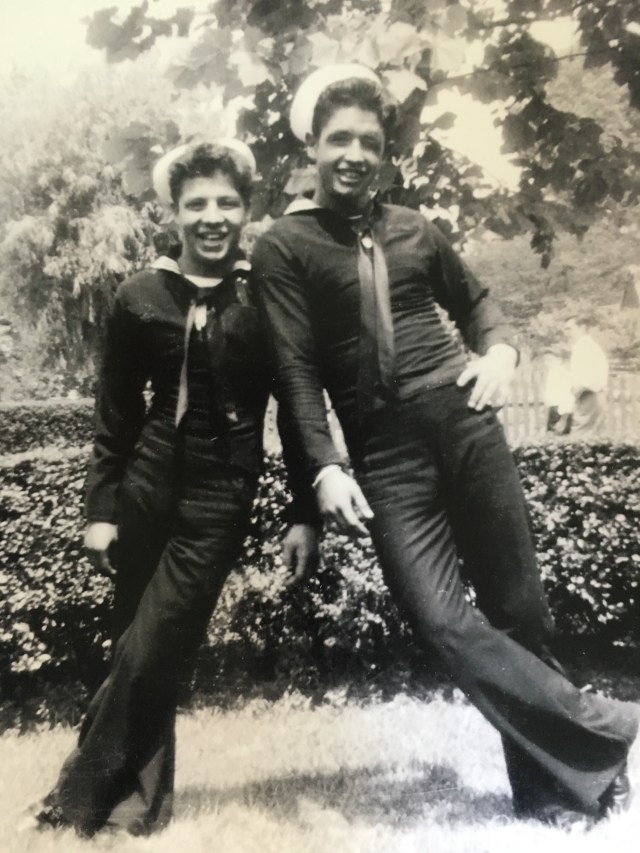
DAD & UNCLE GENE - Navy days

(Dad, age 18, on the left, with his cousin Gene.  Navy days…. some of his happiest memories)

Posted in Uncategorized | Tagged , , , , , , , | 2 Comments

Say Hello to My Little Friend !


TEA PARTY - Katydid with Don't Tread on Me Flag - BEST

Two days ago, I rescued this adorable hopper from my pool. While he was drying off, I took some pics of him. In this pic, with his hand raised, it looked like he was waving Hello to me. And then I thought….  maybe I can stick a flag in that hand.

Diane Rufino

Posted in Uncategorized | Tagged , , , , , , , , , , , | 1 Comment

Government Control of the People – the Progressive Scheme: Making Useful Idiots Out of Useless Idiots

SOCIALISM - One Nation Under Government Control

by Diane Rufino, April 5, 2018

Saul Alinsky, the Godfather of the “Community-Organizing” movement and prophet of the progressive movement, wrote a book that many involved in grassroots politics are familiar with – RULES FOR RADICALS. With that book, he provided a guide for future community organizers to use in uniting and motivating low-income communities, or “Have-Nots,” in order for them to exert social, political, legal, and economic power. In other words, he outlined a plan to turn useless idiots into useful idiots for political purposes. The beauty of his plan is that the “Have-Not’s” are merely pawns; they are really not served in exchange for all their efforts. The ruse, and the promise, is that they will be. And they believe that for their efforts, their cause will be advanced. But the fact is that they are useful for only one purpose – to advance the goals of the progressive elites who need their political contributions to be successful. The ultimate purpose, of course, is the creation of a large, concentrated, socialist government with the power to control the lives of its citizens and the permanent control by the political elite. In fact, Alinsky’s Rules is based heavily on Karl Marx’ Communist Manifesto – the grand plan for world conquest by communism. Marx outlined how to foment a political revolution among the lower classes of people.

If government (controlled by a progressive political elite) can control the lives of the people (or at least, a huge chunk of them), if it can control the information they are given, the way they think, the necessities they need to support themselves, and if it can remove from them the burden of education and personal responsibility and even the confines of a marriage to have and raise children, then it doesn’t have to worry about politics. In the government of Saul Alinsky, and in the government of the Progressives, political power is secured as long as people are controlled.

Therefore, the goal of the progressives, the socialists, the liberals (all those who seek a large aggressive government) is political security and the establishment of a permanent ruling class…  no more “red state” versus “blue state”; no more “Republican vs. Democrat.”  They seek the end of the Conservative movement. They seek the end of the country of our founding. They seek a fundamental transformation.

That goal is made clear by Alinsky in the very dedication he wrote in the forward to his book, which, by the way, has the full title “RULES FOR RADICALS: A Pragmatic Primer for Realistic Radicals.” He dedicated his work to Lucifer, the original “radical” and “community organizer.” The dedication reads: “Lest we forget at least an over-the-shoulder acknowledgment to the very first radical: from all our legends, mythology, and history (and who is to know where mythology leaves off and history begins — or which is which), the first radical known to man who rebelled against the establishment and did it so effectively that he at least won his own kingdom — Lucifer.”

By his own admission, Alinsky’s book is a scheme for transformation – transforming a system “as it is” to one that “is as it should be,” with the “should be” to be determined by progressives. Lucifer took a world modeled by God for good, with parameters established to enrich for goodness and for fruitful conduct and behavior, and by manipulating individuals and appealing to their worst tendencies, transformed that good and decent existence into one plagued with evil and mortal sin. Alinsky praises this radicalization and transformation as a good thing – one that should be modeled and replicated.  One would say that our country – founded on the notion of individual liberty and limited government, predicated on religion and morality in order to provide proper boundaries for acceptable conduct and personal responsibility – is as good a state as humanly and earthly possible and transformation will only destroy the inherent good and Godly in that system.

Which political party has become the party of the Progressive Movement…. The party of transformation?  It is, and has been for many years now, the Democratic Party.

Alinsky’s writings helped mold the likes of Hillary Clinton, Barack Obama, and ultimately, through her husband’s influence, Michelle Obama. Barack Obama studied RULES FOR RADICALS to become the community organizer that he was. His fruits paid off for his own election. How many times have we heard him use to phrase (in one form or another): “the world as it is and the world as it should be…”?  And Hillary Clinton was so enamored and motivated by the book that she characterized Alinsky as her mentor. She invited him to speak at her college, Wellesley College, and gave his introduction. In her college senior thesis, she chose to research and write a dissertation entitled “There is Only the Fight… An Analysis of the Alinsky Model.” As Jeannie DeAngelis wrote in her February 3, 2014 article in American Thinker: “That model may be the reason why, after Bill Clinton took office, nasty tactics, shifting blame, and truth-parsing became commonplace in American politics.”

Following in the footsteps of Marx, Alinsky applies a simple model in his scheme to organize the “Have-Nots” to achieve his ultimate goal of transforming America —  he focuses on their poverty and status while pointing to a government that has not done enough for them as the common enemy.

The first task of the community-organizer is that of agitating the “Have-Nots” (the useless idiots). Alinsky explains how to achieve that – by rubbing resentments, fanning hostilities, and searching out controversy. The organizer must play on their sense of apathy – of accepting a situation that has done little for them. Alinsky would say, “The first step in community organization is community disorganization.” Through a process combining hope and resentment, the organizer tries to create a “mass army” that brings in as many recruits as possible from the streets, the impoverished communities, corner gangs, minority groups, labor unions, corner gangs, and other non-conformist type individuals.

Once the “Have-Nots” have organized, protested, and gone to the voting booth, the pay-off is abysmal. They are not served, but rather, they are put in a position to be controlled over and over again. They are treated to impressive sound bites and unrealistic promises, and perhaps given a free cell phone here and there, but in reality, they are politically enslaved.

Useless idiots are only useful for one purpose, and that’s at the ballot box. They serve no other meaningful purpose in society; they are a burden and merely pose problems. Useless idiots just want to be taken care of; the worst of them believe they are “entitled” to be taken care of.

Because of their lowly status and because of their tendency for dependency, useless idiots can be manipulated and manipulated they are – and have been. They’ve been manipulated since the end of the 1960’s. Again, they are useful for the ultimate transformation of our country.

I never understood the attraction of a socialist state to the individual, especially in this country, and to so many people. In a socialist state, individuals lose their rights, their freedoms, and their choices to the dictates of government.

Alinsky’s tactics for community organizing would inspire two Columbia University sociologists, Richard A. Cloward and Frances Fox Piven to write their now-infamous article “The Weight of the Poor: A Strategy to End Poverty.” In that article, Cloward and Piven articulated a strategy – now known as the “Cloward-Piven Strategy” – which seeks to hasten the fall of capitalism by overloading the government bureaucracy with a flood of impossible demands, in particular welfare and other entitlement programs (“the welfare crisis:). The inability to meet these demands – required, in most part (according to the article) by the ghetto communities and poor African-Americans – would push the United States into crisis and economic collapse and ultimately usher in a social state – one that would have to be established if it was to be able to effectively meet the demands of the people.  The one particular demand that Cloward and Piven wrote about in their article was the demand of a guaranteed income level. There would need to be major economic reform at the national level to provide this new program of direct income redistribution.  This major transformation of the government – from one that leaves the individual free to exercise their rights to pursue opportunities to one that smothers the individual in their free exercise of rights in order to “take care of certain individuals” – is a good thing, and a necessary thing, according to Cloward and Piven.

One can see how Saul Alinsky’s RULES for mobilizing the “Have-Nots” has motivated and has inspired the Columbia sociologists into advancing their “Strategy” for transforming this country into a social state.

By the way, both the Saul Alinsky book and the Cloward-Piven strategy were written to empower and advance the Democratic Party and to secure a Democratic-controlled government.

Now, there is incorrect information being circulated on the internet about “the 8 levels of government control needed to establish a social state” and that information being attributed to Alinsky and his book.  I’ve actually seen where it is attributed to Cloward and Piven as well. While the information is not addressed in RULES FOR RADICALS, nor in the article addressed above, these levels are nonetheless worth addressing.

These 8 levels, according to the unfounded articles, are those that a government would need in order to establish an effective social (socialist) state. I am discussing them below because they actually make a lot of sense. Each level makes it harder for individuals to break free from the unhealthy dependency on government and makes it easier for government to control the people, especially the young. While there is no actual source cited for the origin of these levels of control, several are actually implicated in Karl Marx’ Communist Manifesto and many are mentioned expressly in the Cloward-Piven Strategy. With respect to controlling people for the purposes of manipulating them, Alinsky addresses at least two as being necessary.

The levels of control of which I am referring are:

(1)  Healthcare – A government that controls the people’s healthcare controls the people themselves

(2)  Poverty – people in poverty are easiest to control; hence, it is most beneficial for government to pursue policies that increase the level of poverty or keep individuals and their offspring in poverty

(3)  Debt – government will increase the national debt to unsustainable levels because then it can continue to tax heavily (and to increase taxation; to burden property). Taxation produces more poverty or at least, prevents many from improving their financial situation

(4)  Gun Control – disarming the people allows the government to establish a police state, if need be

(5)  Welfare – welfare allows government to take control of every aspect of a recipient’s life – food, housing, choices, even decisions to marry or to pursue education. Government will never get rid of welfare programs if its goal is socialism

(6)  Education – government needs to take control of what its youth learns…  what they read, what they listen to, and what things mean; it needs to use the education system as a means to indoctrinate its citizens.

(7)  Religion – a belief in God needs to be removed from schools, government, the marketplace, and the public square. A socialist government substitutes itself for the role of God.  A moral, religious people will always question the legitimate role of government and so it must minimize this faction.

(8)  Class Warfare government needs to divide its people into poor and wealthy — the “have’s” and the “have-not’s.”  It also needs to divide people along racial lines – characterizing one group as “victims” and the other as “oppressors” (or as “beneficiaries”). This way it is easier to demonize the wealthy, the empowered, the benefitted classes and therefore, to take from them — their money (through taxation – to benefit the poor), and their positions (through “diversity”-enrichment programs). It is easier to re-engineer society by creating division, hatred, and distrust.

Looking at this list, the federal government has achieved every one of these levels of control – EXCEPT gun control. Is it any wonder that the left is pursuing it at such a rabid level lately?  Is it any wonder that it uses every tragedy to attack the Second Amendment?

If government, in fact, must undertake massive economic reforms to deal with the tremendous burden of our dependent classes (those taking advantage of welfare and other social programs, or using them as a way of life), including the unsustainable burden of immigration, subjugation and control of the American people is the natural consequence. Total control requires people to be unarmed – unable to physically revolt against their government.

Think seriously about the information I’ve written in this article. We are talking about the potential transformation of the country we love. If you are a “useless idiot,” I implore you to resist being manipulated by those who really care little for you and certainly for your improved status. After all, if your position is improved too much, you cannot be controlled and therefore are of no use to them. I also implore you to get angry at the left (the Progressives, the liberals, the Democrats) for characterizing you this way and manipulating you for their purposes. Get angry and take charge of your life, proving to everyone (most importantly, to yourself and your loved ones) that you are a vital part of a society and a country that values every individual and protects their rights to live free), not one that just wants to control him or her and thus limit those rights.

Become involved; become engaged; become educated and informed. Seek out the truth, for the truth will set you free.

This is your home – the United States of America.. The “Home of the Free.”  This is, or will be, the home of your children. This is, or will be, the home of your grandchildren. Help preserve it.  Don’t allow this current generation, and maybe the next, to be the last ones to enjoy the freedoms we’ve come to be known for.


References:

Lonestarliberty, “What is Happening in America: Alinsky’s Rules for Radicals,” May 17, 2017.  Referenced at:  http://lonestarliberty.net/alinskys-rules-radicals/

Frances Fox Piven and Richard Cloward, “The Weight of the Poor: A Strategy to End Poverty,” The Nation, May 2, 1966.  Referenced at:  https://www.commondreams.org/news/2010/03/24/weight-poor-strategy-end-poverty

The Ten Planks of the Communist Manifesto (Karl Marx) –  http://laissez-fairerepublic.com/tenplanks.html

Posted in Uncategorized | Tagged , , , , , , , , , , , , , | 8 Comments

A Proposed State Sovereignty Resolution to Re-Assert the Tenth and Second Amendments

Don't Tread on Me (#3)

by Diane Rufino, February 21, 2018

The following is a proposed State Sovereignty Resolution that I wrote and proposed to my legislators in the North Carolina General Assembly. I feel very strongly that the General Assembly should make it clear that the people’s right to have and bear arms is safe and secure in our state.

NORTH CAROLINA STATE SOVEREIGNTY RESOLUTION

A Bill Announcing the Intention to Nullify any and all Unconstitutional federal Gun Control Bills that the State of North Carolina and its People believe to be an Infringement of their Natural Rights of Self-Defense and Self-Protection as Recognized by the Second Amendment

The State of North Carolina asserts the following

A warm attachment to the Union of the States, to which it had pledged its loyalty in accordance with the terms of the Constitution, the compact that created it, and to that end, it has a duty to watch over and oppose every infraction of those principles which constitute the basis of that Union, because only a faithful observance of them can secure its existence and the public happiness;

Its recognition and respect for the lawful and constitutional process for altering the terms and meaning of the Constitution, including the amendments contained in the Bill of Rights, which are the two procedures listed in Article V (the Amendment Process);

The Second Amendment recognizes that a well-regulated Militia, being necessary to the security of a free State, shall not be infringed;

The Second Amendment also recognizes that the right of the people to keep and bear Arms, shall not be infringed;

The Second Amendment recognizes the natural right of Self-Defense and Self-Protection, both on behalf of the State (“a free State,” by the way) and of the individual;

The Second Amendment doesn’t grant these rights but rather, it protects them, without condition or limitation, from the reaches of the federal government, especially the US Congress and its law-making power;

The phrase “SHALL NOT BE INFRINGED” is clear and instructional on its face;

To affirm the point above further and to support it greater, the States specifically included a Preamble to explain the reason for the ten amendments to the new Constitution (amendments that were demanded by them and without them would have jeopardized and prevented the ratification of that document. The Preamble reads: “The Conventions of a number of the States, having at the time of their adopting the Constitution, expressed a desire, in order to prevent misconstruction or abuse of its powers, that further declaratory and restrictive clauses should be added: And as extending the ground of public confidence in the Government, will best ensure the beneficent ends of its institution”;

The Preamble to the Bill of Rights makes abundantly clear that the Constitution established a federal government of limited powers, and that in those limited objects of government, the federal government is limited even further by the ten amendments added (ratified by 3/4 of the States) on Dec. 15, 1791;

Just as the Supremacy Clause asserts the supremacy of the federal government with respect to the powers delegated to it, which are “few and defined” (Federalist No. 45, written by the same man, James Madison, who authored the Constitution), the Tenth Amendment and the Preamble to the Bill of Rights assert the supremacy of the States with respect to the powers reserved to them;

That one of the reserved powers of the State is the responsibility, the duty, to prevent unconstitutional federal laws, policies, executive actions, and court opinions from infringing on the rights of its people;

The Second Amendment has a very purposeful history; the rights recognized were not rights pulled out of thin air but rather stem from Natural Law and the concept that certain rights are endowed by a Creator (inherent in our very humanity);

Our Founders were not talking about hunting when they demanded that the Second Amendment be added to the Constitution; they were concerned about the freedom of the individual, and also the populace in general, to be armed in the face of a powerful and aggressive government – one that may send out a standing army in times of peace, one that may try to enact laws for gun and ammunition confiscation, and one that may eventually try to outright or effectively disarm its people;

The history of England, and indeed the history of many other nations, teaches us that when individuals are unable to defend themselves and their rights, they essentially have no rights. Rather, they have temporary permission from government to exercise rights until they somehow pose a serious threat to those in power.

James Madison once said: “If Men were angels, no government would be necessary.”  But what if it was the federal government that was not the angel?  The Second Amendment is the contingency plan in such a case;

James Madison also wrote (in Federalist No. 28): “If the representatives of the People betray their constituents, there is no resource left but in the exertion of that original right of self-defense which is paramount to all positive forms of government”;

In addition to the natural right to defend one’s life and property, as well as those of family members and perhaps fellow citizens who are vulnerable,  there are other components of self-defense and self-protection other than the actual confrontation and neutralization of a violent intruder or attacker, that the people recognize – one being DETERRENCE;

Gun-Free Zones, homes without effective firearms, and individuals of sound mind disenfranchised in their right to have and bear arms serve as attractive targets for criminals and evil-intentioned, mentally-disturbed individuals;

The State of North Carolina, under the Tenth Amendment and according to compact principles, reserves the right to determine when the federal government has over-stepped its constitutional bounds with respect to legislation on gun control;

The State of North Carolina will NOT comply with any federal gun control law or policy that hinders or burdens its citizens in their free exercise of the natural right of self-defense and self-protection recognized by the Second Amendment;

In furtherance of its DUTY to prevent unconstitutional or abusive acts of the federal government on its citizens, and in furtherance of its DUTY to prevent the God-given and Natural rights of its People, the State of North Carolina will interpose using whatever means necessary to ensure that such gun control laws or policies (including judicial opinions), or any laws, policies, or court opinions for that matter in violation of the Constitution generally or the Bill of Rights specifically are not enforced in the State.

** ** ** ** ** ** ** ** ** ** ** ** **

I posted a closely-related article, with commentary on the Second Amendment, prior to this one –  https://forloveofgodandcountry.com/2018/04/01/keep-the-second-amendment-secure-in-north-carolina-2/

- 2018 (gray shirt, March 24, 2018) - BEST


Posted in Uncategorized | Tagged , , , , , , , , , , , , , , , , , , , , , , , | Leave a comment

Keep the Second Amendment Secure in North Carolina

SECOND AMENDMENT - Firearm on Constitution

by Diane Rufino, March 27, 2018

My appreciation of the Second Amendment and gratitude for the wisdom and insistence of our Founders and for the States who insisted that it was necessary to be included in our Constitution (or else they would refuse to join the Union) was solidified in an incident that happened to me many years ago.

When I was 26 years old, I was living on my own in my first apartment – a tiny, one-bedroom place in Plainsboro, New Jersey. My first job out of grad school didn’t pay very much so I had to work a second job to support myself.  One night, after getting home from my waitressing job and taking a shower, I had trouble sleeping. So I put on the TV and found a good Clint Eastwood movie to watch – Any Which Way But Loose. It was a very small apartment and it turns out that the TV stand I had was very close to the apartment door, which was locked. It was about 1:00 – 1:30 in the morning – maybe later. As I was watching the movie, I happened to notice that the door knob was moving. Someone was outside my door, trying to get in. The knob was moving harder and harder, and I was scared like I had never been scared before in my life. (I had learned soon after I moved into the apartment complex that a young woman tenant had been murdered just before I moved in).  As I was shaking uncontrollably and trying to find the number for the Plainsboro Police (the days before cell phones and 911), I heard a man speak through the crack in the door “Open the door; you’re the girl with the silver Fiero, right?”  In fact, I had a silver 1983 Pontiac Fiero. The man trying to break in specifically targeted MY apartment. He was looking for ME. I didn’t know who he was and I couldn’t imagine who he was. I was new to the area and had very few friends and acquaintances. I called the police, using the only phone I had, which was next to the kitchen. It was not in a direct line of view to the door. The police dispatcher told me to stay on the line and that a police car would be there shortly.  I picked up the only knife I had in my apartment – a cheap steak knife. All I kept saying was “Please hurry. Please hurry. I’m so scared.”

I was absolutely helpless. I am 4 foot 9 inches tall and weighed less than 100 pounds at the time. I had a cheap knife in my hand, not even sure if I was capable of overcoming my state of fear to defend myself.

The police arrived before the door was pried open and I collapsed in tears, grateful that someone was there to protect me. The potential intruder told the police that he had been drinking and in his drunken state, he must have gotten confused because he thought he was trying to get into his own apartment.  I told the police that it wasn’t the truth because he had called out “You’re the girl with the silver Fiero.”  Nevertheless, the police believed his story and they let him go. They admonished him for scaring me and told him “don’t do it again.” Turns out that he lived in the building next to my building; a grassy courtyard separated our buildings. He lived on the second floor.  My apartment was a ground-floor apartment. So, it was hard to imagine the police would have believed his story about being confused and thinking it was his apartment.

I never stayed in the apartment again after that. I stayed with a friend for about two weeks and then moved into a new place, in another town.

I often thought what I would have needed to defend myself that night, especially if he rushed in and rushed towards me. Again, I’m short and barely able to keep my composure when nervous. I am prone to anxiety attacks. Would a simple handgun holding 5 bullets been sufficient for me to stop him?  I can’t say for sure. Maybe, but maybe not. I imagine I would not have been composed enough to aim well so maybe not. I would have needed something that didn’t require accuracy. What if there were two men?  Well then, a simple handgun would not have been enough.

What if Plainsboro law required individuals to have guns dissembled in the home?

Self-protection is not a one-size-fits-all model. The Right to Self-Defense doesn’t require a one-size-fits all scheme. The Right to Self-Defense has no limits or conditions; it is merely the RIGHT to defend oneself (against others who intend harm), allowing each individual to decide for himself or herself what is needed to ensure that. The government once re-interpreted its “Necessary and Proper” Clause to mean “anything convenient” to help the government carry out its functions. It reasoned, in direct conflict with the very words of Article I, Section 8, that the government needs to determine, and to do, whatever helps it (“whatever is convenient”) to carry out its functions. We the People interpret the Second Amendment in the same broad sense –  “anything convenient” to carry into the effect the right to defend and protect oneself.

The Right to Life is recognized ever so profoundly in perhaps the most important, most significant document in the world – our American Declaration of Independence. “We hold these truths to be self-evident, that All Men are created equal, that they are endowed by their Creator with certain unalienable Rights, that among these are Life, Liberty and the pursuit of Happiness.”  The Right to Life is not the government’s to give, or define, to limit, or to take credit for, and the natural Rights to protect it, secure it, and preserve it (known as the Right of Self-Defense and the Right of Self-Preservation) are inherently equal to that Right to Life.

The day the government denies we the people that right to protect, secure, and preserve our lives is the day that we are no longer free but merely subjects, inferior in our status to the government’s right and power to preserve itself. The day that we lose our Right to Have and Bear Arms is the day that we surrender all other rights. The Right embodied in the Second Amendment is the one right that secures all others.

The Declaration goes on to tell us what we the people have the inherent and natural right to expect from government: “That to secure these rights, Governments are instituted among Men, deriving their just powers from the consent of the governed,….”  And then it instructs what we also have the inherent and natural right to do when government fails to secure our rights and instead, threatens them: “That whenever any Form of Government becomes destructive of these ends, it is the Right of the People to alter or to abolish it, and to institute new Government, laying its foundation on such principles and organizing its powers in such form, as to them shall seem most likely to effect their Safety and Happiness…”

Powerful and progressive actors (individuals and organizations) in this country, including Michael Bloomberg, are forcing an evil agenda on the people of this country and on the government which has, as its ultimate goal, the destruction of the rights we are entitled to and the ones we need to continue being a free people. These actors are forcing us to re-evaluate whether our government is becoming destructive of the ends for which it was created and the result is not going to be pretty.  A government (King George III of England) tried that over 200 years ago at Lexington and Concord, MA, and then at Williamsburg, VA, and the result was a revolution for the right to govern as the colonies saw fit, with the goal to never surrender their rights and liberties again. Today’s youth don’t understand this. Today’s youth don’t even know about this.  Today’s progressives don’t care about this.

There are a lot of people out there, including those who marched on DC, who are advocating for the weakening and even the repeal of the Second Amendment. But that cannot happen. Let’s be absolutely clear on that. The Constitution – and thus the legal status – of the Second Amendment is crystal clear on the matter:  The Second Amendment confers the RIGHT to an individual to have and bear arms for SELF-DEFENSE (McDonald v. Chicago, 2010, and Heller v. District of Columbia, 2008).  That right SHALL NOT BE INFRINGED.  Furthermore, the ONLY way the Second Amendment can be limited or abolished is through the Article V amendment process.  And there are some legal experts who believe that the amendments comprising the Bill of Rights can never be amended. Amendments, they explain, can be added (for example to include other rights), but the original ten amendments are to remain in force as they are because they recognize what, at the very least, our inherent liberty rights include. Because they are rights that are inalienable to us (Life, Liberty, and the Pursuit of Happiness), we are always entitled to them.

What does it mean to have the natural right of self-defense?  It means we can be expected to protect ourselves, in any way that the situation requires. It means that if we are in fear for our lives or serious harm, we have the right to eliminate that threat. Individuals have the right to exercise their rights but only when they don’t seriously impact those of other individuals. I have the right to free speech. But my right doesn’t include the right to shut yours down. I have the right to own a gun, but I don’t have the right to take the life of an innocent person with it. The inherent, or natural, right of self-defense and self-preservation is recognized, and has been recognized historically, in criminal law. A person who shoots and kills an intruder carrying a gun commits homicide which is a serious crime. But under the law, it is considered “justifiable” and therefore not punishable. A woman who stabs and kills a man who is attacking her and intending to rape her commits homicide. But under the law, it is considered “justifiable” and therefore not punishable. “Justifiable” is a term which means that the killing was “justified,” and one of the most common reasons is self-defense.

We don’t need the Second Amendment to have the right to defend ourselves, including with firearms. The Second Amendment confers no such right. Rather, it recognizes the right. If bad guys can threaten lives with guns (which they will ALWAYS be able to do; which they have ALWAYS been able to do), innocent victims have the right to have access to guns to counter that threat. If we continue down the road to governments like the Third Reich, Stalinist Russia, Mao Zedong’s communist China, Pol Pot’s Cambodia, Hugo Chavez’ Venezuela, and even British King James II, to use the full force of government to ignore individual rights and eliminate political opposition, we know that that its operatives and its armies will threaten American citizens with guns and all kinds of advanced weapons. We have the right to have access to guns, and also advanced weapons, to counter that threat.  Like kind for like kind. That is what is meant by being free and that is what is meant by having a meaningful right to self-defense.

We see a dramatic rise in violence by bad people and we see a dramatic rise in retaliatory violence by persons who are emotionally and mentally unstable. We are seeing something play out that people throughout history have also seen – bad people and evil-intentioned people will ALWAYS find ways to get weapons (or they will make them, such as Timothy McVeigh and the UnaBomber Ted Kaczynski, or they will weaponize other instrumentalities, such as cars, trucks, planes).  The rise in abnormal behavior, in criminal tendencies, in retaliatory mass shootings, in mental instability is something we should be focusing on. It’s the behavior – the diseased mind and the black heart – that seeks out the guns for violence. The guns don’t force themselves on those individuals. We should be focusing on what in our society is giving rise to this behavior – this troubling trend. Specifically, we should be looking at policies that government has forced on our communities through its seeming desire to change our social fabric and our social norms, to force new values on us and to force us to repress old conventional ones. Government – our public schools and our colleges and universities, our public offices, our public hospitals, the main-stream media (undoubtedly, an arm of the government’s establishment) – has been pushing a new agenda now for many years and that is “Diversity.”  We are indoctrinated to believe that diversity is the most important factor in college admissions, in the make-up of a student body and in the classroom, in the workforce, in our police forces, and in government; we are indoctrinated to belief that what we look like – what the color of our skin is, what country we came from, what gender we are, and what gender we want to be – is far more important than the competency and skills we bring to that school or that office. The government disregards the entire sad history of this country from the era when slavery was abolished until Civil Rights legislation was passed when we DID focus only on what a person looked like. Government doesn’t learn from history but rather repeats it. Government, through its willing and reckless refusal to enforce the most important of laws, our immigration laws and its willful blind eye to all the crime and lawlessness that has resulted, indoctrinates us, tacitly, that laws are not really to be taken too seriously. Government, contradicting what our parents used to teach us, undermines the importance of the rule of law and undermines the notion of equality under the law.

Morality is a thing of the past and so is religious observance in our daily lives. The family is no longer the bedrock and the pillar of society, and we see that in the laws of progressive states and in the court decisions in all other areas. We are intolerant to focus on the “nuclear family.” We are intolerant to refer to parents in gender terms. We are discriminatory if we dare accept the psychologists’ and the social scientists’ data that the proper emotional and psychological development of children depend on there being both a female and a male parent in the home and in their raising. We are discriminatory if we dare accept the well-established and reproducible data that children end up living in poverty, with a lack of education, and with psychological or domestic problems when they are raised in a single parent home. We are discriminatory if we dare accept the well-established and reproducible data that those who commit violence, those who commit mass murder, and those who embrace a criminal lifestyle are those raised without a father or without an effective father figure in their lives  We who lived in societies that respected and recognized traditional family values (and legislated to that effect) enjoyed its benefits. Societies were safer and children progressed through their childhood and teen years without incident and went on to become healthy and contributing members, having families of their own and raising their children successfully. We who recognize that reality and who recognize the robust data on the social benefits of a traditional family and the social problems created by the lack of such a family are antiquated and a threat to the progress of society in this country. Most families are no longer intact or have been re-established through second marriages, etc.  Children are psychological playthings – mere social experiments whose well-being comes at the expense of the desires or the recklessness of their parents or is merely considered as less important. Those were not the values of my parent’s day.

So, we don’t need the Second Amendment to exercise our rights of self-defense and self-protection. What we would like is our government to say “Government is prohibited from defining limits to the Second Amendment; the Constitution is clear on that.” We need our government to be of the kind that the Declaration of Independence promises us –  one that has as its primary purpose the security of our individual rights to Life, Liberty, and the Pursuit of Happiness. And one way to demonstrate that it is such a government is to respect the Second Amendment and not push to have it limited or as former Supreme Court justice John Paul Stevens urged, to have it abolished. Should that, in fact happen, and especially if it happens through legislation by the US Congress or by pronouncements from the bench by activist judges, then we have an illegitimate government and the provision in the Declaration which states “that whenever any Form of Government becomes destructive of these ends, it is the Right of the People to alter or to abolish it, and to institute new Government, laying its foundation on such principles and organizing its powers in such form, as to them shall seem most likely to effect their Safety and Happiness…” is triggered and the people have the natural right to separate from it.

I have proposed a State Sovereignty Resolution to my legislators in the North Carolina General Assembly. I feel very strongly that the General Assembly, our legislative body (“The People’s Body”), should make it clear that the people’s right to have and bear arms is safe and secure in our state.

The text of my proposed State Sovereignty Resolution is provided below:


NORTH CAROLINA STATE SOVEREIGNTY RESOLUTION

A Bill Announcing the Intention to Nullify any and all Unconstitutional federal Gun Control Bills that the State of North Carolina and its People believe to be an Infringement of their Natural Rights of Self-Defense and Self-Protection as Recognized by the Second Amendment

The State of North Carolina asserts the following

A warm attachment to the Union of the States, to which it had pledged its loyalty in accordance with the terms of the Constitution, the compact that created it, and to that end, it has a duty to watch over and oppose every infraction of those principles which constitute the basis of that Union, because only a faithful observance of them can secure its existence and the public happiness;

Its recognition and respect for the lawful and constitutional process for altering the terms and meaning of the Constitution, including the amendments contained in the Bill of Rights, which are the two procedures listed in Article V (the Amendment Process);

The Second Amendment recognizes that a well-regulated Militia, being necessary to the security of a free State, shall not be infringed;

The Second Amendment also recognizes that the right of the people to keep and bear Arms, shall not be infringed;

The Second Amendment recognizes the natural right of Self-Defense and Self-Protection, both on behalf of the State (“a free State,” by the way) and of the individual;

The Second Amendment doesn’t grant these rights but rather, it protects them, without condition or limitation, from the reaches of the federal government, especially the US Congress and its law-making power;

The phrase “SHALL NOT BE INFRINGED” is clear and instructional on its face;

To affirm the point above further and to support it greater, the States specifically included a Preamble to explain the reason for the ten amendments to the new Constitution (amendments that were demanded by them and without them would have jeopardized and prevented the ratification of that document. The Preamble reads: “The Conventions of a number of the States, having at the time of their adopting the Constitution, expressed a desire, in order to prevent misconstruction or abuse of its powers, that further declaratory and restrictive clauses should be added: And as extending the ground of public confidence in the Government, will best ensure the beneficent ends of its institution”;

The Preamble to the Bill of Rights makes abundantly clear that the Constitution established a federal government of limited powers, and that in those limited objects of government, the federal government is limited even further by the ten amendments added (ratified by 3/4 of the States) on Dec. 15, 1791;

Just as the Supremacy Clause asserts the supremacy of the federal government with respect to the powers delegated to it, which are “few and defined” (Federalist No. 45, written by the same man, James Madison, who authored the Constitution), the Tenth Amendment and the Preamble to the Bill of Rights assert the supremacy of the States with respect to the powers reserved to them;

That one of the reserved powers of the State is the responsibility, the duty, to prevent unconstitutional federal laws, policies, executive actions, and court opinions from infringing on the rights of its people;

The Second Amendment has a very purposeful history; the rights recognized were not rights pulled out of thin air but rather stem from Natural Law and the concept that certain rights are endowed by a Creator (inherent in our very humanity);

Our Founders were not talking about hunting when they demanded that the Second Amendment be added to the Constitution; they were concerned about the freedom of the individual, and also the populace in general, to be armed in the face of a powerful and aggressive government – one that may send out a standing army in times of peace, one that may try to enact laws for gun and ammunition confiscation, and one that may eventually try to outright or effectively disarm its people;

The history of England, and indeed the history of many other nations, teaches us that when individuals are unable to defend themselves and their rights, they essentially have no rights. Rather, they have temporary permission from government to exercise rights until they somehow pose a serious threat to those in power.

James Madison once said: “If Men were angels, no government would be necessary.”  But what if it was the federal government that was not the angel?  The Second Amendment is the contingency plan in such a case;

James Madison also wrote (in Federalist No. 28): “If the representatives of the People betray their constituents, there is no resource left but in the exertion of that original right of self-defense which is paramount to all positive forms of government”;

In addition to the natural right to defend one’s life and property, as well as those of family members and perhaps fellow citizens who are vulnerable,  there are other components of self-defense and self-protection other than the actual confrontation and neutralization of a violent intruder or attacker, that the people recognize – one being DETERRENCE;

Gun-Free Zones, homes without effective firearms, and individuals of sound mind disenfranchised in their right to have and bear arms serve as attractive targets for criminals and evil-intentioned, mentally-disturbed individuals;

The State of North Carolina, under the Tenth Amendment and according to compact principles, reserves the right to determine when the federal government has over-stepped its constitutional bounds with respect to legislation on gun control;

The State of North Carolina will NOT comply with any federal gun control law or policy that hinders or burdens its citizens in their free exercise of the natural right of self-defense and self-protection recognized by the Second Amendment;

In furtherance of its DUTY to prevent unconstitutional or abusive acts of the federal government on its citizens, and in furtherance of its DUTY to prevent the God-given and Natural rights of its People, the State of North Carolina will interpose using whatever means necessary to ensure that such gun control laws or policies (including judicial opinions), or any laws, policies, or court opinions for that matter in violation of the Constitution generally or the Bill of Rights specifically are not enforced in the State.

** ** ** ** ** ** ** ** ** ** ** ** **


Notice that the Resolution only recognizes a rightful limitation of the right and ability to purchase and possess guns when it comes to persons who have a history of violence or mental instability. It is only in these two instances that individuals are unable to appreciate or respect the rights of others and therefore have been deemed to have forfeited their rights under the Second Amendment.

The Resolution that I have written (above) can easily be modified for a Sovereignty Bill or a Nullification Bill. If it is modified for such a bill, it should include the various types of interposition (action) that North Carolina would be willing to pursue (and will pursue) in order to shield its citizens from the effect of unconstitutional federal gun control laws. In other words, the bill should list the various types of action that the state and its officials will carry out in order to prevent such gun laws from being enforced on the citizens – including such things as arresting and jailing federal officers who attempt to come into the state to enforce the laws, not recognizing federal court opinions that erode or limit the Second Amendment, removing and disbarring judges from the bench who attempt to punish NC citizens under the federal law, empowering Sheriffs to not enforce the law or to share information with the federal government, refusal to allow its state officials to cooperate in the enforcement of the law, and challenging the law in court.

If you agree with the sentiment expressed in this article and if you agree with the points articulated in the Resolution, please share with others. If you agree that North Carolina should adopt this, or a similar, resolution affirming the Second Amendment, please contact your representative and send them a copy of what I have written. If you are not from North Carolina but would like your state legislature to adopt such a resolution, please contact your representative(s) and share this article – or at least the resolution.

All tyranny needs is for good people to do nothing.  The powerful progressive movement in our country will continue to misuse and manipulate elements of our government – the liberal, progressive, activist courts and the politically-deranged members of Congress – to strip our rights away. Our rights are what allow us to stand up for the truth and stand up against our aggressive government.  We cannot remain silent and we must not allow their agenda to continue to move forward. The Second Amendment – the right to have and bear guns for self-defense is where we must draw the line, as our founding generation did. That is what Patrick Henry was talking about when he exclaimed: “Give Me Liberty or Give Me Death!”  Without the right of self-defense and the right to use firearms for self-defense, we effectively have no secure rights. Without the Second Amendment, we have no effective way to protect the others.

Saul Alinsky, building on Lenin’s original plan for world conquest by communism, wrote a book entitled “Rules for Radicals” in which he outlined a plan to turn useless idiots into useful idiots for political purposes. The ultimate purpose, of course, is the creation of a large, concentrated, socialist government with the power to control the lives of its citizens. I never understood the attraction of a socialist state, especially in this country, and to so many people.  In a socialist state, individuals lose their rights, their freedoms, and their choices to the dictates of government. Alinsky, like Lenin, examined the various levels of control that a government would need in order to establish an effective socialist state and those levels are, in order:

(1)  Healthcare – A government that controls the people’s healthcare controls the people themselves

(2)  Poverty – people in poverty are easiest to control; hence, it is most beneficial for government to pursue policies that increase the level of poverty or that keep individuals and their offspring in poverty

(3)  Debt – government will increase the national debt to unsustainable levels because then it can continue to tax heavily (and to increase taxation; to burden property). Taxation produces more poverty, or at least, prevents many from improving their financial situation

(4)  Gun Control – disarming the people allows the government to establish a police state, if need be

(5)  Welfare – welfare allows government to take control of every aspect of a recipient’s life – food, housing, choices, even decisions to marry, to have children, or to pursue education. Government will never get rid of welfare programs if its goal is socialism

(6)  Education – government needs to take control of what its youth learns…  what they read, what they listen to, and what things mean. It needs to use the education system as a means to indoctrinate its citizens.

(7)  Religion – a belief in God needs to be removed from schools, government, the marketplace, and the public square. A socialist government substitutes itself for the role of God.  A moral, religious people will always question the legitimate role of government and so, it must minimize this faction.

(8)  Class Warfare – government needs to divide its people into poor and wealthy — the “have’s” and the “have-not’s.”  It also needs to divide people along racial lines – characterizing one group as “victims” and the other as “oppressors” (or as “beneficiaries”). This way it is easier to demonize the wealthy, the empowered, the benefitted classes and therefore, to take from them — their money (through taxation – to benefit the poor), and their positions (through “diversity”-enrichment programs). It is easier to re-engineer society by creating division, hatred, and distrust.

Looking at this list, government has achieved every one of these levels of control – EXCEPT gun control. Is it any wonder that the left is pursuing it at such a rabid level lately?  Is it any wonder that it uses every tragedy to attack the Second Amendment?

So again, if you agree with the sentiment expressed in this article and if you agree with the points articulated in the Resolution, please share with others. And if you live in North Carolina, please contact your state rep and send him a copy.

There was a time when North Carolina was the most liberty-minded of all the colonies and all the states. She has a profound and impressive history. My hope is that her legacy will live on with her respect for its citizens’ Second Amendment rights.

[NOTE:  I wanted to include this disclaimer, after the fact. Doing research for my April 5 article, I learned that the 8 Levels of Government Control to Establish a Social State is not included in Saul Alinsky’s book “Rules for Radicals,” and in fact, is not attributable to him at all. Some, however, have attributed some of the levels to Richard Cloward and Francis Fox Piven (“The Cloward-Piven Strategy”).  In my article: “Government Control of the People – The Progressive Scheme:  Making Useful Idiots Out of Useless Idiots,” I discuss Saul Alinsky and his book, and its potential for transforming the character of our country, but I also address this misinformation about the 8 levels.  The article is posted here:   https://forloveofgodandcountry.com/2018/04/05/government-control-of-the-people-the-progressive-model-making-useful-idiots-out-of-useless-idiots/ ]

- 2018 (gray shirt, March 24, 2018) - BEST


Posted in Uncategorized | Tagged , , , , , , , , , , , , , , , , , , , , , , , , , , , | 7 Comments

OBERGEFELL v. HODGES: An Example of the Very Real Tendency of the Federal Courts to Render Unconstitutional Opinions

THOMAS JEFFERSON - with reading glasses

Photo credit:  Photo is from FreakingNews.com)

by Diane Rufino, March 26, 2018

We are all used to the accusations that a certain Executive Action is unconstitutional or a federal law is unconstitutional, and we are used to challenges to them in federal court. We remember how the progressive federal appellate courts of the 11th and 9th circuits struck down President Trump’s proposed travel ban as an unconstitutional exercise of discretion. And we here in North Carolina are still stunned and outraged at the 4th Circuit for usurping our state’s right to a democratic form of government (Article IV, Section 4 of the US Constitution) and our reserved powers under the 10th amendment when it struck down our duly-enacted Voter ID Law.

We all understand that unconstitutional actions by those branches must be recognized and addressed; they must be struck down and thus not enforceable.

What we don’t hear are accusations that certain Supreme Court, and other federal court decisions, are unconstitutional. The truth is that they, just like the actions of the other branches, are capable of exceeding proper authority and presenting an abuse of power that amounts to federal tyranny.

Why do we just accept their decisions? Why is it that we simply tell ourselves and others: “Well, the Court has decided. It has handed down its opinion.” And then we surrender our protests to that decision, even though we KNOW it is an unconstitutional exercise of judicial power.

Thomas Jefferson recognized the potential of the federal judiciary for profound abuses of power even as early as 1801. In a letter he wrote to his friend, Adamantios Coray, on October 31, 1823, he warned: “At the establishment of our constitutions, the judiciary bodies were supposed to be the most helpless and harmless members of the government. Experience, however, soon showed in what way they were to become the most dangerous; that the insufficiency of the means provided for their removal gave them a freehold and irresponsibility in office; that their decisions, seeming to concern individual suitors only, pass silent and unheeded by the public at large; that these decisions, nevertheless, become law by precedent, sapping, by little and little, the foundations of the constitution, and working its change by construction, before any one has perceived that that invisible and helpless worm has been busily employed in consuming its substance. In truth, man is not made to be trusted for life if secured against all liability to account.”

How do we know for sure that certain federal court opinions are unconstitutional? Sometimes the justices are truthful and tell us so in their dissenting opinions. And sometimes they explain in detail why it is so.

I wrote an article a few days ago about just such a case, the Obergefell v. Hodges case (2015) – the gay marriage decision. Four justices out of the nine wrote dissenting opinions explaining exactly why the majority opinion (5-4) was unconstitutional. So, instead of focusing on the majority opinion in a court decision, as I almost always do, in this article, I focus on the dissenting opinions.

I think it’s important for people to know – to understand – that federal court opinions are often incorrectly decided and moreover, are often decided by exercising power and discretion that they DO NOT HAVE.

The article, “OBERGEFELL v. HODGES: The Scathing Dissent by Chief Justice John Roberts Explains Why the Majority Opinion Was an Abuse of Judicial Power Under the US Constitution,” is posted on my blogsite:

https://forloveofgodandcountry.com/2018/03/23/obergefell-v-hodges-the-scathing-dissent-by-chief-justice-john-roberts-explains-why-the-majority-opinion-was-an-abuse-of-judicial-power-under-the-us-constitution/

Posted in Uncategorized | Tagged , , , , , , , , , , , , , , , , , | Leave a comment

STORIES ARE GOLD: A Movie Review of “Woman in Gold”

WOMAN in GOLD - the movie

By Diane Rufino, March 26, 2018

There are many personal stories throughout history that teach us the depths of tragedies, triumphs, war, innovation, and discovery. We learn about events in history books and but we see them as black and white, without faces and without the human impact. We rarely learn of the human side of history. But the only way we can appreciate these stories and have them touch our lives is if they are recorded, not as simply happening but describing them in detail, in a very human way. That’s why journals and diaries, and letters touch us so deeply. They are personal accounts, describing feeling.

We all know Anne Frank, not simply as one of the millions of victims who perished during the Nazi Holocaust, but as a young girl just trying to live and survive as a teen girl, with teen girl issues, as the Nazis were literally outside her door and all throughout Germany and the territories it occupied scouring for Jews to ship to death camps and eradicate from among their race.  We know some of the Civil War soldiers not merely as victims of an unfortunate and unjust war, but as young men, sons, husbands, fathers, brothers who professed their love to those they wrote to and their devotion to their cause, yet sensing their eventual demise.

Every once and awhile, a writer comes along and brings a story to us, in a stunning and brilliant way, and it changes us forever because it sears an event in our brains and imprints feelings on our heart.

This is how we know of the horrors of war and we can appreciate the courage of men and women who enlist to serve during such times. My husband and son are emotionally invested in the Band of Brothers series. Saving Private Ryan, although mainly a work of fiction, is based on the real-life story of the Niland brothers – Edward, Preston, Robert, and Frederick (from Tonawanda, NY) during WWII, and particularly during the invasion of Europe. I know that forever going forward, WWII is not only about strategy and American moralism and might, but it’s the sum of individual human tragedy and heroism. Schindler’s List, another one of my favorites, not only brings the horror of the Polish Ghettos and the concentration camps, but highlights the two extremes of man’s treatment of his fellow man. Oskar Schindler turned out to be an unlikely hero because initially, after joining the Nazi Party, he sought to profit from its subhuman treatment of the Jews before he had a change of heart. The story traces the real-life story of Schindler as he moved to Krakow, Poland, taking advantage of army contacts in order to exploit cheap labor from the Krakow ghetto. He amassed a fortune and lived the high life off the labor of Krakow Jews, condemned to the ghetto there. I’ll never forget the footage, in black and white, of the little girl in the red coat. She, like every other Jew, was dehumanized and degraded in every possible way. When the Krakow ghetto was liquidated and the Jews shipped off to the Plaszow work and death camp, Schindler used his fortune to buy their lives. Among the horror of the Holocaust and the unfathomable human toll, we can take solace in knowing that there were men and women like Oscar Schindler who risked their lives and fortunes to do the right thing.

I recently watched the movie In the Heart of the Sea, with Chris Hemsworth, about the 1830 tale of the New England whaling ship, the Essex, and its crew. The Essex faced a harrowing battle for survival when a great white whale of mammoth size and strength attacked it with force, crippling their ship and killing several men. But the remaining crew members on the badly-damaged vessel weren’t out of danger. The great whale, perhaps in retaliation for their hunting of his kind, stalked them and finished the job, shattering the ship and leaving the remaining men adrift in the ocean. It was their incredible and harrowing tale that inspired Herman Melville to write the classic Moby Dick.

Last night I watched a 2015 movie that initially didn’t seem to peak my interest, Woman in Red, starring Helen Mirren and Ryan Reynolds. But I’m so glad that I did. The description given of the movie explained that it was “a film about one of the great legal battles in art history.”  But so much more than that, the movie was a beautifully touching, often gut-wrenching, story about the horrible and dehumanizing mistreatment of the Jews at the hands of the Nazis during the Third Reich.

Many will not remember, or as I suspect, never ever knew, about the Nuremburg Laws passed in Germany in the years leading up to the Second World War (first ones were passed in 1935). These laws, which had the official title “The Law for the Protection of German Blood and German Honour,” were the anti-semitic laws that ultimately enabled the Nazis to root the Jews out of their communities and round them up. Under these laws, which the Nazis enforced aggressively and then enlarged when they consolidated their power in 1935, prohibited marriages and sexual relations between Jews and Germans, prohibited them from working in government jobs, stripped them of property, and finally declared that only those of German or related blood were eligible to be Reich citizens; the remainder were classed as state subjects, without citizenship rights. When This law was effectively a means of stripping Jews, and other “undesirables,” of their legal rights, their means of supporting themselves, and their citizenship.

In the context of this history, we have the story of Maria Altmann, told in Woman in Gold.

Maria Altmann, born Viktoria Bloch-Bauer, was the youngest daughter of Gustav Bloch-Bauer and Therese Bauer. She was born on February 18, 1916, in Vienna, Austria. Her wealthy Jewish family included her uncle Ferdinand, a Czech sugar mogul, his wife Adele. Uncle Ferdinand and Aunt Adele were close friends with many of Vienna’s important artists, including painter Gustav Klimt, as well as composers and musicians, including the famed composer Arnold Schoenberg. They all traveled in the same circles. Adele would often hold court for musicians, artists and writers in the salon of her house, which was near the Wiener Staatsoper (the Vienna State Opera house).

When Adele was 25 years old, Ferdinand commissioned Klimt to paint two portraits of her. The first, and by far the most famous of the two, the magnificent “Portrait of Adele Bloch-Bauer” would later become known as “Woman in Gold,” of which the movie title refers. Klimt depicted her, wearing her favorite diamond-studded choker necklace and diamond earrings (wedding presents from Ferdinand), in a swirling gown within a blaze of pure gold (gold leaf) rectangles, spirals and Egyptian symbols – she became the epitome of Vienna’s Golden Age.

WOMAN in GOLD - the painting

Maria grew up visiting her uncle and aunt’s grand palatial house, which was filled with pictures, tapestries, elegant furniture, and a collection of fine porcelain. A total of five Klimt paintings also hung in the home – the “Portrait of Adele Bloch-Bauer,” which was displayed most prominently, another (a later) painting of Adele, and three others. In 1925, Adele died, childless, of meningitis at the age of 43. Afterward, Maria recalled, the family would meet for regular Sunday brunches at her uncle’s house and the afternoon would always include a viewing of the portraits of Adele.

In 1938, just months before the Germans occupied Austria and then annexed her into Germany (the Anschluss), Ferdinand fled the country for Switzerland. But he remained in Austria long enough to see his niece marry opera singer Frederick (“Fritz”) Altmann. As a wedding gift, her gave her Adele’s diamond earrings and the stunning diamond choker necklace – the ones he had given his young wife as a wedding present. When the Nazis occupied Austria, they looted from the Jews, taking everything of value. They entered the Bloch-Bauer home (now the home of Maria and Fritz, and her parents) and seized Ferdinand’s entire art collection, his porcelain collection, and his sugar refinery. The “Portrait of Adele Bloch-Bauer” was taken, as well as her diamond choker necklace and other pieces of jewelry. The Nazis took Gustav’s beloved Stradivarius cello, which was the possession he prized most of all. Maria recalled: “My father died two weeks after that. He died of a broken heart.” The diamond necklace later turned up in Hermann Göring’s possession; he gave it to his wife as a present.

As the Nazification of Austria continued, Maria and Fritz were forced to flee their homeland. But fleeing wasn’t easy as the Nazis were intent on identifying and rounding up the Jews. The Nazis came for Fritz and took him to the Dachau held concentration camp to pressure his brother, Bernhard Altmann, into allowing them to take over his booming textile factory. Having already fled to London, Bernhard signed over his factory to the Nazis and Fritz was then released. The couple then lived under house arrest until Maria managed to elude the guards by claiming that her husband needed a dentist. The two boarded a plane to Cologne and made their way to the Dutch border, where a peasant guided them across a brook, under barbed wire and into the Netherlands. Fredrick and Maria then fled to America and ultimately settled in California.

While Fritz went to work for aerospace firm Lockheed Martin in California, Bernhard had started a new textile factory in Liverpool, England. He sent Maria a cashmere sweater to see if Americans might like the fine, soft wool. Maria took the sweater to a department store in Beverly Hills, which agreed to sell them. Other stores across the country followed suit, and Maria eventually started opened her own clothing boutique. The couple had three sons and a daughter in America, building a life together in a country that welcomed them.

We learn all these details about Maria’s life and the history of the famous painting through flashbacks, for the movie begins with the Nazi occupation of Austria in 1938 and newlyweds, Maria and Fritz Altmann, fleeing for their lives and leaving her family’s famous artworks behind.

The Klimt paintings, the property of Ferdinand Bloch-Bauer, reappeared after the war in the Galerie Belvedere, in Austria.

For many years, Maria supposed that the Klimt paintings had legitimately ended up in the Austrian National Gallery. But in 1998, when she was 82, she learned from the tenacious Austrian investigative journalist, Hubertus Czernin, that the title to the paintings was hers. Uncle Ferdinand, who died, without children and impoverished, in Switzerland at the end of the war, made a will, leaving all of his property to his nephews and nieces. Maria was the only one still alive in 1998. A series of investigative articles in the Austrian press that year, by Czernin, revealed that paintings’ true ownership was with Ferdinand and therefore the bequeath by Adele in her will of the paintings to the Galerie Belvedere, was in invalid. Rightful ownership would therefore pass to Maria. With that astonishing and surprising news, Maria vowed to get them back. She never forgot what the Nazis stole from her family and the “Portrait of Adele Bloch-Bauer” (which, again, became later known as “Woman in Gold”), was a symbol for her of all that the family had lost and all that had been taken from them.

In 1999, she contacted a 32-year-old no-name lawyer (at the time) –E. Randol Schoenberg. He may have had little legal experience or credentials, but what he was was a family friend – someone Maria believed would be motivated by the shared history of their families. E. Randol was – is – the grandson of Austrian composer Arnold Schoenberg. His family and hers were good friends, first in Austria and then in California. She asked him if he could review the information she was given to see if the painting rightfully belonged to her.

It would require locating the wills, first Adele’s and then Ferdinand’s, which they finally did when they traveled to Austria. The Galerie Belvedere had kept the paintings, based on Adele’s will in which she made a “kind request,” (merely a “request”) that Ferdinand donate the paintings to the state museum after his death. However, when he passed, in 1945, he did not honor the request and instead, left all of his property to his nephews and nieces, of which Maria was the only one remaining. In other words, by continuing to keep the paintings, the Galerie disregarded the fact that bequest of the paintings contained in the wills legally left his estate to his nieces and nephews. Yet the paintings hung in Vienna’s Austrian Gallery at Belvedere Palace with a placard inscribed: “Adele Bloch-Bauer 1907, bequeathed by Adele and Ferdinand Bloch-Bauer.”

The film – the story – focuses on Maria’s quest, with the help of her attorney, to reclaim the famous Klimt painting from the Austrian government.

In the movie, an elderly Maria is portrayed by Helen Mirren and attorney Schoenberg is portrayed by Ryan Reynolds. Both do an outstanding job in their roles. The movie was produced by Harvey Weinstein.

The movie, based on the 2012 book written by Anne-Marie O’Connor (“The Lady in Gold: The Extraordinary Tale of Gustav Klimt’s Masterpiece, Portrait of Adele Bloch-Bauer”), follows Maria’s surprising legal journey, while also weaving in the haunting memories of an elderly woman stripped of her property, her homeland, and her humanity in Austria at the hand of the Nazis, who were intent on persecuting and eradicating the Jews. Even though the movie ends on a happy note, with the return of the five Klimt paintings (worth US $135 million at the time), including the portrait of her beloved Aunt Adele, the story conveys very well the legacy of utter terror and brutality against the Jews under the Nazi nightmare and the long trail of sorrow and rebuilding that followed.

Her ordeal was beautifully summed up by a remark by attorney Schoenberg to Chief Justice William Rehnquist when her case came before the US Supreme Court: “Maria Altmann came to America to find peace. Let’s give her justice too.”

Mrs. Altmann died in 2011 at the age of 94. Before she passed, she sold her family paintings to American museums. She didn’t want the painting of her aunt or the other Klimts to remain in Austria. She wanted them in the country that gave her a safe home; the place where she had been a citizen for over 50 years – the United States. Jewish philanthropist Ronald Lauder bought the “Woman in Gold” portrait for $135 million to display at his museum, the Neue Galerie in New York. And the other Klimt paintings sold for another $192 million.

Ms. O’Connor brought Maria Altmann’s ordeal to life for us, and the story, masterfully adapted to the big screen, with heartbreaking flashbacks to a life that she – and millions of Jews – enjoyed, impresses on us the inhumanity of that era and the enormity of the indignations suffered by the European Jews.

Personal stories are important. Told properly and conveying the emotions at the time, they are a powerful testament to history and the human condition. They evoke emotions in us which connect us to other human beings. This is why writing and especially creative writing is so important to us as human beings. We should stress writing and articulation to our children and to our students and teach it to them by having them read and read and read and having them write and write and write. None of us knows when we might be a witness to history or to someone whose story should be shared.

I’m glad I learned about Maria Altmann’s story.


References:

Catherine McHugh, “Who Maria Altmann? The Real Story Behind Woman in Gold,” Biography, April 2, 2015.  Referenced at:  https://www.biography.com/news/woman-in-gold-maria-altmann-biography

For more on the Altmann legal battles and Supreme Court case (Republic of Austria v. Altmann, 2004) –  “The Morning Edition” (NPR), April 2, 2015 “After Nazi Plunder, A Quest To Bring Home The ‘Woman In Gold” –  Referenced at:  https://www.npr.org/2015/04/02/396688350/after-nazi-plunder-a-quest-to-bring-the-woman-in-gold-home


Posted in Uncategorized | Tagged , , , , , , , , , , , , , , , , , , , , , , , , , , | Leave a comment