TAKE ACTION NOW! Tell Congress to Fund the Wall


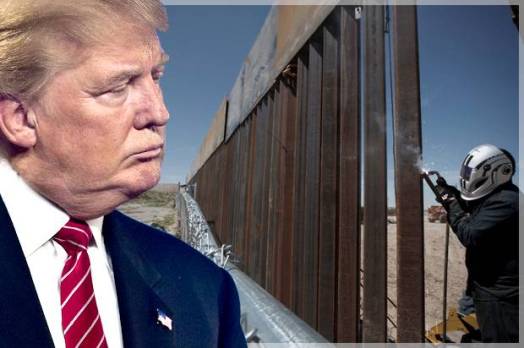
(Photo Credit:  National Border Patrol Council, NGPC)

by Diane Rufino, January 9, 2019

I’m writing this to all Immigration Activists and Concerned Citizens…..

The time for action is NOW !!

Last night President Trump delivered a straightforward message to the American people regarding the situation on the southern border. He called that situation a “crisis.”

That crisis includes uncheck immigration, violent crimes by illegal aliens, drug trafficking, child trafficking, a rise in MS-13 gang activity, rape, scores of hard drugs pouring across the border, lawlessness, over-crowding of our jails, and an unnecessary burden on all our resources (social services, healthcare, education, criminal justice, etc).

Anybody with eyes and ears, anybody who reads the real news, anybody who talks to their legislators, anyone who has a pulse on what’s going on in their community, in their state, and in this country is aware of the negative impact of open borders and unchecked immigration across our southern border. Have we already forgotten the caravan crisis?  Do we not understand that there are reasons why so many aliens are pouring into our country, choosing to take the illegal route – because we are NOT enforcing our laws, not trying to flesh them out once they get here, providing sanctuary cities and communities for them, providing them free education and healthcare, allowing them to go on our welfare system and to receive benefits and social programs (that US citizens must pay for)?

Several years ago, a student that had just graduated from a school I was teaching died of a fentanyl overdose. Someone slipped it to him unsuspectedly at a concert. A year or so later, a young man at my church overdosed from a heroin/fentanyl overdose. No one would have ever suspected him of doing drugs. The young man who treats my lawn recently passed away from an overdose. And my longtime friend and neighbor lost his son to a fentanyl overdose. A few years ago, I spoke with some town officials and they told me that MS-13 gangs have moved into Greenville from the Kinston area (Kiinston, which is Lenoir County, is next to Duplin County, which houses the highest concentration of illegal Hispanics in NC). MS-13 started pushing drugs on ECU’s campus and violence followed. There was a drive-by shooting downtown which killed at least one or two innocent young people, and about two years ago, there was a shooting at an ECU student apartment complex (at a party) involving drugs.

Our state officials talk about the opioid crisis and the enormous toll it is taking on our young and they suggest that we need to provide healthcare for them so they can kick the addiction. Not once has anyone addressed the root cause of the problem – the border “crisis” — yes, a “crisis.” Without the drugs pouring into the country (90% of hard-core drugs such as heroin and fentanyl), we wouldn’t have this epidemic of overdoses, and without the addictions and drug use, we wouldn’t have to consider the increased costs in healthcare to cover this problem.

The same can be said for the burden on education, our healthcare system (how many times have you gone to the emergency room only to see it filled with Hispanics – of which at least 45% are here, in NC, illegally). How many unskilled Americans can’t provide for their families because an illegal has taken a job they could have been hired for?

Again, it’s not hard to understand how the situation at the border has finally escalated to a crisis.

Yet, in response to President Trump’s Oval Office message last night, Democratic leaders, Senator Chuck Schumer and Rep. Nancy Pelosi, had the nerve to call his characterization of the situation a “manufactured crisis.” It was an insult to every mother, father, wife, husband, brother, sister, family member, friend, neighbor who lost someone they love to an illegal alien, it was an insult to everyone who has to close their eyes at night and try to shut out the horrible thoughts of the torture and pain their loved one suffered before being killed by an illegal, an insult to everyone who lost a child or other loved one to an opioid overdose, an insult to everyone harmed by the increase in drug trafficking, and an insult to every federal taxpayer whose tax dollars are being siphoned to address the uncontrolled border situation and to provide welfare and other services to illegals. To them, the situation is not a manufactured crisis but rather a manufactured situation – manufactured intentionally by Democrats as a way to grow the Democratic Party.

They call the wall “immoral” yet live in walled and gated communities themselves. They care little about the threats and burdens to our communities because they don’t live in those communities. They don’t worry about violence because they enjoy the protection of armed security. The don’t care that our laws are broken because as career politicians, they have made sure that they are exempt from the laws they pass (or refuse to pass, or refuse to provide the tools for enforcement).

They mock the President for his campaign promise to have Mexico pay for the wall. Other Democrats and liberals mock him as well for that. But Mexican assets can easily be converted to pay for the border wall, as Trump has alluded to. Trade deals can be negotiated that result in funding for the wall. There are drug forfeiture laws that would allow the government to use money and property confiscated because they were illegally obtained by drug trafficking for the wall. And then there is the simple math – If illegals cost the American people $150 billion each year (EVERY YEAR), and wall funding is only $5 billion, then doesn’t it just make sense to invest a one-time $5 billion allocation for the wall to save $150 billion every year?

Others reject the notion of an actual wall (a physical impenetrable barrier) saying that Trump will never get the $5 billion he is asking for. Well, that’s just a ridiculous, typical-Democratic /liberal response. They have a hard time understanding the concept of “constitutional spending” anyway. A border wall is related to immigration and national security, both of which are expressly delegated tasks to the federal government in the US Constitution. So, funding for the wall would actually be characterized as “constitutional spending,” something our government rarely takes into consideration. Right now, Congress spends far too much on unconstitutional objects – such as funding to South American countries, Afghanistan, Pakistan, other Middle Eastern countries (all of which give us nothing of real value in return), funding for abortion overseas, funding for research on stupid things that have absolutely no relevance or usefulness, funding for education (yep, it’s unconstitutional), funding in the form of state grants, most times simply for the purpose of bribing the states into complying with government guidelines and policies that it technically can’t impose on them (thus enabling the government to do an end-run around the Constitution). Take away the unconstitutional spending and the government has plenty to spend on constitutional obligations such as a border wall to enhance our safety and security and to help enforce our duly-enacted immigration laws.

Schumer and Pelosi fault President Trump alone for the government shutdown, telling the American people that government officials aren’t getting paid because of him, his insistence on dwelling on a “manufactured crisis.,” and his refusal to work with the Democratic leadership in Congress.

As Senator Lindsey Graham commented, the federal employees affected by the government shutdown will get all their back pay. They’ll be OK. But Officer Ronil Singh’s wife will never see her husband again and their baby daughter will never know her father. Angel Moms will never see or hug their children again.

The question is whether all those deaths and tortures of Americans at the hand of illegal aliens, all the drugs (including heroin and fentanyl) pouring onto our country and killing our college-age children, the rise in MS-13 activity which terrorizes our communities, the rise in violent crime, and the very admissions of our border agents amounts to a “manufactured” crisis or an actual crisis.

Remember the faces and the stories of those Americans taken from us because of our border situation – Officer Ronil Singh (shot because the illegal didn’t want a traffic ticket), Pierce Corcoran (killed by a drunk driver, an illegal alien), Kate Steinle (shot while walking on a pier in San Francisco with her parents), Molly Tibbetts (abducted and killed by an alien while she was jogging), Josh Wilkerson (a high school student beaten, tortured, and set on fire by an illegal alien), Jamiel Shaw (high school student killed by an illegal released earlier that same day on his 3rd gun charge), Ronald da Silva (murdered by an illegal who had previously been deported), Kayla Cuevas and Nisa Mickens (best friends who were killed in 2016 by illegal MS-13 gang members), Sandra Duran (killed in a car crash in 2017 at the hands of an illegal alien who had been deported five times), Indianapolis Colts’ linebacker Edwin Jackson (killed by an illegal driving drunk), Rebecca Ann Johnson (murdered by an illegal), and so many others.

Anyway, President Trump NEEDS OUR HELP……

Please read the following and TAKE ACTION NOW – to support President Trump’s request for funding tall steel fence barriers at our southern border and apply pressure to members of Congress.

Here is the contact info. I suggest you call now instead of email, but email if you prefer.

CALL your Member of Congress and our two US Senators today (For those in the Third Congressional District, who knows if a call to Rep. Walter Jones will accomplish anything). This is what you’ll want to tell them:

  • Honor their oath to support and defend the Constitution;
  • Give President Trump the money he wants to fund the tall border fence barriers;
  • If they can’t find the funding for the wall, tell them to cut out all the “unconstitutional” spending and then the money will be available;
  • Close the asylum loopholes that are attracting these ridiculous caravans;
  • An Amnesty should NOT be part of any securing the border deal.
  • Remember that they represent you — not illegal alien smugglers and employers!

Contact your member of the U.S House. If you don’t know, go to: http://www.house.gov [look at the upper right corner of the webpage and enter your Zip Code and then click “GO”].

Call: U.S. Senator Richard Burr (202) 224-3154 at his Washington, DC office or email at: https://www.burr.senate.gov/contact/email

Call: U.S. Senator Thom Tillis (202) 224-6342 at his Washington, DC office or email at:  https://www.tillis.senate.gov/public/index.cfm/email-me


References:

President Donald J. Trump addresses the nation from the Oval Office, January 8, 2019 –  https://www.youtube.com/watch?v=694Kmic4CKY

Senator Lindsey Graham’s Response to President Trump’s border address, Jan. 8, 2019 – https://www.youtube.com/watch?v=Q2GD0YMzE2Q

Schumer and Pelosi’s Response to President Trump’s border address, Jan. 8, 2019 –  https://www.youtube.com/watch?v=Gyb-DjVT5_c

Mark Levin’s Response to President Trump’s border address, Jan. 8, 2019 –

https://www.youtube.com/watch?v=O9QS9gnd3gU

Derek Thompson, “How Immigration Became So Controversial,” The Atlantic, February 2, 2018.  Referenced at:  https://www.theatlantic.com/politics/archive/2018/02/why-immigration-divides/552125/

Posted in Uncategorized | Tagged , , , , , , , , , , , , , , , , , , , , , , , , | Leave a comment

Liberal Insanity


trump - and the wall (wall funding - photo credit - golifa)

(Photo credit:  LIFA – http://www.golifa.com)

by Diane Rufino, January 6, 2019

There is a disabling disease going around; epidemiologists believe it hit sometime in the fall of 2016.

No, I’m not talking about the Swine Flu, or the H1N1 or H3N2 virus strains, all three of which can be deadly if not caught and treated early enough. I’m talking about the derangement syndrome that causes once-ordinary, rational-thinking people to start speaking irrationally, to speak as if they haven’t a single brain cell in their cranium, to spew obscenities, to engage in hate speech, to throw a tantrum when offended in any way, shape, or form, to shout robotically (like paid protesters) when a conservative speaks, to throw the word “racist” around like it was just another common adjective, to manage to turn every story and every bit of news into an occasion to bash Trump, to express their political views cloaked as “humor” (no one is fooled by that), to hate their country, to side with those who would do harm to the country, to think foreigners who have no entitlement to the jurisdiction or benefits of the United States have more rights than legal and other naturalized citizens, to make idle threats (such as, “I’m moving to Canada”), to demand that everything be free except speech, to wish harm on others (usually involving rape or something shoved in some orifice), to be willing to sacrifice traditionally-held human rights like the right to speech, conscience, religion, and firearms for the un-natural right not to be offended, to be willing to minimize or sacrifice most of the expressly-listed human rights in the Bill of Rights for one not listed (the unfettered right to an abortion), to demonize the historically-American right to the free exercise of one’s religion (including the right to have it influence one’s conscience) in order that persons living an alternative lifestyle (gays, lesbians, transgenders, cross-dressers, etc) not have to be confronted by the rationality of religious doctrine and natural law, and often, to wish death on others or to make death threats.

I’m talking about Trump Derangement Syndrome. From what I can deduce so far, it is brought on by extreme hatred combined with a general inability to tolerate opposing viewpoints and especially an inability to deal with people in power who don’t talk and think like them. TDS has hit all ranks of the Democratic Party, has hit nearly all liberals and progressives, is prevalent among the Deep State, and has infected some high-ranking and other Democratic members of Congress, such as crying Chuck Schumer (the crying over illegals while never crying over any American an illegal has killed gave his sickness away), Maxine Waters (a rock has more intelligence and inherent worth than Maxine; consistently voted the most corrupt member of Congress; she is a modern-day reverse KKK leader, and thinks Congress serves only one purpose – to impeach Donald Trump), Nancy Pelosi (another one whose intelligence and common sense is eclipsed by a rock), Bernie Sanders (an avowed socialist), Kamala Harris (a race baiter), Cory Booker (a race baiter and moron), Shiela Jackson (a race baiter), Elizabeth Warren (a liar, a misappropriator of an entitlement for a class of persons actually aggrieved by past US social policies, socialist), Keith Ellison (a Muslim race-baiter and hate-mongerer), willingly associated with the anti-Semitic Louis Farrakhan and his Nation of Islam), Diane Feinstein (so blinded by hatred that she helped hatch a scheme to subvert Judge Brett Kavanaugh during his confirmation hearings by springing unfounded accusations of sexual misconduct by Christine Blasey Ford), Richard Blumenthal (a liar and hypocrite), and others. Obama-era officials, especially with the DOJ and FBI, and other Deep State officials, such as James Comey, Rod Rosenstein, James Mueller, Andrew McCabe, Loretta Lynch, Peter Strzok, Lisa Page, and others (including Hillary Clinton), were so stricken that they funded opposition research on Trump by a known partisan ex-M16 intelligence agent, they fabricated information, created unfounded dossiers, tricked FISA court judges, obtained illegal FISA warrants, rigged the investigation against repeat criminal Hillary Clinton, initiated an investigation by Special Counsel (even though there was no underlying crime; essentially an investigation hoping to find a crime), unconscionably coerced members of Trump’s campaign and indicted them on crimes that Clinton herself and other ranking Democrats themselves had committed, leaked classified government information, and in general, doing anything and everything possible to make good on their “insurance policy” which is to come up with grounds to impeach our duly-elected president.

Every day, ordinary Americans, simply wanting to turn on the news (the mainstream news) to find out what good President Trump and Congress are doing on behalf of the country, its people, its business climate, and its world status, are confronted with nothing more than unfair accusations against Trump, personal political attacks against him, and an unrelenting stream of criticism of every single thing he says and every single thing he does. President Trump has done wonderful, historic things to improve the status of our country, the lives of its people, and the safety and security of our communities, and the results are often staggering, yet the mainstream media shows no decency to deliver such important news to the American people. This is yet another symptom of the Trump Derangement Syndrome.

There is not a day goes by when ordinary people of sound mind and common sense are confronted with a case of TDS – whether it be on social media, in conversation with a diseased friend of family member, on the news, on any of the late night talk shows, in a google search, in print, in a rap song, a music video, on Saturday Night Live, on Comedy Central or other Celebrity Roast show, on an awards show, in an acceptance speech at a correspondence or awards show, on a college campus, in a liberal college or law school classroom, or at a Women’s March or other liberal protest.

Personally, I try to stay away from almost all those venues. But on social media, a conservative post will almost always attract an individual suffering from TSD.  Most times, the individual will post an insult or explicative, reinforcing the horrible ravages of the disease, but sometimes – yes sometimes, they will try to address the post and offer their particular viewpoint.  Most times, that viewpoint will reflect far-left ideology and an outright hostility to our country, our system of government, our Constitution, and our traditional values.

I’d like to share with you one such example.

Right before Christmas, my friend (and columnist) Stan Deatherage wrote a post on social media addressing the looming government shut-down, and the fact that President Trump is more than willing to allow it over funding for the wall.

Here is what Stan wrote:

I can’t believe I am watching the Democrats shutting down the government a second time, since the election of Donald J. Trump, with their arguing point that they must politically “Resist” this President, regardless of the tangible damage committed to this nation.

We see that at every turn: Democrats, who have voted for a wall and border security in the recent past, now continually advocate for “Open Borders” and an open abdication for the rule of law at every possible political point.

Like it or not, this President knows his base of patriotic voters, and will follow their lead to secure our borders, and protect our people at home and abroad, just as passionately as the Democrat base advocates that their Liberal politicians create Open Borders to allow more supposed future voters beginning as illegal immigrants; abdication of national defense whenever possible in hopes of acceptance within the political trappings of the New World Order; and their complete defense and anxious acceptance of the accelerated growth of Socialism.

Never in the history of this Constitutional Republican have two groups of base voters been more different. Democrats can blame President Donald J. Trump all they wish, but, if it was not this President, it would be another one who would stand up for the patriots that still inhabit this nation.

It is my prayer that President Trump will not back down and stand for those patriots that know that securing our borders in a necessity for the continued sovereignty of this nation.

I personally agree with Stan. Several of my previous articles outline my support for border control, including the most persuasive argument of all, which is that national security is probably the #1 responsibility of the federal government. Allowing people to pour into our country illegally and unaccounted for runs completely counter to our Constitution and our Rule of Law. There aren’t a lot of things I feel I pay federal income taxes for (because the federal government doesn’t actually provide me and my family with much) but I do feel that national security and safety together are the one true consolation I get – I SHOULD get – for the exorbitant amount of taxes I pay every April 15th. In fact, if the government ignores that one primary responsibility, I have a hard time believing I should have to pay taxes.

Anyway, a Ms. Angela (full name withheld out of decency) responded to Stan’s post with this with a typical liberal, Democrat, socialist comment:

“Here’s a thought, Trump come up with something other than a wall. For 5 billion dollars every American can be insured. Just a thought. We all know a wall won’t stop the immigrants. History has proven this time and again.”

Frist of all, she makes the outrageous claim that walls don’t work – that “history has proven this time and again.”  I don’t know what history she is referring to, but I think most of us who can read books and who have paid attention to the news recognize that statement as “fake news.”

Let’s look at some of the walls that work – that keep people out:  First, we have the Israel-West Bank Wall (which is actually more a security fence). Almost immediately after it was constructed, in 2001-2002, the number of successful terror attacks in the Jewish state dropped by 90%).  Second, we have the Berlin Wall, which effectively prevented any movement between East and West Berlin (mostly to keep East Berliners from leaving). Third, we have the Cyprus Wall, which, built in 1974 after Turkey invaded the island, divides Cyprus between the northern Turkish portion and the remaining Greek section. Fourth, we have the India-Pakistan Wall (actually a border fence and wall system), built by India to keep Pakistanis out. Thank God for that wall because nowhere else in the world could a simple border incident so quickly escalate into nuclear war. (That’s a testament to how effective the wall is !!)  Fifth, we have the Turkey-Syria Wall, which was built by Turkey during the 1990’s to prevent an Kurdish militant insurgency. It worked very well, for over 15 years. It was only when Turkey’s leader, Erdogan, removed many of the defenses and turned a blind eye to border security that the terrorism problem in Syria, with repercussions in Turkey as well, grew so great. Sixth, we have the Morocco-Algeria Wall, which was a 1,700-mile system of sand berms, fences, mine fields, and ditches built by Morocco to defend against Algerian terrorists. Like the others, it was an effective wall.

There are other walls as well:  Saudi Arabia just built a wall along its disputed border with Yemen to keep Yemeni-based terrorists out. India has a long-standing border fence with Bangladesh to prevent illegal immigration. Hungary is building a fence to protect its borders. Greece maintains a heavily protected border with Turkey. Spain fortifies its enclaves in Africa.  [See Michael Rubin’s article “The Places Where Walls Work” and the article by Simon Tomlinson, “World of Walls”)

And, of course, let’s not forget Hadrian’s Wall (73 miles of heavily fortified wall, in the Roman province of Britannia, begun in AD 122 during the reign of the Roman emperor Hadrian), the wall around the Vatican, the wall erected at the Academy Awards (to keep the ordinary folk out so that Hollywood elite could lump praise on one another and party in privacy), the gated homes of celebrities (like the one Ryan Seacrest is buying from Ellen DeGeneres), and the gated communities that too many US Congressmen live in. Why do they have walls??  To keep those that don’t belong out !

As the organization, Legal Immigrants for America (LIFA), has long stated: “A nation without walls is not a nation, and a nation without borders is not a nation.”

Second of all, when she suggests that we use the $5 billion President Trump wants to fund the wall instead “to insure every American,” she is really saying this:  Those that can afford their own healthcare will still be forced to do so, and in fact, we’ll ask them to pay more so that everyone else who can’t afford healthcare insurance will be provided it for free. And because she wants the government to neglect the border and allow uncontrolled immigration, she suggests that hard-working, law-abiding, LEGAL Americans provide free healthcare for illegals as well.

So, what she is suggesting is that we not only continue to allow anyone who wants to come here to do so, and by any means they can, but we should also provide more and more magnets to attract them here.

In California, 73% of its illegal aliens are on welfare, other means-tested programs (such as Food Stamps, Housing Assistance, Federal Tax Credits), and on social programs. Nationally, 63% – 70% of all illegal aliens  (non-citizens) are on welfare, other means-tested programs, and social programs. Of course, there is no way for the government to know exactly how many illegals are in our country (that’s what “undocumented” means), and so their numbers admittedly are always on the low side. The number we are given, however, is 4.6 million illegal households that are on welfare. For those illegals in this country 10 years or more, the average is over 70%, which goes to show that once illegals go on welfare and get other “free stuff” (programs that citizens have to pay for), they tend to stay on them.  [See Paul Bedard’s article “Census Confirms 63 Percent of Non-Citizens on Welfare, 4.6 Million Households”]

Put compassion aside, because laws are about right and wrong, and not about feelings or compassion or heartstrings. That is what volunteer organizations are for. Government and laws are designed to work for the benefit of legal members of society. Every country not only has limited resources (including tax dollars, because every government of a free people has the obligation to tax its people as little as possible) but has the sovereign right to control who enters the country and the right to know exactly who is entering the country. The rightful expectation of an American citizen is that government MUST enforce the laws that carry out the core functions delegated to it under the Constitution. If the government doesn’t obey laws, why should its citizens?

If we were to use the wall funding instead to insure everyone, that will be a bust since it won’t go very far. Instead, while the borders are open and migrants continue to pour into our country, at the rate of 65-70% going on our welfare and other social programs, American taxpayers will continue and continue and continue to pay for those who come here illegally. The amount we pay to insure them today will exponentially increase as they multiply like crazy and continue on the current trend (which is that they remain in low-skilled jobs generation to generation). We were a “Land of Immigrants” many many years ago when our country was growing, developing, and becoming the greatest production powerhouse on the planet. But those days are long gone – our American union essentially ceased expanding by 1912 when New Mexico and Arizona became states (#47 and #48, respectively; Hawaii and Alaska would join in 1959) and we have shifted from a production economy to a more “service” economy. We do not need to continue bringing in more immigrants to our country simply to feed that onetime notion. People only have the privilege to come here as long as there is a need for them. That need HAS to be that they benefit our country somehow while being able to fully support themselves and their families; preferably, they should ADD to the wealth of the country, as our Founders advised.

Liberal Sharon didn’t address the bigger question: How do Open Borders benefit the American taxpayer?  Maybe she likes having her house cleaned by an illegal who she can pay less to (and of course, pay under the table). Maybe she likes finding illegals to do construction and landscaping projects so she can get away with paying less. But clearly – CLEARLY – these unethical benefits do not outweigh the burdens. She has to realize that.  Everyone has to realize that. If not, I have to doubt their ability to think and reason and use common sense.

Oh, and let’s not forget that today’s illegal immigrant is tomorrow’s Democratic voter. Considering that fact that Republicans pay far and above what Democrats pay in all levels of taxation (local, state, and especially federal), the FACT is that in many areas of the country, every Republican taxpayer’s vote is cancelled by a Democratic voter who in fact very likely does NOT pay federal income tax. Approximately 50% of people have no federal income liability. In other words, there is a very high percentage of people (Democrats) who have too much power to vote to spend the money that OTHERS earn and pay in taxation. Actual taxpayers who want to keep more of their money are losing out at the ballot box, and open borders will continue that trend. It is not the traditional “American Way” or the “Christian Way” to take what others had to earn but those on the left clearly despise traditional values…

Healthcare will become our next national black hole, where any possible tax break will go to die. Entitled (government-provided) healthcare is another one of those essentials in life that motivates a person to work, get a good job, move up the ladder, get a good education, breed responsibly, etc. Taking that pressure off of Americans is just another social program benefit that makes people comfortable and content in their poverty and relieves them of taking care of themselves. Why work? Why apply yourself in high school when you can get by with the absolute minimum and the government will provide you all the rest to allow you to live on par with those who’ve studied, worked hard, and didn’t settle for poverty ? Why invest in learning a trade, a skill, going to college, or starting a business?? I absolutely hate the mentality that says we should do more for those who aren’t making enough money with funding that others worked hard to earn and which is taken from their own families that rightfully should go to national and border security and to stop the insanity that is our current immigration and border problem — uncontrolled illegal entry into the country, human trafficking, more and more drugs flooding into our communities (most of the heroine that is killing our young people comes in across our southern border), gang members and drug traffickers terrorizing our cities and towns and preying on our children. Our OBLIGATION is spelled out in the Constitution — Congress has supreme power to tax and spend for our security, safety, and defense as a nation. Our obligation is NOT to people from other countries.

Liberals, progressives, Democrats, socialists, and Trump-haters are dangerous to this country for many reasons: First because they presume to be motivated by compassion (but its really ideology and politics) rather than intellect, common sense, and rationality, second, because they have no concept or understanding whatsoever of the Constitution and rightful government power, and third, because they have absolutely no respect for decency and the Rule of Law.  Liberals, progressives, Democrats, socialists, and Trump-haters want everything free in this country except free speech. They want everyone to have a better standard of living, while soaking money from those actually working hard, studying hard, and building careers to do that very same thing for their own families. They think everyone everywhere is entitled to America’s wealth except those who earn it.

When you see someone like Ms Angela make a stupid comment like the one she made regarding the wall funding, please take the time to respond with common sense, the law, and facts (As Homeland Security Kirstjen Nielsen told Nancy Pelosi after the latter chided: “I reject your facts..” –  “They are THE facts, not my facts”). We need to educate these mis-informed, soft-brained, often diseased-minded people, one at a time.  You may want to be far kinder than I have been in this article.


References:

Michael Rubin, “The Places Where Walls Work,” AEI, January 27, 2017.  Referenced at:  http://www.aei.org/publication/the-places-where-walls-work/

Simon Tomlinson, “World of Walls: How 65 Countries Have Erected Fences On Their Borders – Four Times As Many As When the Berlin Wall Was Toppled – As Governments Try to Hold Back the Tide of Migrants,” Daily Mail, August 21, 2015.  Referenced at:  https://www.dailymail.co.uk/news/article-3205724/How-65-countries-erected-security-walls-borders.html

Steve Watson, “Walls and Fences Are Bad Except If You’re a Hollywood Elite Attending the Oscars,” InfoWars, February 27, 2017.  Referenced at:  https://www.infowars.com/walls-and-fences-are-bad-except-if-youre-a-hollywood-elitist-attending-the-oscars/

Paul Bedard, “Census Confirms 63 Percent of Non-Citizens on Welfare, 4.6 Million Households,” Washington Examiner, December 3, 2018.  Referenced at:  https://www.washingtonexaminer.com/washington-secrets/census-confirms-63-percent-of-non-citizens-on-welfare-4-6-million-households

“FAKE NEWS: AP Tries to Discredit Trump’s Border Wall,” golifa, December 28, 2016.  Referenced at:  https://www.golifa.com/fake-news-ap-tries-discredit-trumps-border-wall/


Posted in Uncategorized | Tagged , , , , , , , , , , , , , , , , , | 1 Comment

A Bill of Rights is What All Free People Are Entitled To Against Every Government

bill of rights - with james madison

by Diane Rufino, January 3, 2019

Let me add that a bill of rights is what the people are entitled to against every government on earth, general or particular, and what no just government should refuse, or rest on inference……”    –  Thomas Jefferson, in a letter to James Madison, December 20, 1787

December 15 marks a very special day in our founding history – On that date in 1791, the first 14 states (Vermont had just been admitted to the Union as the 14th state), ratified the first 10 amendments to the US Constitution, known collectively as our Bill of Rights. We often take it for granted that these first ten amendments, our Bill of Rights, are included in our Constitution, but if we want to point to one reason the colonies went to war for their independence from Great Britain, it was to permanently secure the rights embodied in our Bill of Rights from all reaches of government. Without the Bill of Rights, the revolution would have been in vein.  Thomas Jefferson, probably the Founder who exerted the most pressure on James Madison for a Bill of Rights, advised: “A bill of rights is what the people are entitled to against every government on earth, general or particular, and what no just government should refuse.”  He wrote this to Madison on December 20, 1787, almost three months after the Constitution had been signed by its drafters in Philadelphia.

On Bill of Rights Day, we reflect upon those rights guaranteed in the first nine amendments (the tenth being a restatement of federalism – the strict separation of power between the federal government and the States) but more importantly, we should come to appreciate the efforts of certain particularly liberty-minded Founders who fought against great odds to make sure that our Constitution in fact included a Bill of Rights. After all, James Madison, considered the Constitution’s author, and most of the other Federalists did not see the need for a Bill of Rights and thought the Constitution wholly sufficient without it. That was the status of the Constitution when it went to the states for ratification.

What is a “Bill of Rights”?  A bill of rights, sometimes called a Declaration of Rights or a Charter of Rights, is a list of the most important rights belonging to the citizens of a country – rights that the King or other form of government must respect. The purpose is to protect those rights against infringement either by law or by conduct from public officials. The US Bill of Rights is the Declaration and enumeration is the individual rights memorialized in the Constitution intended to protect the individual against violations and abuses of power by the government. In that respect, our Bill of Rights is like most other bill of rights (including the English Bill of Rights is 1689 and the great Magna Carta of 1215).  This history of England, including the movement of groups of people (like the Puritans and Pilgrims), to the New World, is a history continually seeking for the recognition and security of fundamental human liberties. And early colonial history continued that tradition of setting out the rights and privileges of the individual in their government charters.

The Preamble to the Bill of Rights explains its clear purpose. It reads: “The Conventions of a number of the States having at the time of their adopting the Constitution, expressed a desire, in order to prevent misconstruction or abuse of its powers, that further declaratory and restrictive clauses should be added: And as extending the ground of public confidence in the Government, will best insure the beneficent ends of its institution.”

In other words, the Bill of Rights is a further limitation on the power of government, above and beyond those limitations already imposed by its very design and delegation of limited powers.

HISTORY:

Again, a Bill of Rights (or Declaration of Rights, or Charter of Rights), is a list of the most important rights belonging to the citizens of a country that the King or other form of government must respect. Bills of rights may be “entrenched” or “unentrenched.”  A bill of rights that is “entrenched” cannot be amended or repealed by the governing legislature through regular procedure, but rather, it would require a supermajority or referendum. Bills of rights that are “entrenched” are often those which are part of a country’s constitution, and therefore subject to special procedures applicable to constitutional amendments. A bill of rights that is not entrenched (“unentrenched”) is merely statutory in form and as such can be modified or repealed by the legislature at will.

The history of the world shows that there have been limited instances where the rights of the people have been enumerated and/or protected by a Bill of Rights. This history includes the following charters, documents, or bills of right:

  • Magna Carta (1215; England) rights for barons
  • Great Charter of Ireland (1216; Ireland) rights for barons – Ireland became independent of Great Britain in 1937
  • Golden Bull of 1222 (1222; Hungary) rights for nobles – which interestingly, included the right of Nullification
  • Charter of Kortenberg (1312; Belgium) rights for all citizens “rich and poor”
  • Twelve Articles (1525; Germany) – considered the first draft of human rights and civil liberties in continental Europe after the Roman Empire.
  • Petition of Right (1628; England)
  • English Bill of Rights 1689
  • Declaration of the Rights of Man and of the Citizen (1789; France) – inspired by Thomas Jefferson
  • The US Bill of Rights (1791)

The roots of our modern-day liberty originated in England, as far back as 1100, culminating there with the English Bill of Rights in 1689 and ultimately providing the blueprint for our very own US Bill of Rights in 1791. The roots of liberty, including the roots of our very own American liberty rights, can be found in the selection of charters and documents listed below:

  • The 1100 Charter of Liberties (also called the Coronation Charter) – The 1100 Charter of Liberties was a written proclamation offered by Henry I of England and issued upon his accession to the throne in 1100. It sought to bind the King to certain laws regarding the treatment of nobles, church officials, and individuals – most notably, certain marriage rights, rights of inheritance, amnesty rights, rights for the criminally-accused, and environmental protection (forests). It is considered to be the precursor to the Magna Carta.
  • The Magna Carta of 1215 (“the Great Charter”) – The barons at the time, frustrated by ten years of excessive taxation by King John in order to finance a campaign to regain lands in France only to watch the King return home in defeat, consolidated their power and threatened to renounce him. Over the next eight months, they made repeated demands to the King, requesting that he give them a guarantee that he would observe their rights. But these negotiations amounted to nothing. And so, on May 5, 1215, the barons gathered and agreed to declare war on him. On May 17, the barons captured London, the largest town in England, without a fight, and finally, King John took notice. With London lost and ever more supporters flocking to the side of the barons, he sent word that he would meet with them to discuss terms of peace.. Over the next few days, the barons assembled in great numbers on the fields of Runnymede, a relatively obscure meadow that lies between the town of Staines and Windsor castle, where King John was based. Negotiations took place over the next several days and finally, on June 15, King John affixed his seal to the document that would become known as the Magna Carta (or “The Great Charter”). The Magna Carta enumerated an expansive list (63 “chapters”) of rights for barons, and also provided the remedy of Nullification.  The principles extended beyond the often-recognized origin of the “No Taxation Without Representation” doctrine in chapter 12 (and hence the creation of a “people’s body” which addressed matters of taxation and spending) and the Due Process clause of chapter 39. The concepts of “Trial by Jury” and “No Cruel Punishments” are present in chapter 21; and the forerunner of the “Confrontation Clause” of our 6th Amendment addressed in chapters 38, 40, and 44. But the most important contribution of the Magna Carta is the claim that there is a fundamental set of principles which even the King must respect. Above all else, Magna Carta makes the case that the people have a “right” to expect boundaries from the King in their lives and with respect to their property. They have a right to expect “reasonable” conduct.  [King John would go on to ignore the promises he made in signing the Magna Carta]
  • The Petition of Right of 1628 – In 1628, under the leadership of Sir Edward Coke, a legal scholar-turned-practical politician, Parliament petitioned Charles I, son of the recently deceased King James I, to uphold the traditional rights of Englishmen, as set forth in the Magna Carta. It was an appeal to his sense of being a just King. Charles was already on his way to being a notorious tyrant. Parliament was not only fed up with is participation in the Thirty Years War (a highly destructive European war) against its consent, but when it refused to provide Charles the revenue to fight the war, he dissolved the body (several times, actually). That would lead Charles to raise revenue other ways – by gathering “forced loans” and “ship money” without Parliamentary approval (hence, taxation without representation in violation of the Magna Carta) and arbitrarily imprisoning those who refused to pay. Among the customary “diverse rights and liberties of the subjects” listed in the Petition of Right were no taxation without consent (as mentioned), “due process of law,” the right to habeas corpus, no quartering of troops, the respect for private property, and the imposition of no cruel punishment. King Charles did not consider himself bound by the Petition and so, he simply disregarded it. He would later be officially tried for high treason by a rump Parliament and beheaded in 1649. [The Petition of Right would have a profound effect on our US Bill of Rights: The Due Process clause of the 5th Amendment, the “Criminal Trials” clause of the 6th Amendment, and the “Civil Jury Trial” clause of the 7th Amendment all are influenced by the Petition of Right.  Furthermore, during the 1760s, the American colonists articulated their grievances against King George in terms similar to those used by Lord Coke in the Petition of Right to uphold the rights of Englishmen].
  • The English Bill of Rights of 1689 – After the Bloodless Revolution or “Glorious Revolution” (in which the English Parliament instigated a bloodless coup, replacing King James II with his daughter, Mary II and her husband, William III), Parliament set to right the abuses of its previous kings – Charles I, Charles II, and James II. It drafted and adopted a bill of rights, known as the English Bill of Rights, as which set out certain basic civil rights and clarified the right of secession for the British Crown. It was presented to William and Mary in February 1689 as a condition to the offer to become joint ruling sovereigns of England.  It was contractual in nature so that the acceptance of the throne was tied to their express promise to recognize the rights set forth in the Bill of Rights. A violation of that agreement would terminate the right of William and Mary to rule. The Bill of Rights lays down limits on the powers of the monarch and sets out the rights of Parliament. It further, and most importantly for this discussion, sets out certain rights of the individual, including:  the right to bear arms for self-defense, the right of Due Process, the right to petition government, such criminal defense rights as the right to be free from excessive bail, the right to a jury trial for the crime of high treason, and the right against any cruel and/or unusual punishment, the guarantee that there would be no taxation without representation, the right to be free of a standing army in times of peace, and the right to be free of any quartering of troops.  [Great Britain is unlike the United States in that it has no formal Constitution; rather, the English Bill of Rights, taken together with the Magna Carta, the Petition of Right, the Habeas Corpus Act 1679 and the Parliament Acts of 1911 and 1949 are considered, in total, as the uncodified British constitution].
  • The colonies being organized under grants and agreements from England, it was assumed that English traditions applied. The colonists considered themselves British subjects and as such, they believed they were entitled to all the rights and privileges of Englishmen. That is why they reacted as they did to the taxes imposed by Parliament, why one protest theme was “No Taxation Without Representation,” why the Sons of Liberty formed, why they harassed the colonial stamp collectors and stamp masters until they resigned, why they engaged in acts of civil disobedience (such as preventing the British from unloading their ships at colonial ports) or hanging colonial governors in effigy, why they tossed crates of tea into the Boston Harbor, why men like Patrick Henry called for the raising and training of colonial militias, and why they were willing to confront the Redcoats with their muskets when they sought to destroy the stockpiles of colonial ammunition. It seemed that once again, as English history has shown true, Englishmen would have to exert their rights and demand that the King to respect them. Proper boundaries would once again have to be established.
  • King John’s rejection of the Magna Carta (1215) and King Charles’s rejection of the Petition of Right (1628) proved to our Founding Fathers that the system established in Great Britain provided only arbitrary security for individual rights. They would need to come up with a different system of government, grounded on more “enlightened” principles and “enlightened” government philosophy. And that is exactly what they did in the Declaration of Independence – announcing that the American states were united on the concept of Individual Sovereignty, that government power originated from the People, to serve the People, and not from kings (“the Divine Right of Kings”) to serve kings.

With what many believe to be divine guidance and protection, the thirteen original colonies fought and won their independence from Great Britain in 1781. Lord Cornwallis surrendered his British troops to General George Washington, Commander of the Continental Army, on October 19, 1781 and the Treaty of Paris, signed in September 1783, marked the official end of the struggle. Since the colonies worked together in a collaborative effort to communicate grievances and concerns to King George and Parliament and to engage in a concerted effort to prevent war, but then once war came, to fight and manage the war effort, it seemed only natural to continue to collaborate in their independence. The first attempt at a loose union of states, under the Articles of Confederation, was not very successful. The government lacked the enforcement power needed to effectively act on behalf of the states, such as the power to collect revenue to pay the war debt.

Taking note of the limitations of the common government (the Confederation Congress, aka, Congress of the Confederation, or sometimes even referred to still as the Continental Congress), certain members of our founding generation instigated for a Convention to amend that government. Eventually, in February 1787, Congress called for such a Convention to meet in May in Philadelphia “to devise such further provisions as shall appear to them necessary to render the constitution of the Federal Government [the Articles of Confederation] adequate to the exigencies of the Union.” And so, the Convention did convene on May 25, 1787 in Philadelphia with delegates from all the states except Rhode Island. The Constitutional Convention, as it came to be known, quickly changed direction – from amending the Articles of Confederation to designing an altogether different form of government. James Madison would be the architect of that plan (the Virginia Plan).  The collective wisdom of the delegates at the Convention identified the weakness of the Virginia Plan, which for the colonies was the creation of a “national” government, with concentrated power in that government, rather than a “federal” government which left most of the sovereign power with the states. A federal government, with the sovereignty of the States keeping the sovereign power of the federal government in check, was the form of government that the delegates preferred. A government that could remain checked against abuses was one that honored the fiercely independent and freedom-loving nature of the colonies and one which would address the reasons for the revolution against Great Britain.

In the summer of 1787, delegates from the 13 states convened in Philadelphia and drafted a remarkable blueprint for self-government — the Constitution of the United States. The first draft set up a system of checks and balances that included a strong executive branch, a representative legislature and a federal judiciary.

The Constitution was remarkable, but deeply flawed. For one thing, it did not include a specific declaration – or bill – of individual rights. As it turned out, and luckily for us as depositories of certain “inalienable rights” as well as civil rights (those belonging to individuals living in a society, subject to the rule of law), the lack of a Bill of Rights turned out to be an obstacle to the Constitution’s ratification by the states that could not be overcome. The Federalists opposed including a bill of rights on the ground that it was unnecessary. According to James Madison, a leading Federalist, a Bill of Rights was not necessary, arguing that because the general government was one of limited powers, having only those powers specifically delegated to it and none touching on individual rights. Besides, he said, a Bill of Rights would only create confusion (inferring that any other right or privilege not listed in the Bill of Rights would be fair game for federal regulation) and also, state governments could ensure these freedoms without the need for a federal mandate. The Anti-Federalists, who were afraid of a strong centralized government and knowing that history has clearly shown that governments tend to concentrate power and tend towards centralization and then tyranny/abuse, refused to support the Constitution without one.

At the close of the Philadelphia Convention, on September 20, 1787, the delegates left with mixed feelings about the document they drafted. Of the 55 delegates to the Convention, only 39 signed it.  Of the 16 that did not sign, some left early (for business, health reasons, family concerns, or out of protest) and some refused to sign out of protest. Some of the more important delegates (ie, position and/or influence in their states) who refused to sign were the following:  George Mason of Virginia (because it did not contain a Bill of Rights), Luther Martin of Maryland (because it violated states’ rights), John Mercer of Maryland (because it did not contain a Bill of Rights), Elbridge Gerry of Massachusetts (because it did not contain a Bill of Rights), John Lansing and Robert Yates, both of New York (because it created too strong of a government, which he characterized as much more “national” than “federal”), and Edmund Randolph of Virginia (because it contained insufficient checks and balances to prevent government abuse). Had some of our most active and influential founding fathers attended the Convention, there would have been far greater opposition to the final product. Those who refused to attend or who were unable to included: Patrick Henry (refused to attend, he “smelled a rat” who he believed would try to vest the common government with too much power), Richard Henry Lee (refused to attend because he too didn’t trust the motives of those who called it), Thomas Jefferson (was acting as Ambassador to France at the time, but offered to advise the delegates by correspondence), John Adams (was acting as Ambassador to Great Britain at the time), Samuel Adams (refused to attend because he rejected the purpose of the Convention) and John Hancock (refused to attend for the same reason as Sam Adams).

Many of those who refused to sign the Constitution vowed to fight its ratification at the state conventions – George Mason, Elbridge Gerry, the delegates from Maryland, Luther Martin and John Mercer, and the delegates from New York, John Lansing and Robert Yates. And some strong anti-Federalists who were not delegates at Philadelphia would oppose it as well –Richard Henry Lee, Sam Adams, John Hancock, James Monroe (Virginia), and New York’s Governor George Clinton (who wrote several anti-Federalist essays under the pen name “Cato”). Add to these “big guns” the biggest ones of all – Thomas Jefferson, who was as strong a proponent of a Bill of Rights as one could be, and Patrick Henry, perhaps our most vocal and passionate orator for liberty. Jefferson would have advised Madison to include one, and certainly would have taken issue with Madison’s position on the matter, even though he would have had to do so by correspondence. Perhaps that is the reason why Madison lapsed during the final days of the Convention in updating Jefferson as to the discussions and decisions made in the Convention. It wasn’t until a month after the Convention wrapped up, on October 24, that he finally wrote to him again and sent him a copy of the draft Constitution. We do know that as the debate intensified over a Bill of Rights, Jefferson wrote Madison with his strong opinion, including his letter of December 20, 1787, in which he wrote: “A bill of rights is what the people are entitled to against every government on earth, general or particular, and what no just government should refuse.”   [The Appendix at the end of this article contains the full commentary in Jefferson’s letter relating to the lack of Bill of Rights in the new Constitution].

On September 28, 1787, the Confederation Congress (aka, Congress of the Confederation) advised the states to begin calling their ratifying conventions, and several did so immediately. Madison left the Philadelphia Convention uncertain what the outcome of the ratification process would be. The dissent by Edmund Randolph and George Mason, both from his home state, and then their refusal to attach their names to the Constitution weighed very heavily on his mind. As Kevin Gutzman pointed out in his book James Madison and the Making of America, the influence that those two men alone had in the overall ratification process potentially could more than counter the entire “unanimity” of the Convention.

As we will see, Madison not only played a leading role in bringing about the Philadelphia Convention (he and Alexander Hamilton orchestrated the report to the Confederation Congress – the Annapolis Report – which made the recommendation that a convention be called in May 1787 in Philadelphia to address the defects of the Articles of Confederation), but he also played a critical supporting role (through his writings) in the debates in the state ratifying conventions, and then a more formal role when ratification seemed to be doomed. The Constitution was “his baby” and he was going to do all he could to see it adopted and a stronger union created. [In September 1786, a conference was called in Annapolis, Maryland to discuss the state of commerce in the fledgling nation. The national government had no authority to regulate trade between and among the states. The conference was called by Virginia, at the urging of Madison, to discuss ways to facilitate commerce and establish standard rules and regulations. Only five of the 13 states sent any delegates at all].

Between November 20, 1787 and January 9, 1788, five states – Delaware, Pennsylvania, New Jersey, Georgia, and Connecticut – ratified the Constitution with relative ease, although the bitter minority report of the Pennsylvania opposition was widely circulated. Despite overwhelming success with these early conventions, the Federalists were well aware of the difficulties that lay ahead. Massachusetts, New Hampshire, Virginia, and New York were still to come and they knew that North Carolina and Rhode Island weren’t going to sign. In other words, the difficult journey still lied ahead because the anti-Federalist (opponents of the proposed Constitution) were aggressively campaigning against ratification, six states were in doubt, and the magic number of 9 states (Article VII – when 9 states ratified the Constitution, it would take effect) might never be achieved.

In the month after the close of the Convention, Madison found himself in New York and with some time to spare. It didn’t look good; too many political heavyweights were lining up against ratification. New York was unlikely to approve the Constitution. When John Lansing and Robert Yates abandoned the Philadelphia Convention, as Gutzman wrote, “they said that they had not been sent to Philadelphia to replace the Confederation with a national government.” New York’s strongest political figure, its Governor, George Clinton, sided with Lansing and Yates. Alexander Hamilton, a delegate to the Convention from NY, advised Madison that the best way to improve the chances of ratification in his state was to appeal directly to the electorate through the newspapers. After all, several anti-Federalists were already writing articles and other publications criticizing the Constitution and condemning the ambitious government it believed it created.

In addition to the anti-Federalist essays written by Governor Clinton (“Cato”), there were other, also powerful, essays published to criticize the Constitution and to highlight its many flaws. There was “Brutus” from New York (likely Robert Yates or Melancton Smith, or maybe even John Williams), “Centinel” from Pennsylvania (Samuel Bryan), “Agrippa” from Massachusetts (James Winthrop), and the “Federal Farmer” from Virginia (most likely Richard Henry Lee, or maybe Mercy Otis Warren). The is no list to identify with certainty which individuals authored the essays. Agrippa published 11 Letters “To the people,” and 5 essays “To the Massachusetts Convention” by February 5. Brutus published 11 of his 16 essays, Cato published all of his 7 essays, Centinel published 14 of his 18 letters, and Federal Farmer published all of his 18 letters between October 1787 and the start of the Massachusetts ratifying convention, which was January 9, 1788. Much to the dismay of the Federalists, the flood of Anti-federalist essays were starting to have their impact on the electorate and on more importantly, on the election of delegates, and key conventions were yet to meet (namely, New York and Virginia).  In fact, in both those states, the majority of delegates selected would be anti-Federalists.

[New York would call for its convention on February 1, select its delegates from April 29 to May 3, and set its date for June 17. Virginia would select its delegates in March, and set a date of June 2 for its convention].

Alexander Hamilton, James Madison, and prominent NY figure, lawyer John Jay agreed to address the anti-Federalist campaign, convinced that rejection of the Constitution would condemn the states to an unworkable union. It is likely that Madison took charge from the beginning, laying out a theme or roadmap for the essays, making sure that the criticisms of the anti-federalists were addressed, making sure the provisions of the Constitution that were most contentious were addressed and effectively explained, and that the arguments in favor of the Constitution were made that he wanted. When Jay became very ill, the bulk of the essays would have to be split between Hamilton and Madison; Jay would only be able to write 3 essays. The three men responded to each and every one of the criticisms of the anti-Federalist, in essay form, under the pen name “Publius.” Beginning in October 1787, these men penned 85 essays for New York newspapers and later collected them into 2 volumes entitled The Federalist (later to be referred to as The Federalist Papers), which addressed each concern of the anti-Federalists, analyzed the Constitution, detailed the thinking of the framers, anticipated scenarios posed by the critics, and explained what each provision meant. The Federalist Papers gave assurances that the fears of the anti-Federalists were unfounded and mere speculation and conjecture. One reading the Federalist Papers would believe the federal government to be one of strict and limited powers and without any threat of overstepping or abusing its powers. Comparing the government explained in the Federalist Papers to the one today would be to compare a pea to a grapefruit.

In contrast to its predecessor states (Delaware, Pennsylvania, New Jersey, Georgia, and Connecticut), the Massachusetts convention was angry and contentious, and at one point, it erupted into a fistfight between Federalist delegate Francis Dana and anti-Federalist Elbridge Gerry when the latter was not allowed to speak. The impasse was resolved only when revolutionary heroes and leading anti-Federalists Samuel Adams and John Hancock agreed to ratification on the condition that the convention also propose amendments. In other words, Massachusetts’ ratification was a “conditional” one. [The convention’s proposed amendments included a requirement for grand jury indictment in capital cases, which would form part of the Fifth Amendment, and an amendment reserving powers to the states not expressly given to the federal government, which would later form the basis for the Tenth Amendment. Massachusetts’ Ratification is provided in the Appendix at the end of this article].

The next contentious convention would be in Virginia – in June.

At this point, I wanted to provide a timeline of the State Ratifying Conventions:

Timeline of State Ratifying Conventions:

Delaware – December 7, 1787 –  Delaware ratified the Constitution, 30-0.  [http://teachingamericanhistory.org/library/document/delaware-ratifies-30-0/ ]

Pennsylvania – December 12, 1787 – Pennsylvania ratified, 46-23.  [http://teachingamericanhistory.org/library/document/pennsylvania-ratifies-46-23/ ]

New Jersey – December 18, 1787 –  New Jersey ratified, 38-0.  [http://teachingamericanhistory.org/library/document/new-jersey-ratifies-38-0/ ]

Georgia – December 31, 1787 – Georgia ratified, 20-0.  [http://teachingamericanhistory.org/library/document/georgia-deed-of-ratification/ ]

Connecticut – January 9, 1787 –  Connecticut ratified 128-40.  [http://teachingamericanhistory.org/library/document/connecticut-ratifies-128-40/]  

Massachusetts – February 6, 1788 – The delegates to the Massachusetts Ratifying Convention were split on whether to ratify the Constitution or reject it, and so they came up with a compromise.  The high road explanation is that responsible leaders from both parties, including Adams and Hancock, convened and said, “Look, we’ve been at this now for nearly a month. We’re not making any progress whatsoever. The country is in crisis and if Massachusetts doesn’t sign, then we’re down the tubes. Is there some way we can come to some common ground on this?” And the common ground was that Massachusetts would ratify now with an expectation that in the First Congress amendments would be proposed to alter the Constitution. This is known as the Massachusetts Compromise. And enough people bought into it because Hancock bought into it, that it swayed enough delegates to ensure ratification. So the high ground is the sense of crisis, the sense of duty, the sense of Hamilton‘s remark in Federalist 85 that states would be better off signing quickly and working within the system, and that sense that Massachusetts had a responsibility to step up and take the lead. Ultimately, the Massachusetts Ratifying Convention ratified 187-168 with 9 proposed amendments – again with the understanding and expectation that a Bill of Rights would be added.  [http://teachingamericanhistory.org/ratification/stagethree/ ]

New Hampshire – February 14, 1788  – A majority of the delegates to the New Hampshire Ratifying Convention were opposed to ratification, and so the delegates to the convention voted to postpone until June 18, at which time they would take up the issue of ratification again.  [http://teachingamericanhistory.org/ratification/stagethree/ ]

Rhode Island – March 24, 1788 – Rhode Island rejected the call for a state ratifying convention; the state had no intention of even considering a new constitution.

Maryland – April 26, 1788 – Maryland ratified 63-11.   [http://teachingamericanhistory.org/ratification/stagefour/#maryland ]

South Carolina – May 23, 1788 – South Carolina ratified, 149-73, with 5 Declarations and Resolves.  [http://teachingamericanhistory.org/ratification/tansill/ratification-southcarolina/ ]

New Hampshire – June 21, 1788 – New Hampshire ratified 57-47, with 12 proposed amendments.  [http://teachingamericanhistory.org/library/document/new-hampshire-ratifies-57-47-with-12-proposed-amendments/ ]

Virginia – June 25, 1788 –  Virginia ratified 89-79, with 20 Bill of Rights and 20 proposed amendments.  [http://teachingamericanhistory.org/library/document/virginia-ratifies-89-79-with-20-proposed-amendments/ ]

On July 2, 1788, the Confederation Congress (still under the Articles of Confederation at the time), adopted the ratification of the US Constitution. The old union (13 colonies-turned-states) was dissolved at that point and a new union, comprising the states that had ratified up until this point (DE, PA, NJ, GA, CT, MA, NH, MD, SC, and VA) was formed.

New York – July 25-26, 1788 – New York ratified on July 26, after debating the day before whether to ratify with amendments or not. It ratified by a slim margin, 30-27, with 25 Bill of Rights and 31 proposed amendments.  [http://teachingamericanhistory.org/library/document/new-york-ratifies-30-27-with-31-proposed-amendments/ ].  The first three Bill of Rights read:

(1)  That all Power is originally vested in and consequently derived from the People, and that Government is instituted by them for their common Interest Protection and Security.

(2)  That the enjoyment of Life, Liberty and the pursuit of Happiness are essential rights which every Government ought to respect and preserve.

(3)  That the Powers of Government may be reassumed by the People, whensoever it shall become necessary to their Happiness; that every Power, Jurisdiction and right, which is not by the said Constitution clearly delegated to the Congress of the United States, or the departments of the Government thereof, remains to the People of the several States, or to their respective State Governments to whom they may have granted the same; And that those Clauses in the said Constitution, which declare, that Congress shall not have or exercise certain Powers, do not imply that Congress is entitled to any Powers not given by the said Constitution; but such Clauses are to be construed either as exceptions to certain specified Powers, or as inserted merely for greater Caution.  [= “RESUMPTION CLAUSE.”  This condition to ratification, as the states of Virginia and Rhode Island also exercised this condition, is critical to understanding the reserved right of a state to secede from the Union].

(4)  That the People have an equal, natural and unalienable right, freely and peaceably to Exercise their Religion according to the dictates of Conscience, and that no Religious Sect or Society ought to be favored or established by Law in preference of others.

(5)  That the People have a right to keep and bear Arms; that a well-regulated Militia, including the body of the People capable of bearing Arms, is the proper, natural and safe defense of a free State;

North Carolina – August 2, 1788 – North Carolina voted 184-84 against ratification.  [http://teachingamericanhistory.org/ratification/elliot/vol4/northcarolina0802/ ]

On September 13, 1788, the Confederation Congress prepared for the new government to take its place. On January 7, 1789, presidential electors were selected, and on February 4, the first election was held to select representatives to the new government under the US Constitution. The candidates receiving the top votes for president were George Washington and John Adams, and so they became the country’s first president and vice-president, respectively. James Madison was elected to the first US Congress from the state of Virginia. The first US Congress was inaugurated on March 4, and finally, on March 30, Washington was inaugurated. He delivered what would become one of the most memorable and often-cited Inaugural addresses.

The first government created by the US Constitution was installed.

North Carolina – November 21, 1789 –  North Carolina ratified 194-77, with 20 Bill of Rights and 21 proposed amendments

Rhode Island – May 29, 1790 –  Rhode Island ratified 34-32, with 18 Bill of Rights and 21 proposed amendments.  [Reference:  http://teachingamericanhistory.org/ratification/tansill/ratification-rhodeisland/ ]

***  Timeline of Ratification of the US Constitution, Reference:  http://teachingamericanhistory.org/bor/timeline/.  By clicking on the State Ratifying Convention, you can pull up the debates, the votes, and the proposed amendments associated with each state’s vote.  Also, I have included, in the Appendix at the end of this article, the proposed Bill of Rights and/or proposed amendments proposed by the certain states in their ratifications].

—————————————————————

Having co-written The Federalist Papers to help secure ratification in New York, James Madison left the state for Virginia, to take up the battle there. [The Virginia Convention would be held before the New York Convention, two weeks before, but as it turned out, they would continue simultaneously].  Back in Virginia, Madison would have to face Patrick Henry, George Mason, Edmund Randolph, James Monroe, Richard Henry Lee (one-time president of the Continental Congress) and William Grayson (VA representative in the Continental Congress). George Mason had authored the 1776 Virginia Declaration of Rights and the state constitution (chief author, at least) so he would clearly be a forceful authority on the necessity of a Bill of Rights. Mason and Lee would mount the most strenuous opposition to the proposed Constitution, in favor of amending it to include a Bill of Rights. Patrick Henry would oppose it on states’ rights grounds as well. He urged that Virginia hold out for amendments.

Virginia elected its delegates to the Convention in March 1788, and many men – many prominent men – ran for a seat. Interestingly, some of the more prominent men who chose not to run, or who did not win, included George Washington, Thomas Jefferson, Beverley Randolph, Richard Henry Lee, and a few others. The most prominent men who were elected included James Madison, Patrick Henry, George Mason, Governor Edmund Randolph, James Monroe, William Grayson, Edmund Pendleton, George Wythe, George Nicholas, former VA Governor Benjamin Harrison V, and John Marshall (who would go on to become our most influential Supreme Court Chief Justice). Of the 168 delegates, the majority were anti-Federalists.

In his book James Madison and the Making of America, Gutzman goes into detail with respect to Mason’s objections to the proposed Constitution. He wrote:

On October 7, Mason sent a letter to [George] Washington including his objections to the Constitution. An amended version of notes he had made during the Philadelphia Convention, this document essentially repeated complaints Mason had raised then: There was no Declaration of Rights, and the Supremacy Clause meant state declarations would be unavailing; the House was too small; the Senate had money powers, although it did not represent the people; the combination of legislative and executive powers in the Senate endangered liberty’ the federal judiciary would swallow up the state judiciaries and thus allow the rich to oppress the poor; the president lacked an executive council, which meant he would be led by the Senate; and the vice-president, in limbo between the Senate and the executive branch, was a dangerous personage – besides which he would give one state three Senate votes, which was unfair.

In addition to these objections, Mason also went public with his Philadelphia Convention prediction that the Commerce Clause would empower the eight northern states to abuse the five southern ones. There would be a tendency for Congress to read almost anything into the Necessary & Proper Clause, which threatened both states’ rights and individuals’ rights.  [James Madison and the Making of America, pg. 189]

Virginia’s Convention met from June 2 – June 27. The Convention would end up pitting Patrick Henry against James Madison, with the former spending much more time on the floor speaking.  Henry was Madison’s most formidable antagonist in the ratification fight.  Henry was perhaps our most passionate founding father, being known for his fiery speeches and his imagery. He was the voice of the revolution. As Gutzman wrote: “He was the great guardian of Virginians’ self-government and inherited rights. He was also an orator without parallel, one who could cause hair to stand up on the necks even of his most devout opponents.”  He did not disappoint at the Convention.

On June 8, he took to the floor to accuse the proposed government created by the Constitution of being a consolidated one. His position was that a confederated government (under the Articles) was being replaced by a consolidated government. He objected to the introductory phrase “We the People…,” claiming that it conjured up the notion that the government would be a consolidated national one. He wanted the language changed to “We the States…”  In his speech that day, he said:

“It is said eight States have adopted this plan. I declare that if twelve States and a half had adopted it, I would, with manly firmness, and in spite of an erring world, reject it. You are not to inquire how your trade may be increased, nor how you are to become a great and powerful people, but how your liberties can be secured; for liberty ought to be the direct end of your Government. Having premised these things, I shall, with the aid of my judgment and information, which, I confess, are not extensive, go into the discussion of this system more minutely. Is it necessary for your liberty that you should abandon those great rights by the adoption of this system? Is the relinquishment of the trial by jury and the liberty of the press necessary for your liberty? Will the abandonment of your most sacred rights tend to the security of your liberty? Liberty, the greatest of all earthly blessings-give us that precious jewel, and you may take every thing else: But I am fearful I have lived long enough to become an fellow: Perhaps an invincible attachment to the dearest rights of man, may, in these refined, enlightened days, be deemed old fashioned: If so, I am contented to be so: I say, the time has been when every pore of my heart beat for American liberty, and which, I believe, had a counterpart in the breast of every true American: But suspicions have gone forth-suspicions of my integrity-publicly reported that my professions are not real. 23 years ago was I supposed a traitor to my country; I was then said to be the bane of sedition, because I supported the rights of my country: I may be thought suspicious when I say our privileges and rights are in danger.”

One of the more contentious days came on June 24; the Convention was winding down. George Wythe opened the day’s proceedings with a speech in favor of ratifying the Constitution before amending it. Madison followed, emphasizing many of the same themes he and Hamilton and Jay had addressed in The Federalist essays. Just as the elderly Benjamin Franklin had urged his fellow delegates in Philadelphia to quit their bickering and work together for the greater good at, Madison essentially tried to make the same point in Richmond. As to the position that amendments should be added before Virginia ratified, Madison argued that it was unreasonable. He didn’t think it was reasonable to expect the other states (eight of them) to retract their unconditional ratifications in order to accommodate Virginia’s demand that the Constitution be first amended, and particularly to include a Bill of Rights. Up until that point, Madison had remained relatively quiet at the Convention. And even when he spoke, he came across as meek. But he was never one to project very well. When he spoke on the 24th, it was in a strained, quiet tone. But he spoke articulately and rationally, and he addressed the many concerns of the anti-Federalists.

When he concluded, he yielded the floor to Henry. From Gutzman’s book:

An account given by Federalist Archibald Stuart proves the point. Henry concluded his speech by calling attention to ‘the awful dangers” attendant upon their vote. “I see beings of a higher order, Henry thundered, “anxious concerning our decision.”  “Our own happiness alone is not affected by the event – All nations are interested in the determination. We have it in our power to secure the happiness of one half of the human race….”    [James Madison and the Making of America, pg. 233]

The Convention was getting ready to take a vote when an obscure delegate endorsed Patrick Henry’s call for a list of amendments. “The delegate said that he could not vote for ratification until he was assured that amendments protecting Virginians’ historic rights would be recommended. Madison answered that he would not oppose any ‘safe’ amendments (but continued to assert that he believed it unnecessary, and perhaps even dangerous.’” [Ibid, pg. 235]

Ultimately, on June 25, the delegates voted against first proposing amendments to the other states prior to Virginia’s ratification (ie, having the other states recall their unconditional ratification and re-consider ratification after amendments were added) and voted 89-79 in favor of ratification, with proposed amendments.  On June 27, the Convention adopted a set of 40 proposed amendments. A committee, headed by law professor George Wythe, drafted the amendments – 20 enumerated individual rights (Bill of Rights) and the other 20 enumerated states’ rights. The amendments were forwarded to the Confederation Congress. [Virginia’s Ratification is provided in the Appendix at the end of this article. Take note of its Bill of Rights – it includes a “Resumption Clause”].

While there were delegates at several conventions who supported an “amendments before” approach to ratification, it soon shifted to an “amendments after” for the sake of trying to hold the Union together. Ultimately, only North Carolina and Rhode Island waited for amendments from Congress before ratifying.

Four days prior to the conclusion of the Virginia Convention, on June 21, 1788, New Hampshire ratified the Constitution. What makes that date special is that when New Hampshire ratified, with its 12 proposed amendments, the required number of state ratifications, according to Article VII of the Constitution, had been met to establish the Constitution. [Article VII – “The ratification of the conventions of nine states, shall be sufficient for the establishment of this Constitution between the states so ratifying the same.”} The Constitution would become operational. A new union (comprised of those states that had ratified) was created and the new frame of government would be established.

The New York ratification convention met on June 17, 1788, while the Virginia Convention was still debating ratification. As with Virginia, a majority of its 67 delegates were anti-Federalists. (The New York Convention would last over month – from June 17 until July 26). On the opening day, the anti-Federalists, led by Governor Clinton, clamored for a Bill of Rights and fought to preserve the autonomy of the state against what it believed were actual and potential federal encroachments. Hamilton (the only NY delegate to the Philadelphia Convention to sign the Constitution) and the Federalists, on the other hand, contended that a stronger central government would provide a solid base from which New York could grow and prosper. While the debates were contentious, the Federalists were ultimately successful and on July 26, the Constitution was ratified by a very slim margin, 30-27, but with 25 Bill of Rights and 31 proposed amendments. The Convention also voted to call for a second federal convention.  [New York’s Ratification is provided in the Appendix at the end of this article. Take note of its Bill of Rights – it includes a “Resumption Clause”].

On September 13, 1788, the Articles of Confederation Congress certified that the new Constitution had been ratified by more than enough states for the new system to be implemented and directed the new government to meet in New York City on the first Wednesday in March the following year. On March 4, 1789, the new frame of government came into force with eleven of the thirteen states participating – and without a Bill of Rights.

Opposition to the new Constitution among leading Virginians lingered. It would continue to be a thorn in James Madison’s ass…  the man who deceived the states into sending delegates to Philadelphia believing they were tasked with proposing amendments to the Articles of Confederation (when all along, he wanted them to take up the issue of an all-new scheme of government – his scheme, the “Virginia Plan”), the man who thought his scheme had finally been realized, and the man who supposedly held that “not a letter of the Constitution” should be altered.

After Virginia’s ratification and New York’s ratification, the future of the Constitution, as ratified, was not certain.  New York wanted to call another federal convention (to amend the new Constitution?  To get rid of the new Constitution?) and several powerful Virginians, with Patrick Henry taking the lead, seemed likely to move for the same.

As fate would have it, Madison set his sights on the US Senate. But there was one problem for him – the Constitution (pre-17th Amendment) empowered the state legislatures to elect senators, but the VA state legislature (VA General Assembly) was comprised of many enemies he had made in his efforts to deceive the states at the Philadelphia Convention, to write the Constitution, and to secure its ratification, including the great Patrick Henry. And Henry and his fellow anti-Federalists got the chance to get even: in its selection of Senators,  the legislature chose Richard Henry Lee and William Grayson.

Both Richard Henry Lee and William Grayson agreed with Patrick Henry that the Constitution should have been amended to include a Bill of Rights (at the least) before it was ratified. Both, it seems, would favor a second convention.

Madison, at this point, was warming somewhat to the notion of amendments, but it’s not sure if he was warming because he agreed that a Bill of Rights is essential to limit powers of government or if he was just nervous that the issue might be the one to sink his Constitution. One thing is for certain though, he would have rather the Constitution be amended by the first option in Article V (amendments proposed by Congress and then sent to the states for adoption) than by a second convention (the second option in Article V; a convention of states). Kevin Gutzman addressed this in his book:

For one thing, some states would oppose a convention so strongly that they would reflexively oppose any amendment it might propose. For another, it would be easier to have Congress propose amendments than to follow the process in Article V of the Constitution for convening another meeting like the one at Philadelphia. Finally, another convention would include members with extreme views on both ends of the political spectrum, enflame the public mind, and produce nothing conductive to the general good. He had seen how the first convention had worked, and he did not want to hazard a second – which, too, would undermine the impression of the American republic’s stability left in European capitals by the success of the recent ratification campaign.  [James Madison and the Making of America, pg. 241]

Defeated in his bid for the US Senate, Madison decided to stand for the House of Representatives. But again, he would be at the mercy of his nemesis, Patrick Henry. Henry wielded power in the General Assembly, and that power included the ability to draw congressional districts. To spite Madison, he helped draw a map that put Montpelier (Madison’s home) in the same district as James Monroe’s house. In the Richmond Convention, Monroe had aligned himself with Henry, Mason, and Grayson and had voted “nay” on the vote for ratification. “Because Monroe had been an authentic hero in the revolution – suffering a significant wound in Washington’s great victory at Trenton – and had established a respectable legislative record in both Virginia and in the Congress of the Confederation, his opposition would be formidable.” [Ibid, pg. 241]

Madison campaigned against Monroe, and due to the contentious issue of the Constitution lacking a Bill of Rights, Madison softened on the issue of adding amendments. Perhaps all the letters that Jefferson sent him at this time emphasizing the need for a Bill of Rights had something to do with it.  “If pursued with a proper moderation and in a proper mode [meaning that the First Congress would propose amendments for the states’ approval, per Article V], they would serve the double purpose of satisfying the minds of well-meaning opponents and of providing additional guards in favor of liberty.”  [Ibid, pg. 242].  Taking Madison at his word and believing him to be a man of his word, voters selected him over Monroe for the US House of Representatives.

On March 4, 1789, the first US Congress was seated, in New York City’s Federal Hall. The first thing to do was to organize itself. On April 1, the House of Representatives elected its officers, and the Senate did the same on April 6. Also on the 6th, the House and Senate met in joint session and counted the Electoral College ballots for the selection of president. George Washington was certified as president (having been unanimously selected) and John Adams as vice president.

On April 30, 1789, George Washington was inaugurated as the nation’s first president, also at Federal Hall, delivering the Inaugural Address that James Madison had written for him. In that message, Washington addressed the subject of amending the Constitution. He urged the legislators:

“Whilst you carefully avoid every alteration which might endanger the benefits of an united and effective government, or which ought to await the future lessons of experience; a reverence for the characteristic rights of freemen, and a regard for public harmony, will sufficiently influence your deliberations on the question, how far the former can be impregnably fortified or the latter be safely and advantageously promoted…..”

Madison knew that as long as the concerns of the anti-Federalists regarding the Constitution remained unaddressed, the threat of a new convention would remain, and so he would take the initiative to propose amendments (comprising a Bill of Rights) himself.  By taking the initiative to propose amendments himself through the Congress, he hoped to preempt a second constitutional convention that might, it was feared, undo  the difficult compromises of 1787, and open the entire Constitution to reconsideration, thus risking the dissolution of the new federal government. Writing to Jefferson, he stated, “The friends of the Constitution, some from an approbation of particular amendments, others from a spirit of conciliation, are generally agreed that the System should be revised. But they wish the revisal to be carried no farther than to supply additional guards for liberty.” He also felt that amendments guaranteeing personal liberties would “give to the Government its due popularity and stability.” Finally, he hoped that the amendments “would acquire by degrees the character of fundamental maxims of free government, and as they become incorporated with the national sentiment, counteract the impulses of interest and passion.” [Historians continue to debate the degree to which Madison considered the amendments of the Bill of Rights necessary, and to what degree he considered them politically expedient; in the outline of his address, he wrote, “Bill of Rights—useful—not essential—”].  (see Wikipedia)

On June 8, Madison introduced a series of Constitutional amendments in the House of Representatives for consideration. Among his proposals was one that would have added introductory language stressing natural rights to the Preamble. Another would apply parts of the Bill of Rights to the states as well as the federal government. Several sought to protect individual personal rights by limiting various Constitutional powers of Congress. He urged Congress to keep the revision to the Constitution “a moderate one,” limited to protecting individual rights.

Madison was deeply read in the history of government and used a range of sources in composing the amendments. The English Magna Carta inspired the right to petition and to trial by jury, for example, while the English Bill of Rights of 1689 provided an early draft for the right to keep and bear arms and also for the right against cruel and unusual punishment.

The greatest influence on Madison’s text, however, was existing state constitutions, and especially Virginia’s. Many of his amendments, including his proposed new preamble, were based on the Virginia Declaration of Rights, which were drafted in 1776 by another great nemesis, anti-Federalist George Mason. To reduce future opposition to ratification, Madison also looked for recommendations shared by many states. He did provide one, however, that no state had specifically requested: “No state shall violate the equal rights of conscience, or the freedom of the press, or the trial by jury in criminal cases.” He did not include an amendment that every state had asked for, one that would have made tax assessments voluntary instead of contributions. Madison’s proposed the following constitutional amendments:

First. That there be prefixed to the Constitution a declaration, that all power is originally vested in, and consequently derived from, the people.

That Government is instituted and ought to be exercised for the benefit of the people; which consists in the enjoyment of life and liberty, with the right of acquiring and using property, and generally of pursuing and obtaining happiness and safety.

That the people have an indubitable, unalienable, and indefeasible right to reform or change their Government, whenever it be found adverse or inadequate to the purposes of its institution.

Secondly. That in article 1st, section 2, clause 3, these words be struck out, to wit: “The number of Representatives shall not exceed one for every thirty thousand, but each State shall have at least one Representative, and until such enumeration shall be made;” and in place thereof be inserted these words, to wit: “After the first actual enumeration, there shall be one Representative for every thirty thousand, until the number amounts to—, after which the proportion shall be so regulated by Congress, that the number shall never be less than—, nor more than—, but each State shall, after the first enumeration, have at least two Representatives; and prior thereto.”

Thirdly. That in article 1st, section 6, clause 1, there be added to the end of the first sentence, these words, to wit: “But no law varying the compensation last ascertained shall operate before the next ensuing election of Representatives.”

Fourthly. That in article 1st, section 9, between clauses 3 and 4, be inserted these clauses, to wit: The civil rights of none shall be abridged on account of religious belief or worship, nor shall any national religion be established, nor shall the full and equal rights of conscience be in any manner, or on any pretext, infringed.

The people shall not be deprived or abridged of their right to speak, to write, or to publish their sentiments; and the freedom of the press, as one of the great bulwarks of liberty, shall be inviolable.

The people shall not be restrained from peaceably assembling and consulting for their common good; nor from applying to the legislature by petitions, or remonstrances for redress of their grievances.

The right of the people to keep and bear arms shall not be infringed; a well-armed and well-regulated militia being the best security of a free country: but no person religiously scrupulous of bearing arms shall be compelled to render military service in person.

No soldier shall in time of peace be quartered in any house without the consent of the owner; nor at any time, but in a manner warranted by law.

No person shall be subject, except in cases of impeachment, to more than one punishment, or one trial for the same offence; nor shall be compelled to be a witness against himself; nor be deprived of life, liberty, or property, without due process of law; nor be obliged to relinquish his property, where it may be necessary for public use, without a just compensation.

Excessive bail shall not be required, nor excessive fines imposed, nor cruel and unusual punishments inflicted.

The rights of the people to be secured in their persons, their houses, their papers, and their other property, from all unreasonable searches and seizures, shall not be violated by warrants issued without probable cause, supported by oath or affirmation, or not particularly describing the places to be searched, or the persons or things to be seized.

In all criminal prosecutions, the accused shall enjoy the right to a speedy and public trial, to be informed of the cause and nature of the accusation, to be confronted with his accusers, and the witnesses against him; to have a compulsory process for obtaining witnesses in his favor; and to have the assistance of counsel for his defense.

The exceptions here or elsewhere in the Constitution, made in favor of particular rights, shall not be so construed as to diminish the just importance of other rights retained by the people, or as to enlarge the powers delegated by the Constitution; but either as actual limitations of such powers, or as inserted merely for greater caution.

Fifthly. That in article 1st, section 10, between clauses 1 and 2, be inserted this clause, to wit: No State shall violate the equal rights of conscience, or the freedom of the press, or the trial by jury in criminal cases.

Sixthly. That, in article 3d, section 2, be annexed to the end of clause 2d, these words, to wit: But no appeal to such court shall be allowed where the value in controversy shall not amount to — dollars: nor shall any fact triable by jury, according to the course of common law, be otherwise re-examinable than may consist with the principles of common law.

Seventhly. That in article 3d, section 2, the third clause be struck out, and in its place be inserted the clauses following, to wit: The trial of all crimes (except in cases of impeachments, and cases arising in the land or naval forces, or the militia when on actual service, in time of war or public danger) shall be by an impartial jury of freeholders of the vicinage, with the requisite of unanimity for conviction, of the right with the requisite of unanimity for conviction, of the right of challenge, and other accustomed requisites; and in all crimes punishable with loss of life or member, presentment or indictment by a grand jury shall be an essential preliminary, provided that in cases of crimes committed within any county which may be in possession of an enemy, or in which a general insurrection may prevail, the trial may by law be authorized in some other county of the same State, as near as may be to the seat of the offence.

In cases of crimes committed not within any county, the trial may by law be in such county as the laws shall have prescribed. In suits at common law, between man and man, the trial by jury, as one of the best securities to the rights of the people, ought to remain inviolate.

Eighthly. That immediately after article 6th, be inserted, as article 7th, the clauses following, to wit: The powers delegated by this Constitution are appropriated to the departments to which they are respectively distributed: so that the Legislative Department shall never exercise the powers vested in the Executive or Judicial, nor the Executive exercise the powers vested in the Legislative or Judicial, nor the Judicial exercise the powers vested in the Legislative or Executive Departments.

The powers not delegated by this Constitution, nor prohibited by it to the states, are reserved to the States respectively.

Ninthly. That article 7th, be numbered as article 8th.

[References:  See the Appendix, at the end of this article, for James Madison’s Speech in the House of Representatives, June 8, 1789, proposing a Bill of Rights, and also see Wikipedia: “United States Bill of Rights”].

The House passed a joint resolution containing 17 amendments based on Madison’s proposal. The Senate changed the joint resolution to consist of 12 amendments and rejected Madison’s suggestions for the Preamble. A joint House and Senate Conference Committee settled remaining disagreements in September. On October 2, 1789, President Washington sent copies of the 12 amendments adopted by Congress to the states. Again, the states would have to call up conventions – this time to debate and ratify the proposed amendments.

In the meantime, North Carolina finally ratified the Constitution, 194-77, with 20 Bill of Rights and 21 proposed amendments. She remained true to her principles – that she would not ratify a constitution without a Bill of Rights included.  Note that while North Carolina was second to last to ratify the Constitution, she was third to ratify the Bill of Rights, on December 22, 1789).

On December 15, Virginia was the eleventh state to adopt the amendments. Having been adopted by the requisite three-fourths of the several states (there being 14 States in the Union at the time, as Vermont had been admitted into the Union on March 4, 1791), the ratification of Articles Three through Twelve was completed and they became Amendments 1 through 10 of the Constitution – also known as our US Bill of Rights. President Washington informed Congress of this on January 18, 1792.

The original First and Second amendments fell short of the required 3/4 majority to make it into the Constitution, but interestingly, the original proposed second amendment (which addressed when Congress can change its pay) finally was adopted in 1992 to become our last amendment, the 27th amendment.

Note that the US Bill of Rights applies only to action by the federal government. It places limits only on its power. As most of you may know from your state constitutions, states have included similar guarantees of liberty of their own. Article I of the North Carolina State Constitution, for example, lists the NC Bill of Rights. The 14th Amendment has been mis-applied to incorporate all guarantees of rights and privileges on the states, and in fact, the 14th amendment, even though it was never constitutionally ratified, is the number one basis for all constitutional challenges.

It is a shame that the cartoon depiction of the Bill of Rights attached leaves off the 9th and 10th Amendments. The 9th Amendment states that the enumeration in the Constitution, of certain rights, shall not be construed to deny or disparage others retained by the people. And the 10th Amendment states that all powers not expressly delegated to the federal government by the Constitution nor prohibited by it to the states are reserved to the states or to the people. These amendments underscore the unique foundation of American liberty – that government is not the ultimate sovereign and individuals enjoy only those rights and privileges the government is generous enough to grant them. In America, rights are endowed on each individual by the Creator, inseparable from our very humanity, and government power derives from the natural and inherent right of each person to govern himself and to protect himself, his family, and his property. This is the concept of Individual Sovereignty referred to in the Declaration of Independence, the document that provides the foundational principles, the rights, and expectations for each State in this Union (despite what the federal government might say). It is the document that recognized each state as an independent sovereign for the world to take note; it is the document for which the Treaty of Paris of 1783 addressed to end the war for American Independence. The treaty included this provision: “Britain acknowledges the United States (New Hampshire, Massachusetts Bay, Rhode Island and Providence Plantations, Connecticut, New York, New Jersey, Pennsylvania, Delaware, Maryland, Virginia, North Carolina, South Carolina and Georgia[15]) to be free, sovereign, and independent states…..

James Madison wrote: “In Europe, charters of liberty have been granted by power. America has set the example … of charters of power granted by liberty. This revolution in the practice of the world, may, with an honest praise, be pronounced the most triumphant epoch of its history, and the most consoling presage of its happiness.”

I urge everyone to take time today and read the Bill of Rights and understand what each guarantees and why. After all, they protect your most essential liberty rights.

- 000000

References:

Kevin R.C. Gutzman, James Madison and the Making of America; St. Martin’s Press (NY), 2012.

Gordon Lloyd, “The Bill of Rights,” Teaching American History. Referenced at:  http://teachingamericanhistory.org/bor/roots-chart/

The Six Stages of Ratification – Stage III: Winter in New England: Postpone and Compromise (Massachusetts – February 6, 1788 and New Hampshire (postpones) – February 24, 1788) –http://teachingamericanhistory.org/ratification/stagethree/

Report of the House Select Committee, July 28, 1789 –  http://teachingamericanhistory.org/library/document/report-of-the-house-select-committee/

House Debates Select Committee Report, August 13-24, 1789 –  http://teachingamericanhistory.org/library/document/house-debates-select-committee-report/

Ratification of the Constitution, State-by-State –  http://teachingamericanhistory.org/ratification/overview/

US Constitution, Virginia’s Ratification, from the Library of Congress (from its copy of Elliot’s Debates) –   https://www.usconstitution.net/rat_va.html

Day-to-Day Summary of the Virginia Ratifying Convention  –   http://teachingamericanhistory.org/ratification/virginiatimeline/   OR  http://teachingamericanhistory.org/ratification/virginia/

US Constitution, New York’s Ratification, from the Library of Congress (from its copy of Elliot’s Debates) – https://www.usconstitution.net/rat_ny.html

Day-to-Day Summary of the New York Ratifying Convention  –  http://teachingamericanhistory.org/ratification/newyorktimeline/     OR:  http://teachingamericanhistory.org/ratification/newyork/

The Debates in the Several State Ratifying Conventions (Elliott’s Debates) – http://teachingamericanhistory.org/ratification/elliot/   [On this site, you can click on links for the following state conventions and it will bring you to calendars so you can see what they did on a day-by-day basis: Massachusetts, Connecticut, New Hampshire, New York, Pennsylvania, Maryland, Virginia, North Carolina, and South Carolina]

James Madison Proposes a Bill of Rights to Congress, June 8, 1789) – http://www.let.rug.nl/usa/documents/1786-1800/madison-speech-proposing-the-bill-of-rights-june-8-1789.php

United States Bill of Rights,” Wikipedia.  https://en.wikipedia.org/wiki/United_States_Bill_of_Rights

Patrick Henry’s Speech at the Virginia Ratifying Convention, June 8, 1788 – http://www.let.rug.nl/usa/documents/1786-1800/the-anti-federalist-papers/speech-of-patrick-henry-(june-5-1788).php

Letter from Thomas Jefferson to James Madison, dated December 20, 1787, Founders Online –  https://founders.archives.gov/documents/Jefferson/01-12-02-0454

Chart: Approval of the Bill of Rights in Congress and the States — https://en.wikipedia.org/wiki/United_States_Bill_of_Rights

APPENDIX #1  (Letter from Thomas Jefferson to James Madison, dated December 20, 1787, on the topic of the new Constitution and the lack of a Bill of Rights)

“…….I have little to fill a letter. I will therefore make up the deficiency by adding a few words on the Constitution proposed by our Convention. I like much the general idea of framing a government which should go on of itself peaceably, without needing continual recurrence to the state legislatures. I like the organization of the government into Legislative, Judiciary and Executive. I like the power given the Legislature to levy taxes; and for that reason solely approve of the greater house being chosen by the people directly. For though I think a house chosen by them will be very ill-qualified to legislate for the Union, for foreign nations etc. yet this evil does not weigh against the good of preserving inviolate the fundamental principle that the people are not to be taxed but by representatives chosen immediately by themselves. I am captivated by the compromise of the opposite claims of the great and little states, of the latter to equal, and the former to proportional influence. I am much pleased too with the substitution of the method of voting by persons, instead of that of voting by states….  There are other good things of less moment. I will now add what I do not like. First the omission of a bill of rights providing clearly and without the aid of sophisms for freedom of religion, freedom of the press, protection against standing armies, restriction against monopolies, the eternal and unremitting force of the habeas corpus laws, and trials by jury in all matters of fact triable by the laws of the land and not by the law of Nations. To say, as Mr. Wilson does that a bill of rights was not necessary because all is reserved in the case of the general government which is not given, while in the particular ones all is given which is not reserved might do for the Audience to whom it was addressed, but is surely gratis dictum, opposed by strong inferences from the body of the instrument, as well as from the omission of the clause of our present confederation which had declared that in express terms. It was a hard conclusion to say because there has been no uniformity among the states as to the cases triable by jury, because some have been so incautious as to abandon this mode of trial, therefore the more prudent states shall be reduced to the same level of calamity. It would have been much more just and wise to have concluded the other way that as most of the states had judiciously preserved this palladium, those who had wandered should be brought back to it, and to have established general right instead of general wrong. Let me add that a bill of rights is what the people are entitled to against every government on earth, general or particular, and what no just government should refuse, or rest on inference……”

[Reference:  https://founders.archives.gov/documents/Jefferson/01-12-02-0454 ]

APPENDIX #2  (James Madison’s Speech in Congress, June 8, 1789, proposing a Bill of Rights)

I am sorry to be accessary to the loss of a single moment of time by the house. If I had been indulged in my motion, and we had gone into a committee of the whole, I think we might have rose, and resumed the consideration of other business before this time; that is, so far as it depended on what I proposed to bring forward. As that mode seems not to give satisfaction, I will withdraw the motion, and move you, sir, that a select committee be appointed to consider and report such amendments as are proper for Congress to propose to the legislatures of the several States, conformably to the 5th article of the constitution.

I will state my reasons why I think it proper to propose amendments; and state the amendments themselves, so far as I think they ought to be proposed. If I thought I could fulfil the duty which I owe to myself and my constituents, to let the subject pass over in silence, I most certainly should not trespass upon the indulgence of this house. But I cannot do this; and am therefore compelled to beg a patient hearing to what I have to lay before you. And I do most sincerely believe that if congress will devote but one day to this subjects, so far as to satisfy the public that we do not disregard their wishes, it will have a salutary influence on the public councils, and prepare the way for a favorable reception of our future measures.

It appears to me that this house is bound by every motive of prudence, not to let the first session pass over without proposing to the state legislatures some things to be incorporated into the constitution, as will render it as acceptable to the whole people of the United States, as it has been found acceptable to a majority of them. I wish, among other reasons why something should be done, that those who have been friendly to the adoption of this constitution, may have the opportunity of proving to those who were opposed to it, that they were as sincerely devoted to liberty and a republican government, as those who charged them with wishing the adoption of this constitution in order to lay the foundation of an aristocracy or despotism. It will be a desirable thing to extinguish from the bosom of every member of the community any apprehensions, that there are those among his countrymen who wish to deprive them of the liberty for which they valiantly fought and honorably bled. And if there are amendments desired, of such a nature as will not injure the constitution, and they can be ingrafted so as to give satisfaction to the doubting part of our fellow citizens; the friends of the federal government will evince that spirit of deference and concession for which they have hitherto been distinguished.

It cannot be a secret to the gentlemen in this house, that, notwithstanding the ratification of this system of government by eleven of the thirteen United States, in some cases unanimously, in others by large majorities; yet still there is a great number of our constituents who are dissatisfied with it; among whom are many respectable for their talents, their patriotism, and respectable for the jealousy they have for their liberty, which, though mistaken in its object, is laudable in its motive. There is a great body of the people falling under this description, who as present feel much inclined to join their support to the cause of federalism, if they were satisfied in this one point: We ought not to disregard their inclination, but, on principles of amity and moderation, conform to their wishes, and expressly declare the great rights of mankind secured under this constitution. The acquiescence which our fellow citizens shew under the government, calls upon us for a like return of moderation. But perhaps there is a stronger motive than this for our going into a consideration of the subject; it is to provide those securities for liberty which are required by a part of the community. I allude in a particular manner to those two states who have not thought fit to throw themselves into the bosom of the confederacy: it is a desirable thing, on our part as well as theirs, that a re-union should take place as soon as possible. I have no doubt, if we proceed to take those steps which would be prudent and requisite at this juncture, that in a short time we should see that disposition prevailing in those states that are not come in, that we have seen prevailing [in] those states which are.

But I will candidly acknowledge, that, over and above all these considerations, I do conceive that the constitution may be amended; that is to say, if all power is subject to abuse, that then it is possible the abuse of the powers of the general government may be guarded against in a more secure manner than is now done, while no one advantage, arising from the exercise of that power, shall be damaged or endangered by it. We have in this way something to gain, and, if we proceed with caution, nothing to lose; and in this case it is necessary to proceed with caution; for while we feel all these inducements to go into a revisal of the constitution, we must feel for the constitution itself, and make that revisal a moderate one. I should be unwilling to see a door opened for a re-consideration of the whole structure of the government, for a re-consideration of the principles and the substance of the powers given; because I doubt, if such a door was opened, if we should be very likely to stop at that point which would be safe to the government itself: But I do wish to see a door opened to consider, so far as to incorporate those provisions for the security of rights, against which I believe no serious objection has been made by any class of our constituents, such as would be likely to meet with the concurrence of two-thirds of both houses, and the approbation of three-fourths of the state legislatures. I will not propose a single alteration which I do not wish to see take place, as intrinsically proper in itself, or proper because it is wished for by a respectable number of my fellow citizens; and therefore I shall not propose a single alteration but is likely to meet the concurrence required by the constitution.

There have been objections of various kinds made against the constitution: Some were levelled against its structure, because the president was without a council; because the senate, which is a legislative body, had judicial powers in trials on impeachments; and because the powers of that body were compounded in other respects, in a manner that did not correspond with a particular theory; because it grants more power than is supposed to be necessary for every good purpose; and controls the ordinary powers of the state governments. I know some respectable characters who opposed this government on these grounds; but I believe that the great mass of the people who opposed it, disliked it because it did not contain effectual provision against encroachments on particular rights, and those safeguards which they have been long accustomed to have interposed between them and the magistrate who exercised the sovereign power: nor ought we to consider them safe, while a great number of our fellow citizens think these securities necessary.

It has been a fortunate thing that the objection to the government has been made on the ground I stated; because it will be practicable on that ground to obviate the objection, so far as to satisfy the public mind that their liberties will be perpetual, and this without endangering any part of the constitution, which is considered as essential to the existence of the government by those who promoted its adoption.

The amendments which have occurred to me, proper to be recommended by congress to the state legislatures are these:

First. That there be prefixed to the constitution a declaration–That all power is originally vested in, and consequently derived from the people. That government is instituted, and ought to be exercised for the benefit of the people; which consists in the enjoyment of life and liberty, with the right of acquiring and using property, and generally of pursuing and obtaining happiness and safety. That the people have an indubitable, unalienable, and indefeasible right to reform or change their government, whenever it be found adverse or inadequate to the purposes of its institution.

Secondly. That in article 2st. section 2, clause 3, these words be struck out, to wit, “The number of representatives shall not exceed one for every thirty thousand, but each state shall have at least one representative, and until such enumeration shall be made.” And that in place thereof be inserted these words, to wit, “After the first actual enumeration, there shall be one representative for every thirty thousand, until the number amount to after which the proportion shall be so regulated by congress, that the number shall never be less than nor more than but each state shall after the first enumeration, have at least two representatives; and prior thereto.”

Thirdly. That in article 2st, section 6, clause 1, there be added to the end of the first sentence, these words, to wit, “But no law varying the compensation last ascertained shall operate before the next ensuing election of representatives.”

Fourthly. That in article 2st, section 9, between clauses 3 and 4, be inserted these clauses, to wit, The civil rights of none shall be abridged on account of religious belief or worship, nor shall any national religion be established, nor shall the full and equal rights of conscience by in any manner, or on any pretext infringed.

The people shall not be deprived or abridged of their right to speak, to write, or to publish their sentiments; and the freedom of the press, as one of the great bulwarks of liberty, shall be inviolable.

The people shall not be restrained from peaceably assembling and consulting for their common good, nor from applying to the legislature by petitions, or remonstrances for redress of their grievances.

The right of the people to keep and bear arms shall not be infringed; a well-armed, and well-regulated militia being the best security of a free country: but no person religiously scrupulous of bearing arms, shall be compelled to render military service in person.

No soldier shall in time of peace be quartered in any house without the consent of the owner; nor at any time, but in a manner warranted by law.

No person shall be subject, except in cases of impeachment, to more than one punishment, or one trial for the same office; nor shall be compelled to be a witness against himself; nor be deprived of life, liberty, or property without due process of law; nor be obliged to relinquish his property, where it may be necessary for public use, without a just compensation.

Excessive bail shall not be required, nor excessive fines imposed, nor cruel and unusual punishments inflicted.

The rights of the people to be secured in their persons, their houses, their papers, and their other property from all unreasonable searches and seizures, shall not be violated by warrants issued without probable cause, supported by oath or affirmation, or not particularly describing the places to be searched, or the persons or things to be seized.

In all criminal prosecutions, the accused shall enjoy the right to a speedy and public trial, to be informed of the cause and nature of the accusation, to be confronted with his accusers, and the witnesses against him; to have a compulsory process for obtaining witnesses in his favor; and to have the assistance of counsel for his defense.

The exceptions here or elsewhere in the constitution, made in favor of particular rights, shall not be so construed as to diminish the just importance of other rights retained by the people; or as to enlarge the powers delegated by the constitution; but either as actual limitations of such powers, or as inserted merely for greater caution.

Fifthly. That in article 2st, section 10, between clauses 1 and 2, be inserted this clause, to wit:

No state shall violate the equal rights of conscience, or the freedom of the press, or the trial by jury in criminal cases.

Sixthly. That article 3d, section 2, be annexed to the end of clause 2d, these words to wit: but no appeal to such court shall be allowed where the value in controversy shall not amount to___dollars: nor shall any fact triable by jury, according to the course of common law, be otherwise re-examinable than may consist with the principles of common law.

Seventhly. That in article 3d, section 2, the third clause be struck out, and in its place be inserted the classes following, to wit:

The trial of all crimes (except in cases of impeachments, and cases arising in the land or naval forces, or the militia when on actual service in time of war or public danger) shall be by an impartial jury of freeholders of the vicinage, with the requisite of unanimity for conviction, of the right of challenge, and other accustomed requisites; and in all crimes punishable with loss of life or member, presentment or indictment by a grand jury, shall be an essential preliminary, provided that in cases of crimes committed within any county which may be in possession of an enemy, or in which a general insurrection may prevail, the trial may by law be authorized in some other county of the same state, as near as may be to the seat of the offence.

In cases of crimes committed not within any county, the trial may by law be in such county as the laws shall have prescribed. In suits at common law, between man and man, the trial by jury, as one of the best securities to the rights of the people, ought to remain inviolate.

Eighthly. That immediately after article 6th, be inserted, as article 7th, the clauses following, to wit:

The powers delegated by this constitution, are appropriated to the departments to which they are respectively distributed: so that the legislative department shall never exercise the powers vested in the executive or judicial; nor the executive exercise the powers vested in the legislative or judicial; nor the judicial exercise the powers vested in the legislative or executive departments.

The powers not delegated by this constitution, nor prohibited by it to the states, are reserved to the States respectively.

Ninthly. That article 7th, be numbered as article 8th.  The first of these amendments, relates to what may be called a Bill of Rights; I will own that I never considered this provision so essential to the federal constitution, as to make it improper to ratify it, until such an amendment was added; at the same time, I always conceived, that in a certain form and to a certain extent, such a provision was neither improper nor altogether useless. I am aware, that a great number of the most respectable friends to the government and champions for republican liberty, have thought such a provision, not only unnecessary, but even improper, nay, I believe some have gone so far as to think it even dangerous. Some policy has been made use of perhaps by gentlemen on both sides of the question: I acknowledge the ingenuity of those arguments which were drawn against the constitution, by a comparison with the policy of Great Britain, in establishing a declaration of rights; but there is too great a difference in the case to warrant the comparison: therefore the arguments drawn from that source, were in a great measure inapplicable. In the declaration of rights which that country has established, the truth is, they have gone no farther, than to raise a barrier against the power of the crown; the power of the legislature is left altogether indefinite. Although I know whenever the great rights, the trial by jury, freedom of the press, or liberty of conscience, came in question in that body, the invasion of them is resisted by able advocates, yet their Magna Charta does not contain any one provision for the security of those rights, respecting which, the people of America are most alarmed. The freedom of the press and rights of conscience, those choicest privileges of the people, are unguarded in the British constitution.

But although the case may be widely different, and it may not be thought necessary to provide limits for the legislative power in that country, yet a different opinion prevails in the United States. The people of many states, have thought it necessary to raise barriers against power in all forms and departments of government, and I am inclined to believe, if once bills of rights are established in all the states as well as the federal constitution, we shall find the although some of them are rather unimportant, yet, upon the whole, they will have a salutary tendency.

It may be said, in some instances they do no more than state the perfect equality of mankind; this to be sure is an absolute truth, yet it is not absolutely necessary to be inserted at the head of a constitution.

In some instances they assert those rights which are exercised by the people in forming and establishing a plan of government. In other instances, they specify those rights which are retained when particular powers are given up to be exercised by the legislature. In other instances, they specify positive rights, which may seem to result from the nature of the compact. Trial by jury cannot be considered as a natural right, but a right resulting from the social compact which regulates the action of the community, but is as essential to secure the liberty of the people as any one of the pre-existent rights of nature. In other instances they lay down dogmatic maxims with respect to the construction of the government; declaring, that the legislative, executive, and judicial branches shall be kept separate and distinct: Perhaps the best way of securing this in practice is to provide such checks, as will prevent the encroachment of the one upon the other.

But whatever may be [the] form which the several states have adopted in making declarations in favor of particular rights, the great object in view is to limit and qualify the powers of government, by excepting out of the grant of power those cases in which the government ought not to act, or to act only in a particular mode. They point these exceptions sometimes against the abuse of the executive power, sometimes against the legislative, and, in some cases, against the community itself; or, in other words, against the majority in favor of the minority.

In our government it is, perhaps, less necessary to guard against the abuse in the executive department than any other; because it is not the stronger branch of the system, but the weaker: It therefore must be levelled against the legislative, for it is the most powerful, and most likely to be abused, because it is under the least control; hence, so far as a declaration of rights can tend to prevent the exercise of undue power, it cannot be doubted but such declaration is proper. But I confess that I do conceive, that in a government modified like this of the United States, the great danger lies rather in the abuse of the community than in the legislative body. The prescriptions in favor of liberty, ought to be levelled against that quarter where the greatest danger lies, namely, that which possesses the highest prerogative of power: But this [is] not found in either the executive or legislative departments of government, but in the body of the people, operating by the majority against the minority.

It may be thought all paper barriers against the power of the community are too weak to be worthy of attention. I am sensible they are not so strong as to satisfy gentlemen of every description who have seen and examined thoroughly the texture of such a defense; yet, as they have a tendency to impress some degree of respect for them, to establish the public opinion in their favor, and rouse the attention of the whole community, it may be one mean to control the majority from those acts to which they might be otherwise inclined.

It has been said by way of objection to a bill of rights, by many respectable gentlemen out of doors, and I find opposition on the same principles likely to be made by gentlemen on this floor, that they are unnecessary articles of a republican government, upon the presumption that the people have those rights in their own hands, and that is the proper place for them to rest. It would be a sufficient answer to say that this objection lies against such provisions under the state governments as well as under the general government; and there are, I believe, but few gentlemen who are inclined to push their theory so far as to say that a declaration of rights in those cases is either ineffectual or improper.

It has been said that in the federal government they are unnecessary, because the powers are enumerated, and it follows that all that are not granted by the constitution are retained: that the constitution is a bill of powers, the great residuum being the rights of the people; and therefore a bill of rights cannot be so necessary as if the residuum was thrown into the hands of the government. I admit that these arguments are not entirely without foundation; but they are not conclusive to the extent which has been supposed. It is true the powers of the general government are circumscribed; they are directed to particular objects; but even if government keeps within those limits, it has certain discretionary powers with respect to the means, which may admit of abuse to a certain extent, in the same manner as the powers of the state governments under their constitutions may to an indefinite extent; because in the constitution of the United States there is a clause granting to Congress the power to make all laws which shall be necessary and proper for carrying into execution all the powers vested in the government of the United States, or in any department or officer thereof; this enables them to fulfil every purpose for which the government was established. Now, may not laws be considered necessary and proper by Congress, for it is them who are to judge of the necessity and propriety to accomplish those special purposes which they may have in contemplation, which laws in themselves are neither necessary or proper; as well as improper laws could be enacted by the state legislatures, for fulfilling the more extended objects of those governments. I will state an instance which I think in point, and proves that this might be the case. The general government has a right to pass all laws which shall be necessary to collect its revenue; the means for enforcing the collection are within the direction of the legislature: may not general warrants be considered necessary for this purpose, as well as for some purposes which it was supposed at the framing of their constitutions the state governments had in view. If there was reason for restraining the state governments from exercising this power, there is like reason for restraining the federal government.

It may be said, because it has been said, that a Bill of Rights is not necessary, because the establishment of this government has not repealed those declarations of rights which are added to the several state constitutions: that those rights of the people, which had been established by the most solemn act, could not be annihilated by a subsequent act of the people, who meant, and declared at the head of the instrument, that they ordained and established a new system, for the express purpose of securing to themselves and posterity the liberties they had gained by an arduous conflict.

I admit the force of this observation, but I do not look upon it to be conclusive. In the first place, it is too uncertain ground to leave this provision upon, if a provision is at all necessary to secure rights so important as many of those I have mentioned are conceived to be, by the public in general, as well as those in particular who opposed the adoption of this constitution. Beside some states have no bills of rights, there are others provided with very defective ones, and there are others whose bills of rights are not only defective, but absolutely improper; instead of securing some in the full extent which republican principles would require, they limit them too much to agree with the common ideas of liberty.

It has been objected also against a Bill of Rights, that, by enumerating particular exceptions to the grant of power, it would disparage those rights which were not placed in that enumeration, and it might follow by implication, that those rights which were not singled out, were intended to be assigned into the hands of the general government, and were consequently insecure. This is one of the most plausible arguments I have ever heard urged against the admission of a bill of rights into this system; but, I conceive, that may be guarded against. I have attempted it, as gentlemen may see by turning to the last clause of the 4th resolution.

It has been said, that it is necessary to load the constitution with this provision, because it was not found effectual in the constitution of the particular states. It is true, there are a few particular states in which some of the most valuable articles have not, at one time or other, been violated; but does it not follow but they may have, to a certain degree, a salutary effect against the abuse of power. If they are incorporated into the constitution, independent tribunals of justice will consider themselves in a peculiar manner the guardians of those rights; they will be an impenetrable bulwark against every assumption of power in the legislative or executive; they will be naturally led to resist every encroachment upon rights expressly stipulated for in the constitution by the declaration of rights. Beside this security, there is a great probability that such a declaration in the federal system would be enforced; because the state legislatures will jealously and closely watch the operation of this government, and be able to resist with more effect every assumption of power than any other power on earth can do; and the greatest opponents to a federal government admit the state legislatures to be sure guardians of the people’s liberty. I conclude from this view of the subject, that it will be proper in itself, and highly politic, for the tranquility of the public mind, and the stability of the government, that we should offer something, in the form I have proposed, to be incorporated in the system of government, as a Declaration of the Rights of the people.

In the next place I wish to see that part of the constitution revised which declares, that the number of representatives shall not exceed the proportion of one for every thirty thousand persons, and allows one representative to every state which rates below that proportion. If we attend to the discussion of this subject, which has taken place in the state conventions, and even in the opinion of the friends to the constitution, an alteration here is proper. It is the sense of the people of America, that the number of representatives ought to be increased, but particularly that it should not be left in the discretion of the government to diminish them, below that proportion which certainly is in the power of the legislature as the constitution now stands; and they may, as the population of the country increases, increase the house of representatives to a very unwieldy degree. I confess I always thought this part of the constitution defective, though not dangerous; and that it ought to be particularly attended to whenever congress should go into the consideration of amendments.

There are several lesser cases enumerated in my proposition, in which I wish also to see some alteration take place. That article which leaves it in the power of the legislature to ascertain its own emolument is one to which I allude. I do not believe this is a power which, in the ordinary course of government, is likely to be abused, perhaps of all the powers granted, it is least likely to abuse; but there is a seeming impropriety in leaving any set of men without control to put their hand into the public coffers, to take out money to put in their pockets; there is a seeming indecorum in such power, which leads me to propose a change. We have a guide to this alteration in several of the amendments which the different conventions have proposed. I have gone therefore so far as to fix it, that no law, varying the compensation, shall operate until there is a change in the legislature; in which case it cannot be for the particular benefit of those who are concerned in determining the value of the service.

I wish also, in revising the constitution, we may throw into that section, which interdicts the abuse of certain powers in the state legislatures, some other provisions of equal if not greater importance than those already made. The words, “No state shall pass any bill of attainder, ex post facto law, etc.” were wise and proper restrictions in the constitution. I think there is more danger of those powers being abused by the state governments than by the government of the United States. The same may be said of other powers which they possess, if not controlled by the general principle, that laws are unconstitutional which infringe the rights of the community. I should therefore wish to extend this interdiction, and add, as I have stated in the 5th resolution, that no state shall violate the equal right of conscience, freedom of the press, or trial by jury in criminal cases; because it is proper that every government should be disarmed of powers which trench upon those particular rights. I know in some of the state constitutions the power of the government is controlled by such a declaration, but others are not. I cannot see any reason against obtaining even a double security on those points; and nothing can give a more sincere proof of the attachment of those who opposed this constitution to these great and important rights, than to see them join in obtaining the security I have now proposed; because it must be admitted, on all hands, that the state governments are as liable to attack these invaluable privileges as the general government is, and therefore ought to be as cautiously guarded against.

I think it will be proper, with respect to the judiciary powers, to satisfy the public mind on those points which I have mentioned. Great inconvenience has been apprehended to suitors from the distance they would be dragged to obtain justice in the supreme court of the United States, upon an appeal on an action for a small debt. To remedy this, declare, that no appeal shall be made unless the matter in controvers amounts to a particular sum:

This, with the regulations respecting jury trials in criminal cases, and suits at common law, it is to be hoped will quiet and reconcile the minds of the people to that part of the constitution.

I find, from looking into the amendments proposed by the state conventions, that several are particularly anxious that it should be declared in the Constitution, that the powers not therein delegated, should be reserved to the several states. Perhaps words which may define this more precisely, than the whole of the instrument now does, may be considered as superfluous. I admit they may be deemed unnecessary; but there can be no harm in making such a declaration, if gentlemen will allow that the fact is as stated. I am sure I understand it so, and do therefore propose it.

These are the points on which I wish to see a revision of the Constitution take place. How far they will accord with the sense of this body, I cannot take upon me absolutely to determine; but I believe every gentlemen will readily admit that nothing is in contemplation, so far as I have mentioned, that can endanger the beauty of the government in any one important feature, even in the eyes of its most sanguine admirers. I have proposed nothing that does not appear to me as proper in itself, or eligible as patronized by a respectable number of our fellow citizens; and if we can make the constitution better in the opinion of those who are opposed to it, without weakening its frame, or abridging its usefulness, in the judgment of those who are attached to it, we act the part of wise and liberal men to make such alterations as shall produce that effect.

Having done what I conceived was my duty, in bringing before this house the subject of amendments, and also stated such as wish for and approve, and offered the reasons which occurred to me in their support; I shall content myself for the present with moving, that a committee be appointed to consider of and report such amendments as ought to be proposed by congress to the legislatures of the states, to become, if ratified by three-fourths thereof, part of the Constitution of the United States. By agreeing to this motion, the subject may be going on in the committee, while other important business is proceeding to a conclusion in the house. I should advocate greater dispatch in the business of amendments, if I was not convinced of the absolute necessity there is of pursuing the organization of the government; because I think we should obtain the confidence of our fellow citizens, in proportion as we fortify the rights of the people against the encroachments of the government.

[Reference:  http://www.let.rug.nl/usa/documents/1786-1800/madison-speech-proposing-the-bill-of-rights-june-8-1789.php ]

APPENDIX #3  (STATE RATIFICATIONS):

I.  NEW YORK RATIFICATION (on July 26, 1788), with 25 Bill of Rights:

WE the Delegates of the People of the State of New York, duly elected and Met in Convention, having maturely considered the Constitution for the United States of America, agreed to on the seventeenth day of September, in the year One thousand Seven hundred and Eighty seven, by the Convention then assembled at Philadelphia in the Common—wealth of Pennsylvania (a Copy whereof precedes these presents) and having also seriously and deliberately considered the present situation of the United States, Do declare and make known.

— That all Power is originally vested in and consequently derived from the People, and that Government is instituted by them for their common Interest Protection and Security.

—  That the enjoyment of Life, Liberty and the pursuit of Happiness are essential rights which every Government ought to respect and preserve.

—  That the Powers of Government may be reassumed by the People, whensoever it shall become necessary to their Happiness; that every Power, Jurisdiction and right, which is not by the said Constitution clearly delegated to the Congress of the United States, or the departments of the Government thereof, remains to the People of the several States, or to their respective State Governments to whom they may have granted the same; And that those Clauses in the said Constitution, which declare, that Congress shall not have or exercise certain Powers, do not imply that Congress is entitled to any Powers not given by the said Constitution; but such Clauses are to be construed either as exceptions to certain specified Powers, or as inserted merely for greater Caution.  [Note:  This provision, or condition is known as a “RESUMPTION CLAUSE.”  This condition to ratification, as the states of Virginia and Rhode Island also exercised this condition, is critical to understanding the reserved right of a state to secede from the Union].

—  That the People have an equal, natural and unalienable right, freely and peaceably to Exercise their Religion according to the dictates of Conscience, and that no Religious Sect or Society ought to be favored or established by Law in preference of others.

—  That the People have a right to keep and bear Arms; that a well-regulated Militia, including the body of the People capable of bearing Arms, is the proper, natural and safe defense of a free State;

—  That the Militia should not be subject to Martial Law except in time of War, Rebellion or Insurrection.

—  That standing Armies in time of Peace are dangerous to Liberty, and ought not to be kept up, except in Cases of necessity; and that at all times, the Military should be under strict Subordination to the civil Power.

—  That in time of Peace no Soldier ought to be quartered in any House without the consent of the Owner, and in time of War only by the Civil Magistrate in such manner as the Laws may direct.

—  That no Person ought to be taken imprisoned, or disseised of his freehold, or be exiled or deprived of his Privileges, Franchises, Life, Liberty or Property but by due process of Law.

—  That no Person ought to be put twice in Jeopardy of Life or Limb for one and the same Offence, nor, unless in case of impeachment, be punished more than once for the same Offence.

—  That every Person restrained of his Liberty is entitled to an enquiry into the lawfulness of such restraint, and to a removal thereof if unlawful, and that such enquiry and removal ought not to be denied or delayed, except when on account of Public Danger the Congress shall suspend the privilege of the Writ of Habeas Corpus.

—  That excessive Bail ought not to be required; nor excessive Fines imposed; nor Cruel or unusual Punishments inflicted.

—  That (except in the Government of the Land and Naval Forces, and of the Militia when in actual Service, and in cases of Impeachment) a Presentment or Indictment by a Grand Jury ought to be observed as a necessary preliminary to the trial of all Crimes cognizable by the Judiciary of the United States, and such Trial should be speedy, public, and by an impartial Jury of the County where the Crime was committed; and that no person can be found Guilty without the unanimous consent of such Jury. But in cases of Crimes not committed within any County of any of the United States, and in Cases of Crimes committed within any County in which a general Insurrection may prevail, or which may be in the possession of a foreign Enemy, the enquiry and trial may be in such County as the Congress shall by Law direct; which County in the two Cases last mentioned should be as near as conveniently may be to that County in which the Crime may have been committed. And that in all Criminal Prosecutions, the Accused ought to be informed of the cause and nature of his Accusation, to be confronted with his accusers and the Witnesses against him, to have the means of producing his Witnesses, and the assistance of Council for his defense, and should not be compelled to give Evidence against himself.

—  That the trial by Jury in the extent that it obtains by the Common Law of England is one of the greatest securities to the rights of a free People, and ought to remain inviolate.

—  That every Freeman has a right to be secure from all unreasonable searches and seizures of his person his papers or his property, and therefore, that all Warrants to search suspected places or seize any Freeman his papers or property, without information upon Oath or Affirmation of sufficient cause, are grievous and oppressive; and that all general Warrants (or such in which the place or person suspected are not particularly designated) are dangerous and ought not to be granted.

—  That the People have a right peaceably to assemble together to consult for their common good, or to instruct their Representatives; and that every person has a right to Petition or apply to the Legislature for redress of Grievances.

—  That the Freedom of the Press ought not to be violated or restrained.

—  That there should be once in four years an Election of the President and Vice President, so that no Officer who may be appointed by the Congress to act as President in case of the removal, death, resignation or inability of the President and Vice President can in any case continue to act beyond the termination of the period for which the last President and Vice President were elected.

—  That nothing contained in the said Constitution is to be construed to prevent the Legislature of any State from passing Laws at its discretion from time to time to divide such State into convenient Districts, and to apportion its Representatives to and amongst such Districts.

—  That the Prohibition contained in the said Constitution against ex post facto Laws, extends only to Laws concerning Crimes.

—  That all Appeals in Causes determineable according to the course of the common Law, ought to be by Writ of Error and not otherwise.

—  That the Judicial Power of the United States in cases in which a State may be a party, does not extend to criminal Prosecutions, or to authorize any Suit by any Person against a State.

—  That the Judicial Power of the United States as to Controversies between Citizens of the same State claiming Lands under Grants of different States is not to be construed to extend to any other Controversies between them except those which relate to such Lands, so claimed under Grants of different States.

—  That the Jurisdiction of the Supreme Court of the United States, or of any other Court to be instituted by the Congress, is not in any case to be increased enlarged or extended by any Fiction Collusion or mere suggestion;

—  And That no Treaty is to be construed so to operate as to alter the Constitution of any State.

Under these impressions and declaring that the rights aforesaid cannot be abridged or violated, and that the Explanations aforesaid are consistent with the said Constitution, And in confidence that the Amendments which shall have been proposed to the said Constitution will receive an early and mature Consideration: We the said Delegates, in the Name and in the behalf of the People of the State of New York Do by these presents Assent to and Ratify the said Constitution. In full Confidence nevertheless that until a Convention shall be called and convened for proposing Amendments to the said Constitution, the Militia of this State will not be continued in Service out of this State for a longer term than six weeks without the Consent of the Legislature thereof; — that the Congress will not make or alter any Regulation in this State respecting the times places and manner of holding Elections for Senators or Representatives unless the Legislature of this State shall neglect or refuse to make Laws or regulations for the purpose, or from any circumstance be incapable of making the same, and that in those cases such power will only be exercised until the Legislature of this State shall make provision in the Premises; — that no Excise will be imposed on any Article of the Growth production or Manufacture of the United States, or any of them within this State, Ardent Spirits excepted; And that the Congress will not lay direct Taxes within this State, but when the Monies arising from the Impost and Excise shall be insufficient for the public Exigencies, nor then, until Congress shall first have made a Requisition upon this State to assess levy and pay the Amount of such Requisition made agreeably to the Census fixed in the said Constitution in such way and manner as the Legislature of this State shall judge best, but that in such case, if the State shall neglect or refuse to pay its proportion pursuant to such Requisition, then the Congress may assess and levy this States proportion together with Interest at the Rate of six per Centum per Annum from the time at which the same was required to be paid.

[Reference:  http://teachingamericanhistory.org/library/document/new-york-ratifies-30-27-with-31-proposed-amendments/ ].

II.  VIRGINIA RATIFICATION (June 25, 1788), with 20 Bill of Rights and 20 proposed amendments:

Ratification of the Constitution by the State of Virginia, June 26, 1788. Virginia ratified the Constitution in two steps. The first was the declaration of ratification. The second was a recommendation that a bill of rights be added to the Constitution, and that a list of amendments also be added in accordance with Article 5.  [Reference: https://www.usconstitution.net/rat_va.html ]

Step 1:

WE the Delegates of the people of Virginia, duly elected in pursuance of a recommendation from the General Assembly, and now met in Convention, having fully and freely investigated and discussed the proceedings of the Federal Convention, and being prepared as well as the most mature deliberation hath enabled us, to decide thereon, DO in the name and in behalf of the people of Virginia, declare and make known that the powers granted under the Constitution, being derived from the people of the United States may be resumed by them whensoever the same shall be perverted to their injury or oppression, and that every power not granted thereby remains with them and at their will: that therefore no right of any denomination, can be cancelled, abridged, restrained or modified, by the Congress, by the Senate or House of Representatives acting in any capacity, by the President or any department or officer of the United States, except in those instances in which power is given by the Constitution for those purposes: and that among other essential rights, the liberty of conscience and of the press cannot be cancelled, abridged, restrained or modified by any authority of the United States.  [Note:  This provision, or condition is known as a “RESUMPTION CLAUSE.”  This condition to ratification, as the states of New York and Rhode Island also exercised this condition, is critical to understanding the reserved right of a state to secede from the Union].

With these impressions, with a solemn appeal to the searcher of hearts for the purity of our intentions, and under the conviction, that, whatsoever imperfections may exist in the Constitution, ought rather to be examined in the mode prescribed therein, than to bring the Union into danger by a delay, with a hope of obtaining amendments previous to the ratification.

Step 2:  Virginia, do by these presents assent to, and ratify the Constitution recommended on the seventeenth day of September, one thousand seven hundred and eighty seven (September 17, 1787), by the Federal Convention for the Government of the United States; hereby announcing to all those whom it may concern, that the said Constitution is binding upon the said People, according to an authentic copy hereto annexed, in the words following:

Wythe reported, from the Committee appointed, such amendments to the proposed Constitution of Government for the United States, as were by them deemed necessary to be recommended to the consideration of the Congress which shall first assemble under the said Constitution, to be acted upon according to the mode prescribed in the fifth article thereof; and he read the same in his place, and afterwards delivered them in at the clerk’s table, where the same were again read, and are as follows:

That there be a Declaration or Bill of Rights asserting and securing from encroachment the essential and unalienable rights of the people in some such manner as the following:

1st. That there are certain natural rights of which men when they form a social compact cannot deprive or divest their posterity, among which are the enjoyment of life, and liberty, with the means of acquiring, possessing and protecting property, and pursuing and obtaining happiness and safety.

2d. That all power is naturally vested in, and consequently derived from, the people; that magistrates therefore are their trustees, and agents, and at all times amenable to them.

3d. That the Government ought to be instituted for the common benefit, protection and security of the people; and that the doctrine of non-resistance against arbitrary power and oppression, is absurd, slavish, and destructive to the good and happiness of mankind.

4th. That no man or set of men are entitled to exclusive or separate public emoluments or privileges from the community, but in consideration of public services; which not being descendible, neither ought the offices of magistrate, legislator or judge, or any other public office to be hereditary.

5th. That the legislative, executive and judiciary powers of government should be separate and distinct, and that the members of the two first may be restrained from oppression by feeling and participating the public burthens, they should at fixed periods be reduced to a private station, return into the mass of the people; and the vacancies be supplied by certain and regular elections, in which all or any part of the former members to be eligible or ineligible, as the rules of the Constitution of Government, and the laws shall direct.

6th. That elections of Representatives in the legislature ought to be free and frequent, and all men having sufficient evidence of permanent common interest with, and attachment to the community, ought to have the right of suffrage: and no aid, charge, tax or fee can be set, rated, or levied upon the people without their own consent, or that of their representatives, so elected, nor can they be bound by any law, to which they have not in like manner assented for the public good.

7th. That all power of suspending laws, or the execution of laws by any authority without the consent of the representatives, of the people in the legislature, is injurious to their rights, and ought not to be exercised.

8th. That in all capital and criminal prosecutions, a man hath a right to demand the cause and nature of his accusation, to be confronted with the accusers and witnesses, to call for evidence and be allowed counsel in his favor, and to a fair and speedy trial by an impartial jury of his vicinage, without whose unanimous consent he cannot be found guilty (except in the government of the land and naval forces) nor can he be compelled to give evidence against himself.

9th. That no freeman ought to be taken, imprisoned, or disseized of his freehold, liberties, privileges or franchises, or outlawed or exiled, or in any manner destroyed or deprived of his life, liberty, or property but by the law of the land.

10th. That every freeman restrained of his liberty is entitled to a remedy to enquire into the lawfulness thereof, and to remove the same, if unlawful, and that such remedy ought not to be denied nor delayed.

11th. That in controversies respecting property, and in suits between man and man, the ancient trial by jury is one of the greatest securities to the rights of the people, and ought to remain sacred and inviolable.

12th. That every freeman ought to find a certain remedy by recourse to the laws for all injuries and wrongs he may receive in his person, property, or character. He ought to obtain right and justice freely without sale, completely and without denial, promptly and without delay, and that all establishments, or regulations contravening these rights, are oppressive and unjust.

13th. That excessive bail ought not to be required, nor excessive fines imposed, nor cruel and unusual punishments inflicted.

14th. That every freeman has a right to be secure from all unreasonable searches, and seizures of his person, his papers, and property; all warrants therefore to search suspected places, or seize any freeman, his papers or property, without information upon oath (or affirmation of a person religiously scrupulous of taking an oath) of legal and sufficient cause, are grievous and oppressive, and all general warrants to search suspected places, or to apprehend any suspected person without specially naming or describing the place or person, are dangerous and ought not to be granted.

15th. That the people have a right peaceably to assemble together to consult for the common good, or to instruct their representatives; and that every freeman has a right to petition or apply to the Legislature for redress of grievances.

16th. That the people have a right to freedom of speech, and of writing and publishing their sentiments; that the freedom of the press is one of the greatest bulwarks of liberty, and ought not to be violated.

17th. That the people have a right to keep and bear arms; that a well regulated militia composed of the body of the people trained to arms, is the proper, natural and safe defense of a free state. That standing armies in time of peace are dangerous to liberty, and therefore ought to be avoided, as far as the circumstances and protection of the community will admit; and that in all cases, the military should be under strict subordination to and governed by the civil power.

18th. That no soldier in time of peace ought to be quartered in any house without the consent of the owner, and in time of war in such manner only as the laws direct.

19th. That any person religiously scrupulous of bearing arms ought to be exempted upon payment of an equivalent to employ another to bear arms in his stead.

20th. That religion, or the duty which we owe to our Creator, and the manner of discharging it, can be directed only by reason and conviction, not by force or violence, and therefore all men have an equal, natural and unalienable right to the exercise of religion according to the dictates of conscience, and that no particular sect or society ought to be favored or established by law in preference to others.

[References:  https://www.usconstitution.net/rat_va.html  and http://teachingamericanhistory.org/library/document/virginia-ratifies-89-79-with-20-proposed-amendments/ ]

III.  MASSACUSETTS RATIFICATION (“Conditional Ratification,” February 6, 1788), with 9 proposed amendments:

The Convention have impartially discussed, and fully considered the Constitution for the United States of America, reported to Congress by the Convention of Delegates from the United States of America, and submitted to us by a resolution of the General Court of the said Commonwealth, passed the twenty fifth day of October last past, and acknowledging with grateful hearts, the goodness of the Supreme Ruler of the Universe in affording the People of the United States in the course of his providence an opportunity deliberately and peaceably without fraud or surprise of entering into an explicit and solemn Compact with each other by assenting to and ratifying a New Constitution in order to form a more perfect Union, establish Justice, insure Domestic tranquility, provide for the common defense, promote the general welfare and secure the blessings of Liberty to themselves and their posterity; Do in the name and in behalf of the People of the Commonwealth of Massachusetts assent to and ratify the said Constitution for the United States of America.

And as it is the opinion of this Convention that certain amendments and alterations in the said Constitution would remove the fears and quiet the apprehensions of many of the good people of this Commonwealth and more effectually guard against an undue administration of the Federal Government, The Convention do therefore recommend that the following alterations and provisions be introduced into the said Constitution.

First, That it be explicitly declared that all Powers not expressly delegated by the aforesaid Constitution are reserved to the several States to be by them exercised.

Secondly, That there shall be one representative to every thirty thousand persons according to the Census mentioned in the Constitution until the whole number of the Representatives amounts to Two hundred.

Thirdly, That Congress do not exercise the powers vested in them by the fourth Section of the first article, but in cases when a State shall neglect or refuse to make the regulations therein mentioned or shall make regulations subversive of the rights of the People to a free and equal representation in Congress agreeably to the Constitution.

Fourthly, That Congress do not lay direct Taxes but when the Monies arising from the Impost and Excise are insufficient for the public exigencies nor then until Congress shall have first made a requisition upon the States to assess levy and pay their respective proportions of such Requisition agreeably to the Census fixed in the said Constitution; in such way and manner as the Legislature of the States shall think best, and in such case if any State shall neglect or refuse to pay its proportion pursuant to such requisition then Congress may assess and levy such State’s proportion together with interest thereon at the rate of Six per cent per annum from the time of payment prescribed in such requisition.

Fifthly, That Congress erect no Company of Merchants with exclusive advantages of commerce.

Sixthly, That no person shall be tried for any Crime by which he may incur an infamous punishment or loss of life until he be first indicted by a Grand Jury, except in such cases as may arise in the Government and regulation of the Land and Naval forces.

Seventhly, The Supreme Judicial Federal Court shall have no jurisdiction of Causes between Citizens of different States unless the matter in dispute whether it concerns the realty or personally be of the value of three thousand dollars at the least. nor shall the Federal Judicial Powers extend to any actions between Citizens of different States where the matter in dispute whether it concerns the Realty or personally is not of the value of Fifteen hundred dollars at the least.

Eighthly, In civil actions between Citizens of different States every issue of fact arising in Actions at common law shall be tried by a Jury if the parties or either of them request it.

Ninthly, Congress shall at no time consent that any person holding an office of trust or profit under the United States shall accept of a title of Nobility or any other title or office from any King, prince or Foreign State.

And the Convention do in the name and in behalf of the People of this Commonwealth enjoin it upon their Representatives in Congress at all times until the alterations and provisions aforesaid have been considered agreeably to the Fifth article of the said Constitution to exert all their influence and use all reasonable and legal methods to obtain a ratification of the said alterations and provisions in such manner as is provided in the said Article.

[Reference:  http://teachingamericanhistory.org/library/document/massachusetts-ratifies-187-168-with-9-proposed-amendments/ ]


 IV.  SOUTH CAROLINA RATIFICATION (May 23, 1788), with 5 Declarations and Resolves

And Whereas it is essential to the preservation of the rights reserved to the several states, and the freedom of the people under the operations of a General government that the right of prescribing the manner time and places of holding the Elections to the Federal Legislature, should be forever inseparably annexed to the sovereignty of the several states. This convention doth declare that the same ought to remain to all posterity a perpetual and fundamental right in the local, exclusive of the interference of the General Government except in cases where the Legislatures of the States, shall refuse or neglect to perform and fulfil the same according to the tenor of the said Constitution.

This Convention doth also declare that no Section or paragraph of the said Constitution warrants a Construction that the states do not retain every power not expressly relinquished by them and vested in the General Government of the Union.

Resolved that the general Government of the United States ought never to impose direct taxes, but where the monies arising from the duties, imposts and excise are insufficient for the public exigencies nor then until Congress shall have made a requisition upon the states to Assess levy and pay their respective proportions of such requisitions And in case any state shall neglect or refuse to pay its proportion pursuant to such requisition then Congress may assess and levy such state’s proportion together with Interest thereon at the rate of six per centum per annum from the time of payment prescribed by such requisition

Resolved that the third section of the Sixth Article ought to be amended by inserting the word “other” between the words “no” and “religious,”

Resolved that it be a standing instruction to all such delegates as may hereafter be elected to represent this State in the general Government to exert their utmost abilities and influence to effect an Alteration of the Constitution conformably to the foregoing Resolutions.

Done in Convention the twenty third day of May in the year of our Lord One thousand Seven hundred and eighty eight and of the Independence of the United States of America the twelfth

[Reference:  http://teachingamericanhistory.org/ratification/tansill/ratification-southcarolina/ ]


V.  NEW HAMPSHIRE RATIFICATION (June 21, 1788), with 12 proposed amendments:

In Convention of the Delegates of the People of the State of New—Hampshire June the Twenty first 1788.

The Convention having Impartially discussed and fully considered the Constitution for the United States of America, reported to Congress by the Convention of Delegates from the United States of America & submitted to us by a Resolution of the General Court of said State passed the fourteenth Day of December last past and acknowleging with grateful Hearts the goodness of the Supreme ruler of the Universe in affording the People of the United States in the Course of his Providence an Opportunity, deliberately & peaceably without fraud or surprise of entering into an Explicit and solemn compact with each other by assenting to & ratifying a new Constitution in Order to form a more perfect Union, establish Justice, Insure domestic Tranquility, provide for the common defence, promote the general welfare and secure the Blessings of Liberty to themselves & their Posterity—Do In the Name & behalf of the People of the State of New—Hampshire assent to & ratify the said Constitution for the United States of America. And as it is the Opinion of this Convention that certain amendments & alterations in the said Constitution would remove the fears & quiet the apprehensions of many of the good People of this State & more Effectually guard against an undue Administration of the Federal Government— The Convention do therefore recommend that the following alterations & provisions be introduced into the said Constitution.—

First, That it be Explicitly declared that all Powers not expressly & particularly Delegated by the aforesaid Constitution are reserved to the several States to be, by them Exercised.—

Secondly, That there shall be one Representative to every Thirty thousand Persons according to the Census mentioned in the Constitution, until the whole number of Representatives amount to Two hundred.—

Thirdly, That Congress do not Exercise the Powers vested in them, by the fourth Section of the first Article, but in Cases when a State shall neglect or refuse to make the Regulations therein mentioned, or shall make regulations Subversive of the rights of the People to a free and equal Representation in Congress. Nor shall Congress in any Case make regulations contrary to a free and equal Representation.—

Fourthly, That Congress do not lay direct Taxes but when the money arising from Impost, Excise and their other resources are insufficient for the Public Exigencies; nor then, untill Congress shall have first made a Requisition upon the States, to Assess, Levy, & pay their respective proportions, of such requisitions agreeably to the Census fixed in the said Constitution in such way & manner as the Legislature of the State shall think best and in such Case if any State shall neglect, then Congress may Assess & Levy such States proportion together with the Interest thereon at the rate of six per Cent per Annum from the Time of payment prescribed in such requisition—

Fifthly. That Congress shall erect no Company of Merchants with exclusive advantages of Commerce.—

Sixthly, That no Person shall be Tried for any Crime by which he may incur an Infamous Punishment, or loss of Life, until he first be indicted by a Grand Jury except in such Cases as may arise in the Government and regulation of the Land & Naval Forces.—

Seventhly, All Common Law Cases between Citizens of different States shall be commenced in the Common Law—Courts of the respective States & no appeal shall be allowed to the Federal Court in such Cases unless the sum or value of the thing in Controversy amount to three Thousand Dollars.—

Eighthly, In Civil Actions between Citizens of different States every Issue of Fact arising in Actions at Common Law shall be Tried by Jury, if the Parties, or either of them request it—

Ninthly, Congress shall at no Time consent that any Person holding an Office of Trust or profit under the United States shall accept any Title of Nobility or any other Title or Office from any King, Prince, or Foreign State.—

Tenth, That no standing Army shall be Kept up in time of Peace unless with the consent of three fourths of the Members of each branch of Congress, nor shall Soldiers in Time of Peace be quartered upon private Houses without the consent—of the Owners.—

Eleventh, Congress shall make no Laws touching Religion, or to infringe the rights of Conscience—

Twelfth, Congress shall never disarm any Citizen unless such as are or have been in Actual Rebellion.—

And the Convention Do. In the Name & behalf of the People of this State enjoin it upon their Representatives in Congress, at all Times untill the alterations and provisions aforesaid have been Considered agreeably to the fifth Article of the said Constitution to exert all their Influence & use all reasonable & Legal methods to obtain a ratification of the said alterations & Provisions, in such manner as is provided in the said article—And That the United States in Congress Assembled may have due notice of the assent & Ratification of the said Constitution by this Convention.—It is resolved that the Assent & Ratification aforesaid be engrossed on Parchment, together with the Recommendation & injunction aforesaid & with this Resolution—And that John Sullivan Esquire President of Convention, & John Langdon Esquire President of the State Transmit the same Countersigned by the Secretary of Convention & the Secretary of the State under their hands & Seals to the United States in Congress Assembled.

[Reference:  http://teachingamericanhistory.org/library/document/new-hampshire-ratifies-57-47-with-12-proposed-amendments/ ]

VI.  NORTH CAROLINA RATIFICATION (November 21, 1789), with 20 Bill of Rights:

Resolved, That a Declaration of Rights, asserting and securing from encroachment the great Principles of civil and religious Liberty, and the unalienable Rights of the People, together with Amendments to the most ambiguous and exceptional Parts of the said Constitution of Government, ought to be laid before Congress, and the Convention of the States that shall or may be called for the Purpose of Amending the said Constitution, for their consideration, previous to the Ratification of the Constitution aforesaid, on the part of the State of North Carolina.

Declaration of Rights:

1st. That there are certain natural rights of which men, when they form a social compact, cannot deprive or divest their posterity, among which are the enjoyment of life, and liberty, with the means of acquiring, possessing, and protecting property, and pursuing and obtaining happiness and safety.

2d. That all power is naturally vested in, and consequently derived from the people; that magistrates therefore are their trustees, and agents, and at all times amenable to them.

3d. That Government ought to be instituted for the common benefit, protection and security of the people; and that the doctrine of non-resistance against arbitrary power and oppression is absurd, slavish, and destructive to the good and happiness of mankind.

4th That no man or set of men are entitled to exclusive or separate public emoluments or privileges from the community, but in consideration of public services; which not being descendible, neither ought the offices of magistrate, legislator or judge, or any other public office to be hereditary.

5th. That the legislative, executive and judiciary powers of government should be separate and distinct, and that the members of the two first may be restrained from oppression by feeling and participating the public burthens, they should at fixed periods be reduced to a private station, return into the mass of the people; and the vacancies be supplied by certain and regular elections; in which all or any part of the former members to be eligible or ineligible, as the rules of the Constitution of Government, and the laws shall direct.

6th. That elections of Representatives in the legislature ought to be free and frequent, and all men having sufficient evidence of permanent common interest with, and attachment to the community, ought to have the right of suffrage: and no aid, charge, tax or fee can be set, rated, or levied upon the people without their own consent, or that of their representatives, so elected, nor can they be bound by any law, to which they have not in like manner assented for the public good.

7th. That all power of suspending laws, or the execution of laws by any authority without the consent of the representatives, of the people in the Legislature, is injurious to their rights, and ought not to be exercised.

8th. That in all capital and criminal prosecutions, a man hath a right to demand the cause and nature of his accusation, to be confronted with the accusers and witnesses, to call for evidence and be allowed counsel in his favor, and to a fair and speedy trial by an impartial jury of his vicinage, without whose unanimous consent he cannot be found guilty (except in the government of the land and naval forces) nor can he be compelled to give evidence against himself.

9th That no freeman ought to be taken, imprisoned, or disseized of his freehold, liberties, privileges or franchises, or outlawed or exiled, or in any manner destroyed or deprived of his life, liberty, or property but by the law of the land.

10th. That every freeman restrained of his liberty is entitled to a remedy to inquire into the lawfulness thereof, and to remove the same, if unlawful, and that such remedy ought not to be denied nor delayed.

11th. That in controversies respecting property, and in suits between man and man, the ancient trial by jury is one of the greatest securities to the rights of the people, and ought to remain sacred and inviolable.

12th. That every freeman ought to find a certain remedy by recourse to the laws for all injuries and wrongs he may receive in his person, property, or character. He ought to obtain right and justice freely without sale, completely and without denial, promptly and without delay, and that all establishments, or regulations contravening these rights, are oppressive and unjust.

13th. That excessive bail ought not to be required, nor excessive fines imposed, nor cruel and unusual punishments inflicted

14th. That every freeman has a right to be secure from all unreasonable searches, and seizures of his person, his papers, and property: all warrants therefore to search suspected places, or seize any freeman, his papers or property, without information upon oath (or affirmation of a person religiously scrupulous of taking an oath) of legal and sufficient cause, are grievous and oppressive, and all general warrants to search suspected places, or to apprehend any suspected person without specially naming or describing the place or person, are dangerous and ought not to be granted.

15th. That the people have a right peaceably to assemble together to consult for the common good, or to instruct their representatives; and that every freeman has a right to petition or apply to the Legislature for redress of grievances.

16th. That the people have a right to freedom of speech, and of writing and publishing their sentiments; that the freedom of the press is one of the greatest bulwarks of Liberty, and ought not to be violated.

17th. That the people have a right to keep and bear arms; that a well-regulated militia composed of the body of the people, trained to arms, is the proper, natural and safe defense of a free state. That standing armies in time of peace are dangerous to Liberty, and therefore ought to be avoided, as far as the circumstances and protection of the community will admit; and that in all cases, the military should be under strict subordination to, and governed by the civil power.

18th. That no soldier in time of peace ought to be quartered in any house without the consent of the owner, and in time of war in such manner only as the Laws direct

19th. That any person religiously scrupulous of bearing arms ought to be exempted upon payment of an equivalent to employ another to bear arms in his stead.

20th. That religion, or the duty which we owe to our Creator, and the manner of discharging it, can be directed only by reason and conviction, not by force or violence, and therefore all men have an equal, natural and unalienable right to the free exercise of religion according to the dictates of conscience, and that no particular religious sect or society ought to be favored or established by law in preference to others.

Amendments to the Constitution:  (21 amendments were proposed, but I only included the first here):

  1. THAT each state in the union shall, respectively, retain every power, jurisdiction and right, which is not by this constitution delegated to the Congress of the United States, or to the departments of the Federal Government.

[Reference:  http://teachingamericanhistory.org/ratification/tansill/ratification-northcarolina/ ]

VII.  RHODE ISLAND RATIFICATION (May 29, 1790), with 18 Bill of Rights:

We the Delegates of the People of the State of Rhode-Island, and Providence Plantations, duly elected and met in Convention, having maturely considered the Constitution for the United States of America, agreed to on the seventeenth day of September, in the year one thousand seven hundred and eighty seven, by the Convention then assembled at Philadelphia, in the Commonwealth of Pennsylvania (a Copy whereof precedes these presents) and having also seriously and deliberately considered the present situation of this State, do declare and make known

1st That there are certain natural rights, of which men when they form a social compact, cannot deprive or divest their posterity, among which are the enjoyment of Life and Liberty, with the means of acquiring, possessing and protecting Property, and pursuing and obtaining happiness and safety.

2d That all power is naturally vested in, and consequently derived from the People; that magistrates therefore are their trustees and agents, and at all times amenable to them.

3d That the powers of government may be reassumed by the people, whensoever it shall become necessary to their happiness [Note: This is a “RESUMPTION CLAUSE.”  New York and Virginia also included such a clause/condition in their ratifications], :-That the rights of the States respectively, to nominate and appoint all State Officers, and every other power, jurisdiction and right, which is not by the said constitution clearly delegated to the Congress of the United States or to the departments of government thereof, remain to the people of the several states, or their respective State Governments to whom they may have granted the same; and that those clauses in the said constitution which declare that Congress shall not have or exercise certain powers, do not imply, that Congress is entitled to any powers not given by the said constitution, but such clauses are to be construed as exceptions to certain specified powers, or as inserted merely for greater caution.

4th That religion, or the duty which we owe to our Creator, and the manner of discharging it, can be directed only by reason and conviction, and not by force or violence, and therefore all men, have an equal, natural and unalienable right to the free exercise of religion, according to the dictates of conscience, and that no particular religious sect or society ought to be favored, or established by law in preference to others.

5th That the legislative, executive and judiciary powers of government, should be separate and distinct, and that the members of the two first may be restrained from oppression, by feeling and participating the public burthens, they should at fixed periods be reduced to a private station, return into the mass of the people, and the vacancies be supplied by certain and regular elections, in which all, or any part of the former members, to be eligible or ineligible, as the rules of the constitution of government and the laws shall direct.

6th That elections of representatives in legislature ought to be free and frequent, and all men having sufficient evidence of permanent common interest with, and attachment to the community ought to have the right of suffrage, and no aid, charge tax or fee can be set, rated or levied upon the people, without their own consent or that of their representatives so elected, nor can they be bound by any law, to which they have not in like manner assented for the public good.

7th That all power of suspending laws or the execution of laws, by any authority without the consent of the representatives of the people in the legislature, is injurious to their rights, and ought not to be exercised.

8th That in all capital and criminal prosecutions, a man hath a right to demand the cause and nature of his accusation, to be confronted with the accusers and witnesses, to call for evidence and be allowed counsel in his favor, and to a fair and speedy trial by an impartial jury of his vicinage, without whose unanimous consent he cannot be found guilty; (except in the government of the land and naval forces) nor can he be compelled to give evidence against himself.

9th That no freeman ought to be taken, imprisoned or disseised of his freehold, liberties, privileges, or franchises, or outlawed, or exiled, or in any manner destroyed or deprived of his life, liberty or property but by the trial by jury, or by the law of the land.

10th That every freeman restrained of his liberty, is intitled to a remedy, to enquire into the lawfulness thereof, and to remove the same if unlawful, and that such remedy ought not to be denied or delayed.

11th That in controversies respecting property, and in suits between man and man the antient trial by jury, as hath been exercised by us and our ancestors, from the time whereof the memory of man is not to the contrary, is one of the greatest securities to the rights of the people, and ought to remain sacred and inviolate.

12th That every freeman ought to obtain right and justice, freely and without sale, completely and without denial, promptly and without delay, and that a establishments or regulations contravening these rights, are oppressive and unjust.

13th That excessive bail ought not to be required, nor excessive fines imposed, nor cruel or unusual punishments inflicted.

14th That every person has a right to be secure from all unreasonable searches and seizures of his person, his papers or his property, and therefore that all warrants to search suspected places or seize any person, his papers or his property, without information upon oath, or affirmation, of sufficient cause, are grievous and oppressive, and that all general warrants (or such in which the place or person suspected, are not particularly designated,) are dangerous, and ought not to be granted.

15th That the people have a right peaceably to assemble together, to consult for their common good, or to instruct their representatives; and that every person has a right to petition or apply to the legislature for redress of grievances.

16th That the people have a right to freedom of speech and of writing, and publishing their sentiments, that freedom of the press is one of the greatest bulwarks of liberty, and ought not to be violated.

17th That the people have a right to keep and bear arms, that a well-regulated militia, including the body of the people capable of bearing arms, is the proper, natural and safe defense of a free state; that the militia shall not be subject to martial law except in time of war, rebellion or insurrection; that standing armies in time of peace, axe dangerous to liberty, and ought not to be kept up, except in cases of necessity; and that at all times the military should be under strict subordination to the civil power; that in time of peace no soldier ought to be quartered in any house, without the consent of the owner, and in time of war, only by the civil magistrate, in such manner as the law directs.

18th That any person religiously scrupulous of bearing arms, ought to be exempted, upon payment of an equivalent, to employ another to bear arms in his stead.

Under these impressions, and declaring, that the rights aforesaid cannot be abridged or violated, and that the explanations aforesaid, are consistent with the said constitution, and in confidence that the amendments hereafter mentioned, will receive early and mature consideration, and conformably to the fifth article of said constitution, speedily become a part thereof; We the said delegates, in the name, and in the behalf of the People, of the State of Rhode-Island and Providence-Plantations, do by these Presents, assent to, and ratify the said Constitution. In full confidence nevertheless, that until the amendments hereafter proposed and undermentioned shall be agreed to and ratified pursuant to the aforesaid fifth article, the militia of this State will not be continued in service out of this State for a longer term than six weeks, without the consent of the legislature thereof; That the Congress will not make or alter any regulation in this State, respecting the times, places and manner of holding elections for senators or representatives, unless the legislature of this state shall neglect, or refuse to make laws or regulations for the purpose, or from any circumstance be incapable of making the same; and that n those cases, such power will only be exercised, until the legislature of this State shall make provision in the Premises, that the Congress will not lay direct taxes within this State, but when the monies arising from the Impost, Tonnage and Excise shall be insufficient for the public exigencies, nor until the Congress shall be have first made a requisition upon this State to assess, levy and pay the amount of such requisition, made agreeable to the census fixed in the said constitution, in such way and manner, as the legislature of this State shall judge best, and that the Congress will not lay any capitation or poll tax.

[Reference:  http://teachingamericanhistory.org/ratification/tansill/ratification-rhodeisland/ ]

Posted in Uncategorized | Tagged , , , , , , , , , , , , , , , , , , , , , , , , , , , , , | Leave a comment

Why Open Borders Should Be a Non-Issue for America

IMMIGRATION - OPEN BORDERS (Credit Jonathan McIntosh, Wikimedia Commons)

(Photo credit: Jonathan McIntosh, Wikimedia Commons)

by Diane Rufino, December 22, 2018

On October 16, 2018, Francisco Gonzalez wrote an article, or more aptly, a book review, entitled “ Why Open Borders Are Bad for America’s Immigrants”; it was published by The Federalist. In that article, Gonzalez reviewed and commented (apparently in support of) Reihan Salam’s book ‘Melting Pot or Civil War? A Son of Immigrants Makes the Case Against Open Borders.”

In this article below, I am providing some thoughts and commentary, and some opinions and counter-arguments as well, on both Gonzalez’ article and the underlying work which is Salam’s book. I write this with no disrespect at all for either Mr. Gonzalez or Mr. Salam, and I hope that my commentary does not suggest so. I am grateful to both for their coverage and thoughts on this hot topic of open borders because it helps to further a robust debate on the issue. Immigration reform is certainly the defining issue of our time, with the current administration. I believe strongly in the First Amendment and the need for all viewpoints in order that Americans can have the most exhaustive discussions and debates on matters touching on their country, their government, and their communities. Exhaustive discussions and debates helps us to form our opinions, to keep us most acutely informed, and to decide on the best course of action. The First Amendment was adopted first and foremost for political speech and expression, with the intent that a “marketplace of ideas” would be robust and full of diverse opinions and viewpoints and thus, enable Americans to make the most informed choices at the ballot box and to keep tabs on government.

I should begin by saying that I agree with Salam’s ultimate conclusion, which is that an “open borders” immigration policy is bad for the United States. But I want to emphasize that I believe it is bad for the country in general, for the population as a whole, and for the fatal threats it poses to our safety and security, and not simply for the reason that Salam suggests – which is that it is bad for America’s more recent immigrants.  I also believe it is a reckless and illegitimate attempt to advance a political party’s interests way and above any other interests (including moral) that key political leaders may offer.

Gonzalez’s article begins:

Immigration has long been one of the hottest topics in America with no agreed upon policy solutions. We are often presented with one of two polarized choices. The first favors an open borders policy, where the free flow of migrants across our borders is welcomed and amnesty is granted to those who previously crossed the border unlawfully. The second option would seal the border, perhaps with a “wall,” and find and hunt down all illegal immigrants and deport them.

The election of Donald Trump, who clearly leans towards that second choice, has forced a needed argument about immigration. We can disagree on the tactics and the rhetoric Trump uses about immigration, but he has certainly compelled the nation to have the discussion and has moved the nation – including Congress – as close as it’s been to taking some kind of action to remedy this long standoff.

This is as timely a moment as ever for the release Reihan Salam’s book, “Melting Pot or Civil War? A Son of Immigrants Makes the Case Against Open Borders.” Salam, a son of Bangladeshi immigrants, the executive director of National Review, and a fellow with National Review Institute (where I also work), argues that the real choice we have in our immigration debate “is whether we see the immigrants we welcome to our shores as permanent strangers to whom we have no obligation other than to deliver them from the relative poverty of their homelands, or as free and equal citizens to whom we are pledging our loyalty in this generation and in those to come.”

Clearly, Gonzalez says, Reihan Salam’s book provides an important viewpoint to the on-going discussion about immigration policy, and in particular, an open-borders policy.

However, what Gonzalez fails to recognize, fails to criticize, and fails to comment on is that Salam is insincere and intellectually dishonest about the issues surrounding the immigration debate. If Gonzalez is indeed framing the debate correctly according to Salam’s point of view, it is clear that Salam neglects the real issue in the immigration debate – which is “legal immigration” versus “illegal immigration.” Are we a nation of laws?  Do we believe in the Rule of Law and the Constitution as the foundation of that law?  If so, then we must demand that immigrants come here legally and our policy must enforce that and discourage illegal entry. If we don’t believe in the Rule of Law, if we believe laws are only for tax-burdened citizens to adhere to, if we believe that enforcement of federal laws is arbitrary, and we’ve abandoned the notion that the federal government is absolutely responsible for the objects expressly delegated to it by the Constitution, then open borders makes sense.

Salam also neglects the true nature of the push for an open borders immigration policy. The truth is that a relaxed immigration policy (ie, open borders policy) is a political issue with no concern at all for national security (a very real reason for the power to regulate immigration) but rather for political ends. Today’s illegal immigrants are tomorrow’s Democratic voters.

In his book, Salam argues that if we are to live up to the standards of America’s principles, which he hopes we will do, we would certainly want to move in a direction more towards an open immigration policy and a welcoming of illegals “as free and equal citizens.”

Salam argues that US immigration policy needs to address the concerns of those immigrants newly added to our country. He notes that, unfortunately, most immigrants and children of immigrants are not moving up the economic ladder. That is simply the truth of the matter. They are also not taking advantage of college and secondary education opportunities (or have as successful graduation rates) compared with their counterparts.

Gonzalez writes:

When they don’t do that, as Salam shows, they become stuck in ethnic enclaves. When they remain poor and only around other poor immigrants from their own ethnic backgrounds, not only do they not assimilate into America’s melting pot, but they also start forming grievances against their new host country. That’s a dangerous proposition not only for the American economy, but also for the American identity.

One of the key factors that contributes to this situation is that most immigrants are low-skilled workers who have traditionally been welcomed into our economy by those seeking cheap labor. However, as Salam shows throughout this book, low-skilled workers are less and less needed, as our modern economy shifts to automation and off-shoring of labor becomes a more likely proposition.

Note that others, economic experts, assert that since the United States has moved from a production economy to a “service” economy, low-skilled workers (such as servers, maids, housecleaners, landscapers, etc), will continue to be needed. In other words, there will always be a need (a “magnet”) for immigration – legal and illegal…. After all, we can’t forget that “there are certain jobs that Americans just won’t do,” even those who need jobs to support themselves and their families.

Gonzalez continues in his review of Salam’s book:

Salam points out that traditional free-market libertarians tend to favor a more open border policy, coupled with free trade, that is open to a more globalized labor pool, where products and services are manufactured abroad and imported at lower rates for consumers in the United States. At the same time, those who favor more protectionism in trade tend to be more limiting on immigration. He observes both of these sides can’t have their cake and eat it, too. “The decline of protectionism has made restricting low-skill immigration a more viable option,” says Salam. If we are to pursue more egalitarianism, this is a good thing. Salam argues that we need to shift our immigration policies towards a more selective, skills-based approach.

A selective, skills-based approach is the same approach that President Trump favors. He believes in an immigration policy that is not only based on legal entry into this country but also that focuses on merit-based entry as well. In other words, he wants immigrants to join our country who can add to our country – wealth, advanced skills, intellect – rather than to drain from taxpayers and otherwise burden our towns, cities, and communities.

Salam believes that such an approach will favor immigrants who are likely to be more economically stable and upwardly mobile. It will also favor our un-skilled citizenry who need jobs yet often find them given to immigrants (legal and illegal).

As Gonzalez points out, Salam’s concern regarding U.S. immigration policy is not simply for immigrants already in the United States, but also for those who need to emigrate to the United States because they are impoverished in the countries they currently reside:

Salam does not ignore that there are hundreds of millions of people living in poverty around the world who are on the move. He goes one further and recognizes that “the international poverty line is fundamentally arbitrary. It grossly underestimates the number of people around the world who are desperate to better their lot.”

In fact, it often takes that first lift out of poverty to be able to afford to move at all. That’s part of the reason we are seeing many migrants move from impoverished places in Latin America, Africa, and Asia. To this end, Salam provides many ways we can help those people. He goes so far as to suggest that “it’s time for Americans to roll up their sleeves and help.”

Why is it always “America’s problem” ?  Why does it always seem to become America’s obligation to “help impoverished people,” to “help people around the world to better their lot,” and to help them “move from impoverished places.”  Why must it become America’s moral imperative “to roll up our sleeves and help”?  Last I remember, we have a United Nations and a concept known as “shared responsibility.”

Just because America is deemed a “wealthy” country (indeed, where on Earth are those considered poor and living in poverty seen so obese and living so relatively comfortably?), where does it say that she is obligated to share that wealth with those who need it?  Where does it say that the money earned by hard-working Americans must be re-distributed to those who have no legal entitlement to it?  Why must America’s wealth be constantly re-distributed all over the globe?  Again, when are we going to recognize the concept of “shared responsibility”?  (And let’s be clear, it’s not an actual responsibility, like that of a parent to raise and take care of his children; it’s more of a moral responsibility, one that helps relieve our collective conscience)

I know what our country’s actual prime responsibility is… It is a responsibility to its citizens. It is a responsibility to enforce the laws tasked to it by our government’s creation to regulate immigration (to enforce a common-sense effective immigration policy) and to keep us safe from harm and any threat of it, and to keep us secure at home in our way of life.

Gonzalez article continues and concludes:

Salam doesn’t say we have to tackle any one or all of the ideas he proposes in one of the later chapters of the book; however, he does add some innovative concepts on how Americans could help those in poverty abroad. They include: international development; incentivizing older Americans to retire abroad (including investing their Medicare and Social Security benefits in developing countries, which alleviates the stress on America’s health-care sector); working with other countries to develop charter cities that would employ low-skill workers without them having to enter the United States; and creating financial incentives and trade concessions to spur industrial development in zones that consist of large multitudes of displaced refugees.

Some of these solutions may be a hard pill to swallow for those who believe in smaller government and even smaller U.S. foreign aid, but it seems Salam proposes these ideas mostly to counter advocates who claim the United States has a moral obligation to open its borders to those in impoverished nations who are migrating to improve their circumstances.

He smartly weighs the short-term and long-term costs to the U.S. government and economy for each of these proposals. However, one wonders what will happen once these ideas go from a scholarly book like Salam’s into the hands of policymakers in Congress. At that point, how much more will that budget increase and for how long will America’s ruling class want to keep these new programs in place?

Salam’s book should add weight to many of the policy proposals in the RAISE Act (the bill from U.S. Sens. Tom Cotton and David Perdue that has found some favor with President Trump). It creates a points system that rewards immigrants who have higher skills and won’t burden U.S. taxpayers.

Salam also suggests the United States should be working closer with Mexico rather than the keeping our currently strained relationship. He points out that as the Mexican economy has been improving, we have seen fewer Mexicans coming into the United States. The largest sector of immigrants crossing the U.S. border from Mexico – mostly illegally – has been from poorer Central American countries. A stronger U.S. partnership would encourage Mexico to stop the flow of migrants coming through Mexico from Central America into the United States. Salam also argues that we should partner with Mexico in a combined effort to help the economies of Central American nations improve, so that citizens of those countries have less need to uproot themselves for a better opportunity in the United States.

Throughout his book Melting Pot or Civil War? Salam forces us to look at the effects more than 8 million unauthorized immigrants have on the U.S. economy and government spending, not to mention the ethnic tensions their economic stagnation could contribute towards fracturing America’s culture.

That is perhaps what Salam considers the most important element of his argument. If we do not create conditions that allow immigrants who come to the United States from all over the world to assimilate and build a melting pot culture, then we are doomed to move towards cultural fragmentation and the polarization of different peoples in our country. There will be an increasingly widening gap between the affluent and the poor. Working-class Americans, as well as immigrants, will continue to fight for a scarcity of low-skill jobs, struggle to achieve economic mobility, and fail to move towards the cultural mainstream of America.

Just as Trump’s election has forced an argument over immigration, Salam’s book has the opportunity to persuade us to look at innovative policy solutions to transform America’s mired immigration system into one that works for migrants seeking to better their lot. At the same time, these solutions will also help American citizens and the immigrants we welcome work towards building a melting pot, rather than continue to intensify ethnic conflict and economic strife.

Salam overemphasizes the obligation we owe to immigrants – both those who seek to come here and those who are here illegally, hoping for some kind of amnesty policy. He overemphasizes the obligation we owe to people from other parts of the world, especially unilaterally.

It is in this respect that Salam, like so very many others, commits another erroneous assumption. Salam and others like to say that “America is a land of immigrants,” not to underscore how the country was created and developed, but to suggest that our immigration system MUST ensure that the country continues to bring on more and more immigrants. America had no choice at one time but to grow as a land of “immigrants” because its only native population were the American Indians. Immigrants are, by definition, people who leave their country to move to another with the intent of making that new country their home. For over two hundred years, in three major waves, our country grew and benefitted from immigration:  During the colonial era, during the first part of the 19th century, and finally, from the 1880s to 1920. (For now, let’s ignore the recent immigration crisis we are experiencing from Mexico and other Hispanic countries). The last two waves saw immigrants coming to America for greater economic opportunity, while the first wave, particularly with such groups as the Pilgrims and the Puritans, who arrived to here in 1620 and then 1630, respectively, saw immigrants seeking religious freedom. By 1912, the United States was just about completely formed (New Mexico and Arizona became states that year, becoming the 47th and 48th states to join the union; Hawaii and Alaska would complete the union in 1959). While America had become a land of immigrants, the country began to re-consider how exactly it wanted to grow even before the start of the 20th century, which is its sovereign right. The first significant pieces of federal legislation restricting immigration were passed in 1875 and then in 1882, when they specifically restricted Chinese immigrants. The Page Act of 1875 restricted the immigration of forced laborers coming from Asia, the Chinese Exclusion Act of 1882 halted all legal immigration of Chinese laborers (our country’s first major exclusionary immigration restriction), and then the Immigration Act of 1882 which restricted other classes of persons from entering the country. Additional restrictions, including compete bans, followed in the early 1920’s.

Yesterday’s immigrants have become generational Americans. Many can trace their roots to colonial times and to the American Revolution. Many can point to relatives that were killed during the American Civil War. And still more can take immense pride in the fact that great-grandparents and grandparents fought for our country in World War I and in World War II, respectively. These one-time immigrants truly contributed and help build this country; they came here legally with nothing to support them but the money in their pockets and the desire to work or find a niche in the community to support themselves and their families. There were no welfare checks, no social programs, no Food Stamps, no tax credits, no free healthcare. There were ethnic communities but no ethnic protesting or ethnic rage; no flying of home country flags and burning of American flags.

During her years of robust immigration, America offered something special – opportunity and freedom, two things that other countries around the world could not offer or deliver. The inscription on the base of the Statue of Liberty is a poignant reminder of how the United States embraced immigrants to its shored: “Give me your tired, your poor, Your huddled masses yearning to breathe free…” Indeed, Lady Liberty represents an exciting new chapter in Lady Liberty’s story of freedom. ” The statue was given to America as a gift of friendship from the people of France and dedicated on October 28, 1886. France gave it the name “Statue of Liberty Enlightening the World” to recognize its mission of freedom and democracy. The very design of the statue reflects that message of freedom and democracy: At the feet of Lady Liberty, partially hidden by her robe, are broken shackles (signify a breaking away from tyranny and oppression), in her outstretched hand, she carries a torch, lighting the way to freedom and showing the path to Liberty, in her other arm, she cradles a tablet (evoking law; the Rule of Law), and on her head rests a crown with seven rays (representing the seven continents).

The years after our Civil War and then Reconstruction were years of rapid industrialization, western expansion, and rapid growth. Yes, it was a time for immigration. It was a time when immigration was necessary and important for the growth that the country was experiencing and the production it was becoming world famous for.  So yes, at one time (and for many years at that), “America was a land of immigrants.”

But it is false and misleading to think that our country needs to perpetuate the idea that our country  still a land of ” – that notion that we need to continue being a “land of immigrants.”  Our country is now fully developed and fully populated (lest we truly believe in a diminished quality of life) and our focus is to grow our country mostly from within. The country belongs to its citizens and its citizens have spoken clearly – they want a wall and they want legal immigration – with a sensible policy to guide immigration here.


Reference:  Francisco Gonzalez, “Open Borders Are Bad for America’s Immigrants,” The Federalist, October 16, 2018.  Referenced at:  http://thefederalist.com/2018/10/16/open-borders-are-bad-for-americas-immigrants/

***  Francisco Gonzalez is the director of philanthropy at National Review Institute.

Posted in Uncategorized | Tagged , , , , , , , , , , , | Leave a comment

The Boston Tea Party and Its Protest Against Government Power Concentrated in a Far-Distant Land

HISTORY - Boston Tea Party (BEST)

by Diane Rufino, December 20, 2018

Four days ago, a date came and went without much mention. Yet it was so significant.

On December 16, 1773, some 30 to 130 protesters, mostly members of the Sons of Liberty, dressed up as Mohawk Indians, boarded three British ships (the Beaver, Dartmouth, and Eleanor), and dumped all its cargo of tea. In all, they dumped 342 chests of British East India Company tea, weighing over 92,000 pounds (roughly 46 tons) into Boston Harbor. The cargo was worth more than $1,700,000 dollars in today’s money. Merchant John Andrews wrote in his December 18, 1773 letter, “ten thousand pounds sterling of the East India Company’s tea was destroyed the evening before last…” The British East India Company reported £9,659 worth of damage caused by the Boston Tea Party.

The chests were smashed using an assortment of axes but aside from the tea and one  broken padlock, historical accounts of the event record no damage was done to any of the three ships, the crew or any other items onboard the ships. The padlock was the personal property of one of the ships’ captains, and was promptly replaced the next day by the Patriots. Nothing was stolen or looted from the ships, not even the tea. One participant tried to steal some tea but was reprimanded and stopped. The Sons of Liberty were very careful about how the action was carried out and made sure nothing besides the tea was damaged and they took great care to avoid any destruction of personal property. After the destruction of the tea, the participants swept the decks of the ships clean and anything that was moved was put back in its proper place.

The point of this seemingly useless emphasis on detail is that the Sons of Liberty used the event as a protest, carefully and glaringly obvious as one aimed at the importation of the East India Company tea pursuant to the Tea Act. It wasn’t a protest against Britain in general and it wasn’t a protest against the East India Company. It was a protest designed to show the colonists’ resistance to a law that was passed in abuse of government power. They were interposing to exert their liberty rights.

The Boston Tea Party wasn’t about the AMOUNT of tax on the tea, because in reality, the tax would have lowered the amount colonists would pay for tea. (In fact, King George thought the Tea Act would be welcome in the colonies because finally, it was going to save them money). No, the Boston Tea Party was about two things:  (1) The Tea Act was passed by a legislature that did not allow any representatives from the colonies (in violation of the English Bill of Rights of 1689, with its precursor being the Magna Carta; the Magna Carta introduced the concept of “Taxation with Representation”), and (2)  The Tea Act established a monopoly on the sale of tea, destroying the free market on the item and putting colonial traders out of business (or making criminals out of them should they dare to continue selling tea), thus highlighting the lack of procedures in government to protect and respect the rights of the colonies.

I bring this last point up because, as you would have noticed by reading the list of grievances against King George III in the Declaration of Independence, gradually, the King and Parliament came to exert complete control and governance over the colonies and the colonists; the last straw came when, at Lexington & Concord, the Redcoats attempted to destroy the colonial arsenal of ammunition, and then the King sent a decree to all Royal governors and the Royal Navy to block all importation of guns and ammunition to the colonies, and then in Virginia (1775), when Royal Governor Dunmore disbanded the colonial legislature, seized ammunition stores, and sought to confiscate colonial stockpiles of ammunition (prompting Patrick Henry to introduce resolutions to raise colonial militias and to deliver his famous “Give me Liberty or Give me Death!” speech). The last and most valuable of the rights of the colonists (recognized in the English Bill of Rights) were their rights of self-defense and self-determination. They would be worth fighting for.

Effective and responsive government in a free land is government that is closest to the people. A government that attempts to control people from a distant land (or a distant part of the country) is not responsible government. It is not what our Founders intended. That is why our Founders gave us a limited federal government; a federation of sovereign states. That is why we have the Tenth Amendment.

In a speech Ronald Reagan delivered on October 27, 1964 in support of Barry Goldwater (the conservative candidate), this idea was put clearly to the American people. Reagan said:

“And this idea that government is beholden to the people, that it has no other source of power except the sovereign people, is still the newest and the most unique idea in all the long history of man’s relation to man.

This is the issue of this election: whether we believe in our capacity for self-government or whether we abandon the American revolution and confess that a little intellectual elite in a far-distant capitol can plan our lives for us better than we can plan them ourselves.”

The Sons of Liberty, along with our great founding fathers, resisted, with every means possible, all attempts of the King and Parliament to concentrate power and control over the colonies and colonists from the far-off land of Great Britain. That control came at a huge cost – the loss of natural rights and rights specifically enumerated in the various charters of England and in its Bill of Rights.

We as Americans are allowing that very same thing to happen to us – allowing almost all government control to be concentrated in DC, to be carried out by a group of corrupt human beings more beholden to a political party than to the people themselves. How can we justify this when our history is one defined by the Boston Tea Party and the American Revolution?

We should be ashamed of ourselves.

Anyway, I hope you will take the time to read my good friend Dave Benner’s article on the Boston Tea Party. “Today in History: The Boston Tea Party” [https://tenthamendmentcenter.com/2018/12/16/today-in-history-the-boston-tea-party/ ].  In that article, Mr. Benner writes:

Contrary to popular belief, this was not specifically a tax protest – the patriots did object to taxes levied without representation, but 1773 Tea Act had actually lowered the taxes on tea. Instead, the colonists disavowed mercantile practices of the British government, specifically the tea monopoly that was granted to the East India Tea Company through the law. Additionally, they renounced the idea that Parliamentary law was supreme over all of the British Empire and could override the will of the colonial assemblies.

Upon learning of the event, John Adams wrote: “This Destruction of the Tea is so bold, so daring, so firm, so intrepid, and so inflexible, and it must have so important Consequence sand so lasting, that I cannot but consider it as an Ecpocha in History.”

Although it was the most famous event called a “Tea Party,” other states resisted the implementation of the act as well. In South Carolina, patriots dumped tea into the Cooper River. In Annapolis, a ship carrying loads of tea was put to the torch. In New York and Philadelphia, the ships bringing the tea were rejected and turned back to England.

In Edenton, North Carolina, Penelope Barker organized a group of patriot women and signed a document of rebuke against the act and pledged to boycott British goods. They agreed to obstruct the policy “until such time that all acts which tend to enslave our Native country shall be repealed.” Effectively, all states meddled with the enforcement of the law in the same ways they had resisted the Stamp Act, effectively nullifying it.

As I hope most of us remember from our study of early American History, the British responded harshly to the Boston Tea Party. Parliament responded by passing a series of four acts collectively known as the Coercive Acts of 1774. The Acts were meant to punitive, to punish the Massachusetts colonists for their Tea Party protest. Parliament hoped these punitive measures would, by making an example of Massachusetts, reverse the trend of colonial resistance to parliamentary authority that had begun with the 1765 Stamp Act.

The first of the four Acts was The Boston Port Act which closed the port of Boston until the colonists paid for the destroyed tea and the king was satisfied that order had been restored.  This, of course, crippled the colony’s maritime economy. The second of the Acts was The Massachusetts Government Act, which essentially abolished the colonial government. It unilaterally took away Massachusetts’ charter and brought it under control of the British government, and for that reason, it provoked even more outrage than the Port Act. Under the terms of the Government Act, almost all positions in the colonial government were to be appointed by the governor, Parliament, or king. The act also severely limited town meetings in Massachusetts to one per year.  The third act, The Administration of Justice Act, allowed the Royal governor to order trials of accused royal officials to take place in Great Britain or elsewhere within the Empire if he decided that the defendant could not get a fair trial in Massachusetts. And the fourth, the Quartering Act, allowed a governor to house soldiers in certain buildings if suitable quarters were not provided. Unlike the other acts, the Quartering Act applied to all the colonies.

The Intolerable Acts were so harsh that the colonists referred to them as the Intolerable Acts.

Quickly, the Intolerable Acts would set the colonies on a course that would lead to war and ultimately to our independence. Months after the Intolerable Acts were imposed on Massachusetts, the First Continental Congress was called in order to address the conduct by Great Britain towards her colonies. The First Continental Congress met in Philadelphia from September 5 – October 26, 1774. Three achievements came of that historic meeting:  (1) The twelve colonies who sent representatives to the Congress agreed to boycott the import of British goods beginning on December 1, 1774: (2) The representatives called for a second Continental Congress to meet in May of the following year; and (3) The Congress approved a Petition to the King of England (King George III) which it sent before adjourning. That Petition explained to his majesty that if it had not been for the acts of oppression forced upon the colonies by the British Parliament, the American people would be standing behind British rule. It further appealed to the King to interceded on their behalf (in regard to their opposition to and subjugation under the Coercive Acts) and to call for their repeal.

The colonists appealed to the King with these words: “To a Sovereign, who glories in the name of Briton, the bare recital of these Acts must, we presume, justify the loyal subjects, who fly to the foot of his Throne, and implore his clemency for protection against them…..”  [The Petition can be read at:  https://en.wikipedia.org/wiki/Petition_to_the_King ] King George never gave the Colonies a formal reply to their petition. In fact, it is said he compared the colonists to petulant children who were rebelling rather than protesting. Although the Petition was not meant for Parliament, the King sent it there where it also received little attention and no response.

On April 19, 1775, the first shots of the revolution were fired at Lexington and Concord after a contingent of British redcoats marched from Boston to arrest the tea party planners Samuel Adams and John Hancock and to destroy the munitions stockpiled at Concord. The following month, on May 11, the Second Continental Congress convened in Philadelphia, no longer to tasked with smoothing relations with Britain but now to plan and manage the war that was certainly coming.

On June 14, the Second Continental Congress adopted a resolution to establish the Continental Army, to coordinate the military efforts of the colonies in their revolt against the rule of Great Britain, and five days later, on June 19, George Washington was appointed General of that Army. Still hoping to prevent war, the Second Continental Congress, on July 5, agreed to send a petition to King George asking him to reach an agreement with the Americans. This petition was termed “The Olive Branch Petition.” The following day, the Congress adopted the “Declaration on the Causes and Necessity of Taking Up Arms” to follow the Olive Branch Petition and explain why the American colonies were fighting.

The “Declaration of the Causes and Necessity of Taking Up Arms,” which was written by John Dickinson but relying on language from Thomas Jefferson, would be the final attempt on the part of the colonies to avoid war with Great Britain. Just as the Petition asserted the year before, The Declaration of Causes affirmed American loyalty to Great Britain and beseeched King George III to prevent further conflict. Like the petitions presented to the earlier Kings of England, the one sent by the colonies listed their grievances (again reminding the King of their right to have representation when being taxed and their concerns over the growing tyranny over the colonies), gave their reasons for fighting the British, and stated that the American colonies are “resolved to die free men rather than live as slaves.” When the Petition and Declaration arrived in August and were handed to the King, he refused to read them. Yet, on August 23, he proceeded to formally declare the colonies to be in a state of active rebellion against the Crown (Proclamation of Rebellion) and declared the colonists to be traitors.

It is said that up until this Petition, Benjamin Franklin held great regard and affection for Great Britain and valued his status as a British subject. But when the King chose not to respond to the Petition, nor to even acknowledge the colonists’ legitimate grievances, and when Parliament did the same, he realized that his affections and loyalty to Great Britain were ill-placed and that the relationship between the colonies and the Crown was in a fatal state of disunity, and from that moment on, he was in favor of independence from Great Britain. After he voted in favor of sending the Petition, Franklin penned a letter to a friend there, William Straham. Straham was a British Member of Parliament who had, until that point, been a good friend of his for at least thirty years. In that letter, Franklin vented his anger and frustrations:

“You are a Member of Parliament, and one of that Majority which has doomed my country to destruction. You have begun to burn our towns, and murder our people. Look upon your hands! They are stained with the blood of your relations! You and I were long friends: You are now my enemy, and I am Yours.  —  B. Franklin.”

The Second Continental Congress continued to meet in 1776, with the war in full swing. On July 2, the Congress adopted the Lee Resolution, formally declaring independence from Great Britain (“Resolved, That these United Colonies are, and of right ought to be, free and independent States, that they are absolved from all allegiance to the British Crown, and that all political connection between them and the State of Great Britain is, and ought to be, totally dissolved.”), and finally, on July 4, the longer Declaration of Independence (listing the many grievances against the King and Parliament) was adopted.

To reject the principles that drove the Sons of Liberty and other colonial protesters to destroy the tea in Boston that cold December evening in 1773, to diminish its impact on our founding. or to fail to understand its influence on our Founders’ intent for government is to help send our country on its way to government supremacy over our lives. It is to accept that government tyranny is acceptable. It is to submit to the easier course of action which is that we can tolerate government violating and limiting our liberty rights.

Ronald Reagan, in that famous speech mentioned above, had this to say:  “You and I are told increasingly we have to choose between a left or right. Well I’d like to suggest there is no such thing as a left or right. There’s only an up or down: [up] man’s old — old-aged dream, the ultimate in individual freedom consistent with law and order, or down to the ant heap of totalitarianism. And regardless of their sincerity, their humanitarian motives, those who would trade our freedom for security have embarked on this downward course.”


References:

“The Boston Tea Party Destruction of the Tea” –  https://www.bostonteapartyship.com/the-destruction-of-the-tea

Dave Benner, “Today in History: The Boston Tea Party,” Tenth Amendment Center, December 16, 2018.  Referenced at:  https://tenthamendmentcenter.com/2018/12/16/today-in-history-the-boston-tea-party/

Ronald Reagan, speech of October 27, 1964 (“A Time for Choosing”) – https://www.americanrhetoric.com/speeches/ronaldreaganatimeforchoosing.htm

David B. Kopel, “How the British Gun Control Program Precipitated the American Revolution,” Charleston Law Review, Vol. 6, No. 2 (Winter 2012).  Referenced at:  http://www.academia.edu/10621580/How_the_British_Gun_Control_Program_Precipitated_the_American_Revolution

David B. Kopel, “The American Revolution Against British Gun Control” Administrative and Regulatory Law News (American Bar Association), Vol. 37, no. 4 (Summer 2012).  Referenced at:  http://www.davekopel.org/2A/LawRev/american-revolution-against-british-gun-control.html

“Benjamin Franklin Joins the Revolution,” The Smithsonian.  Referenced at:  https://www.smithsonianmag.com/history/benjamin-franklin-joins-the-revolution-87199988/

Posted in Uncategorized | Tagged , , , , , , , , , , , , , , | Leave a comment

The Persistent Racist Accusations of the NC NAACP and its Continued Attempts to Frustrate a Voter ID Law in North Carolina

Rev. Anthony Spearman - NC NAACP (photo courtesty of Virignia Pilot)

(Photo source: Associated Press and the Virginian Pilot)

by Diane Rufino, December 4, 2018

On November 6, an amendment to the North Carolina constitution requiring voters to present a photo identification for voting in person (the “Voter ID” amendment) passed with 55 percent support. The language of that amendment, per House Bill 1092 (H.B. 1092) which gave rise to the amendment, states: “Every person offering to vote in person shall present photo identification before voting in the manner prescribed by law.”

The next step in the process, of course, is to back the amendment up with appropriate legislation. The NC General Assembly officially began that task when it reconvened in Raleigh this week.

With this in mind, we can predict what the North Carolina NAACP, other black activist groups, and Democrats/liberals will do —  challenge any proposed legislation as too strict, too burdensome, and too discriminatory on black voters. Any law will be challenged as an orchestrated attempt to disenfranchise black voters at the ballot.  It has already filed a motion for Summary Judgement to declare all four of the adopted amendments void as being the product of an illegal general assembly (The NC NAACP holds that the election of the 2017-2018 General Assembly body was the product of racially-motivated gerrymandering and hence illegal).

On November 15, Reverend T. Anthony Spearman, the head of the NC NAACP held a press conference and outlined the group’s opposition to a photo ID law.  He said: “The North Carolina NAACP calls on all people of good will to attend the ‘All Roads Lead to Raleigh’ rally on November 27 as we prepare for a usurper general assembly which came to power illegally through racially-discriminatory maps and which will meet in Raleigh in a lame-duck special session to make a final effort to enshrine discrimination in our laws.”

He said the proposed amendments which were on the ballot on November 6 were “misleading and unlawful” and “forced upon North Carolina” by an illegal general assembly.

He continued:

“We will continue to fight the anti-democracy racist Photo ID law and its attempt to suppress black votes. A Photo ID discriminates against blacks, Hispanics, people of color, immigrants, and veterans. These people cannot be disenfranchised from their rightful access to the ballot box. Democracy requires that they have access to the ballot box.

History teaches us, and our hearts know it to be true – morally and constitutionally and practically that North Carolina is trying once again to suppress the votes of black people. I speak to our history……

Even before the ink was dry on President Grant’s clear signature on the 15th constitutional amendment on March 30, 1870, the slaveholders of North Carolina and the other ten treasonous states who declared war on the red, white, and blue flag and its government, had met in their lily-white caucuses to design schemes to deny and abridge, to suppress and gerrymander the black vote power down to nothing. Like today, in many NC counties, black voters were in the majority and anyone who could count could understand that if people voted by their racial category, the white man was going to lose. Like today, Mr. Berger and Mr. Moore hide in their lily-white caucus in our people’s house, and plan, with all their tricks, how to ram thru legislation and over-ride vetoes. Their motivations are clear. Their intent is to intimidate, trick, and confuse poor black voters…. “

He continued:

“The 15th Amendment states clearly – ‘The right of citizens of the United States to vote shall not be denied or abridged by the United States or by any state on account of race, color, or previous condition of servitude.” House Speaker Moore, Senator Berger… What is it about the 15th Amendment’s clear guarantee that you don’t understand?  Perhaps we should hang the 15th Amendment high on a banner outside the lily-white caucus room in which you scheme up your scams. Will you have your police arrest us for holding up the Constitution, which you purport to love? The US Supreme ruled twice, in cases our organization brought, that the Photo ID legislation that you all passed (obviously talking to the NC General Assembly Republicans) was intentionally racist, ‘targeting voters of color with surgical precision.’ (quoting from the decision of the 4th Circuit’s 2016 opinion). You have contemptuously ignored the court’s ruling.

The second sentence of the 15th Amendment is even more elementary than the first. It reads: ‘The Congress shall have power to enforce this article by appropriate legislation.’  In 1965, Congress authorized the Voting Rights Act and re-authorized it three times. Since last Tuesday, many believe the votes are there to pass the bill (the Photo ID bill) that was stalled in the house. Thank God. The House used every trick I the book to abridge, curtail, trick, suppress, supplant, scare, intimidate, humiliate, and violently kill people, characterize them as felons, frame them as felons, imprison them as felons, and create impossible barriers to register – such as finding and producing birth certificates when high proportions of older black voters today were born with midwives with no birth certificates at all.

Even before the ink was dry on President Grant’s clear signature on the 15th constitutional amendment, sore-loosing slaveholders began organizing a defeated confederate army into secret political societies. In North Carolina, not far from here, in Alamance County, Colonel Sanders, from Chapel Hill, shed his gray uniform and donned a silly-looking white sheet to ride with burning sticks. That being in the White House and Nazi groups were particularly upset when black and white neighbors came together and began challenging the fake history that glorifies the statues of Robert E. Lee.  Perhaps it would be worthwhile to erect statues of Ulysses S. Grant across the South since many of our neighbors and students don’t seem to know who won the war to abolish slavery…….”

Wow, what a mouthful of racism….   So much hatred oozing from his words.

NOTE:  Spearman was absolutely INCORRECT (and perhaps even intentionally misleading) in his claim that the US Supreme Court has ruled on the NC Voter ID law. The Supreme Court DECLINED to look at the law (see later).

Well, at least we know now that the NAACP, with its extreme racist political position and its toxic, offensive, racist, and hate-filled rhetoric, is once again hoping to derail honest intentions to ensure honesty and integrity in North Carolina elections and once again framing the initiative (voted on by a majority of the voters in NC) as one pursued by Republicans for the purpose of intentionally disenfranchising blacks. Its intent is clear – to fight a restrictive Photo-Voter ID law.

And keeping its word, the NC NAACP held its protest beginning in the morning of November 27 (as the special lame-duck session of the NC General Assembly met to take care of business) on the Bicentennial Mall, headlined by its head, Rev. Spearman, and Rev. William Barber. In keeping with his rhetoric of November 15, Spearman shouted these words: “Senator Berger, Speaker Moore, what is it about that clear guarantee in the 15h Amendment that you cannot understand?”

Spearman thinks the racially-divided South of the Jim Crow era and pre-Civil Rights era has never ended. He needs a reality check. Sure, racism existed for a long time in our country. No one can deny that and no one does. But to think that it exists on a level even close to what it did back during the Jim Crow era and even up until the early 1960’s is sheer dishonesty. Although it took far too long for blacks to be recognized with full civil rights, the federal government not only stepped in to solve the problem but it went far beyond, granting all kinds of special protections, government over-sight, court orders, and affirmative action programs to remedy generations of past discrimination. Every race was discriminated at some point in our 20th century history (including Italians, Irish, Chinese, Middle-Easterners – all facing employment practices that excluded them from being hired. All faced horrible stereotypes which translated into the government intentionally limiting their numbers or banning them through our US immigration laws). Yet only one race has received and continues to receive special protection. Just look at all the federal and state laws that protect blacks and punish employers, schools, public accommodations, etc who attempt to discriminate against them. There are even laws that make it particularly easy to sue on the basis of racial discrimination. (When whites sue for discrimination, including when they are discriminated against in their application to universities in favor of blacks who are far less qualified, they are told that there is no law that protects them and hence, those schools are given great latitude and deference as to what they choose to do in reviewing and accepting applicants).  Only one race believes it holds the copyright on discrimination and disenfranchisement.

Writer and journalist Rachel Lu (of The Federalist) is tired what she sees as constant, unfounded accusations of racism from the left. She explains: “Liberals need racist foes to vanquish. Most of the time they have to resort to finding them where they obviously aren’t there.”  What I think she means is that accusations of racism by Democrats and other leftist groups are means to an end.

We see how racial discrimination has been dealt with in employment and public accommodations, so let’s look at how race influences things these days in other areas that really matter:

A 2005 study by Princeton sociologists Thomas J. Espenshade and Chang Y. Chung compared the effects of Affirmative Action on racial and special groups at three highly selective private research universities, including Harvard University. The data below, which is from the study, represents admissions disadvantage and advantage in terms of SAT points (on the old 1600-point scale):

Whites (non-recruited athlete/non-legacy status): 0 (control group)

Blacks: +230

Hispanics: +185

Asians: –50

Recruited athletes: +200

Legacies (children of alumni): +160

In other words, whatever the SAT test score that a white applicant received, the university judges that student and weighs his or her application exactly on that score. Whatever SAT score a black applicant received, the university automatically adds 230 additional points to the score before that applicant’s application is reviewed and judged and compared to other applicants. Hispanic applicants have their SAT scores upgraded and recruited athletes as well (and legacies, but we all kinda suspected that). Universities (again, at least the top private universities which were the target of the study) punish Asian applicants by automatically subtracting points from their earned SAT scores before reviewing their applications.

In 2009, Espenshade and researcher Alexandria Walton Radford, in their book No Longer Separate, Not Yet Equal, examined data on students applying to college in 1997 and calculated that Asian-Americans needed nearly perfect SAT scores of 1550 to have the same chance of being accepted at a top private university as whites who scored 1410 and African Americans who got 1100.

After controlling for grades, test scores, family background (legacy status), and athletic status (whether or not the student was a recruited athlete), Espenshade and Radford found that whites were three times, Hispanics six times, and blacks more than 15 times as likely to be accepted at a US university as Asian Americans.

It’s hard for most Americans to understand the notion that blacks are insidiously discriminated today in American society.

President Obama signed two federal orders, one in 2011 and another in 2016, which strengthened the ability to use race-related affirmative action to enroll in elementary and secondary education, as well as an Executive Order to require schools to ease off on punishing blacks in their school discipline policies (Obama assumed that since blacks were disproportionately the target of high school disciplinary action, the policies or the school administrators must be racist]. President Trump rescinded the federal orders.

The NC Voter Integrity Project, in talking about cases of voter fraud in North Carolina, recalls the incident where a black woman voted multiple times. No one wanted to say anything or call her out on it because they were afraid it would create a scene. Finally, on the third or fourth time voting, one poll worker finally questioned her. She immediately started screaming “They are trying to disenfranchise my vote!” She said she was voting for her black neighbor. The poll officials essentially did nothing; she was told to come back with her neighbor. As it turned out, she HAD voted multiple times, she LIED and DECEIVED the poll officials, the poll officials CHOSE to look the other way and ignore the fact that she voted illegally, and poll officials DECLINED to go to the officials about what she had illegally done. Once that brave poll worker left, she could continue to keep voting. (The last attempt at voting, she gave the name of her neighbor, a man).  Imagine if a white man had claimed: “I’m white and they are trying to stop me from voting.”  What do you think the outcome would be?  And people wonder why a photo ID is absolutely necessary.

Again, it’s hard for most Americans to understand the notion that blacks are insidiously discriminated today in American society.

The Supreme Court has said, in so many words and in many different ways, that our laws have done everything possible to eradicate discrimination against blacks and there is nothing else that can, or should be, done. To continue affirmative action programs (except in professional programs, such as law schools, for example) would be to violate the 14th Amendment as reverse-discrimination.  All that being said, I deplore racism in any form, whether it is outright in its action or application or whether it results by disparate application of law or policy. There is something wrong with a person who thinks that just because a person has a different skin color, there is something fundamentally different about what’s underneath – in his or her heart or mind. There isn’t…..  Unless, of course, it is the skin color that compels people to act differently, in a bad way – in a way that harms society. We are all different, on so many levels, but to think that skin color, a feature that a person is born with and has no ability to change (unless he or she is Michael Jackson) somehow makes that person inherently superior or inferior is the very definition of racist.

We can hold our own opinions regarding culture, cultural values, cultural conduct, and cultural priorities, and that is, in fact, where we are today. And that is our right as individuals who are allowed to think freely. It is our right of conscience and are right of association. But what we should never do is think that any one group of persons, simply based on skin color, is inherently inferior or superior. And we should never impute a bad quality to a group of persons simply because of skin color. Yet we see that all too often, from both sides.

And that’s why I hate racists; I hate what they have done to our society and what they continue to do. I hate race baiters and race mongers. I hate that they constantly force people to look at the characteristics that we can’t change, like skin color, rather than the characteristics that we have control over, such as character, personality, intelligence, talent, kindness, goodness, the ability to promote harmony, and the ability to make others smile. I hate racists from both sides. But to be honest, aside from neo-Nazi groups and strict white supremacists, the real racists are the ones on the left, and yes, from the black community like the NC NAACP, the Democratic Party, Reverend Al Sharpton’s black activist group, Black Lives Matter, the liberal mainstream media, and more. No one takes the neo-Nazis or the white supremacist groups seriously; they are lunatic fringe hate groups. Sadly, they have First Amendment rights. But luckily, they are small, powerless groups who don’t organize huge protests or cause any real violence or damage (as a group).  Dylann Roof, the young man who killed 9 when he shot up a black church in Charleston, identified as a white supremacist and even wrote a manifesto following the Travon Martin shooting.

But the more insidious racism comes from the left. President Obama accused every white person of being a racist (“whether they know it or not”), of being incapable of subconsciously thinking that black people are inferior. Hillary Clinton said the exact same thing. Michelle Obama spent almost her entire life seeing the world, and especially academia, in terms of black and white. She accused Princeton of being a racist institution yet protested the school demanding that black students be allowed to have their own dormitory (blacks, she said, have their own issues and shared interests that warrant getting their own living arrangements). As soon as Barack Obama took office, he rushed to judgement, publicly, when a Harvard professor, Henry Gates, a black man, was apprehended by a police officer when he was caught breaking into his own home (he lost his key).  Obama characterized the incident as an all-too-commonplace incident when a white officer racial profiles a black man. The truth of the matter is that Gates was observed by a neighbor who only saw his back, concluded it was an attempted home break-in, and notified the police. She never once said the man was black. When police arrived at the scene, Gates became overly hostile and accused the police of harassing him only because he was black and refused to answer the policeman’s questions. It was Gates who was the racist; it was he who created a racist incident where it didn’t deserve to be. The Black Lives Matter movement encourages blacks to kill white members of law enforcement for no other reason than they are white. Al Sharpton led a march in New York City in protest of supposed police brutality against blacks in which the marchers chanted “What Do We Want?  Dead Cops!  When Do We Want Them?  NOW!”)  The mainstream media perpetuated an incorrect narrative regarding the Travon Martin shooting, reporting that Community Watch leader George Zimmerman stalked and shot Travon because he was black and didn’t belong in the neighborhood. The truth is (I studied the tox reports, the autopsy findings, the court filings, and the case itself) that yes, while Zimmerman was keeping an eye on Travon (in his car), it was Travon who ultimately stalked him, attacked him, and beat him almost to the point of death, prompting Zimmerman to shoot his gun. Travon was high on drugs, had a history of aggressive behavior (was expelled from high school on account of it), had likely became paranoid because he saw Zimmerman keeping an eye on him (a side-effect of the drugs), and became aggressive, jumping Zimmerman, and while on top of him, punching him and beating him so hard that his nose was broken and blood was flowing down his throat and into his lungs. Zimmerman thought he was going to die and felt himself beginning to lose consciousness, which finally prompted him to shoot Travon. We all remember Obama condemning Zimmerman and saying “Travon could be my son.”  The dishonest media, throughout the ordeal, continued to show Travon as a sweet-faced young kid rather than the angry, thug-faced teen he had grown into, all in an effort to push the narrative that the shoot was racially-motivated. And how many times have we heard the testimonies of pro athletes who talk about their lives in the inner city and how they were raised to hate and mistrust whites. Even college-age liberals seem to be indoctrinated with the notion that all whites share a history of discriminating and mistreating blacks and that all whites are inherently given preferential treatment in society, in schools, in employment, in business, etc even when they don’t deserve it (“white privilege”). That term alone tells us that racism is becoming more entrenched in our society.

The truth is that more than ever, we find ourselves faced with gentle societal pressure to view people in terms of skin color and race, even when we don’t want to… even when every instinct and every moral, religious, and practical impulse tells us it is wrong. But Rev. Spearman is wrong to suggest, and to dare perpetuate, the message that the racism of the pre-Civil Rights era is the same racism poisoning our society and guiding our legislature here in North Carolina.

I.  HISTORY OF NC VOTER ID —

In all its prior elections, North Carolina voters were not obligated to show any form of identification at all when they showed up to vote, which seems impossible given the many instances of voter irregularity, the numbers that don’t make sense, the highly questionable votes that continue to roll in even after the election, the persistent appearance of impropriety in several of the counties in NC, the many instances of reported voter fraud by poll workers and other eyewitnesses, the instances of actual verified voter fraud uncovered by the NC Voter Integrity Project, the refusal of the state Board of Elections to prosecute the instances of fraud, and the inconsistencies (pointing to a scheme of voter fraud) unearthed by Major Dave Goetze when he analyzed all the numbers of voters versus recorded votes.

The adoption of a photo ID requirement to vote finally brings North Carolina into alignment with the great majority of other states who have voter identification requirements. Thirty-four states already require some sort of identification for voting in person. Of those, 17 states require a photo ID.

A voter ID must be viewed as a common sense requirement because many Western democracies, in fact, require voter ID in some form.

North Carolina recognized the need for a photo ID to vote, to address the claims and the opportunity for voter fraud and to address the general lack of trust and confidence in the integrity of its elections, and had already passed a valid Voter ID law back in 2013 (HB 589, which was the initial bill that originated in the NC House; it was amended in the Senate and then enacted as SL 2013-381). It was actually an omnibus bill which essentially means that it includes many changes, or packages many smaller bills into one larger single bill that could be passed with only one vote in each house. SL2013-381, in fact, including many changes to North Carolina’s voting laws in addition to adding a photo ID requirement. It was to take effect in 2016, in time for the presidential election. But African-American activist groups, like the NC chapter of the NAACP, protested strongly against it and challenged it in court, alleging the law to be a “blatant attempt to disenfranchise voters of color.” The Federal District Court for the Middle District of NC found no discriminatory intent, but on appeal to the 4th Circuit Court of Appeals, the 3-judge panel agreed with the petitioners (challengers) and on July 29, 2016, it struct down NC’s Voter ID law as being an intentional attempt to target black voters in its changes to the states’ voter laws. In other words, the 4th Circuit struck the Voter ID law down as being intentionally discriminatory. The opinion of the 4th Circuit will be addressed later, in a little more detail. [The opinion can be accessed at: http://www.ca4.uscourts.gov/Opinions/Published/161468.P.pdf ]

The NC state legislature appealed to the US Supreme Court the following May, but the high court refused to grant review. It denied review, not on the merits, and not on the valid issue at hand, but based on a procedural inconsistency. Pat McCrory filed the petition for review but lost his Governor’s seat in 2016 to Roy Cooper, thus making the challenge by the legislature invalid. In the Court’s response to the NC legislature, Chief Justice John Roberts wrote: “Given the blizzard of filings over who is and who is not authorized to seek review in this Court under North Carolina law, it is important to recall our frequent admonition that ‘the denial of a writ of certiorari imports no expression of opinion upon the merits of the case.’” Again, in denying to hear the case, the Supreme Court was not ruling on whether the 4th U.S. Circuit Court of Appeals’ three-judge panel was correct or not in its assessment of the North Carolina law.

After the crushing blow by the activist 4th Circuit, the NC legislature was left to figure out another way to deliver to the NC citizens a Photo ID voter law, a law which was top on their list of demands in sending a Republican majority to Raleigh. A constitutional amendment was the solution. It was not a legislature-driven initiative but rather one voted upon by the people themselves. And the people voted to adopt it. It was their will; it was their voice.

The NC NAACP can’t accuse 55% of the voters of North Carolina of being racist, of being motivated by a desire to disenfranchise blacks.

The more likely motivation was that they were concerned over too many irregularities in North Carolina elections (the election returns in Durham county, for example, back in 2016 ) and over too many stories (many true) of illegals voting and people voting by misappropriating the names of dead persons and those who have moved away. A photo ID requirement which proves to the poll official that the person who is voting is who he or she says he/she is is a simple way to address such opportunities to defraud the voting process (“One Citizen, One Vote”). Voter fraud and election fraud were also the reasons the NC General Assembly pursued a Voter ID law back in 2013, pursuant to a clear mandate pressured by the voters in the 2010 election. People were sick of the shenanigans being pulled at the ballot box. Despite what the mainstream media says about voter fraud, which in regard to this issue is absolutely fake news, the people know the truth. In 2010, Republicans finally secured the majority in both houses of the NC General Assembly (giving them the power to draw legislative districts, a critical move which helped them achieve GOP supermajorities in both the House and Senate). The opportunity finally arrived to address the lack of faith in NC elections and to address actual voter fraud and potential opportunities to commit it.

The voters of North Carolina put pressure on their state legislature for a Voter ID bill through the ballot box in 2010 (Republicans ran on a Voter ID bill) and then again on November 6 when they adopted a constitutional amendment requiring North Carolinians to present a photo ID to vote.

The language of the  Photo ID amendment, per House Bill 1092 (H.B. 1092), states: “Every person offering to vote in person shall present photo identification before voting in the manner prescribed by law.”

On November 21, Republican leaders in the NC General Assembly drafted a bill that describes what forms of photo ID would be allowed. It is considered a strict form of a photo ID bill; that is, it is restrictive in terms of what forms of ID would be allowed. That initial bill (v. 09) would have required persons to show one of the following forms of photo identification when they show up to vote: A North Carolina driver’s license, a U.S. passport, a military ID and veteran ID, tribal IDs, other forms of photo ID issued by the North Carolina Department of Transportation, a student ID (but only one issued by any of the 17 universities belonging to the UNC university system), and a voter ID card issued by each county’s board of elections office. This week, on Tuesday (Nov. 27), the General Assembly convened for a special two-week lame duck session in order to continue work on the new Voter ID law, as well as to address the other constitutional amendments adopted by voters on election day. Almost immediately, though, a revised draft of the Photo-Voter ID bill was submitted (Senate Bill 824; or S.824 – See below for its content) and as expected, Democrats played their games in an attempt to water-down the bill. From what I am told, the General Assembly will tackle in earnest the legislation to address photo ID next week.

And that is where the amendment stands right now.

The intent of the amendment would suggest that voters want a strict photo ID voter law. Why do I say this?  Considering the intense fight by Democrats and groups representing blacks to oppose and challenge a common-sense Voter ID law (it wasn’t even a strict one) and the intense media opposition campaign by the liberal-controlled media and by the Democrats (with George Soros providing much of the funding) to the Voter ID amendment, it seems obvious that the reason they were (and have been) so intently opposed to any type of voter ID is because they don’t want honest elections. Only a strict photo ID requirement can effectively thwart any of their plans to engage in voter manipulation or fraud.

NC Representatives Michele Presnell (R-Yancey) and John Sauls (R-Lee), both primary sponsors of H.B. 1092, believed the amendment was vital to block election fraud. As Rep. Presnell explained: “Citizens are increasingly concerned about attempts to subvert our elections process and it is incumbent upon government officials to safeguard public perception of our democracy as well as the actual ballots cast.” And Rep. Sauls added: “Confidence in the American democracy is essential to its longevity. Our state must not tolerate anyone’s vote being threatened because lawmakers failed to prevent fraud.”

Which brings us to the special lame-duck session which convened this week. Republicans want a strict form of a Photo ID law and but they face a potential hurdle if they don’t act quickly – Governor Roy Cooper, a Democrat and a strong opponent of voter ID laws. In fact, his entire history as Attorney General and we see a little of it also as Governor is that he has little respect for laws that are duly enacted and supported by the majority of the people of the state. He refused to support the Marriage Amendment that was adopted in the state by a ballot initiative (refused to defend it when it was challenged, even though it was his job) and he refused to allow the Supreme Court to review the 4th Circuit’s opinion on the 2013 Voter ID law. If Republicans have any chance of passing a strict Photo ID law, it needs to do so while it still enjoys a supermajority on both houses (that is, it needs to pass it before the new General Assembly is sworn in and the 2019-2020 session begins, which will be in January).

Interested persons should review the recent draft (S.824 – see below) and if they have questions or concerns, they should contact their legislators as quickly as possible.

II.  THE RELEVANT LAW

Let’s go back to the accusations made by race-mongers, Rev. Anthony Spearman and Rev. William Barber, and his racist organization, the NC NAACP.  I call them “race mongers” because they and their organization feed off racial stress and racial division. The organization exists only to perpetuate it and in fact, should racial harmony exist, the organization would die. It would become irrelevant; Rev. Spearman would become irrelevant. Rev. William Barber would be irrelevant. These men and this organization (like many similar ones) offer nothing brand new, nothing good, no solutions, but rather, just emphasize and re-emphasize the dispute between the races and the sins of the past.

Let’s look at their accusations that any form of Voter ID law is an absolute “abridgement” of the voting rights guarantee in the 15th Amendment to black people, that all attempts to enact a Voter ID law in North Carolina amounts to an intentional scheme to disenfranchise blacks of their right to vote, and that white legislators, in general, meet in their caucuses for the precise purpose to scheme against blacks and to seek legislation to discriminate against them and to disenfranchise them of rights and privileges and opportunities.

The first step, of course, is to take note of the relevant law, which I’ve summarized below:

A.  The 15th Amendment:

Section 1:  The right of citizens of the United States to vote shall not be denied or abridged by the United States or by any state on account of race, color, or previous condition of servitude.

Section 2:  The Congress shall have power to enforce this article by appropriate legislation.

B.  The 14th Amendment:

Section 1:  All persons born or naturalized in the United States, and subject to the jurisdiction thereof, are citizens of the United States and of the state wherein they reside. No state shall make or enforce any law which shall abridge the privileges or immunities of citizens of the United States; nor shall any state deprive any person of life, liberty, or property, without due process of law; nor deny to any person within its jurisdiction the equal protection of the laws.

C.  Voting Rights Act of 1965 (relevant sections)

Section 4: (a) To assure that the right of citizens of the United States to vote is not denied or abridged on account of race or color, no citizen shall be denied the right to vote in any Federal, State, or local election because of his failure to comply with any test or device in any State with respect to which the determinations have been made under subsection (b) or in any political subdivision with respect to which such determinations have been made as a separate unit, unless the United States District Court for the District of Columbia in an action for a declaratory judgment brought by such State or subdivision against the United States has determined that no such test or device has been used during the five years preceding the filing of the action for the purpose or with the effect of denying or abridging the right to vote on account of race or color: Provided, That no such declaratory judgment shall issue with respect to any plaintiff for a period of five years after the entry of a final judgment of any court of the United States, other than the denial of a declaratory judgment under this section, whether entered prior to or after the enactment of this Act, determining that denials or abridgments of the right to vote on account of race or color through the use of such tests or devices have occurred anywhere in the territory of such plaintiff. An action pursuant to this subsection shall be heard and determined by a court of three judges in accordance with the provisions of section 2284 of title 28 of the United States Code and any appeal shall lie to the Supreme Court. The court shall retain jurisdiction of any action pursuant to this subsection for five years after judgment and shall reopen the action upon motion of the Attorney General alleging that a test or device has been used for the purpose or with the effect of denying or abridging the right to vote on account of race or color.

If the Attorney General determines that he has no reason to believe that any such test or device has been used during the five years preceding the filing of the action for the purpose or with the effect of denying or abridging the right to vote on account of race or color, he shall consent to the entry of such judgment

(b) The provisions of subsection (a) shall apply in any State or in any political subdivision of a state which (1) the Attorney General determines maintained on November 1, 1964, any test or device, and with respect to which (2) the Director of the Census determines that less than 50 percentum of the persons of voting age residing therein were registered on November 1, 1964, or that less than 50 percentum of such persons voted in the presidential election of November 1964.

A determination or certification of the Attorney General or of the Director of the Census under this section or under section 6 or section 13 shall not be reviewable in any court and shall be effective upon publication in the Federal Register.

(c) The phrase “test or device” shall mean any requirement that a person as a prerequisite for voting or registration for voting (1) demonstrate the ability to read, write, understand, or interpret any matter, (2) demonstrate any educational achievement or his knowledge of any particular subject, (3) possess good moral character, or (4) prove his qualifications by the voucher of registered voters or members of any other class.

(d) For purposes of this section no State or political subdivision shall be determined to have engaged in the use of tests or devices for the purpose or with the effect of denying or abridging the right to vote on account of race or color if (1) incidents of such use have been few in number and have been promptly and effectively corrected by State or local action, (2) the continuing effect of such incidents has been eliminated, and (3) there is no reasonable probability of their recurrence in the future.

Section 5:  Whenever a State or political subdivision with respect to which the prohibitions set forth in section 4(a) are in effect shall enact or seek to administer any voting qualification or prerequisite to voting, or standard, practice, or procedure with respect to voting different from that in force or effect on November 1, 1964, such State or subdivision may institute an action in the United States District Court for the District of Columbia for a declaratory judgment that such qualification, prerequisite, standard, practice, or procedure does not have the purpose and will not have the effect of denying or abridging the right to vote on account of race or color, and unless and until the court enters such judgment no person shall be denied the right to vote for failure to comply with such qualification, prerequisite, standard, practice, or procedure: Provided, That such qualification, prerequisite, standard, practice, or procedure may be enforced without such proceeding if the qualification, prerequisite, standard, practice, or procedure has been submitted by the chief legal officer or other appropriate official of such State or subdivision to the Attorney General and the Attorney General has not interposed an objection within sixty days after such submission, except that neither the Attorney General’s failure to object nor a declaratory judgment entered under this section shall bar a subsequent action to enjoin enforcement of such qualification, prerequisite, standard, practice, or procedure. Any action under this section shall be heard and determined by a court of three judges in accordance with the provisions of section 2284 of title 28 of the United States Code and any appeal shall lie to the Supreme Court.

Source:  https://www.ourdocuments.gov/doc.php?flash=false&doc=100&page=transcript

The Voting Rights Act of 1965 has no bearing on NC Voter ID laws since June 2013, when, in the case of Shelby County v. Holder, the Supreme Court struck down the operative section that used to require the federal government to review changes to any state’s voting laws, provided that state had a history of discrimination against African-Americans.

Section 5 is known as the Pre-Clearance Section, which provides that any state or political subdivision thereof meeting the criteria set forth in Sections 4(a)-(b), must have any changes to its voting laws reviewed by a federal court to make sure that such changes do not discriminate outright on account of race or have the effect of doing so. Section 5 was not invalidated, but Section 4 was. Section 4 is the section which establishes the “Pre-Clearance Formula” to determine which state or subdivision thereof comes under the jurisdiction of Section 5. In other words, Section 4 contained the legislative formula to determine which jurisdictions must get “preclearance” from the federal government to change their voting laws—a procedure mandated by Section 5 of the Act. Without Section 4, Section 5 has no effect, since no states or jurisdictions are subject to the preclearance mandate. (The formula hadn’t been updated by Congress since 1975 and so a majority of the Court struck down Section 4 because the formula was far too outdated to pass constitutional muster.)

Note, however, that the Court in Shelby decided to exempt Section 5 from scrutiny, thereby leaving an opening for Congress to enact a new formula that “identifies those jurisdictions to be singled out on a basis that makes sense in light of the current conditions.”

I should go into the Shelby decision a little further since the 2016 4th Circuit opinion striking down the 2013 NC Voter ID law touches on it and also because Rev. Spearman is under the impression that the 15th Amendment and Voting Rights Act go hand-in-hand as perpetual law. He believes that the constraints imposed by the Voting Rights Act extend, and should rightly so, into perpetuity. He is under the impression that there is a continual struggle between whites and blacks and that whites will always find ways to disenfranchise blacks to minimize their standing in society. But that just isn’t so.

The following is taken right from the Opinion:  (https://www.law.cornell.edu/supremecourt/text/12-96 )

FACTS & HISTORY:  The Voting Rights Act of 1965 was enacted to address entrenched racial discrimination in voting, “an insidious and pervasive evil which had been perpetuated in certain parts of our country through unremitting and ingenious defiance of the Constitution.” South Carolina v. Katzenbach (1966).  Section 2 of the Act, which bans any “standard, practice, or procedure” that “results in a denial or abridgement of the right of any citizen . . . to vote on account of race or color,” 42 U. S. C. §1973(a), applies nationwide, is permanent, and is not at issue in this case. Other sections apply only to some parts of the country. Section 4 of the Act provides the “coverage formula,” defining the “covered jurisdictions” as States or political subdivisions that maintained tests or devices as prerequisites to voting, and had low voter registration or turnout, in the 1960s and early 1970s. §1973b(b). In those covered jurisdictions, §5 of the Act provides that no change in voting procedures can take effect until approved by specified federal authorities in Washington, D. C. §1973c(a). Such approval is known as “preclearance.”

The coverage formula and preclearance requirement were initially set to expire after five years, but the Act has been reauthorized several times. In 2006, the Act was reauthorized for an additional 25 years, but the coverage formula was not changed. Coverage still turned on whether a jurisdiction had a voting test in the 1960s or 1970s, and had low voter registration or turnout at that time. Shortly after the 2006 reauthorization, a Texas utility district sought to bail out from the Act’s coverage and, in the alternative, challenged the Act’s constitutionality. This Court resolved the challenge on statutory grounds, but expressed serious doubts about the Act’s continued constitutionality. See Northwest Austin Municipal Util. Dist. No. One v. Holder (2009).

Petitioner Shelby County, in the covered jurisdiction of Alabama, sued the Attorney General in Federal District Court in Washington, D. C., seeking a declaratory judgment that sections 4(b) and 5 are facially unconstitutional, as well as a permanent injunction against their enforcement. The District Court upheld the Act, finding that the evidence before Congress in 2006 was sufficient to justify reauthorizing §5 and continuing §4(b)’s coverage formula. The D. C. Circuit affirmed. After surveying the evidence in the record, that court accepted Congress’s conclusion that §2 litigation remained inadequate in the covered jurisdictions to protect the rights of minority voters, that §5 was therefore still necessary, and that the coverage formula continued to pass constitutional muster.

OPINION & REASONING:  The majority opinion was delivered by Chief Justice John Roberts joined by Justices Antonin Scalia, Anthony Kennedy, Clarence Thomas, and Samuel Alito.  The Court held that Section 4(b) of the Voting Rights Act is unconstitutional, that its formula can no longer be used as a basis for subjecting states and political subdivisions to preclearance. The majority concluded that Section 4(b) exceeded Congress’s power to enforce the 14th and 15th Amendments, reasoning that the coverage formula conflicts with the constitutional principles of federalism and “equal sovereignty of the states” because the disparate treatment of the states is “based on 40 year-old facts having no logical relationship to the present day” and thus is not responsive to current needs. The Court expressed that Congress cannot subject a state to preclearance based simply on past discrimination. The opinion reads:

In Northwest Austin, this Court noted that the Voting Rights Act “imposes current burdens and must be justified by current needs” and concluded that “a departure from the fundamental principle of equal sovereignty requires a showing that a statute’s disparate geographic coverage is sufficiently related to the problem that it targets.” It is this basic principle of sovereignty and also this principle of “burden v. necessity” that guide the Court in addressing the issue presented – in reviewing the constitutionality of Sections 4 and 5 of the Voting Rights Act.

(1)  State legislation may not contravene federal law. States retain broad autonomy, however, in structuring their governments and pursuing legislative objectives. Indeed, the Tenth Amendment reserves to the States all powers not specifically granted to the Federal Government, including “the power to regulate elections.” Gregory v. Ashcroft (1991). There is also a “fundamental principle of equal sovereignty” among the States, which is highly pertinent in assessing disparate treatment of States. See Northwest Austin. The Voting Rights Act sharply departs from these basic principles. It requires States to beseech the Federal Government for permission to implement laws that they would otherwise have the right to enact and execute on their own. And despite the tradition of equal sovereignty, the Act applies to only nine States (and additional counties). That is why, in 1966 (in Katzenbach), this Court described the Act as “stringent” and “potent.” The Court nonetheless upheld the Act, concluding that such an “uncommon exercise of congressional power” could be justified by “exceptional conditions.”

(2)  In 1966, these departures were justified by the “blight of racial discrimination in voting” that had “infected the electoral process in parts of our country for nearly a century” [Katzenbach]. At the time, the coverage formula – the means of linking the exercise of the unprecedented authority with the problem that warranted it – made sense. The Act was limited to areas where Congress found “evidence of actual voting discrimination,” and the covered jurisdictions shared two characteristics: “the use of tests and devices for voter registration, and a voting rate in the 1964 presidential election at least 12 points below the national average.” The Court explained that “tests and devices are relevant to voting discrimination because of their long history as a tool for perpetrating the evil; a low voting rate is pertinent for the obvious reason that widespread disenfranchisement must inevitably affect the number of actual voters.” [Ibid]  The Court therefore concluded that “the coverage formula was rational in both practice and theory.” [Ibid]

(3)  Nearly 50 years later, things have changed dramatically. While any racial discrimination in voting is too much, Congress must ensure that the legislation it passes to remedy that problem speaks to current conditions. Largely because of the Voting Rights Act, “voter turnout and registration rates” in covered jurisdictions “now approach parity. Blatantly discriminatory evasions of federal decrees are rare. And minority candidates hold office at unprecedented levels.”  See Northwest Austin. The tests and devices that blocked ballot access have been forbidden nationwide for over 40 years. Yet the Act has not eased §5’s restrictions or narrowed the scope of §4’s coverage formula along the way. Instead those extraordinary and unprecedented features have been reauthorized as if nothing has changed, and they have grown even stronger. Because §5 applies only to those jurisdictions singled out by §4, the Court turns to consider that provision.

Later in the opinion, Chief Justice Roberts wrote:

A statute’s “current burdens” must be justified by “current needs,” and any “disparate geographic coverage” must be “sufficiently related to the problem that it targets.” The coverage formula met that test in 1965, but no longer does so.

Coverage today is based on decades-old data and eradicated practices. The formula captures States by reference to literacy tests and low voter registration and turnout in the 1960s and early 1970s. But such tests have been banned nationwide for over 40 years. And voter registration and turnout numbers in the covered States have risen dramatically in the years since. Racial disparity in those numbers was compelling evidence justifying the preclearance remedy and the coverage formula. There is no longer such a disparity…..  The nation is no longer divided along racial lines, yet the Voting Rights Act continues to treat it as if it were.

…..  the Fifteenth Amendment commands that the right to vote shall not be denied or abridged on account of race or color, and it gives Congress the power to enforce that command. The Amendment is not designed to punish for the past; its purpose is to ensure a better future.

In light of the outdated formula, in light of the fact that at one time (1966), the formula was “rational in both practice and theory” (preclearance was a “tailored remedy” under the circumstances) but that times have dramatically changed, and in light of the undue burden it placed on certain states in violation of the Tenth Amendment, the Supreme Court concluded that Section 4’s formula is unconstitutional in light of current conditions.

Taking to heart the opinion’s explanation that times have “changed dramatically,” ask yourself a question: Referring to the black women I wrote about much earlier, who had attempted to vote at least three times on a single day in North Carolina, with the poll officials purposely not saying anything about it or turning her in – Does anyone think that such a thing could have ever happened in pre-Civil Rights era America? Does anyone even think such a thing could have happened in 1965?  Absolutely not. That instance shows just how much times have changed and how far behind us we’ve put racial discrimination at the ballot box.

Again, note that Justice Roberts opted to strike down only the formula in Section 4 that determined which jurisdictions would be subject to the preclearance requirements. The Court declined to address the constitutionality of Section 5 (invoking the doctrine of “constitutional avoidance,” which says that a federal court should refuse to rule on a constitutional issue if the case can be resolved on a non-constitutional basis), although it also was challenged by Shelby County, Alabama, thus leaving it in place for Congress, should it ever wish to enact an updated “formula.”  (Giving Congress the chance to address or update Section 5 was the “chance to resolve the issue on a non-constitutional basis”).

As Justice Antonin Scalia said during oral arguments: “Congress reauthorized Section 5 (in 2006) not because the legislation was necessary, but because it constituted a ‘racial entitlement’ that Congress was unlikely to end.”

The important thing to know is that as it stands now, Section 5 has been rendered useless by the decision in Shelby because the provision that gives it force (Section 4) has been struck down as unconstitutional. And because Section 5 is rendered useless, the Voting Rights Act no longer demands and requires federal court review and approval of any changes to North Carolina’s voting laws. (Same for any other southern state previously identified by the law’s “preclearance” provision)

D.  Latest Draft of a NC Photo-Voter ID bill (S.824):

PART I:  IMPLEMENTATION OF THE CONSTITUTIONAL REQUIREMENT REQUIRING PHOTOGRAPHIC IDENTIFICATION TO VOTE

SECTION 1.1(a)  Article 17 of Chapter 163A of the General Statutes is amended by adding a new section to read:

“§ 163A-869.1.  Voter Photo Identification Cards.

(a) The county board of elections shall, in accordance with this section, issue without charge voter photo identification cards upon request to registered voters. The voter photo identification cards shall contain a photograph of the voter and the registration number for that voter. The voter photo identification card shall be used for voting purposes only, and shall expire ten years from the date of issuance.

(b) The State Board shall make available to county board of elections the equipment necessary to print voter photo identification cards. The county board of elections shall operate and maintain the equipment necessary to print voter photo identification cards.

(c)  County boards of elections shall maintain a secure database containing the photographs of registered voters taken for the purpose of issuing voter photo identification cards.

(d)  The State Board shall adopt rules to ensure at a minimum, but not limited to, the following:

(1) A registered voter seeking to obtain a voter photo identification card shall provide the voter’s date of birth and the last four digits of the voter’s social security number.

(2) Voter photo identification cards shall be issued at any time, except during the time period between the end of the voter registration deadline for a primary or election as provided in G.S. 163A-865 and election day for each primary and election.

(3) If the registered voter loses or defaces the voter’s photo identification card, the voter may obtain a duplicate card without charge from his or her county board of registration upon request in person, or by telephone, or mail.

(e) Ninety days prior to expiration, the county board of elections shall notify any voter issued a voter photographic identification card under this section of the impending expiration of the voter photographic identification card.”

SECTION 1.2(a)  Article 20 of Chapter 163A of the General Statutes is amended by adding a new section to read:

“§ 163A-1145.1.  Requirement for Photo Identification to Vote in Person.

(a).  Photo Identification Required to Vote. – When a voter presents to vote in person, the voter shall produce any of the following forms of identification that contain a photograph of the voter:

(1)  Any of the following that is valid and unexpired, or has been expired for one year or less::

  1. A North Carolina drivers license.
  2. A special identification card for nonoperators issued under G.S. 20-37.7 or other form of non-temporary identification issued by the Division of Motor Vehicles of the Department of Transportation.
  3. A United States passport.
  4. A North Carolina voter photo identification card of the voter issued pursuant to G.S. 163A-869.1.
  5. A valid and current tribal enrollment card issued by a federally recognized tribe.
  6. A valid and current tribal enrollment card issued by a tribe recognized by this State under Chapter 71A of the General Statutes, provided that card meets all of the following criteria:

(i). Is issued in accordance with a process approved by the State Board that requires an application and proof of identity equivalent to the requirements for issuance of a special identification card by the Division of Motor Vehicles of the Department of Transportation.

(ii). Is signed by an elected official of the tribe.

  1. A student identification card issued by a constituent institution of the University of North Carolina, a community college, as defined in G.S. 115D-2(2), or eligible private postsecondary institution as defined in G.S. 116-280(3), provided that card is issued in accordance with G.S. 163A-1145.2.
  2. An employee identification card issued by a state or local government entity, including a charter school, provided that card is issued in accordance with G.S. 163A-1145.3.
  3. A drivers license or special identification card for nonoperators issued by another state, the District of Columbia, or a territory or commonwealth of the United States, but only if the voter’s voter registration was within 90 days of the election.

(2)  Any of the following, regardless of whether the identification contains a printed expiration or issuance date:

  1. A military identification card issued by the United States government.
  2. A Veterans Identification Card issued by the United States Department of Veterans Affairs for use at Veterans Administration medical facilities.

(3)  Any expired form of identification allowed in this subsection presented by a voter having attained the age of 65 years at the time of presentation at the voting place, provided that the identification was unexpired on the voter’s sixty-fifth birthday.

(b). Verification of Photo Identification. – After presentation of the required identification described in subsection (a) of this section, the precinct officials assigned to check registration shall compare the photograph contained on the required identification with the person presenting to vote. The precinct official shall verify that the photograph is that of the person seeking to vote. If the precinct official disputes that the photograph contained on the required identification is the person presenting to vote, a challenge shall be conducted in accordance with the procedures of G.S. 163A-914.

(c)  Provisional Ballot Required Without Photo Identification. – If the registered voter cannot produce the identification as required in subsection (a) of this section, the voter may cast a provisional ballot that is counted only if the voter brings a valid and current photo identification to the county board of elections no later than the end of business on the business day prior to the canvass by the county board of elections as provided in G.S. 163A-1172.

(d)  Exceptions. – The following exceptions are provided for a voter who does not produce a valid and current photograph identification as required above:

(1) Religious Objection. – If a voter does not produce a valid and current photograph identification due to a religious objection to being photographed, the voter may complete an affidavit under penalty of perjury at the voting place and affirm that the voter: (i) is the same individual who personally appears at the voting place; (ii) will cast the provisional ballot while voting in person; and (iii) has a religious objection to being photographed. Upon completion of the affidavit, the voter may cast a provisional ballot.

(2) Reasonable Impediment. – If a voter does not produce a valid and current photograph identification because the voter suffers from a reasonable impediment that prevents the voter from obtaining photograph identification,

the voter may complete an affidavit under the penalty of perjury at the voting place and affirm that the voter: (i) is the same individual who personally appears at the voting place; (ii) will cast the provisional ballot while voting in person; and (iii) suffers from a reasonable impediment that prevents the voter from presenting photograph identification. The voter also shall complete a reasonable impediment declaration form provided in subsection (d1) of this section, unless otherwise prohibited by state or federal law. Upon completion of the affidavit, the voter may cast a provisional ballot.

(3) Natural Disaster. – If a voter does not produce an acceptable form of photograph identification due to being a victim of a natural disaster occurring within 100 days before election day that resulted in a disaster declaration by the President of the United States and the Governor of this State, the voter may complete an affidavit under penalty of perjury at the voting place and affirm that the voter: (i) is the same individual who personally appears at the voting place; (ii) will cast the provisional ballot while voting in person; and (iii) was a victim of a natural disaster occurring within 100 days before election day that resulted in a disaster declaration by the President of the United States and the Governor of this State. Upon completion of the affidavit, the voter may cast a provisional ballot.

(d1) Reasonable Impediment Declaration Form. – The State Board shall adopt a Reasonable Impediment Declaration form that, at a minimum, includes the following as separate boxes that a voter may check to identify the voter’s reasonable impediment:

(1)  Inability to obtain photo identification due to:

  1. Lack of transportation.
  2. Disability or illness.
  3. Lack of birth certificate or other underlying documents required.
  4. Work schedule.
  5. Family responsibilities.

(2)  Lost or stolen photo identification

(3)  Photo identification applied for but not yet received by the voter voting in person.

(4)  Other reasonable impediment. If the voter checks the “other reasonable impediment” box, a further brief written identification of the reasonable impediment shall be required, including the option to indicate that State or federal law prohibits listing the impediment.

(e)  County Board Review of Exceptions. – If the county board of elections determines that the voter voted a provisional ballot only due to the inability to provide proof of identification and the required affidavit required in subsection (d) of this section is submitted, the county board of elections shall find that the provisional ballot is valid unless the county board has grounds to believe the affidavit is false.

(f)  Purpose. The purpose of the identification required is to confirm the person presenting to vote is the voter on the voter registration records. Any address listed on the identification is not determinative of a voter’s residence for the purpose of voting. A voter’s residence for the purpose of voting is determined pursuant to G.S. 163A-842.

SECTION 1.2(b)  Article 20 of Chapter 163A of the General Statutes is amended by adding a new section to read:

“§ 163A-1145.2.  Approval of Student Identification Cards for Voting Identification.

(a) The State Board shall approve the use of student identification cards issued by a constituent institution of The University of North Carolina, a community college, as defined in G.S. 115D-2(2), or eligible private postsecondary institution as defined in G.S. 116-280(3) for voting identification under G.S. 163A-1145.1 if the following criteria are met:

(1) The chancellor, president, or registrar of the university or college submits a signed letter to the Executive Director of the State Board under penalty of perjury that the following are true:

  1. The identification cards that are issued by the university or college contain photographs of students taken by the university or college or its agents or contractors.
  2. The identification cards are issued after an enrollment process that includes methods of confirming the identity of the student that include, but are not limited to, the social security number, citizenship status, and birthdate of the student.
  3. The equipment for producing the identification cards is kept in a secure location.
  4. Misuse of the equipment for producing the identification cards would be grounds for student discipline or termination of an employee.
  5. University or college officials would report any misuse of student identification card equipment to law enforcement if G.S. 163A-1389(19) was potentially violated.
  6. The cards issued by the university or college contain a date of expiration, effective January 1, 2021.
  7. The university or college provides copies of standard identification cards to the State Board to assist with training purposes.

(2) The university or college complies with any other reasonable security measures determined by the State Board to be necessary for the protection and security of the student identification process.

(b) The State Board shall approve the use of student identification cards issued by a constituent institution of The University of North Carolina, a community college, as defined in G.S. 115D-2(2), or eligible private postsecondary institution as defined in G.S. 116-280(3) every four years.

(c) The State Board shall produce a list of participating universities and colleges every four years. The list shall be published on the State Board’s Web site and distributed to every county board of elections.”

SECTION 1.2(c)  Article 20 of Chapter 163A of the General Statutes is amended by adding a new section to read:

“§ 163A-1145.3.  Approval of Employee Identification Cards for Voting Identification.

(a) The State Board shall approve the use of employee identification card issued by a state or local government entity, including a charter school, for voting identification under G.S. 163A-1145.1 if the following criteria are met:

(1) The head elected official or lead human resources employee of the state or local government entity or charter school submits a signed letter to the Executive Director of the State Board under penalty of perjury that the following are true:

  1. The identification cards that are issued by the state or local government entity contain photographs of the employees taken by the employing entity or its agents or contractors.
  2. The identification cards are issued after an employment application process that includes methods of confirming the identity of the employee that include, but are not limited to, the social security number, citizenship status, and birthdate of the employee.
  3. The equipment for producing the identification cards is kept in a secure location.
  4. Misuse of the equipment for producing the identification cards would be grounds for termination of an employee.
  5. State or local officials would report any misuse of identification card equipment to law enforcement if G.S. 163A-1389(19) was potentially violated.
  6. The cards issued by the state or local government entity contain a date of expiration, effective January 1, 2021.
  7. The state or local government entity provides copies of standard identification cards to the State Board to assist with training purposes.

(2) The state or local government entity complies with any other reasonable security measures determined by the State Board to be necessary for the protection and security of the employee identification process.

(b) The State Board shall approve the use of employee identification cards issued by a state or local government entity, including a charter school, every four years.

(c) The State Board shall produce a list of participating employing entities every four years. The list shall be published on the State Board’s Web site and distributed to every county board of elections.

SECTION 1.2(d)  Notwithstanding G.S. 163A-1145.1, 163A-1145.2, and 163A-1145.3, the State Board shall approve (i) tribal enrollment cards issued by a tribe recognized by this State under Chapter 71A of the General Statutes; (ii) student identification cards issued by a constituent institution of The University of North Carolina, a community college, as defined in G.S. 115D-2(2), or eligible private postsecondary institution as defined in G.S. 116-280(3); and (iii) employee identification cards issued by a state or local government entity, including a charter school, for use as voting identification under G.S. 163A-1145.1 no later than March 15, 2019, for use in primaries and elections held in 2019 and 2020, and again no later than May 15, 2021, for elections held on or after that date. The State Board shall adopt temporary rules on reasonable security measures for use of student or employee identification cards for voting identification in G.S. 163A-1145.2 and G.S. 163A-1145.3 no later than February 1, 2019. The State Board shall adopt permanent rules on reasonable security measures for use of student or employee identification cards for voting identification in G.S. 163A-1145.2 and G.S. 163A-1145.3 no later than May 15, 2021. The State Board shall produce the initial list of participating institutions and employing entities no later than April 1, 2019.

SECTION 1.2(e)  Notwithstanding G.S. 163A-1145.1, 163A-1145.2, and 163A-1145.3, a student identification card issued by a constituent institution of The University of North Carolina, a community college, as defined in G.S. 115D-2(2), or eligible private postsecondary institution as defined in G.S. 116-280(3) or an employee identification card issued by state or local government entity that does not contain an expiration date shall be eligible for use in any election held before January 1, 2021. 9

SECTION 1.2(f)  Notwithstanding G.S. 163A-1145.1(d)(2), for elections held in 2019, any voter who does not present a photograph identification listed as acceptable in G.S. 163A-1145.1(a) when presenting to vote in person shall be allowed to complete a reasonable impediment affidavit and cast a provisional ballot, listing as the impediment not being aware of the requirement to present photograph identification when voting in person or failing to bring photograph identification to the voting place.

***  Language and sections highlighted in bold are the revisions to the original draft proposed by lawmakers just prior to the start of the special lame-duck session of the NC General Assembly.

[Source:  The draft bill (S.824) –  https://www.ncleg.net/Sessions/2017/Bills/Senate/PDF/S824v2.pdf

The changes made to the original draft Voter ID bill (v. 09) which gave rise to S.824 are listed in more plain terms below:

(a) SECTION 1.1(a) adds a new section to § 163A-869: Voter Photo Identification Cards – requiring county boards of election to maintain a secure database containing the photographs of registered voters taken for the purpose of issuing voter photo identification cards.

(b) SECTION 1.2(a) broadens the section in § 163A-1145.1: Requirement for Photo Identification to Vote in Person which lists Student ID cards as an acceptable form of photo identification. In the prior version of the bill, the only acceptable student ID cards were those issued by any of the 17 schools belonging to the UNC University system.

(c) SECTION 1.1(b) adds a new section to § 163A-869: Voter Photo Identification Cards – adding Employment Identification cards as an acceptable form of photo identification.

(d) SECTION 1.1(b) adds additional language to the section (“Exceptions – Reasonable Impediment”) in § 163A-869: Voter Photo Identification Cards. It further includes Section (dl) which requires that a voter claiming a Reasonable Impediment to fill out a Reasonable Impediment Declaration Form.

(e) SECTION 1.1(b) adds a new subsection to § 163A-869: Voter Photo Identification Cards – to section “Exceptions.” The new exception is “Natural Disaster.”

(f) All the sections after that – Sections 1.2 (c) – 1.2 (f) – are newly-added; that is, they are new to S.824.

E.  The Opinion of the Supreme Court, Crawford v. Marion County Board of Elections (2008) – upholding the constitutionality of a strict photo ID type voter ID law

In 2005, Indiana passed a strict Voter ID law.  It was the most restrictive voter law at the time. The Indiana statute required citizens voting in person on election day, or casting a ballot in person at the office of the circuit court clerk prior to election day, to present photo identification issued by the government.

Under the law, voters MUST have a specific form of ID in order to vote. The ID must be issued by the state of Indiana or the U.S. government and must show the following:

  • Name of individual to whom it was issued, which must conform to the individual’s registration record
  • Photo of the person to whom it was issued
  • Expiration date (if it is expired, it must have an expiration date after the most recent general election; military IDs are exempted from the requirement that ID bear an expiration date)

Voters in Indiana who are unable to or decline to produce such an identification may vote a provisional ballot. The ballot is counted only if: (1) the voter returns to the election board by noon on the Monday after the election and: (A) produces proof of identification; or (B) executes an affidavit stating that the voter cannot obtain proof of identification, because the voter: (i) is indigent; or (ii) has a religious objection to being photographed; and (2) the voter has not been challenged or required to vote a provisional ballot for any other reason.  [Indiana statute §3-5-2-40.5, 3-10-1-7.2 and 3-11-8-25.1]

The strict photo identification requirement was challenged as being an unreasonable burden on the right to vote and that challenge made its way to the Supreme Court in 2008.  [Crawford v. Marion County Election Board, (2008)].  Civil rights groups (including ACORN), the Women’s League of Voters, and other groups filed amici briefs challenging the constitutionality of the ID requirement.  After concluding that no voter would conceivably be precluded from voting under the law, the Supreme Court upheld the constitutionality of the photo ID requirement, finding it closely related to Indiana’s legitimate state interest in preventing voter fraud, modernizing elections, and safeguarding voter confidence.

Justice John Paul Stevens, who wrote the majority opinion, stated that the burdens placed on voters are limited to a small percentage of the population and were offset by the state’s interest in reducing fraud. He opined: “Because Indiana’s cards are free, the inconvenience of going to the Bureau of Motor Vehicles, gathering required documents, and posing for a photograph does not qualify as a substantial burden on most voters’ right to vote, or represent a significant increase over the usual burdens of voting. The severity of the somewhat heavier burden that may be placed on a limited number of persons—e.g., elderly persons born out-of-state, who may have difficulty obtaining a birth certificate—is mitigated by the fact that eligible voters without photo identification may cast provisional ballots that will be counted if they execute the required affidavit at the circuit court clerk’s office. Even assuming that the burden may not be justified as to a few voters, that conclusion is by no means sufficient to establish petitioners’ right to the relief they seek.”

He concluded:

      “In sum, on the basis of the record that has been made in this litigation, we cannot conclude that the statute imposes “excessively burdensome requirements” on any class of voters. A facial challenge must fail where the statute has a ‘plainly legitimate sweep.’ When we consider only the statute’s broad application to all Indiana voters we conclude that it imposes only a limited burden on voters’ rights. The precise interests advanced by the State are therefore sufficient to defeat petitioners’ facial challenge.

      Finally we note that petitioners have not demonstrated that the proper remedy – even assuming an unjustified burden on some voters – would be to invalidate the entire statute. When evaluating a neutral, nondiscriminatory regulation of voting procedure, we must keep in mind that a ruling of unconstitutionality frustrates the intent of the elected representatives of the people.”

Justice Scalia wrote separately in a concurring opinion: “The law should be upheld because the overall burden is minimal and justified.”  He went on to state that the Supreme Court should defer to state and local legislators and that the Supreme Court should not get involved in local election law cases, which would do nothing but encourage more litigation. “It is for state legislatures to weigh the costs and benefits of possible changes to their election codes, and their judgment must prevail unless it imposes a severe and unjustified overall burden upon the right to vote, or is intended to disadvantage a particular class,” he wrote.

Finally, he concluded: “The universally applicable requirements of Indiana’s voter-identification law are eminently reasonable. The burden of acquiring, possessing, and showing a free photo identification is simply not severe, because it does not “even represent a significant increase over the usual burdens of voting.”  And the State’s interests are sufficient to sustain that minimal burden. That should end the matter.”

In addition to the challenge that the strict ID requirement was an unreasonable burden on the right to vote, civil rights groups alleged that the requirement benefitted Republicans and harmed Democrats at the ballot box (because Democrats include more poor people and minorities).  Justice Stevens, joined by Justices Scalia and Kennedy, disregarded that argument and wrote: “The justifications for the law should not be disregarded simply because partisan interests may have provided one motivation for the votes of individual legislators.”

What exactly does the Indiana Voter ID law require of each voter when he or she shows up to vote?  This is important because according to the Supreme Court, the ID requirement is NOT an unreasonable limitation on the right to vote.  The Supreme Court did not say it was not an unreasonable limitation on the right to vote for a WHITE person.  The Court held that the limitation was not an unreasonable limitation on any person’s right to vote.

F.  The Opinion of the 4th Circuit, North Carolina NAACP v. Pat McCrory (2016) – striking down the 2013 NC Voter ID Law

Reverend Spearman points to the opinion of the leftist 4th Circuit as proof that North Carolina’s 2013 Voter ID law was intentionally racist and racially-motivated, that the NC General Assembly is a racist government body, and that any law enacted in North Carolina to regulate voting (particularly to address potential fraud and integrity concerns) is nothing more than an intentional scheme to continue the historical repression of black votes. He points to the language of the opinion, which just happens to sing his favorite tune. The language also happens to be horribly offensive and I submit, legally dishonest.

But first let’s look at the judicial history:  The day the NC Voter ID law was passed (SL 2013-381).

On August 12, 2013, the NC General Assembly, with the signature of Governor Pat McCrory, enacted the first NC Voter ID law [Carolina Session Law 2013-381, or “SL 2013-381”], which made a number of changes to North Carolina’s voting laws.  All the changes were to take effect immediately except for the voter photo ID requirement, which would not be effective until January 1, 2016.  That same day, the NC NAACP joined several groups in suing to overturn several provisions – provisions they alleged as being racially motivated: the photo-ID requirement, elimination of same-day registration (“SDR”), elimination of the first week of early voting (shortening the total early voting period from seventeen to ten days), elimination of one of the two “souls-to-the-polls” Sunday voting days (which allow churches to provide transportation to voters), prohibition on counting out-of-precinct (“OOP”) provisional ballots, elimination of mandatory pre-registration of sixteen-year-olds (when they attend mandatory high school driver’s education or go to the DMV to obtain a drivers license), and expansion of poll observers and ballot challenges.

Trial was set for July 13, 2015.  On June 18, 2015, the NC General Assembly passed House Bill 836, and on June 22, 2015, the Governor signed it into law as North Carolina Session Law 2015-103 (“SL 2015-103”). The law relaxed the photo-ID requirement created by SL 2013-381 by providing an additional exception that permits individuals to vote without a photo ID so long as they sign a “reasonable impediment” affidavit. Beginning July 13, 2015, the district court held a trial on the merits of all claims except those challenging the merits of the photo-ID provision, but then the NC NAACP and other plaintiffs sought to also ask the court for an injunction preventing the implementation of the “watered-down” photo ID requirement (as amended, or “watered down” by the “reasonable impediment” provision). In all, the NC NAACP sought a preliminary injunction against the challenged changes to existing voting laws and a preliminary injunction only as to the “soft roll-out” of the photo ID requirement.”  The district court denied the injunctions, concluding that the plaintiffs did not make a strong enough showing that they would succeed on the merits of their case. The court held that the NC General Assembly did not act with discriminatory intent in enacting its Voter ID omnibus bill and deferred to its wisdom and intent in drafting and passing the law.

The case was then appealed to the 4th Circuit Court of Appeals, which reversed the opinion of the District Court. The opinion was written by Judge Motz.

The 4th Circuit 3-judge panel noted that all of the voting tools restricted or eliminated by the bill were ones that African-Americans disproportionately used. Furthermore, according to the court, the photo ID requirement imposed a hardship on African-American as they disproportionately lacked them.  [Note again that the legislature had amended the bill, in 2015 (version SL 2013-103) before its trial date to include other forms of identification that African-Americans would likely possess, as well as to include a provision providing that if a person could not produce a photo ID, a one free of charge would be provided by the county, but the 4th Circuit ignored that]. Essentially, the 4th Circuit concluded that the NC state legislature acted with discriminatory intent in enacting the 2013 Voter ID bill because it restricted voting mechanisms and procedures that most heavily affect blacks.

The opinion began:

“During the period in which North Carolina jurisdictions were covered by Section 5 of the Voting Rights Act (preclearance of any voting laws with the US Justice Department), African-American electoral participation dramatically improved.  In particular, between 2000 and 2012, when the law provided for the voting mechanisms at issue here (ie, early voting, Sunday voting, same-day voting, provisional voting) and did not require photo ID, African-American voter registration swelled by 51.1% – as compared to an increase of only 15.8% for white voters.  African-American turnout similarly surged, from 41.9% in 2000 to 71.5% in 2008 and 68.5% in 2012.”

[The 4th Circuit incorrectly credited North Carolina’s very relaxed voting laws with the African-American voter turn-out when the truth is that the turn out was exceptionally high, in relation to white voter turn-out,] because for the first time in our country’s history, an African-American was running for president. The African-American community couldn’t be more energized!]

The opinion continued:

“After years of preclearance and expansion of voting access, by 2013 African-American registration and turnout rates had finally reached near-parity with white registration and turnout rates. African-Americans were poised to act as a major electoral force.”

The judges concluded that the sole purpose of the Voter ID law was to prevent that from happening.

In late June 2013, the Supreme Court issued its opinion in Shelby County v. Holder, a case that held enormous implications for North Carolina.  In it, the Court invalidated Section 4(b) of the Voting Rights Act, which provided the preclearance coverage formula to be used by the federal government when assessing a change to a state voting law under Section 5.  The government reviews changes to state voting laws under the Voting Rights Act one of two ways: either in an administrative review by the Attorney General, or in court, in the US District Court for the District of Columbia. The Supreme Court in Shelby found that Section 4 was unconstitutional as an undue burden on the States’ inherent sovereign powers under the Tenth Amendment because it continued to rely on greatly outdated data which had no place in our current times. finding it based on outdated data. [The Shelby v. Holder case was addressed in detail earlier). Consequently, as of that date (late June 2013), North Carolina no longer needed to preclear changes to its election laws. It was no longer under the historic presumption that any changes to election laws would be an intentional scheme to  disenfranchise African-American voters. North Carolina was free from the taint of its discriminatory past.

Up until that decision, the NC legislature had been working on a Voter ID bill. Voters were getting very impatient, but the legislators assured their constituents that a good, legally-sound bill would take time; it needed to be reviewed and re-reviewed by lawyers in order to make sure it would be “challenge-proof. When the Shelby decision came out, the legislature decided to enlarge the Voter ID bill into an omnibus bill, seeking several changes to what was without a doubt, an extensive early voting period. That bill would become Session Law (“SL”) 2013-381, which we all knew as the 2013 NC Voter ID bill.

Noting that the Shelby opinion came out just as blacks had become energized to vote and as the NC legislature was putting its Voter ID in final form, the 4th Circuit concluded that is when the so-called “racist” republicans (the court’s view) hatched their diabolical discriminatory scheme to disenfranchise black voters.

The opinion read:

“But, on the day after the Supreme Court issued Shelby County v. Holder, eliminating preclearance obligations, a leader of the party that newly dominated the legislature (and the party that rarely enjoyed African American support) announced an intention to enact what he characterized as an “omnibus” election law.  Before enacting that law, the legislature requested data on the use, by race, of a number of voting practices used in North Carolina.  Upon receipt of the race data, the General Assembly enacted legislation that restricted voting and registration in five different ways, all of which disproportionately affected African Americans.”

The court continued: “In response to claims that intentional racial discrimination animated its action, the State offered only meager justifications.”  I bring this particular statement up because of several reasons:

(1)  The justifications were sufficient for the district court. As a court is supposed to do, it defers judgement and wisdom to the legislative branch when reviewing a law, being careful not to substitute its judgement.

(2)  The court mocked the “justifications” offered by the NC legislature, namely voter fraud and potential for voter fraud, claiming the law was passed to “impose cures for problems that did not exist.”

(3)  Evidence of voter fraud was not allowed at the trial court (the District Court). I asked Jay Delancy of the Voter Integrity Project, the most reputable group addressing NC voter fraud, the group which has investigated and uncovered verified cases of actual voter fraud, voter fraud schemes, evidence of possible organized criminality in voter and election fraud, and serious potential opportunities for fraud, if he had been asked to give testimony, he told me that he was not allowed to.  It is important to note that the Circuit Courts are appeals courts and so it does not hear any testimony. It just reviews the record sent up from the District Court. If the District Court has no evidence (or allowed no evidence) of voter or election fraud, then the Circuit Court cannot assess the credibility of the issue and hence its justification for the Voter ID omnibus bill.

(4)  Consequently, the court lacks the foundation and knowledge to state that “the asserted justifications cannot and do not conceal the State’s true motivation…..  which is intentional discrimination.”

“The new provisions target African Americans with almost surgical precision….  And this bears the mark of intentional discrimination,” wrote the court.

In reaching its conclusion that the NC General Assembly “enacted the challenged provisions of the law with discriminatory intent,” the 4th Circuit pointed to what it called a “smoking gun.” As mentioned earlier, prior to the enactment of SL 2013-381, the legislature requested and received data as to the racial breakdown of usage of each of the early voting tools and practices that it was seeking to amend. The data was requested and collected in order to help enlighten and guide the General Assembly in its task to amend the state’s voting laws. The goal, as it had always been, was to address actual and potential voter fraud (and election fraud), and to remove and minimize such opportunities. The district court concluded as such but the 4th Circuit could only think in terms of race.

That “smoking gun,” by the way, had nothing to do with any requirement to show a photo ID to vote since that provision was a brand new provision and had not yet been in effect for any election; hence, it could not be evaluated. The “photo ID” requirement was actually a voter initiative. Voters were demanding it of their candidates and then when elected, of their representatives. Since only conservatives believe in voter integrity, it made sense that it became a priority when Republicans finally took control of the state government.

The 4th Circuit looked at the data the legislature collected and the changes it made to the state’s voting laws and concluded that according to the data, every change made was one that disproportionately affected African-Americans. Each of the voting tools and practices eliminated or restricted were ones that African-Americans disproportionately took advantage of.  They apparently take advantage of the first 7 days of early voting, their churches use the souls-to-the-polls Sundays, they take advantage of same-day voting and same-day registration, they, for some reason, are responsible for a disproportionate amount of the out-of-precinct voting (“of those registered voters who happened to vote provisional ballots outside their resident precinct, a disproportionately high percentage were African American”), and apparently, they disproportionately benefit from pre-registration (I don’t know how there can be any racial preference here at all). As the opinion read:

“In response to claims that intentional racial discrimination animated its action, the State offered only meager justifications. Although the new provisions target African-Americans with almost surgical precision, they constitute inapt remedies for the problems assertedly justifying them and, in fact, impose cures for problems that did not exist. Thus the asserted justifications cannot and do not conceal the State’s true motivation. ‘In essence,’ as in League of United Latin American Citizens v. Perry (2006), ‘the State took away minority voters’ opportunity because they were about to exercise it.’ This bears the mark of intentional discrimination.  Faced with this record, we can only conclude that the North Carolina General Assembly enacted the challenged provisions of the law with discriminatory intent.”

Furthermore, it read: “The record makes obvious that the ‘problem’ the majority in the General Assembly sought to remedy was emerging support for the minority party.  Identifying and restricting the ways African-Americans vote was an easy and effective way to do so.  We therefore must conclude that race constituted a but-for cause of SL 2013-381, in violation of the Constitutional and statutory prohibitions on intentional discrimination.”

What I don’t understand is how the court concluded that a photo ID constituted intentional discrimination against African-Americans when many states already require photo ID’s to vote, including strict photo ID laws, and the law itself provides one free of charge to anyone who doesn’t have one or cannot afford one.  Furthermore, the Supreme Court held in Crawford v. Marion County (2008) that a strict photo ID requirement to vote, to prove the identity of the person seeking to cast a vote, does not constitute an undue burden at all on anyone in their exercise of the right to vote. It addressed a challenge to Indiana’s strict photo ID law and upheld it. (North Carolina’s Voter ID law was modeled after it).  There are black people in Indiana, there are poor black people in Indiana, there are elderly people there, and there are poor elderly there; yet the Supreme Court, after reviewing all the evidence and testimony given at the district court level, still concluded that requiring a photo ID as a condition to vote in person is not discriminatory and does not impose an undue burden.

The court, in its analysis,  I believe, committed several serious errors. First, it converted a privilege (a long early voting period, two Sunday voting days, same-day registration, etc) into an entitlement. Instead of looking into whether the changes would absolutely prevent any voter who really wished to vote from doing so, the court should have looked into whether blacks would likely be able to conform with the stream-lining of the voting laws. What are voters actually entitled to when it comes to early voting and opportunities to register? And what are African-Americans specifically entitled to, above and beyond what are offered to persons of other races?

Up until the end of 1990’s, voters in North Carolina were only “entitled to” one day to vote – Election Day, a Tuesday. If a voter couldn’t vote at that time, he or she could either submit an absentee ballot or forfeit the opportunity. At what point must we submit to making election increasingly more convenient, especially when apparently, only one group of voters benefits?  Remember, there are significant costs associated with early voting.

Second, despite the Supreme Court’s holding in Shelby that the DOJ and courts should no longer rely on or consider historical discrimination, the 4th Circuit did exactly that. In its opinion, it continually reminded the reader of North Carolina’s “shameful” history of “past discrimination.” In its introduction, the opinion noted: “Unquestionably, North Carolina has a long history of race discrimination generally and race-based vote suppression in particular.  Although we recognize its limited weight, see Shelby, North Carolina’s pre-1965 history of pernicious discrimination informs our inquiry. It was in the South that slavery was upheld by law until uprooted by the Civil War, that the reign of Jim Crow denied blacks the most basic freedoms, and that state and local governments worked tirelessly to disenfranchise citizens on the basis of race.”

Third, in forming it’s opinion, the 4th Circuit did something that a court is never supposed to do (under the Separation of Powers doctrine) and that was to substitute its judgment for that of the legislature. To the court, the justifications in enacting the law may not have seemed good enough. Maybe the court felt that the excessive voting tools and voting mechanisms to benefit predominantly black voters were more important than addressing voter fraud, election fraud, ensuring voter confidence in NC elections, costs, etc. But that is exactly what a court must not do – substitute its judgement for that of the legislative body responsible to its particular constituency, its taxpayers. Here are some justifications that the 4th Circuit should have considered rather than dismiss:

(a)  Early voting imposes a tremendous cost. It is a rightful exercise of the legislative body to try to keep state costs at a minimum.

(b)  Maybe the General Assembly asked for the data, broken down by race, etc, in order to streamline early voting and to streamline the voting laws in such a way that when extra days, extra procedures benefit only one race instead of everyone, then that would seem a common sense way to look at making changes.

(c)  Maybe the General Assembly had access to information related to voter fraud in the state, when it is committed, by which group of people, etc and the changes made to the voting laws were intended to minimize the potential for voter fraud and election fraud. What I do know is that certain of the voting tools and procedures originally permitted in North Carolina have been great sources of problems. Pre-registration, same-day registration, same-day voting pose great potential for abuse and voter fraud. And what I also know is that decent people of good intentions have watched for years as the democrat-controlled State Board of Election did absolutely nothing when faced with hard evidence of actual voter fraud. It refused to prosecute any of the criminals.

(d)  Perhaps the streamlining of voter laws, its voting mechanisms and voting tools, was strictly political rather than racial. Since one cannot separate race from political party in North Carolina (blacks make up 22% of North Carolina’s electorate, and 83% identify with the Democrat Party), so every law affecting a political party in general also affects blacks particularly. In fact, having black skin is a better predictor for voting Democratic than party registration here in North Carolina. Maybe the General Assembly, with Republicans in the majority and wanting to continue enjoying political power, thought that it made sense to amend the voting laws by eliminating or paring back those tools and mechanisms that Democrats particularly take advantage of. The justification would be political (as political parties are prone to do) rather than racial. Here is something else to consider:

(e)  Perhaps the General Assembly had some data and facts and figures to support their photo ID requirement, such as:

(i)  Black voter turnout was higher than white voter turnout in 2012, including in states that had implemented voter ID laws. (This is according to U.S. Census Bureau data, and even the leftist PolitiFact)

(ii)  A recent study of the 2010 and 2012 primaries and general elections shows that voter ID laws did not disproportionately decrease minority turnout. (In fact, the study showed that turnout declined for people of all races from 43 to 31 percent, as ID requirements became stricter).  Contrary to what the left claims, photo ID requirements don not discriminate disproportionately according to race.

(iii)  Despite what the left argues and the mainstream media reports, voter fraud does exist. In 2012, the Pew Research Center found the following:

  • There were almost “24 million active voter registrations in the US which were either invalid or inaccurate
  • There were almost two million dead Americans were still on the active voting lists.
  • 12 million voter records were riddled with “incorrect addresses or other errors.”
  • Almost 2.75 million voters were registered in over one state.
  • 6.4% of all noncitizens voted illegally in the 2008 presidential election, and 2.2% voted in the 2010 midterms. (80% of illegals vote Democratic)

(iv)  In a close election, voter fraud could play a significant role. There is evidence that Al Franken, in fact, won his election due to voter fraud, with illegals playing a part.

(v)  Polls show that the vast majority of Americans support voter ID laws, including Democrats and blacks. Poll after poll confirms this, including the Rasmussen Poll, the FOX News Poll, and the Washington Post Poll.

Again, a court’s role is simple and must never presume to impart a different intention to, or to substitute its judgement for that of the legislative body.  That is why, under the Separation of Powers doctrine, each branch of government has its own separate role.

III.  THE ANALYSIS

So let’s look at the NC Photo-Voter ID Bill and assess it in light of the requirements of the 15th and 14th Amendments, as guided by the Supreme Court’s opinions in Shelby v. Holder and Crawford v. Marion County.

First of all, recall that the 14th and 15th Amendments, together with the 13th, are the Reconstruction amendments abolishing slavery and then granting blacks rights of citizenship (constitutional and civil. The amendments were intended to serve a specific purpose, necessitated by the political situation created by an unconstitutional war and in part, motivated by a desire to punish the southern states for seceding.

All three amendments, for the particular purposes they served, were morally justified – the 13th to abolish the vile and unconscionable institution of slavery, the 14th to grant citizenship to the free blacks and newly-freed slaves (and in fact, to define citizenship since nowhere in the Constitution is it defined), to ensure they were recognized with the same rights as every other citizen, to make sure they would not be denied due process should their liberty rights or property rights be violated, and to make sure they would be assured equal protection under the law, and the 15th to make sure that blacks would not be denied the right to vote.

The 15th Amendment was indeed striking in what it accomplished. On March 30, 1870, the amendment immediately made voters out of 4,000,000 people who had only 13 years earlier, been declared by the highest tribunal in the land (the Supreme Court, in the 1857 Dred Scott decision), as not being capable of becoming citizens of the United States because the black man who never intended to be part of the country so created, that “black men had no rights which the white man was bound to respect” (conclusions articulated by Justice Roger Taney, who wrote the opinion in Dred Scott). But let’s not read anything more into the language or intent of the 15th Amendment than was intended.

The 15th Amendment simply states that the right to vote cannot be denied or abridged to a person on account of race (ie, blacks cannot be denied the right to vote).  We know what the word “denied” means and we know what the word “abridged” means (to curtail). The NC Photo-Voter ID Bill does nothing to deny or abridge the right. It puts reasonable procedures in place to guarantee the right to vote for everyone Every instance of voter fraud cancels someone’s rightful vote. Obtaining an identification with a photograph is not unduly burdensome and is, in fact, is something that 99.99% of the people already do once they come of age and what they need to carry out many of life’s functions – such as get medication, pick up a check, cash a check, use a check or credit card, enter a school building, enter a courthouse, fly, etc. The Supreme Court has already ruled (in 2008, in the case of Crawford v. Marion County Board of Elections) that a voter ID law requiring persons who show up at the polls to vote to present a government-issued form of photo identification (strict photo ID requirement) presents no meaningful burden to a person’s right to vote.  It’s 2018, for crying out loud !!!

The second section of the 15th Amendment which provides that “Congress shall have power to enforce this article by appropriate legislation,” does NOT imply that the Voter Rights Act is a permanent law to be used on the South.  That section simply means that when states or political subdivisions thereof employ verifiable schemes of black voter suppression or actual disenfranchisement of the black vote, the federal government has the authority to step in to correct the situation in order to give meaning to the guarantee in Section 1. The Supreme Court, in Shelby County v. Holder (2013) made the constitutional determination that the Voting Rights Act has outlived its usefulness against the south because those invidious schemes no longer exist.

To repeat, Shelby removes North Carolina from the preclearance requirement with the federal government (NC can now do its own thing !) and Crawford stands for the constitutional bright-line rule that a strict photo ID is not inherently racist or discriminatory and does not pose any meaningful burden on a person’s right or ability to vote.

Furthermore, according to the Supreme Court, all rights can be abridged. We already know the first amendment rights to speech and religion, the rights to be free from searches, and the right to obtain and possess guns are already abridged.

The 14th Amendment provides that all laws should be equally applied to everyone (“Equal Protection;” everyone is protected or served equally by our laws).  The 14th Amendment requires “equal” protection and not “special” protection. The NC Photo-Voter ID Bill is neutral on its face and is written to ensure that every single voter can meet its requirements, including the poor and the elderly. A photo ID will be provided, free of charge, to anyone who cannot afford one and it will be provided at all county board of elections (which is more convenient than waiting in line at DMV locations).  Everyone knows someone that drives. To make any argument that certain people are too poor or too isolated to be able to find someone to give them a ride would be to assume we never modernized or entered the industrial era. A country, and a court system, so intent on moving forward with such sweeping social change like same-sex marriage and transgender acceptance can’t at the same time, assume people can’t get access to a car or a phone or a computer or a DMV or other county office.

Just because changing a law makes it easier or more convenient for only one group to vote doesn’t mean that the 15th or 14th Amendment requires that change. Heck, extending the election season for a whole month and including 4 “souls-to-the-polls” Sundays would be really convenient, right?  Taking votes over the phone would be convenient, yes?  Allowing one family member to vote for everyone in the family, and extended family, would be perfect, for sure!  Just because the legislative body or the voting public doesn’t want to make the changes (and sacrifice voter integrity) doesn’t mean the bill is racist or the voting public is racist, or the state legislature is racist. Groups like the North Carolina NAACP have to stop that nonsensical rhetoric.

NOTHING in the VOTER ID law of 2013 or in the current draft Photo-Voter ID law integrally impairs ANYONE’s right to vote. There is the single entitlement – the right to vote on Election Day (as was the law in NC up until the end of the 21st century (late 1990’s) and the right to submit an Absentee ballot if a person can’t make it to the polling location in person. All the other voting tools and mechanisms are privileges, or “indulgences” (as Justice Scalia termed them). The state interest (in honest, fraud-free elections that comports with the constitutional principle of “one citizen, one vote”) clearly outweighs any claims that a strict photo ID requirement may burden one group of voters. Again, the expectation is that EVERYONE’S vote is important, and the legislature has an obligation to protect the integrity of each person’s vote. Every instance of voter fraud, which we know has become a serious problem here in North Carolina, diminishes the weight of honest citizens. Every instance of voter fraud cancels the vote of someone who has voted legally.

Recently, I watched a YouTube video by journalist Ami Horowitz to examine just what people think of the NC photo ID law and the argument that blacks in North Carolina don’t all have a photo ID and that some simply can’t get one. It was rather enlightening. Ami went to the campus of UC-Berkeley to find out what college students think of voter ID laws and whether they believe they suppress the black vote. Their responses are classic liberal rhetoric. It is clear that white liberal college students have been indoctrinated by the rhetoric of Democrats and by such racist groups as the NAACP which alleges and alleges and repeats and repeats the same accusation – that voter ID laws are racist, they target blacks in their ability to vote, and that blacks are a particularly disadvantaged, incapable, uninformed, unskilled group of people.

Horowitz then took his “On the Street” segment to east Harlem, New York City to find out what black people there thought of the answers that the UC-Berkeley students gave. Their responses were clear – the answers given by the white UC-Berkeley students was offensive, and yes, racist.  Each person questioned had a photo ID on them, they said to be without one would be irresponsible, and not a single one thought it would be impossible to get one. To them, it appeared that blacks in the South have been stereotyped, to the detriment of their race in general. They could not understand the notion that fellow blacks couldn’t get a photo ID, something that everyone in modern society must have.

The point I am clumsily making is that groups like the NC NAACP and other groups that pursue policy (including challenging common-sense Voter ID and Photo ID laws) by promoting the inability of blacks, by alleging that whites use government to scheme in order to disenfranchise blacks, and by claiming that blacks are still the target of intentional discrimination are indirectly perpetuating the old stereotype that blacks are victims, that blacks are a disadvantaged race, that they are somehow less capable than every other race to conform with neutral laws. How offensive is it to allow the same stereotypes to be perpetuated as the one cited by Justice Taney in the Dred Scott decision? That was 160 years ago.  By constantly using arguments like blacks are too poor to be expected to get an ID, that they don’t have cars to drive to a DMV to get a free county-issued ID, that they are too uneducated to understand laws, that they can’t get to a computer (all libraries have them for people to use), that they don’t have cell phones (even though Obama gave every Democrat a phone), and that even if they could get to a computer, they lack the skills to use one or the ability to learn how to use one, they are teaching and indirectly recreating the segregated society that we left behind long ago, where there exists two general races – blacks who are generally inferior and unable to do for themselves and all others, who have no problem complying with laws.

We’ve worked too hard as a society – passing laws, enacting policies, federalizing traditional state sovereign functions, remedying past wrongs, whites teaching their children that skin color is irrelevant, and hopefully blacks teaching their children the same, and reinforcing in all school children, and in fact, every single person, of the plight of blacks in this country (Black History Month) – to put the wrongs of the past behind us and to move forward in a colorblind society, judging one another not by the color of our skin (which we can’t change) but by the content of our character (which is something each of us controls). It serves no purpose whatsoever to keep rehashing the past and reminding folks of how bad our country used to be. We can’t move forward until the restraints of the past are removed, or ignored. Black activist groups such as the NC NAACP certainly aren’t empowering blacks by poisoning them with the notion that they continue to need special protections in order to take an equal place in American society.

IV.  CONCLUSION

There is a reason the NC NAACP fights so hard to oppose a Voter ID. It truly can’t be that the NAACP and the Democratic Party believe that blacks are unable to obtain a photo ID (something every other race has no problem obtaining). No, the real reason is that the Democratic Party NEEDS the ability and opportunity to perpetrate fraud in the election process to order to win elections. It’s been that way since the illegal election of John F. Kennedy, a Democrat, as president, and even the election of Roy Cooper, a Democrat, as North Carolina’s governor. The NC NAACP and Democratic Party need elections in North Carolina to be loosely-controlled. NC is a potential swing state and because both groups stand on the same side of the political fence, they have more than a vested interest in how politics plays out.

The NC NAACP and Democratic Party in North Carolina continue to imply that blacks are disadvantaged in many many respects [poor, uneducated, uniformed, more likely to move around (you need a car for that!!), have more health problems, less access to technology, have less ability to comprehend laws, etc etc], are inferiorly-situated (because of the aforementioned issues), and inferior in general (by their claims of being less educated, less knowledgeable, generally un-informed and less capable) in order to make the case that a photo ID is inherently discriminatory. We see clearly which party is the real racist party.  What I don’t understand  is why blacks tolerate it. Their opposition to voting laws that take away excessive mechanisms and voting opportunities and tools, their support for Affirmative Action programs, and their constant demands for “special protection” rather than “equal protection” are all tacit ways they accept their inferior status in our society. Where is their dignity? Where are the black activist groups to stand up to oppose these positions on the grounds that they are racist and perpetuate horrible stereotypes?

Again, the real reason the NC NAACP and the Democratic Party fight so hard to oppose a strict photo voter ID law is because requiring a photo ID at the polls will frustrate their schemes to perpetrate voter fraud and blacks, as always, are the perfect group to manipulate and use to challenge common-sense laws. In 2018 (53 years after the Civil Rights Act passed and 63 years after the forced integration of public schools) we should NOT be having this conversation and blacks should NOT allow themselves to still be characterized as inferior or somehow behind all other races (including Hispanics).  Let’s be clear — both parties can benefit from voter fraud, but only one party is dishonest enough to want to do so.  And also, let’s be clear…  Enforcing a strict Photo ID has been challenged as discriminatory and as an undue burden on blacks and on the very elderly. Again, the Supreme Court entertained that challenge in Crawford v. Marion County (2008), against Indiana’s strict photo ID Voter ID law. It held that a STRICT photo ID requirement to vote does NOT amount to an unnecessary burden on anyone’s right to vote. Both a liberal justice and a conservative justice wrote opinions to that effect (yes there were two majority opinions!). In North Carolina, the challenge to our Voter ID law back in 2015-2016 was that it was discriminatory against blacks. The challenge was not that it burdened the elderly or that it burdened all minorities. (the review by the 4th Circuit was that it was intentionally discriminatory against blacks).  We have to stop falling for the NC NAACP and Democratic Party bullshit. We should all be horribly offended at Spearman’s words, just as a liberal college student is offended at hearing Ann Coulter or Ben Shapiro.

Reverend Spearman and the NC NAACP like to point to President Grant and his “clear signature” on the 15th Amendment and his message to Congress as to the historic nature of the amendment, but they cherry-pick with his message. In that special message to Congress delivered by President Ulysses S. Grant on March 30, 1870 in honoring the passage of the 15th Amendment, he offered this encouragement:

“I call attention of the newly enfranchised race to the importance of their striving in every honorable manner to make themselves worthy of their new privilege. To the race more favored heretofore by our laws I would say, withhold no legal privilege of advancement to the new citizen. The framers of our Constitution firmly believed that a republican government could not endure without intelligence and education generally diffused among the people. The Father of his Country, in his Farewell Address, uses this language: ‘Promote, then, as an object of primary importance, institutions for the general diffusion of knowledge. In proportion as the structure of a government gives force to public opinion, it is essential that public opinion should be enlightened.’”

Most people would hope that groups like the NC NAACP would put politics of race aside, stop inferring that the racism of the Reconstruction era still lingers in the hearts of white people and that every act of government is intentionally designed to somehow disenfranchise or otherwise discrimination against blacks, and instead take their cue from President Grant – to empower blacks not to cling to a history of victimhood but rather to project empowerment and equality through education and intelligence.


References:

The NC NAACP Addresses the Voter ID Law, November 26, 2018 at the NC State Capital in Raleigh –  https://www.wral.com/news/state/nccapitol/video/18023119/

NAACP Outlines of Voter ID Protest –  https://www.wral.com/news/state/nccapitol/video/17996798/

Opinion, US District Court for the Middle District of North Carolina, North Carolina NAACP v. Pat McCrory, 2016 (upholding the 2013 NC Voter ID law) –  http://www.ncmd.uscourts.gov/sites/ncmd/files/opinions/13cv658moo_0.pdf

Opinion, 4th Circuit Court of Appeals, North Carolina NAACP v. Pat McCrory, 2016 (reversing the District Court opinion and striking down the 2013 NC Voter ID law) –  http://www.ca4.uscourts.gov/Opinions/Published/161468.P.pdf

Opinion, US Supreme Court, Crawford v. Marion County Board of Elections, 553 U.S. 181 (2008) –  Opinion by Justice Stevens –  https://www.law.cornell.edu/supct/html/07-21.ZO.html

Opinion by Justice Scalia –  https://www.law.cornell.edu/supct/html/07-21.ZC.html

VIDEO:  Ami Horowitz “How White Liberals Really View Black Voters”  –  https://www.youtube.com/watch?v=rrBxZGWCdgs

Ulysses S. Grant’s Special Message to Congress, March 30, 1870 (after the passage of the 15th Amendment)  –  https://www.nps.gov/ulsg/learn/historyculture/grant-and-the-15th-amendment.htm

Shelby County v. Holder, 570 U.S. __ (2013) –  https://www.law.cornell.edu/supremecourt/text/12-96

Jay Delancy, “The Voter Fraud Too Many Deny,” US News & Observer, February 18, 2016. Referenced at: https://www.newsobserver.com/opinion/op-ed/article61140462.html

Jay Delancy, “The Voter Integrity Project (VIP) Issues Response to Draft NC Voter ID Bill (v 0.9),” November 27, 2018.  Referenced at:  https://voterintegrityproject.com/draft-voter-id/ (or  https://voterintegrityproject.com/draft-voter-id/?fbclid=IwAR1SAo_s5tVW-QV5oEFO9Frf5AAXU6FhgZz7Z4N3pSRWCitLXXVyxfhtKGM

Aaron Bandler, “5 Statistics That Show Voter ID is Not Racist,” Dailywire, August 2, 2016.  Referenced at:  https://www.dailywire.com/news/7992/5-statistics-show-voter-id-not-racist-aaron-bandler

NC’s draft Voter – Photo ID Law (S.824), “Implementation of the Constitutional Amendment Requiring a Photographic Identification to Vote” –

https://www.ncleg.net/Sessions/2017/Bills/Senate/PDF/S824v2.pdf

Voting Rights Act of 1965 –  https://www.ourdocuments.gov/doc.php?flash=false&doc=100&page=transcript

Government Relations, Regulatory Affairs and Contracting Group, “Supreme Court Strikes down Voting Rights Act’s ‘Preclearance’ Formula,” Ballard Spahr, June 27, 2013.  Referenced at:  https://www.ballardspahr.com/alertspublications/legalalerts/2013-06-27-supreme-court-strikes-down-voting-rights-acts-preclearance-formula.aspx

Thomas J. Espenshade, Chang Y. Chung, and Joan L. Walling, (December 2004), “Admission Preferences for Minority Students, Athletes, and Legacies at Elite Universities,” Social Science Quarterly, December 2004. Referenced at: http://www.princeton.edu/~tje/files/Admission%20Preferences%20Espenshade%20Chung%20Walling%20Dec%202004.pdf    [OR accessible from Wiley Online Library, 85 (5): 1422–46].


Posted in Uncategorized | Tagged , , , , , , , , , , , , , , , , , , , , , , , , , , , , , , , , , | Leave a comment

The NC General Assembly Readies to Give Life to the New Photo-Voter ID Amendment


VOTER ID - with license

by Diane Rufino, Nov. 27, 2018

On November 6, an amendment to the North Carolina constitution requiring voters to present a photo identification for voting in person (the “Voter ID” amendment) passed with 55 percent support. In all its prior elections, North Carolina voters were not obligated to show any form of identification at all when they showed up to vote, which seems impossible given the many instances of voter irregularity, the numbers that don’t make sense, the highly questionable votes that continue to roll in even after the election, the persistent appearance of impropriety in several of the counties in NC, the many instances of reported voter fraud by poll workers and other eyewitnesses, the instances of actual verified voter fraud uncovered by the NC Voter Integrity Project, the refusal of the state Board of Elections to prosecute the instances of fraud, and the inconsistencies (pointing to a scheme of voter fraud) unearthed by Major Dave Goetze when he analyzed all the numbers of voters versus recorded votes,

The adoption of a photo ID requirement to vote finally brings North Carolina into alignment with the great majority of other states who have voter identification requirements. Thirty-four states already require some sort of identification for voting in person. Of those, 17 states require a photo ID.

A voter ID must be viewed as a common sense requirement because many Western democracies, in fact, require voter ID in some form.

North Carolina recognized the need for a photo ID to vote, to address the claims and the opportunity for voter fraud and to address the general lack of trust and confidence in the integrity of its elections, and had already passed a valid Voter ID law back in 2013 (HB 589, which was the initial bill that originated in the NC House; it was amended in the Senate and then enacted as SL 2013-381).. It was to take effect in 2016, in time for the presidential election. But African-American activist groups, like the NC chapter of the NAACP, protested strongly against it and challenged it in court, alleging the law to be a “blatant attempt to disenfranchise voters of color.” The Federal District Court for the Middle District of NC found no discriminatory intent, but on appeal to the 4th Circuit Court of Appeals, the 3-judge panel agreed with the petitioners (challengers) and on July 29, 2016, it struct down NC’s Voter ID law. [The opinion can be accessed at: http://www.ca4.uscourts.gov/Opinions/Published/161468.P.pdf ] The NC state legislature appealed to the US Supreme Court the following May, but the high court refused to grant review. It denied review, not on the merits, and not on the valid issue at hand, but based on a procedural inconsistency. Pat McCrory filed the petition for review but lost his Governor’s seat in 2016 to Roy Cooper, thus making the challenge by the legislature invalid. In the Court’s response to the NC legislature, Chief Justice John Roberts wrote: “Given the blizzard of filings over who is and who is not authorized to seek review in this Court under North Carolina law, it is important to recall our frequent admonition that ‘the denial of a writ of certiorari imports no expression of opinion upon the merits of the case.’” Again, in denying to hear the case, the Supreme Court was not ruling on whether the 4th U.S. Circuit Court of Appeals’ three-judge panel was correct or not in its assessment of the North Carolina law.

After the crushing blow by the activist 4th Circuit, the NC legislature was left to figure out another way to deliver to the NC citizens a Photo ID voter law, a law which was top on their list of demands in sending a Republican majority to Raleigh. A constitutional amendment was the likely solution. It was not a legislature-driven initiative but rather one voted upon by the people themselves. It would be their direct voice.

And they made it known at the ballot box. Again, 55% of North Carolinians voted in favor of the amendment.

The language of the Photo ID amendment, per House Bill 1092 (H.B. 1092), states: “Every person offering to vote in person shall present photo identification before voting in the manner prescribed by law.”

And that is where the amendment stands right now – waiting for the statute outlining North Carolina’s voting laws to be amended to include new language giving life to the amendment and setting forth the specifics regarding the photo ID requirement to vote. Yesterday, a legislative committee in charge of the draft legislation held an open hearing, to hear from interested persons and parties regarding the strictness of the photo requirement.

The intent of the amendment would suggest that voters want a strict photo ID voter law. Why do I say this? Considering the intense fight by Democrats and groups representing blacks to oppose and challenge a common-sense Voter ID law (it wasn’t even a strict one) and the intense media opposition campaign by the liberal-controlled media and by the Democrats (with George Soros providing much of the funding) to the Voter ID amendment, it seems obvious that the reason they were (and have been) so intently opposed to any type of voter ID is because they don’t want honest elections. Only a strict photo ID requirement can effectively thwart any of their plans to engage in voter manipulation or fraud.

NC Representatives Michele Presnell (R-Yancey) and John Sauls (R-Lee), both primary sponsors of H.B. 1092, believe the amendment is vital to block election fraud. As Rep. Presnell explained: “Citizens are increasingly concerned about attempts to subvert our elections process and it is incumbent upon government officials to safeguard public perception of our democracy as well as the actual ballots cast.” And Rep. Sauls added: “Confidence in the American democracy is essential to its longevity. Our state must not tolerate anyone’s vote being threatened because lawmakers failed to prevent fraud.”

Republicans have a narrow window between now and January to pass legislation under their veto-proof majority. Although Republicans were able to maintain control of both chambers of the state legislature, they failed to preserve the three-fifths supermajority requirement in the North Carolina House and Senate. This is especially critical since the sitting governor, Roy Cooper, is a Democrat.

Last week, Republican leaders in the NC General Assembly drafted a strict Voter ID bill that describes what forms of photo ID would be allowed. That bill would require persons to show one of the following forms of photo identification when they show up to vote: A North Carolina driver’s license; a U.S. passport; a military ID and veteran ID; tribal IDs; other forms of photo ID issued by the North Carolina Department of Transportation; and a voter ID card issued by each county’s board of elections office. But an issue came up as to whether student ID cards should be included as an acceptable form of identification. Legislators were inclined to include student identification cards issued by the public university system, but not by private colleges and universities. And so a revised bill was submitted, by Rep. David Lewis (R-Harnett), which included two additional forms of acceptable identification – new voter photo ID cards issued for free by county boards and student IDs issued by the University of North Carolina system’s 17 schools. It is this latest draft bill (v. 09) that was the focus of attention at yesterday’s public hearing.

That draft bill is a strict Photo ID type of Voter ID bill. That is, it is restrictive in terms of what forms of ID would be allowed.

Specifically, the draft bill (v. 09) provides:

PART I: IMPLEMENTATION OF THE CONSTITUTIONAL REQUIREMENT REQUIRING PHOTOGRAPHIC IDENTIFICATION TO VOTE
SECTION 1.1(a) Article 17 of Chapter 163A of the General Statutes is amended by adding a new section to read:
“§ 163A-869.1. Voter photo identification cards.
(a) The county board of elections shall, in accordance with this section, issue without charge voter photo identification cards upon request to registered voters. The voter photo identification cards shall contain a photograph of the voter and the registration number for that voter. The voter photo identification card shall be used for voting purposes only, and shall expire eight years from the date of issuance.
(b) The State Board shall make available to county board of elections the equipment necessary to print voter photo identification cards. The county board of elections shall operate and maintain the equipment necessary to print voter photo identification cards.
(c) The State Board shall adopt rules to ensure at a minimum, but not limited to, the following:
(1) A registered voter seeking to obtain a voter photo identification card shall provide the voter’s date of birth and the last four digits of the voter’s social security number.
(2) Voter photo identification cards shall be issued at any time, except during the time period between the end of the voter registration deadline for a primary or election as provided in G.S. 163A-865 and election day for each primary and election.
(3) If the registered voter loses or defaces the voter’s photo identification card, the voter may obtain a duplicate card without charge from his or her county board of registration upon request in person, or by telephone, or mail.”

“§ 163A-1145.1. Requirement for photo identification to vote in person.
(a). Photo Identification Required to Vote. – When a voter presents to vote in person, the voter shall produce any of the following forms of identification that contain a photograph of the voter:
(1) Any of the following that is valid and unexpired:
a. A North Carolina drivers license.
b. A special identification card for nonoperators issued under G.S. 20-37.7 or other form of non-temporary identification issued by the Division of Motor Vehicles of the Department of Transportation.
c. A United States passport.
d. A North Carolina voter photo identification card of the voter issued pursuant to G.S. 163A-869.1.
e. A valid and current tribal enrollment card issued by a federally recognized tribe.
f. A valid and current tribal enrollment card issued by a tribe recognized by this State under Chapter 71A of the General Statutes, provided that card meets all of the following criteria:
(i). Is issued in accordance with a process approved by the State Board that requires an application and proof of identity equivalent to the requirements for issuance of a special identification card by the Division of Motor Vehicles of the Department of Transportation.
(ii). Is signed by an elected official of the tribe.
g. A student identification card issued by a constituent institution of the University of North Carolina in accordance with a process approved by the State Board that requires an application and proof of identity equivalent to the requirements for issuance of a special identification card by the Division of Motor Vehicles of the Department of Transportation.
h. A drivers license or special identification card for nonoperators issued by another state, the District of Columbia, or a territory or commonwealth of the United States, but only if the voter’s voter registration was within 90 days of the election.

(2) Any of the following, regardless of whether the identification contains a printed expiration or issuance date:
a. A military identification card issued by the United States government.
b. A Veterans Identification Card issued by the United States Department of Veterans Affairs for use at Veterans Administration medical facilities.

(3) Any expired form of identification allowed in this subsection presented by a voter having attained the age of 70 years at the time of presentation at the voting place, provided that the identification was unexpired on the voter’s 70th birthday.

(b). Verification of Photo Identification. – After presentation of the required identification described in subsection (a) of this section, the precinct officials assigned to check registration shall compare the photograph contained on the required identification with the person presenting to vote. The precinct official shall verify that the photograph is that of the person seeking to vote. If the precinct official disputes that the photograph contained on the required identification is the person presenting to vote, a challenge shall be conducted in accordance with the procedures of G.S. 163A-914.

(c) Provisional Ballot Required Without Photo Identification. – If the registered voter cannot produce the identification as required in subsection (a) of this section, the voter may cast a provisional ballot that is counted only if the voter brings a valid and current photo identification to the county board of elections no later than the end of business on the business day prior to the canvass by the county board of elections as provided in G.S. 163A-1172.

(d) Exceptions. – The following exceptions are provided for a voter who does not produce a valid and current photograph identification as required above:
(1) Religious Objection. – If a voter does not produce a valid and current photograph identification due to a religious objection to being photographed, the voter may complete an affidavit under penalty of perjury at the voting place and affirm that the voter: (i) is the same individual who personally appears at the voting place; (ii) will cast the provisional ballot while voting in person; and (iii) has a religious objection to being photographed. Upon completion of the affidavit, the voter may cast a provisional ballot.
(2) Reasonable Impediment. – If a voter does not produce a valid and current photograph identification because the voter suffers from a reasonable impediment that prevents the voter from obtaining photograph identification, the voter may complete an affidavit under the penalty of perjury at the polling place and affirm that the voter: (i) is the same individual who personally appears at the polling place; (ii) will cast the provisional ballot while voting in person; and (iii) suffers from a reasonable impediment that prevents the voter from obtaining photograph identification. The voter also shall list the impediment, unless otherwise prohibited by state or federal law. Upon completion of the affidavit, the voter may cast a provisional ballot.

(e) County Board Review of Exceptions. – If the county board of elections determines that the voter voted a provisional ballot only due to the inability to provide proof of identification and the required affidavit required in subsection (d) of this section is submitted, the county board of elections shall find that the provisional ballot is valid unless the county board has grounds to believe the affidavit is false.

(f) Purpose. The purpose of the identification required is to confirm the person presenting to vote is the voter on the voter registration records. Any address listed on the identification is not determinative of a voter’s residence for the purpose of voting.

The draft bill (v. 09) can be accessed here: https://www.ncleg.net/documentsites/committees/JLElectionsOC/2017-2018/11-26-2018/Voter%20ID%20Draft.pdf

A group – THE group – which has done most to uncover instances of verified voter fraud, as well as to investigate and identify schemes and potential for voter fraud and election fraud, the NC Voter Integrity Project, led by founder Jay Delancy, has been following the plight for a North Carolina Voter ID law for a long time now. Regarding the draft bill, Jay says while it isn’t perfect and isn’t a perfect fix to prevent voter fraud, there are many great things in the bill which conservatives should be happy about. In his review of the bill, Jay wrote:

First, NC’s upcoming voter ID law will easily survive federal judicial review.

Second, the highly partisan NC Justice system will fail at derailing this law on constitutional grounds, now that voters approved the voter ID amendment to the state constitution.

Third, our version of the law is still being drafted and debated; and with only take a small amount of tweaking North Carolina’s voter ID law can show other states how they can tighten up their laws in such a way that cuts out voter impersonation fraud “with surgical precision,” while not harming law-abiding voters. [“The Voter Integrity Project (VIP) Issues Response to Draft NC Voter ID Bill (v 0.9),” https://voterintegrityproject.com/draft-voter-id/?fbclid=IwAR1SAo_s5tVW-QV5oEFO9Frf5AAXU6FhgZz7Z4N3pSRWCitLXXVyxfhtKGM ]

The NC Voter Integrity Project has a few criticisms and suggestions for the legislative committee charged with passing an appropriate voter-photo ID law. It suggests 6 additions to the draft bill: (the additions are, for the most part, copied and pasted directly from Jay’s post above, “VIP Issues Response to Draft NC Voter ID Bill”)

(1)  Safeguards Against Abuse (Require Non-ID Voters’ Fingerprint !!!):

Explanation: According to the Voter Integrity Project, the law should require a biometric from any voter who refuses to produce a valid ID card. The Federal Grand Jury Report of the massive vote fraud conspiracy trials of 1982 recommended fingerprints. And the VIP agrees! Accordingly, it strongly recommends that the current law (draft bill, v. 09) should be edited as such: (added language is highlighted and underlined)

163A-1145.1. (d) Exceptions. – The following exceptions are provided for a voter who does not produce a valid and current photograph identification as required in subsection (a): (1) Religious Objection. – If a voter does not produce a valid and current photograph identification due to a religious objection to being photographed, the voter may complete an affidavit under penalty of perjury at the voting place, provide, either by ink or by electronic scan, a print of the right forefinger, and affirm that the voter: (i) is the same individual who personally appears at the voting place; (ii) will cast the provisional ballot while voting in person; and (iii) has a religious objection to being photographed. Upon completion of the affidavit, the voter may cast a provisional ballot. (2) Reasonable Impediment. – If a voter does not produce a valid and current photograph identification because the voter suffers from a reasonable impediment that prevents the voter from obtaining photograph identification, the voter may complete an affidavit under the penalty of perjury at the polling place, provide, either by ink or by electronic scan, a print of the right forefinger, and affirm that the voter: (i) is the same individual who personally appears at the polling place; (ii) will cast the provisional ballot while voting in person; and (iii) suffers from a reasonable impediment that prevents the voter from obtaining photograph identification. The voter also shall list the impediment, unless otherwise prohibited by state or federal law. Upon completion of the affidavit, the voter may cast a provisional ballot.

Rationale: The rationale for this additional requirement is twofold: (1) Again, the Federal Grand Jury Report which investigated and addressed massive voter fraud in 1982 strongly recommended fingerprints, and (2) Think about this — How would you feel about your candidate losing by 100 votes and later learning that 1,000 voters managed to vote without producing a photo ID? A simple fingerprint would discourage any voter attempting to “game” the system to steal extra votes without disenfranchising the unicorns who truly lacked the proper ID.

(2)  Issue Only Temporary Board of Election (BOE) Voter ID Cards

Explanation: The state already assists any voter who is unable to obtain a fully legal state-issued ID card, and according to the Voter Integrity Project, these bogus “voter ID cards” should only be viewed as a stop-gap measure that also identifies people who need the help. (Added language is highlighted and underlined)

163A-869.1. (a) The county board of elections shall, in accordance with this section, issue without charge temporary voter photo identification cards upon request to registered voters who sign an affidavit, testifying to their inability to obtain an identification card issued by the Division of Motor Vehicles. Receipt of this card and the image of each recipient shall be public information that shall be retained in the voter registration file. The voter photo identification cards shall contain a photograph of the voter, a scanned print of the right forefinger, and the registration number for that voter. The voter photo identification card shall be used for voting purposes only, and shall expire at the end of the calendar year in which it was issued. (DELETE “eight years from the date of issuance”).

Rationale:  The Voter Integrity Project explains the reality of the situation with regard to the inability of people to get photo ID cards. “Very few people actually lack the other types of ID required under law. State Board of Elections Director Kim Strach testified that the original 254,391 voters listed without a DVM record translated to less than 2,000 actual persons who needed help getting an ID. And out of those, 620 were never found. Strach concluded that those 620 likely “either died or moved away,” which essentially means that the BOE has no clue. Another likely possibility is that they never even existed in the first place. These “free” ID cards are not needed by 99.9% of the population since they can ONLY be used for voting. Think about that for a second. They’re not reliable enough for conducting any other type of lawful transaction. Why is that? Because no birth certificates are required to obtain one. (Note, it was unelected Federal Judges who are responsible for this provision in the law). It will, literally, take an act of Congress to unscrew this fraud-friendly clause in every state’s voter ID law.”

(3)  End Curbside Voter ID Exception

Explanation: This is a loophole around the intent of the law and it needs to go. NC Senator Jerry Tillman introduced a bill to kill it in the 2015 session, but court pressure forced leadership to table it. NC Senator Jerry Tillman introduced a bill to kill it in the 2015 session, but court pressure forced leadership to table it. (Added language is highlighted and underlined)

SECTION 1.5(b) The State Board is directed to create a list containing all registered voters of North Carolina who are otherwise qualified to vote but do not have a North Carolina drivers license or other form of identification containing a photograph issued by the Division of Motor Vehicles of the Department of Transportation, as of April (DELETE “September”) 1, 2019. Every month thereafter, an updated and current version of the list must be made available at no cost to the public. (DELETE “to any registered voter upon request. The State Board may charge a reasonable fee for the provision of the list in order to recover associated costs of producing the list”). The Division of Motor Vehicles must provide the list of persons with a North Carolina drivers license or other form of identification containing a photograph issued by the Division of Motor Vehicles at no cost to the State Board.

(4)  Double Verification of Voters’ Identity at Polls

Explanation: Under current law, a single poll worker can collude with a voter impersonator who presents an ID. Whether the voter is actually the stated person is in the hands of one poll worker, who may or may not be a partisan activist. With 2,700 precincts in NC, the Voter Integrity Project believes the best solution to address that potential for voter fraud is two-person (two-party) verification. (Added language is highlighted and underlined)

163A-1145.1. (b) Verification of Photo Identification. – After presentation of the required identification described in subsection (a) of this section, the precinct officials assigned to check registration and to issue ballots shall compare the photograph contained on the required identification with the person presenting to vote. The two precinct officials, not of the same political party, shall verify that the photograph is that of the person seeking to vote. If (DELETE: “the”) any precinct official disputes that the photograph contained on the required identification is the person presenting to vote, a challenge shall be conducted in accordance with the procedures of G.S. 163A-914.

Rationale: Current law only requires one person to verify the voter’s face matches their ID card, while denial currently requires triple verification. Any photo-voter ID law is greatly weakened if only one person is allowed to confirm a voter’s identity at the polls. This critical step should be a bipartisan, two-person process: once at check-in and once at the ballot station. In 2016, the Voter Integrity Project already proved that some election workers were illegally disenfranchising certain voters in the 2016 primaries, so two-person acceptance is just as important as three-person denial of voters. (For a report on an eyewitness account of the fraud, go to – https://voterintegrityproject.com/wake-boe-dis-three/ )

(5)  Repeal the Student ID Exception

Explanation: The Voter Integrity Project has had concerns regarding student ID’s for some time now, believing it is a source for potential voter fraud. High school students must present valid ID in order to take the SAT and ACT for college applications. Students entering college even need a valid ID in order to be issued a college One Card or college ID. (Source: https://onecard.unc.edu/services/get-a-unc-one-card/ ). Allowing college ID cards to serve as a voter ID card is simply redundant. If they were required to show a valid ID to get the college ID card in the first place, then it makes sense to require college students to show that same valid ID when they vote. Allowing a separate card, a college ID (again, it being a redundant requirement) simply invites rampant fraud or abuse in a multitude of ways.

63A-1145.1. (a) (1) (DELETE Subsection (g): “g. A student identification card issued by a constituent institution of the University of North Carolina in accordance with a process approved by the State Board that requires an application and proof of identity equivalent to the requirements for issuance of a special identification card by the Division of Motor Vehicles of the Department of Transportation”).

Rationale:  The Left strongly advocates for accepting student IDs at the polls. That alone should set off some red flags. The Voter Integrity Project strongly opposes student ID cards and for several good reasons – student IDs fail to provide needed information, some are issued without the student even providing the needed information, university students may or may not be permanent residents of North Carolina, and they may or may not even be U.S. citizens. Jay believes, and for good reason, that to allow student IDs as an acceptable form of ID to vote opens the door for non-residents or non-citizens to vote in North Carolina elections.

Furthermore, it is no secret that Democrat activists and party reps spend time on college campuses (and we have also learned that they go to high schools as well) where they give students incorrect information such as “as long as you live here, you can vote here.” According to one first-hand account, a student told the person attempting to register voters for the Democratic Party that he was illegal and was under the impression he was not allowed to vote. The response was: “That’s wrong. You live here, right? Then you can vote.” Just so everyone knows – it is a felony for non-citizens to vote, and in fact, their voting may permanently jeopardize their path to citizenship. As Jay says: “We do not need to make life harder for non-US citizens who are trying to follow the rules.”

(6)  Increase Voter Transparency

Explanation: It is vital for election integrity and public confidence that anybody who votes in NC becomes a resident of the state. One of the key features to residency is their having a legal DMV-issued driver license or ID card. Candidates and parties need to know how many voters within their district do not have legal residency. This type of critical information cannot be hidden from the public if we are to rebuild public confidence in the democratic process. The Voter Integrity Project recommends that Section 1.5 (b), which is a section that addresses voter education, be amended as follows:

SECTION 1.5(b) The State Board is directed to create a list containing all registered voters of North Carolina who are otherwise qualified to vote but do not have a North Carolina drivers license or other form of identification containing a photograph issued by the Division of Motor Vehicles of the Department of Transportation, as of April (DELETE: “September”) 1, 2019. Every month thereafter, an updated and current version of the list must be made available at no cost to the public. (DELETE: “to any registered voter upon request. The State Board may charge a reasonable fee for the provision of the list in order to recover associated costs of producing the list”). The Division of Motor Vehicles must provide the list of persons with a North Carolina drivers license or other form of identification containing a photograph issued by the Division of Motor Vehicles at no cost to the State Board.

Rationale: The Voter Integrity Project believes this information should be made public, on the State Board of Election (SBOE) site, at no cost.

[Source: “The Voter Integrity Project (VIP) Issues Response to Draft NC Voter ID Bill (v 0.9),” https://voterintegrityproject.com/draft-voter-id/?fbclid=IwAR1SAo_s5tVW-QV5oEFO9Frf5AAXU6FhgZz7Z4N3pSRWCitLXXVyxfhtKGM ]

The NC General Assembly reconvened today for an expected two-week session, to continue work on the new Voter ID law. In fact, the law is expected to be its top priority. I am encouraging everyone to contact their representative to make sure the photo-voter ID law proceeds as the voters intended (establishing a strict system of identification in order to vote) and to support the recommendations made by Jay Delancy and the NC Voter Integrity Project.

The NC Voter Integrity Project has been a tireless advocate for a strong, common-sense Voter ID law here in North Carolina and for years, it has been investigating, uncovering, and prosecuting verified instances of actual voter fraud, highlighting the reality that voter fraud in NC is very real and a very real problem thus providing the basis for such a law. Jay has been a guest on FOX News, the Rachel Maddow Show, and other shows to address the reality of voter fraud and to educate the American people who otherwise continue to be told by the main stream media that voter fraud is a myth. Jay Delancy and the NC Voter Integrity Project have our backs here in North Carolina and always have. We owe them so much.

As mentioned earlier, state House and Senate Republican leaders want to pass the implementing law before the end of the year – before they lose their supermajority. Once the next session begins, Republicans will no longer have enough votes to override any veto issued by Democratic Gov. Roy Cooper, a longtime photo ID opponent. And so, time is of the essence !

***  Of course, after I finished the article and began formatting it to post, the NC General Assembly rewrote the bill and filed it at 4:30 pm as Senate Bill 824 (S.B. 824).  I will review the new bill tomorrow (or whenever I can access it from the General Assembly’s website – http://www.ncleg.net) and then comment on it.
Jay Delancy


References:
Jay Delancy, “The Voter Integrity Project (VIP) Issues Response to Draft NC Voter ID Bill (v 0.9),” November 27, 2018. Referenced at: https://voterintegrityproject.com/draft-voter-id/ (or https://voterintegrityproject.com/draft-voter-id/?fbclid=IwAR1SAo_s5tVW-QV5oEFO9Frf5AAXU6FhgZz7Z4N3pSRWCitLXXVyxfhtKGM

NC’s draft Voter – Photo ID Law (v. 09), “Implementation of the Constitutional Amendment Requiring a Photographic Identification to Vote” –
https://www.ncleg.net/documentsites/committees/JLElectionsOC/2017-2018/11-26-2018/Voter%20ID%20Draft.pdf

4th Circuit Court of Appeals, Opinion (2016; striking down NC’s Voter ID law) – http://www.ca4.uscourts.gov/Opinions/Published/161468.P.pdf

VIDEO: Ami Horowitz “How White Liberals Really View Black Voters” – https://www.youtube.com/watch?v=rrBxZGWCdgs

Posted in Uncategorized | Tagged , , , , , , , , , , , , | Leave a comment

The Legacy of a President

TRUMP - and KENNEDY

by Diane Rufino, November 18, 2018

A week ago, I visited Dealey Plaza in Dallas, the place where John F. Kennedy as assassinated so brutally on November 22, 1963. We will celebrate the 55th anniversary in 4 days. At the end of the tour of the Texas Book Depository Building, where Oswald supposedly shot from the 6th floor window, there was a memorial plaque dedicated to Kennedy asking “What Might Have Been.” He brought out the best in young Americans, he energized them, called them to serve the country, he dared them to dream, he inspired them to be the best versions of themselves in order to inspire the rest of the world to be like America. This is what the assassination has galvanized in our collective memory, at least according to the Museum at Dealey Plaza.

Author Walter Lippman observed that “the final test of a leader is that he leaves behind in other men the conviction and the will to carry on.”  I thought that was a powerful statement.

Kennedy’s assassination certain made him a legend in the people’s mind. In American history. After his death, his widow Jackie Kennedy was heartbroken that his dreams would likely be forgotten. And to a great extent, with the Vietnam War (a conflict Kennedy was determined to avoid), the political turmoil of the 60’s, the race riots, the continued assassinations of popular figures (like Martin Luther King Jr and Robert Kennedy), his ideals became obscured and forgotten.

To her credit, Jackie created an image of Jack Kennedy’s presidency to help people, to help the country, remember – and that was CAMELOT.  She did this within days of her husband’s assassination. In interviews, she compared Jack’s 3 years in office to Camelot – King Arthur’s kingdom.

Camelot, the musical about King Arthur and Guinevere, created by Lerner and Loewe in 1961, was Jackie’s favorite. She loved the music and loved the story.  What prompted Jackie to make the analogy to “Camelot” was that the story hit so close to home. Like King Arthur’s kingdom, she wanted the country to remember Jack’s presidency as one built on lofty principles, hoping to build an idyllic America. And yet, like story plot, it all came undone by the forces set out to destroy Camelot.

Ronald Reagan was a leader like Jack Kennedy, in that he continues to inspire others to carry out his convictions for smaller, less intrusive government and the ability of the people to make their own decisions over their lives, their property, and their businesses. Rather than youthful age, it was Reagan’s gentle nature and good-hearted humor that endeared him to the American people. And yet he was strong and forceful when he needed to be – when the country needed him to be.

Barack Obama at first embraced an almost Kennedy-like persona – youthful, energetic, connecting to the people. But he was flash over substance. His promises were empty and instead of inspiring Americans to be their best and do their best, he inspired groups to retreat into their racial identity and to hate one another.

Enter Donald Trump.  He brought energy, common sense, expertise, vision, and a sense of purpose when he ran. Brass, often crass, arrogant and perhaps narcissistic, he brought to the public forum everything that was on the forgotten man and woman’s mind. He spoke their language and connected with the people like no candidate had done before. His rallies were a testament to the absolute gratitude of the people to finally have a candidate they could rally around, someone who might actually address their concerns and do what he promised.

And in an almost “Dewey Wins” moment (that is, defying all the polls and all the predictions), Trump won the presidential election in 2016.  The question, of course, would be whether he would keep his promises and be the president the people hoped he would be.

In taking the oath of office that gloriously warm January day (my husband and I were in attendance), Donald Trump spoke words reminiscent of Thomas Jefferson and Ronald Reagan, and set the tone for what his vision of government would be:

“This moment is your moment: it belongs to you. It belongs to everyone gathered here today and everyone watching all across America. This is your day and your celebration. This is your country. What truly matters is not which party controls our government, but whether our government is controlled by the people. January 20th 2017, will be remembered as the day the people became the rulers of this nation again.

The forgotten men and women of our country will be forgotten no longer.

This is a historic movement, the likes of which the world has never seen before. At the center of this movement is a crucial conviction: that a nation exists to serve its citizens. Americans want great schools for their children, safe neighborhoods for their families, and good jobs for themselves. These are the just and reasonable demands of a righteous public. But for too many of our citizens, a different reality exists. Mothers and children trapped in poverty in our inner cities; rusted-out factories scattered like tombstones across the landscape of our nation; an education system that’s flush with cash, but which leaves our young and beautiful students deprived of knowledge; and the crime and gangs and drugs that have stolen too many lives and robbed our country of so much unrealized potential.

This American carnage stops right here and stops right now. The oath of office I take today is an oath of allegiance to all Americans.

For many decades, we’ve enriched foreign industry at the expense of American industry; We’ve subsidized the armies of other countries while allowing for the very sad depletion of our military;

We’ve defended other nation’s borders while refusing to defend our own;  and spent trillions of dollars overseas while America’s infrastructure has fallen into disrepair and decay.

We’ve made other countries rich while the wealth, strength, and confidence of our country has disappeared over the horizon.

One by one, the factories shuttered and left our shores, with not even a thought about the millions upon millions of American workers left behind.

The wealth of our middle class has been ripped from their homes and then redistributed across the entire world.

But that is the past. We assembled here today are issuing a new decree to be heard in every city, in every foreign capital, and in every hall of power.  From this day forward, a new vision will govern our land.  From this moment on, it’s going to be AMERICA FIRST.

I will fight for you with every breath in my body – and I will never, ever let you down.”

I want us all to remember his words and use them, like food and water, to nourish our political souls and remind us why we do what we do, why we should try to do more, and why we must not let our president down.  To let President Trump down is to abandon our own movement.

And so, I think when we reflect on that final test of a leader, of which author Lippman spoke, Donald Trump will be remembered and thought of as one of our greatest presidents ever. His conviction to make America Great Again is already contagious and inspiring others to serve with that same mindset. And I have a feeling that his ideals, his dreams will not only leave a conviction in others to carry them on, but I think they will re-define the conservative movement and maybe even the Republican Party.


- 0006

Posted in Uncategorized | Tagged , , , , , , , , , , , | Leave a comment

HATE COMEDY: Another Form of Political Expression Exercised by the Left


DEMOCRATS - SNL and Dan Crenshaw

by Diane Rufino, November 10, 2018

What is Hate Comedy?  Basically, it is the only form of comedy that one is subjected to these days – from the hate-mongering late night talk show hosts, to all the rabid liberal faux comedians touting themselves as stand-up comedians, to the no-longer-funny Comedy Central Roasts, and even to the White House Correspondents Association Dinner.

Hate Comedy is cruelty and humiliation disguised as humor, confusing no sane person of its motivation, which is visceral hatred of the target of the so-called humor and an unbounding anger that their party did not win the White House or take control of Congress. It is pure, unadulterated hate thinly-masked as satire.

Hate Comedy is, in fact, not comedy at all.

Comedians, the overwhelming majority who are mentally feeble and rabid leftists, hate Donald Trump and all those who in any way, shape, or form, support him or embrace his views, so much that they aren’t funny anymore. They have become so sickening and despicable that people listening to them react to their routines as they would a dog suffering from signs of rabies or liberal millennials act deranged and who scream unintelligible and rantings. First they are repulsed, but then they look on with curiosity, diagnosing them as suffering from a compulsive sickness and noting how advanced their condition is.  Only like-minded looney leftist haters get the “humor.” It’s only because they identify with the underlying hate.

They also share the same vile vocabulary, the same lack of a sense of decency, and the same level of disrespect.

Pete Davidson, a cast member of the once-funny Saturday Night Live, is one such so-called comedian… another liberal piece of dog poop who deals in hate comedy. At 25, he seems pretty impressed with himself. He supported Hillary Clinton in the 2016 presidential election, and on December 5, 2017, he stated on his Instagram account that he got a tattoo on his leg of Clinton, whom he called his “hero,” a “badass”, and “one of the strongest people in the universe.”  The parents and families of US Ambassador Chris Stevens, Information Officer Sean Smith, and CIA operatives Tyrone Woods and Glen Doherty who died in 2012 Benghazi under Clinton’s watch, as well as the millions still waiting for answers in regard to that fateful attack, would hardly use those words to describe Mrs. Clinton.  Davidson, who says he “cannot function without marijuana” apparently feels he is qualified to know what is best for the country.

Like so many other liberal comedians, Pete Davidson tries to disguise his hatred of conservatives with humor. But here’s a news flash: Politics and humor don’t mix anymore, not in this political climate, not with Donald Trump as president. What oozes from the mouths of so many liberal self-proclaimed comedians is indistinguishable from the stuff that exits their asses. Former Speaker of the House Newt Gingrich refers to their choice of expression as a pathology “So they exhibit their anger as almost a pathology on late-night television and you’re supposed to laugh because, after all, they’re comedians,” he said.

Two weeks ago, Pete Davidson used a skit on SNL to take a cheap shot at former Navy SEAL Dan Crenshaw – in particular, to make fun of his eyepatch, which he wears to cover the loss of his eye (lost in service to his country):

(Laughing like a moronic high school kid trying to act cool in front of his classmates)  “There are some really gross people running for office this year, so here are my first impressions…..   Dan Crenshaw (laughing even harder when a picture of Mr. Crenshaw was shown on the screen)….. You might be surprised to hear that he’s a Republican Congressional candidate from Texas and not a hitman in a porno movie. (Unable to contain his laughter; apparently he thinks he’s the next Rodney Dangerfield). I’m sorry (still laughing), I know he lost his eye in a war – or whatever……  “

Crenshaw lost his eye when an IED blew up in his face during his third combat tour in Afghanistan. Unlike Davidson, he is kind and respectful and full of humility, as well as intelligent and informed.

There was a time, years ago, when both sides at least were somewhat respectful and yes, funny. Who can forget the time when Saturday Night Live (SNL) was actually funny and ran skits mocking President Gerald Ford for his clumsiness, teasing President Bill Clinton about his Oval Office shenanigans, making fun of George W. Bush for his clumsy use of the English language, and depicting President Barack Obama as egotistical and narcissistic. Good times. We all laughed and no one was offended by these skits. There never seemed to be any outright hatred underlying the comedy skits.

During the 2016 presidential election season, President Obama appeared on Jimmy Kimmel Live to help stump for Hillary Clinton. He read a tweet from Donald Trump in which the Republican nominee wrote “President Obama will go down as the worst President in American history.” To that Obama responded, in perfect comedic form, “At least I will go down as a President.”

It was funny. I got a good laugh out of it. The truth is that Obama was good with the jokes and I enjoyed his sense of humor.

But then Donald Trump, against all odds (the Democratic odds, that is), won the election. And everything changed. Sure, he egged folks on with his Trumpian brand of crassness and confrontation, and sure, it instigated the left, but he has backed off on such tactics and has been acting more “presidential” since taking office.

On his late night show, Stephen Colbert had the audacity to articulate this message to President Trump: “The only thing your mouth is good for is being Vladimir Putin’s c–k holster.” (hinting at Trump engaging on oral sex with the Russian leader).

Never-funny Samantha Bee commented on her show, Full Frontal: “We are living in a Golden Age of journalism.  Unfortunately, that’s partly due to a golden president who’s rumored to enjoy golden showers.”  During another show, she called Sen. Ted Cruz a “fish-faced horses*** salesman.”

Michelle Wolf shocked the entire nation with her cruel insults of White House Press Secretary, Sarah Huckabee Sanders at the 2018 annual White House Correspondents dinner. Sarah was sitting right near Wolf and had to endure the harsh insults, including comments on her appearance, while the live and viewing audiences watched. She managed to hide her humiliation with composure and grace.

Chelsea Handler was so over-the-top hateful and so aggressive with her attacks on the president that her Netflix comedy show was cancelled.

The Democratic Party is the home of these whack-a-doo, liberal haters. They are in comedy, in entertainment, in reporting, in our university faculty, and are hosts of talk shows. It is said that the Democratic Party used to be the Party of bad ideas but now it’s the party of bad people.  The rhetoric from these individuals proves the point.

Hopefully, Full Frontal will be next to be cancelled. Bee can always don a pink vagina hat and speak at a Woman’s March if she wants to rail against Trump and use the vile gutter language that joins her with the likes of Madonna and Ashley Judd. And maybe someone will convince Lorne Michaels, the producer of Saturday Night Live to finally put the show out of its misery. The show is clearly suffering from a lack of comedic material.

Davidson’s skit was universally condemned as being vile and despicable, and totally uncalled for. He crossed a line. It was offensive and repugnant, and not the least bit funny. Without making any point at all, he disrespected a man who wore the uniform of the United States and made as near the ultimate sacrifice for his country as possible. Crenshaw, taking note, took to Twitter with a perfect, and classy, response: “Good rule in life: I try not to offend. I try harder not to be offended. That being said, I hope that @nbcsnl [Saturday Night Live] recognizes that vets don’t deserve to see their wounds used as punchlines for bad jokes.”

Dan Crenshaw served his country in probably one of the most demanding of ways – as a Navy SEAL. We are indebted to men like him who can withstand the physical challenges that SEALS must endure.  Pete Davidson can’t even serve his country by treating them to some decent comedy.


References:

VIDEO: Pete Davidson on SNL, mocking Dan Crenshaw –  https://www.washingtonpost.com/arts-entertainment/2018/11/04/pete-davidson-takes-heat-snl-bit-that-made-fun-veteran-candidate-who-lost-an-eye/?utm_term=.4dae9bfa36a3

VIDEO: Obama on Jimmy Kimmel (Oct. 25, 2016) –   https://youtu.be/-FkIJEmOyoA

Michelle Wolf eviscerates White House Press Secretary, Sarah Huckabee Sanders at the White House Correspondents’ Dinner (2018) –  https://www.washingtonpost.com/video/entertainment/michelle-wolf-eviscerates-sarah-huckabee-sanders-at-correspondents-dinner/2018/04/28/1a87bee0-4b5c-11e8-8082-105a446d19b8_video.html?utm_term=.6839b9e8656a

Christian Toto, “Donald Trump and the Rise of Hate Comedy,” Acculturated, May 4, 2017.  Referenced at:  https://acculturated.com/donald-trump-rise-hate-comedy/

Rachel Alexander, “Late Night Comedy Has Become Hate Speech,” Townhall, Nov. 6, 2017.  Referenced at: https://townhall.com/columnists/rachelalexander/2017/11/06/late-night-comedy-has-become-hate-speech-n2405257

Posted in Uncategorized | Tagged , , , , , | Leave a comment

BIRTHRIGHT CITIZENSHIP: Does the 14th Amendment Really Recognize it for Illegal Aliens?


ILLEGAL IMMIGRATION - Birthright Citizenship

by Diane Rufino, November 16, 2018

The term “birthright citizenship” refers to the idea that you can become a citizen of a country simply by being born there. The fancy legal term is jus soli, “right of the soil” (as opposed to the policy termed jus sangunis (“right of blood”) by which nationality or citizenship is not determined by place of birth, but by having an ancestor who is a national or citizen of the state.

In this country, citizenship is defined not in the Constitution per se, but in the first section of the 14th Amendment. It is referred to as the Citizenship Clause” and reads: “All persons born or naturalized in the United States and subject to the jurisdiction thereof, are citizens of the United States and of the State wherein they reside…… “

It is currently the object of great contention right now after President Trump announced he was planning on eliminating “birthright citizenship” as it pertains to those entering our country illegally.

The purpose of this article is to explain why the “Citizenship Clause” cannot be understood, or should be interpreted, to include birthright citizenship to babies born to illegal aliens.

The 14th Amendment is one of the three post-Civil War Reconstruction era amendments to the Constitution – the 13th (abolishing slavery and indentured servitude), 14th (giving freed blacks citizenship and civil rights), and 15th (giving blacks the right to vote). It passed in the US House, after several proposals were considered, in May 1866 (House Resolution 127, 39th Congress), sent to the Senate where amendments were added, and sent back to the House which eventually agreed to the Senate amendments on June 18, 1868. On June 18, a concurrent resolution requesting the President to transmit the proposal to the executives of the several states was passed by both houses of Congress.

It’s general intent, at least that of the first section, was to vest newly-freed slaves, and other African-Americans with the rights of citizenship in light of the 13th Amendment which had abolished slavery and in light of the Dred Scott decision of 1857 which held that any person descended from Africa (Africans), whether slave or free, is not a citizen of the United States, according to the US Constitution.

I. HISTORY:

In 1857, the US Supreme Court handed down arguably the most offensive opinion issued by the high court, or any court – the Dred Scott v. Sandford opinion (commonly just referred to as the Dred Scott opinion).

The case had been in the court system for more than a decade. Scott had been born into slavery in 1795. In subsequent years, he lived in two parts of the United States that didn’t allow slavery, Illinois and Wisconsin, along with his master. When his current master died in 1846, Scott filed suit on behalf of himself and his wife, also a slave, to gain their freedom. The case was heard by three other courts as it made its way to Washington.

The Court ruled, in a 7-2 opinion, against Scott. Judge Roger Taney wrote the opinion of the Court, which highlighted, include the following:

4. A free negro of the African race, whose ancestors were brought to this country and sold as slaves, is not a “citizen” within the meaning of the Constitution of the United States. The words “people of the United States” and “citizens” are synonymous terms, and mean the same thing. They both describe the political body who, according to our republican institutions, form the sovereignty and who hold the power and conduct the Government through their representatives. They are what we familiarly call the “sovereign people,” and every citizen is one of this people, and a constituent member of this sovereignty. The question before us is whether the class of persons described in the plea in abatement compose a portion of this people, and are constituent members of this sovereignty? We think they are not, and that they are not included, and were not intended to be included, under the word “citizens” in the Constitution, and can therefore claim none of the rights and privileges which that instrument provides for and secures to citizens of the United States. On the contrary, they were at that time considered as a subordinate and inferior class of beings who had been subjugated by the dominant race, and, whether emancipated or not, yet remained subject to their authority, and had no rights or privileges but such as those who held the power and the Government might choose to grant them.

5. When the Constitution was adopted, they were not regarded in any of the States as members of the community which constituted the State, and were not numbered among its “people or citizens.” Consequently, the special rights and immunities guaranteed to citizens do not apply to them. And not being “citizens” within the meaning of the Constitution, they are not entitled to sue in that character in a court of the United States, and the Circuit Court has not jurisdiction in such a suit.

6. The only two clauses in the Constitution which point to this race treat them as persons whom it was morally lawfully to deal in as articles of property and to hold as slaves.
7. Since the adoption of the Constitution of the United States, no State can by any subsequent law make a foreigner or any other description of persons citizens of the United States, nor entitle them to the rights and privileges secured to citizens by that instrument.

8. A State, by its laws passed since the adoption of the Constitution, may put a foreigner or any other description of persons upon a footing with its own citizens as to all the rights and privileges enjoyed by them within its dominion and by its laws. But that will not make him a citizen of the United States, nor entitle him to sue in its courts, nor to any of the privileges and immunities of a citizen in another State.

9. The change in public opinion and feeling in relation to the African race which has taken place since the adoption of the Constitution cannot change its construction and meaning, and it must be construed and administered now according to its true meaning and intention when it was formed and adopted.

[Taken from the Opinion – Dred Scott v. Sandford, 60 U.S. 393. Go to the Appendix for more information on the case]

In a poor exercise of reasoning, Judge Taney argued: “There are two clauses in the Constitution which point directly and specifically to the negro race as a separate class of persons, and show clearly that they were not regarded as a portion of the people or citizens of the Government then formed.”

The Dred Scott decision (“opinion’) came just two days after President James Buchanan took office, and it set the tone for his controversial term that led to the Civil War. The decision was celebrated in the South but the Abolitionists in the North were outraged. The court also declared the Missouri Compromise of 1820 to be unconstitutional. And it said that Congress did not have the authority to prohibit slavery in the territories, which would seem to prohibit Lincoln from his campaign promise to prohibit the spread of slavery into the western territories.

With the Dred Scott decision and its voiding of the Missouri Compromise, thus making slavery legal in all U.S. territories, and the promise by candidate Abraham Lincoln that he would enforce the Morrill tariff (the highest tariff yet, up to 47% by 1863) passed by Congress in May 1860 and signed by President Buchanan), the election of 1860 was a completely sectional election – pitting the North against the South.

In November 6, 1860, Lincoln was elected the 16th president of the United States, without an actual majority (less than 40%) and without a single vote from any of the Southern states that would later form the Confederacy (except Virginia, where he got 1%). On December 20, the South Carolina state legislature voted to secede from the Union (issuing its “Declaration of the Immediate Causes which Induce and Justify the Secession of South Carolina” on December 24). Six other states followed suit before Lincoln was even inaugurated: Mississippi (on January 9, 1861), Florida (on January 10), Alabama (on January 11), Georgia (on January 19), Louisiana (on January 26), and Texas (on February 1). On February 8, the seceded states met and held a convention in Montgomery, Alabama and agreed to form a Union – the Confederate States of America. They adopted a constitution at that convention, which by many accounts was superior to the US Constitution.

Lincoln was inaugurated on March 4, 1861 and on April 12, shots were fired by South Carolina on Fort Sumter (held by Union Major Anderson), giving him the pretext to invade the South and begin the Civil War. Rejecting the natural right of secession, he characterized the actions of the Southern states as “rebellion,” and used the armed forces of the United States to “force them back into the Union” (which was confusing since Lincoln claimed they never left the Union since they didn’t have the right to do so).

Lincoln called the question about whether the Southern states were in or out of the Union a “pernicious abstraction.” “Obviously,” he explained, they were not “in their proper practical relation with the Union.”

After General Robert E. Lee’s surrender at Appomattox on April 9, 1865 and Lincoln’s assassination on April 14 (he died the following morning), the country entered into a decade-long period, or process, known as “Reconstruction” – the “reconstructing” of the Union. Through this process of Reconstruction, the Northern-dominated federal government attempted to resolve the political and constitutional issues that led to the Civil War and in effect, through punishment of the South (those responsible for seceding and those in support of the Confederacy) and by changing the body politic of the former Confederate states. The priorities were: to guarantee that Confederate nationalism and slavery were ended, to ratify and enforce the 13th Amendment which outlawed slavery; the 14th Amendment which guaranteed dual U.S. and state citizenship to all native-born residents, regardless of race; and the 15th Amendment, which made it illegal to deny the right to vote because of race.

The US House passed the 13th Amendment in January of 1865, without any representation from the Southern states (their representatives were not allowed to be seated), and then sent to the states for ratification. As for the former Confederate states, the amendment was submitted to “reconstruction governments,” devoid of anyone that had “supported the Confederacy.” The question as to whether these were in fact legitimate legislatures is a valid one. Nevertheless, the 13th Amendment was ratified by 3/4 of the states, and hence certified as valid, on December 18, 1865.

Next would come the 14th Amendment.

It would play an important role in Reconstruction (in the North’s reconstruction of the South back into the Union).

When it looked as if the North would defeat the South, even before Sherman’s march, Republicans had began to make plans for the reconstruction of the war-torn and still greatly divided country. Their most important concerns were for the formal adoption of the 14th Amendment (which they intended would elevate newly-freed slaves and free black persons to full citizenship), elimination from power anyone who supported the Confederacy, and the adoption of black male suffrage provisions (to dilute the South Democrats) as conditions for re-admission.

The 14th Amendment was intended to memorialize the guarantees of the 1965 Civil Rights Act in the US Constitution. In 1865, Congress passed what would become the Civil Rights Act of 1866, guaranteeing citizenship without regard to race, color, or previous condition of slavery or involuntary servitude. The bill also guaranteed equal benefits and access to the law, a direct assault on the Black Codes passed by many post-war states. The Black Codes attempted to return ex-slaves to something like their former condition by, among other things, restricting their movement, forcing them to enter into year-long labor contracts, prohibiting them from owning firearms, and preventing them from suing or testifying in court.

Although strongly urged by moderates in Congress to sign the bill, President Andrew Johnson vetoed it on March 27, 1866. In his veto message, he objected to the measure because it conferred citizenship on the freedmen at a time when 11 out of 36 states were unrepresented in the Congress, and that it discriminated in favor of African-Americans and against whites. Three weeks later, Johnson’s veto was overridden and on April 9, the measure became law. Despite this victory, even some Republicans who had supported the goals of the Civil Rights Act began to doubt that Congress really possessed constitutional power to turn those goals into laws. The experience also encouraged both radical and moderate Republicans to seek Constitutional guarantees for black rights, rather than relying on temporary political majorities.

While the Civil Rights Act of 1866 addressed many of Congress’s concerns about citizenship and civil rights, several members of Congress worried about the Act’s constitutionality and permanence. Two months after the Act became law, Congress would approve H.R. Res. 127, which when ratified by the states would become the 14th Amendment. Addressing citizenship in words almost identical to those of the 14th Amendment, the Civil Rights Act declared: “That all persons born in the United States and not subject to any foreign power, excluding Indians not taxed, are hereby declared to be citizens of the United States . . . .”

The Act then addressed certain specified civil rights by saying:

“Such citizens, of every race and color, without regard to any previous condition of slavery or involuntary servitude, except as a punishment for crime whereof the party shall have been duly convicted, shall have the same right, in every State and Territory in the United States, to make and enforce contracts, to sue, be parties, and give evidence, to inherit purchase, lease, sell, hold, and convey real and personal property, and to full and equal benefit of all laws and proceedings for the security of person and property, as is enjoyed by white citizens, and shall be subject to like punishment, pains, and penalties, and to none other, any law, statute, ordinance, regulation, or custom, to the contrary notwithstanding.”

In late 1865, Rep. John A. Bingham of Ohio, who was a member of the Joint Committee of Fifteen on Reconstruction, proposed a constitutional amendment which would enable Congress to safeguard “equal protection of life, liberty, and property” of all citizens; this proposal failed to pass the House. In April 1866, the Joint Committee forwarded a third proposal to Congress, a carefully negotiated compromise that combined elements of the first and second proposals as well as addressing the issues of Confederate debt and voting by ex-Confederates. The House of Representatives (39th Congress) passed House Resolution 127 several weeks later and sent to the Senate for action. The resolution was debated and several amendments to it were proposed. Amendments to Sections 2, 3, and 4 were adopted on June 8, 1866, and the modified resolution passed by a 33 to 11 vote (5 absent, not voting). The House agreed to the Senate amendments on June 13 by a 138–36 vote (10 not voting). The “Citizenship Clause” was added by Senator Jacob Howard of Michigan.

That is the very simplified history of the 14th Amendment.

As most of you know, either through your reading, your learning of Supreme Court or other federal court opinions regarding civil rights or discrimination (the 14th Amendment being the #1 basis for lawsuits), your history courses, your study of law, or even just listening to the heated debates by legal experts and pundits on TV, the absolute meaning of the 14th Amendment is not known; it means different things to different people. It meant one thing to the Supreme Court at the end of the 20th century (Slaughterhouse cases, 1873) and early 21st century, but meant something else in later cases.

So I think it’s important to take a closer look at the proposal of the amendment and its adoption by the US House and Senate.

Congress had two important concerns about civil rights in 1866. One was that the Bill of Rights by itself did not limit the actions of state governments and the other was the Congress lacked any express power to enforce the Bill of Rights against the states. Congress ultimately addressed these concerns in Sections 1 and 5 of the 14th Amendment. But before Congress approved H.R. Res. 127, the House considered another provision, H.R. Res. 63, which had similar objectives. H.R. Res. 63 arose in the Joint Committee. On January 12, the Joint Committee formed a subcommittee on the powers of Congress.209 On January 27, 1866, Representative Bingham reported to the full committee that the subcommittee had approved a proposed amendment. The subcommittee’s proposal said:

“Congress shall have power to make laws which shall be necessary and proper to secure to all persons in every state full protection in the enjoyment of life, liberty and property; and to all citizens of the United States in any State the same immunities and equal political rights and privileges.”

Although the Journal of the Joint Committee does not report the debates of the full committee, it does show that the full committee made minor amendments to the proposal on both January 27 and February 3. On February 10, the Committee then voted to send the proposed amendment to both Houses of Congress as a proposed constitutional amendment.

On February 26, Representative Bingham introduced the proposed constitutional amendment to the House as a joint resolution, H.R. Res. 63. The proposal, as it had been revised by the full committee, said:

“The Congress shall have power to make all laws which shall be necessary and proper to secure to the citizens of each State all privileges and immunities of citizens in the several States (Art. 4, Sec. 2), and to all persons in the several States equal protection in the rights of life, liberty, and property (5th Amendment).”

After quoting the Privileges and Immunities Clause in Article V and the last clause of the Fifth Amendment, Representative Bingham said:

“Sir, it has been the want of the Republic that there was not an express grant of power in the Constitution to enable the whole people of every State, by congressional enactment, to enforce obedience to these requirements of the Constitution. Nothing can be plainer to thoughtful men than that if the grant of power had been originally conferred upon the Congress of the nation, and legislation had been upon your statute-books to enforce these requirements of the Constitution in every State, that rebellion, which has scarred and blasted the land, would have been an impossibility.”

Representative Bingham explained that the proposed amendment would solve these problems. He said: “The proposition pending before the House is simply a proposition to arm the Congress of the United States, by the consent of the people of the United States, with the power to enforce the bill of rights as it stands in the Constitution today.”‘

The House of Representatives debated H.R. Res. 63 on February 26-28. Despite Representative Bingham’s arguments, opponents of the proposal strongly objected that it went too far. The Supreme Court summarized the opposition to H.R. Res. 63 in City of Boerne v. Flores (1997):

“Some argued that the] proposed Amendment gave Congress too much legislative power at the expense of the existing constitutional structure. Democrats and conservative Republicans argued that the proposed Amendment would give Congress a power to intrude into traditional areas of state responsibility, a power inconsistent with the federal design central to the Constitution. Typifying these views, Republican Representative Robert Hale of New York labeled the Amendment “an utter departure from every principle ever dreamed of by the men who framed our Constitution,” and warned that under it “all State legislation, in its codes of civil and criminal jurisprudence and procedure . . . may be overridden, may be repealed or abolished, and the law of Congress established instead.” Senator William Stewart of Nevada likewise stated the Amendment would permit “Congress to legislate fully upon all subjects affecting life, liberty, and property,” such that “there would not be much left for the State Legislatures,” and would thereby “work an entire change in our form of government.” Some radicals, like their brethren “unwilling that Congress shall have any such power . . . to establish uniform laws throughout the United States upon . . . the protection of life, liberty, and property,” also objected that giving Congress primary responsibility for enforcing legal equality would place power in the hands of changing congressional majorities.”

On February 28, 1866, when it appeared that the proposal would not gain approval, the House voted to postpone consideration until “the second Tuesday in April” (i.e., April 10, 1866).

After these unsuccessful initial attempts to approve the previously discussed joint resolutions proposing amendments to the Constitution, Congress finally succeeded with H.R. Res. 127, the provision that became the 14th Amendment. H.R. Res. 127 was broader in scope than the prior proposals. It addressed all of the subjects of H.R. Res. 9, H.R. Res. 51, and H.R. Res. 63. It also included a provision on the eligibility of former Confederate officials to hold government office.

On April 21, 1866, Representative Stevens introduced into the Joint Committee “a plan of reconstruction, one not of his own framing, but [one] which he should support.” This proposal contained five sections. Section 1 of the April 21 proposal in the Committee said: “No discrimination shall be made by any state, nor by the United States, as to the civil rights of persons because of race, color, or previous condition of servitude.”‘ The Committee revised this sentence substantially before submitting it to Congress. As introduced in Congress, the proposal said:

“No State shall make or enforce any law which shall abridge the privileges or immunities of citizens of the United States; nor shall any State deprive any person of life, liberty, or property without due process of law; nor deny to any person within its jurisdiction the equal protection of the laws.”

Two features of the revision in the Committee deserve mention. First, as the text shows, the Committee decided to drop all mention of race. The revised version sounds very much like H.R. Res. 63, but does not say anything about the powers of Congress.

Section 2 of the April 21 proposal would have banned racial discrimination with respect to the right to vote. The proposal said: “From and after the fourth day of July, in the year one thousand eight hundred and seventy-six, no discrimination shall be made by any state, nor by the United States, as to the enjoyment by classes of persons of the right of suffrage, because of race, color, or previous condition of servitude.”

The Committee, however, deleted the original Section 2. Because the Journal does not record committee discussions, the reasons for deleting this provision are lost to history. Voting discrimination became a subject that ultimately would be addressed by the 15th Amendment (ratified in 1870).

The Joint Committee debated the proposal of April 21 and, as explained above, made various revisions before approving it for submission to Congress on April 28, 1866. Representative Stevens introduced the proposal into the House on April 30, 1866, as H.R. Res. 127, but the House voted to postpone discussing the proposal until May 8.

On May 8, Representative Stevens gave a long speech in which he explained the meaning and purpose of each section. The House debated H.R. Res. 127 on May 8, 9, and 10. On May 10, the House voted to approve H.R. Res. 127, without amendment, by a two-thirds majority (128 yeas, 37 nays, and 19 not voting). [NOTE: The House never reopened H.R. Res. 63. On June 6, 1866, Representative Bingham moved that it “be indefinitely postponed, for reason that the constitutional amendment [H.R. Res. 127] already passed by the House covers the whole subject matter.” The House approved the motion. The Senate never considered H.R. Res. 63].

H.R. Res. 127 was introduced into the Senate on May 10, but no discussion occurred on that day.” On May 23, Senator Howard initiated the Senate’s consideration of H.R. Res. 127 by analyzing each of its five sections. The Senate discussed H.R. Res. 127 as a committee of the whole on May 23, 24, and 29, and during at time, the made various amendments to it. Discussions continued in both committee and in regular sessions until June 8. [Regular sessions on May 30 and 31, and as a committee of the whole from June 4 to June 8].

On May 23, 1866, Senator Benjamin Wade, Republican of Ohio, suggested that, given the importance in Section 1 of a guarantee of privileges or immunities to United States citizens, it was imperative that a “strong and clear” definition of citizenship be added to the proposed 14th Amendment – a “Citizenship clause.” He suggested “persons born in the United States or naturalized by the laws thereof.” Senator Howard, Republican of Michigan, responded on May 30, 1866, with a proposal that was drafted in the Joint Committee on Reconstruction which eventually became the first sentence of the 14th Amendment as it was finally adopted. It read: “All persons born or naturalized in the United States, and subject to the jurisdiction thereof, are citizens of the United States and of the States wherein they reside.” Both Howard and the Joint Committee evidently placed some importance on the addition of the jurisdiction clause, which meant, at a minimum, that not all persons born in the United States were automatically citizens, but also had to be subject to the jurisdiction of the United States.

This is how we got the “Citizenship Clause” of the 14th Amendment.

Senator Howard and others discussed the purpose, meaning, and limitations of this amendment to the proposal on May 30. He explained that the purpose of the first sentence was to eliminate doubt caused by the Dred Scott decision on the issue of citizenship. He said: “It settles the great question of citizenship and removes all doubt as to what persons are or are not citizens of the United States.” In that statement, Senator Howard was not explaining the meaning of the first sentence of Section 1, but instead the purpose that the first sentence serves. The sentence had the effect of overruling the Supreme Court’s decision in Dred Scott that persons of African descent could never be citizens. Senator Revardy Johnson, who as an attorney had represented John Sanford against petitioner Dred Scott before the Supreme Court, supported the amendment. Without discussing his former role in the matter, he subtly mentioned that “serious questions have arisen, and some of them have given rise to embarrassments, as to who are citizens of the United States, and what are the rights which belong to them as such; and the object of this amendment is to settle that question.”‘ When the matter came before the House, Representative Stevens merely commented: “This is an excellent amendment, long needed to settle conflicting decisions between the several States and the United States.”

His remarks introducing the new language in the Senate have attracted much attention — and much controversy.

Senator Howard said:

“I do not propose to say anything on that subject except that the question of citizenship has been so fully discussed in this body as not to need any further elucidation, in my opinion. This amendment which I have offered is simply declaratory of what I regard as the law of the land already, that every person born within the limits of the of the United States, and subject to their jurisdiction, is by virtue of natural law and national law a citizen of the United States. This will not, of course, include persons born in the United States who are foreigners, aliens, who belong to the families of ambassadors or foreign ministers accredited to the Government of the United States, but will include every other class of persons. It settles the great question of citizenship and removes all doubt as to what persons are or are not citizens of the United States. This has long been a great desideratum in the jurisprudence and legislation of this country.”

On June 8, 1866, the Senate approved the amended version of H.R. Res. 127 by a two-thirds vote (33 yeas, 11 nays). Because the Senate had approved an amended version, the joint resolution had to go back to the House to see if the House would concur in the Senate’s amendments. The amended version of H.R. Res. 127 was introduced in the House on June 9. The House debated the amended version on June 13. Rep. Thaddeus Stevens, the Committee Chair, briefly described the Senate’s amendments, some of which he approved and some of which he disfavored. In the end, the House concurred in the Senate’s version by a two-thirds vote (120 yeas, 32 nays, and 32 not voting) and the 14th Amendment was passed by Congress.

On June 16, Congress sent the approved version of joint resolution H.R. Res. 127 to the Secretary of State William Seward for delivery to President Andrew Johnson. President Johnson opposed the 14th Amendment, but Article V assigns no role to the President in the Amendment process. Accordingly, President Andrew Johnson’s only duty was to send the proposed 14th Amendment to the states, which he instructed Seward to do on June 22, 1866.

Initially, none of the ex-Confederate states ratified the 14th Amendment in 1866, except Tennessee. Accordingly, Tennessee was quickly re-admitted to the Union – reclaiming full status as a state and having its representatives allowed once again to sit in Congress.

In response, the Northern-dominated Congress passed a series of punishing laws aimed at making sure the South came back into the Union on the terms it required – the Reconstruction Acts. It passed four of them (three in 1867 and one in 1868)

The essential provisions can be summed up as follows:

• The Reconstruction Acts of 1867 created five military districts in the seceded states (again, with the exception of Tennessee, which ratified the 14th Amendment and was thus re-admitted to the Union). The five districts were (1) Virginia; (2) North and South Carolina; (3) Georgia, Alabama, and Florida; (4) Mississippi and Arkansas; and (5) Texas and Louisiana. Around 200,000 troops were placed in the South to enforce military rule.
• Each district in the Union was now headed by a military official empowered to remove and subsequently anoint state leaders/officials. All states were required to employ a military leader from the North (Marshall Law).
• The Reconstruction Acts of 1867 required each state had to draft a new state constitution, which would have to be approved by Congress before that state could be re-admitted to the Union.
• The Reconstruction Acts of 1867 implemented regulations regarding voter registration; all freed individuals were allowed to vote along with white persons who took extended oaths.
• The Reconstruction Acts of 1867 required each state to ratify the 14th Amendment prior to readmission into the Union.
• State constitutional conventions were required to draft new governing documents that included laws on black male suffrage and the elimination of their black codes.
• The Reconstruction Acts of 1867 disabled confederate leaders and any individual who did not pledge their allegiance to the United States from voting. (Thirty-five percent to forty-five percent of potential white voters were either excluded from voting because of the Reconstruction Acts, or failed to register or were prevented from registering).

One thing all military commanders did – because they were told to do so by Congress – was to place former slaves in positions in government. These former slaves knew nothing about government or money. They were not trained for their jobs. But they were loyal to the Republican Party. And nearly all were puppets under the control of army officials.

[It should be noted that President Andrew Johnson, who had taken over as President of the United States after Lincoln was assassinated, vetoed the Reconstruction Acts, asserting that they were unconstitutional. But Johnson’s veto was overruled by Congress. Military rule in the South would last for 10 years, until 1877, when the Republican party agreed to return Southern states to home rule in exchange for their support of the Republican candidate for president, Rutherford B. Hayes. That was the end of reconstruction].

By early 1868, the former Confederate States began to draft and submit to Congress new state constitutions. By June 9, all had new “acceptable” constitutions and thus Secretary Seward announced that all had formed republican governments and would be entitled to representation in Congress (have its representation restored) once they ratified the 14th Amendment. On these terms, Florida ratified the amendment on June 9, North Carolina on July 2, Louisiana and South Carolina on July 9, and Alabama on July 16.

These Southern ratifications seemed to give Secretary of State William Seward the required twenty-eight states necessary for the 14th Amendment to become law. Secretary Seward had twenty-nine ratifications on file, but prior to receiving the twenty-eighth, New Jersey and Ohio had rescinded their ratification. Nevertheless, on July 20, 1868, Secretary Seward issued a proclamation declaring the 14th Amendment ratified. Congress reacted quickly to Seward’s proclamation, and on July 21, 1868, declared all twenty-nine ratifications to be valid and that the 14th Amendment was “part of the Constitution of the United States, and it shall be duly promulgated as such by the Secretary of State.” On July 28, Seward, issued a second proclamation, declaring the 14th Amendment had “become valid to all intents and purposes as a part of the Constitution of the United States.”

As is explained in detail in the Appendix, there were serious irregularities in the ratification of the 14th Amendment, thereby making it most likely that it was never legally passed in Congress or ratified by the States. Nevertheless, on July 28, 1868, Secretary of State William Seward proclaimed that three-fourths of the states had ratified it.

The Radical Republicans were satisfied that they had secured civil rights for blacks, but were disappointed that the amendment did not include the right to vote. That would come with the 15th Amendment, which was ratified on February 3, 1870.

II.  “AND SUBJECT TO THE JURISDICTION THEREOF….”

Again, the purpose of this article is to discuss birthright citizenship, which is addressed immediately in Section 1 of the 14th Amendment —

All persons born or naturalized in the United States and subject to the jurisdiction thereof, are citizens of the United States and of the State wherein they reside. No State shall make or enforce any law which shall abridge the privileges or immunities of citizens of the United States; nor shall any State deprive any person of life, liberty, or property, without due process of law; nor deny to any person within its jurisdiction the equal protection of the laws.”

Although the Constitution of 1787 mentioned citizens, it did not define citizenship. It was not until the 14th Amendment was added that a definition of citizenship entered the Constitution. “All persons born or naturalized in the United States and subject to the jurisdiction thereof, are citizens of the United States and of the State wherein they reside.” Thus there are two components to American citizenship: birth or naturalization in the US and being subject to the jurisdiction of the US. Today, we somehow have come to believe that anyone born within the geographical limits of the US. is automatically subject to its jurisdiction; but this renders the jurisdiction clause utterly superfluous. If this had been the intention of the framers of the 14th Amendment, presumably they would have said simply that all persons born or naturalized in the U.S. are thereby citizens.

During debate over the amendment, Senator Jacob Howard attempted to assure skeptical colleagues that the language was not intended to make Indians citizens of the United States. Indians, Howard conceded, were born within the nation’s geographical limits, but he steadfastly maintained that they were not subject to its jurisdiction because they owed allegiance to their tribes and not to the Senator Lyman Trumbull, chairman of the Senate Judiciary Committee, supported this view, arguing that “subject to the jurisdiction thereof” meant “not owing allegiance to anybody else and being subject to the complete jurisdiction of the United States.”

Jurisdiction understood in terms of “allegiance,” Senator Howard explained, excludes not only Indians but “persons born in the United States who are foreigners, aliens, who belong to the families of ambassadors or foreign ministers.” Thus, “subject to the jurisdiction” does not simply mean, as is commonly thought today, subject to American laws or courts. It means owing exclusive political allegiance to the United States.

Furthermore, there has never been an explicit holding by the Supreme Court that the children of illegal aliens are automatically accorded birthright citizenship. In the case of Elk v. Wilkins (1884), the Court held that children born to Native Indian parents could not be citizens under the 14th Amendment’s citizenship clause because at the time of the birth, the allegiance of the parents belonged to the tribal nation. In the case of United States v. Wong Kim Ark (1898) the Court ruled that a child born in the U.S. of legal aliens was entitled to “birthright citizenship” under the 14th Amendment. [A more in-depth analysis of Elk and Wong is provided in the Appendix].

In a third Supreme Court case, Plyler v. Doe (1982), the Court addressed the treatment of children of illegal aliens, in the context of public education. Texas had a statue allowing the state to withhold funds to public school districts for illegal children. The provision at issue was not the Citizenship Clause but the Equal Protection Clause, but supporters of birthright citizenship for illegals will point to a footnote that the liberal judges included in the opinion. It read, in part:

“As one early commentator noted, given the historical emphasis on geographic territoriality, bounded only, if at all, by principles of sovereignty and allegiance, no plausible distinction with respect to Fourteenth Amendment “jurisdiction” can be drawn between resident aliens whose entry into the United States was lawful, and resident aliens whose entry was unlawful.”

This footnote, however has little or no persuasive power. It provides no precedence power. It merely recited the views of a commentator and was irrelevant to the matter under decision.

Ideological liberals have recently invented a novel and wholly fabulous interpretation of this passage, maintaining that when Howard mentions that “foreigners, aliens” are not “subject to the jurisdiction” of the United States he means to include only “families of ambassadors or foreign ministers.” If so, this would be an extraordinarily loose way of speaking: Ambassadors and foreign ministers are foreigners and aliens and their designation as such would be superfluous. If we give full weight to the commas after “foreigners” and after “aliens,” this would indicate a series which might be read in this way: “foreigners, aliens, families of ambassadors, foreign ministers,” all separate classes of persons who are excluded from jurisdiction. Or it could be read in this way: “foreigners, aliens, [that is, those who belong to the] families of ambassadors or foreign ministers.” I suggest that the natural reading of the passage is the former, i.e., that the commas suggest a discrete listing of separate classes of persons excluded from jurisdiction. Of course, the debate was taken by shorthand reporters and not always checked by the speakers, so the issue cannot be settled simply on the basis of the placement of commas. In addition, Howard seemed to make a glaring omission — he failed to mention Indians. He was forced to clarify his omission when challenged by Senator James R. Doolittle of Wisconsin who queried whether the “Senator from Michigan does not intend by this amendment to include the Indians”; he thereupon proposed to add the language of the Civil Rights Act of 1866 “excluding Indians not taxed.” Howard vigorously opposed the amendment, remarking that “Indians born within the limits of the United States and who maintain their tribal relations, are not in the sense of this amendment, born subject to the jurisdiction of the United States. They are regarded, and always have been in our legislation and jurisprudence, as being quasi foreign nations.” In other words, the omission of Indians from the exceptions to the jurisdiction clause was intentional. Howard clearly regarded Indians as “foreigners, aliens.” This conclusion is supported by Senator Lyman Trumbull who, as we will discuss shortly, also opposed Doolittle’s amendment. This is clear evidence, against the claims of ideological liberals who have become the proponents of open borders and are intent to replace citizens with “universal persons,” that Howard meant that foreigners and aliens included only the families of ambassadors and foreign ministers. Based on the evidence we have proffered so far, this has been exposed as an utterly preposterous idea. But there is more to come. There is no evidence anywhere in the debates to support the assertions of ideological liberals. [Edward J. Erler, “Trump’s Critics Are Wrong About the 14th Amendment and Birthright Citizenship”]

Howard had said earlier in his statement that “[t]his amendment which I have offered is simply declaratory of what I regard as the law of the land already.” The “law of the land” to which Howard referred was undoubtedly the Civil Rights Act of 1866, passed over the veto of President Andrew Johnson by a two-thirds majority in both houses less than two months prior to the May 30 debate in the Senate. The Civil Rights Act provided the first definition of citizenship after the ratification of the 13th Amendment, specifying “[t]hat all persons born in the United States and not subject to any foreign power, excluding Indians not taxed, are hereby declared to be citizens of the United States.” Thus an overwhelming majority of Congress on the eve of the debate over the meaning of the citizenship clause of Section 1 of the 14th Amendment were committed to the view that foreigners — and presumably aliens — were not subject to birthright citizenship. Most of those who voted in favor of the act were still serving in Congress when the 14th Amendment was under consideration. In fact, Senator Lyman Trumbull, the author of the Civil Rights Act and chairman of the powerful Senate Judiciary Committee, was an ardent supporter of Howard’s version of the citizenship clause. “The provision is, that ‘all persons born in the United States, and subject to the jurisdiction thereof, are citizens.’ That means ‘subject to the complete jurisdiction thereof.’ . . . What do we mean by ‘subject to the jurisdiction of the United States?’ Not owing allegiance to anybody else.” Not owing allegiance to anybody else, subject to the complete jurisdiction of the United States, and not subject to a foreign power. During debate over the Civil Rights Act, Senator Trumbull remarked that purpose of its citizenship clause was “to make citizens of everybody born in the United States who owe allegiance to the United States.” Read in the light of the Civil Rights Act and the authoritative statements by Senator Trumbull in the May 30 debate, can there be any real dispute that “foreigners, aliens” in Senator Howard’s opening statement does not refer to “families of ambassadors or foreign ministers” but to “foreigners, aliens” as a separate class of persons? Thus, is it not fair — and accurate — to read Howard’s statement introducing the citizenship clause to the Senate in this way:

“This amendment which I have offered is simply declaratory of what I regard as the law of the land already, that every person born within the limits of the United States, and subject to their jurisdiction, is by virtue of natural law and national law a citizen of the United States. This will not, of course, include persons born in the United States who are foreigners, aliens [or] who belong to the families of ambassadors or foreign ministers accredited to the Government of the United States, but will include every other class of persons.” [Erler, cont’d]

This use of the bracketed “[or]” is fully justified when this statement is read in the light of the Civil Rights Act, which explicitly excludes foreigners (and aliens) from birth-right citizenship, an exclusion that was authorized by an overwhelming majority of the same Congress that approved the citizenship clause of the 14th Amendment. The many statements in the debate by supporters of the citizenship clause support this conclusion. [Erler, cont’d]

III. BIRTHRIGHT CITIZENSHIP: SHOULD IT APPLY TO THE CHILDREN BORN TO ILLEGAL ALIENS?

Citizenship must be considered in the context of some absolutes, as articulated in the Constitution:

(1) A sovereign nation has the authority to control immigration and to determine and to ascertain who is entering the country, as well as to establish guidelines and laws as to WHO can enter the country. Article I, Section 8 articulates this as one of the core and primary functions of the general, or federal, government. The Immigration & Naturalization Act outlines the law related to the function of immigration and naturalization, and it also outlines where authority is delegated to the President.

(2) Government power is shared or divided, whichever way you choose to look at it, between the States and the federal government. The government was created to serve the States and to aid them in their ability to work together in the form of a Union; the government power delegated to it is clear and can be summed up in general terms: to regulate commerce, to regulate immigration and naturalization, to establish a uniform system of currency, to act as a common agent for the states on the international stage and with Indian tribes, and to establish a common army and navy to keep the states safe and secure and to make sure essential federal laws are enforced. The functions of the federal government were intended to affect the states, to assist them in their sovereign responsibilities; they were not intended to reach inside the states to regulate their people. It was to be the States themselves who would be responsibility to legislate for the benefit and service for their people. All government power not expressly delegated to the federal government by the Constitution is reserved to the States, or to the people. This is the division of power, the basis for our “federal” system, restated by the Tenth Amendment. (“The powers not delegated to the United States by the Constitution, nor prohibited by it to the States, are reserved to the States respectively, or to the people.”) Legally and historically speaking, certain functions have been reserved to the States, and these have been summed up by the term “state police powers.” A state’s police powers includes the right to legislate (regulate) “for the health, safety, welfare, and morality” of its people. Typical state functions include legislation related to education, voting, health, law enforcement, property and zoning/land use, marriage, professional certifications.

Keeping that explanation in mind, people live or reside in states, except for the District of Columbia, of course and other US territories. No one can be a United States citizen who is not first a citizen of a state and therefore a responsibility of such state. Because the federal government serves the interests of the States, if the States understand Section 1 of the 14th Amendment to require individuals to be “subject to the jurisdiction” of the United States” (ie, the special protections of citizenship offered by the US Constitution), then that is what the 14th Amendment MUST mean. If States do NOT want the magnet of automatic citizenship (and hence, chain migration) for those who come here illegally (as well as the burden on the state associated with it), then that is the lens through which the 14th Amendment must be viewed and interpreted.

(3) It is important to recognize and understand the significance of a constitution, and particularly of our Constitution. As Thomas Paine explained: “A constitution is not the act of a government, but of a people constituting a government; and government without a constitution is power without a right. All power exercised over a nation, must have some beginning. It must be either delegated, or assumed. There are not other sources. All delegated power is trust, and all assumed power is usurpation. Time does not alter the nature and quality of either.” (Rights of Man, 1791-1792) The key point is that the Constitution is the People’s document – the rightful and legal members of the society we call the United States of America. It embodies the People’s and the States’ intent and NOT government’s intent.

(4). Section 1 of the 14th Amendment reads: “All persons born or naturalized in the United States, and subject to the jurisdiction thereof, are citizens of the United States and of the state wherein they reside. No state shall make or enforce any law which shall abridge the privileges or immunities of citizens of the United States; nor shall any state deprive any person of life, liberty, or property, without due process of law; nor deny to any person within its jurisdiction the equal protection of the laws.” Most people understand, and even the Supreme Court has agreed in prior opinions, that non-citizens are not entitled to the protections provided by our Constitution. (They are entitled to be have their inalienable rights respected, of course, but the rights of citizenship are only available to those who can rightfully and legally be citizens).

(5) The cases regarding the citizenship of those born on US soil (ie, “birthright citizenship”) have only involved those parents who were here in the country legally. The Supreme Court has never addressed the question of birthright citizenship to the child of someone who has intentionally entered the US illegally. Some advocates for birthright citizenship for those of illegal immigrants point to the 1898 case of United States v. Wong Kim Ark, but that case merely held that a child born on US soil to parents who were lawfully, permanent (legally, “domiciled”) residents was a citizen. The parents who gave birth had a legal reason for being in the United States; they had “permission.” Because the United States has laws governing the entrance of foreigners and aliens into our country, for the purposes of the Citizenship Clause and birthright citizenship, it should be assumed that birthright citizenship applies when the mother has arrived here legally. As Mark Levin would say: “A person can’t self-emigrate.” There are laws – immigration laws.

(6) When the 14th Amendment was introduced and ratified, the country didn’t have an illegal immigration problem

(7) In no sane, rational world can an element of the Rule of Law (here the “Citizenship Clause”) be taken to reward, and even encourage, the breaking of the needful and essential laws of the United States.

(8) In two cases, the US Supreme Court has decided that the Citizenship Clause’s term “subject to the jurisdiction thereof” (ie, the jurisdiction of the United States – ie, subject to the full extend of its laws) means subject to the English common law doctrine of “allegiance.” In the more crucial case, United States v. Wong Kim Ark, the “allegiance” rationale was central to the holding.

The best way to determine what “subject to the jurisdiction thereof” was intended to mean would be to uncover evidence that state legislatures ratifying the 14th Amendment understood “subject to the jurisdiction thereof” to exclude illegal aliens (“invaders”) and their children. It is the understanding of, or meaning to, the ratifiers, moreso than the intent of the drafters, that carries most weight in constitutional questions. Commentary from the Congressional debates is certainly helpful evidence of meaning, but relying on it entirely would be foolish. It’s only half the puzzle. Commentary from the debates in the state ratifying conventions carry far more weight because that evidenced the “meeting of the minds” – the understanding – by those who agree to be bound by the amendment. In some cases, the meaning as evidenced by the Congressional record is the same as the understanding of the states; yet, sometimes the states read the amendment differently or foresee how it can be enlarged or abused and seek to limit its application in their conventions. The question is whether illegal aliens are a group of people that the US is willing to concede are entitled to any benefits or protections under our Constitution and our laws (subject to our jurisdiction”). We know illegals go through great lengths to evade our jurisdiction. We know illegals are treated differently by our laws than ordinary legal citizens (they are allowed to continue breaking our laws, for one). We know sanctuary cities provide safe zones for illegal aliens to live without legal US status (no such “safe” zones exist for legal citizens to break laws).

(9) Why should the evaders of our laws be then able to claim the protections OF our law? Why should we interpret the 14th Amendment to reward those who intentionally break and evade our laws? It wouldn’t make sense. It would fly in the face of the very meaning and intent of “sovereignty” and of our “Rule of Law.”

(10) It is not a straightforward assumption that a child of illegal aliens, if born in the United States, is automatically, at the moment of birth, subject to the jurisdiction of the United States. The criminality of the mother, or the parents, is imputed to the newborn. “But for” analysis supports this conclusion. “But for” the criminality of the parents, the baby would not have been born in the United States.

Should the newborn child be considered independent of the parents? Certainly not. In no situation is a newborn considered anything other than a responsibility of the parents. It has no free will, no thought, no sense of independence.

(11) The 14th Amendment was never legally or legitimately passed. Refer to the Appendix. [See David Lawrence, “There Is No 14th Amendment!”, Sept. 27, 1957; https://www.constitution.org/14ll/no14th.htm and Douglas H. Bryant, “Unorthodox and Paradox: Revisiting the Fourteenth Amendment,” Alabama Law Review, Vol. 53, 2:555. Referenced at: https://www.law.ua.edu/pubs/lrarticles/Volume%2053/Issue%202/Bryant.pdf. Bryant’s article is included at the end of this article, in the Appendix]

IV. CONCLUSION:

Birthright citizenship is currently a policy whereby the children of illegal aliens born within the geographical limits of the U.S. have been automatically entitled to American citizenship. Trump, correctly, says it is a great magnet for illegal immigration. Today it is the magnet for illegal Hispanics. Tomorrow it may be the magnet for Islamic radicals.

Democrats, open-border activist groups, and others on the left, as well as other critics of Trump’s believe that this policy is an explicit command of the Constitution, embraced by the 14th Amendment and consistent with the British common-law system (see Appendix). As Edward Erler writes: “This is simply not true.”


- 2018 (Carolina Clinic) (2)


References:
Mark Levin, “Birthright Citizenship,” Mark Levin Show (October 30, 2018) – https://www.youtube.com/watch?v=vefyjFcbiNU

John Eastman, “Birthright Citizenship is Not Actually in the Constitution,” NY Times, December 22, 2015. Referenced at: https://www.nytimes.com/roomfordebate/2015/08/24/should-birthright-citizenship-be-abolished/birthright-citizenship-is-not-actually-in-the-constitution

David Lawrence, “There Is No 14th Amendment!”, U.S. News & World Report, September 27, 1957; posted in The Constitution Society. Referenced at: https://www.constitution.org/14ll/no14th.htm

Epps, Garrett (2010) “The Citizenship Clause: A “Legislative History”, American University Law Review: Vol. 60: Iss. 2, Article 2. Referenced at: http://digitalcommons.wcl.american.edu/aulr/vol60/iss2/2 OR:
https://digitalcommons.wcl.american.edu/cgi/viewcontent.cgi?referer=&httpsredir=1&article=1607&context=aulr

Rob Nateson, “An Objective Guide to Birthright Citizenship,” Tenth Amendment Center, August 31, 2015. Referenced at: https://tenthamendmentcenter.com/2015/08/31/an-objective-guide-to-birthright-citizenship/

Maggs, Gregory E., “A Critical Guide to Using the Legislative History Of The Fourteenth Amendment to Determine The Amendment’s Original Meaning (2017). A Critical Guide to Using the Legislative History of the Fourteenth Amendment to Determine the Amendment’s Original Meaning,” 49 Conn. L. Rev. 1069 (2017); GWU Law School Public Law Research Paper No. 2017-77; GWU Legal Studies Research Paper No. 2017-77. Referenced at: https://ssrn.com/abstract=3068014

Dred Scott v. Sandford, 60 U.S. 393 (1857), Cornell Law Library – https://www.law.cornell.edu/supremecourt/text/60/393

Dred Scott, Wikipedia – https://en.wikipedia.org/wiki/Dred_Scott

Douglas H. Bryant, “Unorthodox and Paradox: Revisiting the Fourteenth Amendment,” Alabama Law Review, Vol. 53, 2:555. Referenced at: https://www.law.ua.edu/pubs/lrarticles/Volume%2053/Issue%202/Bryant.pdf

Congressional Globe, 39th Cong., 1st Sess. (1866), 2768-2769 (Sen. Wade).

Gregory E. Maggs, “A Critical Guide to Using the Legislative History Of The Fourteenth Amendment to Determine The Amendment’s Original Meaning,” 49 Conn. L. Rev. 1069 (2017). Referenced at: https://scholarship.law.gwu.edu/cgi/viewcontent.cgi?referer=https://www.google.com/&httpsredir=1&article=2572&context=faculty_publications

Edward J. Erler, “Trump’s Critics Are Wrong About the 14th Amendment and Birthright Citizenship,” National Review, August 19, 2015 (but re-printed in 2018). Referenced at: https://www.nationalreview.com/2015/08/birthright-citizenship-not-mandated-by-constitution/


APPENDIX:

I. US CONSTITUTION, Article I, Section 8:

The Congress shall have power to lay and collect taxes, duties, imposts and excises, to pay the debts and provide for the common defense and general welfare of the United States; but all duties, imposts and excises shall be uniform throughout the United States;
To regulate Commerce with foreign Nations, and among the several States, and with the Indian Tribes;
To establish an uniform Rule of Naturalization, and uniform Laws on the subject of Bankruptcies throughout the United States;
To coin Money, regulate the Value thereof, and of foreign Coin, and fix the Standard of Weights and Measures;
To provide for the Punishment of counterfeiting the Securities and current Coin of the United States;
To establish Post Offices and Post Roads;
To promote the Progress of Science and useful Arts, by securing for limited Times to Authors and Inventors the exclusive Right to their respective Writings and Discoveries;
To constitute Tribunals inferior to the supreme Court;
To define and punish Piracies and Felonies committed on the high Seas, and Offenses against the Law of Nations;
To declare War, grant Letters of Marque and Reprisal, and make Rules concerning Captures on Land and Water;
To raise and support Armies, but no Appropriation of Money to that Use shall be for a longer Term than two Years;
To provide and maintain a Navy;
To make Rules for the Government and Regulation of the land and naval Forces;
To provide for calling forth the Militia to execute the Laws of the Union, suppress Insurrections and repel Invasions;
To provide for organizing, arming, and disciplining, the Militia, and for governing such Part of them as may be employed in the Service of the United States, reserving to the States respectively, the Appointment of the Officers, and the Authority of training the Militia according to the discipline prescribed by Congress;

II. 14th AMENDMENT, Section 1

All persons born or naturalized in the United States and subject to the jurisdiction thereof, are citizens of the United States and of the State wherein they reside. No State shall make or enforce any law which shall abridge the privileges or immunities of citizens of the United States; nor shall any State deprive any person of life, liberty, or property, without due process of law; nor deny to any person within its jurisdiction the equal protection of the laws.

III. DRED SCOTT case – Facts of the Case and Judicial History

Dred Scott was born into slavery circa 1799 in Southampton County, Virginia. It is not clear whether Dred was his given name or a shortened form of Etheldred. In 1818, Peter Blow and his family took their six slaves to Alabama, where the family ran an unsuccessful farm in a location near Huntsville that is now occupied by Oakwood University. The Blows gave up farming in 1830 and moved to St. Louis, Missouri, where they ran a boarding house. Dred Scott was sold to Dr. John Emerson, a surgeon serving in the United States Army. After Scott learned he would be sold to Dr. Emerson and relocated to Rock Island, Illinois, he attempted to run away. His decision to do so was spurred by a distaste he had previously developed for Dr. Emerson. Scott was temporarily successful in his escape as he, much like many other runaway slaves during this time period, “never tried to distance his pursuers, but dodged around among his fellow slaves as long as possible.”

Eventually, he was captured in the “Lucas Swamps” of Missouri and taken back. Blow died in 1832, and historians debate whether Scott was sold to Emerson before or after Blow’s death. Some believe that Scott was sold in 1831, while others point to a number of slaves in Blow’s estate who were sold to Emerson after Blow’s death, including one with a name given as Sam, who may be the same person as Scott.

As an army officer, Dr. Emerson moved frequently, taking Scott with him to each new army posting. In 1836, Emerson and Scott went to Fort Armstrong, in the free state of Illinois. In 1837, Emerson took Scott to Fort Snelling, in what is now the state of Minnesota and was then in the free territory of Wisconsin. There, Scott met and married Harriet Robinson, a slave owned by Lawrence Taliaferro. The marriage was formalized in a civil ceremony presided over by Taliaferro, who was a justice of the peace. Since slave marriages had no legal sanction, supporters of Scott would later point to this ceremony as evidence that Scott was being treated as a free man. Nevertheless, Taliaferro transferred Harriet to Emerson, who treated the Scotts as his slaves.
Emerson moved to Jefferson Barracks in 1837, leaving the Scott family behind and leasing them out to other officers. In February 1838, Emerson met and married Eliza Irene Sanford at Fort Jesup in Louisiana, whereupon he sent for the Scotts to join him. While on a steamboat on the Mississippi River, between the free state of Illinois and the Iowa district of Wisconsin Territory, Harriet Scott gave birth to their first child, whom they named Eliza after their mistress. They later had a daughter, Lizzie.

The Emersons and Scotts returned to Missouri in 1840. In 1842, Emerson left the Army. After he died in the Iowa Territory in 1843, his widow Irene inherited his estate, including the Scotts. For three years after Emerson’s death, she continued to lease out the Scotts as hired slaves. In 1846, Scott attempted to purchase his and his family’s freedom, offering $300, about $8,000 in current value. However, Irene Emerson refused, prompting Scott to resort to legal recourse.

The Dred Scott case of the U.S. Supreme Court, which denied Scott his freedom by ruling that negro-slave descendants were not U.S. citizens, was the end of years of legal cases during 1846-1857, in lower federal district court and Missouri courts which had granted Dred Scott freedom for about 2 years, until overturned upon appeal.

Back in 1846, having failed to purchase his freedom, Scott filed legal suit in St. Louis Circuit Court. Scott stood on solid legal ground, because Missouri precedent dating back to 1824 had held that slaves freed through prolonged residence in a free state would remain free when taken back to Missouri. The doctrine was known as “Once free, always free”. Scott and his wife had resided for two years in free states and free territories, and his eldest daughter had been born on the Mississippi River, between a free state and a free territory.

Dred Scott was listed as the only plaintiff in the case, but his wife, Harriet, played a critical role, pushing him to pursue freedom on behalf of their family. She was a frequent churchgoer, and in St. Louis, her church pastor (a well-known abolitionist) connected the Scotts to their first lawyer. The Scott children were around the age of ten at the time the case was originally filed, which was the age when younger slaves became more valuable assets for slave owners to sell. To avoid the family from breaking up, Harriet urged Dred to take action.

The Scott v. Emerson case was tried in 1847 in the federal-state courthouse in St. Louis. Dred Scott’s lawyer was originally Francis B. Murdoch and later Charles D. Drake. Because more than a year elapsed from the time of the initial petition filing until the trial, Drake moved away from St. Louis during that time. Samuel M. Bay tried the case in court. The verdict went against Scott, as testimony that established his ownership by Mrs. Emerson was ruled to be hearsay. However, the judge called for a retrial, which was finally held in January 1850. This time, direct evidence was introduced that Emerson owned Scott, and the jury ruled in favor of Scott’s freedom.

Irene Emerson appealed the verdict. In 1852, the Missouri Supreme Court struck down the lower court ruling, arguing that growing antislavery sentiment in the free states made it no longer necessary for Missouri to defer to the laws of free states. In doing so, the court had overturned 28 years of precedent in Missouri. Justice Hamilton R. Gamble, who was later appointed governor of Missouri, sharply disagreed with the majority decision and wrote a dissenting opinion.

In 1853, Scott again sued; this time under federal law. Irene Emerson had moved to Massachusetts, and Scott had been transferred to Irene Emerson’s brother, John F. A. Sanford. Because Sanford was a citizen of New York, while Scott would be a citizen of Missouri if he were free, the Federal courts had diversity jurisdiction over the case. After losing again in federal district court, they appealed to the United States Supreme Court in Dred Scott v. Sandford. (The name is spelled “Sandford” in the court decision due to a clerical error). And well, the rest is history. The Supreme Court handed down its opinion on March 6, 1857.

IV. THE BRITISH COMMON LAW

The framers of the Constitution were well-versed in the British common law, having learned its essential principles from William Blackstone’s Commentaries on the Laws of England. As such, they knew that the very concept of citizenship was unknown in British common law. Blackstone speaks only of “birthright subjectship” or “birthright allegiance,” never using the terms “citizen” or “citizenship.” The idea of birthright subjectship, as Blackstone admitted, was derived from feudal law. It is the relation of master and servant: All who are born within the protection of the king owed perpetual allegiance as a “debt of gratitude.” According to Blackstone, this debt is “intrinsic” and “cannot be forfeited, cancelled, or altered.” Birthright subjectship under common law is the doctrine of perpetual allegiance.

America’s Founders rejected this doctrine. The Declaration of Independence, after all, solemnly proclaims that “the good People of these Colonies . . . are Absolved from all Allegiance to the British Crown, and that all political connection between them and the State of Great Britain, is and ought to be totally dissolved.” So, the common law — the feudal doctrine of perpetual allegiance — could not possibly serve as the ground of American citizenship. Indeed, the idea is too preposterous to entertain.

Consider as well that, in 1868, Congress passed the Expatriation Act. This permitted American citizens to renounce their allegiance and alienate their citizenship. This piece of legislation was supported by Senator Howard and other leading architects of the 14th Amendment, and characterized the right of expatriation as “a natural and inherent right of all people, indispensable to the enjoyment of the right of life, liberty and the pursuit of happiness.” Like the idea of citizenship, this right of expatriation is wholly incompatible with the common-law understanding of perpetual allegiance and subjectship. One member of the House expressed the general sense of Congress when he proclaimed: “The old feudal doctrine stated by Blackstone and adopted as part of the common law of England . . . is not only at war with the theory of our institutions, but is equally at war with every principle of justice and of sound public policy.” The notion of birthright citizenship was characterized by another member as an “indefensible doctrine of indefeasible allegiance,” a feudal doctrine wholly at odds with republican government.

Reference: Edward J. Erler, “Trump’s Critics Are Wrong About the 14th Amendment and Birthright Citizenship,” National Review, August 19, 2015 (but re-printed in 2018). Referenced at: https://www.nationalreview.com/2015/08/birthright-citizenship-not-mandated-by-constitution/

V. SUPREME COURT CASES (addressing the 1 Amendment’s “Citizenship Clause” – particularly the “subject to the jurisdiction thereof” clause)

The Supreme Court has addressed the Fourteenth Amendment’s “subject to the jurisdiction” language in two important cases. None of these cases definitively resolve our question. But they offer hints.

Elk v. Wilkins (1884) was decided before Congress extended citizenship to Indians who remained tribal members. In Elk, the Court ruled that an Indian born into a tribe was not a citizen unless naturalized under a statute or treaty. The Elk case is only weak evidence of the rule applied to foreigners. This is because the Constitution’s text and history suggest that the citizenship standards for tribal Indians and foreigners are different. However, the Elk case does tell us that:

* “Subject to the jurisdiction” in the 14th Amendment has a specialized meaning, different from the common meaning of “within a given territory and therefore subject to a court’s order,” as, for example, appears in the 13th Amendment.
* This meaning is connected to the concept of “allegiance,” a legal term traditionally used to determine whether a person is a natural born citizen.
* For deciding whether a child born in the U.S. receives citizenship under the 14th Amendment, the relevant issue is the parents’ allegiance when the child was born. The parents’ or child’s later decisions are irrelevant, unless the United States accepts them by statute or naturalization ceremony.

Two justices dissented from the holding in Elk. They accepted the connection between “jurisdiction” and allegiance. But they argued that an Indian becomes a citizen if he changes his allegiance by abandoning his tribe and becoming a member of his state’s political community. Their version of allegiance thus depended partly on a person’s intent.

United States v. Wong Kim Ark (1898) ruled that the U.S.-born child of two legally-resident foreigners was a natural born citizen. Horace Gray, the same justice who wrote for the Court in Elk, also wrote for the Court in Wong. The result was different in Wong primarily because the Constitution implicitly made it easier for foreigners to get automatic citizenship than tribal Indians. But the underlying approach of Elk and Wong was similar in that citizenship by birth depended more on geography rather than subjective intent.

The most important lesson of Wong was this: The Constitution’s version of “allegiance” was the version we inherited from Great Britain in 1776—not versions prevailing in other countries or under international law.

As modified by Parliamentary statute, the British version of allegiance was as follows:

* Birth in a country (or on a country’s ships) normally creates a “natural allegiance” to that country.
* A child born abroad is in allegiance to a country, and is therefore natural born, only if his father is a citizen of that country and not engaged in treasonous or felonious activities. In Anglo-American law, a person’s status usually followed that of the mother, but for allegiance the rule was partus sequitur patrem.
* Foreign residents and visitors generally are in “local allegiance” to the host country, since they submit themselves to its laws and protection. Their children born in the host country are natural born citizens of that country.
* To this last rule, there are two exceptions: When the father is a foreign diplomat or a foreign invader, he has no allegiance to the host country, and his offspring are not citizens.

Two justices dissented in Wong. They argued that the British version of allegiance should not apply in America. They contended that parents in merely local allegiance should not bestow citizenship. For example, they stated that if a foreign power occupied U.S. territory, the natural allegiance of parents should pass U.S. citizenship to their children, even if those parents had a local duty to obey the conqueror.

In my view, the Wong majority was right to hold that the British version of allegiance applies to the original Constitution. But because of developments between 1789 and 1868, the dissent made a good argument that a newer, American version applied to the 14th Amendment.

Reference: Rob Nateson, “An Objective Guide to Birthright Citizenship,” Tenth Amendment Center, August 31, 2015. Referenced at: https://tenthamendmentcenter.com/2015/08/31/an-objective-guide-to-birthright-citizenship/

VI. The Validity of the 13th and 14th Amendments (from Douglas H. Bryant’s law review article “Unorthodox and Paradox: Revisiting the Fourteenth Amendment”)

When Southern senators and representatives began arriving in Washington to take their place in the Thirty-Ninth Congress, which convened on December 4, 1865, they were confronted with two opposing legal signals. The Secretary of State’s proclamation that the13th Amendment had been ratified seemed to suggest the recognition of the validity of the Southern government. Congress, however, had no intention of making such recognition. When the 39th Congress convened, Republicans refused to seat any Southern representative, and would later declare, “no legal State governments . . . exist in the rebel state.” The Southern states were refused representation in Congress throughout the entire period in which the 14th Amendment was proposed and ratified.

There can be little doubt that, were the Southern delegations admitted into the Congress, they would not have supported the 14th Amendment. Of course, this is the exact reason the Republicans excluded them. The Southern delegations, from the Republicans’ viewpoint, seemed to be the same group of rebels who had started this crisis in the first place. Southern voters elected “no fewer than nine Confederate congressmen, seven Confederate state officials, four generals, four colonels, and Confederate Vice President Alexander Stephens.” Furthermore, the abolition of slavery would do away with the three-fifths method of determining population, which would actually give the South more power in Congress than it had before the Civil War.

Regardless of this, however, if the Southern states were still in the Union, and with legitimate governments, which the ratification of the 13th Amendment suggests, then they were entitled to sixty-one representatives and twenty-two senators. The final vote on the 14th Amendment in the House was 120-32, with 32 abstentions. The tally was far greater than the necessary two-thirds. If the excluded Southern representatives’ votes were added to the negative column, however, the two-thirds would not have been achieved. Similarly, if the twenty-two Southern senators’ votes had been added negatively to the Senate tally of 33-11, with 5 abstentions, then the vote would have ended in a tie.

It is here, then; where the first problem with the proposal of the 14th Amendment arises. If the Southern governments were legitimate enough to ratify the 13th Amendment, how is it they could be denied representation in Congress? The Constitution seems to give the Republican Congress an out. It provides in Article I, Section 5 that: “Each House shall be the Judge of the Elections, Returns and Qualifications of its own Members, and a Majority of each shall constitute a Quorum to do Business.” Thus the Constitution contemplates a legitimate congress that excludes some of its members, and allows such an exclusionary power on a majority vote.

But there is still a problem in respect to how Congress exercised this exclusionary power. The Qualification Clause gives Congress the power to serve as a “Judge” of its members’ qualifications. In this case, however, Congress made no inquiry into the qualifications of any particular Southern senators or representatives. Instead of rejecting particular men, Congress excluded all the Southern delegates, regard- less of their qualifications.

However, even a loose reading of the Qualification Clause is limited by other Constitutional provisions. Article I states that “each State shall have at Least one Representative” and Article V asserts that “no State, without its Consent, shall be deprived of its equal Suffrage in the Senate.” It appears, then, that the Constitution does not allow the Qualification Clause to serve as a textual warrant to defeat a state’s claim of representation. Congress would have to find some other way to deny Southern representation and still be a Constitutional “Congress” for the purpose of Article V.

The Republicans did have another justification for excluding the South from Congress. Article IV, Section 4, states that “the United States shall guarantee to every State in this Union a Republican Form of Government.” The Southern constitutions of 1865 looked very similar to their antebellum constitutions, with the exception that the 1865 documents had provisions outlawing slavery. The South’s antebellum constitutions, which protected slavery, had never been found to be un- republican and, in fact, Congress had on several occasions rejected abolitionist arguments that the Guarantee Clause barred the admission of new slave states. It seems very odd, then, to promote the idea that the Southern governments had rendered themselves unrepublican by freeing the slaves.

This argument supports Secretary of State Seward’s proclamation that recognized the South as having legitimate state governments still in the Union with the ability to ratify or reject proposed amendments. But, at the same time, there was nothing to keep the Republicans from advancing a new and revolutionary interpretation of the Guarantee Clause. There had never been a case of a state swapping a republican form of government for an unrepublican version, and thus there had never been any prior reason for Congress to question the validity of a government under the Guarantee From a modern point of view, at least, there seems to be quite a good argument for declaring Southern governments “unrepublican.”

No Southern government had granted blacks the right to vote, and some radicals in Congress argued that “republican government required not merely that blacks be free but that they be enfranchised.” This argument was hard for many Republicans to accept. For one reason, only six Northern states had granted blacks the right to vote by 1865, and during the period where Southern states were excluded, seven Northern states defeated proposals for black suffrage in popular referenda. The best they could do was to point out that in the South one- half to one-third of the eligible male voters were disenfranchised, while in the North, only a minuscule portion of male voters were excluded.

Further, if black suffrage was required, did a republican government also require women’s suffrage? All this lead many Republicans to become uneasy over the possibility that the federal government might soon have some permanent role in structuring state governments. Therefore, in preparing the document justifying Congress’s power to exclude the Southern states and still propose the 14th Amendment, the Congress, while still using the Guarantee Clause as its legal basis, looked not at the substance of the Southern constitutions, but on the presidential process of setting up the state governments.

In determining whether the Guarantee Clause may properly serve as a basis for constitutionally excluding Southern representation, it must be noted that, with two exceptions, everything in the Constitution, including the Guarantee Clause, may be changed or eliminated through amendment. The first exception expired in 1808. The clause in Article V, however, which states that “no State, without its Consent, shall be deprived of its equal Suffrage in the Senate,” may not be altered and is forever a part of the Constitution. If this clause was so important to the framers of the Constitution that they declared it unamendable, can it really be trumped by the Guarantee Clause?

Even if one agrees with the reasonable argument that the South’s governments were so unrepublican that the Guarantee Clause could allow Congress to exclude Southern representation and still propose the 14th Amendment in accordance with Article V, there still remains one unavoidable problem. For while that argument potentially saves the proposition that the 14th Amendment was constitutionally proposed, it necessarily admits that the 13th Amendment was never ratified. How could an unrepublican and thus unrecognized government’s vote count towards the ratification of the 13th Amendment?

One other matter clouds the proposal of the 14th Amendment. Even with the Southern delegations excluded, an initial poll of support for the Amendment in the Senate showed that the Senate was still one vote shy of the required two-thirds. One outspoken opponent of the Amendment was John. P. Stockton of New Jersey. Stockton had taken the oath of office and was formally seated on December 5, 1865, when the 39th Congress convened. While it only takes a majority vote to refuse to seat a congressman, the Constitution requires a two-thirds vote to expel a member who has already been seated. A motion was passed by only a bare majority in the Senate to expel Stockton. Thus, Stockton was unconstitutionally expelled. Only through this bit of chicanery did the 14th Amendment gain its requisite two-thirds majority in the Senate.

While the proposal of the 14th Amendment seems trouble- some, the ratification process is even more perplexing and irregular. Once the Amendment had been “proposed” in Congress it was sent to all existing state governments, North and South. Here lies an interesting inconsistency: If there were no legitimate republican governments in the South, why did Congress send these illegitimate governments the proposed 14th Amendment? It seems the very fact that Congress sent the 14th Amendment to the South for ratification serves as a tacit endorsement that the Southern states had legitimate governments, or at least that these states were “still full-fledged members of the Union.”

Yet these very governments had been denied representation in Congress, and, as we shall see, would be abolished and the South divided into military districts after their refusal to ratify. Against this dubious background, some states began to ratify the Amendment. Twenty-eight states were needed to ratify, and rejection by ten states would prevent ratification. The first wave of states to ratify included Connecticut, New Hampshire, Tennessee, New Jersey, and Oregon. The ratifications of Tennessee and Oregon, however, are troublesome. In Tennessee, opponents of the Amendment absented themselves from the House in order to prevent a quorum. This did not stop the supporters of the Amendment, who forcibly seized two absent members and held them in a committee room. The House ignored a court order to release the two and overruled the Speaker, who ruled there was no quorum present. Thus, the Tennessee House voted for ratification amid significant controversy.

Ratification in Oregon was also irregular. The Amendment supporters had a three vote majority in the House, but two of their seats were disputed. The Amendment was quickly put to a vote and ratified by three votes. The disputed seats were later awarded to Democrats on the grounds that the Republican supporters of the Amendment were illegally elected. Therefore, Oregon would later rescind, by one vote, its ratification of the 14th Amendment.

Regardless of these controversies, by February 1, 1867, only seventeen states had ratified the 14th Amendment and eleven had rejected it, one more than the ten required to prevent ratification. The 14th Amendment appeared defeated. Congress would have to formulate a new strategy to get the Amendment ratified. This new strategy would see Congress exercise power well beyond that contemplated by Article V, and the ratification of the 14th Amendment began a course of action that cannot be squared with the text of the Constitution.

Enter – The Reconstruction Acts.

Senator Doolittle of Wisconsin, in a statement before Congress, demonstrated quite clearly the new strategy Congress would pursue to ensure the ratification of the 14th Amendment: “The people of the South have rejected the constitutional amendment, and therefore we will march upon them and force them to adopt it at the point of bayonet, and establish military power over them until they do adopt it.”

This statement exemplified how many moderate Republicans were exasperated by the South’s refusal to accept the 14th Amendment. This refusal, coupled with rising violence against blacks in the South and President Johnson’s botched plan to promote Southern re-admission, resulted in a resounding victory for Republicans in the 1866 Congressional election. The Republicans viewed this one-sided victory as a mandate in favor of the 14th Amendment, and would not allow the initial rejection by the South to curb their efforts to seek its ratification.”

Indeed, on March 2, 1867, Congress passed the first Reconstruction Act over President Johnson’s veto. The Act stated that “no legal State governments . . . exist in the rebel States,” and divided the South, with the exception of Tennessee, into military districts. The Act served to enfranchise black males and to disenfranchise large numbers of white voters. Moreover, the Act required these voters in each state to form new constitutions, to be approved by Congress, and to ratify the 14th Amendment. Even then, however, before the “State shall be declared entitled to representation in Congress,” the 14th Amendment must have “become a part of the Constitution of the United States.” The Act further proclaimed that “until the people of said rebel States shall be by law admitted to representation in the Congress of the United States, any civil governments which may exist therein shall be deemed provisional only, and in all respects subject to the paramount authority of the United States at any time to abolish, modify, control, or supersede the same.”

Yale University scholar, Bruce Ackerman, noted that, “Up until now, it was possible to drape a legal fig leaf over each Congressional action. But at this point, we are in the presence of naked violations of Article Five.”‘ University of Alabama history professor, Forrest McDonald, has stated that, “the act flew in the face of the Constitution in a large variety of ways.” Thus, as these commentators note, there is simply no way to fit the Reconstruction Acts within the bounds of the Constitution, yet the 14th Amendment owes its existence in the Constitution to this troublesome legislation.

Additionally, the Reconstruction Act seemed to run afoul of a recent decision (1866) of the Supreme Court. In Ex parte Milligan,” the Court held that military trials of civilians in times of peace and outside of war zones were un-constitutional, and stated that “martial rule can never exist where the courts are open.” Since the Civil War had been over for almost two years prior to the passage of the Reconstruction Acts and because Southern governments and courts had been operating for some time, the Reconstruction Act seemed to run counter to the Court’s ruling in Milligan. Further, the Court spoke of martial law in strong terms:

“If the country is subdivided into military departments for mere convenience . . . republican government is a failure, and there is an end of liberty regulated by law, martial law, established on such a basis, destroys every guarantee of the Constitution, and effectually renders the ‘military independent of and superior to the civil power.”

The Republicans in Congress denounced the decision as a “piece of judicial impertinence which we are not bound to respect.” Others said that the War was not over until Congress said so, and in the meantime the South was a war zone in which martial law could be imposed. At any rate, Congress, as we shall further see, had no intention of letting the Supreme Court get in its way. The Reconstruction Act also deprived most white voters in the South of their political rights, without due process of law, on a whole-sale basis. President Johnson noted this in his lengthy veto message:

“Here is a bill of attainder against 9,000,000 people at once. It is based upon an accusation so vague as to be scarcely intelligible and found to be true upon no credible evidence. Not one of the 9,000,000 was heard in his own defense. The representatives of the doomed parties were excluded from all participation in the trial. The conviction is to be followed by the most ignominious punishment ever inflicted on large masses of men. It disfranchises them by hundreds of thousands and degrades them all, even those who are admitted to be guiltless, from the rank of freemen to the condition of slaves.”

Congress quickly brushed aside President Johnson’s stinging veto message.

More importantly, in holding that no legitimate republican state governments existed in the South, with the exception of Tennessee, Congress had trapped itself in an interesting inconsistency. These same governments had been called upon to ratify the 13th Amendment. Five Southern states had ratified the 13th Amendment and their votes had been counted towards the required two-thirds majority. How could these governments have been legitimate enough to ratify the 13th Amendment, but not legitimate when they rejected the 14th? Once again, then, we are faced with the “13th -14th Amendment paradox,”‘ which plagues the 14th Amendment from proposal to ratification. For, if Congress was right, and no legitimate state governments actually existed in the South, then Secretary of State Seward7s proclamation that the 13th Amendment was ratified is also illegitimate. Therefore the 13th Amendment has not really been ratified, and slavery has not constitutionally been abolished. But if Congress was wrong, and the Southern governments were legitimate, then the 14th Amendment is dead at this point. Therefore the Reconstruction Act is unconstitutional because the South’s legitimate governments had been denied representation in Congress during the Amendment’s proposal and had rejected the proposed amendment once submitted to them.

Placing aside this “13th-14th Amendment Paradox” for the moment, if possible, there are further problems and inconsistencies on the face of the Reconstruction Act. The coercive nature of the Act itself is well beyond anything contemplated by Article V. Article V gives Congress the power to propose amendments and allows them to determine whether ratification will be by state legislatures or state conventions. Through the Reconstruction Act, however, Congress is attempting to exert a power to override a veto by the states of a proposed amendment. The Southern governments must have been viewed as legitimate because they were allowed to ratify the 13th Amendment and were initially sent the 14th Amendment. But now, through the Reconstruction Act, Congress is saying that their refusal to accept the Amendment has deprived them of all political power in the councils of the nation. Further, Congress is also telling the South that if they ever want that power back, the 14th Amendment must become part of the Constitution, and until it does, the South will be governed by the Union army. This is entirely inconsistent with the limited power granted to Congress in Article V. Surely, the founding fathers never contemplated that an amendment to the Constitution could be lawfully compelled “at the point of the bayonet,” or that a state could be placed under the duress of continued and compelling military force to achieve the ratification of a desired amendment.

Even placing aside the coercive nature of the Reconstruction Act, there is a further unavoidable problem with the Act’s inconsistent internal logic. The Act stated that no legal republican state governments existed in the South. According to the Act, in order for Congress to legally recognize Southern governments, the 14th Amendment must have been ratified by the Southern states, and must have become part of the Constitution. The key inconsistency is that the Amendment must have been ratified by the provisional government of a Southern state before that government was legally recognized. Yet, what good is ratification by a government that is not legally recognized or entitled to representation in Congress? And if ratification by a congressionally unrecognized state government is allowed, why can’t an unrecognized state government reject an amendment?

With this problem duly noted, we may now further question the ratification of the 14th Amendment by Tennessee. Tennessee had initially ratified the 14th Amendment when other Southern governments had rejected it. Upon ratification of the 14th Amendment by Tennessee, Congress, on July 24, 1866, declared Tennessee restored to the Union. But Tennessee’s government had been set up under the direction of the Chief Executive, as had all the other Southern governments. Tennessee’s government was no different from the other Southern governments, with the exception that it had enough votes to ratify the 14th Amendment. So, if Tennessee’s government was legitimate enough to accept the 14th Amendment, why were the other Southern governments illegitimate when they refused? But as Congress’s proclamation points out, Tennessee was declared restored to the Union because it had ratified the 14th Amendment. Again, this raises the question, what good is a ratification from a state whose government is not legally recognized?

This, however, brings us back to a now familiar problem. If the Southern governments were legitimate enough to ratify the 13th Amendment, and Tennessee’s government was legitimate enough to ratify the 14th, then the Reconstruction Acts cannot be constitutional. For Congress had no more power in 1867 to abolish a valid state government, than it would today to put New England under military rule for refusing to ratify a proposed anti-abortion amendment.

Both North and South realized the Reconstruction Acts stood on unstable constitutional grounds, and that the Supreme Court would likely have the final say. In fact, after the Milligan decision, Congress had introduced a flurry of bills and constitutional amendments seeking to limit the power of the Supreme Court. The House passed a bill which would have required a two-thirds Court majority to overturn legislation deemed unconstitutional, but the bill did not make it out of the Senate. Some congressional Republicans even sought to have the Supreme Court abolished. These Republican attacks on the Supreme Court may have convinced some justices “that discretion was the better part of valor,”‘ because the Court would dismiss two suits by state officials in the South to enjoin the enforcement of the Reconstruction Acts.

In Mississippi v. Johnson (1866), the Supreme Court refused to issue an injunction against enforcement of the Reconstruction Acts by the President. The Court noted that if it did grant the injunction against the President on the grounds of unconstitutionality, the President might very well be impeached by the House for complying with the Court order and refusing to enforce the Act. The Court cited this “collision . . . between the executive and legislative departments” in refusing to grant the injunction, and therefore dodged the question of the Reconstruction Acts’ constitutionality.

In Georgia v. Stanton (1867), the Supreme Court dismissed an action by the State of Georgia to restrain the Secretary of War and other executive officials from enforcing the Reconstruction The Court noted that the Acts’ execution would “annul, and totally abolish the existing State government of Georgia, and establish another and different one in its place; in other words, would overthrow and destroy the corporate existence of the State.” However, the Court held that this was a political question and was not justiciable. Again the Supreme Court had dodged the issue of the constitutionality of the Reconstruction Acts. The Court did hint, however, that if an action was brought relating to the rights of “persons or property,” it would hear the matter.

The Supreme Court’s language in Stanton left the door open for one more challenge to the Constitutionality of the Reconstruction Acts in Ex parte McCardle. McCardle, the editor of the Vicksburg Times, was arrested by military authorities in Mississippi for publishing an editorial denouncing the constitutionality of the Reconstruction Acts. He was charged with impeding reconstruction; inciting insurrection, disorder, and violence; libel; and disturbance of the peace, and was to be tried before a military court. McCardle filed for a writ of habeas corpus on the ground that the Reconstruction Act was unconstitutional. The district court refused to grant this petition for a writ of habeas corpus and McCardle appealed to the Supreme Court. The Supreme Court agreed to hear the case and denied the government’s motion to dismiss for lack of jurisdiction.

After the Court denied the government’s motion to dismiss, word soon reached congressional leaders that the Supreme Court would be forced to declare the Reconstruction Acts unconstitutional. The Congressional response was quick. Republicans passed a bill that repealed the Habeas Corpus Act of 1867, the act under which McCardle had appealed, thereby removing the Supreme Court’s jurisdiction in the case. Congress noted that the purpose of this bill was to prevent the Supreme Court from passing on the validity of the Reconstruction Acts. The case had already been argued about two weeks before Congress passed its bill striping the Supreme Court of its jurisdiction, giving the Court time to issue a decision. The Court, however, backed down from congressional authority, fearing that if they ruled on the Reconstruction Acts, the Republicans in Congress might retaliate by inflicting even more damage upon the Court’s institutional independence.

Despite a strong dissent by Justice Grier, the Court decided to wait for the bill stripping its jurisdiction to become law. The Court dismissed McCardle’s case for want of jurisdiction and refused to find the jurisdiction stripping legislation unconstitutional. The Court had again, though just barely and for the last time, dodged the question of the Reconstruction Act’s constitutionality.

While the constitutionality of the Reconstruction Acts was being challenged in the Supreme Court, military officials, and twenty thousand federal troops, had begun registering voters in the South in order for new Southern governments to be organized. After the registration of voters was completed in September 1867, black voters made up a majority of voters in five of the ten unreconstructed states. Thirty-five percent to forty-five percent of potential white voters were either excluded from voting because of the Reconstruction Acts, or failed to register. Southerners still made some attempts to resist the forced creation of new governments. In Alabama, for example, most voters stayed away from the polls to prevent the new constitution from being approved by the required majority of registered voters. This tactic was tried in other Southern states as well, but Congress responded by repealing the “majority-of-the-voters” requirement, and allowed for a majority of the votes cast to enable the new constitutions. Thus, all the unreconstructed states “approved” new constitutions, and the new governments began ratifying the 14th Amendment.

Arkansas was the first of the unreconstructed Southern states to act. For the state’s new constitution to be legal, it required congressional approval, but it’s new legislature informally convened and approved the 14th Amendment on April 6, 1868. The Congress voted to admit Arkansas to representation in Congress on June 22, 1868. It should be pointed out, then, that Arkansas ratified the 14th Amendment, even though it still had “no legal state governments” until June.

Florida was the next of the unreconstructed states to act. Florida, in May of 1868, had approved its new constitution that had been drafted by a convention presided over by United States Army Colonel John Sprague in full military uniform. Florida ratified the 14th Amendment on June 9, 1868. While Congress debated the readmission of Florida, it was pointed out that the text of the Amendment ratified by the state contained numerous errors and variations. Some senators, therefore, argued that Florida had not properly adopted the Amendment. Yet, after the ratifications of New York, Pennsylvania, Wisconsin, and Michigan were examined and found to have similar errors, some of them substantive, Congress decided that ratification in any form would suffice. Florida was therefore readmitted as a legal government. However, like Arkansas, Florida had ratified the 14th Amendment before Congress declared it a legal government.

After Florida ratified the Amendment, Congress changed the rules slightly. It declared that all the Southern states had, by adopting new constitutions, formed republican governments, and would be entitled to representation once they ratified the 14th Amendment. Congress, then, would no longer have to consider representation of an unreconstructed state once it ratified the Amendment. A state would automatically have its representation restored once it ratified the 14th Amendment. On these terms, North Carolina ratified the Amendment on July 2, 1868, Louisiana and South Carolina on July 9, 1868, and Alabama on July 16, 1868. But again, regardless of the coercive factor that ratification was still a condition precedent to admission in Congress, the governments that ratified the Amendment still cannot be considered legal state governments if they were not entitled to representation in Congress until after they ratified it.

These Southern ratifications seemed to give Secretary of State William Seward the required twenty-eight states necessary for the 14th Amendment to become law. Secretary Seward had twenty-nine ratifications on file, but prior to receiving the twenty-eighth, New Jersey and Ohio had rescinded their ratification. Nevertheless, on July 20, 1868, Secretary Seward issued a proclamation declaring the 14th Amendment ratified. However, as one commentator has pointed out, “it is hard to ignore the tell-tale signs of irregularity that peer out from the fifteenth volume of the Statutes at Large.” Seward’s proclamation shows he obviously had doubts as to the validity of all of the listed twenty-nine ratifications. Clearly, on Seward’s mind was the constitutionality of using military force to set up new Southern governments as a means securing ratification. Seward’s proclamation explained that the Amendment had “also been ratified by newly constituted and newly established bodies avowing themselves to be and acting as the legislatures, respectively, of the States of Arkansas, Florida, North Carolina, Louisiana, South Carolina, and Alabama.” As to the rescissions by Ohio and New Jersey, Seward noted that it was “a matter of doubt and uncertainty whether such resolutions” were valid. Seward further concluded his proclamation conditionally, stating, “if the resolutions of the legislatures of Ohio and New Jersey ratifying the aforesaid Amendment are to be deemed as remaining of full force and effect . . . then the aforesaid amendment has been ratified.”

Congress reacted quickly to Seward’s proclamation, and on July 21, 1868, declared all twenty-nine ratifications to be valid and that the 14th Amendment was “part of the Constitution of the United States, and it shall be duly promulgated as such by the Secretary of State.” On July 28, Seward, issued a second proclamation in conformance with the congressional resolution, and declared the 14th Amendment had “become valid to all intents and purposes as a part of the Constitution of the United States.”

The 14th Amendment has been considered a part of the Constitution ever since. Yet, 130 years after Secretary of State Seward’s proclamation, no one has answered the question of how the original reconstruction Southern governments were to be counted when they said “yes” to the 13th Amendment, but when they said “no” to the 14th Amendment, Congress had a right to destroy these governments, and then keep the new governments in the cold until they said “yes”?

Should we just go ahead and assume the validity of the 14th Amendment?

It is possible that a person, after reading the story of the ratification of the 14th Amendment, might say something like: “This is very interesting, but the 14th Amendment has been accepted as a part of the Constitution for over 130 years and we must assume its validity.” While this seems like a reasonable enough statement, there are certain unfavorable consequences forced upon one who assumes it is valid. These consequences are set out in the following scenarios from which one is required to choose from if he assumes the constitutionality of the 14th Amendment.

Scenario A: The “Thirteenth-Fourteenth Amendment Paradox.” One possibility may be to assume that the Southern governments were so “unrepublican” that they could constitutionally be excluded from Congress and deprived of their right to participate in the proposal of the Amendment. It must further be assumed that the Reconstruction Acts were constitutional and that Congress had the power to set up, through military occupation, republican governments in the South and compel ratification by these new governments and that these ratifications were valid even before Congress had declared these new governments “legal.” These assumptions save the 14th Amendment, but in a way that necessarily invalidates the 13th Amendment. For if the Southern governments were unconstitutionally unrepublican, there is no way to justify counting their ratifications towards the 13th Amendment. One is thereby left with the unfortunate choice between the validity of the 14th Amendment or the abolition of slavery.

Scenario B: Constitutional Secession. Another possibility would be to assume that a state may somehow constitutionally leave, or be removed from, the Union through some method such as an ordinance of secession or by state suicide. With this assumption, one could conclude that the Southern states were not entitled to representation in Congress and were not to be counted in determining whether three-fourths of the states had ratified an amendment. Therefore, if one also assumes that the resolutions by New Jersey, Ohio, and Oregon rescinding their ratifications were invalid, then the 14th Amendment can be saved. One who chooses to follow this scenario must not only repudiate the principle of an indissoluble Union, but also several Supreme Court decisions holding that the South had never left the Union as well as actions by the legislative and executive branches that asserted the South had never left the Union. Even if one decides that recognizing some form of secession or method for dissolution of the Union is not so bad when compared to invalidation of the 14th Amendment, this scenario is still problematic simply because it was not the method followed by Congress.

Scenario C: Ratification Outside Article V. A final method which might potentially save the 14th Amendment would be to assume that the Constitution can legally be ratified outside of the method set out in Article V. For example, one might argue that the North had a right to force the Southern governments to accept the 14th Amendment because it had the South within “the grasp of war.” This “grasp of war” theory would save both the 13th and 14th Amendments without recognizing any form of secession by assuming that these amendments were not made part of our Constitution through Article V ratification, but by Gettysburg and Appomattox. While this would save the 14th Amendment, “grasp of war” is an extremely undesirable justification for the Amendment, because while all amendments other than the Reconstruction amendments were products of the constitutional will of the American people, the 14th Amendment would then find its justification solely by the guns of the Union Army. Equally troubling is that, if the “grasp of war” theory is assumed to be a constitutional method for ratification, what other extra-Article V amendment methods might be found to exist?

The most disturbing problem arising out of the 14th Amendment ratification story is the precedent for constitutional amendment it may have set. For one to assume the constitutionality of the Amendment, they must accept its method of proposal and ratification as constitutional. Therefore, one who accepts the constitutionality of the 14th Amendment must also accept the premise that, at least in certain circumstances, Congress may deny states their representation in Congress in order to compel ratification of a desired amendment. This cannot be right, but the dilemma is heightened by the recognition that the 14th Amendment is a cornerstone of federal jurisprudence. There is simply no acceptable outcome if we are forced to choose between accepting a doctrine of congressional coercion or the 14th Amendment. The only answer, besides ignoring the question, is to re- propose the 14th Amendment.

It seems quite clear that the 14th Amendment was not ratified, if proposed, even loosely within the text of Article V of the Constitution. Article V does not give Congress the power to deny a state representation in Congress without its consent. In fact, it prohibits such conduct. Nor does Article V give Congress the power to abolish a state government when it refuses to ratify a proposed amendment. And certainly, Article V does not allow Congress to deny a state its representation until it ratifies a desired amendment. Furthermore, Article V is the only way the Constitution can be amended. The Supreme Court in Hawke v. Smith (1920) has stated:

The Fifth Article is a grant of authority by the people to Congress. The determination of the method of ratification is the exercise of a national power specifically granted by the Constitution; that power is conferred upon Congress, and is limited to two methods, by action of the legislatures of three-fourths of the States, or conventions in a like number of States. The Framers of the Constitution might have adopted a different method. Ratification might have been left to a vote of the people, or to some authority of government other than that selected. The language of the article is plain, and admits of no doubt in its interpretation. It is not the function of courts or legislative bodies, national or state, to alter the method which the Constitution has fixed.

So, if the Constitution can only be amended through Article V, and the 14th Amendment was not ratified properly under that Article, what is its status? It seems as though this question can only be answered in one way. However, having the 14th Amendment suddenly declared invalid would be disastrous. There would be a long list of cases, including many landmark cases such as Brown v. Board of Education, Roe v. Wade, all the religion and prayer cases, and McDonald v. Chicago, which would be invalidated. The question is one for the Supreme Court. Yet, in Coleman v. Miller (1939), the Court discussed the ratification of the 14th Amendment for the first, and likely the last time. The Court did not discuss whether the ratification had conformed to Article V. It said only that:

While there were special circumstances, because of the action of the Congress in relation to the governments of the rejecting States (North Carolina, South Carolina and Georgia), these circumstances were not recited in proclaiming ratification and the previous action taken in these States was set forth in the proclamation as actual previous rejections by the respective legislatures. This decision by the political departments of the Government as to the validity of the adoption of the 14th Amendment has been accepted. We think that in accordance with this historic precedent the question of the efficacy of ratifications by state legislatures, in the light of previous rejection or attempted withdrawal, should be regarded as a political question pertaining to the political departments, with the ultimate authority in the Congress in the exercise of its control over the promulgation of the adoption of the Amendment.

So, while the Court seemed to recognize that there were problems with the 14th Amendment’s ratification, it decided that Article V questions are non-justiciable political questions. It seems that whenever the Congress and the Secretary of State proclaim an amendment to be ratified, that proclamation is binding on the Court and “would not be subject to review by the courts.” While the wisdom of applying this political question doctrine to declared amendments is questionable, the Court has been true to its word in Coleman, as it has not decided a single Article V case since. Still, the ratification process of the 14th Amendment has never been reviewed by the Supreme Court and, in light of Bush v. Gore (2000), the political question doctrine may have lost favor with the Court. So, while a federal court would likely be unreceptive to an argument claiming the 14th Amendment invalid, it would make for an interesting affirmative defense. The 14th Amendment will, undoubtedly, remain a part of the Constitution, but as one commentator has stated, “no one ever became rich by predicting what the Supreme Court would do from one generation to another.” We should at least be aware of its irregular adoption and guard against such constitutional disrespect in the future. Congress should also seriously consider re- proposing the Amendment if it is concerned with preserving Equal Protection and Due Process for future generations.

The ratification story of the 14th Amendment, which shows the irregular and likely unconstitutional process by which it has been declared part of our Constitution, demonstrates that a major cornerstone of constitutional law is placed on a shaky and uneasy foundation. Un- fortunately, although one may wish to remedy the constitutional wrongs committed during its ratification, it is apparent that this cornerstone amendment should be left in place, lest the entire house of higher law as we know it should come toppling down. It is not too late, however, to shore up the foundation of constitutional jurisprudence. Congress and the states should re-propose and ratify the 14th Amendment, and thereby ensure the principles of equal protection and due process which the Amendment guarantees.

Reference: Douglas H. Bryant, “Unorthodox and Paradox: Revisiting the Fourteenth Amendment,” Alabama Law Review, Vol. 53, 2:555. Referenced at: https://www.law.ua.edu/pubs/lrarticles/Volume%2053/Issue%202/Bryant.pdf

Posted in Uncategorized | Tagged , , , , , , , , , , , , , , , , , | Leave a comment