And Now We Wait (for the healthcare ruling)

by Diane Rufino

On Monday, March 26, the Supreme Court began oral arguments in the highly-anticipated case challenging the constitutionality of the Patient Protection & Affordable Care Act.  By Wednesday afternoon, the hearings had concluded.  The historic arguments consolidated an appeal from 26 states, a group representing several small businesses, and several individuals who contend that the 2010 health care law, President Obama’s signature legislative achievement, is unconstitutional.

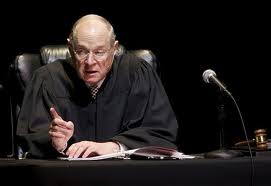
Perhaps significantly, Justice Kennedy, the Court’s notorious swing vote, appeared to be very concerned about the status of young people with respect to the healthcare bill. He noted that the government hasn’t exactly been honest about its intentions with the bill, which was to offset the burden that uninsured individuals place on healthcare.

If the administration was really interested in preventing young people (many who are uninsured) from being such a burden, the healthcare plan would allow them to buy only catastrophic health insurance (instead of the plan that includes well visits, preventative care).  Catastrophic health insurance is all that 20-30 year-olds really need; It’s the only product that makes any economic sense for them.  But Obamacare doesn’t allow that. So, as Kennedy emphasized, we see what the healthcare bill is really all about. It’s about using 20-30 year-olds to subsidize the plan, to subsidize insurance for those who can’t afford it.  It’s about using young healthy people to fund the program.  It’s about a social scheme.

As we all know, the government’s plan is to subsidize health insurance for everyone, especially those who are uninsured and sick (approximately 20% of all uninsured). The plan forces insurance companies to cover the sick. But it doesn’t want to use the typical means to pay for this – such as tax subsidies.  Instead, the government wants to reach OUTSIDE the market and COMPEL a whole bunch of healthy people into that market so they can be used to subsidize the program and help bring healthcare premiums down.  In fact, this was the finding by Congress: that bringing young healthy people into the market will bring down the health insurance premium by about 15% for everyone.  Unfortunately, though, it will force them to buy something they don’t need or want.

The healthcare challenge, on its face, is about the Individual Mandate – the government’s belief that it has the power under the Commerce Clause to force Americans to purchase the specific health insurance it dictates, even those who don’t need it.  It is also about the fundamental scheme in place, established by our Founders and memorialized with the Tenth Amendment, that the federal government is a government of limited powers with the bulk of powers being reserved to the States where they can most effectively regulate for the health, safety, welfare, and morality of their people. It is about the section of the bill which enlarges the Medicaid program and coerces the States to participate in its healthcare scheme by threatening to withhold all Medicaid funding should they decide not to.  According to the states, the sheer volume of the federal funding at stake leaves them with no practical capacity to withdraw from Medicaid.  By placing all of a state’s federal Medicaid dollars at risk for the failure to adhere to the healthcare bill’s conditions, they claim the Act also amounts to compulsion.  And furthermore, they claim that conditions imposed on state governments to implement the scheme constitutes impermissible commandeering of the states and their resources.

But the underlying issue is individual liberty.  It is about the right of an individual to be free from government compulsion – not being forced to do something against one’s will or spending one’s money (that is, what remains after the government takes its cut in the form of income taxes) on things one don’t want or need.  It’s the fundamental right to conduct one’s life the way he or she feels fit and to make his or her own personal decisions.  It’s the basic right “to be left alone” by government.

And the decision, therefore, will speak volumes about how strongly our nation’s highest court is committed to this grand notion of individual liberty. We already know that there are several justices who believe in an expansive view of government and use the court to evolve its responsibilities. And there are those justices who believe in the strict interpretation of the Constitution and in limits to federal power.  And then there is Justice Kennedy, who can be defined by neither classification. His opinion may turn out to be the deciding factor in this case.

All eyes are usually on Justice Kennedy, the genial justice who sits on the fence, often keeping interested parties nervous as to which side he will side with – the liberal bloc (Justices Ruth Bader Ginsburg, Stephen Breyer, Sonia Sotomayor, and Elena Kagan)  or the conservative bloc (Justices Antonin Scalia, Clarence Thomas, Samuel Alito, and the Chief Justice John Roberts). Kennedy was appointed to the bench in 1988 by President Reagan, after the Senate failed to confirm his first choice, committed originalist Robert Bork. Reagan also appointed Justice Scalia.  At the time of his appointment, he was a judge on the US Court of Appeals for the Ninth Circuit, appointed by President Gerald R. Ford. The Ninth Circuit is known as the most liberal of the circuit courts, and in fact, tried to remove the words “Under God” from the Pledge of Allegiance. Justice Kennedy’s crucial swing vote has often been the decisive factor in many of our most important and controversial cases of recent years.

  • Boy Scouts of America v. Dale (2000; upholding the Boy Scouts of America’s organizational right to ban homosexuals from being scoutmasters.  He joined the conservative justices in this decision)
  • Lawrence v. Texas (2003; finding the right of homosexual men to engage in sodomy in the privacy of their home thereby overturning an earlier Supreme Court decision which banned the practice. He joined the liberal justices on this decision)
  • Kelo v. City of New London (2005; holding that local government has the power to take private property for economic development through the use of eminent domain. He joined the liberal justices in this decision)
  • United States v. Lopez (2005: holding that possession of a gun in a local school zone is not an economic activity that might, in the aggregate, have a substantial effect on interstate commerce because the conduct at issue has nothing to do with “commerce.” He joined the conservative justices in this decision)
  • Kennedy v. Louisiana (2008; holding that the 8th Amendment bars Louisiana from imposing the death penalty for the heinous rape of a child where the crime did not result, and was not intended to result, in the victim’s death, although the injuries were so extensive, doctors don’t know how she survived. Kennedy joined the liberal justices on this decision)
  • Boumediene v. Bush (2008; a case challenging the legality of Boumediene’s detention at Guantanamo Bay. Kennedy sided with the four liberal justices in finding that the constitutionally guaranteed right of habeas corpus applies to persons held in Guantanamo Bay and to persons designated as enemy combatants on that territory)
  • District of Columbia v. Heller (2008; holding that the 2nd Amendment confers an individual right to keep and bear arms; All four of the liberal justices believe it only applies to state militias and therefore prevents individuals from having the right to possess guns in their homes)
  • McDonald v. City of Chicago (2010; holding that Heller applies to the States through the 14th Amendment. holding that the Fourteenth Amendment makes the Second Amendment right to keep and bear arms for the purpose of self-defense applicable to the states. Kennedy sided with the conservative justices in asserting that these rights are “fundamental to the nation’s scheme of ordered liberty” and are “deeply rooted in this Nation’s history and tradition” and hence are appropriately applied to the states through the 14th Amendment)
  • Brown v. Plata (2011; holding that releasing violent criminals from an over-crowded prison is a proper remedy to address the violation of prisoners’ 8th Amendment guarantee against ‘cruel and unusual punishment’ caused by long wait times to see prison doctors and less-than-ideal medical accommodations)

In the 2008–2009 term, there were 16 decisions in which the justices split strictly along ideological lines. Kennedy joined the conservative members of the Court eleven times and the liberals only five.

And so, all eyes were on Justice Kennedy in the case against the Patient Protection & Affordable Care Act (PPACA) and all ears were open to his questions and comments, in the hopes of providing a glimpse into his mindset regarding the administration’s huge power grab under the Act.

On the first day of hearings, the justices had to entertain whether the healthcare challenge is even allowable under the Anti Injunction Act (AIA), a federal tax law that says, in essence, that a taxpayer cannot challenge a tax until it comes into effect.  The provision at issue is the penalty portion of the Act, which requires that almost every individual purchase health insurance by 2014 or pay a penalty. The questions before the Court were twofold: (1)  Can the penalty be classified as a “tax” and therefore implicate the AIA?  And (2)  If so, is it then premature for the court to consider the present challenge to the individual mandate?

Justice Breyer asked point blank: “Where I see the problem is in the part of the AIA which refers to the ‘assessment or collection of any tax.’  Now, Congress has nowhere used the word ‘tax.’  What it says is ‘penalty.’ Moreover, this is not in the Internal Revenue Code ‘but for purposes of collection.’  And so why is this a tax?”  He further emphasized that lawmakers intentionally did not use the term when they crafted the legislation nor did they intend the penalty as a tax.

Justice Ruth Bader Ginsburg, another liberal member of the Court,  also expressed skepticism. “This is not a revenue-raising measure because, if it’s successful, nobody will pay the penalty and therefore there will be no revenue to raise.”

Judging on the arguments and discussion made the first day, it seems likely the case will be decided and not postponed.  Even the administration’s lawyer, Solicitor General Donald B. Verrilli urged the justices to decide the merits of the dispute. “This case presents issues of great moment,” he said.

On the second day of hearings Verrilli faced a barrage of skeptical questions from four of the court’s more conservative justices, including Justice Kennedy.  The questions posed to him went straight to the central issue in the case and that is whether the federal government can compel individuals not engaged in commerce to buy a product – health insurance – and hence become part of that commerce in order to be regulated. “Can you create commerce in order to regulate it?” Justice Kennedy asked.  That was his very first question of the day.  He later told Mr. Verrilli that the federal government faced “a heavy burden of justification” for the Individual Mandate and pressed him to articulate “some limits on the Commerce Clause.”

The court focused on whether the mandate for Americans to have insurance “amounts to an affirmative duty to engage in commerce” and is therefore “an unprecedented step beyond what our cases allow,” which is how Justice Kennedy phrased the issue. He then told Verrilli: “With this law, you are changing the relationship of the individual to the government.”

Chief Justice Roberts asked: “So, can the government require you to buy a cell phone because that would facilitate responding when you need emergency services? That way, you can just dial 911 no matter where you are?”  Verrilli tried to argue that Roberts’ scenario was distinguishable from the health care market.  But Roberts fired back: “It seems to me that’s the same as in my hypothetical. You don’t know when you’re going to need police assistance. You can’t predict the extent to emergency response that you’ll need. But when you do, and the government provides it. I thought that was an important part of your argument, that when you need health care, the government will make sure you get it. Well, when you need police assistance or fire assistance or ambulance assistance, the government is going to make sure to the best of its ability that you get it.”

Justice Alito asked Solicitor General Verrilli: “Do you think there is a, a market for burial services?”  He answered in the affirmative. Alito then continued: “All right, suppose that you and I walked around downtown Washington at lunch hour and we found a couple of healthy young people and we stopped them and we said, “You know what you’re doing? You are financing your burial services right now because eventually you’re going to die, and somebody is going to have to pay for it, and if you don’t have burial insurance and you haven’t saved money for it, you’re going to shift the cost to somebody else. Isn’t that a very artificial way of talking about what somebody is doing?”  Verrilli didn’t agree.  But Alito pushed further: “And if that’s true, why isn’t it equally artificial to say that somebody who is doing absolutely nothing about health care is financing health care services?  See, I don’t see the difference. You can get burial insurance. You can get health insurance. Most people are going to need health care. Almost everybody. Everybody is going to be buried or cremated at some point. What’s the difference?  If you don’t have money then someone has to pay… Whether the State or a family member.  And isn’t that what the mandate is doing?  You can correct me if these figures are wrong, but it appears to me that the CBO (Congressional Budget Office) has estimated that the average premium for a single insurance policy in the non-group market would be roughly $5,800 in — in 2016.  The administration estimates that a young, healthy individual targeted by the mandate on average consumes about $854 in health services each year. So the mandate is forcing these people to provide a huge subsidy to the insurance companies for other purposes that the act wishes to serve, but if those figures are right, isn’t it the case that what this mandate is really doing is not requiring the people who are subject to it to pay for the services that they are going to consume?  It is requiring them to subsidize services that will be received by somebody else.”  Verrilli acknowledged that this was in fact the case.

Chief Justice Roberts commented: “It’s critical how you define the market. If I understand the law, the policies that you’re requiring people to purchase involve – must contain provision for maternity and newborn care, pediatric services, and substance use treatment. It seems to me that you cannot say that everybody is going to need substance use treatment, substance use treatment or pediatric services, and yet that is part of what you require them to purchase.  Your theory is that there is a market in which everyone participates because everybody might need a certain range of health care services, and yet you’re requiring people who are never going to need pediatric or maternity services to participate in that market.”

He then asked: “If the government can force people to buy health insurance can it require people to buy certain types of cars?  Broccoli?”  Justice Scalia hinted that if everyone were forced to buy a new car, it might help lower the costs of new cars for everyone.

Scalia offered his interpretation of the government’s case: “I don’t agree with you that the relevant market here is health care. You’re not regulating health care. You’re regulating insurance. It’s the insurance market that you’re addressing and you’re saying that some people who are not in it must be in it. That approach is different from the regulation of any type of commerce that already exists out there.”

Solicitor General Verrilli tried to paraphrase the government’s position: “Our position is that it’s not an illegitimate exercise of the commerce power for some people to subsidize others. You’re young and healthy one day, but you don’t stay that way. And the system works over time.”

Justice Scalia spoke up: “We’re not stupid. They’re going to buy insurance later. They’re young and need the money now.  When they think they have a substantial risk of incurring high medical bills, they’ll buy insurance, like the rest of us. You seem to suggest that they are never going to buy it.  You could solve that problem by simply not requiring the insurance company to sell it to somebody who has a condition that is going to require medical treatment, or at least not require them to sell it to him at a rate that he sells it to healthy people.  But you don’t want to do that.  And to me, that seems like a problem created by the government – a self-created problem.”

Chief Justice Roberts added: “You say your argument is limited to health insurance  But once you establish that you have a market for health care, would you suppose Congress’s power under the Commerce Clause is broad in scope with regard to how they  they regulate that market. I don’t see how we can accept your argument that ‘it’s just insurance.’  Once we say that there is a market and Congress can require people to participate in it, as some would say – or as you would say, that people are already participating in it – it seems to me that we can’t say there are limitations on what Congress can do under its commerce power.  It could regulate the market in any rational way.  Congress has chosen to regulate the health care market. Everybody’s in it, they said, so it can be regulated. This year, they looked at a particular serious problem, which is how people pay for it.  And they decided to compel people to purchase insurance. But next year, they can decide to look at something else – a different problem – and decide how they are going to regulate it. And they’ll be able to do it because they’ve already accepted the argument that this is a market in which everybody participates.”

Scalia jumped in: “I tell you what the something else is. The something else is everybody has to exercise, because there’s no doubt that lack of exercise cause — causes illness, and that causes health care costs to go up. So the Federal government says everybody has to join an exercise club. That’s the something else.”

Mr. Verrilli tried to explain: “What matters here is whether Congress is choosing a tool that’s reasonably adapted to the problem that Congress is confronting. And that may mean that the tool is different from a tool that Congress has chosen to use in the past.”

Justice Scalia responded: “Well, that’s both “Necessary and Proper.” What you just said addresses what’s necessary. Yes, has to be reasonably adapted. Necessary does not mean essential, just reasonably adapted. But in addition to being necessary, it has to be proper. And we’ve held in two cases that something that was reasonably adapted was not proper because it violated the sovereignty of the States, which was implicit in the constitutional structure. The argument here is that this also may be necessary, but it’s not proper because it violates an equally evident principle in the Constitution, which is that the Federal Government is not supposed to be a government that has all powers; that it’s supposed to be a government of limited powers. And that’s what all this questioning has been about. What is left?  If the government can do this, what, what else can it not do?  But that’s not the only constitutional principle at stake in this case. An equally evident constitutional principle is the principle that the Federal Government is a government of enumerated powers and that the vast majority of powers remain in the States and do not belong to the Federal Government. Do you acknowledge that that’s a principle?”  Verrilli so acknowledged.

Scalia continued: “I mean, the Tenth Amendment says the powers not given to the Federal Government are reserved, not just to the States, but to the States and the people. And the argument here is that the people were left to decide whether they want to buy insurance or not.”

Justice Kennedy added:  “The reason this Mandate is concerning is because it requires the individual to do an affirmative act. In the law of torts our tradition, our law, has been that you don’t have the duty to rescue someone if that person is in danger. The blind man is walking in front of a car and you do not have a duty to stop him absent some relation between you. And there is some severe moral criticisms of that rule, but that’s generally the rule.  And here the government is saying that the Federal Government has a duty to tell the individual citizen that it must act, and that is different from what we have in previous cases and that changes the relationship of the Federal Government to the individual in the very fundamental way.”

Chief Justice inserted: “The States are not limited to enumerated powers, but the Federal Government is. And it seems to me it’s an entirely different question when you ask yourself whether or not there are going to be limits in the Federal power, as opposed to limits on the States.”

Another issue that came up was whether the penalty could be classified as a tax (returning to some degree to the topic touched on the day before).  If the penalty could be classified as a tax, then the thought is that the Individual Mandate could be supported, in the alternative, under Congress’ “Tax and Spend” powers.  Justice Scalia quickly noted that “the President has said it isn’t a tax.”  Then Justice Ginsberg added: ” A tax is to raise revenue, tax is a revenue-raising device, and the purpose of this exaction is to get people into the health care risk pool before they need medical care, and so it will be successful. If it doesn’t raise any revenue, if it gets people to buy the insurance, that’s what this penalty is designed to do – to affect conduct. The conduct is buy health protection, buy health insurance before you have a need for medical care. That’s what the penalty is designed to do, not to raise revenue.”

At that point, the Solicitor General stepped down and the respondents’ attorney (that is, for the states), Mr. Clement was given time before the Court.  He immediately struck down the administration’s position that the Individual Mandate (the penalty, in particular) could be legally supported under the Taxing power.  As he told the Court: “I think it might raise some issues about whether or not that would be a valid exercise of the taxing power. My constitutional concern is that it would be a disguised impermissible direct tax. And we all know that Congress is limited in its ability to impose direct taxes. The one thing I think the framers would have clearly identified as a direct tax is a tax on not having something. I mean, the framing generation was divided over whether a tax on carriages was a direct tax or not. Hamilton thought that was a indirect tax; Madison thought it was a direct tax. I have little doubt that both of them would have agreed that a tax on not having a carriage would have clearly been a direct tax. I also think they would have thought it clearly wasn’t a valid regulation of the market in carriages.”

Attorney Clement then moved on to the market that the government is trying to dominate: “What health insurance does and what all insurance does is it allows you to diversify risk. And so it’s not just a matter of I’m paying now instead I’m paying later. That’s credit. Insurance is different than credit. Insurance guarantees you an upfront, locked-in payment, and you won’t have to pay any more than that even if you incur much great expenses. And in every other market that I know of for insurance, we let people basically make the decision whether they are relatively risk averse, whether they are relatively non-risk averse, and they can make the judgment based on…”

Justice Sotomayor interrupted: “But we don’t in car insurance, I mean the states don’t.  Let me ask you a question:  Do you think that if some states decided not to impose an insurance requirement, that the Federal Government would be without power to legislate and require every individual to buy car insurance?”

Clement answered: “Let me say this, you’re right in the first point to say that it’s the states that do it, which makes it different right there.”

Justice Kennedy asked:  “Isn’t everyone in the market in the sense that they are creating a risk that the market must account for?”  Similarly, Justice Kagan asked:  “If the effect of all the uninsured people is to raise everybody’s premiums, not just when they get sick, if they get sick, but right now in the aggregate, and Wickard and Raich  tell us we should look at the aggregate, and the aggregate of all these uninsured people are increasing the normal family premium, Congress says, by a thousand dollars a year. Those people are in commerce. They are making decisions that are affecting the price that everybody pays for this service.”
[Wickard v. Filburn (wheat case; 1924, holding that Farmer Filburn couldn’t grow wheat for his own use because, if other were to do the same, then in the aggregate, all these farmers would have no need to buy wheat on the open market and would therefore affect commerce) and Gonzalez v. Raich (medical marijuana case; 2005; holding that California’s Compassionate Use Act, which legalized marijuana for medical use, conflicted with the federal government’s Controlled Substances Act, which is a valid exercise of Congress’ commerce powers)].

Mr. Clement disagreed.  He answered: “Let’s be careful about what they were regulating in Wickard. What they were regulating was the supply of wheat. It didn’t in any way imply that they could require every American to go out and buy wheat. And yes, one of the consequences of regulating local market participants is it’ll affect the supply and the demand for the product. That’s why you can regulate them, because those local market participants have the same effect on the interstate market that a black market has on a legal market……

That aside, I don’t think the point you make distinguishes the healthcare market from other markets. When I’m sitting in my house deciding I’m not to buy a car, I am causing the labor market in Detroit to go south. I am causing maybe somebody to lose their job, and for everybody to have to pay for it under welfare. So the cost shifting that the government tries to uniquely to associate with this market, it is everywhere. And even more to the point, the rationale that they think ultimately supports this legislation, that look, it’s an economic decision, once you make the economic decision, we aggregate the decision, there is a substantial effect on commerce. That argument works here. It works in every single industry.  There are other markets that affect every one: transportation, food, burial services, though we don’t like to talk about that either. There also are situations where there are many economic effects from somebody’s failure to purchase a product. My unwillingness to buy an electric car is forcing up the price of an electric car. If only more people demanded an electric car there would be economies of scale, and the price would go down………

If I could talk about the difference between the health insurance market and the health care market…… If some private company comes up with a great new wonder drug that would have huge benefits for everybody’s health and if everybody had to buy it, it would facilitate economies of scale, and the production would be efficient, and the price would be cheaper and force everybody in the health care market, the actual health care market to buy the wonder drug, and if the government wanted to compel people to take this drug, I’d be up here making the same argument. I would be saying that there is no such authority within the commerce power of the federal government. In Federalist 45, Madison says the commerce power is a new power, but it’s not one anyone has any apprehension about. And the reason they didn’t have any apprehension about it is because it’s a power that only operated once people were already in commerce. You see that from the text of the clause. The first kind of commerce Congress gets to regulate is commerce with foreign nations. Did anybody think the fledgling Republic had the power to compel some other nation into commerce with us?  Of course not.  And in the same way, I certainly don’t think the framers had understood the commerce power to include the power to compel people to engage in commerce.”

At that point, Attorney Clement stepped down and Michael Carvin, the attorney representing several small businesses (National Federation of Independent Businesses, NFIB), addressed the Court to argue the unconstitutionality of the PPACA.  “I’d like to begin with the Solicitor General’s main premise, which is that they can compel the purchase of health insurance in order to promote commerce in the health market because it will reduce uncompensated care. If you accept that argument, you have to fundamentally alter the text of the Constitution and give Congress plenary power. It simply doesn’t matter whether or not this regulation will promote health care commerce by reducing uncompensated care; all that matters is whether the activity actually being regulated by the act negatively affects Congress or negatively affects commerce regulation, so that it’s within the commerce power. If you agree with us that this is — exceeds commerce power, the law doesn’t somehow become redeemed because it has beneficial policy effects in the health care market. In other words, Congress does not have the power to promote commerce. Congress has — Congress has the power to regulate commerce. And if the power exceeds their permissible regulatory authority, then the law is invalid…  Think about it this way…  when you’ve entered the marketplace they can impose all sorts of restrictions on you. But what can’t they do?  I think everyone intuitively understands that regulating participants after A and B have entered into a contract is fundamentally less intrusive than requiring the contract in the first place.”

Justice Ginsberg asked: “Isn’t the only way to prevent people from paying for the cost-free healthcare of those who are sick and uninsured to have people pay sooner rather than later?”

Carvin answered: “The real problem are those who default on their health care payments. That is an entirely different group of people, an entirely different activity than being uninsured. The people who impose the costs on the rest of us are people who engage in a different activity at a different time, which is defaulting on their health care payments. It’s not the uninsured. Under Justice Kagan’s theory, you could regulate anybody if they have got a statistical connection to a problem. You could say, since we could regulate people who enter into the mortgage market and impose mortgage insurance on them, we can simply impose the requirement to buy private mortgage insurance on everybody before they have entered the market because we are doing it in this prophylactic way before it develops.”  [Chief Justice Roberts interrupted to note that not everyone enters the housing market while everyone eventually enters the healthcare market]  Carvin continued: “And my basic point to you is this: the Constitution only gives Congress the power to regulate things that negatively affect commerce or commerce regulation. It doesn’t give them the power to regulate things that are statistically connected to things that negatively affect the commerce. If they have that power, then they obviously have the power to regulate everything because everything in the aggregate is statistically connected to something that negatively affects commerce, and every compelled purchase promotes commerce.”  (I admit, I initially had a hard time following that).

Finally, Mr. Carvin ended with these words: “We turn you to the Commerce Clause jurisprudence that bedeviled the Court before the 1930s, where they were drawing all these kinds of distinctions among industries; whereas our test is really very simple. Are you buying the product or is Congress compelling you to buy the product?  I can’t think of a brighter line.  And again, if Congress has the power to compel you to buy this product, then obviously, they have got the power to provide you – to compel you to buy any product, because any purchase is going to benefit commerce, and this Court is never going to second-guess Congress’s policy judgments on how important it is this product versus that product.  The words “inactivity” and “activity” are not in the Constitution.  But the words “commerce” and “noncommerce” are.  It’s a distinction that comes directly from the text of the Constitution…..     The Framers consciously gave Congress the ability to regulate commerce, because that’s not a particularly threatening activity that deprives you of individual freedom. If you were required, if you were authorized to require A to transfer property to B, you have, as the early cases put it, a monster in legislation which is against all reason in justice, because everyone intuitively understands that regulating people who voluntarily enter into contracts in setting changing conditions does not create the possibility of Congress compelling wealth transfers among the citizenry. And that is precisely why the Framers denied them the power to compel commerce, and precisely why they didn’t give them plenary power.”

On the third day of oral arguments, the Court engaged in a discussion of severability – whether the healthcare bill could survive if the Individual Mandate was struck down and whether other provisions could still survive.  It was a tortuous line of questioning. Justice Scalia suggested many members of Congress might not have voted for the bill without the central provisions, and so perhaps it wouldn’t be fair to allow remaining portions of the bill to survive.  He also was emphatic that it was not the province of the Court to go through each and every page to sort out which provision should remain and which should go.  He even joked that being required to read the 2,700-page bill should fall under the 8th Amendment’s concept of “Cruel and Unusual Punishment.”  Justice Sotomayor argued that it was Congress’ job to fix or scrap the bill, should the mandate be found unconstitutional.  Opponents of the bill argued against severability, suggesting that simply striking the mandate while leaving in place corresponding new insurance regulations could result in a spike in premiums that Congress did not intend.

In the afternoon session, the justices considered a challenge by the 26 states to the expansion of the Medicaid program for low-income Americans, an important feature in the effort extending health insurance to an additional 30 million people. The court’s liberal justices made it fairly clear they will vote to uphold the Medicaid expansion, which would take in 15 million people with the federal government paying almost all the costs. They did not seem to agree with the challengers that expansion of the program is unconstitutionally coercive.  Justice Kagan asked: “Why is a big gift from the federal government a matter of coercion?”

Attorney Clement defended the states’ position: “Let me focus on what I think are the three hallmarks of this statute that make it uniquely coercive. One of them is the fact that this statute is tied to the nonvoluntary individual mandate. The second factor, of course, is the fact that Congress here made a distinct and conscious decision to tie the state’s willingness to accept these new funds, not just to the new funds but to their entire participation in the statute, even though the coverage for these newly eligible individuals is segregated from the rest of the program. In other words, if a state doesn’t want to cover the newly eligible individuals, it not only doesn’t get the new money, it also doesn’t get any of the money under the original contact, agreement (old money).  What’s coercive is not the absolute guarantee that the secretary could cut off every penny, but the fact that she could. And the third factor is the sheer size and scope of Medicaid. The expansion of Medicaid since 1984 is really breathtaking. In 1984 the Federal spending to the States was a shade over $21 billion for Medicaid. Right now it’s $250 billion, and that’s before the expansion under this statute. If the Secretary should withhold all funding for a state’s poor population, that state would have an impossible time coming up with the funds on its own to cover those people.”

Hopefully, we know where Justice Kennedy stands on matters that threaten to upset the balance of power created under our federalist system. In short, he has never been one to want to enlarge the government’s status with regard to its relationship to the States.

The arguments and answers given on day two of course represent the meat of the case. I believe it is the closing remark by Attorney Carvin which holds the key to how Justice Kennedy will ultimately view the Individual Mandate.  He emphasized that the ability to regulate commerce was not the same as compelling commerce for the latter would deprive individuals of individual liberty. I believe in his final analysis, Justice Kennedy will look at the implications the Individual Mandate has on individual liberty – the very precious intangible that our Founders so judiciously and ambitiously sought to protect and promote.

I point to two fairly recent cases to highlight Justice Kennedy’s views on Liberty and Federalism – United States v. Lopez (1995) and Bond v. United States (2011).  His words make his intentions clear. I believe his firm belief in the concept of federalism and the liberty interests it serves is an important insight as to how he may come down on the healthcare question, and especially the Individual Mandate.

In Lopez, the Court was asked to decide the constitutionality of a federal statute – the Gun-Free School Zones Act of 1990, which made it a crime for any individual to “knowingly possess a firearm at a place that [he] knows…is a school zone.”  Alfonzo Lopez, a high school senior, carried a concealed weapon into his San Antonio, Texas high school and was arrested and charged under Texas law with firearm possession on school premises. The next day, the state charges were dismissed after federal agents charged Lopez with violating a federal criminal statute, the Gun-Free School Zones Act.  Lopez challenged the federal statute on the grounds that it exceeded the power of Congress to legislate conduct in the states under the Commerce Clause.  Justice Kennedy agreed with the majority that the conduct the federal statue sought to regulate was not in fact “commerce” and therefore was an unconstitutional exercise of authority.  He wrote a concurring opinion:

The history of our Commerce Clause decisions contains at least two lessons of relevance to this case. The first, as stated at the outset, is the imprecision of content-based boundaries used without more to define the limits of the Commerce Clause. The second, related to the first but of even greater consequence, is that the Court as an institution and the legal system as a whole have an immense stake in the stability of our Commerce Clause jurisprudence as it has evolved to this point. Stare decisis operates with great force in counseling us not to call in question the essential principles now in place respecting the congressional power to regulate transactions of a commercial nature. That fundamental restraint on our power forecloses us from reverting to an understanding of commerce that would serve only an 18th-century economy, dependent then upon production and trading practices that had changed but little over the preceding centuries; it also mandates against returning to the time when congressional authority to regulate undoubted commercial activities was limited by a judicial determination that those matters had an insufficient connection to an interstate system. Congress can regulate in the commercial sphere on the assumption that we have a single market and a unified purpose to build a stable national economy.

In referring to the whole subject of the federal and state balance, we said this just three Terms ago: ‘This framework has been sufficiently flexible over the past two centuries to allow for enormous changes in the nature of government. The Federal Government undertakes activities today that would have been unimaginable to the Framers in two senses: first, because the Framers would not have conceived that any government would conduct such activities; and second, because the Framers would not have believed that the Federal Government, rather than the States, would assume such responsibilities. Yet the powers conferred upon the Federal Government by the Constitution were phrased in language broad enough to allow for the expansion of the Federal Government’s role.’  It does not follow, however, that in every instance the Court lacks the authority and responsibility to review congressional attempts to alter the federal balance. This case requires us to consider our place in the design of the Government and to appreciate the significance of federalism in the whole structure of the Constitution.

Of the various structural elements in the Constitution, separation of powers, checks and balances, judicial review, and federalism, only concerning the last does there seem to be much uncertainty respecting the existence, and the content, of standards that allow the judiciary to play a significant role in maintaining the design contemplated by the Framers. Although the resolution of specific cases has proved difficult, we have derived from the Constitution workable standards to assist in preserving separation of powers and checks and balances. These standards are by now well accepted and judicial review is also established beyond question, Our role in preserving the federal balance seems more tenuous.

There is irony in this, because of the four structural elements in the Constitution just mentioned, federalism was the unique contribution of the Framers to political science and political theory. Though on the surface the idea may seem counterintuitive, it was the insight of the Framers that freedom was enhanced by the creation of two governments, not one.

In the compound republic of America, the power surrendered by the people is first divided between two distinct governments, and then the portion allotted to each subdivided among distinct and separate departments. Hence a double security arises to the rights of the people. The different governments will control each other at the same time that each will be controlled by itself.”  James Madison, Federalist No. 51

Just as the separation and independence of the coordinate branches of the Federal Government serve to prevent the accumulation of excessive power in any one branch, a healthy balance of power between the States and the Federal Government will reduce the risk of tyranny and abuse from either front. . . . In the tension between federal and state power lies the promise of liberty.  The Constitution divides authority between federal and state governments for the protection of individuals. State sovereignty is not just an end in itself. Rather, federalism secures to citizens the liberties that derive from the diffusion of sovereign power.

The theory that two governments accord more liberty than one requires for its realization two distinct and discernible lines of political accountability: one between the citizens and the Federal Government; the second between the citizens and the States. If, as Madison expected, the federal and state governments are to control each other, see Federalist No. 51, and hold each other in check by competing for the affections of the people, see Federalist No. 46, those citizens must have some means of knowing which of the two governments to hold accountable for the failure to perform a given function. Federalism serves to assign political responsibility, not to obscure it. Were the Federal Government to take over the regulation of entire areas of traditional state concern, areas having nothing to do with the regulation of commercial activities, the boundaries between the spheres of federal and state authority would blur and political responsibility would become illusory. The resultant inability to hold either branch of the government answerable to the citizens is more dangerous even than devolving too much authority to the remote central power.

To be sure, one conclusion that could be drawn from The Federalist Papers is that the balance between national and state power is entrusted in its entirety to the political process. Madison’s observation that “the people ought not surely to be precluded from giving most of their confidence where they may discover it to be most due,” (Federalist No. 46) can be interpreted to say that the essence of responsibility for a shift in power from the State to the Federal Government rests upon a political judgment, though he added assurance that “the State governments could have little to apprehend, because it is only within a certain sphere that the federal power can, in the nature of things, be advantageously administered, Whatever the judicial role, it is axiomatic that Congress does have substantial discretion and control over the federal balance.

For these reasons, it would be mistaken and mischievous for the political branches to forget that the sworn obligation to preserve and protect the Constitution in maintaining the federal balance is their own in the first and primary instance. In the Webster-Hayne Debates and the debates over the Civil Rights Acts before the Senate Committee on Commerce (88th Congress; 1963), some Congresses have accepted responsibility to confront the great questions of the proper federal balance in terms of lasting consequences for the constitutional design. The political branches of the Government must fulfill this grave constitutional obligation if democratic liberty and the federalism that secures it are to endure.

Although it is the obligation of all officers of the Government to respect the constitutional design, the federal balance is too essential a part of our constitutional structure and plays too vital a role in securing freedom for us to admit inability to intervene when one or the other level of Government has tipped the scales too far.

Our ability to preserve this principle under the Commerce Clause has presented a much greater challenge. This clause has throughout the Court’s history been the chief source of its adjudications regarding federalism no other body of opinions affords a fairer or more revealing test of judicial qualities.  But as the branch whose distinctive duty it is to declare what the law is, are often called upon to resolve questions of constitutional law not susceptible to the mechanical application of bright and clear lines. The substantial element of political judgment in Commerce Clause matters leaves our institutional capacity to intervene more in doubt than when we decide cases, for instance, under the Bill of Rights even though clear and bright lines are often absent in the latter class of disputes. But our cases do not teach that we have no role at all in determining the meaning of the Commerce Clause.

The statute before us upsets the federal balance to a degree that renders it an unconstitutional assertion of the commerce power, and our intervention is required. As the Chief Justice explains, unlike the earlier cases to come before the Court here neither the actors nor their conduct have a commercial character, and neither the purposes nor the design of the statute have an evident commercial nexus. The statute makes the simple possession of a gun within 1,000 feet of the grounds of the school a criminal offense. In a sense, any conduct in this interdependent world of ours has an ultimate commercial origin or consequence, but we have not yet said the commerce power may reach so far. If Congress attempts that extension, then at the least we must inquire whether the exercise of national power seeks to intrude upon an area of traditional state concern.

If a State or municipality determines that harsh criminal sanctions are necessary and wise to deter students from carrying guns on school premises, the reserved powers of the States are sufficient to enact those measures. Indeed, over 40 States already have criminal laws outlawing the possession of firearms on or near school grounds.”

In the case of Bond v. United States, a woman was convicted of trying to poison her husband’s mistress. (24 times over several months). He had had a child with the mistress while still married to Bond. The government tried to convict her under a federal statute designed to go after terrorists and so she sued, claiming that she should have been convicted under an applicable state criminal statute.  The Court of Appeals for the Third Circuit held that Bond lacked standing to challenge the statute. The Supreme Court, in a unanimous decision, held that a criminal defendant who has been convicted under a federal statute can challenge that conviction on grounds that the statute is unconstitutional. In this particular case, the Court held that the statute exceeded the federal government’s powers with respect to the Tenth Amendment.  Justice Kennedy wrote the majority opinion:

“The federal system rests on what might at first seem a counter-intuitive insight, that “freedom is enhanced by the creation of two governments, not one.” Alden v. Maine, 527 U. S. 706, 758 (1999). The Framers concluded that allocation of powers between the National Government and the States enhances freedom, first by protecting the integrity of the governments themselves, and second by protecting the people, from whom all governmental powers are derived.

The principles of limited national powers and state sovereignty are intertwined.  While neither originates in the Tenth Amendment, both are expressed by it. Impermissible interference with state sovereignty is not within the enumerated powers of the National Government, see New York v. United States, 505 U. S. 144 (1992), at 155–159, and action that exceeds the National Government’s enumerated powers undermines the sovereign interests of States.  See United States v. Lopez, 514 U. S. 549, 564 (1995). The unconstitutional action can cause concomitant injury to persons in individual cases.

Federalism has more than one dynamic. It is true that the federal structure serves to grant and delimit the prerogatives and responsibilities of the States and the National Government vis-à-vis one another. The allocation of powers in our federal system preserves the integrity, dignity, and residual sovereignty of the States.  The federal balance is, in part, an end in itself, to ensure that States function as political entities in their own right.

But that is not its exclusive sphere of operation. Federalism is more than an exercise in setting the boundary between different institutions of government for their own integrity. “State sovereignty is not just an end in itself: Rather, federalism secures to citizens the liberties that derive from the diffusion of sovereign power.

Some of these liberties are of a political character. The federal structure allows local policies ‘more sensitive to the diverse needs of a heterogeneous society,’ permits ‘innovation and experimentation,’ enables greater citizen ‘involvement in democratic processes,’ and makes government ‘more responsive by putting the States in competition for a mobile citizenry.’  [All of these would protect and enlarge individual liberty and protect against an oppressive “one-size-fits-all” approach].

Federalism secures the freedom of the individual. It allows States to respond, through the enactment of positive law, to the initiative of those who seek a voice in shaping the destiny of their own times without having to rely solely upon the political processes that control a remote central power. True, of course, these objects cannot be vindicated by the Judiciary in the absence of a proper case or controversy; but the individual liberty secured by federalism is not simply derivative of the rights of the States.

Federalism also protects the liberty of all persons within a State by ensuring that laws enacted in excess of delegated governmental power cannot direct or control their actions. [See ibid]. By denying any one government complete jurisdiction over all the concerns of public life, federalism protects the liberty of the individual from arbitrary power. When government acts in excess of its lawful powers, that liberty is at stake.

The limitations that federalism entails are not therefore a matter of rights belonging only to the States. States are not the sole intended beneficiaries of federalism. An individual has a direct interest in objecting to laws that upset the constitutional balance between the National Government and the States when the enforcement of those laws causes injury that is concrete, particular, and redressable. Fidelity to principles of federalism is not for the States alone to vindicate.”

The outcome of this historic case against the massively oppressive healthcare reform bill will no doubt shape the legacy of the Roberts’ Court, influence President Obama’s re-election prospects, and potentially deepen the ideological rift that is already dividing the country.  But most importantly, the outcome will determine what impact the US Constitution still has on protecting the individual from the pernicious reaches of government.

References:

United States v. Lopez, 514 U.S. 549 (1995).  Referenced at:  http://www.law.cornell.edu/supct/html/93-1260.ZO.html

Bond v. United States, 564 U.S. ___ (2010).

“Anthony A. Kennedy,” NY Times, March 29, 2012.  Referenced at:  http://topics.nytimes.com/top/reference/timestopics/people/k/anthony_m_kennedy/index.html

Transcript and Audio for Monday’s Arguments:  http://www.politico.com/news/stories/0312/74477.html

Transcript and Audio for Tuesday’s Arguments:  http://www.npr.org/2012/03/27/149465820/transcript-supreme-court-the-health-care-law-and-the-individual-mandate

Transcript and Audio for Wednesday’s Arguments:  http://www.npr.org/2012/03/28/149548299/transcript-audio-supreme-court-the-health-care-law-and-medicaid-expansion

Audio for Tuesday’s arguments:  http://apne.ws/Hft6z3

Audio for Wednesday’s arguments:  http://apne.ws/GX1p23  (morning) and  http://apne.ws/GXdZOP  (afternoon).

“The Supreme Court Arguments Are Over – What Happens Now?,” Kaiser Health News, March 29, 2012.  Referenced at:  http://www.kaiserhealthnews.org/Daily-Reports/2012/March/29/supreme-court-big-picture-wrap-up.aspx
Posted in Uncategorized | Leave a comment

Christian Derangement Syndrome – Bill Maher and the Huffington Post Have It !


by Diane Rufino

Not long ago, a blogger wrote: “Recently, my Biology teacher threw a bible across the classroom! Not that I am a Christian, but that’s not how you treat other peoples religion. When we asked him why he did it, he said ‘That book is full of lies.’ Every time I’m in his class, he always talks about how there are many mistakes in the Bible.  He’s always criticizing the Bible.”

What is it about Christianity that causes so many people to become deranged?  Why do they it so much more than other religions?

Years ago, liberals suffered a similar type of derangement whenever President Bush was in the limelight. It was called the Bush Derangement Syndrome (BDS).  Former House Speaker Nancy Pelosi was a perfect example. She couldn’t pass an opportunity to use the microphone, on any occasion, to call Bush names and criticize his every move. I remember one year, President Bush started his State of the Union Address by congratulating Pelosi on being the first woman Speaker of the House and graciously introducing her as a woman of integrity.  She sat there, all smiles, taking in the moment and lavishing the praise he was giving her in front of the entire nation.  Yet the minute the Address was concluded and Pelosi was able to get in front of a microphone, her demeanor changed, the rabies kicked in, and she let loose a vitriolic diatribe against Bush.  I believe I saw saliva foaming at her mouth.  The foaming was not always indicative of BDS, but we often saw it in members of the liberal media.  Its goal was not necessarily to show that President Bush was bad for the country – because they never were able to make that case – but rather to show that he was bad for people’s mental health.  At least that’s the way I saw it.

And now we have a similar syndrome – Christian Derangement Syndrome.  Similarly, while their goal apparently is to show that Christians are bad for the country, they will never be able to make that case. In fact, the more they carry on, it’s much clearer that they are the ones that are harmful.  Rather, their default goal is to show that Christians are bad for the mental health of non-believers.

A teacher at Capistrano Valley High School in Mission Viejo, California, was  accused of violating the Establishment Clause by repeatedly making statements critical and derogatory of religion in his AP European History class.  For example, he told his class: “When you put on your Jesus glasses, you can’t see the truth.”

He also said: “Aristotle was a physicist. … He argued that there has to be a God.  Of course that’s nonsense.”  And he made this comment, among many others: “The people who want to make the argument that God did it, there is as much evidence that God did it as there is that there is a giant spaghetti monster living behind the moon.”  The Ninth Circuit Court of Appeals held that the teacher was using appropriate critical thinking skills to teach his students.  I imagine that if it were the other way around, and the teacher had been praising God, the Ninth Circuit would have held that there was an improper establishment of religion.

A kindergarten teacher in New Jersey saw the name “Jesus” on a Thanksgiving poster made by one of her students and instantly removed it from a display she made of the class posters out in the hall.  God forbid someone should walk by and see that name!!  In the spirit of the Thanksgiving holiday, the teacher asked the students to make posters depicting what they were “thankful for.”  The child at issue wanted to thank Jesus. The child was 5 years old.  It was a kindergarten hallway. Imagine the confusion the child suffered, being taught one thing at home and in church but being punished for it by her teacher.

And then there’s the personal, one-man crusade led by rabid atheist Michael Newdow.  He is the man who went to court to try to stop children from being able to say the Pledge of Allegiance in school because it includes the offensive phrase “Under God.”  He alleged that the words “under God” in the pledge amounted to an establishment of religion, in violation of the First Amendment. He brought the case on behalf of his 9-year-old daughter who he didn’t even have custody of.  He also brought the case in spite of the fact that the girl herself wanted to continue saying the pledge and didn’t want the lawsuit filed.  The district court held the pledge was constitutional but the Ninth Circuit Court of Appeals, in a 2-1 vote, reversed the decision and held that recitation of the pledge with the words “under God” in the school system violated the Establishment Clause.   To celebrate the decision by the Court of Appeals, Time Magazine did a story on Newdow and made him their “Person of the Week.”

[The case eventually reached the US Supreme Court in 2004. The Court held that Michael Newdow didn’t have standing to bring the case in the first place, so the pledge was affirmed].

A little over fifty years ago, in 1954, when the phrase “under God” was added to the Pledge of Allegiance by Congress, the vote was unanimous. The decision to insert the words “under God” was made “to recognize a Supreme Being” and advance religion at a time “when the government was publicly fighting against atheistic communism.” Furthermore, when President Dwight D. Eisenhower signed the act which added the phrase “under God,” he announced: “From this day forward, the millions of our school children will daily proclaim in every city and town, every village and rural schoolhouse, the dedication of our Nation and our people to the Almighty.”

In light of this bit of history and Congressional intent, it took a lot of arrogance for a federal judge to rule it was unconstitutional.  The pledge is symbolic; it is not a prayer and never intended to be.  It just goes to show how messed up our legal system has become.

The Pledge of Allegiance is a short statement of patriotic recognition for what this country stands for.  The words hold much meaning, particularly to those who have learned and who appreciate our history.  There are many commentaries attesting to the meaning of the pledge, but one that has always stuck with me is the video by a real comedian, Red Skelton.  I still have this video on my computer, where I watch it from time to time.  On his television program many many years ago, he told the story of one of his teachers, Mr. Laswell, who felt the students didn’t have a proper appreciation of the Pledge of Allegiance. Skelton recited this story of Mr. Laswell:  “He said to the class: “I’ve been listening to you boys and girls recite the Pledge of Allegiance all semester and it seems as though it is becoming monotonous to you. If I may, I would like to recite it to you and explain the meaning of each word:

I — me, an individual, a committee of one.

PLEDGE — dedicate all of my worldly goods to give without self pity.

ALLEGIANCE — my love and my devotion.

TO THE FLAG — our standard, Old Glory, a symbol of freedom. Wherever she waves, there’s respect because your loyalty has given her a dignity that shouts freedom is everybody’s job!

UNITED — that means that we have all come together.

STATES — individual communities that have united into 48 great states. Forty-eight individual communities with pride and dignity and purpose; all divided with imaginary boundaries, yet united to a common purpose, and that’s love for country.

AND TO THE REPUBLIC — a state in which sovereign power is invested in representatives chosen by the people to govern. And government is the people and it’s from the people to the leaders, not from the leaders to the people.

FOR WHICH IT STANDS, ONE NATION — one nation, meaning “so blessed by God”

INDIVISIBLE — incapable of being divided.

WITH LIBERTY — which is freedom — the right of power to live one’s own life without threats, fear or some sort of retaliation.

AND JUSTICE — the principle or quality of dealing fairly with others.

FOR ALL — which means, boys and girls, it’s as much your country as it is mine.”

Skelton went on to explain that since the time he was a small boy and had Mr. Laswell as a teacher, “two states have been added to our country and two words have been added to the Pledge of Allegiance… UNDER GOD.”

He asked his audience: “Wouldn’t it be a pity if someone said that is a prayer and that would be eliminated from schools too?”  (The Red Skelton Show aired in the 60′s and into the early 70′s; In that last question, he was noting that prayer itself had already been removed from schools)

Well, Michael Newdow indeed tried to argue before the Supreme Court that the pledge was a prayer. And he nearly got away with it.

But Newdow wasn’t done trying to dismantle traditional national institutions recognizing our Christian heritage.  He tried to stop the invocation prayer at President George Bush’s inaugural in 2005.  Clearly the obsessive desire he has to root out all mention of “God” and wipe out all prayer has caused him to become deranged. If he’s not in an institution somewhere, then I’m sure he plotting his next lawsuit. Such contempt and disrespect he has to the overwhelming number of Americans who believe in God and understand the role religion has played in our history and continues to play in the guidance of proper moral and social values.

Recent surveys show that almost 85% of Americans identify themselves as Christians. Less than 2% are atheists or agnostics.

Almost 60% of Americans think that Intelligent Design should be taught in the public school system as an alternative to Darwin’s Theory to discuss the origin and diversity of species on Earth.  They believe that the  universe is so complex that it must have been created by a higher being with a purpose. But organizations like the Southern Poverty Law Center and the National Education Association would never allow that to happen because they can’t seem get past the association of Intelligent Design with a Higher Power or God.  Heaven forbid.

Aside from the outright attacks against Christianity we hear about in the news – the legal battles to remove or hide crosses, stop prayers, remove the name “Jesus Christ,” whitewash our national Christian heritage – there are the more insidious kinds… the ones that take the form of subtle propaganda, such as the messages put out by department stores, corporations, and other businesses.  Remember the days when companies held fun Christmas parties for their employees?  Remember enjoying a Christmas tree in your company’s atrium or even in your department?  Now, such parties either have been done away with or have been replaced with a “Happy Holidays” and the tree is now called a “holiday tree.”  Why aren’t these big companies concerned about how Christians feel about the substitution of “Happy Holidays” for “Merry Christmas?” Why aren’t department stores concerned that Christians might not shop their stores?   Maybe it’s time that they hear from Christians and feel their economic wrath.

Recently, the attacks have gotten personal, and in my opinion, ugly and hateful.  They have certainly gone beyond any realm of decent behavior. Rick Santorum, a man who takes his faith seriously and lives by its tenets, including making the loving decision to have and raise a child born with a potential life-threatening disability, has been ridiculed up and down about his religious stance. Reporter Reza Aslan compared Santorum to the Iranian supreme leader Ali Khamenei and wrote: “One is a religious fanatic railing against secularism, the role of women in the workplace, and the evils of higher education, as he seeks to impose his draconian moral values upon the state. The other is the supreme leader of the Islamic Republic of Iran.”

Denver Broncos quarterback Tim Tebow, who praises Jesus after interviews or goes on bended knee after a touchdown as a tribute to God, is apparently the new “polarizing figure in sports” because of his squeaky clean image, his bubbly personality, and his courage to wear his faith on his sleeve. He doesn’t carry a gun, he hasn’t used one at a night club, he hasn’t killed anyone, he hasn’t assaulted anyone or beat up his wife/girlfriend, he hasn’t raped anyone, he doesn’t use drugs or hasn’t been arrested for possession, he didn’t kill dogs, or hasn’t run over innocent pedestrians while driving drunk. But it is Tebow who brings out hatred in people and encourages their foul insults.  Again, it’s the Christian Derangement Syndrome (CDS). Megan Kelly of FOX News made a noteworthy comment: “I have a feeling that the people who don’t like Tim Tebow doing it wouldn’t have a problem in our hyper-sensitive world if a Muslim did it.”  And we all know this is true.

The view of many atheists is that belief in God is a form of stupidity, which often leads to a diatribe of how they supremely intelligent they are.

The Huffington Post published an article on February 24, 2012 which not only amounted to a gross personal attack on Santorum for being a Catholic, but proceeded to use the most vile and derogatory terms to characterize that religion and its practices. The author said the Catholic Church is the tactical arm of the North American Man-Boy Love Association, the ritual of communion is nothing more than a fake spell cast over wafers and wine so parishioners can partake in a “cannabalistic reverie,” and the Pope is too pre-occupied with “vaginas and anuses.”  If such lewd terms had been used against Muslims, there would be such an outburst of violence, that Obama would be apologizing up and down and side to side in an effort to control it.

Ironically, the Huffington Post wrote the following in an article only seven months earlier: “The issue of freedom of speech and the rights of hate groups is not new in American history. Even today, the Ku Klux Klan, neo-Nazi and anti-Semitic organizations are allowed to express their disdain for certain ethnic and religious groups, regardless of how distasteful their ideologies may be.”  They neglected to include their own organization with those hate groups.

Freedom of religion is the ability to live your life based upon your religious teachings.  Our Founding colonists came here to America’s shores to escape the persecution that came from believing in religious tenets that differed from what the Church of England dictated.  Our Founding Fathers and framers of our government compacts (constitutions, both federal and state) sought to protect the right of religious liberty.

The strict purpose of the establishment clause of the First Amendment was never to require a strict neutrality between religion and non-religion. It was designed to prohibit Congress from establishing a national church, from designating a particular faith. As a matter of history, the First Amendment was adopted solely as a limitation upon the newly created federal government. The Establishment Clause was not designed to interfere with existing state establishments. In fact, each State was left free to go its own way and pursue its own policy with respect to religion. It was never intended for a “one-size fits all” approach for each state. This was evidenced by provisions in state constitutions which were often very different from the US Constitution.  For example, Massachusetts had an established church until well into the nineteenth century.  Virginia, on the other hand, had always pursued a policy of disestablishmentarianism – a separation of politics and religion.

And that’s pretty much how matters stood until the adoption of the Fourteenth Amendment which was a complete game-changer for this country.  The amendment, inspired by the need to protect the civil rights of newly-emancipated slaves, quickly became a tool for the federal government to regulate and assimilate the States into a nationalized union rather than a federal union.  Rep. John Bingham (of Ohio), who proposed the Amendment on January 12, 1866, offered this explanation (in 1871): “The Fourteenth Amendment, it is believed, did not add to the privileges or immunities before mentioned, but was deemed necessary for their enforcement as an express limitation upon the powers of the States. It had been judicially determined that the first eight articles of amendment of the Constitution were not limitations on the power of the States, and it was apprehended that the same might be held of the provision of the second section, fourth article. To remedy this defect of the Constitution, the express limitations upon the States contained in the first section of the fourteenth amendment, together with the grant of power in Congress to enforce them by legislation, were incorporated in the Constitution.”  [House Report No. 22]   Bingham also stated: “If the rebel States would make no denial of right to emancipated citizens no [Fourteenth] Amendment would be needed. But they will make denial.”  [P. A. Madison, “Historical Analysis of the Meaning of the 14th Amendment’s First Section”]  Many believe that the Amendment was intended to give legal effect to the Civil Rights Bill of 1866, which was designed to put an end to the criminal black codes established under former rebel States that at the time were being administered under policies of President Andrew Johnson.

In 1940, in a case known as Cantwell v. Connecticut in 1940, the Supreme Court decided that the Fourteenth Amendment was broad enough to bring the First Amendment’s religious prohibitions upon the States . In that case the Court said: “The First Amendment declares that Congress shall make no law respecting an establishment of religion or prohibiting the free exercise thereof. The Fourteenth Amendment has rendered the legislatures of the states as incompetent as Congress to enact such laws.”  It reached this interpretation despite the intention of the Fourteenth Amendment and despite the very words of the Supreme Court in South Carolina v. United States (1905) – “The Constitution is a written instrument. As such its meaning does not alter. That which it meant when adopted, it means now.”

The question to ask, under the 14th Amendment is this: “Is the Establishment Clause one of the fundamental rights growing out of citizenship of the United States, and therefore applicable to the States such that black citizens cannot be denied such a right?”  (as per the “Due Process” clause of the 14th Amendment)  The right in the Establishment Clause is the right not to have the US Congress impose a national religion. Hence this right should have never been imputed to the States because it was clearly written and intended as a federal prohibition only.

Today, Americans are more incompetent than ever in truly understanding what their Constitution provides and why it was designed as it was.  There are still too many who don’t understand the intent of the First Amendment and don’t realize that our Founders and the ratifying States chose their words carefully when they drafted the particular amendments which became the Bill of Rights. “The Constitution was written to be understood by the voters; its words and phrases were used in their normal and ordinary, as distinguished from technical meaning; where the intention is clear, there is no room for construction, and no excuse for interpolation or addition.”  (The Supreme Court in Gibbons v. Ogden, 1824).  Americans believe blindly in the “Wall of Separation,” which appears nowhere in the Constitution.  They’ve heard it so often by liberals in the media and probably from their own liberal teachers and professors that it has become engrained in their vocabulary and their understanding, just like the terms “global warming” and “sustainable living” are becoming the catch phrases for government regulation and controlled development. They believe the “Wall” is an imaginary, high, impenetrable wall mandated by the government (endorsed enthusiastically by the courts) that requires a complete disconnect between itself and religion. But from the moment that horrible phrase entered constitutional jurisprudence and became law and defined the new intent of our First Amendment, it re-wired our collective national understanding and initiated the outward hostility to our founding religion has crept into our historically-Christian nation. [Everson v. Board of Education (1947)].  In reality the hostility preceded that decision, and in fact, it was for that very reason that Thomas Jefferson’s statement in a personal letter to the Danbury Baptists about a “wall of separation between Church and State” was twisted and misinterpreted. The Supreme Court justice who delivered the decision and wrote the opinion, Justice Hugo Black, was a ranking KKK official who promoted “the Separation of Church in State” for the express purpose of keeping the influence of Christians OUT OF GOVERNMENT.

In his book Persecution, David Limbaugh wrote: “Anti-Christian discrimination occurs in a variety of contexts throughout our culture, from the public sector to the private sector, in the mainstream media and in Hollywood, in the public education system and in our universities. Often the discrimination comes from activist judges misinterpreting the law (the hostility to Christian religious freedom infects our judiciary as much as anywhere else); other times it comes from entities misapplying the law. It also comes from what we call ‘political correctness.’ The discrimination mostly stems from a hostility to Christianity and from rampant disinformation in our society about what the Constitution actually requires in terms of the so-called ‘separation of church and state’.”

The Courts have not treated the first amendment right of religious freedom as kindly as they have treated the first amendment right of free speech, the latter of which is capable of greater alienation and offense.  “Overall, the Court has been far more hospitable to free speech cases than to cases involving religious expression or exercise. In the speech area, the courts have taken a somewhat monolithic approach: protecting the speech no matter what the argument for censorship is. Everything from sexually explicit speech to hateful insults to flag-burning to offensive art to profanity is protected, all under the theory that the marketplace of ideas requires the most speech possible. Almost never do the courts look into what discomfort or antagonism the speech might cause, nor into how valuable the speech is for a democratic society. And yet, in Establishment Clause cases, judges justify their restricting of religious expression on any number of grounds, many of which relate to perceptions of the social divisiveness or alienation that religion might cause.”  [Patrick Mr. Garry, “The Cultural Hostility to Religion”]

Our Founders proposed several different versions of the First Amendment before the final wording was settled upon.  Looking at those earlier drafts, it is abundantly clear that our Founders, and especially the States to our federal compact (US Constitution) were not trying to prevent a complete separation of Church and State.  They were intent on forbidding a national religion, as they had in England.  In 1983, in the case of Jaffree v. Board of School Commissioners, Judge Brevard Hand quoted former Supreme Court Justice Joseph Story who clarified the original meaning of the First Amendment: “The real object of the First Amendment was not to countenance, much less to advance Mohammedanism, or Judaism, or infidelity, by prostrating Christianity, but to exclude all rivalry among Christian sects (denominations) and to prevent any national ecclesiastical patronage of the national government.”

Our Founding Fathers certainly never envisioned that our government would become hostile to the very liberty that brought our early settlers here in the first place – the freedom to freely exercise one’s faith.

But Jefferson was suspicious.  He was suspicious of a federal judiciary who would assume the power of being the final arbiter on the meaning of the Constitution. In a letter to Abigail Adams, he wrote: “Nothing in the Constitution has given them [the federal judges] the right to decide what laws are constitutional, and what not, not only for themselves in their own sphere of action, but for the legislature and executive also, in their spheres, would make the judiciary a despotic branch.”  He warned us to be suspicious of the federal judiciary who might twist the meaning of the right of religious freedom.  On September 6, 1819, he wrote:  “The Constitution is a mere thing of wax in the hands of the judiciary, which they may twist and shape into any form they please.” (America’s God and Country, p. 330).  And that they certainly did.

Our history is rich in examples of how the Christian religion formed our foundation and the early great character of our nation. First and foremost, 52 out of 55 of the delegates at the Constitutional Convention were “orthodox, evangelical Christians.” These same gentlemen would go on to push for greater assurances of individual liberty – with a Bill of Rights.  It is safe to assume that had our Founders not been such strong believers, if they had not possessed such servants’ hearts, we would not be blessed with the inspired documents that so strongly and profoundly form the foundation of our country.

Atheists like to point out that our Founders were deists, but the importance of religion in their lives, in their thinking, in the way they served their states and their country, and especially in the way they crafted our government and secured our rights are undeniable.  Our nation is truly a Christian nation. Many of our most important Founding Fathers, including George Washington, were strong believers.

George Washington, our most devoted and selfless public servant, delivered one of the most important political speeches in our nation’s history when he offered a farewell address in 1796 and talked about the importance of religion.  He said:

“I shall carry with me to my grave……   May heaven continue to you the choicest tokens of its beneficence; that your union and brotherly affection may be perpetual; that the free Constitution, which is the work of your hands, may be sacredly maintained; that its administration in every department may be stamped with wisdom and virtue; that, in fine, the happiness of the people of these States, under the auspices of liberty, may be made complete by so careful a preservation and so prudent a use of this blessing as will acquire to them the glory of recommending it to the applause, the affection, and adoption of every nation which is yet a stranger to it…  On an occasion like the present, I offer sentiments which are the result of much reflection and which appear to me all-important to the permanency of your felicity as a people. These will be offered to you as the disinterested warnings of a parting friend, who can possibly have no personal motive to bias his counsel.

The unity of government which constitutes you one people is also now dear to you. It is justly so, for it is a main pillar in the edifice of your real independence, the support of your tranquility at home, your peace abroad; of your safety; of your prosperity; of that very liberty which you so highly prize.  The name of American, which belongs to you in your national capacity, must always exalt the just pride of patriotism more than any appellation derived from local discriminations. With slight shades of difference, you have the same religion, manners, habits, and political principles. You have in a common cause fought and triumphed together; the independence and liberty you possess are the work of joint counsels, and joint efforts of common dangers, sufferings, and successes.

Of all the dispositions and habits which lead to political prosperity, religion and morality are indispensable supports. In vain would that man claim the tribute of patriotism, who should labor to subvert these great pillars of human happiness, these firmest props of the duties of men and citizens. The mere politician, equally with the pious man, ought to respect and to cherish them. A volume could not trace all their connections with private and public felicity. Let it simply be asked: Where is the security for property, for reputation, for life, if the sense of religious obligation desert the oaths which are the instruments of investigation in courts of justice ? And let us with caution indulge the supposition that morality can be maintained without religion. Whatever may be conceded to the influence of refined education on minds of peculiar structure, reason and experience both forbid us to expect that national morality can prevail in exclusion of religious principle.

It is substantially true that virtue or morality is a necessary spring of popular government. The rule, indeed, extends with more or less force to every species of free government. Who that is a sincere friend to it can look with indifference upon attempts to shake the foundation of the fabric?

In offering to you, my countrymen, these counsels of an old and affectionate friend, I dare not hope they will make the strong and lasting impression I could wish; that they will control the usual current of the passions, or prevent our nation from running the course which has hitherto marked the destiny of nations. But, if I may even flatter myself that they may be productive of some partial benefit, some occasional good; that they may now and then recur to moderate the fury of party spirit, to warn against the mischiefs of foreign intrigue, to guard against the impostures of pretended patriotism; this hope will be a full recompense for the solicitude for your welfare, by which they have been dictated.

How far in the discharge of my official duties I have been guided by the principles which have been delineated, the public records and other evidences of my conduct must witness to you and to the world. To myself, the assurance of my own conscience is, that I have at least believed myself to be guided by them.”

An article about Washington’s faith appeared in an early newspaper called The National Tribune. It was a post-Civil War publication (forerunner to today’s Stars and Stripes magazine), published for the men and women in the armed forces), and intended as a forum for old soldiers to share their reminiscences. The article was entitled “George Washington’s Vision” at Valley Forge and described an eyewitness account by a soldier named Anthony Sherman of an direct encounter with General George Washington. Sherman was a soldier in the Continental Army and claimed to be at Valley Forge during the winter of 1777-1778.  The article is as follows:

“The last time I ever saw Anthony Sherman was on the fourth of July, 1859, in Independence Square. He was then 99 years old, and becoming very feeble. But though so old, his dimming eyes rekindled as he gazed upon Independence Hall, which he had come to visit once more.

‘Let’s go into the hall,’ he said. ‘I want to tell you of an incident of Washington’s life — one which no one alive knows of except myself; and if you live, you will before long see it verified. Mark the prediction, you will see it verified.

From the opening of the Revolution we experienced all phases of fortune, now good and now ill, one time victorious and another conquered. The darkest period we had, I think, was when Washington after several reverses, retreated to Valley Forge, where he resolved to pass the winter of 1777. Ah! I have often seen the tears coursing down our dear commander’s careworn cheeks, as he would be conversing with a confidential officer about the condition of his poor soldiers. You have doubtless heard the story of Washington’s going into the thicket to pray. Well, it was not only true, but he used to pray often in secret for aid and comfort. And God brought us safely through the darkest days of tribulation.

One day, I remember it well, the chilly winds whistled through the leafless trees, though the sky was cloudless and the sun shone brightly. He remained in his quarters nearly all the afternoon, alone. When he came out I noticed that his face was a shade paler than usual, and there seemed to be something on his mind of more than ordinary importance. Returning just after dusk, he dispatched an orderly to the quarters of an officer, who was presently in attendance. After a preliminary conversation of about half an hour, Washington, gazing upon his companion with that strange look of dignity which he alone could command, said to the latter:

I do not know whether it is owing to the anxiety of my mind, or what, but this afternoon, as I was sitting at this table engaged in preparing a dispatch, something in the apartment seemed to disturb me. Looking up, I beheld standing opposite me a singularly beautiful being. So astonished was I, for I had given strict orders not to be disturbed, that it was some moments before I found language to inquire the cause of the visit. A second, a third, and even a fourth time did I repeat the question, but received no answer from my mysterious visitor except a slight raising of the eyes.

But this time I felt strange sensations spreading over me. I would have risen but the riveted gaze of the being before me rendered volition impossible. I assayed once more to speak, but my tongue had become useless, as if paralyzed. A new influence, mysterious, potent, irresistible, took possession of me. All I could do was to gaze steadily, vacantly at my unknown visitor.

Gradually the surrounding atmosphere seemed to fill with sensations, and grew luminous.  Everything about me seemed to rarefy, the mysterious visitor also becoming more airy and yet more distinct to my eyes than before. I began to feel as one dying, or rather to experience the sensations which I have sometimes imagined accompany death. I did not think, I did not reason, I did not move. All were alike impossible. I was only conscious of gazing fixedly, vacantly at my companion.

Presently I heard a voice saying, ‘Son of the Republic, look and learn,’ while at the same time my visitor extended an arm EASTWARD. I now beheld a heavy white vapor at some distance rising fold upon fold. This gradually dissipated, and I looked upon a strange scene. Before me lay, spread out in one vast plain, all the countries of the world — Europe, Asia, Africa and America. I saw rolling and tossing between Europe and America the billows of the Atlantic, and between Asia and  America lay the Pacific. ‘Son of the Republic,’ said the same mysterious voice as before, ‘Look and learn.’

At that moment I beheld a dark, shadowy being, like an angel, standing, or rather floating in midair, BETWEEN EUROPE AND AMERICA. Dipping water out of the ocean in the hollow of each  hand, he sprinkled some upon America with his right hand, while with his left he cast some over Europe. Immediately a cloud arose from these countries, and joined in mid-ocean. For a while it seemed stationary, and then it moved slowly WESTWARD, until it enveloped America in its murky folds. Sharp flashes of lightning gleamed through it at intervals, and I heard the smothered groans and cries of the American people.

A second time the angel dipped water from the ocean and sprinkled it out as before. The dark cloud was then drawn back to the ocean, in whose heavy billows it sank from view.

A third time I heard the mysterious visitor saying, ‘Son of the Republic, look and learn.’ I cast my eyes upon America and beheld villages and towns and cities springing up one after another  until the whole land from the Atlantic to the Pacific was spotted with them. Again, I heard the mysterious voice say, ‘Son of the Republic, the end of the century cometh, look and listen.’

And this time the dark shadowy angel turned his face SOUTHWARD. From AFRICA I saw an ill-omened specter approach our land. It flitted slowly and heavily over every town and city of  the latter. The inhabitants presently set themselves in battle array against each other. As I continued looking I saw a bright angel on whose brow rested a crown of light, on which was traced the word ‘Union.’  He was bearing the American flag. He placed the flag between the DIVIDED NATION and said, ‘Remember, ye are brethren.’

Instantly, the inhabitants, casting down their weapons, became friends once more and UNITED around the National Standard.

Again I heard the mysterious voice saying, ‘Son of the Republic, look and learn.’ At this the dark, shadowy angel placed a  trumpet to his mouth, and blew three distinct blasts; and taking water from the ocean, he sprinkled it upon Europe, Asia and Africa.

Then my eyes beheld a fearful scene. From each of these continents arose thick black clouds that were soon joined into one. And through this mass there gleamed a dark red light by which I saw hordes of armed men. These men, moving with the cloud, marched by land and sailed by sea to America, which country was enveloped in the volume of the cloud. And I dimly saw these vast armies devastate the whole country and burn the villages, towns and cities which I had seen springing up.

As my ears listened to the thundering of the cannon, clashing of sounds and the shouts and cries of millions in mortal combat, I again heard the mysterious voice saying, “Son of the Republic, look and learn.” When this voice had ceased, the dark shadowy angel placed his trumpet once more to his mouth, and blew a long and fearful blast.

Instantly a light as of a thousand suns shone down from above me, and pierced and broke into fragments the dark cloud which enveloped America. At the same moment the angel  upon whose head still shone the word ‘Union,’ and who bore our national flag in one hand and a sword in the other, descended from the heavens attended by legions of white spirits. These immediately joined the inhabitants of America, who I perceived were well-nigh overcome, but who immediately taking courage again, closed up their broken  ranks and renewed the battle.

Again, amid the fearful noise of the conflict I heard the mysterious voice saying, ‘Son of the Republic, look and learn.’ As the voice ceased, the shadowy angel for the last time dipped water from the ocean and sprinkled it upon America. Instantly the dark cloud rolled back, together with the armies it had brought, leaving the inhabitants of the land victorious.

Then once more, I beheld the villages, towns and cities springing up where I had seen them before, while the bright angel, planting the azure standard he had brought in the midst of them, cried with a loud voice: ‘While the stars remain, and the heavens send down dew upon the earth, so long shall the Union last.’ And taking from his brow the crown on which blazoned the word ‘Union,’ he placed it upon the standard while the people kneeling down said, ‘Amen.’

The scene instantly began to fade and dissolve, and I at last saw nothing but the rising, curling vapor I at first beheld. This also disappeared, and I found myself once more gazing upon the mysterious visitor, who in the same voice I had heard before, said, ‘Son of the Republic, what you have seen is thus interpreted. THREE GREAT PERILS will come upon the Republic. THE MOST FEARFUL FOR HER IS THE THIRD.  But the whole world united shall not prevail against her. Let every child of the Republic LEARN TO LIVE FOR HIS GOD, his land and Union.’ With these words the vision vanished, and I started from my seat and felt that I had seen a vision wherein had been shown me the birth, the progress, and the destiny of the United States.

‘Such, my friends,’ the venerable narrator concluded, ‘were the words I heard from Washington’s own lips, and America will do well to profit by them.’”

Alexis de Tocqueville (1805-1859), the French statesman and historian who spent time in America studying why its political system was successful and wrote his observations and conclusions in his famous book, Democracy in America.  He described the relationship between character and society in America, but noted that it was the religious aspect of our country that first caught his attention.  He wrote: “Religion in America…. must be regarded as the foremost of the political institutions of that country.”

De Tocqueville also wrote:

“I have known of societies formed by the Americans to send out ministers of the Gospel into the new Western States to found schools and churches there, lest religion should be suffered to die away in those remote settlements, and the rising States be less fitted to enjoy free institutions than the people from which they emanated. I met with wealthy New Englanders who abandoned the country in which they were born in order to lay the foundations of Christianity and of freedom on the banks of the Missouri, or in the prairies of Illinois. Thus religious zeal is perpetually stimulated in the United States by the duties of patriotism. These men do not act from an exclusive consideration of the promises of a future life; eternity is only one motive of their devotion to the cause; and if you converse with these missionaries of Christian civilization, you will be surprised to find how much value they set upon the goods of this world, and that you meet with a politician where you expected to find a priest. They will tell you that ‘all the American republics are collectively involved with each other; if the republics of the West were to fall into anarchy, or to be mastered by a despot, the republican institutions which now flourish upon the shores of the Atlantic Ocean would be in great peril. It is, therefore, our interest that the new States should be religious, in order to maintain our liberties.’

Such are the opinions of the Americans, and if any hold that the religious spirit which I admire is the very thing most amiss in America, and that the only element wanting to the freedom and happiness of the human race is to believe in some blind cosmogony, or to assert with Cabanis the secretion of thought by the brain, I can only reply that those who hold this language have never been in America, and that they have never seen a religious or a free nation. When they return from their expedition, we shall hear what they have to say.     [Democracy in America, Vol, 1, pp. 311-312]

Patrick Henry wrote: “It cannot be emphasized too strongly or too often that this great nation was founded not by religionists but by Christians.”

Thomas Jefferson, not one to discuss his particular religious beliefs with others, sent a letter to Benjamin Rush on April 1803 in which he wrote:  “To the corruptions of Christianity I am indeed, opposed; but not to the genuine precepts of Jesus himself. I am a Christian, in the only sense in which he wished any one to be; sincerely attached to his doctrines, in preference to all others; ascribing to himself every human excellence; and believing he never claimed any other.”

He wrote the following to Thomas Pickering in 1827:  “[With respect to] the pure and simple doctrines he (Jesus) inculcated, we shall then be truly and worthily his disciples. It is my opinion is that if nothing had ever been added to what flowed purely from his lips, the whole world would at this day have been Christian. I do not know that you and I may think alike on all points… As the Creator has made no two faces alike, so no two minds, and probably no two creeds, we well know that there are shades of differences. There may be peculiarities in your creed and in mine and they are honestly formed without doubt. I do not wish to trouble the world with mine, nor to be troubled for them. These matters are to be settled only with Him who made us; and to Him we leave it, with charity for all others, of whom also he is the only rightful and competent judge. I have little doubt that the whole of our country will soon be rallied to the Unity of the Creator, and, I hope, to the pure doctrines of Jesus also.”

Thomas Jefferson was so pleased that he had helped to secure religious freedom in our new nation, that he specifically wanted that title to be listed on his epitaph.  His epitaph reads: “Here was buried Thomas Jefferson, Author of the Declaration of Independence, Author of the Statute of Virginia for Religious Freedom, and Father of the University of Virginia.”  It was Jefferson’s wish that his tomb stone reflect the things that he had given the people, and not the things that the people had given to him.

Joseph Story, a member of the Supreme Court from 1811 to 1845, and during much of that time also a professor at Harvard Law School, published by far the most comprehensive treatise on the US Constitution. Volume 2 of Story’s Commentaries on the Constitution of the United States (5th ed. 1891; pp. 630-632) discussed the meaning of the Establishment Clause of the First Amendment this way: “Probably at the time of the adoption of the Constitution, and of the amendment to it now under consideration [First Amendment], the general if not the universal sentiment in America was, that Christianity ought to receive encouragement from the State so far as was not incompatible with the private rights of conscience and the freedom of religious worship. An attempt to level all religions, and to make it a matter of state policy to hold all in utter indifference, would have created universal disapprobation, if not universal indignation.”

Thomas Cooley, who was as renown a legal school as Joseph Story, also wrote a treatise on the US Constitution, entitled Constitutional Limitations. In that treatise, he explained that aid to a particular religious sect was prohibited by the US Constitution, but he went on to say:  “But while thus careful to establish, protect, and defend religious freedom and equality, the American constitutions contain no provisions which prohibit the authorities from such solemn recognition of a superintending Providence in public transactions and exercises as the general religious sentiment of mankind inspires, and as seems meet and proper in finite and dependent beings. Whatever may be the shades of religious belief, all must acknowledge the fitness of recognizing in important human affairs the superintending care and control of the Great Governor of the Universe, and of acknowledging with thanksgiving his boundless favors, or bowing in contrition when visited with the penalties of his broken laws.  This public recognition of religious worship, however, is not based entirely, perhaps not even mainly, upon a sense of what is due to the Supreme Being himself as the author of all good and of all law; but the same reasons of state policy which induce the government to aid institutions of charity and seminaries of instruction will incline it also to foster religious worship and religious institutions, as conservators of the public morals and valuable, if not indispensable, assistants to the preservation of the public order….  No principle of constitutional law is violated when thanksgiving or fast days are appointed; when chaplains are designated for the army and navy; when legislative sessions are opened with prayer or the reading of the Scriptures, or when religious teaching is encouraged by a general exemption of the houses of religious worship from taxation for the support of State government. Undoubtedly the spirit of the Constitution will require, in all these cases, that care be taken to avoid discrimination in favor of or against any one religious denomination or sect; but the power to do any of these things does not become unconstitutional simply because of its susceptibility to abuse. . . .” (pp. 470- 471).

As presented in an article by Dee Wampler – “Never Hostile to Religion” (2005) – political science professors at the University of Houston collected all the writings from America’s founding era to see whom the Founders were quoting. Researchers assembled more than 15,000 writings. The project spanned 10 years, and by the end of their work, researchers isolated 3,154 direct quotes made by the Founders, and identified the sources of these quotes. The man most quoted was Baron de Montesquieu (8.3%). Sir William Blackstone was second (7.9%) and John Locke was third (2.9%)). Surprisingly, researchers discovered that the Founders quoted directly out of the Bible four times more often than they quoted Montesquieu, four times more than Blackstone, and 12 times more than John Locke. In all, 34%  all the Founders’ quotes came directly out of the Bible.

Our Christian heritage was so firmly respected that in 1892, in the case of Church of the Holy Trinity v. U.S., the U.S. Supreme Court declared: “No purpose of action against religion can be imputed to any legislation, state or national, because this is a religious people. . . . This is a Christian nation.”  The decision did not mean, however, that the Supreme Court was endorsing Christianity as the official religion because that would offend the very intention of the First Amendment.  It was the heritage that the Court was acknowledging.  The decision also read: “There is no dissonance in these declarations. There is a universal language pervading them all, having one meaning. They affirm and reaffirm that this is a religious nation. These are not individual sayings, declarations of private persons. They are organic utterances. They speak the voice of the entire people. While because of a general recognition of this truth the question has seldom been presented to the courts, yet we find that Christianity, general Christianity, is, and always has been, a part of the common law of Pennsylvania.”

Other examples of our how Christianity impacted our founding , our view of government and society, and our culture include the following:

1.  The Declaration of Independence reads, “All men . . . are endowed by their Creator with certain unalienable rights, that among these are life, liberty, and the pursuit of happiness.”

2.  When the US Congress met for the first time under the Constitution, in 1789, one of its very first actions was to appoint chaplains in both Houses.

3.  On the day after the House of Representatives voted to adopt the form of the First Amendment Religion Clauses which was ultimately proposed and ratified, Rep. Elias Boudinot proposed a resolution asking President George Washington to issue a Thanksgiving Day Proclamation, assigning a day of national thanksgiving. The wording was as follows: A proclamation should be issued such that “the President recommend to the people of the United States a day of public thanksgiving and prayer, to be observed by acknowledging with grateful hearts the many and signal favors of Almighty God, especially by affording them an opportunity peaceably to establish a form of government for their safety and happiness.”

4.  President Washington then issued such a proclamation (similar to an Executive Order), assigning a day of national prayer and thanks to God.  Congress made it an official national holiday in 1941.  (See below for the official Presidential Proclamation)

5.  Every president of the United States (with only one possible exception) has been administered the oath of office with his hand on the Bible, ending with the words “So help me God.”

6.  The Supreme Court begins every proceeding with the ringing proclamation “God save the United States and this honorable Court.”

7.  All currency bears our national motto, “In God we trust.”

8.  The Pledge of Allegiance to the Flag affirms that we are “one nation under God.” Congress would not allow a comma to be placed after the word nation, in order to reflect the basic idea that ours is a “nation founded on a belief in God.”

9.  In 2010, the Ninth Circuit Court of Appeals, the most liberal federal appeals court, has upheld the phrase “Under God” in the pledge. The Supreme Court has repeatedly refused to hear any challenges to the phrase.

10.  The National Gallery of Art in Washington, D.C., exhibits arts with religious messages, including The Sacrament of the Last Supper, The Birth of Christ, The Crucifixion, and The Resurrection, among many others with explicit Christian themes and messages.

11.  Legislative prayers have been upheld by the U.S. Supreme Court.

12.  Tax exemptions for church properties were upheld by the U.S. Supreme Court.

13.  Congress approves of federal grants for college buildings of church-sponsored institutions.

14.  Engraved on the metal cap of the Washington Monument are the Latin words Laus Deo, which mean “Praise be to God.”

[including references to “Never Hostile to Religion,” Liberty Magazine]

In issuing his Presidential Proclamation to set aside a day of national thanksgiving, President George Washington wrote:  ”Now, therefore, I do recommend and assign Thursday, the 26th day of November next, to be devoted by the people of these States to the service of that great and glorious Being who is the beneficent author of all the good that was, that is, or that will be; that we may then all unite in rendering unto Him our sincere and humble thanks for His kind care and protection of the people of this country previous to their becoming a nation; for the signal and manifold mercies and the favorable interpositions of His providence in the course and conclusion of the late war; for the great degree of tranquility, union, and plenty which we have since enjoyed; for the peaceable and rational manner in which we have been enabled to establish constitutions of government for our safety and happiness, and particularly the national one now lately instituted; for the civil and religious liberty with which we are blessed, and the means we have of acquiring and diffusing useful knowledge; and, in general, for all the great and various favors which He has been pleased to confer upon us.  And also that we may then unite in most humbly offering our prayers and supplications to the great Lord and Ruler of Nations, and beseech Him to pardon our national and other transgressions; to enable us all, whether in public or private stations, to perform our several and relative duties properly and punctually; to render our National Government a blessing to all the people by constantly being a Government of wise, just, and constitutional laws, discreetly and faithfully executed and obeyed; to protect and guide all sovereigns and nations (especially such as have shown kindness to us), and to bless them with good governments, peace, and concord; to promote the knowledge and practice of true religion and virtue, and the increase of science among them and us; and, generally, to grant unto all mankind such a degree of temporal prosperity as He alone knows to be best.”

Our Founding Fathers believed that religion has an important role in this country. They believed that good citizens derive moral guidance from the precepts of Christianity and that moral guidance was essential in the proper governing of society and the integrity of the republic.  As John Adams declared: “Our Constitution was made only for a moral and religious people. It is wholly inadequate to the government of any other.”

Even ultra-liberal President Woodrow Wilson admitted that “America was born a Christian nation.”

The doctrine prohibiting government inhibition of religion can be traced through some significant U.S. Supreme Court cases. In 1984, Chief Justice Warren Earl Burger delivered the Supreme Court’s opinion in the case of Lynch v. Donnelly, which held that the city of Pawtucket, Rhode Island did not violate the Constitution by displaying a Nativity scene. Noting that presidential orders and proclamations from Congress have designated Christmas as a national holiday in religious terms for two centuries and in the Western world for twenty centuries, he wrote: “There is an unbroken history of official acknowledgment by all three branches of government of the role of religion in American life…The Constitution does not require a complete separation of Church and State. It affirmatively mandates accommodation, not merely tolerance, of all religions and forbids hostility towards any….Anything less would require the ‘callous indifference’ we have said was never intended by the Establishment Clause. Indeed, we have observed, such hostility would bring us into a war with our national tradition as embodied by the First Amendment’s guarantee of the free exercise of religion.”

In 1963, avowed and rabid atheist and hedonist, Madelyn Murray O’Hare, brought suit to challenge a Pennsylvania statute that called for the reading of ten verses from the Bible, “along with the pledge of allegiance,” to start every morning in the public schools. After reflecting on the Bible versions, students were then required to recite the Lord’s prayer. (The law permitted students to be excluded from these exercises by a written note from their parents to the school). It was that landmark case, School District of Abington Township v. Schempp, in which the Supreme Court effectively took religion out of public school. It struck down the statute as offending both the Establishment Clause and the Free Exercise Clause.  But despite its damage, the Court wrote that some degree of religious acknowledgment – some religious exercises – must be allowed.  “It is insisted that unless these religious exercises are permitted, a ‘religion of secularism’ is established in the schools. We agree of course that the State may not establish a ‘religion of secularism’ in the sense of affirmatively opposing or showing hostility to religion, thus preferring those who believe in no religion over those who do believe.”  In other words, if religion is completely excluded, then the school will have effectively adopted a ‘secular’ position or “religion of secularism” (no religion), and that is as equally forbidden under the First Amendment as the endorsement of one religion over another.  Although having the dubious distinction of removing religion from schools, Abington also stands for the principle that “opposing or showing hostility to religion” is the same as establishing a “religion of secularism” and “preferring those who believe in no religion over those who do believe.” In 1968, in Epperson v. Arkansas the Court likewise held that “The First Amendment mandates governmental neutrality between religion and religion, and between religion and non-religion” and “the State may not adopt programs or practices in its public schools or colleges which ‘aid or oppose’ any religion. This prohibition is absolute.”  Consistent with this general principle and continuing to recognize it, the Court, in 1990, ruled that state action is impermissible when it “would demonstrate not neutrality but hostility toward religion.”

In 1985, William Rehnquist, then an Associate Justice of the U.S. Supreme Court, sought to emphasize the Court’s error in Everson with its “Wall of Separation” rule.  In Wallace v. Jaffree, he delivered the dissenting opinion and wrote: ” It is impossible to build sound constitutional doctrine upon a mistaken understanding of constitutional history, but unfortunately the Establishment Clause has been expressly freighted with Jefferson’s misleading metaphor for nearly 40 years. Thomas Jefferson was of course in France at the time the constitutional Amendments known as the Bill of Rights were passed by Congress and ratified by the States. His letter to the Danbury Baptist Association was a short note of courtesy, written 14 years after the Amendments were passed by Congress. He would seem to any detached observer as a less than ideal source of contemporary history as to the meaning of the Religion Clauses of the First Amendment.… There is simply no historical foundation for the proposition that the framers intended to build a wall of separation [between church and state] … The recent court decisions are in no way based on either the language or intent of the framers….  Whether due to its lack of historical support or its practical unworkability, the Everson “wall” has proved all but useless as a guide to sound constitutional adjudication. It illustrates only too well the wisdom of Benjamin Cardozo’s observation that “metaphors in law are to be narrowly watched, for starting as devices to liberate thought, they end often by enslaving it.” Berkey v. Third Avenue R. Co. (1926).  But the greatest injury of the “wall” notion is its mischievous diversion of judges from the actual intentions of the drafters of the Bill of Rights. The ‘crucible of litigation’ is well adapted to adjudicating factual disputes on the basis of testimony presented in court, but no amount of repetition of historical errors in judicial opinions can make the errors true. The ‘wall of separation between church and State’ is a metaphor based on bad history, a metaphor which has proved useless as a guide to judging.  It should be frankly and explicitly abandoned.”

He also wrote in that dissenting opinion: “In Abington School District v. Schempp (1963), the Court made the truly remarkable statement that the views of Madison and Jefferson, preceded by Roger Williams, came to be incorporated not only in the Federal Constitution but likewise in those of most of our States.  On the basis of what evidence we have, this statement is demonstrably incorrect as a matter of history. And its repetition in varying forms in succeeding opinions of the Court can give it no more authority than it possesses as a matter of fact.  Stare decisis (the policy of the courts to rely on preceding case law or “precedent”) may bind courts as to matters of law, but it cannot bind them a to matters of history.  [Wallace v. Jaffree, pp. 2511-2512]

In other words, we are blindly following bad law.  The Supreme Court, a branch of the federal government, has established law that is contrary to what our Founders devised, which was based on what the States themselves submitted and then ratified. The current hostility to religion is offensive to every Supreme Court decision, except perhaps the offensive decision in Everson.

How else do you characterize a federal court decision to ban the mere mention of Jesus Christ in a student presentation or a valedictorian address at a high school commencement ceremony because it might “do irreparable harm to some students and families.”  What “irreparable harm” could come of hearing such a name?  The only “irreparable harm” that could occur is the confusion and frustration a child may suffer when he or she is taught to believe, offer praise when appropriate, seek prayer when needed, and not be ashamed and yet the school system classifies all that as a bad thing.  Why are the rights of atheists more important than Christians?  Why, in the name of tolerance, can’t a Christian publicly acknowledge the spiritual aspect of his or her life that has had an impact on his/her achievement?  Graduation is a personal achievement and I believe great latitude should be shown in one’s expression on that momentous occasion.  After all, isn’t it the same tolerance that students nowadays are forced to show gays/ lesbians/ transgenders/ atheists/ ethnic minorities in their schools?

Why the growing hostility to a religion that provided so strong a foundation to the nation that has given us so much freedom and security?  When did it become so hip and cool to openly criticize and denigrate Christians?  Why did the federal courts turn their back on history and become complicit in the rejection and  defamation of our most historically-relevant religion?

Is it the federal courts that have opened the door to the current wave of hostility to Christians which seems to be gaining momentum?

Jason Jackson noted the growing hostility to Christianity: “Its manifestations are seen in the advancement of moral decay, the dissemination of secularism, the reconstructionism of Christianity’s role in American history, and the demonizing of Christian values. Consequently, if you morally object to homosexuality, society labels you as a ‘homophobe’ and a bigot. If you advocate creationism, you are castigated as a back-woods, superstitious individual, who likely was abused at church camp. If you allude to the divine references in the Declaration of Independence, you are characterized as ignorant of the original intent.”  If you strongly express your deeply-felt belief in our national religious heritage, then our own government potentially classifies you as a “rightwing extremist,” capable of radicalizing others and therefore posing a grave security risk to this country.

[See the Homeland Security Report, issued by Secretary Janet Napolitano on April 7, 2009 entitled “Rightwing Extremism: Current Economic and Political Climate Fueling Resurgence in Radicalization and Recruitment”]

So-called comedian Bill Maher, an outspoken atheist and pig, let loose a profane tweet about Tim Tebow on Christmas following the Denver Broncos’ loss to the Buffalo Bills.  “Wow, Jesus just f—d #TimTebow bad! And on Xmas Eve! Somewhere in hell Satan is tebowing, saying to Hitler “Hey, Buffalo’s killing them,” he tweeted.  Tebowing,” of course, is the term inspired by the quarterback, to mean getting down on one knee to pray in a crowd no matter what else is going on.  Tebow’s conduct has been an easy target for ridicule, even inspiring a sketch on Saturday Night Live. He has even immortalized in song by some creative ESPN editors.

Maher, an unapologetic atheist, made a 2008 documentary called “Religulous,” which mocked organized religion.  He also routinely jokes about religion on his show.  If the tweet is any indication of his comedic talent, then it’s no wonder why no one thinks he’s funny or relevant.  On the other hand, Tebow is not only a brilliant and endearing quarterback, but he has also written the top-selling religious book of the year, “Through My Eyes” (a memoir) and has been named the Most Desirable Celebrity Neighbor by Zillow (which asks “Which celebrity would you most like to have as your neighbor?”)

Tebow didn’t bother to respond to Maher’s tweet.  Rather he posted: “Tough game today but what’s most important is being able to celebrate the birth of our Savior, Jesus Christ. Merry Christmas everyone GB².”

GB2 is a phrase Tebow has made popular that means “God Bless + Go Broncos,” according to his official website.

But a week later, the morally-bankrupt Maher still couldn’t let go. He tweeted two photos of himself “Tebowing” (mimicking the prayer position that the beloved quarterback assumes on the football field).  In one photo, he assumed the pose in a tree, and added the caption: “Treebowing.”  He was yet another victim of the Christian Derangement Syndrome.

I’ve been writing about the growing hostility to religion for a few years now and it just keeps getting worse.  But I believe an all-time low was hit when Dick Doyle wrote an intensely offensive piece for the Huffington Post which was published on February 24 (in the ‘Comedy’ section). The article was entitled “The Jesus-Eating Cult of Rick Santorum” and was an opportunity, under the guise of satire, to insult Christians and their religion.

In that article, Doyle opened the  by saying that we “should take a look at Rick Santorum’s faith.” A real journalist would genuinely find a real story in that topic, linking it to his firm commitment to marriage and family, to the willingness to have a disabled child (rather than abort it), and to his firm belief in the sanctity of every life, including the unborn.

But that wasn’t Doyle’s particular direction. To him, those very traits must indicate that Santorum is brainwashed by some evil, religious cult. Why else would Doyle write: “Many of you will be shocked to learn what our possible future president believes, who he answers to, the bloody jihads his so-called church has carried on for centuries, and its current role as the tactical arm of the North American Man-Boy Love Association.”

Personally, I think that if we’re “taking a look” at anyone’s religion, I think it should be Obama’s.

Doyle continued to spew more vile, contemptible drivel: “Unlike Christians, Santorum and his fellow Roman Catholics participate in a barbaric ritual dating back two millennia, a “mass” in which a black-robed cleric casts a spell over some bread and wine, transfiguring it into the actual living flesh and blood of their Christ. Followers then line up to eat the Jesus meat and drink his holy blood in a cannibalistic reverie not often seen outside Cinemax…

Roman Catholics like Santorum take their orders from “the Pope,” a high priest who, they believe, chats with God. Santorum has made no secret of his plans to implement his leader’s dicta on allowed uses of vaginas and anuses, but has said little about what additional dogma he will be compelled to obey……. Santorum has also remained silent on his religious organization’s various reigns of terror, in which good protestants and others were tortured and killed in imaginatively grisly ways. Even more chilling is a possible connection between the Roman Catholic Church pedophile program and NAMBLA, which I discovered after conducting some research on the internet.”

But the coup de grace was in the way he wrapped up his “humor piece” –  ”Need I remind you that only once in our great history has a Roman Catholic been elected president, and how tragically it ended?”

What was the purpose of that vile line?  My initial reaction was that it was hate speech. As Mike Opelka of The Blaze said: ” Nothing says funny like the assassination of a President.”

By the way, Doyle was a writer for such brainy hits as Beavis & Butt-head and The Simpsons – shows that I didn’t and still don’t permit my children to watch because time should be spent on building one’s mind and becoming more cultured, and not learning to act and speak like an idiot.

The article generated a lot of outrage, as any decent person could imagine. And in an attempt to acknowledge the pain and insult he caused religious groups, Dick Doyle offered an apology….   NOT !   What he wrote was this: “Actually, I’m not sorry at all, but I suppose an explanation is in order.  Last week, I wrote a piece with the somewhat provocative title ‘The Jesus-Eating Cult of Rick Santorum.’ My criticism took the form of a ridiculously over-the-top broadside against Roman Catholicism, a demonstration of the type of vicious religious ignorance and intolerance I too often see coming from too many so-called Christians, especially Santorum. I won’t say that Catholics need to lighten up or learn to take a joke, because the piece wasn’t intended to be light-hearted or funny. It was satire, meaning… well, you can look that up…  It’s traditional at this point for me to half-apologize, to say that I’m sorry if anybody was offended, but I really don’t mind if anybody was offended. I hope they will now think twice before they question the faith of progressive Christians, or Mormons or Muslims. I doubt they will.”

Oh, and it appears I must offer an apology.  The writer’s name is Larry Doyle and not Dick Doyle.  My bad.  I guess I was confused because he acted like a Dick.

Needless to say, Catholics and others of faith are demanding that HuffPo editor Arianna Huffington  issue an apology for allowing a column to be published on her website that “compares Catholics to pedophiles and attacks communion as a ‘barbaric ritual.’” In a letter drafted to Ms. Huffington, protesters accuse the website of being ‘complicit in bigotry.” The letter was signed by Brent Bozell, founder and president of the Media Research Center; Brian Brown, president of the National Organization for Marriage; Brian Burch, president of Catholic Vote; Marjorie Dannenfelser, president of the pro-life Susan B. Anthony List; Richard Viguerie chairman of ConservativeHQ.com; and Tony Perkins, president of the Family Research Council.  Similarly, Catholics and others of faith should finally stand up and say: “I’m mad as hell and I’m not going to take it!”  The only thing low-lives understand is being taken to task and being made to answer for their conduct.  What makes people low-lives is their belief that they can play by a different set of rules than the rest of society and their arrogance in that belief.

It’s always open season for Christians. Those who claim to embrace diversity are inclusive of such varied groups as gays, lesbians, transgenders, blacks, Hispanics, Muslims, atheists….  that is, everyone EXCEPT CHRISTIANS.  And the very tolerance they demand from everyone for such groups as  gays and lesbians and transgenders is the very tolerance they are incapable of showing to Christians. A 2005 CNS News poll showed that 64%  of Americans believe that religion is under attack in this country. Those polled were selected at random.  Furthermore, 80% of those who identified themselves as fundamentalist/evangelical/charismatic Christians said they “are keenly aware” of such an attack, meaning that they feel it in their personal lives.

As Brian Koenig of The New American wrote: “Saying ‘Mexican’ rather than ‘Hispanic,’ asserting that the majority of welfare recipients are black, or suggesting that most terrorists are of Muslim descent are remarks often characterized as racist or derogatory. But associating Catholics with pedophiles and referring to communion as a “barbaric ritual” is, apparently, politically correct, at least, according to some standards.

The same people who criticized the planned burning of the Koran in Florida for its extreme insensitivity to Muslims seem to have no problem attacking the most fundamental tenets of Catholicism. Roman Catholic worship centers around the Eucharist – the ‘appearance’ of the body and blood of Christ through the transformation of bread and wine. To call Mass a “barbaric ritual” and “cannibalistic” moves beyond satire towards outright hatred.  Doyle’s article reeks of utter disrespect and contempt.

Just imagine if Doyle had written his piece mocking the prophet Mohammed.  In fact, I challenge him to do just that.  Why doesn’t he use the same pair of balls he used to write his article attacking the Catholic Church to write an equally scathing critique of Islam.

Between Doyle and Maher, we just don’t see the “humor” in a vicious, vile, mal-intentioned attack on Catholics or Christians in general.  Coming from an avowed atheist like Maher, there is no other way to take his remarks except with the contempt and hate they were inspired by.  Everyone cries when their civil rights are violated.  Courts had better start acknowledging that Christians have civil rights too.  Christians may have thick skin, unlike other religious and racial groups, but they have rights just like everyone else.

Ben Witherington wrote: “Psalm 14 says: ‘The fool says in his heart, there is no God.’  How foolish indeed to confidently deny the existence of a Being simply because one has not yet personally found Him or been found by Him. This is the very definition of a lost, and in the end, unintelligent and unwise creature, standing as he does against the backdraft of the posture and position of most of the most brilliant minds in all ages of history, and spitting into the prevailing wind.”

Atheists are in denial about God because they are, in fact, in denial about their own nature and condition.  They don’t want to believe they are created in God’s image because they don’t want to acknowledge there are expectations and consequences for their lives.

Sadly, they don’t realize that had atheists founded this country and designed our foundation and drafted our founding documents, we would likely be just another failing democracy.  It is only in a country as profoundly free and dedicated to individual liberty and equality that they could have hoped to have the power they hold today.  And that power they hold is the power to destroy the very foundations and institutions which have made us strong and free.

There are clearly a lot of things happening in this country that indicate that we have increasing anarchy in this country. And for those who haven’t taken notice, the Obama administration and even members of Congress are reacting by giving the government greater powers to watch over us, investigate us, confiscate our property, and even detain and condemn us as “radicals” and “belligerents.” It doesn’t take a rocket scientist to equate the increasing immorality and anarchy with the decreasing emphasis we place on religion in our communities and in this country as a whole.  As the country turns away from Christianity, and even begins to discriminate against Christians, we continue to pay an even greater price, including our very freedoms.

The fact is that there is an energized bigotry in this country, endorsed by our current administration, fueled by the left-wing media, taken advantage of by the very small minority of atheists in this country against the Catholic religion and its insistence on maintaining its tenets, its conscience, and its projects in order to teach and instill morality in our depraved society and to bring a little of God’s light into a dark, Godless world. The Huffington Post is taking advantage of this bigotry for all it’s worth.

References:

Dee Wampler, ‘Never Hostile to Religion,” Liberty Magazine, July/August 2005.  Referenced at:  http://www.libertymagazine.org/index.php?id=1396

Joseph Story, Commentaries on the Constitution of the United States (5th ed.), 1891.

Alexis de Tocqueville, Democracy in America, Vol. I, 1831.

Patrick Mr. Garry, “The Cultural Hostility to Religion,” First Principles, (written: Spring 2005).  Referenced at:  http://www.firstprinciplesjournal.com/articles.aspx?article=786&theme=home&page=1&loc=b&type=cttf

House Report No. 22 Summarizing the 14 & 15th Amendments (January 30, 1871).  Referenced at: http://www.federalistblog.us/h-r-report-no-22-bingham/

P.A. Madison, “Historical Analysis of the Meaning of the 14th Amendment’s First Section,” Federalist Blog, Aug. 2, 2010.  Referenced at:  http://federalistblog.us/mt/articles/14th_dummy_guide.htm

Rehnquist’s Dissent in Wallace v. Jaffree (1985).  Referenced at:  http://www.belcherfoundation.org/wallace_v_jaffree_dissent.htm

Larry Doyle, “The Jesus-Eating Cult of Rick Santorum,” Huffington Post, Feb. 24, 2012.  Referenced at:  http://www.huffingtonpost.com/larry-doyle/the-jesuseating-cult-of-r_b_1296358.html

John L. Esposito and Shiela B. Lalwani, ” Combating Religious Intolerance When Freedom of Speech Enables Hate Speech,” Huffington Post, July 7, 2011.  Referenced at: http://www.huffingtonpost.com/john-l-esposito/combating-religious-intol_b_890537.html

Mike Opelka, “Outrage After HuffPo Contributor Calls Catholics “Jesus Eaters,” The Blaze, Feb. 29, 2012.  Referenced at:  http://www.theblaze.com/stories/outrage-after-huffpo-contributor-calls-catholics-jesus-eaters/

Conservative Leaders Demand Apology from Huffington Over Anti-Catholic Column,” Fox News, Feb. 29, 2012.  Referenced at: http://www.foxnews.com/politics/2012/02/28/conservative-leaders-demand-apology-from-huffington-over-anti-catholic-column/?intcmp=trending

Brian Koenig, “Huffington Post Urged to Apologize For Anti-Catholic Hate Screed,” The New American, March 1, 2012.  Referenced at:  ttp://www.thenewamerican.com/culture/faith-and-morals/11044-huffington-post-urged-to-apologize-for-anti-catholic-hate-screed

David Limbaugh, Persecution: How Liberals Are Waging War Against Christianity, Regnery Publishing (DC), 2003, p. ix-x

Jason Jackson, “Baseball, Apple Pie, and Persecution,” Christian Courier.  Referenced at:  http://www.christiancourier.com/articles/1219-baseball-apple-pie-and-persecution

“Washington’s Farewell Address, 1796,” Yale Law School Library.  Referenced at:  http://avalon.law.yale.edu/18th_century/washing.asp

America’s Christian History: George Washington.  Referenced at:  http://www.whateveristrue.com/heritage/washington.htm

“Washington’s Vision,” Historic Valley Forge.  Referenced at:  http://www.ushistory.org/valleyforge/washington/vision.html  (also in the Library of Congress)

Jefferson’s Religious Beliefs,” Monticello.  Referenced at: http://www.monticello.org/site/research-and-collections/jeffersons-religious-beliefs

Church of the Holy Trinity v. U.S., 143 U.S. 457 (1892)

William J. Federer, ed., America’s God and Country, Fame Publishing Inc., 1996.

Virtue, Liberty, and Independence. (blog)   http://liberty-virtue-independence.blogspot.com/2009/09/seperation-examination-of-record.html  [The purpose of this blog is to inform readers of the profound positive influence of Christianity upon history, culture, and American heritage]

Nando Di Fino, “Bernie Goldberg Turns Tebow Discussion Into Soapbox On Religion….” December 14, 2011. Referenced at:  http://www.mediaite.com/tv/bernie-goldberg-turns-tebow-discussion-into-soapbox-on-religion-ridiculous-to-think-the-earth-is-6000-years-old%E2%80%99/

Reza Aslan, “Grand Ayatollah or Grand Old Party?,” Foreign Policy, February 29, 2012.  Referenced at:  http://www.foreignpolicy.com/articles/2012/02/29/grand_ayatollah_or_grand_old_party

Cantwell v. Connecticut, 60 U.S. 900 (1940)

South Carolina v. United States, 26 U.S. 110 (1905).  [quote found on pg. 111]

Jaffree v. Board of School Commissioners, 459 U.S. 1314 (1983).

Abington School District v. Schempp, 83 U.S. 1560 (1963)

Lynch v. Donnelly,  465 U.S. 668 (1984).

School District of Abington Township v. Schempp, 374 U.S. 203, 225 (1963)

Epperson v. Arkansas, 393 U.S. 97 (1968).

Larson v. Valente, 456 U.S. 228 (1982).

Board of Education of Westside Community Schools v. Mergens, 496 U.S. 226 (1990).

Janet Napolitano, Department of Homeland Security Report, “Rightwing Extremism: Current

Economic and Political Climate Fueling Resurgence in Radicalization and Recruitment,” April 7, 2009.   Referenced at:  http://www.fas.org/irp/eprint/rightwing.pdf

Wallace v. Jaffree, 472 U.S. 38 (1968). [Anyone wishing an in-depth look at the discussions attending the First Amendment’s religious rights and the intent behind them should read Justice William Rehnquist’s dissenting opinion]

Casey Luskin, “No, Ninth Circuit, the Relevant Law in C.F. v. Capistrano Unified School District Was Indeed “Clearly Established,” Evolution News, Oct. 20, 2011.  Referenced at:  http://www.evolutionnews.org/2011/10/no_ninth_circuit_the_relevant_052081.html

“Atheist Michael Newdow: Attacks on Christianity,” Radio Broadcast of November 27, 2005.  Referenced at:  http://www.jonsquillministries.org/MEAntiC16.htm

Ben Witherington, ” Angry Apostles of Atheism Attack,” January 11, 2008.  Referenced at:  http://benwitherington.blogspot.com/2007/01/angry-apostles-of-atheism-attack.html

blogsite:  http://www.animeonline.net/f4/why-do-some-atheist-hate-christians-religion-so-much-47859/

Newdow v. U.S. Congress, 292 F.3d 597 (9th Cir.2002) – also listed as 328 F.3d 00-16423, 466 (9th cir. 2003).  [This lawsuit was originally filed in 2000 by Michael Newdow on behalf of his daughter. He said that the words “under God” in the Pledge of Allegiance amounted to an unconstitutional establishment of religion. The district court held that the pledge was constitutional.  The decision was appealed and led to a 2002 ruling by the United States Court of Appeals for the Ninth Circuit that the words “under God” in the Pledge of Allegiance are an endorsement of religion and therefore violate the Establishment Clause of the First Amendment to the United States Constitution. The mother of the child at issue, Michael Newdow’s ex-wife, then filed suit to challenge the decision and the case then went to the U.S. Supreme Court, as Elk Grove Unified School District v. Newdow, 542 U.S. 1 (2004).

On June 14, 2004, the Supreme Court held Michael Newdow, as a non-custodial parent, did not have standing to bring the suit on his daughter’s behalf. The mother was previously given sole custody of the daughter. The Ninth Circuit’s decision was thus reversed as a matter of procedural law].

Posted in Uncategorized | Leave a comment

Abortion: Where Conscience Meets the Womb

by Diane Rufino

A baby is never a mistake, even if the mother’s conduct was.

Lately, I’ve been thinking about our country’s stand on abortion and what the issues are on both sides. As we all know, abortion is the voluntary, or calculated, intentional termination of an embryo or fetus.  I understand that reasonable people can debate when life actually begins and I understand that religion teaches that life begins at conception.  Yet I somehow feel there could be some room for common ground in the very early stages of a pregnancy.  But once there is a heartbeat, it would be impossible for me to imagine any reason why that living being should be terminated, absent an urgent dire threat to the mother’s life.  Yet as it stands now, abortions performed prior to the third trimester are legal in this country, thanks to the Roe v. Wade decision in 1973.  [The decision essentially states that since a fetus is not a human being and therefore has no rights, including any that are protected under our Constitution, the woman’s right to control her fertility and reproduction ability naturally outweigh any possible rights of the developing fetus for the first two trimesters.  With respect to the third trimester, the state may have an interest in protecting the life of the unborn and so it can regulate, but NOT when the woman’s health – either physical or mental (including stress) – becomes an issue. So Roe also shows great tolerance for the abortion of a baby that is ready to be born].

Pro-life groups believe in the sanctity of all life.  They believe, as Ronald Reagan wrote so eloquently in 1983, that to diminish the value of one category of human life — the unborn – diminishes the value of all human life. They believe that God is the giver of life.  They believe that the embryo or fetus is “alive” and thus abortion is tantamount to murder.  To them the question is not when human life begins, but rather ‘What is the value of human life?’  “The abortionist who reassembles the arms and legs of a tiny baby to make sure all its parts have been torn from its mother’s body can hardly doubt whether it is a human being. The real question for him and for all of us is whether that tiny human life has a God-given right to be protected by the law — the same right we have.”  (Ronald Reagan)

Since the decision in Roe v. Wade, which stands for the legal fiction that a fetus is not a human being, more than 20 million unborn children have had their lives snuffed out by legalized abortions. That is well over ten times the number of Americans lost in all our nation’s wars. In 1982 the nation watched as a court in Indiana allowed the starvation death of “Baby Doe” because the child had Down’s Syndrome.  The death of the tiny infant Baby Doe tore at the hearts of Americans because the child was undeniably a human being – alive.  He was born mentally retarded and with an incomplete esophagus.  He laid helpless before the eyes of the doctors and the eyes of the nation. The parents wanted to deny it a simple medical procedure to fix his esophagus so he could eat and they sued for the right to let him die. This time the issue before the court was not whether Baby Doe was a human being, but rather whether parents had the right to choose to terminate the life of their baby when it was handicapped or whether the state could step in and try to save its life. They sided with the parents.  If Baby Doe received such little compassion from the courts, how do those who haven’t had the opportunity to enter the world stand a chance?

Dr. Bernard Nathanson, who in 1969 was a co-founder of the National Association for the Repeal of Abortion Laws (NARAL), later renamed the National Abortion Rights Action League, helped make abortion legal. He provided statistics to the Supreme Court in Roe to help support that decision.  He was also the former director of New York’s City’s Center for Reproductive and Sexual Health, the largest abortion clinic in the world at the time.  In the late 1970’s he turned against abortion to become a prominent pro-life advocate, wrote Abortion America, and produced the powerfully revealing video, “The Silent Scream.”  He later admitted that the statistics he presented to the high court were intentionally misrepresented. As he wrote: “We fed the public a line of deceit, dishonesty, a fabrication of statistics and figures.  We succeeded because the time was right and the news media cooperated.  We sensationalized the effects of illegal abortions, and fabricated polls which indicated that 85 percent of the public favored unrestricted abortion, when we knew it was only 5 percent.  We unashamedly lied, and yet our statements were quoted by the media as though they had been written in law.”

Dr. Nathanson also wrote: “I believe  with all my heart that there is a divinity of existence  which commands us to declare a final and irreversible halt to this infinitely sad and shameful crime against humanity.”

Roe v. Wade and the continued devaluation of the unborn continues to prod the moral conscience of Americans.

Pro-lifers understand that they can’t fully appreciate all abortion decisions nor the wrenchingly difficult dilemmas presented by their particular situations – such as those made by an ill-informed 16-year-old who made an impulsive decision or was coerced, or a college student who has an education ahead of her, or an unwed mother who can’t afford to feed or take care of another child, or a woman who has had non-consensual sex, but they don’t believe the solution lies in a deliberate act of destruction of human life. They don’t believe an otherwise viable and living fetus should be killed because of inconvenience – or for any other reason, for that matter. There are options and resources.  There is education and common sense.  There is a lifestyle built on decent moral values, discipline, and priorities.

Pro-choice groups, on the other hand, believe that a woman should have access to whatever health care she needs and that she should have control over her own body.  Of course, as Ronald Reagan once commented: “I’ve noticed that everyone who is for abortion is already born.”  Finally, there is the issue of state intervention and to what degree the state should have a say in a pregnancy.

There are some women (pro-choice) who believe that they have a fundamental civil right to have complete control over her fertility and therefore she should have the freedom to decide whether she wants to continue or terminate her pregnancy.  Others simply want the right to an abortion to undue something they aren’t capable or ready to deal with.  Some have a change of heart and want to postpone having a baby until a future time.  As Frederica Mathewes-Green explained: “No woman wants an abortion as she wants an ice cream cone or a Porsche. She wants an abortion as an animal caught in a trap wants to gnaw off its own leg.”  Yet we all know that abortion is often performed with less consideration than that.  It is often a woman’s choice of birth control…. birth control after the fact.  Sometimes many months after the fact.

Pro-choice for women means no-choice for men.

Career women overwhelmingly side with the pro-choice view.  Women who consider themselves pro-life have typically been stereotyped as church-going women and those who are stay-at-home wives and mothers. They are often portrayed as not really needing the option of an abortion. In 2008, my husband and I attended a rally at East Carolina University for John McCain.  Sarah Palin was the speaker.  Although most of us thought the event would be mobbed by Obama supporters in protest of Ms. Palin’s visit, there were no such mobs.  In fact, the only protesters we saw were those who stood across the street carrying plenty of signs calling for the right of women to have an abortion if she chooses. As we were walking on the campus to the event, we saw a woman walking out of one of the University buildings, wearing a nice tailored suit, and asked if we were walking in the right direction.  She made a snide comment about Sarah Palin and as we continued on our way, she shouted this to me: “You can’t be a successful woman if you don’t support abortion rights.”  Am I to believe that in order to be successful and respected in today’s world, the innocent unborn might need to be sacrificed?   Am I to believe that in order to be successful and respected, a woman must knowingly set aside the laws that God asks us to respect?  Is that what it means to be successful?  I don’t think so.

In fact, I have these few words to say to those career women who so lightly sacrifice the fruits of their womb for a chance to be a player in the business world:  Please don’t think there is a comparison between a good job and giving life. Jobs are fleeting and merely ‘positions’ that are temporarily held by one person or another. They either consume you for a business purpose or they consume you for some selfish egotistical gain. A child is a legacy; a permanent bond; a life-long friend….  A reason to live life to the fullest every single day of your life.  When I finished graduate school, when I was in my 20s and into my early 30s, I planned for a life of great accomplishment. I was going to be a great scientist. I was going to help understand the molecular basis of cancer and maybe find a cure. There was nothing inside me urging me to get married and start a family.  In fact, at that point in my life, I didn’t want children. And I was hoping I would find a man who would want the same.  But God knew better.  He knew more about my heart than I did.  And he blessed me with a child right after I got married.  I admit I was scared. I had no maternal instincts whatsoever (but was great with animals) and wasn’t sure I would know what to do.  But the minute I saw my daughter’s beautiful face and helpless body, I was hooked.  I knew that I was meant to be a mother. I instantly knew there was no greater meaning to life than having a child.  I knew I would love this child every minute of my life.  When I saw her fragile tiny, red, wrinkled body and the way she was so uncoordinated and didn’t know how to do the simplest of things, I knew I wanted to care for her and keep her safe and comforted for as long as I was able to do so. By the time I left the hospital, I had already circled the dates I would try to conceive my next child.  And only in having children of my own was I able to appreciate the depths of the unconditional and eternal love my own parents have for me.  And that is the true meaning of life.  It is the true circle of life.  And like a circle, the love between parents and children are never-ending, just as God’s love is for all of us.

To any woman unsure of her lot in life, I would offer  this heartfelt advice:  Don’t make the mistake of thinking a career or anything else of such material worth is more valuable than the life-long love you experience and the life lesson you learn from being a parent.  My biggest regret in life was not being able to start having children earlier, while I was younger, so that I could have had more of them before it was too late. While all of my friends were dating and getting married, I was still trying to figure out what degrees I wanted and so I got married much later.

The way I see it, the killing of an innocent viable fetus is utterly and fundamentally opposed to everything we stand for as a nation guided by Natural Law and memorialized under Christian values.  The right to life is the foundation of every other human right that we hold so dear in this country. We hold vigils, we protest, and we march for the rights of violent criminals.  We claim to be a compassionate society.  We claim it is too inhumane to put to death, albeit painlessly, those who violently took the life of other human beings. Yet we support the violent murder of the live unborn.  Our compassion stops at the womb.  Winifred Egan noted:  “What an irony that a society confronted with plastic bags filled with the remains of aborted babies should be more concerned about the problem of recycling the plastic.” American journalists David Kupelian and Mark Masters wrote: “Fetal tissue implants are not that much different from Nazi lamp shades made of Jewish skin.  Both are intend to put by-products of murder to good use.”

Pastor Richard Exley, also an author, has compared abortion laws to the Fugitive Slave laws, which were enacted to make sure that runaway slaves be returned to their masters. He wrote: “Current laws, making abortion on demand legal, bear a frightening affinity with the Fugitive Slave Act.  They too make ‘lawful’ what is unlawful – the taking of a human life – and forbid as ‘unlawful’ that which is right – the rescue of the unborn child.”

Glenn Beck had a sobering segment on his show once, when he talked about the federal protections for the Bald Eagle.  You can do jail time for killing an eagle’s egg, but you are protected for killing a human child in the mother’s womb.  In our country the Bald Eagle is federally protected.  And not just the living bald eagle but also the egg sitting in the nest. Anyone who tries to remove the egg or destroy it can be prosecuted by federal law.  The only plausible explanation for criminal prosecution is that the taking of the egg or destruction of it prevents a bald eagle from being born.  I have a question: How much more important is a child than an eagle?

We have an admirable history in this country of standing up for the inherent rights of human beings. We saw the injustice of enslaving Africans and treating them as property, and one of the reasons we fought a devastating Civil War was to correct that injustice. When we realized that women were treated as property and were degraded, we fought for their dignity and equality. Yet the most vulnerable of all in our society – our unborn children – are still being treated as property to be disposed of as we see fit.  I am baffled by the ambiguity…  we can’t commit to defining the unborn as a “human being” yet we call a woman “mother” or “Mom-to-be” upon the moment of conception and throughout her entire pregnancy we consider her to be “with child.”

I have a friend who ponders the reasons we mistreat others and the reasons for it.  He is right that it is easier to marginalize a person or group of people when we diminish their worth and demean their inherent value.  We already see how people dehumanize those persons that offend them or that stand in their way ideologically and politically. It is in this way they can mistreat them, strip them of their dignity, their worth, their property, and their lives.  We saw the Nazis do this to the Jews and the Japanese do this to the Chinese during World War II and the years leading up to it.  The U.S. did it to the Indians when the settled with West, the KKK did it to the blacks, and we do it today with the unborn under the guise of “woman’s choice.”

I remember an interview that Sean Hannity did with a young woman named Gianna Jessen, an abortion survivor.  I remember listening to what this miraculous woman had to say, which she did so very gracefully and eloquently, and having my eyes swollen with tears.  Her message is the one people need to here.

On Sept. 15, 2008, Gianna addressed a crowd at Queen’s Hall, Parliament House, in Victoria, Australia.  She spoke on the eve of the debate that was to take place as to whether to de-criminalize abortion in Victoria and this is what she said:

“I’m adopted.  My biological mother was 17.  So was my father.  My biological mother was 7½ months pregnant when she decided to go to Planned Parenthood, which is the largest abortion provider in the world. They counseled her to have a late-term saline abortion which is a procedure where a saline (salt) solution is injected into the mother’s womb, where the baby ingests it. The baby is burned inside and out and the mother is then able to deliver a dead baby within 24 hours.  But to everyone’s great shock and surprise, I didn’t arrive dead, but alive. I was born on April 6, 1977 in a Los Angeles County abortion clinic.  What’s fantastic about this, about the perfect timing of my arrival, is that the abortionist was not on duty yet.  So he wasn’t even given the opportunity to continue on with his plan for my life – which was death.  And I know that I am in a government building, and a beautiful one it is at that, and I love your country as well as my own, but I know that in the age we live in, it is not at all politically correct to say the name Jesus Christ in places like this. It’s not politically correct to bring him into these types of meetings because his name can make people so terribly uncomfortable. But I didn’t survive to make people comfortable.  I survived so I can stir things up a bit, and I have a great time doing just that.

So I was delivered alive, as I said, after 18 hours.  I should be blind, I should be burned, I should be dead. And yet I’m not.  Do you want to hear a fantastic vindication?   The abortion doctor had to sign my birth certificate.  So I know who he is.  And it also says in my birth records, for any skeptic listening, ‘Born during saline abortion.’  They didn’t win.  I’ve done some research on the man who performed the abortion on me and his clinics are the largest chain of clinics in the US; they gross over $70 million each year.  I read a quote from him several years ago: ‘I have aborted over a million babies. I consider it my passion.’  I tell you these things because we are involved in an interesting battle in the world. It is a battle between life and death… of good and evil.  What side are you on?

A nurse called an ambulance and had me transferred to a hospital, which is absolutely miraculous.  Generally, the practice at the time in my country, and up until 2002, was to end the life of an abortion survivor – by strangulation, suffocation, leaving the baby there to die, or throwing it away.  But on August 5, 2002, the extraordinary President Bush signed into law the ‘Born Alive Infants Protection Act’ to prevent that from occurring anymore.

I’m hoping to be hated by the time that I die so that I can feel God about me and understand what it was like to be hated.  I mean, Christ was hated…truly hated by those whose existence he threatened. Like me.  It’s not that I look forward to being hated and I already know that along my journey, I’m already hated. I’m hated because I declare life.  I declare: ‘You didn’t get me.  The Silent Holocaust didn’t win over me.’  And my mission, ladies and gentlemen, among many things, is this: to infuse humanity into a debate that ignores it… to infuse humanity into a debate that we have compartmentalized.  We have removed our emotions from the debate.  Do you really want that?  How much are you willing to take and how much are you willing to risk to speak the truth, in love and graciousness, and to stand up and at least be willing to be hated?  Or at the end of the day, is it all about you?

And so, after I was born, I was placed in an emergency foster care home where they decided they didn’t like me very much.  I don’t know how they could not adore me right from the start. What was wrong with those people?  But they didn’t like me. They couldn’t learn to love me.  You see, I’ve been hated since conception, by so many….  but loved by so many more, and especially by God.  I’m his girl.  You don’t mess around with God’s girl.  I have a sign on my forehead that says: ‘You better be nice to me because my Father runs the world.’

After I was placed in the mean home, I was taken out of the mean home and placed into a new home – a beautiful home… Penny’s home.  And Penny said that by this time, I was 17 months old, 32 pounds of dead weight, and diagnosed with what I consider the gift of cerebral palsy, which was caused directly by the lack of oxygen to my brain while I was trying to survive.  How I am compelled to say this: If abortion is merely about women’s rights, what were mine?  There were no radical feminists standing up and yelling about how my rights were being violated that day.  In fact, my life was being snuffed out in the name of women’s rights.  And, ladies and gentlemen, I would not have cerebral palsy had I not survived what I did, so when I hear the appalling, disgusting argument that we should have abortions because the child just might be disabled… Ugh…  The horror that fills my heart.

Ladies and gentlemen, there are things that you will only be able to learn from the weakest among us and when you snuff them out, you are the ones that lose.  The Lord looks after them, but you are the ones who will suffer forever from their loss.  And what arrogance… what absolute arrogance in the argument that has been made for so long in this human place that we live in that the stronger should dominate the weaker.  That they should determine who lives and who dies.  I can’t believe the arrogance in that.  Don’t you realize that you can’t even make your own heart beat?  Don’t you realize that all the power that you think you possess you really possess none of it.  It is only the mercy of God that sustains you –  even when you hate him.

So they looked at my dear Penny and they said: ‘Gianna will never be anything,’ which is always encouraging. But Penny decided to ignore them and she worked with me three times a day. To make a long story short, I was walking by 3½ with a walker and braces, and I stand up here today before you with a mild little limp and without a walker and without braces.  I fall gracefully sometimes and very ungracefully other times, but I consider it all for the glory of God.  You see ladies and gentlemen, I am weaker than most of you, but this is my sermon.  What a small price to pay to be able to blaze through the world as I do and offer hope.  And I think in our misunderstanding of how things work, we misunderstand how beautiful suffering can be.  I don’t suggest that you willing sign up for it, but when it comes, we forget that God is in control and He often has a way of making the most miserable thing beautiful.

I have met my biological mother.  I have forgiven my biological mother.  I am a Christian.  She is a very broken woman.  She came to an event that I was having two years ago.  She showed up unannounced and said: ‘Hello, I’m your mother.’  It was a very difficult day and yet, as I was sitting there, I kept thinking: ‘I don’t belong to you.  I belong to Christ.  He loves me.  I’m his girl and he treats me like a princess.’

So, ladies and gentlemen, you have an opportunity.  But for just one moment, I’d like to speak just to the men in this room:  Men, you are made for greatness.  You are made to stand up and be men.  You are made to defend women and children and not stand by and turn your head when you know murder is occurring and do nothing about it.  You are not made to use women and leave them alone.  You are made to be kind and great and gracious and strong, and to stand for something.  Men, listen to me… I’m too tired to keep doing your job.

Women, you are not made for abuse.  You are not made to deny your worth and your value.  You are made to be fought for.. forever.

So now is your moment….  What sort of people are you going to be?  I trust incredible.  I trust, men, that you will rise to the occasion.  To the politicians listening, particularly to the men, I would say this: You are made for greatness.  Set your politics aside.  You are made to defend what is right and good.  This fiery young girl will stand here and say:  ‘Now is your moment.  What sort of man do you want to be?  Are you going to be a man obsessed with his own glory or a man obsessed with the glory of God?  It’s time to take a stand, Victoria.  This is your hour.  God will assist you.  God will be with you.  You will have the opportunity to glorify and honor Him in 2008.’

I will just end with this.  Some of you might be slightly annoyed that I keep talking about God and Jesus.  But how on earth can I walk about, limping, through this world and not give all my heart and my mind and my soul and my spirit and my strength to the Christ who showed me mercy and gave me life.  So if you think I’m a fool, it’s just another jewel in my crown.  My whole intent in living here is simply to make God smile.

I hope some of this makes sense.  It just came from my heart.  May God bless and keep you.”

Wow.  Imagine living your life knowing you weren’t wanted, and even worse, that of all the options available, death was the most convenient.

Simply put, the abortion of a viable fetus is the thoughtful premeditated decision to take the life of another human being. Out on the streets we call it first-degree murder – a capital crime.

God created us and gave us the gift of life.  He gave us our free will and fundamental liberties yet set limits on them.  We know these limitations from reading the Bible.  We understand these limitations so that we can be a morally-upright, decent, stable, and compassionate people worthy of the dignity and humanity that God intended for us.  We also understand these limitations so that we, as a people, can be assured of making laws and creating a society that value life and goodness, while punishing and preventing evil.

In this country alone, we acknowledge that our fundamental rights and liberties derive from God and his benevolent nature. And only those fundamental rights are the ones protected by the Constitution. The right to take the life of a viable fetus would never be a right granted by our Creator.

Instead of conforming their behavior to God’s expectations, it is much easier to deny the role that God has played in our founding.  It is much easier to take the watchful eye of God out of society and all reminders of his laws. Instead of people looking to God’s law and conforming their behavior accordingly, they live their lives as a complete free-for-all and then seek to invalidate God’s law to absolve themselves of their immoral acts.

Mother Teresa once asked: “If we can accept that a mother can kill even her own child, how can we tell other people not to kill one another?”

I may not know the precise moment when life happens, but it is indeed miraculous — that moment when the miracle of life occurs, like a switch being flipped, when life all of a sudden infuses a mass of cells. Unlike all other living things which man has been granted “dominion over,” only man shares that special bond with God for he is blessed with a deep and quick intelligence, foresight, a complex memory, advanced reason, and profound wisdom.  And so we know God loves us. This is why we are supposed to always respect and celebrate this bond we have with God.

So what happens when a woman is carrying a viable fetus and wants to abort that unborn child?  She presents quite a dilemma to God, doesn’t she.  On the one hand it is her body. Yet on the other hand, she was created to be able to bring children into the world.  And still on the other hand, there is the fetus, the growing child, who, although has been miraculously infused with life only asks for a few short months of shelter and support in the mother’s womb.  While God indeed loves all his children, we know from the Bible that He has a particular bond to those who are helpless. He wants us to do what he would do.

Mother Teresa once said: “There are two victims in every abortion: a dead baby and a dead conscience.”  She also commented: “It’s a shame that a child must die so that you may live as you wish.”

One abortion provider provided this eye-witness account of working in an abortion clinic: “From May to November 1988, I worked for an abortionist. He specializes in third trimester killings. I witnessed evidence of the brutal, cold blooded murder of over 600 viable, healthy babies at seven, eight and nine months gestation. A very, very few of these babies, less than 2%, were handicapped…I thought I was pro-choice and I was glad to be working in an abortion clinic. I thought I was helping provide a noble service to women in crisis….I was instructed to falsify the age of the babies in medical records. I was required to lie to the mothers over the phone, as they scheduled their appointments, and to tell them that they were not ‘too far along’ Then I had to note, in the records that Dr. Tiller’s needle had successfully pierced the walls of the baby’s heart, injecting the poison what brought death…one day, Dr. Tiller came up the stairs from the basement, where the mothers were in labor. He was carrying a large cardboard box, and ducked into the employees only area of the office so that he wouldn’t have to walk through the waiting room. He passed behind my desk as I sat working on the computer, and he turned the corner to go around a short hall. He called out for me to come and help him. the box was so big and heavy in his arms that he couldn’t get the key into the lock. So I unlocked the door for him, and , pushing the door open, I saw very clearly the gleaming metal of the crematorium- a full sized crematorium, just like the ones used in funeral homes. I went back to my computer. I could hear Dr. Tiller firing up the gas oven. A few minutes later I could smell burning human flesh. Mine was the agony of a participant, however reluctant, in the act of prenatal infanticide.”

Another abortion provider gave this heart-wrenching account: “The doctors would remove the fetus while performing hysterotomies (removal of the uterus) and then lay it on the table., where it would squirm until it died.  We weren’t permitted to attend to them. They all had perfect forms and shapes. I couldn’t take it. No nurse could.”  Another wrote: “It is sobering to think that there is an actual human being at the end of the table willingly taking a baby apart.” Another eyewitness said: “The procedure changes significantly at 21 weeks because fetal tissues become much more cohesive and it becomes more difficult to dismember” And still another commented: “A long curved Mayo scissors may often be necessary to decapitate and dismember the fetus.”

If we as a nation continue to close our eyes and our hearts to the physical torture and purposeful death that these innocent souls endure for the sake of ‘convenience,’ then we have no humanity.  We truly have a dead conscience.

I was thinking about what this country stands for – Life, Liberty, and the Pursuit of Happiness.  There is one thing for sure when it comes to our Founders – they meant what they wrote and they wrote what they meant.  Words mattered to them and the order of words mattered. The sentence structure dictated the exact meaning. “Life” is listed first.

What happened to our nation’s foundation?  What happened to the “innate rights of human beings,” defined by those seven words – “Life, Liberty, and the Pursuit of Happiness” – that our Founders worked so hard to embrace and protect in our Constitutional and to engrain in our national fiber?  A living fetus living inside a woman’s uterus has no rights under our laws or Constitution yet pregnant women have the right to play God and terminate life, and homosexual men have the fundamental right to sodomy – a form of sexual pleasure against the laws of science because it cannot result in conception. California says there is a fundamental right to marry a same-sex partner, in contradiction to both the laws of nature and the Bible. According to Roe v. Wade, women have the fundamental right to an abortion on demand (up until the last trimester) yet according to Judge Roger Vinson, the district court judge for the Northern District of Florida in the case of the 20 states against Obamacare (Florida v. Sebelius, Oct. 14, 2010), there is no fundamental right in general for a person to determine his or her own medical treatment. Where is our collective conscience?  Where is our moral compass pointing these days?  Why is it so important that women have the right to terminate a life inside them without condition?

Just as we knew, in our hearts, that racial segregation was wrong, we also know that killing an unborn is wrong.  If our minds try to rationalize things differently, our hearts still tell us it is wrong and inhumane.

Our society is so uptight about religion in anyplace other than within the church walls or in the home where no one has to know about it. They cry “Wall of Separation” to demand that religion be removed from the sphere of government and absent from the thought process.  Religion and morality have no place in the legislative process or in the halls of justice, they cry.  Yet the “Wall of Separation” equally demands that government can’t support a position that denies God’s law.  Government may not endorse religion or promote religion over non-religion, yet every decision either has to fall on one side or another, doesn’t it.  Every decision is someone’s moral judgment or reflects someone’s view of religion/non-religion. Obama and Nancy Pelosi want Obamacare to cover abortions. They refused to include language preventing government funding for abortion.  Well, that’s a moral and religious stand.  Government is endorsing an absence of religion.  Government currently funds Planned Parenthood, the largest national supplier of abortions.  Again, that’s a position that has the government supporting non-religion.

We all sense that our country is on the verge of being overwhelmed by the many complicated issues, challenges, and crises it faces. We know that when men like Thomas Jefferson, James Madison, John Adams, George Washington, Samuel Adams, Patrick Henry and so many others guided us towards independence and founded this great country…  despite their personalities and their varying individual religious beliefs, they acknowledged that the success of their fragile endeavor rested firmly on the grace of God.  They invoked the blessings of Divine Providence in government and for over 100 years we prospered greatly.  And then we took God out of national life and then ignored him in making our laws.

We are going to need to ask God’s help and His divine providence if we are to pull through the crises – moral, political, and Constitutional – that we face.  But first we need to let Him know that his laws are still in our hearts and minds.  And the compassion and loyalty we seek from Him is the same we show to our fellow human beings.  As Pope John Paul II said: “America you are blessed . . . . The ultimate test of your greatness is the way you treat every human being, but especially the weakest and most defenseless. If you want equal justice for all and true freedom and lasting peace, then America, defend life.”

In closing, I want to share something that touched me when I read it:

Elegy To The Unborn”  by Dr. James R. McLane

One starlit night

As I gazed into the heavens

I knew each star was created by God.

The ocean of stars above me

Spoke of the sea of humanity

Around me and I realized,

I too was created with purpose.

I was created to be born alive

To run and play, to laugh and cry

To work and to grow old.

But most of all

To show love amidst hatred

And to bring hope in despair.

Each one of us was created

With this purpose

And our mother’s womb

Became our passageway,

Our first universe.

From the moment of conception

The light of God breathed forth

An immortal soul,

A new human being of untold value.

As the beauty of the stars shone

I cried for my fellow man,

For millions of unborn babies

Had been crushed by humanity

And discarded as garbage.

Let us turn to the glory of Jesus

So all mothers and their unborn

Might be embraced by humanity

To bring glory unto God.

References & Further Reading:

See:  Ronald Reagan, “Abortion and the Conscience of the Nation,” The Human Life Review, Spring 1983.  Reference at:  http://old.nationalreview.com/document/reagan200406101030.asp

Eye-witness  accounts from people who are current and former abortion providers.  Referenced at:  http://www.abortionfacts.com/providers/quotes.asp

Gianna Jessen, Sept. 15, 2008 at Queen’s Hall, Victoria, Australia.  Referenced at:   http://www.youtube.com/watch?v=q5YlJ9CZ9fI&feature=related

Dr. James R. McLane, “Elegy to the Unborn.”  Referenced at:  http://www.priestsforlife.org/resources/elegy-to-the-unborn.htm

Posted in Uncategorized | 1 Comment

The Social Reformer’s Definition of Life (Roe v. Wade, revisited)


by Diane Rufino

Demeaning the ‘Sanctity of Life’ for an enhanced ‘Quality of Life’ 

“One day, I walked into an operating room, to just be an observant, which we would do generally, as a medical resident. It was the 1960’s and abortion was still legal. They were performing this hysterectomy, which was a caesarean section. And they lifted out a fetus that weighted approximately 2 pounds, and it was breathing and crying and struggling to breathe. And it was put in a bucket and set in the corner of the room, and everybody in the room just pretended that they didn’t hear it. Soon the crying stopped. And the baby died. And I walked out of that room a different person. That same day in the OB suite, an early delivery occurred and the infant boy was only slightly larger than the one that was just aborted. But in this room everybody did everything conceivable to save this child’s life. My conclusion that day was that we were overstepping the bounds of morality by picking and choosing who should live and who should die. There was no consistent moral basis to the value of life under these circumstances. Some people believe that being pro-choice is being on the side of freedom. I’ve never understood how killing a human being, albeit a small one in a special place, is portrayed as a precious right.”   (Ron Paul, Liberty Defined, pg. 1 and the Natural Right Convention 2007)

On Monday, January 23, thousands of pro-life supporters marched on Washington DC in the freezing rain to show their lend their voice to those who have no voice of their own – the unborn.  In the struggle for rights and recognition, those most fragile and innocent among us look to those with a conscience and a heart to speak for them.  Doctors and lawyers have let them down.  Politicians have let them down. And in too many cases, their very mothers have let them down. But in the end, in the tribunal that mattered most (except in the kingdom of heaven, of course), the exalted Justices of the Supreme Court let them down. They minimized them, just as the others have. Next year, January 22, 2013, will mark the 40th anniversary of the Roe v. Wade decision, which held that abortion is a fundamental right guaranteed by the Constitution under an implied right to privacy and thus established the notion of abortion-on-demand. The 1973 U.S. Supreme Court announced nationalized abortion law, prohibiting states from deciding on the matter, and leaving the unborn defenseless.

For almost 40 years, nine unelected men and women on the Supreme Court have allowed themselves to play God with innocent human life. As Rand Paul puts it, “They have invented laws that have condemned 56 million babies to painful deaths without trial for the crime of being “inconvenient.” Yet President Obama, who is staunchly pro-abortion, proudly announces that “America doesn’t torture.”

The Roe v. Wade decision has been hailed as a great decision for the empowerment of women and the right of women to decide matters involving her body and fertility, yet while they celebrate the enhanced ‘quality of life’ for women, they demean the ‘sanctity of life.’  The truth of the matter is, the high court’s decision wasn’t so much about respecting “Life and Liberty” as it was about serving the social goals of the women’s rights movement and the increase in unwanted pregnancy and uncontrolled population growth.  Ron Paul has said: “As an obstetrician, I know that partial birth abortion is never a necessary medical procedure. It is a gruesome, uncivilized solution to a social problem.”

Currently, about 90% of abortions are done in the first trimester of pregnancy.  But abortions in the third trimester and even moments before delivery are currently legal as well.  Consider what would happen to that same woman if, one minute after birth, she should dispose of that newborn in a dumpster.  She would rightfully be charged with murder, right?  Note the inconsistency.

Conservatives believe that a fetus has a right to life because it is a person from the very moment of conception, or because it is a ‘potential’ person. Liberals deny that a fetus has a right to life because it is not a person. Moderates believe that although a fetus is not a living being from the moment of conception and therefore doesn’t immediately have a right to life, it does acquire that right at some point in its development (usually sometime in the second trimester).  The law, established by Roe v. Wade, says that even if the fetus acquires a right to life because it has become a “person,” such a right is trumped by a woman’s right to do what she wants with her body.

The term “abortion,” as offered in the Roe decision states: “the life of the fetus or embryo shall be destroyed in the woman’s womb.”  Note that the very definition of ‘abortion’ verifies that life is destroyed.  And that brings us to the question: “What is Life?”  Lawmakers and judges struggle to define it, but perhaps it should not be in their domain, because as they try to define it, they often manipulate its definition and meaning and then proceed to devalue it.

Tim Radford wrote this in his article What is Life: “Living things do not die: they begin again, from a tiny cell, and scavenge the dust, the air and water, to find the elements necessary to fashion an aspidistra, an elephant, or an attorney-general, using only the raw materials at hand and energy from a thermonuclear reactor 93 million miles away (the sun). The freshly-minted, self-replicating organism then grows up, grows old and melts away, but not before imparting a fragment of itself to generate yet another copy, but not an identical copy. The process is visible and transparent, everywhere on the planet, but it is ultimately mysterious….   Life looks after itself.”

I think that is what Jesus teaches us – to respect life.  And to do so with love and compassion.

But as our government effectively uses the “wall of separation” concept to squash ‘religion’ in favor of ‘no religion,’ and powerful atheist elements of our country use the no-religion environment established by our government to push a liberal, free-for-all human existence, ‘quality-of-life’ supersedes the ‘sanctity of life.’  Our own president, Barack Obama, praised the Roe v. Wade decision as recognizing the “fundamental constitutional right” to abortion and to “continue our efforts to ensure that our daughters have the same rights, freedoms, and opportunities as our sons to fulfill their dreams.”  On this year’s anniversary of the decision, Obama chose these words:  “As we mark the 39th anniversary of Roe v. Wade, we must remember that this Supreme Court decision not only protects a woman’s health and reproductive freedom, but also affirms a broader principle: that government should not intrude on private family matters. And as we remember this historic anniversary, we must also continue our efforts to ensure that our daughters have the same rights, freedoms, and opportunities as our sons to fulfill their dreams.  And I remain committed to protecting a woman’s right to choose and this fundamental constitutional right.”

While serving in the Illinois State Legislature and now as president of the United States, Obama has consistently taken a hard line on abortion rights.  As a legislator in Illinois, he voted four times AGAINST legislation to protect the life of a baby that survived a botched abortion, in 2001, 2002 and 2003.

As President, Obama has emphatically stated that America doesn’t torture. It won’t tolerate the torture or mistreatment of terrorists.  But the physical trauma that an unborn undergoes in order to be aborted and then killed is beyond anything that we can comprehend.

If the intentional killing of a baby born live isn’t the very definition of murder, and first-degree murder at that, I don’t know what else can be. And by a physician no less.  The Hippocratic Oath stands for the simple premise to “do no harm.”  The modern version of the Oath states: “Above all, I must not play God.”  As Doctor Paul (aka, Rep. Ron Paul) frequently explains:”I was taught that for each pregnancy I had two patients.”

‘Playing God’ occurs when one person believes he has the power or authority to decide who lives and who dies, often without the force of law, such as making a decision to take someone off life support or targeting someone for a thrill kill.

The abortion issue shows no signs of going away.  The controversy has become firmly engrained in our culture and is becoming sharper than ever as we continue to celebrate the enormous civil rights advances for all minority groups except those growing inside another’s womb.  Pro-life supporters hope that the Roe v. Wade decision will not survive to celebrate its 40th anniversary but those who understand that society cannot be burdened with more unwanted, unplanned babies see the decision as the green light to manage population growth.  Whether you hate or applaud the decision, the Supreme Court certainly put a lot of time and effort into coming up with the ruling, but not necessarily doing so by strictly interpreting of the US Constitution. To look carefully at how the Court came up with its decision is to understand the angle it took in sorting the issues.

The plaintiffs in the case included Texas residents Norma McCorvey, who used “Jane Roe” as an alias, and Dr. James Hallford, a licensed physician. In 1969, Norma was 21 years old, possessed a 10th-grade education, and was pregnant with her third child. She wanted an abortion but a Texas statute prohibited them except in instances to save the life of the mother.  She was too poor to get an illegal abortion in Texas or a legal one in California. Her friends advised her to assert, falsely, that she had been raped because then she could obtain a legal abortion. (There was such a provision in the Texas statute).  But the plan failed  because there was no police report documenting the alleged rape. She nonetheless attempted to obtain an illegal abortion, but found that the facility was shut down by police.  Dr. Hallford was a licensed physician whose practice was suffering because he could not perform legal abortions and who had two pending state abortion prosecutions pending against him. In March, 1970, McCorvey filed a lawsuit on behalf of herself and “all other women similarly situated,” along with Dr. Hallford (and others).  By the time the case was finally heard, McCorvey had given birth and so the case was dismissed for lack of standing and the Texas abortion law was reaffirmed.

Although McCorvey had given birth (and put the child up for adoption), she nonetheless appealed her case to the Supreme Court. As we all know, the question before the Court was whether the Constitution embraces a woman’s right to terminate her pregnancy by abortion. Now, before reading any further, dwell on that last sentence. What would your gut feeling tell you?   An abortion…  a violent act, a traumatic act to a living human being growing and developing inside its mother.  Would you think the Constitution embraces that right?

The Supreme Court held that it does.  In a 7-2 decision, the Court held that while there is no express right of a woman to have an abortion, the right falls within the right to privacy. The thing is, there is no express right of “privacy” in the Constitution.  But the Court had already gotten around that in 1965, in Griswold v. Connecticut,  by reasoning that many of the rights expressly granted and protected by the Bill of Rights are grounded in a fundamental right to privacy. In Griswold, the Court was asked whether married couples have the right to use contraceptives, and in reaching the decision that it does, the Court reasoned that it must fall within the “penumbra” of privacy rights. “Penumbra” refers to those rights guaranteed by implication in a constitution.  (Activist judges will use it to refer to the ‘implied’ powers of the federal government or its laws).  The Supreme Court was able to hold that the right to privacy is an implied basic human right because privacy underlies many of the express fundamental rights in our Bill of Rights.

Appellants (challengers) Estelle Griswold, executive director of the Planned Parenthood League of Connecticut, and Dr. C. Lee Buxton, director of the PPL’s office in New Haven and also a professor of Medicine at Yale Medical School, were convicted for prescribing contraceptive devices and giving contraceptive advice to married persons in violation of a Connecticut statute which prohibited contraception. The statute read:  (i) “Any person who uses any drug, medicinal article or instrument for the purpose of preventing conception shall be fined not less than fifty dollars or imprisoned not less than sixty days nor more than one year or be both fined and imprisoned.  (ii) Any person who assists, abets, counsels, causes, hires or commands another to commit any offense may be prosecuted and punished as if he were the principal offender.”  Griswold and Buxton challenged the constitutionality of the statute on behalf of the married persons with whom they had a professional relationship.  The Supreme Court held that the right of married persons to use contraception is a matter of privacy. (Marital privacy). Writing for the Court, Justice Douglas stated that the specific guarantees of the Bill of Rights have penumbras “formed by emanations from those guarantees that help give them life and substance,” and that the right to privacy exists within this area. The Supreme Court struck down the statute, holding that the Constitution created substantive rights, including privacy, which are so “fundamental to the principles of liberty” that they could not be restricted by government.

To be more specific, according to the Supreme Court, this right of privacy is grounded in the First, Third, Fourth, Fifth, and Ninth amendments. (“The enumeration in the Constitution of certain rights, shall not be construed to deny or disparage others retained by the people”). Griswold was the first case that created a right relating to reproduction without naming a specific clause in the Constitution, because, of course, there is no such provision.

In Roe v. Wade, the Court held that a right to privacy under the Due Process clause of the Fourteenth Amendment  extends to a woman’s decision to have an abortion, but that right is not absolute. That right must be balanced against the state’s legitimate interests in: (1) regulating abortions; (2) protecting prenatal life; and (3) protecting the mother’s health.  According to the decision, a woman’s right to control matters involving her fertility and reproduction is strongest in the early months of pregnancy and the state’s interests become stronger as the pregnancy goes on.  The judges therefore used a balancing test and came up with a trimester approach to determine which party’s interests are most important at which time during the pregnancy.

The case was addressed methodically, first looking at the history of abortion, then the problems presented by abortion services not being regulated (‘back-alley abortions”), and finally the general and historical view of when life begins. According to the Supreme Court’s historical analysis, at common law, abortions were performed before “quickening” — the first recognizable movement of the fetus in-utero which appears usually between 16th to the 18th week of pregnancy. That was the time that a “person” was understood to come into being – to become sufficiently ‘formed” or recognizably human.  It was also the time at which the fetus was believed to be infused with a “soul” or “animated.”  At common law, abortion was not an indictable offense.  The so-called authorities on which this early definition was based, and on which the Supreme Court relied, included philosophers, theologists, and civil rights laws.  The Court also claimed that the definition coincides with the canons of the Christian church.  Where was the medical evidence?  “Although Christian theology and the canon law came to fix the point of animation at 40 days for a male and 80 days for a female, a view that persisted until the 19th century, there was otherwise little agreement about the precise time of formation or animation. There was agreement, however, that, prior to this point, the fetus was to be regarded as part of the mother, and its destruction, therefore, was not homicide. The significance of quickening was echoed by later common law scholars, and found its way into the received common law in this country.”  [Roe, pg. 134]

By 1840, when Texas had received the common law, only eight American states had statutes dealing with abortion. It was not until after the Civil War that legislation began generally to replace the common law. Most of these initial statutes dealt severely with abortion after quickening, but were lenient with it before quickening. While many statutes included the exception for an abortion thought by one or more physicians to be necessary to save the mother’s life, that provision soon disappeared, and the typical law required that the procedure actually be necessary for that purpose. Gradually, in the middle and late 19th century, the quickening distinction disappeared from the statutory law of most States and the degree of the offense and the penalties were increased. By the end of the 1950’s, a large majority of the states banned abortion in general, except and unless it was necessary to save or preserve the life of the mother. In 1967, Colorado became the first state to legalize abortion in cases of rape, incest, or in which pregnancy would lead to permanent physical disability of the woman. Similar laws were passed in California, Oregon, and North Carolina. In 1970, New York repealed its 1830 law and allowed abortions up to the 24th week of pregnancy. Similar laws were soon passed in Alaska, Hawaii, and Washington. A law in Washington, DC, which allowed abortion to protect the life or health of the woman, was challenged in the Supreme Court in 1971 in United States v. Vuitch. The court upheld the law, deeming that “health” meant “psychological and physical well-being,” essentially allowing abortion in Washington, DC.  By the end of 1972, 13 states had a law similar to that of Colorado, while Mississippi allowed abortion in cases of rape or incest only and Alabama and Massachusetts allowed abortions only in cases where a woman’s physical health was endangered.

Therefore, the Court claimed, at common law and at the time of the adoption of our Constitution, abortion was viewed with less disfavor than it was after the Civil War and then in the 20th century.  The Court never once entertained the possibility that the medical field understands fetal development better or that medical advances care for pregnancies better now than in earlier times, therefore preserving the health of the mother and not necessitating abortions for those pregnancies that pose a potential risk to her. Furthermore, in the Court’s opinion, “risk of harm” to the mother which would necessarily justify an abortion (in almost all cases) would include stress and emotional and psychological harm. “Maternity, or additional offspring, may force upon the woman a distressful life and future. Psychological harm may be imminent. Mental and physical health may be taxed by child care. There is also the distress, for all concerned, associated with the unwanted child, and there is the problem of bringing a child into a family already unable, psychologically and otherwise, to care for it. In other cases, as in this one, the additional difficulties and continuing stigma of unwed motherhood may be involved.”  All these are factors that might justify a decision to terminate a pregnancy, according to the Court. [Roe, pg. 153]

Along this line of thinking, then, couldn’t a child who is born, or even a difficult relative, also interfere with this definition of “liberty”?  Does a person have the right to kill an aged parent because of “the stress” and “taxing” of elder care and the problem of trying to provide care when he/she is unable, mentally, psychologically, and physically able to do so?   Does a parent have the right, under this thinking, to kill his/her child who might be born with a disability that makes care so burdensome and stressful as to cause psychological harm?

The Court then went into a discussion of the need to make sure that women get reputable medical care when they go for abortions. They didn’t want them to have to seek back-alley abortions or have to travel from a state where abortion was illegal to a state where it was legal.  And finally, they looked to the Constitution to see if there is even a fundamental right to an abortion such that a woman cannot be denied the ability and opportunity to have one.  That is when they made their famous pronouncement that such a right indeed exists, within another right that is not expressly protected on its own – privacy.  As Justice Blackmun announced in the majority opinion of the Court: “This right of privacy, whether it be founded in the Fourteenth Amendment’s concept of personal liberty and restrictions upon state action, as we feel it is, or, as the District Court determined, in the Ninth Amendment’s reservation of rights to the people, is broad enough to encompass a woman’s decision whether or not to terminate her pregnancy.”

The Court, however, never looked far enough into the Bill of Rights or in any penumbra of rights to find protection for the unborn. It never showed the degree of concern for them that it showed for women’s rights.  Not even close.

A central issue in the Roe case (and in the wider abortion debate in general) was the question of when human life begins.  Does it begin at conception, birth, or at some point in between?  The Court declined to resolve that issue, noting that: “We need not resolve the difficult question of when life begins. When those trained in the respective disciplines of medicine, philosophy, and theology are unable to arrive at any consensus, the judiciary, at this point in the development of man’s knowledge, is not in a position to speculate as to the answer.”  Instead, the Court chose to point out that historically, under English and American common law and statutes, “the unborn have never been recognized as persons in the whole sense” and therefore, they are not legally entitled to the protection afforded by the right to life specifically enumerated in the Fourteenth Amendment.  (“All persons born or naturalized in the United States, and subject to the jurisdiction thereof, are citizen of the United States and of the State wherein they reside.”)  So rather than assert that human life begins at any specific point, the court simply declared that the State has a “compelling interest” in protecting “potential life” at the point of viability (which in reality has amounted to ‘little interest’).

In other words, because an unborn child doesn’t fit within the definition of the 14th Amendment, it is not entitled to any rights afforded under the US Constitution.  The Supreme Court reached a very similar decision in the Dred Scott case when it decided that blacks could never qualify as ‘citizens’ of this country and therefore have no rights recognized under the US Constitution.

But the High Court made a key admission, which it conveniently swept under the carpet in reaching its ultimate decision: “If this suggestion of personhood is established, the appellant’s case (Norma McCorvey; aka, Roe, who sought an abortion), of course, collapses, for the fetus’ right to life is then guaranteed specifically by the 14th Amendment.”  [“… nor shall any state deprive any person of life, liberty or property, without due process of law, nor deny to any person within its jurisdiction the equal protection of the law.”]

Sadly, the Court redefined “life” to mean only babies who have been born. As Justice Blackmun wrote: We are persuaded “that the word ‘person,’ as used in the Fourteenth Amendment, does not include the unborn. The unborn have never been recognized in the law as persons in the whole sense.”

In assessing the interests at stake when a woman doesn’t want the baby growing inside her, the decision reads:

“The State has a legitimate interest in seeing to it that abortion, like any other medical procedure, is performed under circumstances that insure maximum safety for the patient. This interest obviously extends at least to the performing physician and his staff, to the facilities involved, to the availability of after-care, and to adequate provision for any complication or emergency that might arise. The prevalence of high mortality rates at illegal “abortion mills” strengthens, rather than weakens, the State’s interest in regulating the conditions under which abortions are performed. Moreover, the risk to the woman increases as her pregnancy continues. Thus, the State retains a definite interest in protecting the woman’s own health and safety when an abortion is proposed at a late stage of pregnancy. The third reason is the State’s interest — some phrase it in terms of duty — in protecting prenatal life. Some of the argument for this justification rests on the theory that a new human life is present from the moment of conception. The State’s interest and general obligation to protect life then extends, it is argued, to prenatal life. Only when the life of the pregnant mother herself is at stake, balanced against the life she carries within her, should the interest of the embryo or fetus not prevail. Logically, of course, a legitimate state interest in this area need not stand or fall on acceptance of the belief that life begins at conception or at some other point prior to live birth. In assessing the State’s interest, recognition may be given to the less rigid claim that as long as at least potential life is involved, the State may assert interests beyond the protection of the pregnant woman alone.   It is with these interests that this case was concerned. [pp. 151-152]

But the privacy right involved cannot be said to be absolute. A State may properly assert important interests in safeguarding health, in maintaining medical standards, and in protecting potential life. The Court has refused to recognize an unlimited right of a person to do whatever he or she wishes with his or her body.

We, therefore, conclude that the right of personal privacy includes the abortion decision, but that this right is not unqualified, and must be considered against important state interests in regulation.

In view of all this, we do not agree that, by adopting one theory of life, Texas may override the rights of the pregnant woman that are at stake. We repeat, however, that the State does have an important and legitimate interest in preserving and protecting the health of the pregnant woman, whether she be a resident of the State or a nonresident who seeks medical consultation and treatment there, and that it has still another important and legitimate interest in protecting the potentiality of human life. These interests are separate and distinct. Each grows in substantiality as the woman approaches term and, at a point during pregnancy, each becomes “compelling.”

With respect to the State’s important and legitimate interest in the health of the mother, the “compelling” point, in the light of present medical knowledge, is at approximately the end of the first trimester. This is so because of the now-established medical fact, referred to above that, until the end of the first trimester mortality in abortion may be less than mortality in normal childbirth. It follows that, from and after this point, a State may regulate the abortion procedure to the extent that the regulation reasonably relates to the preservation and protection of maternal health. Examples of permissible state regulation in this area are requirements as to the qualifications of the person who is to perform the abortion; as to the licensure of that person; as to the facility in which the procedure is to be performed, that is, whether it must be a hospital or may be a clinic or some other place of less-than-hospital status; as to the licensing of the facility; and the like.

This means, on the other hand, that, for the period of pregnancy prior to this “compelling” point, the attending physician, in consultation with his patient, is free to determine, without regulation by the State, that, in his medical judgment, the patient’s pregnancy should be terminated. If that decision is reached, the judgment may be effectuated by an abortion free of interference by the State.

With respect to the State’s important and legitimate interest in potential life, the “compelling” point is at viability. This is so because the fetus then presumably has the capability of meaningful life outside the mother’s womb. State regulation protective of fetal life after viability thus has both logical and biological justifications. If the State is interested in protecting fetal life after viability, it may go so far as to proscribe abortion during that period, except when it is necessary to preserve the life or health of the mother.

Measured against these standards, Art. 1196 of the Texas Penal Code, in restricting legal abortions to those “procured or attempted by medical advice for the purpose of saving the life of the mother,” sweeps too broadly. The statute makes no distinction between abortions performed early in pregnancy and those performed later, and it limits to a single reason, “saving” the mother’s life, the legal justification for the procedure. The statute, therefore, cannot survive the constitutional attack made upon it here.   [pp. 163-165]

And so that’s how  the Court came up with its famous balancing test:

1.  In the first trimester, the state (that is, government) can treat abortion only as a medical decision, leaving medical judgment to the woman’s physician.

2.  In the second trimester (before viability), the woman has the right to have an abortion and the state can assert a legitimate interest to protect the health of the mother (ie, to regulate abortion procedure so that it related to the woman’s health).

3.  After viability (the third semester), the potential of human life can be considered as a legitimate state interest, and the state can choose to “regulate, or even proscribe abortion” as long as the life and health of the mother is protected.

“A state criminal abortion statute of the current Texas type, that excepts from criminality only a lifesaving procedure on behalf of the mother, without regard to pregnancy stage and without recognition of the other interests involved, violates the Due Process Clause of the Fourteenth Amendment….     This holding, we feel, is consistent with the relative weights of the respective interests involved, with the lessons and examples of medical and legal history, with the lenity of the common law, and with the demands of the profound problems of the present day. The decision leaves the State free to place increasing restrictions on abortion as the period of pregnancy lengthens, so long as those restrictions are tailored to the recognized state interests. The decision vindicates the right of the physician to administer medical treatment according to his professional judgment up to the points where important state interests provide compelling justifications for intervention. Up to those points, the abortion decision in all its aspects is inherently, and primarily, a medical decision, and basic responsibility for it must rest with the physician. If an individual practitioner abuses the privilege of exercising proper medical judgment, the usual remedies, judicial and intra-professional, are available.  [Roe, pg. 166]

Roe is clearly quite a stretch under the “Due Process” clause of the 14th Amendment.  In fact, I firmly believe it was incorrectly decided under that amendment. The Court stated many years ago that the Due Process Clause protects those liberties that are “so rooted in the traditions and conscience of our people as to be ranked as fundamental.”  [See Snyder v. Massachusetts (1934), pg. 105]  The reference point was the time period in which the amendment was drafted and enacted, which was 1868. (Valid ratification is still not certain since the southern states were coerced into ratifying the amendment after their defeat in the Civil War).  Liberties “rooted in the traditions and conscience of our people” refers to those which were fundamental in the establishment of our country.  I don’t argue that the rights of privacy are not fundamental.  They are.  Our notions of individual liberty are certainly not so restricted as to exclude the right of marital privacy.  But there can be no understanding or argument that the right to an abortion is one that is “so rooted in our traditions and culture” as envisioned by the drafters of the 14th amendment. There is no understanding that a privacy right can extend to situations that directly involve the brutal denial of rights of another. Alexis de Tocqueville, who compared the embrace of liberty in America to that in Europe in his book Democracy in America, said: “It was never assumed in the United States that the citizen of a free country has a right to do whatever he pleases; On the contrary, more social obligations were there imposed upon him than anywhere else.” [Vol. 1, Chapter V]  Abortion is a woman’s rights movement issue, an empowerment tool, designed to give women greater control over her body and a “get out of jail” free card over certain responsibilities for the purpose of allowing her greater freedom over her time and energies.

Never once does the Court discuss the “Equal Protection” rights of the unborn to the rights and privileges afforded other human beings. The Court acknowledges that there comes a point in the development of the fetus when it becomes a viable human being.  Yet it seems to deny that it is a “citizen” and therefore not entitled to any protections under the US Constitution.  This is similar to what the Supreme Court held for Dred Scott (1857), the slave who sued for freedom when he was moved to a “free” state.  In that decision, the Court held that those of African descent could never be “citizens” and therefore are not entitled to any protectable rights under the Constitution. The Supreme Court seems to have a habit of defining which human beings have rights and liberties.  Our laws need to be enforced with equal justice, not social justice.

Carolyn Gargaro in her article “Roe v. Wade: The Unconstitutional Decision,” wrote:  “Recall the 1857 Dred Scott v. Sanford decision, which declared that slavery could not be prohibited by Congress in any territory of the U.S. and that African Americans were not full persons and not afforded the same rights as “full persons.” Sound familiar? President Lincoln argued that the slaves were persons, not possessions, and that their unalienable right to liberty was protected by the Declaration of Independence unborn. To add to the irony, after the Emancipation Proclamation in 1863, came the Thirteenth (1865) and Fourteenth (1868) Amendments, all which overthrew slavery and the erroneous Dred Scott Supreme Court decision.”  How ironic it is that clause 1 of the Fourteenth Amendment, which was drafted specifically to overturn the law established by the Dred Scott case and to provide citizenship for a class of persons who were ignored, is the very clause used by the same Court to deny citizenship to another class of persons. The Fourteenth Amendment was supposed to protect people from the arbitrary denial of rights.

Justice William Rehnquist also did not believe that abortion was a right reasonably protected under the 14th Amendment.  In his dissenting opinion, he emphasized that the decision by the majority to break pregnancy into three distinct terms and to outline the permissible restrictions the State may impose in each one amounts to judicial activism rather than a determination of the intent of the drafters of the Fourteenth Amendment. He wrote:

“The fact that a majority of the States reflecting, after all, the majority sentiment in those States, have had restrictions on abortions for at least a century is a strong indication, it seems to me, that the asserted right to an abortion is not “so rooted in the traditions and conscience of our people as to be ranked as fundamental,” [Snyder v. Massachusetts, 291 U.S. 97, 105 (1934); discussing the criteria for those rights that should be covered under the 14th Amendment’s “due process” clause]. Even today, when society’s views on abortion are changing, the very existence of the debate is evidence that the “right” to an abortion is not so universally accepted as the appellant would have us believe.

To reach its result, the Court necessarily has had to find within the scope of the Fourteenth Amendment a right that was apparently completely unknown to the drafters of the Amendment. As early as 1821, the first state law dealing directly with abortion was enacted by the Connecticut Legislature. By the time of the adoption of the Fourteenth Amendment in 1868, there were at least 36 laws enacted by state or territorial legislatures limiting abortion. While many States have amended or updated their laws, 21 of the laws on the books in 1868 remain in effect today. Indeed, the Texas statute struck down today was, as the majority notes, first enacted in 1857, and “has remained substantially unchanged to the present time.”

There apparently was no question concerning the validity of this provision or of any of the other state statutes when the Fourteenth Amendment was adopted. The only conclusion possible from this history is that the drafters did not intend to have the Fourteenth Amendment withdraw from the States the power to legislate with respect to this matter.”  [Roe, pp. 176-177]

Justice White dissented as well and wrote: “I find nothing in the language or history of the Constitution to support the Court’s judgment. The Court simply fashions and announces a new constitutional right for pregnant mothers and, with scarcely any reason or authority for its action, invests that right with sufficient substance to override most existing state abortion statutes. The upshot is that the people and the legislatures of the 50 States are constitutionally disentitled to weigh the relative importance of the continued existence and development of the fetus, on the one hand, against a spectrum of possible impacts on the mother, on the other hand. As an exercise of raw judicial power, the Court perhaps has authority to do what it does today; but, in my view, its judgment is an improvident and extravagant exercise of the power of judicial review that the Constitution extends to this Court.”  [Roe, pg. 179]  

Why the regulation of abortion should become a federal constitutional issue is a sign of how far our nation has strayed from the initial clear language of our Constitution. Nearly all governmental authority over matters touching on the lives of citizens was left to state governments, to reflect the interests of its citizens. James Madison wrote in Federalist No. 45: “The powers delegated by the proposed Constitution to the federal government are few and defined.  Those which are to remain in the state governments are numerous and indefinite. The powers reserved to the several states will extend to all the objects which, in the ordinary course of affairs, concern the lives, liberties, and property of the people, and the internal order, improvement, and prosperity of the state.”   The Bill of Rights, which lists those rights possessed by Americans that the government shall not take away, or burden without an absolute necessity, includes the Ninth Amendment, which proclaims that the prior amendments are not meant to diminish the importance of other rights retained by the people, and the Tenth Amendment, which makes the residual powers of the state governments even clearer.

Many claim that the right to an abortion potentially falls within the purview of the Ninth Amendment, which reads: “The enumeration in the Constitution, of certain rights, shall not be construed to deny or disparage others retained by the people.”  But an essential concept in this country, and the reason we are a nation of laws, is that no person is entitled to exercise their rights when they infringe upon the rights of another.  It has long been the dominion of the states – and not the federal government – to enact laws which define self-defense, justifiable homicide, manslaughter, rape, and murder.

Our Bill of Rights were cautiously drafted and adopted for a reason.  And that reason was the apprehension of the States for a federal government by the very nature of man and power would tend to try to concentrate more power in itself and assume powers away from them.  As Machiavelli wrote: “Whoever wishes to foresee the future must consult the past; for human events ever resemble those of preceding times. This arises from the fact that they are produced by men who ever have been, and ever shall be, animated by the same passions, and thus they necessarily have the same results.”  Alexander Hamilton, a leading Federalist argued that a Bill of Rights was not necessary and in Federalist No. 84, he posed: Why do we need a Bill of Rights to “declare that things shall not be done which there is no power to do?  Why, for instance, should it be said that the liberty of the press shall not be restrained, when no power is given by which restrictions may be imposed?”

He went into further detail: “It has been several times truly remarked that bills of rights are, in their origin, stipulations between kings and their subjects, abridgements of prerogative in favor of privilege, reservations of rights not surrendered to the prince. Such was the MAGNA CHARTA, obtained by the barons, sword in hand, from King John. Such were the subsequent confirmations of that charter by succeeding princes. Such was the Petition of Right assented to by Charles I., in the beginning of his reign. Such, also, was the Declaration of Right presented by the Lords and Commons to the Prince of Orange in 1688, and afterwards thrown into the form of an act of parliament called the Bill of Rights. It is evident, therefore, that, according to their primitive signification, they have no application to constitutions professedly founded upon the power of the people, and executed by their immediate representatives and servants. Here, in strictness, the people surrender nothing; and as they retain everything they have no need of particular reservations. “WE, THE PEOPLE of the United States, to secure the blessings of liberty to ourselves and our posterity, do ordain and establish this Constitution for the United States of America.”  [Federalist No. 84]

The Federalists were concerned that any constitutional enumeration of liberties might imply that other rights, not enumerated by the Constitution, would be surrendered to the government.  Nationalist (turned Federalist) James Madison argued that any attempt to enumerate fundamental liberties would be incomplete and might imperil other freedoms not listed. In 1789, he introduced 19 draft amendments (to become the Bill of Rights) to the House of Representatives and for one in particular, he offered this comment: “It has been objected also against a Bill of Rights, that, by enumerating particular exceptions to the grant of power, it would disparage those rights which were not placed in that enumeration; and it might follow by implication, that those rights which were not singled out, were intended to be assigned into the hands of the General Government, and were consequently insecure. This is one of the most plausible arguments I have ever heard against the admission of a bill of rights into this system; but, I conceive, that it may be guarded against. I have attempted it, as gentlemen may see by turning to the last clause of the fourth resolution: “The exceptions here or elsewhere in the constitution, made in favor of particular rights, shall not be so construed as to diminish the just importance of other rights retained by the people; or as to enlarge the powers delegated by the constitution; but either as actual limitations of such powers, or as inserted merely for greater caution.”  This draft amendment submitted by Madison would be the precursor of the Ninth Amendment.  It was specifically proffered to quiet fears that a bill of specifically enumerated rights would be interpreted as a denial that others were protected.

A similar sentiment was expressed in the anti-Federalist essay, Federal Farmer No. 16 (widely acknowledged was written by Founder Richard Henry Lee, of Virginia): “The supreme power is undoubtedly in the People, and it is a principle well established in my mind, that they reserve all powers not expressly delegated by them to those who govern; this is as true in forming a state as in forming a federal government. There is no possible distinction but this founded merely in the different modes of proceeding which take place in some cases. In forming a state constitution, under which to manage not only the great but the little concerns of a community: the powers to be possessed by the government are often too numerous to be enumerated; the people to adopt the shortest way often give general powers, indeed all powers, to the government, in some general words, and then, by a particular enumeration, take back, or rather say they however reserve certain rights as sacred, and which no laws shall be made to violate….  When we particularly enumerate the powers given, we ought either carefully to enumerate the rights reserved, or be totally silent about them; we must either particularly enumerate both, or else suppose the particular enumeration of the powers given adequately draws the line between them and the rights reserved, particularly to enumerate the former and not the latter, I think most advisable: however, as men appear generally to have their doubts about these silent reservations, we might advantageously enumerate the powers given.”

In his address to the House to introduce the final draft of the Bill of Rights, Madison said: “It has been said, by way of objection to a bill of rights….that in the Federal Government they are unnecessary, because the powers are enumerated, and it follows, that all that are not granted by the constitution are retained; that the constitution is a bill of powers, the great residuum being the rights of the people; and, therefore, a bill of rights cannot be so necessary as if the residuum was thrown into the hands of the Government. I admit that these arguments are not entirely without foundation, but they are not as conclusive to the extent it has been proposed. It is true the powers of the general government are circumscribed; they are directed to particular objects; but even if government keeps within those limits, it has certain discretionary powers with respect to the means, which may admit of abuse.”

Many believe that abortion is not an area that is reserved to the federal government to regulate. While a State has the inherent police powers to regulate for the health, safety, welfare, and morality of its people, the federal government has no such police powers.  The States have this power to regulate behavior and enforce order within their borders because of the reservation of powers under the Tenth Amendment.  The federal government, on the other hand, is a creation of the States and has limited powers and therefore no police power is assumed by it. The federal government was created by the federal compact formed by the States in drafting and ratifying the US Constitution.  The federal government can only regulate and burden individual rights when: (i) there is a compelling governmental interest; (ii) when the law or policy is narrowly-tailored to achieve that goal or interest; and (iii) the law or policy applies the least restrictive means for achieving that interest.

The balance of power between the States and the federal government, as embraced by the US Constitution, was an issue that concerned the States deeply.  Patrick Henry was so distrustful of the Constitution that he urged Virginia to secede from the Union and not ratify it.  He  believed it was poised for abuse by the federal government, would ultimately result in tyranny, and would undue all that was fought for in the Revolutionary War. He believed the lynchpin of the American system was the recognition and protection of strong, sovereign, independent States which would keep checks on a federal government that was infused with certain limited delegated powers. This was our concept of federalism, or Dual Sovereignty.

Federalism is the constitutional division of powers between the federal and state governments.  It is widely regarded as one of America’s most valuable contributions to political science and the most important ‘check’ in our system of checks and balances on the power of our centralized government.

Again, James Madison, “the father of the Constitution,” explained the separation in terms we can all understand: “The powers delegated to the federal government are few and defined. Those which are to remain in the state governments are numerous and indefinite. The former will be exercised principally on external objects, such as war, peace, negotiation, and foreign commerce…. The powers reserved to the several states will extend to all the objects which, in the ordinary course of affairs, concern the lives, liberties, and properties of the people.” [Federalist No. 45]  In a letter that Jefferson wrote, he emphasized that states are not “subordinate” to the national government, but rather the two are “coordinate departments of one simple and integral whole….  The one is the domestic, the other the foreign branch of the same government.”

In Federalist No. 39, an extremely important essay which discussed the nature of the government, Madison wrote:  “[The nature of the government] in relation to the extent of its powers is federal. The idea of a national government involves in it, not only an authority over the individual citizens, but an indefinite supremacy over all persons and things, so far as they are objects of lawful government. Among a people consolidated into one nation, this supremacy is completely vested in the national legislature. Among communities united for particular purposes, it is vested partly in the general and partly in the municipal legislatures. In the former case, all local authorities are subordinate to the supreme; and may be controlled, directed, or abolished by it at pleasure. In the latter, the local or municipal authorities form distinct and independent portions of the supremacy, no more subject, within their respective spheres, to the general authority, than the general authority is subject to them, within its own sphere. In this relation, then, the proposed government cannot be deemed a national one since its jurisdiction extends to certain enumerated objects only, and leaves to the several States a residuary and inviolable sovereignty over all other objects. The most effectual precautions are taken to secure this impartiality, to  prevent an appeal to the sword and a dissolution of the compact.”

Since governments tend to overstep the bounds of their authority, the Founders knew it would be difficult to maintain a balanced federalism. In fact, that was one of the central issues raised by the state ratifying conventions as they met to decide whether to approve the new Constitution. Responding to this concern, in Federalist No. 31, Alexander Hamilton expressed his hope that “the people will always take care to preserve the constitutional equilibrium between the general and the state governments.” As he wrote: “This balance between the national and state governments forms a double security to the people. If one government encroaches on their rights, they will find a powerful protection in the other. Indeed, they will both be prevented from overpassing their constitutional limits by the certain rivalship which will ever subsist between them.”

He went on to say, in Federalist No. 31: “The moment we launch into conjectures about the usurpations of the federal government, we get into an unfathomable abyss, and fairly put ourselves out of the reach of all reasoning. Imagination may range at pleasure till it gets bewildered amidst the labyrinths of an enchanted castle, and knows not on which side to turn to extricate itself from the perplexities into which it has so rashly adventured. Whatever may be the limits or modifications of the powers of the Union, it is easy to imagine an endless train of possible dangers; and by indulging an excess of jealousy and timidity, we may bring ourselves to a state of absolute skepticism and irresolution. I repeat here what I have observed in substance in another place, that all observations founded upon the danger of usurpation ought to be referred to the composition and structure of the government, not to the nature or extent of its powers. The State governments, by their original constitutions, are invested with complete sovereignty……  As in republics, strength is always on the side of the People, and as there are weighty reasons to induce a belief that the State governments will commonly possess most influence over the Union (ie, the federal government)….  The safest course is to confine our attention wholly to the nature and extent of the powers as they are delineated in the Constitution. Everything beyond this must be left to the prudence and firmness of the People; who, as they will hold the scales in their own hands, it is to be hoped, will always take care to preserve the constitutional equilibrium between the general and the State governments.”

And so, in the end, the States spoke out clearly and strongly in their ratification conventions.  They would not give up sovereignty.  They would not adopt a Constitution without a Bill of Rights.  They didn’t trust that a federal government would be able to police itself and not attempt to abuse and enlarge its powers and tread on the rights reserved to the States and to the people. The federal government was never intended to regulate abortion nor define life.  The statements made by Madison make abundantly clear that the Framers did not intend that the first eight amendments be construed to exhaust the basic and fundamental rights which the Constitution guaranteed to the people and the powers it reserves to the States.

Not only did the Supreme Court err by removing the regulation of abortion by the States, it did something far worse.  It used its lofty judicial powers not for strict interpretation of the US Constitution, but rather to fashion a remedy for a pressing social issue – the increasing rate of unwanted pregnancies by those who can’t properly provide for them.

The Burger Court in Roe decided that the Constitution must evolve, and it must be flexible enough to consider current public opinion when deciding whether a right was sufficiently “fundamental” to deserve constitutional protection.

In an interview with the NY Times Magazine in 2009, Justice Ruth Bader Ginsburg made the following statement: “Frankly I had thought that at the time Roe was decided, there was concern about population growth and particularly growth in populations that we don’t want to have too many of.”  So, instead of Roe being about a woman’s right to choose, Justice Ginsburg actually thought it was more about getting rid of unborn babies of an “undesirable” portion of our population, because after that, Medicare funding became available for abortions (which she saw as affecting predominantly one segment of the population). She came to question that perception when the Court decided Harris v. McCrae eight (8) years later in 1980, upholding the Hyde Amendment, which was passed in 1976 by Republicans and which forbids the use of public funding for abortion.  But the Amendment has rarely been used or state funding has taken its place, since the ACLU and other groups have argued that the Amendment targets blacks and other low-income minorities and denies them abortion services (ie, since abortion services are provided/used mainly by low-income minorities, denying them unfairly targets minorities!) [See Emily Bazelon, “The Role of Women on the Court”].  So, social engineering appears to be what the abortion issue was and is all about.

But it is also an issue strongly associated with Women’s Rights.

In 2005, Ginsburg, a lifelong proponent of Women’s Rights, addressed NY University’s law school and said that if she were on the Court at the time, she would have secured the right of a woman to have an abortion even more firmly through the Equal Protection Clause.  She said she would have argued that women cannot participate in society equally with men without the ability to control their reproductive lives.  Perhaps Ginsburg had a mind melt with Justice Sandra Day O’Connor.  In Casey v. Planned Parenthood (1992), Justice O’Connor wrote: “The ability of women to participate equally in the economic and social life of the nation has been facilitated by their ability to control their reproductive lives.”  That case went on to remove any obstacles in the way of a woman getting an abortion, such as consent by her husband.

This case is a perfect example of judicial activism.  This is what judicial activism sounds like and smells like.

We all know that Planned Parenthood is prominent in providing abortion services. It receives about $1 million each day in taxpayer funds.  And we know that our pro-abortion President and Democrat leaders refused to cut funding to Planned Parenthood last year. When House Speaker John Boehner asked President Obama how much he was willing to cut from the organization, he said “None, zip, zero, nada.”  Vice President Joe Biden even told Boehner the Obama administration was prepared to take the battle to voters and allow a shutdown of the federal government over Planned Parenthood funding.  This year, the Susan G. Komen Foundation, a breast cancer charity, made a decision to cut funding to Planned Parenthood. A few days later, however, it reversed that decision, after intense pressure from pro-abortion groups. As one commentator put it: “We have witnessed an absolute shakedown of an organization that simply wants to save the lives of women through cancer research.”

But what most people don’t know is that Planned Parenthood was founded by Margaret Sanger in 1916 for the purpose of “stopping the multiplication of the unfit.”  Eugenics.  She boasted that the services provided would be “the most important and greatest step towards race betterment.” But it even more sinister than that.  Sanger united with eugenics financier and businessman, Clarence Gamble, to find several personable black ministers who could help them promote and sell their services as ‘community health and welfare services.’  As Michelle Malkin described in her recent article on the Planned Parenthood founder: “Outright murder wouldn’t sell. But wrapping it under the egalitarian cloak of “women’s health” — and adorning it with the moral authority of black churches — would.  Sanger and Gamble called their deadly campaign ‘The Negro Project.’ ”

The social problems caused by uncontrolled pregnancy was one that the Supreme Court no doubt entertained in Roe v. Wade.  In fact, it was later learned that the plaintiff, Norma McCorvey, really never intended to push her case any further once her pregnancy progressed and she gave birth. She was pressured by pro-abortion groups to appeal her case to the Supreme Court.  If the Court could somehow find that a woman has an inherent right to terminate her pregnancy, then populations could more easily be controlled.  Women wouldn’t be “saddled” with babies they didn’t want or never planned for. Cities wouldn’t be overly burdened with children that its institutions would have to help raise and care for.  Society would be spared exceeding numbers of “useless idiots.”

John Holdren, President Obama’s science czar, is an outspoken proponent of forced abortions and mass sterilizations. For those old enough to remember or those who read their history, only a few years into his presidency of the Third Reich, Hitler instituted a similar policy of forced sterilization.  Any citizen who was deemed “unfit” (insane, infirm, disabled, malformed) or didn’t possess characteristics suitable enough for the “master race” were either institutionalized and sterilized or received a letter informing them that they had to report and be sterilized. Holdren is a self-professed protege of eugenicist Harrison Brown, whom he credits with inspiring him to become a scientist. Brown envisioned a government regime in which the “number of abortions and artificial inseminations permitted in a given year would be determined completely by the difference between the number of deaths and the number of births in the year previous.” He urged readers to “reconcile ourselves to the fact that artificial means must be applied to limit birth rates.” He likened the global population to a “pulsating mass of maggots.”  [Michelle Malkin, “To Stop the Multiplication of the Unfit’]

To some, the abortion ruling in Roe is the most significant decision in modern history. To those who learned about such horrors as what happened under Dr. Kermit Gosnell in Philadelphia, where hundreds of late-term, healthy, living, breathing viable babies were  aborted live and then systematically killed (including with scissors), they ask themselves “What have we done?” And to others, the fight is not over to give the unborn the rights they deserve. They continue to respect the sanctity of life.  Social problems must be addressed by the legislature and not by the Courts, because in doing so, legal analysis will often be skewed to the result that solves the problem. And the funny thing about jurisprudence is that courts hardly ever re-invent the wheel. They just continue to re-cycle and re-cite prior decisions.

The growing opposition to abortion-on-demand has led to a number of proposals, including some which are my own, which I’ve attempted to summarize below:

1).  Amend the US Constitution (much in the same way that the 14th Amendment did to over-turn the Dred Scott decision).  Senator Rand Paul suggests a Human Life Amendment to the US Constitution.  His father has already introduced such a constitutional amendment.

2).  Congress should define life.  The “Life at Conception Act,” which was introduced in January 2011 by Rep. Roger Wicker (R-Miss) and which was co -sponsored by Senator Rand Paul, would define all fetuses to be persons with a right to life guaranteed by the 14th Amendment.  It would effectively negate Roe v. Wade.  Such a law would permit states to declare abortion to be murder and to outlaw new fetal stem cell research and some contraception and fertility treatments.  In 2005 and 2007, Rep. Ron Paul introduced the “Sanctity of Life Act,” which would define human life as beginning from conception, removing abortion from federal jurisdiction.

But life doesn’t necessarily have to be defined as beginning at conception.  To many, a fertilized egg is hardly a person. To recognize that leaves a narrow window of opportunity available for the morning after pill or something similar. To emphatically state that a fertilized egg is a person ultimately gives the government the right to place the woman’s body under the control of the government.  Reasonable minds can come up with a solution that doesn’t involve the highest Court getting in the business of legislating abortion from the bench.  This approach is infinitely more compatible with the 14th Amendment and with the US Constitution in general.

A constitutional amendment on the definition of life would provide better protection than an act of Congress because the amendment would be supreme law.

3).  State nullification of the Roe v. Wade decision.  States can pass a nullification bill which, in effect, says that the Roe decision exceeds the authority of the Supreme Court to strictly interpret the US Constitution and is therefore null and void and not to be enforced in the State.  The bill would have to state something like this:

“The government formed by the Constitution of the united States was not the exclusive or final judge of the extent of powers delegated to itself.  Likewise, the authority of the Supreme Court extends only to the strict interpretation of the Constitution and not to any arbitrary decisions designed for social purposes. The States, the parties to the federal compact (which brought the government into existence for limited responsibilities), have the right under that compact to judge for themselves the extent of powers so delegated and the interpretation of the Constitution that they themselves created and ratified. We, the People of ______ (state), will not submit to the application of force or judicial decision to undermine rights and powers reserved in the Ninth and Tenth amendments and to reduce this State to obedience to the federal government.

The State of ______, having the right, and being duty-bound, to interpose to address any usurpation of power and rights delegated in the US Constitution and for the protection of the liberties of its citizens, declare that the Supreme Court’s decision in Roe v. Wade invades upon the State’s powers and is therefore null and void. The People of this State will henceforth hold themselves absolved from all further obligation to be bound by that decision.

No state or federal court shall adjudicate a case that relies on the Roe v. Wade decision.

No federal agency or agent shall attempt to interfere with the force of this bill. They will have no authority to do so within the borders of this State.”

4).  Leave it to the States to define life as they wish.  Let states determine the point of fetal viability. Congress would have to legislatively limit the jurisdiction on the federal courts such that they would be prohibited from hearing any case or relying on any judicial precedent when it comes to the matter of how life is defined.

5).  Leave the issue of abortion to the States.  Pressure Congress to pass HR 300, sponsored by Rep. Ron Paul, which reads: “Prohibits the Supreme Court and each federal court from adjudicating any claim or relying on judicial decisions involving: (1) state or local laws, regulations, or policies concerning the free exercise or establishment of religion; (2) the right of privacy, including issues of sexual practices, orientation, or reproduction; or (3) the right to marry without regard to sex or sexual orientation where based upon equal protection of the laws.”

HR 300 would negate the effect of Roe v Wade by removing the ability of federal courts to interfere with state legislation to protect life.  So if North Carolina or Texas or any state passes a law against abortion, no one can challenge that law in federal court. As Ron Paul explains: “This is a practical, direct approach to ending federal court tyranny which threatens our constitutional republic and has caused the deaths of 45 million of the unborn.”

This bill was originally introduced in 2005 as the “We the People Act.”

6).  Define abortion as an act of violence against an unborn. As Ron Paul explained: “I see abortion as a violent act.  All other violent acts are handled by the States – murder, rape, armed robbery..  Take away the jurisdiction of the government by a majority vote of the House.”

7).  Abortion should be allowed in the first few weeks (before a heartbeat) and then after that, there should be consequences, including having the child and putting it up for adoption.  If the church is pushing for the right to life, then one solution is to have the church be in charge of adopting and raising the children. That might sound as if I’m pushing the burden on the Catholic Church, but wouldn’t that be one way to help push back against the decay that has resulted in allowing women raise children who aren’t equipped to do so or were motivated solely for a government check and a way to raise children with good solid morals? Besides, adoption is always a decision one can live with.  Plus, sometime down the road, the woman might have a change of heart and try to be part of that child’s life in some way.

8).  Schools should push abstinence.  Schools should promote morality and that means to bring religion back into the public schools. The fact is that humans, like almost all other species, must reproduce to propagate the species.  Sex is how we, biologically, reproduce.  Since we have become such an amoral, sex-driven, gratification-based culture, women have forgotten the duty, and burden, they bear by being the partner that develops and brings forth life.  Young women need to be reminded of the significance of sex for the role it plays in biology and in evolution and schools and other authority should be highly critical of decisions to engage in a sexual relationships.   Only with a strong background in biology and religion (and an overhaul of the welfare program which rewards teen pregnancy and the creates the mentality where mothers encourage their daughters to get pregnancy for security) teach dependency as a way of life) can we expect to fight the abortion problem.  Because religious reverence and reflection has been removed from anywhere a child may go, except Church and perhaps home, momentary physical pleasure is the new social norm.

9).  If it is a social problem that the Court intended to use the decision to address, why not simply address that social problem legislatively.  It may not be as “politically correct,” as legislators would like, but it’s far better addressed by statute, which can be better responsive to changing social conditions, than by twisting constitutional law.

As explained earlier, the abortion issue isn’t about the sanctity of life as much as it is about the impact on society of having so many unwanted babies born into a society with limited financial resources (half of Americans paying income taxes) and with such severe social decay.  Children who are unwanted don’t stand a chance of growing up to be the kind of upstanding, intelligent, respectful, well-adjusted adults to contribute meaningfully in our country.  The abortion problem is a problem of morality and a turn from religious instruction, both of which our government is completely complicit in.  Thanks to government policies and the legal fiction known as “Wall of Separation,” American culture has adopted the idea that momentary pleasure is better than lasting pleasure and physical pleasure is better than spiritual pleasure. Our culture has clearly rejected the historic notion that sexuality is meant to be enjoyed within the confines of a stable, committed marital relationship. Sexual immorality and promiscuity is glorified. Our children are inundated with it from TV shows, movies, and music videos. The government claims it is not its role to get involved with morality, but every decision by government reflects someone’s moral judgment.  What they mean to say is that they just don’t want any decisions made that remotely have anything to do with religion.  And we all know that religion provides the principles, restraint, and posturing that define morality.  I say to government:  “If you don’t believe you should promote morality, then get out of the public education business!”  Leave it to the States who are legitimately charged with regulating for the general health, safety, morality, and welfare of its citizens.

The case of Roe v. Wade overruled the 100-year-old Texas abortion law which banned abortion except when necessary to save the life of the mother.  Even further, it engrained something terrible and evil in our collective national conscience…  abortion-on-demand..  the mindset that abortion is completely acceptable in almost all cases, in all stages of pregnancy, and for almost all reasons. It engrained something unconscionable in the minds of women who put convenience, career, and equal competition in society with men above all else — that a baby conceived by the Holy Spirit to be loved, wanted, and cared for, is expendable.

The silent screams have increased to levels we can’t even imagine…  They are the silent screams that no one hears except God.

References:

Roe v. Wade, 410 U.S. 113 (1973).  Referenced at:  http://www.law.cornell.edu/supct/html/historics/USSC_CR_0410_0113_ZS.html

Tim Radford, “What is Life?,” The Guardian/The Observer, April 26, 2008.  Referenced at: http://www.guardian.co.uk/science/2008/apr/27/genetics.evolution

Alexander Hamilton, Federalist No. 84.  Referenced at:  http://www.constitution.org/fed/federa84.htm    [Hamilton addresses  general objections to the Constitution]

James Madison, Speech Introducing the Bill of Rights (to House of Representatives), June 8, 1789.

Federal Farmer No. 16.  [Making the case for a Bill of Rights].  Referenced at:  http://press-pubs.uchicago.edu/founders/documents/v1ch14s32.html

Griswold v. Connecticut, 381 U.S. 479 (1965).  Referenced at:  http://www.law.cornell.edu/supct/html/historics/USSC_CR_0381_0479_ZO.html

Griswold v. Connecticut, 381 U.S. 479 (1965).  Referenced at:  http://law2.umkc.edu/faculty/projects/ftrials/conlaw/griswold.html

Snyder v. Massachusetts, 291 U.S. 97 (1934).  Referenced at:  http://caselaw.lp.findlaw.com/scripts/getcase.pl?court=us&vol=291&invol=97

Michelle Malkin, “To Stop the Multiplication of the Unfit,” Feb. 10, 2012.  Referenced at: http://michellemalkin.com/category/health-care/

Carolyn Gargaro, “Roe V Wade – The Unconstitutional Decision,” Rightgrrl, Feb. 3, 2000.  Referenced at:  http://www.rightgrrl.com/carolyn/roe.html

Alexander Hamilton, Federalist No. 31.  Referenced at:  http://constitution.org/fed/federa31.htm   [The general power of taxation, cont’d from No. 30]

Alexander Hamilton, Federalist No. 28.  Referenced at:  http://constitution.org/fed/federa28.htm    [Limitations on legislative power with respect to Providing for the Common Defense]

James Madison, Federalist No. 39.  Referenced at:  http://constitution.org/fed/federa39.htm    [The absolute need to have the government conform to Republican principles; Addresses the question of whether the government is ‘federal’ or ‘national’]

James Madison, Federalist No. 51.  Referenced at:  http://www.constitution.org/fed/federa51.htm    [The importance of proper checks and balances]

Andrew M. Allison, “Federalism and the 10th Amendment,” The National Center for Constitutional Studies, March 1995.  Referenced at: http://www.nccs.net/newsletter/mar95nl.html

Letter to Major John Cartwright, 5 June 1824; in The Writings of Thomas Jefferson , ed. Albert Ellery Bergh, 20 vols. (Washington: Thomas Jefferson Memorial Association, 1907), Vol.16.

Alexis de Tocqueville, Democracy in America, 1831.

Steven Ertelt, “Obama Refused Boehner’s Demand to Cut Planned Parenthood Spending”, Life News, April 11, 2011.  Referenced at:  http://www.lifenews.com/2011/04/11/obama-refused-boehner-demand-to-cut-planned-parenthood-funding/

Fred Lucas, “Obama Defends Roe v. Wade As Way for ‘Our Daughters’ to Have Same Chance As Sons to ‘Fulfill Their Dreams’,” January 23, 2012.  Referenced at: http://cnsnews.com/news/article/obama-defends-roe-v-wade-way-our-daughters-have-same-chance-sons-fulfill-their-dreams

Ron Paul, Liberty Defined: 50 Essential Issues That Define Our Freedom, Grand Central Publishing, 2011.

Ron Paul, National Right to Life Convention, Kansas City, Missouri, June 15, 2007

Emily Bazelon, “The Role of Women on the Court,” NY Times, July 9, 2009.

Posted in Uncategorized | Tagged , , , , | 1 Comment

What is the Significance of Our Constitution, and Can Nullification Save It?

by Diane Rufino

Obamacare has the potential to transform this country into one that dangerously curbs our fundamental freedoms, socializes wealth, status, and risk, and puts us at the mercy and the discretion of a government that is more interested in social engineering than the individual rights so profoundly advanced by our founding documents and so proudly defended by patriotic heroic Americans.  It also has led to something perhaps President Obama never intended and that is a renewed interest in the US Constitution and a rekindled appreciation for our Founders and the values and principles upon which they established our nation.  Suddenly, the Constitution, the Federalist Papers, and books on our Founding Fathers have topped the reading lists for ordinary Americans. An article in The Hill (May 2010) announced that the Constitution was the best-seller of the year. Former Attorney General Ed Meese, and current head of the Heritage Foundation’s Constitution Center, said: “I think there is more interest now than I’ve seen in the last many years, and I think it’s because people are really worried about whether the federal government is getting so large, so expansive, so intrusive and so powerful that the Constitution is in jeopardy.”

Thanks to the policies and conduct of President Obama, many people are finally learning what real American values are. In the end, his legacy may very well be that he inspired Americans to take a stand for their constitutional liberties.

Yet, I am amazed that certain people still don’t appreciate the immeasurable value of that simple document that spans about six printed pages.  Or maybe they don’t want to take the time to educate themselves on the meaning of life, liberty, and pursuit of happiness. Maybe life in the United States for many people isn’t about freedom and opportunity anymore but rather about control, boundaries, and things.  Maybe “bread and circuses” satisfy the soul more deeply than the exercise of one’s freedom.  If that is true, how sad a statement it makes about the evolution of mankind.  What a sad statement it makes about a people who are overwhelmingly blessed with freedom and protection and who have been the lucky benefactors of the actions of generations of brave and honorable men and women who fought and sacrificed for those ideals but too weak and apathetic to pay it back or pay it forward.

What is a constitution?  The whole purpose of any constitution, and especially the Constitution of the United States, is to remove as best as possible and as much as possible the interpretation and application of the law from political controversy.  With a constitution, the purpose is to set up basic principles that are going to apply and which the legislature and the courts are supposed to faithfully abide by.  In bullet points, our Constitution can be summed up as follows:

  • It is a social compact (ie, a contract, listing the responsibilities and obligations that bind parties)
  • Like the Magna Carta, the Right of Petition of 1628, the Habeas Corpus Act of 1679, the English Bill of Rights of 1689, the constitutions of the individual Colonies, and the Declaration of Independence, the US Constitution defines the relationship between the People and their government.  It sets limits on government power and authority with respect to essential freedoms, especially those of life, liberty, property, and the pursuit of happiness (the right to enjoy the fruits of one’s freedoms)
  • It sets forth the enumerated, limited responsibilities of each branch of government, leaving the residual bulk of power to the States (10th amendments).  All government action beyond the expressly enumerated powers is unconstitutional.  It exceeds the grant of power that was agreed to under the compact.
  • The first ten amendments (the Bill of Rights) list those rights which are so fundamental to the concept of individual liberty that the government is forbidden to intrude upon them.
  • It represents our Founders’ intent to treat each person as a sovereign, vested with certain inalienable rights that no government can take away.  Individuals willingly transfer some of their rights to their local and state governments for their protection, but they DON’T agree to transfer any such rights or responsibilities to a federal or central government other than those that are clearly and expressly listed in the Constitution.  Government roles were always intended to be narrowly-construed so as not to burden the sovereign people or divest them of their God-given rights.
  • Is a shield, to protect each individual against the unlawful acts of the federal government.  It is NOT a sword for the government to slice away rights and liberties.
  • It stands for the fundamental proposition that in a free society, and especially in a constitutional republic, people do not require constitutional authority to act and to exercise their rights.  Government does.

A social contract is an agreement intended to explain the appropriate relationship between individuals and their governments.  People form an implicit social contract, ceding their natural rights to an authority to protect them from abuse and from the actions of depraved individuals.  John Locke, one of the most influential philosophers of government of the Enlightenment Era, explained that people escape their primitive state by forming into communities and thus entering a social contract under which the state provides protective services to its citizens. Locke regarded this type of contract as revocable.  A government
depends on the consent of those who are governed, which may be withdrawn at any time, thus dissolving the agreement and thereby invalidating the government.  That is what Thomas Jefferson meant when he wrote in the Declaration of Independence: “”We hold these truths to be self-evident, that all men are created equal, that they are endowed by their Creator with certain unalienable Rights, that among these are Life, Liberty and the pursuit of Happiness. — That to secure these rights, Governments are instituted among Men, deriving their just powers from the consent of the governed, — That whenever any Form of Government becomes destructive of these ends, it is the Right of the People to alter or to abolish it, and to institute new Government, laying its foundation on such principles and organizing its powers in such form, as to them shall seem most likely to effect their Safety and Happiness.”

Thomas Paine, in his Rights of Man, wrote: “The fact therefore must be that the individuals themselves, each in his own personal and sovereign right, entered into a contract with each other to produce a government, and this is the only mode in which governments have a right to arise, and the only principle on which they have a right to exist.”

While we today barely talk about this fundamental concept, the States were keenly aware of the relationship created by the Constitution and obligations associated with it.  That is why it is so important to read contemporaneous historical documents to understand our history and especially our Constitution and its foundations.  Look at the phraseology officially given by the state of Virginia when it finally adopted (reluctantly) the Constitution on June 25, 1788:

The Virginia Ratification of the Constitution of the United States  —

“We the delegates of the people of Virginia, duly elected in pursuance of a recommendation from the general assembly, and now met in convention, having fully and freely investigated and discussed the proceedings of the Federal Convention, and being prepared as well as the most mature deliberation hath enabled us, to decide thereon, Do, in the name and on behalf of the people of Virginia, declare and make known, that the powers granted under the Constitution, being derived from the people of the United States, may be resumed by them whensoever the same shall be perverted to their injury or oppression, and that every power nor granted thereby, remains with them and at their will; and therefore no right, of any denomination, can be cancelled, abridges, restrained or modified by the congress, by the senate or house of representatives acting in any capacity, by the president or any department, or officer of the United States, except in those instances in which power is given by the constitution for those purposes; and that among other essential rights, the liberty of conscience and of the press cannot be cancelled, abridged, restrained or modified by any authority of the United States.”

We all know that Virginia, and other states as well, refused to ratify the Constitution until special assurances were given that the federal government would remain constrained and would not burden individual rights. That is why several delegates to the Constitutional Convention refused to sign the document – Virginia’s George Mason and Edmund Randolph, New York’s John Lansing Jr. and Robert Yates, Maryland’s Martin Luther and John Francis Mercer, and Massachusetts’ Elbridge Gerry. One of those assurances was the addition of a Bill of Rights and others were given in The Federalist Papers, written by James Madison and Alexander Hamilton, two of the delegates and drafters of the Constitution.  The States, in general, were fearful of a government that would have the tendency to become increasingly centralized and destructive of state sovereignty and ratification wasn’t taken very lightly at all. It took almost two years, generated some heated debate (including a suggestion of secession by Patrick Henry), generated transcripts that we are able to consult today as to the meaning and intent of the Constitution, and caused many to wonder whether they weren’t frustrating the goals they sought to achieve with the American Revolution.

As I explained in my article, “The Proper Role of Government,” of December 2011, in every compact or contract between two or more parties, there is mutual obligation. The failure of one of the contracting parties to perform a material part of the agreement entirely releases the obligation of the other.  This, in fact, was the position of the state of South Carolina in its “Declaration of Secession” (adopted on December 24, 1860):

The People of the State of South Carolina, in Convention assembled, on the 26th day of April, A.D., 1852, declared that the frequent violations of the Constitution of the United States, by the Federal Government, and its encroachments upon the reserved rights of the States, fully justified this State in then withdrawing from the Federal Union; but in deference to the opinions and wishes of the other slaveholding States, she forbore at that time to exercise this right. Since that time, these encroachments have continued to increase, and further forbearance ceases to be a virtue….

In the year 1765, that portion of the British Empire embracing Great Britain, undertook to make laws for the government of that portion composed of the thirteen American Colonies. A struggle for the right of self-government ensued, which resulted, on the 4th July, 1776, in a Declaration by the Colonies, “that they are, and of right ought to be, FREE AND INDEPENDENT STATES….

They further solemnly declared that whenever any “form of government becomes destructive of the ends for which it was established, it is the right of the people to alter or abolish it, and to institute a new government.” Deeming the Government of Great Britain to have become destructive of these ends, they declared that the Colonies “are absolved from all allegiance to the British Crown….”

In pursuance of this Declaration of Independence, each of the thirteen States proceeded to exercise its separate sovereignty; adopted for itself a Constitution, and appointed officers for the administration of government in all its departments–Legislative, Executive, and Judicial. For purposes of defense, they united their arms and their counsels; and, in 1778, they entered into a league known as the Articles of Confederation, whereby they agreed to entrust the administration of their external relations to a common agent, known as the Congress of the United States, expressly declaring, in the first article, “that each State retains its sovereignty, freedom and independence….”

Thus were established the two great principles asserted by the Colonies, namely: the right of a State to govern itself; and the right of a people to abolish a Government when it becomes destructive of the ends for which it is instituted….

In 1787, Deputies were appointed by the States to revise the Articles of Confederation, and…these Deputies recommended, for the adoption of the States…the Constitution of the United States.

The parties to whom this Constitution was submitted, were the several sovereign States; they were to agree or disagree, and when nine of them agreed, the compact was to take effect among those concurring; and the General Government, as the common agent, was then to be invested with their authority….

By this Constitution, certain duties were imposed upon the several States, and the exercise of certain of their powers were restrained, which necessarily implied their continued existence as sovereign States. But, to remove all doubt, an amendment was added, which declared that the powers not delegated to the United States by the Constitution, nor prohibited by it to the States, are reserved to the States, respectively, or to the people….

We hold that the mode of its [the United States’s] formation subjects it to a…fundamental principle: the law of compact. We maintain that in every compact between two or more parties, the obligation is mutual; that the failure of one of the contracting parties to perform a material part of the agreement, entirely releases the obligation of the other…. We assert, that fourteen of the States have deliberately refused for years past to fulfill their constitutional obligations….

The Declaration of Secession (it’s full title reading “Declaration of the Immediate Causes Which Induce and Justify the Secession of South Carolina From the Federal Union”) acknowledged that the federal government is “a common agent” of the States.  This means that from South Carolina’s understanding of the compact, the federal government was intended to work on behalf of the States….   each one fairly and equally.

Today, we all feel the federal government breathing too deeply down our backs.  We don’t like the fact that it knows a little too much about us or can if it wants to.  We don’t like the fact that at any point in time, we are very likely breaking a law or regulation that we know absolutely nothing about.  We don’t like the fact that government makes a social statement about every aspect of community and public life. Communities have lost their ‘local flavor,” unless those communities have become just too undesirable for most people to want to live.  The pessimism we feel in this land marked by Lady Liberty is because the balance of power has shifted away from the States (where it is closest to the people and therefore more responsible to their needs and interests) and the People themselves. The shift has been a slow, but steady descent into a culture that our founding patriots fought a Revolution to avoid.  To put one’s finger on the reason, it would most certainly have to be the failure of elected officials to honor their oaths to the very foundation of our republic – the Constitution.  Government has been run willy nilly and at the discretion of omnipotent leaders who have been too willing to sacrifice freedom and the proper, balanced rule of law for a quick fix.  They’ve violated, perverted, ignored, and subverted the Constitution by their actions.  Power has proven to be a tempting mistress. Citizen legislators have become beltway professionals. And the emphasis on local government and people, as promised by Founding Fathers, has given way to a centralization of power in Washington DC and the socialization of the people for their easiest management and their best service to the government.  The shift away from the ‘Individual’ to the ‘Government’ has resulted from the following:

  • By the concentration of power in the government as to what the Constitution means and how it is to be interpreted.  Consider this: When a controversy arises over what the Constitution means and whether a particular act or law exceeds its bounds, who or what body should be entrusted to make that decision?  Do you think our Founders (understanding that our government was a creation of the People and the States and never to burden their sovereignty, except for a few narrow exceptions; Article I and II) intended the Supreme Court to be the ultimate arbiter and interpreter?  Since the federal courts are themselves a branch of the federal government, how can the people expect them to be impartial?  The federal government, which the states themselves created and took great pains to define, cannot hold a monopoly on constitutional interpretation and cannot decide for itself what the extent of its own powers are.  As Thomas Woods wrote: “That would mean that the people are governed by the mere discretion of their rules rather than by the Constitution.”
  • With the 14th, 16th, and 17th Amendments
  • With the erosion of States’ rights and the assertion of State sovereignty
  • The interpretation of the Supreme Court that the ‘elastic clauses” of the Constitution (‘Commerce’ Clause, the ‘General Welfare’ Clause, and the ‘Necessary & Proper’ Clause), in total disregard to all the writings and assurances provided for our benefit by our Founders, pointedly addressed in the Federalist Papers, explained in the State ratifying conventions, and the wording of Constitution itself, confer additional and greatly expanded, implied powers.
  • Several decisions by the Supreme Court which amount to ‘judicial activism’ rather than strict interpretations of the Constitution. (For too  many years, and for too many important cases, Supreme Court justices have willingly ignored the writings of our Founding Fathers in their deliberations to concentrate greater power in the federal government).

References to the Federalist Papers in decisions from the high court have only become particularly popular since the beginning of the Rehnquist Court in 1986.  Luckily, there has been a substantial increase in the frequency of citations to this authority in the last two decades so maybe the leftward pendulum of the Court is now swinging to the right to somehow… hopefully, bring our government back in line with a more strict reading of the Constitution and help get it off our backs, out of our pockets, and out of our way so we can be productive.

But we just can’t hope for the Supreme Court to re-establish proper constitutional bounds on government, re-assert the proper and intended balance of power, re-interpret the Constitution to construe the elastic clauses strictly and narrowly as our Founders intended, and re-affirm the true design of our government because we can’t count on the justices to do the right thing.  It’s the hard thing to do and an unpopular one too many groups who believe the Constitution must be weakened in order to create a new social order. It requires discipline and a backbone. Therefore, the Court will likely not take that route – the “high road.”

So how can we re-establish the proper balance between the People and government, before it’s too late?  How can we reign in the centralization and exceeding control of government?  The answer, most simply, is nullification – the action of a State to declare when the federal government has stepped outside its constitutional bounds and then declare those actions null and void and therefore unenforceable. Nullification, as a States’ rights principle originally proposed by the Federal Farmer (anti-Federalist paper) and then by Thomas Jefferson, says that the States’, being closest and most responsive to the people, are the sovereigns that are the proper guardians of individual liberty. If a federal law exceeds the power in the Constitution or violates the proper balance of power between the government and the states, then it is up to the States, the parties to the federal compact that is our Constitution, to declare it so and then refuse to enforce it. It would be absurd to wait for the federal government to condemn its own law or policy or department.

How can a state do this?  Because it is a sovereign. Under our federalist system, each state is considered as a dual sovereign with the federal government. Other views consider the states as the dominant sovereigns, with the federal government having more of a “support” capacity. As Thomas Woods explains: “Nullification is a shield between the people State and an unconstitutional law from the federal government.”

The Federal Farmer (penned most likely by Richard Henry Lee) subscribed to the compact theory of federalism, of which Thomas Jefferson and James Madison also subscribed. In fact, it can be argued that this is the basis of the Tenth Amendment.  The Federal Farmer explains that the nation was formed through a compact agreed upon by all the states, and that the national government is consequently a creation of the states. Both Thomas Jefferson and James Madison wrote separately to propose that the Constitution be based on this principle. Under the Compact Theory of Federalism, the United States is made up of a voluntary union of States that agreed to cede some of their authority in order to join the union, but that the states did not and could not, ultimately, surrender their sovereign rights. Under this theory, states can determine if the federal government has violated its agreements, including the Constitution, and nullify such violations or even withdraw from the Union (ie, states would be the final judges of whether the national government has overstepped the boundaries of the “compact.”).  If the states did not have inherent authority, the Federal Farmer reasoned, the Constitution would tear down the sovereign states in favor of a consolidated government, and that this end of the federal system would be destructive of American liberties. Richard Henry Lee was a very important historical figure.  He was a delegate to the Continental Congress from Virginia and president of that body in 1774. He later served as President of the United States in the Congress assembled under the Articles of Confederation, and as a US Senator from Virginia (1789–1792) under the new Constitution. It was he who, in 1776, presented the formal request for a Declaration of Independence from Great Britain.

So, the concept of nullification was indeed a founding doctrine.  In fact, it got significant attention in the very early years of our newly-created government. In 1798, the federal government passed the Alien & Sedition Acts of 1798.  The Alien Acts were essentially not enforced so they posed no concern at the time. [Note however that the Alien Enemies Act is still on the books today and authorizes the president to deport aliens whose home countries are at war with the US. The Alien Friends Act authorized the president to deport resident aliens who were considered “dangerous to the peace and safety of the US.’  This particular act expired in 1800].  The Sedition Act, however, posed a serious and grave threat to fundamental liberties.  The Act established fines and jail time to persons who write (even personal letters), spoke, uttered, published any false, malicious, or inciting statements against the government, or contributed in any way to them or even caused any such to be made. No writings or utterances were to be made to bring contempt or disrepute upon the President or Congress or its members.  John Adams was the president at the time. Thomas Jefferson was the vice president.

Jefferson was outraged.  What could be done, he thought?  Petitions or protests wouldn’t work because they would only subject the protestors to fines and imprisonment under the Sedition Act.  He reasoned that a stronger response was needed.  The extreme, he fully understood, was secession (which he believed was the absolute right of a people who wanted to abolish a oppressive government; he believed wholeheartedly in the principle and right of self-government).  This crisis led Jefferson to propose the concept of interposition and nullification – the duty of states and state governments to stand between the People and the unconstitutional actions of the federal government.  He wrote: “The true barriers of our liberty are our State governments.” Jefferson claimed that the Sedition Act was a nullity.

Jefferson’s concept of nullification states that since the federal government, either as a whole or by any of its branches, is not and cannot be an impartial arbiter of disputes between it and the States, it must be up to each state’s own judgment to decide when the Constitution has been violated and how that violation is to be addressed (such as by refusing to abide by it).

In response to the Sedition Act, Jefferson drafted a series of resolutions.  Again Jefferson rose to the occasion to protect individual liberty.  His resolutions condemned the Alien & Sedition Acts as gross violations of the Constitution and addressed the proper response by the States.  He gave a draft of his resolutions to Wilson Nicholas, a member of the Virginia state legislature, who then passed a copy along to his friend John Breckinridge, a member of the Kentucky state legislature.  Jefferson’s resolutions would become the Virginia Resolutions of 1798 and the Kentucky Resolutions of 1798.

The Kentucky Resolutions state:  “Resolved, that the several States composing the United States of America are not united on the principle of unlimited submission to the federal government, but that by a compact titled the ‘Constitution for the United States’ and of amendments thereto, they constitute a general government for specific purposes – delegated with certain definite powers, reserving to each State the residuary mass of rights to their own self-government; and that whensoever the federal government assumes undelegated powers, its acts are unauthoritative, void, and of no force.  That to this compact, each State acceded.  The government created by this compact was not made the exclusive or final judge of the extent of powers delegated to itself, since that would have made its discretion, and not the Constitution, the measure of its powers.  As in all other cases of compact among powers having no common judge, each party has an equal right to judge for itself what is the proper measure of powers, as well as the proper mode and manner of redress.”

The concept of nullification was officially introduced as a proper means of limiting the size and scope of government.

John Breckinridge, who sponsored the resolutions in the Kentucky legislature, argued that when the federal government passed laws that extend beyond its constitutional powers and bounds, the people at the state level (ie, the State legislatures) ought to make a legislative declaration that such laws are unconstitutional and therefore null and void and thereby protect their citizens from their operation.  In other words, it is the States’ duty to protect the People and their rights from an overreach of power by the federal government.

It was James Madison who ultimately wrote the Virginia Resolutions and in it he asserted that whenever the federal government exceeds its constitutional limits and begins to oppress the citizens of a state, that state’s legislature is duty bound to ‘interpose’ its power to prevent the federal government from victimizing its people.

The Virginia Resolutions of 1798 state that the Virginia Assembly views the powers of the federal government “as resulting from the compact, to which the States are parties, as limited by the plain sense and intention of the instrument constituting the compact; as no further valid than they are authorized by the grants enumerated in that compact, and that in case of a deliberate, palpable, and dangerous exercise of other powers not granted by that compact, the States, who are parties thereto, not only have the right, but are duty-bound, to interpose to arrest the progress of the evil, and to maintain within their respective limits the authorities, rights, and liberties pertaining to them.”

Because of the wording of the Kentucky Resolutions and the Virginia Resolutions, we use the terms “nullification” and/or “interposition” to refer to state action that makes a determination that a federal law exceeds constitutional bounds and therefore it is not enforceable as against the people. The terms are slightly different but they essentially mean the same thing (with some minor differences).

The principle of nullification is essential to the maintenance of our federal republic. According to Jefferson, perhaps our most learned and well-read Founder, the States must stand firm against the federal government when it attempts to enlarge its powers, either by forced or activist constructions of the Constitution or by federal action that is not otherwise authorized by our founding compact.  Nullification is well-supported by the compact theory of government (by all accounts, the theory upon which our government was established under the Constitution), by the concept of federalism that provides the greatest “check and balance” on the power of government, and by the very words of the Declaration of Independence which establishes the right of self-governance as a fundamental human right.

Nullification was not only a principle, but it was the force behind South Carolina’s attempt to curb the power of the federal government in 1832.  This would become known as the Nullification Crisis.  History has gone to extensive efforts to erase the doctrine of nullification from the books and from meaningful political discussions.  It has gone through extensive efforts to portray South Carolina in a bad light and as an agitator for its part in trying to exert sovereign influence over the conduct of the US Congress and the executive and in understanding this, we can understand why the South was so easily vilified for its decision to secede from the Union.

In 1824, a high protective tariff was proposed.  The purpose was to protect industry in the North which were being driven out of business by low-priced imported goods (by putting a tax on them).  On May 19, 1828, it was passed by the US Congress. It came to be labeled the “Tariff of Abominations” by the Southern states because of the negative effects it had on the Southern economy.  The South was harmed directly by having to pay higher prices on goods the region did not produce, and indirectly because reducing the exportation of British goods to the US made it difficult for the British to pay for the cotton they imported from the South. The South responded by lowering the price on their products, cotton in particular. The North took advantage of this and bought the cotton at the lower value for their manufacturing looms. (The South in fact suspected the tariff was put in place for this very purpose – to benefit Northern industry). It also harmed the South by reducing the demand for raw cotton abroad. Because the South was an agricultural society, Southerners relied heavily on sales in the world market for their produce so that the protective tariffs did not offer them any service (only a detriment).  All in all, the South suffered most of the losses from the tariff policy and the North reaped most of the gains and the South accused the government of not being concerned with Southern interests.

At the time, the South was impoverished and declining in prosperity while the North was becoming wealthy and very prosperous. Historians say that the trend began after the Revolutionary War; they say that the South’s golden era had peaked and was in decline.  The South believed they were impoverished to enrich the North. The North, on the other hand, blamed the decline on the South’s inability to modernize and industrialize.  The southern states claimed that their economy was suffering because of the intentional conduct of the federal government, which it accused of being pro-North and anti-South. They claimed that the double action on the part of the government of levying revenue from the industry of one section of the Union (the South) and spending it on the industry of another section of the Union (the North) was to blame, we well as the protective tariffs.  But despite charges of an impoverished South, its exports, along with the tariffs and customs revenues, were the only important sources of tax revenue that supported the federal government.  Some have estimated that 30% of the U.S. population (the South) was providing at least 70% of the income to the government.

During one session of  Congress in 1829, Representative Daniel Webster of Massachusetts happened to criticize slavery during one House session. He spoke of the repressing effects of slavery upon the progress and prosperity of a state. He pointed to Ohio and Kentucky, which are neighbors, as an example of a stark contrast, suggesting that Ohio was more prosperous because it was not a slave state. Representative Robert Hayne of South Carolina took offense to the remarks and told Mr. Webster that the New England states, and the Free States in general, should keep their opinions to themselves and that the matter was certainly none of their business.  Mr. Hayne uttered the sentiments of John C. Calhoun (former US Senator from SC, but serving as Vice President at the time under Andrew Jackson), who was a proponent of the doctrine of nullification.  Hayne declared that it is the right and the duty of a state to decide upon the constitutionality of a federal law and refuse to obey it if that state determines it to be unconstitutional. This is, to declare it null and void, and without force of law.  Unenforceable.  When Mr. Webster retaliated by calling attention to the public meetings taking place all over South Carolina to openly oppose the tariff laws, Mr. Hayes re-emphasized the right of state nullification.  He said that allegiance was to the State and only obedience was required to the National government.  He would stand with what he considered his legitimate sovereign – the state of South Carolina. He followed that bold utterance with the theme – “Liberty first and the Union afterwards!”

Speaking from the House floor, Rep. Webster accused Rep. Hayes of plain defiance to the US Constitution and blasted the doctrine of nullification.  He ended his speech by exclaiming: “Liberty and Union, now and forever, one and inseparable!”

On April 13, 1830, there was a dinner party at Jesse Brown’s Indian Queen Hotel in Washington DC to honor the birthday of Thomas Jefferson. President Andrew Jackson was present and so was his Vice- President, John Calhoun, as well as Martin Van Buren and others. The purpose for the party soon became apparent.  The event would mark the official inauguration of the doctrine of nullification, as put forth by Jefferson and memorialized in The Kentucky Legislature (Kentucky Resolves) in 1798.  At the close of the meeting, Calhoun offered a toast: “The Union, next to our Liberty, most dear…. may we remember that it can only be preserved by respecting the rights of the States and by distributing equally the benefit and burden of the Union.”

In that toast was presented the issue that liberty precedes the Union. “Liberty before Union.” Supreme state sovereignty and the right of disunion. In fact, Calhoun wrote an essay entitled, “An Exposition and Protest,” which he published anonymously. The essay argued that since the federal Constitution was a compact between the states, the states had the ability to declare laws unconstitutional. If a state did this, Calhoun argued, then the proper course of action was for the federal government to reconsider the law. Under Calhoun’s plan, a nullified law would have to be re-approved by a two-thirds vote in Congress and a three-fourths vote in the state legislatures, then the nullifying state would have the option of acquiescing or seceding.

Andrew Jackson, a Democrat, clearly did not support nullification.  After that dinner party and that memorable toast, he kept a watchful eye on his vice president.  Going forward, he viewed him with great suspicion.  For it was no secret that there was a party in the country intent on subordinating the government to the States and at the time, the greatest voice to that position was in South Carolina.  Note that soon after the dinner party, in an attempt to distance itself from the doctrine of nullification, the Virginia state legislature passed resolves intended to wipe from Jefferson’s “fair fame” the “stigma” of nullification that Calhoun was attempting to promote.  But nullification continued to become more popular in South Carolina, to the point that the state even began talking about secession. But the state was not yet moved to action.

In 1832, Congress passed another tariff which was also protectionist in nature and also harmful to the South’s interests.  Although Calhoun was vice president at the time, he could not prevent Andrew Jackson from signing the bill into law. But when the Democratic Party replaced Calhoun with Martin Van Buren as the vice-presidential candidate for the 1832 election (because of the “difference in opinion” between Calhoun and Jackson), Calhoun felt that he had nothing to lose by challenging the law.  Calhoun then resigned his position as vice president.

In November 1832, Andrew Jackson was re-elected.  Upon learning of the election results, a convention of the delegates of the people of South Carolina was called, with Mr. Hayes as its president, and at its conclusion was put forth an Ordinance of Nullification. The exact title read: “An Ordinance to Nullify Certain Acts of Congress of the United States Purporting to be Laws Laying Duties and Imposts on the Importation of Foreign Commodities.”  After the convention convened, the state legislature elected Hayes as Governor of the commonwealth.  He resigned his Senate seat to assume the position. Calhoun was selected to replace Haynes. The Ordinance of Nullification forbade all authorities (state and federal) within the borders of South Carolina to enforce the payment of duties imposed by the tariff laws and stated that no case based on law or equity, decided in the courts of South Carolina and touching on the authority of the Ordinance or the validity of the acts of the legislature for giving effect to it, would be permitted to be appealed to the Supreme Court of the United States.  The exact words of the Ordinance read:

“And we, the people of South Carolina, to the end that it may be fully understood by the Government of the United States, and the people of the co-States, that we are determined to maintain this, our Ordinance and Declaration, at every hazard, Do further Declare that we will not submit to the application of force, on the part of the Federal Government, to reduce this State to obedience; but that we will consider the passage by Congress, of any act… to coerce the State, shut up her ports, destroy or harass her commerce, or to enforce the acts hereby declared null and void, otherwise than through the civil tribunals of the country, as inconsistent with the longer continuance of South Carolina in the Union: and that the people of this state will thenceforth hold themselves absolved from all further obligation to maintain or preserve their political connection with the people of the other States, and will forthwith proceed to organize a separate Government, and do all other acts and things which sovereign and independent States may of right do…. ”

The Ordinance of Nullification reached President Jackson on December 1st and on the 10th, he  issued a proclamation to the people of South Carolina – The Nullification Proclamation.  He warned that they should use their better judgment and denounce the Ordinance.  The Proclamation stated that states and municipalities are forbidden from nullifying federal laws. He also threatened to enforce the proclamation with the use of federal arms. Although congressional compromise soon defused the situation, Jackson’s proclamation made it clear that he believed the federal government was the supreme power in the United States and he was willing to use the military to ensure its supremacy.

The state of South Carolina felt an escalation of tensions and felt that their position might eventually lead to secession. The states of Virginia, Georgia, and Alabama gave their neighbor assurances that if the government took a stand against her and forced her to secede, they would join her.  [North Carolina, “always patriotic at heart, nobly refused to stain her annals with even the semblance of treason and rebellion.”]  South Carolina was fully prepared to enforce its Ordinance of Nullification, including a military response.

John Calhoun, who had resigned his position as Vice President, assumed Hayne’s seat in the Senate, where he felt he could more effectively defend his state.  When President Jackson found out, he resolved to arrest him the minute he stepped foot in Washington, have him tried for treason, and then hung (if found guilty).  Representative Webster and others persuaded Jackson to abandon those extreme measures.

In order to avert a national crisis (termed the “Nullification Crisis”), leaders in Congress attempted to work out a compromise on the first day of the new session. Representative Gulian Verpalnck of New York proposed a reduced tariff, but it failed to win majority support. Senator Henry Clay then proposed what became known as the “Compromise Tariff.” This tariff would maintain protection, but its rates would decrease every year, until the protective tariff itself was totally eliminated by 1842.  The reduction in the tariff over the course of 10 years was designed so that all interests would not be harmed. This proposal was acceptable to a majority in Congress and to South Carolina.

When President Jackson was made aware of the Compromise Bill, he exclaimed: “Compromise! I will make no compromise with traitors.  I will have no negotiations. I will execute the laws. Calhoun shall be tried for treason and hanged, if he does not instantly cease his rebellious course.”  In fact, before he went to bed that night, Jackson let it be known that he intended to act without delay.  Representative Letcher of Kentucky was notified (awoken from his sleep) by a Louisiana Senator who had heard directly from a member of Jackson’s staff that Calhoun’s arrest might take place at any hour.  Letcher immediately alerted Calhoun to the danger.

Letcher, a friend of Senator Clay’s, immediately proposed the identical Compromise bill in the House. Representatives from many states bonded together to pass the bill in order to try to avert the danger posed by the tensions between the state of South Carolina and President Jackson. This was true in both the Senate and the House. The one demand was that Senator Calhoun himself would vote for the bill and not go on record to oppose it.  They feared that if he did so and attempted to derail the bill, it would be the gallows for him and might also lead to military conflict. It was indeed a bitter pill to swallow, but Calhoun agreed to vote in favor of the Compromise bill

Not happy with the ‘concession‘ by Congress and wanting the supreme power to crush state rebellion in the bud, President Jackson had a bill introduced from the Judiciary Committee (formally introduced by Rep. Wilkins of Pennsylvania) which would be known as the Force Bill.  The Force Bill would give the President the power to use military force to subordinate states and force them to obey all federal laws.

The Force Bill met with great opposition in Congress, including arguments that it was unconstitutional. But in the end, both houses passed the Compromise Tariff and the Force Bill, and Jackson signed them both into law on March 2, 1833.  Jackson immediately sent US Navy warships to Charleston Harbor.

In the aftermath of the debate on the Force Bill, Calhoun said: “The contest between the North and South will, in fact, be a contest between power and liberty, a contest in which the weaker section, with its peculiar labor, productions, and situation, has at stake all that is dear as freemen. Should they be able to maintain, in their full vigor, their reserved rights, liberty and prosperity will be their portion.  But if they yield and permit the stronger interest to consolidate within itself all the power of the government, then will its fate be more wretched than that of the Aborigines, whom they have expelled, or of their slaves…..  Every Southern man, true to the interests of his section and faithful to the duties which Providence has allotted to him, will be forever excluded from the honors and emoluments of this government, which will be reserved for those who have qualified themselves, by political prostitutions, for admission into the Magdalen Asylum.”

With the passage of the Compromise Bill, South Carolina rescinded its nullification of the tariffs. But it went on record to nullify the Force Bill, perhaps as an act of principle. The crisis was averted.  But it wouldn’t last, for Lincoln ran on a platform to raise the tariff to its 1832 rate.

Although the crisis was avoided, President Jackson continued to distrust South Carolina and the other southern states.  To him, it wasn’t about the preservation of Liberty. He believed their goal was the destruction of the Union and the destruction of the government. He was in favor of a supreme federal government and the southern states were not.  He believed the tariff issue was merely a ruse to undermine the government’s supremacy. In fact, he publicly espoused these views.  He warned his countrymen that slavery would be the next “pretense” used by the “conspirators” (as he called the southern states) to destroy the nation.

The South, however, continued to express the opinion that slavery would ultimately be abolished. The States generally felt that slavery was only to be regarded as a “choice of two evils” – an “unfortunate inheritance” to be “endured so long as it must be endured,” and “to be abolished just as soon as it could be done so safely.”

After the Nullification Crisis, the South would forever be looked upon with suspicion. They had already been labeled as “conspirators.” They would never be taken seriously again on their legitimate States’ Rights concerns or their fear for the erosion of liberty.

In hindsight, the Nullification Crisis would be a rehearsal for the political turmoil that culminated in the American Civil War.

It could be argued that nullification worked.  South Carolina got the relief it sought (albeit over the course of 10 years).  Without its stance, the tariff would have never been lowered.  Imagine if all the southern states had banded together to nullify the tariff of 1832.  What if all 50 states, or even a majority, decide to nullify the healthcare bill?  What if the states decide to nullify a Supreme Court decision, such as Roe v. Wade?  Will the federal government send out troops to each state to enforce its law?  What reaction will Americans have upon seeing the federal government take up arms against the states for doing what our nation was set up to do – stand up for rights and liberties?

The question becomes this: Should the States have an express responsibility to be vigilante regarding the conduct of the federal government and nullify laws, action, and Supreme Court decisions that exceed the scope of the Constitution?   Is this the answer to paring back the size of government and preventing the Supreme Court from taking a “living document” approach and engaging in judicial activism rather than strict interpretation?   Remember that Jefferson introduced the concept of nullification as a “proper” and logical means of limiting the size and scope of government. Again, states were at least equal sovereigns to the federal government, and not subservient. As we are indeed in a constitutional crisis, shouldn’t nullification once again be introduced as the proper means to limit the size and scope of government?  (I would also stress that in addition to nullification, the 17th amendment needs to be repealed…..  but now that people have control over their Senators, how willing will they be to give that control up?  Only an educated populace can understand the true significance of federalism as a check and balance, the original selection of Senators, and the 17th amendment).

How else can we effectively curb the abominations, violations, and excesses of government than to assign an obligation upon the States to be diligent in reviewing the acts of the federal government? The States need to be our first line of defense and then the voting process can be the coup de grace. Again, we just need people to do their homework and research their candidates and elect those to state government who are strong on States’ rights.

In a speech to Arizona State University in December 2009, Congressman Ron Paul had this to say: “My suspicion is that there will never be official nullification or secession, but if the federal government continues to fail, and they can’t deliver anything and checks bounce, then we will be forced to take care of ourselves. And we will be forced to almost ignore everything they do.”

Less than a week later, Congressman Paul was interviewed by Mike Church on his radio show, and when asked about his thoughts on nullification, he answered: “I think it’s a great idea. It was never really successful in our history. But I think it’s going to grow in importance. And I think it’s going to grow because the federal government will be seen as inept and ineffective. And I think it will almost be de facto in the sense that the states will eventually just ignore some of the mandates.”

In 2011, a bill entitled “Protect Healthcare Freedom” Act – aka, House Bill 2 (H.B. 2) – would have acknowledged the illegality of Obamacare and declared that North Carolinians would not have to be bound by its mandate.  It was a nullification bill. It provided that the federal Patient Protection and Affordable Care Act  “shall not to any of the following:

(1) Compel a person to (i) provide for health care services or medical treatment for that person or (ii) contract with, or enroll in, a public or private health care system or health insurance plan.

(2) Interfere with a person’s right to pay directly for lawful health care services or medical treatment to preserve or enhance that person’s life or health.

(3) Impose a penalty, tax, fee, or fine on a person for (i) providing for, or failing to provide for, health care services or medical treatment for that person or (ii) contracting with, or enrolling in, or failing to contract with or enroll in, a public or private health care system or health insurance plan.

The NC House voted to approve it and the Senate approved it as well, by a strong margin. It reached the desk of the Governor, Beverly Perdue, and she quickly vetoed it.  Democrats refused to cross over to the conservative side to over-ride the veto.  The Governor and democratic legislators played politics, choosing to provide another service to their constituents rather than stand up to an unconstitutional act of Congress and by the President.

My state of North Carolina, once a proud leader and advocate for state sovereignty and individual rights, is nothing more than a puppet of a socialist federal administration. It has no backbone and serves no function to limit the federal government. It is powerless to protect its citizens. It can only “give them things”….. the “things” that are provided by Sugar Daddy, big government. In perhaps the most audacious attempt to enlarge Congress’ power under the Commerce Clause, extending its power from mere objects (goods and services) and instrumentalities of commerce to the forceful compulsion of human beings, North Carolina threw its citizens to the wolves rather than stick up for their right to make healthcare insurance decisions themselves. North Carolina needs a Ken Cuccinelli or a Jan Brewer.

State leaders who cannot stand up to the federal government will only give reason for ordinary citizens to believe they will have to take matters into their own hands, as English subjects did in the 17th century to get the monarchy off their backs.  But first, ordinary citizens must try to infuse their state government with Ken Cuccinelli types. If states will stand up for their citizens, citizens will stand up for their states.  And an era of supreme state sovereignty and prosperity will return.  As Andrew Jackson once said: “Americans are not a perfect people, but we are called to a perfect mission.”

For those who want to preserve Liberty – preserve fully the rights guaranteed by the Declaration of Independence and protected in the US Constitution – you must realize what our Founders understood: “Only the States can defend Liberty.”  It is therefore absolutely essential that people focus their attention on electing state legislators, governors, judges, and sheriffs who will fearlessly defend their God-given liberties.

Daniel Webster perhaps said it best: “Hold on, my friends, to the Constitution and to the Republic for which it stands. Miracles do not cluster, and what has happened once in 6000 years, may not happen again. Hold on to the Constitution, for if the American Constitution should fail, there will be anarchy throughout the world.”

References:

Diane Rufino, “The Proper Role of Government,” Dec. 2011.  https://forloveofgodandcountry.wordpress.com

Thomas E. Woods, Jr., Nullification, 2010, Regnery Publishing, Washington DC.

Benson J. Lossing, “South Carolina Nullification,” Harper’s New Monthly Magazine, Volume 0025 Issue 147 (August, 1862);  pp. 367-376.  Accessed from the Cornell University Library.  Referenced at: http://digital.library.cornell.edu/cgi/t/text/pageviewer-idx?c=harp;cc=harp;rgn=full%20text;idno=harp0025-3;didno=harp0025-3;view=image;seq=381;node=harp0025-3%3A1;page=root;size=100

Note:  Harper’s New Monthly Magazine (1850 – 1899)

American President:  Jackson Issues Nullification Proclamation – December 10, 1832,” Miller Center (University of Virginia).  Referenced at: http://millercenter.org/president/events/12_10

Derek Sheriff, “Nullification: It’s Official,” The Tenth Amendment Center, Jan. 28, 2010.  Referenced at:  http://tenthamendmentcenter.com/2010/01/28/nullification-its-official/

Posted in Uncategorized | 1 Comment

VOTING REFORM: A Progressive Voting Scheme

by Diane Rufino

This article follows the one I previously wrote, entitled “Who is Really Disenfranchised?”  In that article I talked about the incessant claims of  “disenfranchisement” of minority voters when no such disenfranchisement exists nor any intent to do so. I argued that those Americans who are really “disenfranchised” today in this country are the taxpayers.  These are the Americans who really have a “fairness” and “equality” argument.  These are the ones whose interests are not being fairly or equally protected by a government that is required to do so.  These are the Americans that government wishes to exploit and the ones that fellow Americans want to take advantage of.

In this article, I will offer a remedy to safeguard their legitimate constitutional rights.

Claims of “disenfranchisement” of minority voters lack merit and are based on a hypothetical negative impact that common sense, neutral, and necessary voter laws may possibly have upon minorities. It is another attempt to find racial intent where none exists.  Voter ID laws require a voter to present an ID in order to vote (with suitable provisions should a person not have one), yet Democrats and civil rights groups fight such laws with great energy. Common sense Americans want protective laws to ensure the integrity of the voting system, so that we have “one person, one vote” and every vote counts equally. The laws are reasonably related to the problem of voter dilution where a person’s legitimate vote is diluted by those cast fraudulently.  No one should lost the full force of their vote because Mickey Mouse casts a vote or because dead people are voting. Most people don’t see any undue burden on a person to show an ID to vote.  People can barely get by in today’s world without one. For example, a person needs to show an ID to get a driver’s license, open a bank account, buy alcohol, buy cigarettes, apply for welfare, apply for food stamps, sign up for healthcare, cash a check, write a check, purchase a firearm, make a significant credit card purchase, rent an apartment, be admitted to a hospital, enter certain federal buildings, and get a marriage license. Yet having to produce one to vote once every couple of years is somehow a problem. They claim it’s ‘racist.’  This is assuming that minorities don’t feel they need to get any ID at all in their lives, even though every single American needs an ID to conduct some kind of business or in general to simply prove that he is who he says he is. This is a speculative argument and one that most people don’t buy. Yet the tax laws that require working Americans at a certain income level to turn over a chunk of their earned income to the government are an outright disenfranchisement of property. There is no speculation. This is the government determining that some Americans must work about 4 months of the year – from January until April, sometimes May –  for the government and there is nothing they can do about it. They must work, as indentured servants, to pay Uncle Sam. The risks are criminal penalties and incarceration.

The liberal media doesn’t talk about this “disenfranchisement” because their party is of the belief that they have a RIGHT to take whatever money they need from Americans who are condemned to be taxpayers.  Everyone talks about the 14th Amendment and the “Equal Protection” clause, but no one talks about the 13th Amendment (which abolished slavery and indentured servitude).  The “disenfranchised” have no meaningful advocates.  They are soon to be “minority” upon which the majority will soon completely oppress. It is their lot in life to support a government that rarely gives them anything in return, other than roads, public parks, and decaying public schools. It is their lot in life to support others who they have nothing in common with and in fact, are ones they have little respect for.  It is their lot in life to support government programs that stand for everything that they abhor –  programs that dumb down society, remove personal responsibility, lead to increasing levels of crime and decay, result in moral depravity, and yes, highlight racial differences by establishing different sets of rules for different groups – all in the name of “equal opportunity.”  It is their lot in life to finance the destruction of the United States by taking us from the once-proud “Land of the Free and Home of the Brave” to “Land of the Depraved and Home of the Enslaved.”

Actually, the liberal media does talk about those ‘disenfranchised’ Americans. It wants them to pay more.  As the number of persons paying federal income tax to support a rapidly growing US population decreases, the amount of money needed will increase. Democrats won’t require their voters to pay (because once an “entitlement” is given, it is very hard to take it away), so they will look for ways to soak more out of those who are working and earning enough.  “Enough’ is the key term.  Those men and women working hard to support their families, who have put the time and energy into their education and have sacrificed to develop a career, and who are trying to realize the “dream” that they so diligently sacrificed for, have no say in what is “enough.”  What is “enough” for them and their family has no relevance. The fact that they might want to have more children (which would require them to buy a larger house and put more and more money aside for college educations) means nothing to the government.  The fact that they might have $100,000 in school loan debt which they want to pay off as fast as possible means nothing.  Doing the right thing, investing in education, buying and improving property, and raising responsible children means nothing to the government.

“Class Warfare” is the new term for “Equality.”  The poor can only improve their lot by making the richer less well-off.  That sounds fair, doesn’t it?  In whose eyes?  For which party?  In some cultures, it is unheard of to look at the finances and the “stuff” that other people have. In fact, that was the mindset of our earlier (legal) immigrants.  That was the attitude of my parents and grandparents. That was the mindset of our Founders. They wisely protected all those opportunities for individuals to attain the same station in life. We aren’t supposed to covet the things that others have.

“Three years after the ‘Hope and Change’ president took office, Hope turns out to mean high taxes and lots of regulations, and Change consists of celebrating the government’s takeover of General Motors.. The Great Uniter is all about class warfare…  It’s one thing to beat up on the big banks that caused the financial crisis; it’s another to hammer any family that earns a combined income of $250,000 a year as “millionaires,” pretending they didn’t work for their success and thus ought to pay the government more hard-earned money.”   (Charles Gasparino).

Barack Obama based his entire State of the Union address around envy, pointing to tax disparity as proof.  As Gasparino says: “The tax code is indeed a glaringly obvious problem. It pits every constituency against the rest, and Leftists are especially adept at exploiting that to wage class warfare.”  Obama’s tired rhetoric continues to be that the rich don’t pay their “fair share.”  In his State of the Union address, he stated: “If you make $100,000 – 250,000 a year, like 98% of American families do, then your taxes shouldn’t go up.”  Where did he get that data?   If that were indeed the case, we wouldn’t need entitlements and there would be no class warfare, right?  Obama continued: “You’re the ones struggling with rising costs and stagnant wages. You’re the ones who need relief.”  What he neglected to mention is that it is his administration’s own policies that are causing such struggles.  In other words, he wants the wealthy to do more to support his failing government policies. He wants the wealthy to relieve his corrupt policies of blame.

The money that goes to the federal government is a combination of income tax and payroll taxes.  Those who want the rich to pay more attack the amounts they pay in capital gains and estate taxes.  They pay too little, they cry.  Obama mislead the American people by alleging that Warren Buffett pays as much in income tax as his secretary. He provided a new sound-bite for the class-warriors when he said: “You can call this class warfare all you like, but asking a billionaire to pay as much as his secretary is simply common sense.” First of all, Buffett’s secretary, whom Obama deceptively tried to pass off as being in the same category as the typical office secretary that many of our mothers were, is believed to earn between $200,000 and $500,000 per year.  I have a PhD, 2 Masters, and assorted other degrees and I will never see that kind of salary in my life.  Second of all, the amount each person pays is automatically progressive according to that person’s income.  A billionaire who pays 30% in taxes clearly pays tons more in taxes than a secretary who pays 30% on $200,000.  It’s just simple math. Buffett says that the rich have lobbyists to try to lower the estate and capital gains taxes and that’s why they should be vilified and that’s why the middle and poor class are right in hating them, but he misses the point. Everyone paying taxes is paying at least a “fair share,” even if they are all paying the same percentage and sometimes even if they are paying even a little less.  What “services” does a man get back from the government when he pays $9 million in taxes, for example [30% of $30 million in taxable income]. The bottom line is that everyone paying taxes receives the same benefits from the government. Well, that isn’t exactly true, right?  Those who don’t work and those earning below the poverty limit certainly receive a whole lot more services and benefits.

Mitt Romney has released his tax records and is being criticized as having paid “too little in income tax.”  Certainly he is a wealthy man; he earned more than $20 million in taxable income in each of the last two years for which he released returns.  But he paid exactly what he was required under the law.  Because his income was entirely from short-term capital gains (the money earned on the profit realized on the sale of a non-inventory asset that was purchased at a lower price), his tax rate was around 15%.  Unnoticed and therefore not taken into consideration by those criticizing him, however, is that most of that money was taxed already at the corporate rate of 35% before it was ever paid to him. So the government certainly got its money.  While Democrats criticize Romney’s unfairly low burden and point to this as the very reason to attack the rich, when John Kerry paid only 13%  in 2004, they remained noticeably silent. Americans have to get over the mindset that just because a man is wealthy, he must have become so because he screwed over poorer people and therefore it’s OK to hate him, envy him, and take his money. We could easily say the reverse..  Poorer people tend to stay in their socioeconomic class and not move upward because they’re screwing over richer people.

The sad thing is that Americans are so out of touch with their founding documents and have become so ignorant with respect to the values on which our country was founded that they aren’t posing the most fundamental question of all: “Why should the government even have the right to tax so many aspects of an individual’s property?”  The layers of taxation is incredible. The government is charged with securing an individual’s “life, liberty, and property,” and should always be looking for ways to allow Americans to keep what is theirs under natural law and not for more and more ways to “convert” the people’s money to its own uses.  Arthur Brooks, President of the American Enterprise Institute, is bothered by the fact that most people only seem to care about the fairness of the tax system as it relates to how much taxes rich people are paying. He explains: “When a government that has overspent for years turns to tax increases instead of spending cuts simply for the sake of “fairness,” it weakens free enterprise, lowers opportunity and impoverishes us in many ways.”

According to Obama and his supporters, there are Americans who aren’t paying “their fair share.”  But the facts and figures simply don’t back him up.  The top 1% of Americans pay 38% of the federal income tax burden.  The top 5% of Americans pay 60% of the federal income tax burden.  The top 10% of Americans pay at least 70% of the federal income tax burden. The middle class pays 15.1% of the federal income tax burden.  And half of Americans don’t pay any federal income taxes at all and contribute essentially nothing to the funding of our government.  In fact, a good chunk of that last category actually “makes money” under our current tax system. It is, after all, a wealth redistribution scheme. And that, by definition, is forcing some people to work to support others, which is unfair and unconstitutional. But perhaps Obama was referring to the capital gains tax not being high enough. The short-term capital gains tax is already 33%  – the highest since 1978. (Long-term is 15%, which was a result of the 2003 Bush tax cuts, and then extended by Congress through 2012).

How dare US politicians exploit and intensify class warfare. It was class warfare – the hatred for the rich – which led to the 16th Amendment and then the vast expansion of government.  Why single out the rich?  Why not look at ordinary tax cheats?  According to documents obtained through the Freedom of Information Act, more than 450,000 active and retired federal employees failed to file tax returns in 2005.  Those taxes totaled over $3 million. Timothy Geithner, Obama’s Treasury Secretary, failed to pay his taxes, and so did Rep. Charles Rengel.  There are many others.  Former IRS Commissioner Charles Rossotti testified back in 2002 that there is a “tax gap,” which is the amount of tax owed that will never be collected.  In 2002, that amount was a whopping $30 billion. Recently, the IRS reported that 36 of Obama’s executive office staff owe some $833,970 in back taxes, and thousands of federal employees owe back taxes totaling $3.4 billion. Why aren’t tax cheats the subject of the president’s economic recovery policy?  Isn’t this what we are talking about – or should be talking about – when we refer to those “not paying their fair share.”  Why is it always the rich who are to blame when there isn’t enough money for government to spend recklessly?

Note the hypocrisy of our President.  On Dec. 5, 2008, Obama’s transition team told Finance Committee staff that Geithner had not paid social security or self-employment taxes on income received from the International Monetary Fund from 2001 to 2004.  In 2005, the IRS audited Geithner for tax years 2003 and 2004, and he was ordered  to pay back taxes and interest — but no penalties!!  Imagine that.  Even after a pattern of willingly and intentionally not paying taxes for 4 years, he was not required to pay any penalties, which would have totaled  $16,732.  But wait a minute, the IRS only looked at 2003-2004. Geithner was not compelled to pay taxes for 2001 and 2002. [The statute of limitations had expired, and the IRS did not have the authority to enforce any policies in these years.]  The Senate Finance Committee characterized those errors as “honest mistakes.”  Does this sound reasonable or does it sound like political cronyism?  In all fairness (cough, cough), when Obama was getting ready to nominate him to the Treasury position, Geithner was “pressured” to voluntarily pay those taxes, but all he paid was $25, 970 as a total for both years.

Tim Geithner repeatedly failed to adhere to tax law, from 2001 through 2004. He is a bona fide serial tax cheat. If it weren’t for an IRS audit, he would never have paid any taxes. He was hoping to take advantage of the statute of limitations and cheat the system. Only when the opportunity to become Treasury Secretary presented itself  did Geithner pay his back-taxes from the former two years. Learning of his pattern of cheating, President Obama chose to ignore them and nominated him to the post anyway – with the Senate’s consent, of course.

And what about charitable giving?  In 2011 alone, Mitt Romney gave more than 19% of his income to various charities, including the Mormon Church.  He donated more in charitable giving than in federal taxes, although the latter wasn’t a donation but rather a legal obligation, under penalty of fines and jail time (that’s only because he’s not a Democrat). The Obamas, on the other hand, gave just 1% of their income to charity between 2000 and 2004, but increased it to 5% by 2007.  Joe Biden gave $369  (you read that correctly) the year before becoming vice president, and just $5,350 in 2010.  “A reasonable conclusion is that because “liberals” are so miserly with their money, they think the only way to “spread the wealth” around is through forced taxation.” (The Patriot Post).

Indeed, Obama has a monopoly on hypocrisy.  It oozes from his lips every time he speaks. But the majority of Americans are too brainwashed or ignorant to know this to be true.  Near the end of his State of the Union address, he said: “No one built this country on their own. This nation is great because we built it together.  We’re great because we have each other’s backs.”  What he really was too cowardly to say was this: “The rich must do more to have the backs of the poor.”  (Wow, that rhymes).

Not one time in any of his speeches has he addressed how the “lifestyle freeloaders” help benefit anyone other than themselves?  What should they be required to be disposed of in order to serve the nation?  The taxpayers are disposed of their earnings (property) and their precious time (working 3-4 months to pay Uncle Sam).  The conversations coming from our President and his party have to stop being one way.  Cutting entitlement and other government programs will cut the need for increasing tax revenue and perhaps even do something magical, like force people to take education seriously (have you spent any time in the public school system lately and seen which students aren’t putting any effort in because they already know where their paychecks will be coming from?), force people to develop skills and become ambitious, curb teen pregnancy, prevent so many women from having babies when they aren’t married, and lower the out-of-control birthrate of those who can’t raise their children properly and make sure they go to school and excel. People will finally start doing the responsible thing, such as applying themselves in school, taking care of their health, taking care of their communities (because they have to work to pay for upkeep and repair, to protect their investments), and having only as many children as they can reasonably support and raise. But these common-sense ideas are never discussed by a Democrat. Why not?  Imagine the great benefit to society if these things could happen. So many problems would be solved.  In fact, their knee-jerk response to such talk is to cry “racism” – even though color has nothing to do with this discussion.  But they will find a way to make it about color… they always do.  And even if they claim that that such a solution would “disenfranchise” people of color, the next question should be “why?”  Then they should do some further objective analysis.  Because, as Obama said in his State of the Union address…  we all must make this country together – not just one group or another.

Newt Gingrich recently said: “What allows one group of people to believe they have the right to determine what’s best for the lives of others and the right to take what they need for that agenda?  We have gone the full spectra in the rights of man with respect to government: We replaced the divine right of Kings with the divine right of the individual to the divine right self-righteous groups.”

Members of society must accept that individual effort determines income, and that all have a right to enjoy the fruits of their effort. Equality is in the opportunity, not the status. Equality of wealth will ultimately make every man poor and sluggish and equality of social condition will ultimately lead to complete social decay.

Background:

Earlier I stated that the government has an obligation to protect the rights of citizens equally.  After all, it expressly says so under the 14th Amendment. This amendment, after all, has not only been used to give rights to every group under the sun but it has also been used to give spirit to the Court’s broad powers as judicial activists.  Schools were not only desegregated (legislative segregation was ended under Brown), but they were judicially mandated to use bussing and other artificial means to mix the races and reach acceptable “quotas” in school districts, even if it meant using extensive plans to move students around.  Surely, the “Equal Protection” clause must extend to the most basic of fundamental rights….  the right to property.  After all, men and women convert the fruits of their mind and their creativity (intellectual property), the benefits of their personality, ethics, etc (good will, which is also an intellectual property), and the fruits of their labor into compensation. Salaries and other investments are converted “property.”

The Constitution was written for those in whose name it was cast – “We the People.”  Why was it written for the People?  As the Preamble explains, it was written so that people and their posterity would know what to expect from their new government. Basically the government would protect citizens from internal strife and from attack from the outside, but most importantly, it would defend individual liberty. In other words, the Founders did not establish the Constitution for the purpose of granting rights but rather for the purpose of protecting rights.

Thomas Jefferson, who drafted our Declaration of Independence, understood that there are certain rights fundamental to the idea of man being free and because it is our Creator who is responsible for life and because those rights flow from our humanity, governments have no power to take them away and instead, must be obligated to protect them. Drawing inspiration from philosopher John Locke, whom he studied intently, Jefferson believed that government is morally obliged to serve people, namely by protecting life, liberty, and property, and our government, as based on limited powers and the principle of checks and balances, was crafted to protect these fundamental rights.  The Declaration was initially written to read: “We hold these truths to be self-evident, that all men are created equal, endowed by the Creator with certain natural rights that among these are the Enjoyment of Life and Liberty, with the Means of acquiring and possessing Property, and pursuing and obtaining Happiness and Safety.”  This language was believed, especially according to Virginia’s George Mason, to be a literal improvement of Locke’s phrase “Life, Liberty, and Property.”

John Locke stressed that private property is absolutely essential for liberty. In his Treatise on Government, he explains that the primary reason for men to organize themselves into societies and to institute a common government is for “the Preservation of their Property.”  He wrote: “Every Man has a Property in his own Person. This no Body has any right to but himself. The Labour of his Body, and the Work of his Hands, we may say, are properly his.” Certainly, the right to property and the right to the fruits of one’s labor (including compensation) are as fundamental a right as the right to life itself.

Locke believed people legitimately turned common property into private property by mixing their labor with it, improving it.  He insisted that people, not rulers, are sovereign, which also happens to be the bedrock principle underlying our Constitution.  Government, Locke wrote, “can never have a Power to take to themselves the whole or any part of the Subjects Property, without their own consent.  For this would be in effect to leave them no Property at all.” He makes his point even more explicit: rulers “must not raise Taxes on the Property of the People, without the Consent of the People, given by themselves, or their Deputies.”  Thus, according to Locke, an individual’s labor, his intellect, his personality, the good will he earns through his honest and ethical conduct, and the fruits of all of these are his PROPERTY and are to be protected with the greatest zeal by any legitimate government.

Locke went further and affirmed an explicit right to revolution: “Whenever the Legislators endeavor to take away, and destroy the Property of the People, or to reduce them to Slavery under Arbitrary Power, they put themselves into a state of War with the People, who are thereupon absolved from any farther Obedience, and are left to the common Refuge, which God hath provided for all Men, against Force and Violence.”

In 1772, John Adams wrote “The Rights of the Colonists,” which he delivered to a Boston Town meeting.  He started his historic document with these words: “Among the natural rights of the Colonists are these: First, a right to life; Secondly, to liberty; Thirdly, to property; together with the right to support and defend them in the best manner they can. These are evident branches of, rather than deductions from, the duty of self-preservation, commonly called the first law of nature.”  As the colonists were British subjects at the time, Adams further wrote in his essay: “The absolute rights of Englishmen and all freemen, in or out of civil society, are principally personal security, personal liberty, and private property.”

Arthur Lee of Virginia (1775) wrote: “The Right of property is the guardian of every other Right, and to deprive the people of this, is in fact to deprive them of their Liberty.”  William Blackstone, the great British legal scholar, wrote: “So great is the regard of the law for private property, that it will not authorize the least violation of it; no, not even for the general good of the whole community.”  Ayn Rand, author and philosopher, wrote: “Just as man can’t exist without his body, so no rights can exist without the right to translate one’s rights into reality, to think, to work and keep the results, which means: the right of property.”  Thomas Jefferson wrote: “To take from one because it is thought that his own industry and that of his father’s has acquired too much, in order to spare to others, who, or whose fathers have not exercised equal industry and skill, is to violate arbitrarily the first principle of association – ‘the guarantee to every one of a free exercise of his industry and the fruits acquired by it.'”  He also said, in his 1801 inaugural address: “A wise and frugal government, which shall restrain men from injuring one another, shall leave them otherwise free to regulate their own pursuits of industry and improvement, and shall not take from the mouth of the laborer the bread he has earned.”  And finally, Frederic Bastiat, a French economist, wrote: “Each of us has a natural right – from God – to defend his person, his liberty, and his property. These are the three basic requirements of life, and the preservation of one is completely dependent upon the preservation of the other two.”

Prior to 1913, the government operated with revenues raised through tariffs, excise taxes, and property taxes, without ever touching a worker’s paycheck. The Supreme Court has classified income tax as a direct income tax.  Apparently, in enacting the 16th Amendment, legislators ignored the pesky little problem of States’ rights and the concept of federalism.  After the government attempted to enact a peace-time income tax following the Civil War, the Supreme Court, in Pollock v Farmer’s Loan and Trust, 157 U.S. 429 (1895), declared it unconstitutional.  Referring to the explicit prohibition against direct taxation in Article I, the Court argued that the income tax would excessively enhance federal power in relation to state power.  But in an effort to “soak the rich” and attempt to strip them of at least some of the power they held, the 16th Amendment was passed despite the important Constitutional principle it violated.

In his book “The Income Tax: Root of all Evil,” Frank Chodorov explains why taxes on income and inheritance are different in principle from all other taxes: “The government says to the citizen: ‘Your earnings are not exclusively your own; we have a claim on them, and our claim precedes yours; we will allow you to keep some of it, because we recognize your need, not your right; but whatever we grant you for yourself is for us to decide.’”

As Larry Arnn and Grover Norquist wrote in their 2003 article in Claremont entitled “Repeal the 16th Amendment”:  “Although the first income tax in 1913 was very limited – it applied to just 2% of the labor force, and its highest rate was 7% – it prepared the way for the federal government’s almost unlimited access to revenue. It thus provided an almost unlimited ability to fund programs that are properly state matters–crime fighting, education, welfare–and to pressure the states into conforming to a national standard in matters that should reflect regional differentiation, like speed limits and drinking ages.”

The Problem:

The nation currently faces a crisis not only financially, but also of conscience.  It also faces a crisis of Constitutional proportions, under both the very language of Article I and under the Equal Protection Clause which requires that laws must be applied equally to all Americans.  In 2009, the Democratic-led Congress enacted a series of tax reforms and generous exemptions and tax credits and then in 2010, it passed the gargantuan economic stimulus bill.  The result of these reforms, credits, and stimulus bill is that millions of Americans have been dropped from the federal tax rolls. A huge number of Americans are simply no longer affected by the federal income tax. Before these tax reforms, 47% of Americans were already not paying income tax.  Now this number is about 50% and shows every indication of continuing to climb higher.  As if that weren’t enough, the bottom 40% of income-earners actually receive a cash payment from the government at tax time – “the Earned Income Credit.” This is a re-distribution of wealth in its most recognizable form and is not covered under the “General Welfare” Clause. Hence it is not a legitimate exercise of Congress’s powers.

To make matters even more unfair, those who are required to pay taxes often have to spend quite a bit of money on tax compliance. A recent study shows that taxpayers spend an astounding $431.1 billion annually on such compliance. How large is $431.1 billion? It’s more than the dollar value of all the goods and services produced in a state such as Virginia or Michigan.

Under the Obama administration, many Americans accustomed to paying their share of federal taxes are being taken off the tax rolls. Recent tax law changes mean that for the first time, in 2009, a family of four making $50,000 can pay no federal income tax at all.  A family at this income level has surely suffered in this recession, but should they really pay no federal income tax at all?  By the way, can you guess which political party they will now side with?

The fact is that America has become divided between a growing class of people who pay no income taxes and a shrinking class of people who are bearing the lion’s share of the burden. Despite what critics have said about former President Bush that the tax cuts enacted in 2001, 2003 and 2004 favored the “rich,” these cuts actually reduced the tax burden of low- and middle-income taxpayers and shifted the tax burden onto wealthier taxpayers. Everything the government does continues to shift the tax burden onto wealthier taxpayers and at some point it has to stop before the notion of fundamental fairness we so treasure in this country is made a complete mockery of.

The current mindset of the Democrats and progressives is dangerous and alarming. It goes against the fundamental principles of our founding documents.  Democrats and progressive politicians have turned John Kennedy’s “Ask not what your country can do for you – ask what you can do for your country” on its head. And telling so many Americans that they don’t need to make sacrifices for our government, as we are now saying, is dangerous new territory for our nation and for the health of our democracy and economy.

Furthermore, by placing the tax burden so heavily on a certain class of Americans and continuing to do so by excluding so many others, the situation is almost tantamount to institutional slavery, or involuntary servitude (to be free only when he or she retires, loses his job, or takes a job at a very low pay).  In other words, a taxpayer can only be freed from this immense burden (over 4 months of the year are spent in financial hock to the federal government) if he or she betrays her own conscience and inalienable right to pursue the career of his/her own choice. The 13th Amendment promises that “Neither slavery nor involuntary servitude, shall exist within the United States.”

Recognizing that there is an inherent laziness and “degree of depravity in mankind” which will unfortunately flourish greater in a republican form of government (James Madison), we would expect non-taxpayers to behave as they do. Their demand for entitlements and government programs is naturally insatiable because they don’t care at all about the cost. Others are providing the funding who, in their eyes, have “more than enough.” Consequently, they will always support increasing government programs as a long as they get even a small benefit from them because it does not cost them a cent.  And so they will support politicians who favor more spending.  Representatives who need the support of such persons to be elected will continue to take from the pockets of others to provide to this solid voting bloc.

Therefore, by taking more and more Americans off the federal tax rolls, Democrats and progressives are creating a permanent base of supporters for themselves. In doing so, they have abused the progressive income tax too flagrantly and too unashamedly.  Many years ago, when Americans were Christians and God-fearing people, they knew it wasn’t right to take something for nothing.  They knew they should not look at what another has and covet it.  But Americans are a new breed and ‘honor’ isn’t a word that’s used much anymore.

At the rate Democrats and progressives are going, hard-working Americans can never expect their tax rates to go down. And it has to stop now, in the name of fundamental fairness and with reference to the Constitution and the reason the nation was formed in the first place.

Just as Democrats are catering to the needs of their voter base, Republicans must now begin to look after the interests of their voters.

The Solution:

We’ve talked about disenfranchisement and about class warfare.  We’ve looked at the fundamental values underlying our nation’s founding and we’ve looked at the problem created by our broken, unfair tax system. At its core, the problem isn’t about how much one group thinks the government should take from another group to somehow satisfy some subjective notion of ‘fundamental fairness,’ the problem is about the audacious and arrogant “right” of the government to take what it thinks it needs from people in the first place.  And if the government is going to take from some without taking from others, then there must be constitutional safeguards put in place to legitimately protect the interests of that former group with respect to the latter group.  That is a legitimate “fundamental fairness” issue and one that our Constitution in fact does demand.  The question becomes this: What is a fair way to safeguard the interests of taxpayers against those who do not pay?

For all the reasons above, I make the following proposal.  I propose that voter rights be subjected to the same arbitrary and progressive rules that property rights are.  Just as the tax burden is assigned on the ability to pay, the weight of an individual’s vote should be assigned based on the ‘stake’ that person has in government policies that will potentially diminish his or her property rights.  In other words, the weight of a person’s vote should equal the amount of skin that person has in the game.  A person with a lot of money might be taxed more but he also should have a greater say in what the government does with his money as opposed to someone who has contributes nothing.

So how would this play out?  Well, everyone is entitled to the “equal opportunity” to vote so every citizen of legal age would automatically get one vote.  Additional votes would be allotted, progressively, according to the amount of property subject to government regulation and according to the amount of money the citizen would be required to turn over in taxes.  For example, every taxpayer who owns a house might get a second vote. Every taxpayer who owns a business would get a third vote.  Every taxpayer who experiences a jump in the tax rate gets additional votes.

Notice that I didn’t say that everyone has the constitutional right to vote.  While most Americans believe that we possess the “legal” right to vote in this country, the fact is that our Constitution only provides for non-discrimination in voting on the basis of race, sex, and age in the 15th, 19th and 26th Amendments, respectively. The US Constitution contains no affirmative individual right to vote nor is it protected from the forces of government in the Bill of Rights.  The 10th Amendment to the Constitution states: “The powers not delegated to the United States by the Constitution, nor prohibited by it to the State, are reserved to the States respectively, or to the people.”  Since the word “vote” appears in the Constitution only with respect to non-discrimination, the so-called right to vote is a “state right.”  It could be argued, however, that the right to vote underlies our other fundamental rights because it protects them and therefore it is an affirmative right. In fact, voting rights protect all other rights and privileges in this country.  But it was the Supreme Court in Bush v. Gore (2000) which reminded us that there is no explicit or fundamental right to suffrage in the Constitution.  Chief Justice William Rehnquist had this to say: “In the eyes of the [Supreme] Court, democracy is rooted not in the right of the American people to vote and govern but in a set of state-based institutional arrangements for selecting leaders.”  Even more, the Court stated:  “The individual citizen has no federal constitutional right to vote for electors for the President of the United States.” [So, for example, if President George Bush lost the case, the Florida legislature could have discarded the 6 million popular votes cast in Florida (either real or by “hanging chads”!) and been within its legal authority to select a panel of electors of their choosing to vote for President. It was Republican at the time, so following this hypothetical, it would have made sure that Bush got the electoral votes].

Only an amendment to the Constitution – a “Voting Rights” amendment – can correct the flaw in our system highlighted by the Bush v. Gore case.  Only a constitutional amendment would give every American an individual affirmative citizenship right to vote and not one subject to any limitations by the state, such as a residency requirement. (“You must be a resident in the state for at least one year in order to vote.”)

Consider this proposal for a 28th Amendment:

SECTION 1:  All citizens of the United States, who are eighteen years of age or older, shall have the right to vote in any public election held in the jurisdiction in which the citizen resides.  The right to vote shall not be denied or abridged by the United States, any State, or any other public or private person or entity, except that the United States or any State may establish regulations narrowly tailored to produce efficient and honest elections.

SECTION 2:  The weight of each citizen’s vote shall be determined in accordance with the liability to which he or she is subject to the laws and regulations of the federal government because of property ownership and earned income.

SECTION 3:  The District constituting the seat of Government of the United States shall elect Senators and Representatives in the Congress in such number and such manner as it would be entitled if it were a State.

SECTION 4: The Congress shall have power to enforce this article by appropriate legislation.

Why is a progressive voting scheme necessary?  It is necessary for essentially two reasons: (1) to ensure that interests are fairly and proportionally represented; and (2) to ensure that checks are in place to force Congress to be responsible with people’s money.  American taxpayers will soon face a crisis of no longer being fairly represented in government because the percentage of Americans who have no tax liability are reproducing at a faster pace than those paying taxes and welfare is becoming a way of life rather than a short-term necessity. Persons with no tax liability and no “skin in the game” are voting to spend other people’s money. They have no “stake” in the decisions of the government to spend taxpayer money or to raise taxes.  It simply doesn’t matter to them.  (When their programs get threatened, they can just hate the rich more and claim they aren’t “paying their fair share”). These non-taxpayers lack the proper nexus to the “checks and balances” that keeps government responsibly tied to person’s property. As a result, Congress will continue its out-of-control spending. Oh, it may talk about cutting the rate it is increasing its spending, but it won’t stop the ridiculous enlargement of programs and the irresponsible spending. Congress doesn’t have a taxing problem; it has a spending problem.  It sees hardworking Americans as an unlimited source of revenue – but only those that make what the government deems is “enough.”  And then that burden is enormous.

As I’ve already discussed, the federal income tax is a direct tax on property and therefore an unconstitutional burden on inalienable personal freedoms.  The right to property and the right to the fruits of one’s labor (including a paycheck) are as fundamental a right as the right to life itself.  The Declaration of Independence gives each individual the right to Life, Liberty, and the Pursuit of Happiness (embodied in all types of property), and under the US Constitution, the federal government MUST protect these rights equally for all Americans.  Yet the government has not done so.

Our Founders created a republic form of government to protect the rights of minority groups from mob rule, but they never expected other groups of Americans to be required to support them through forced and regulated charity (spreading the wealth or redistribution of wealth).  There is indeed a Constitutional crisis when fundamental rights are treated so shabbily.  There is indeed a Constitutional crisis when fundamental rights are treated so differently between and among groups of Americans. We’ve gone through many crises in our country when civil liberties and fundamental rights were not respected equally and we’ve put laws in place to remedy the situation.  Yet when it comes to money, our government and courts can’t seem to apply the same notions of fundamental fairness and equality, even though money is intricately tied to more precious fundamental rights.

We have undeniably sunk to a new low in “punishing” productive behavior – such as investing in education, conducting oneself morally and ethically, building a career, and making the necessary sacrifices in family life to move up the corporate or business ladder – through excessive taxation.  Such productive behavior used to be the ones that defined Americans.  That’s not the case anymore.  The character of Americans has changed.  The dynamics in this country are changing.  There is an old saying which goes something like this – If you punish those who work hard and raise their families right, they will start having less children, and if you reward those for being lazy and being freeloaders, then they will have more children.  And that’s what we are seeing. We are seeing a shift in the distribution of those who are contributing and those who are taking and it doesn’t bode well for the country and especially for taxpayer.  Our financial bankruptcy is finally catching up with the depth of our moral and ethical bankruptcy.

Congress bears a moral responsibility to provide for and protect individual Liberty, including economic Liberty, and personal property (whether real or intellectual). If the current income tax structure is permitted to exist in its arbitrary and progressive nature, then immediately, there MUST be voter reform to institute a progressive, or weighted, voting system to protect the inherent property interests of taxpayers. While each person is entitled to one vote, additional voter weight will be given to those who pay taxes, own property, own a business, and otherwise engage in activities which are subject to the onerous and burdensome taxation requirements of the federal government.  This progressive voting scheme will be necessary to combat the inherent unfairness of the current income tax scheme.  It will provide that necessary constitutional safeguard to protect a person’s property from the insatiable jaws of government.  It will help exceedingly to protect against the thing that could destroy personal freedom and that is government confiscation of property. Then we’d surely have communism here in America. Right now it’s socialism that is moving closer to fascism. (Note that you don’t need outright confiscation of private property or business to impose socialism. It doesn’t really matter if you hold the title to your property the government regulates it so heavily as to render it useless or unproductive.  It doesn’t really matter if you hold the title to your business if the government holds the power over the life or death of it).

In the alternative, of course, we could simply abolish the 16th Amendment and move to a Fair Tax or other fair taxation scheme, or go back to the taxation scheme that served our nation well for the first 126 years of our existence – revenues which were raised through tariffs, excise taxes, and property taxes.  It never touched a worker’s paycheck. Of course, that would require the federal government to divest all its unconstitutional powers and functions, return the responsibilities to the states, where they certainly would apply them more fairly and intuitively to their citizens.

My solution just keeps getting better !!

In summary, we need to a return to fairness, and not the kind of fairness that Democrats talk about.  Fairness needs to apply to everyone and not just those who have chosen to do the very least to get by and therefore feel they are entitled to what others have earned. We need tax reform (or if not, then voter reform!). With tax reform, we need the government to cut its “cradle-to-grave” nanny-state policies. Then we can finally expect to see tax breaks. We need to get the millions off dependency and into self-sufficiency. We need them to stop waiting around for a government check and instead, getting out each day to work to earn a paycheck or to class for an education to get a bigger paycheck. No one has the right to claim inequality unless he or she is willing to put an honest effort into an education and learning the English language in order to speak and communicate fairly intelligently. We need to stop the mean-spirited accusations and the tired old line that certain Americans can’t achieve because they are victims. Everyone is in charge of their own destiny.  As Machiavelli once warned: “It is just as difficult and dangerous to try to free a people that wants to remain servile as it is to enslave a people that wants to remain free.”

References:

Larry P. Arnn and Grover Norquist, “Repeal the 16th Amendment,” The Claremont Institute, April 15, 2003.  Referenced at: http://www.claremont.org/publications/pubid.477/pub_detail.asp

Ilana Mercer, Repeal the Abominable 16th Amendment, WorldNetDaily, November 20, 2002.  Referenced at:  http://www.wnd.com/news/article.asp?ARTICLE_ID=29716#ixzz1F6ILra20

“Government and Policies: Class Warfare Dominates Debate,” The Patriot Post, Digest – January 27, 2012.  Referenced at: http://patriotpost.us/edition/2012/01/27/digest/

Charles Gasparino, “Adding Up to Nothing,” NY Post, January 26, 2012.  Referenced at: http://www.nypost.com/p/news/opinion/opedcolumnists/adding_up_to_nothing_8K1eBN3afYXNELupfK8tRL

Timothy Geithner, Honest Questions.  Referenced at:  http://www.honestquestions.com/tim-geithner/

Bush v. Gore, 531 U.S. 98, 104 (2000)

Posted in Uncategorized | Leave a comment

Who is Really Disenfranchised?

WHO IS REALLY DISENFRANCHISED?

by Diane Rufino

We hear a lot from the Obama administration and the Democratic Party about who in America is disenfranchised.  And according to them, it certainly isn’t the American taxpayer. In fact, according to them, most often, they aren’t doing enough…. they aren’t doing “their fair share.”

This is a phrase that I’ve come to despise lately, because all notions of fairness and equality have either been severely distorted or thrown out by the federal government.

Disenfranchised…..  The word takes us back to that shameful time in American history when blacks, having been freed from the bonds of slavery, were denied so many fundamental civil rights. But those days are over. Equality rings loud and clear, in rights and opportunities, and secured by force of law.

Today’s Democratic party offers free stuff, that other people pay for.  But it offers no real hope and certainly offers no solutions, except to remain uneducated and uninspired and pregnant so the checks and free services continue.  There’s no vision, and therefore, there’s can be no hope. The rhetoric is based on hate, mistrust, anger, and victimization.  The party message is that the poor and minorities are oppressed because they are victims. The whole system is against them. In order to push their programs of dependency, the message is that most Americans are racist and selfish.

And so, because of the history this one word summons, modern civil rights-conscious America is doomed to hear it each and every election cycle from now until we say that enough is enough.

There is a lot of talk of “disenfranchisement” of minority voters by Voter ID laws, which is another ridiculous attempt to cast common-sense, color-blind legislation in terms of race.  The way Eric Holder and civil rights leaders carry on, you would think there was a legitimate argument.  But there isn’t.  There is no credible evidence to suggest that blacks are being denied the right to vote.  It’s another race-based attempt to deflect the very real instances of voter fraud (benefiting Democrats) away from the Democratic party and onto good law-abiding Americans who demand integrity in the voting and election process. Americans who are standing up for an end to years of voter fraud are called racists.  Racism is the Black Panthers standing at polling locations intimidating white voters with batons.  We all remember Election Day 2008 in Philadelphia where members of the Black Panthers stood menacingly in front of a polling place, dressed in military-style uniforms and carrying night sticks, and hurled horrible racial slurs at whites. Racism is the US Justice Department refusing to prosecute the case, claiming there was no solid evidence that there were any violations of the Voter Rights Act, even though several videos surfaced clearly showing the intimidation and the racial slurs.

The Democrats won’t tolerate a reasonable law requiring people to show a valid ID because it might prevent blacks from voting but it will tolerate blacks beating up whites to physically prevent them from voting.

Democratic leadership all over the country are attacking efforts in their states to enact reasonable assurances that a person casting a vote is who he or she claims to be and is lawfully entitled to cast that vote.  Obama’s Attorney General, Eric Holder, king of the “disenfranchisement” card, has used the full resources of the federal government to block South Carolina’s Voter ID law. Holder and the other leaders claim such measures would disenfranchise blacks and therefore amount to a poll tax.  “This is how Republicans keep African-Americans from voting now,” they proclaim.  Not so.  If only Republicans could get a dollar for every time a Democrat lied. What Democrats really should confess is that need fraudulent votes to win elections. They need people to vote early and often. They need people to vote for their relatives (even though they may have moved away or passed away). They need felons to vote. They need illegal immigrants to vote. They need dead people to vote.  And yes, they even need Mickey Mouse’s vote.  Newt Gingrich had this comment to make: “You have to ask, why is it that they are desperate to retain the ability to steal elections; I think that’s what it comes down to.”

“Disenfranchise” means to deny a person a right; usually a right of citizenship. So let’s talk about who the real “disenfranchised” Americans are.  They are hard-working American taxpayers – the most abused and forgotten group of people in this country.

Two years ago (2009), it was reported that 43.4% of Americans paid zero or negative federal income taxes. The number of single or jointly-filing “taxpayers” who paid no taxes or received government handouts reached 65.6 million, out of a total of 151 million. In 2010, 45% of Americans paid no income tax. And this year (for tax year 2011), less than half will be paying income tax.  That is quite a shift in just two years.

However, it appears that the statistics reported are not quite accurate.  According to the government Joint Committee on Taxation, 51% – that is, a majority of American households – paid no income tax in 2009.  None at all.  As if that isn’t alarming enough, 30% of those households actually made money from the tax system. They did this by way of refundable tax credits, such as the Earned Income Tax Credit, among others.

These statistics come from a document produced by the Joint Committee on Taxation, a respected bipartisan committee of Congress. The JCT found that for tax year 2009, roughly 22% of “tax units” (not exactly “households”) ended up without any tax liability. Another 30%  not only didn’t pay anything, but they got money back from the government, through mechanisms such as the Earned Income Tax Credit, a policy enacted in 1975 that encourages low-income Americans to work by refunding money through the tax code.  People who receive these checks often have no income tax liability. This tax credit was established, in part, to offset the burden of social security taxes and to provide an incentive to work. A greater tax credit is given to those who also have qualifying children. By contrast, the JCT found that only 49% of Americans owed tax revenue to the government.

How is this possible?  It’s possible when the federal government uses the federal income tax program not only to generate income for the government but also as a means of wealth distribution. These tax credits are an income transfer – a federal check – from taxpayers to non-taxpayers. This is another form of welfare.  Or, to use a term coined in George McGovern’s 1972 campaign – it is a ‘Demogrant.’  The government is using the labor of some people to benefit other people. Hmmm.. That sounds like a form of slavery to me. It allows people to have property by taking property from another.  (Property, as we know, is transformable, from intellectual to monetary, to personal to real property).  It allows people to have children at other people’s expense.  In fact, the Earned Income Tax Credit encourages such people to have more children to get a larger check.  There aren’t too many “old-school” Americans whose parents taught them that this is a proper way to raise a family.  Most taught their children to get a good job so they can make enough money to raise a family.  Those were the days when American values and morality mattered.  We all know that too many parents today teach their children a completely different lesson – to have children in order to get as much money from the government as possible. Unfortunately, a sperm donor is all that is required for that…  not a husband and father.

These type of citizens not only place a burden on those who pay taxes, but perhaps more importantly, they have a vote in government without any “skin in the game.”  They have no stake in the federal government other than what they can get out of it. The United States is close to a tipping point. The dynamics in this country are changing. Our moral code, “Thou Shalt Love Thy Neighbor,” is being replaced by a secular code, “Thou Shalt Steal From Thy Neighbor.” We’re almost at the point, if we’re not already there, where most people don’t have to worry about running out to the post office on April 15th because they’re expecting one from the government instead.  Oh such a happy day for these people. That is, if they have no conscience and no pride.

I’m a scientist by training and I’ve come to conclude that a particular biological association explains the association between persons living according to democratic ideology and those living according to Republican, conservative ideology. It’s called ‘Parasitism.’ It is a living arrangement where one species benefits while the other is harmed.  There are far too many Americans who condemn conservatives yet sit back, collect checks, contribute nothing, and reap the benefits that conservative individuals provide.  Conservatives are the ones who work hard and pay their disproportionate share of taxes for all the programs and services while over 50% of Americans are excused from paying income tax yet receive the benefits that the others pay for.  Conservatives believe in family values and raise their children properly, with an emphasis on education and responsibility. They provide the stability in schools and society that others rely on. They also provide most of the charity that benefit those in need.

While taxpayers look for the day their obligation to the federal government will be relieved, Obama shows no sign of curbing entitlements or addressing meaningful reform.  In fact, spending continues to increase. Entitlements makes up about 40% of the budget and is comprised of Medicare, Medicaid and Social Security and spending on such programs is projected to grow to nearly $3.5 trillion by 2021, up from $2.1 trillion which is what is provided in this year’s budget.  That comes out to an increase of 67% over the next 8 years.

Again I ask, who are the real Americans being disenfranchised?

There are no laws to protect these ‘disenfranchised’ Americans. There are no civil rights laws for them to seek redress.  They used to have the Declaration of Independence, which guaranteed the equal rights to “Life, Liberty, and Property,” and they used to have the US Constitution, which required that all direct taxes must be apportioned equally. Citizens are supposed to have the right to keep the reasonable rewards of their labor and the fruits of their intellect and enterprise. It was a fundamental premise upon which our independence was anchored.  It is unreasonable to expect citizens to work at least one third of the year just to pay taxes to a federal government that is lawfully only vested with the power to do a limited number of things on behalf of the people of the country.  Nowhere in the Constitution does it grant the government the power to legislate charity and require one group of people benefit another group of people.

When the group of ‘disenfranchised’ Americans use perhaps the only rights left – to speak and petition, under the First Amendment – they are attacked by the poor as being greedy and “not paying their fair share.” Even more offensively, they are attacked by the very representatives that have sworn oaths to protect the rights of citizens equally and to protect our republic. [Reminds me of a story I read my children – “Animal Colony”].  A government that fears its citizens and ‘serves’ its citizens would never treat them so shabbily. But we no longer have that type of government. Ours is government more concerned about social justice (social re-engineering) than individual rights. Ours is a government that is intent on transforming this country rather than restoring her. You ‘transform’ something that no longer appeals to you.

Forget their right to vote to assert their rights to keep their property. That’s been long rendered useless by the rising entitlement society.

I suppose the only thing left for those who want to keep their money and assets and don’t want to pay taxes is to work in the Obama administration.

Do you ever notice how Democrats are always talking about some people being disenfranchised (ie, their constituents) while at the same time trying to stick their hands deeper and deeper into hard working people’s pockets and taking money away from other people’s families, education, and retirement plans. They are literally looting the property of hard-working Americans. Newt Gingrich recently said this: “I don’t want to make people’s lives better by giving them other people’s money. I want to give them the opportunity to go out and earn the money.”

Democrats have got it all wrong.  You don’t help people by robbing them of their self-worth or dignity, and you certainly don’t help them by diminishing their worth in the eyes of other people by labeling them “dependent” and a “burden on society.” Perhaps the party leaders should take a cue from John W. Gardner, who said: “If you have some respect for people as they are, you can be more effective in helping them to become better than they are.”

But why aren’t Democratic constituents asking for education and training rather than outright hand-outs?  My mother worked for years at the New Hanover County Department of Social Services in North Carolina until she finally had enough and quit. She said she was tired of trying to giving welfare recipients job tips and information on education programs or asking about the whereabouts of the father of the children and being told: “Just give me my damn check.”

Matt Robbins of American Thinker may have said it best when he wrote: “Eighty million ordinary citizens take the one extraordinarily conventional step every single day that makes the U.S. economic engine actually run. They go to work. Monday through Friday, and even sometimes on Saturdays. They’ve been labeled the Silent Majority by Nixon (and ‘masses leading lives of quiet desperation’ before him by Henry David Thoreau), the middle class, the consumer class, the bourgeoisie. And yet their unfailing habit of playing by the rules, putting in overtime to put food on the table and pay their taxes has created the financial wonder of the modern world: the American economy.

This is to say nothing of those millions of mom-and-pop proprietors, the legal immigrant shopkeepers, those entrepreneurs who take the biggest financial and personal gambles and start their own small businesses. I’ll never forget the story from a friend in the Korean community who had to have his wedding reception first, prior to the ceremony that weekend, so the bulk of his guests could return to their dry cleaning businesses, their small corner markets, their stores……”

Mr. Robbins then asked this question: “Who always has to pay the bill?”

And he answered it as follows, talking to the American taxpayer: “You do. You’re part of that grand American tradition of holding up your end of the bargain. You’re that proud parent who works extra hours to give your child the best education available. You’re that citizen who foots ever-increasing taxes on everything from the car you drive to the property you ‘own,’ all the while believing that the men and women you send to your city council, your county board or commission, your state capital, or even Washington, D.C. are actually going to do what they said they would do. Then you watch and listen, year after year—it seems helplessly—as your voice gets drowned out by the chorus of shouts and cries…always for more spending, more government programs……  And on your dime.  Call me crazy but I’d say that’s the textbook definition of disenfranchised.”

Claims of voter disenfranchisement are specious claims. They are baseless, meaningless. There is no merit to them.  But again, the mere mention of “disenfranchisement” conjures up memories of the old Jim Crow era and then preys on racial sentiments.  The real disenfranchised American is the one who doesn’t have a significant say in how the government spends his or her money. In this case, a real, tangible liberty interest is at stake… property rights.

Our founders understood that property rights were just as important as the rights to life and liberty, because one without the other two render the right almost meaningless. We also must take into consideration that the rich pay a disproportionate amount of taxation, probably in violation of the Constitution’s guarantee that all men are “endowed with certain inalienable rights” (which include the right to life, liberty, the pursuit of happiness, which is synonymous with property and the fruits of one’s labor and intellect) and the government is supposed to protect those rights equally. A fair system would have everyone contributing.  And every American would have to live according to his or her means. Every American receives the same benefits and protections from the government so everyone should contribute. In fact, those who contribute less or nothing receive the most services. If we look at something like a flat tax, it ends up being graduated in the end after all, doesn’t it ?  10% of a poor person’s wages is a relatively small amount, while 10% of a wealthy person’s wages is certainly a lot greater.

We have to remember a simple fact:  People with access to other people’s money have no sense of its worth. Tell a person who has never worked a day in his life that he has access to Bill Gates’ account. What do you think he will do?  He will spend like crazy and for everything he wants or thinks he should have.  Why?  Because first, he looks at someone like Bill Gates and assumes that he already has enough money and certainly more than one person should need.  Second, he might have a chip on his shoulder and harbor resentment that while he doesn’t have much, it’s not fair that Bill Gates should have so much more.

Aside from getting a hand-out and benefitting at another’s expense, our current tax scheme inherently corrupts the political process. It necessarily becomes tempting for the politician to promise more and more hand-outs to attract votes, and it becomes far too tempting for poor and unconscionable people to vote for politicians who make those promises. Those hand-outs are paid for, as we’ve seen, by money forcibly extracted from an ever-shrinking number of their neighbors. Furthermore, people who take such hand-outs are less likely to be diligent and scrutinize their elected representatives. Peter Sepp, vice president of policy and communications at the National Taxpayers Union, which advocates for lower taxes, explains: “At some point people become less and less invested in making sure their government is accountable and frugal. If you pay very little for getting all kinds of government benefits, you might view those programs as a bargain, even though they may waste tens of billions of dollars a year.”

As I mentioned earlier, the dynamics in this country are changing and more and more people are being relieved of paying income tax, thereby shifting the responsibility for paying for the running of government and its functions to less than half the people.  At the same time, money is also being redistributed, ever so subtly through various government programs, from those same taxpayers. The burden on American taxpayers is indeed harsh and repressive. As the dynamics continue to shift and less and less people shoulder the burden of financing the government (what will their “fair share” be then?), more “dependent” people will be voting for the fruits of other people’s labor. Their increasing vote will negate the voices of the very people upon whom the government has become oppressive.  Again I ask, who are the real Americans who are disenfranchised?

[This article will be followed up by another article offering a plausible solution].

References:

Matt Robbins, “Who’s Really Disenfranchised,” American Majority, July 20, 2011.  Referenced at: http://americanmajority.org/uncategorized/whos-really-disenfranchised/

“John Cornyn Says 51% of American Households Pay No Income Tax, PolitiFact, July 7, 2011.  Referenced at:  http://www.politifact.com/truth-o-meter/statements/2011/jul/08/john-cornyn/john-cornyn-says-51-percent-american-households-pa/

Lori Martin, “Your Take: Elephant in the Room?,” Wallace Watch Blog, Feb. 14, 2011.

Posted in Uncategorized | Leave a comment

Then They Came For Me, and There Was No One Left to Speak Out ……


by Diane Rufino

If you ever get the chance to visit the Holocaust Museum in Washington DC, you will be forever affected by what you see and learn there, and you will be moved by a quote you see hanging near one of the exhibits.  It is a quote by Martin Niemoller which reads:

First they came for the communists, and I did not speak out–  because I was not a communist;
Then they came for the socialists, and I did not speak out– because I was not a socialist;
Then they came for the trade unionists, and I did not speak out– because I was not a trade unionist;
Then they came for the Jews, and I did not speak out– because I was not a Jew;
Then they came for me– and there was no one left to speak out for me.

The reason it will touch you is because these short five sentences explain how a people could so effectively detach themselves from the policies of their government so that it could ultimately imprison all political enemies and slaughter six million innocent people.

Martin Niemoller was a Protestant (Lutheran) pastor who founded the anti-Nazi Confessing Church in 1934. In November 1945, he visited the Dachau concentration camp, where he was imprisoned from 1941 until it was liberated in 1945, and it was this particular visit which is believed to have inspired him to write his now-famous quote.

In 1931, Martin Niemoller became a  Lutheran pastor in a wealthy suburb of Berlin. Initially, he supported Hitler and most of his policies. But then the Fuhrer began to interfere in church affairs.  One of the first laws that Hitler put into effect in Germany was known as the “Aryan Paragraph.” This new rule stated that only Aryans could have positions in the German government; Jews were no longer allowed to have government jobs. The rule was quickly expanded to ban Jews from becoming Pastors in any of the Christian churches in Germany. Meanwhile, in 1934, Niemoller and several other ‘rebel’ pastors established the Confessing Church, a branch of the German Protestant (Lutheran) Church, to resist the German Christians’ Faith Movement (the Reich Church).  One of the major distinguishing policies of the Confessional Church was that Jews who had converted to Christianity could become pastors. The Aryan law, as it applied to the catholic church, was a sore spot for Pastor Niemoller. He argued that once Jews had converted to Christianity they should be allowed to remain in the Church.

In June 1936, Niemoller and nine other leaders of the Confessing Church signed and sent a memorandum to the Fuhrer.  Among other complaints, it specifically attacked the Nazi party’s attempts to force anti-Semitism and hatred of Jews on Christians in violation of the commandment to “Love they neighbor as thyself” and it chastised the party for presenting Christian parents with the dilemma of forcing their children to adopt such non-Christian policies. Six of these leaders were arrested and thrown into prison or concentration camps, and one died under “suspicious circumstances.”  Niemoller himself was arrested in 1937, for delivering outspoken sermons. He was arrested later than the others because he was a member of the Nazi Party and had been a war hero; he commanded a sub in WWI and successfully torpedoed and sunk a British vessel. He was held for eight months at Moabit prison without a trial and when his case was finally heard, he was found guilty of “abusing the pulpit” and treason. At that point he was only fined.  But as he left the courthouse, he was arrested by the Gestapo and sent to Sachsenhausen concentration camp to be “re-educated.”  Niemoller refused to change his views, even after a personal plea from Hitler himself, and in 1941, he was transferred to the infamous Dachau camp, where he stayed until the end of the war.  Joseph Goebbels urged Hitler to have him executed, but he was released on April 24th, a few days before the camp was liberated by the Americans on April 29, 1945.

[Dachau was one of the three concentration camps in Germany (Dachau, Sachsenhausen, and Buchenwald); It opened on March 22, 1933, less than two months after Hitler was appointed chancellor of Germany, and the first prisoners were Communists, just as Niemoller said.  The Socialists, mentioned in Niemoller’s quote were officially known as the Social Democrats. They posed the greatest political risk to Hitler and the Nazi party so that’s why they were rounded up. In fact, all three camps three were located in areas of Germany considered to be hotbeds of Communist and Social Democrat political activity].

Unfortunately, while Niemoller stood up for converted Jews, he otherwise appears to have harbored anti-Semite feelings and openly professed his belief that the Jews had been punished through the ages because they had “brought the Christ of God to the cross.”  He delivered a sermon which included, in part: “I cannot help saying quite harshly and bluntly that the Jewish people came to grief and disgrace because of their own actions.  The Jewish people bear a curse throughout the history of the world because they were ready to approve of their Messiah just as long and as far as they thought they could gain some advantage for their own plans from Him, His words, and His deeds.  They bear a curse because they rejected Him and resisted Him to the death.”  Sadly, his very words would support the teachings of the Reich Church.

For those who have not yet visited the Holocaust Museum, there is one section dedicated to how hatred for the Jews escalated in Nazi Germany.  It followed a carefully-designed plan of propaganda, of course, first outlined by Hitler in the book he wrote while imprisoned – Mein Kampf – and then implemented by Heinrich Himmler, head of the SS and the key Nazi official responsible for conceiving and overseeing the implementation of the Final Solution, the Nazi plan to murder and dispose of the Jews of Europe.  Before the Nazis labeled Jews as ” Judenrat” and forced them to wear yellow ribbons, destroyed their businesses and synagogues during the “Night of Broken Glass” (or Kristallnacht; when SS destroyed over 7,000 Jewish businesses and over 1,000 synagogues), seized their property, took away their rights, and rounded them up for deportation to concentration camps, there were more insidious strategies to turn the German people against the Jews. For one, Jews were blamed for controlling much of the country’s banks and finances during World War I and not freeing money up to support the German troops. Jews were accused of  stabbed their fellow countrymen in the back. Germany had been forced to ask for an Armistice in World War I because it could no longer finance the war and because the trade unions called for a general strike of all the workers so that the whole country of Germany came to a total stop. Germany lost World War I, even though the country was never invaded and its army was not defeated in the field. Another propaganda campaign was to have German churches teach that Jews were evil and enemies of Christians because they killed Jesus. Martin Luther, father of the Protestant Church in Germany, professed this view back in the 1540s so hostility to the Jews was nothing new in Europe. He even suggested at the time that all Jews be removed from Germany. Luther wrote a book entitled On the Jews and Their Lies, and just about every church and every anti-Jewish book printed in the Third Reich contained references to and quotations from this book.

I didn’t write this article to offer praise to Niemoller for his famous quote or to extol any of his virtues. The truth is that his actions during the rise of Nazi Germany and the ensuing genocide were really only to sustain the church and nothing more. He was essentially concerned only when church members were arrested and many were. He did not seem overly concerned with what was happening to the Jewish population or willing to accept any responsibility as a church leader to stand up for the inhumanity that was going on in ghettos, camps, and ovens.   I simply want to find the lesson in his story.  And I know there has to be a lesson because his quote is so eloquent and so astute.

When he visited Dachau in 1945 after he had been released, something about the trip caused him to reflect and appreciate what had happened in Germany.  Did he have a change of heart about what happened to the Jews and about his anti-semitic sermons?  Perhaps not.  Was he affected by the suffering and oppression around him while at Dachau?  Probably not. He and other pastors were separated into different facilities and given favorable treatment there.  Did he finally appreciate the enormity of the Nazi’s persecution of the Jews?  Perhaps.

I think the lesson Niemoller finally learned and what he tried to sum up so he could teach us is that innocent people were sent to concentration camps by the Nazis for no reason at all, and because good people did nothing, the result was that in a good person (Niemoller himself) was wrongly imprisoned. Martin Niemoller was a German citizen, a member of the Nazi party, and a Protestant minister in a country that was predominantly Protestant and controlled by the Nazi party.  He merely disagreed with his Fuhrer on one simple issue.

What this lesson says to me is that we need to stand up for all attacks on liberty with equal passion, even if they might not affect us personally. For those who need healthcare, maybe the fight against socialized healthcare is not your issue. But the underlying freedom that is eroded because of such a government program should be an issue worth your attention.  Only you can do the balancing test – between getting a break on healthcare because the government is providing it AND the natural right to decide matters of healthcare on your own and without the government mandating coverage and solutions.  For those who don’t agree with the message of Occupy Wall Street, remember that the underlying freedom to protest and disrupt government is one that is vital to us all as Americans and might become even more vital in the months ahead.  We all want to feel safe against terrorists who want to do us harm and we believe the government owes us that protection, yet a law that ultimately allows our very government to spy on its citizens and detain us indefinitely for suspicious activity is one that gives an already dubious and untrustworthy government the power to decide what the “suspicious activity” is and who the suspects might be.  We have the natural right to be free from harassment from our government.

God who gave us life gave us liberty. We need to value our liberties just as we value our lives.

Let’s learn the lesson embraced in Niemoller’s quote.  Let’s take it to heart. If we can truly appreciate that valuable lesson then maybe the horror of the concentration camps wasn’t in complete vain.

References:

Harold Marcuse, ” Martin Niemöller’s Famous Quotation,” Sept. 12, 2011.  Referenced at:  http://www.history.ucsb.edu/faculty/marcuse/niem.htm

Martin Niemoller, “ Exile in the Fatherland: Martin Niemöller’s Letters from Moabit Prison,” (Memoir), 1975.

“Rev. Martin Niemoller: First they came for the Communists….,” Scrapbookers blog, Aug. 19, 2010.   Referenced at:  http://furtherglory.wordpress.com/2010/08/19/rev-martin-niemoller-first-they-came-for-the-communists/                             

Posted in Uncategorized | 1 Comment

The Government Shall Not Prohibit the Free Exercise of Religion…. Wake Up Call


by Diane Rufino

I wanted to touch on something, as you already probably know, that had me really upset over Thanksgiving. And that was Obama’s failure to acknowledge and thank God in his Thanksgiving message to the nation.

I think we are witnessing something that our Founders warned us about ….. A government which is growing HOSTILE to religion. This is something that our founding settlers devoted their lives to and the one issue above all else that Thomas Jefferson devoted his public service career to – the notion that we all can worship and embrace the rights of conscience without the government prohibiting “the free exercise thereof” and without establishing a government-sponsored form of religion which creates hostility towards other denominations. As lovers of liberty, Tea Party members, and constitutional warriors, we know this and it kills us every time we hear public servants and activist judges cite the phrase “Wall of Separation.”  We know that activist judges created a legal fiction out of this phrase, and most offensively too, by claiming it was Jefferson’s very own concept. They indeed used his own words, out of context, against the very freedoms he sought to protect.  Jefferson, by his own wishes, wanted to be remembered as the Father of Religion… the man who secured the rights to free exercise and the right to be secure in one’s own religion such that the government wouldn’t establish one religion and punish a person for allegiance to another faith or denomination.

When atheist groups such as Freedom from Religion, which represent less than 1% of the population, can sue to remove a religious artifact or a prayer or a word/phrase, they are suing because “It makes me uncomfortable to hear the prayer.” “It makes me uncomfortable to drive past the town square and see a nativity scene.” So what does the court do?  It requires the prayer to be removed. Sometimes it requires the prayer to be so altered that it lacks religious significance and ends up being a pep talk. It requires nativity scenes to be removed and crosses to be taken down.  In essence, the court is choosing NO RELIGION over religion. And that makes the current population of Christians in this country – 85% (according to a 2011 census) – and other believers very uncomfortable.  It makes us uncomfortable because we can’t recognize the proper religious implications of a holiday and it makes us uncomfortable because we know that government is becoming increasingly hostile to the rights of religion and rights of conscience.  In particular, it makes us uncomfortable because the government is becoming increasingly more hostile to us and to those who think like us.  Liberty is becoming more fragile.

I write this as a plea to keep the pressure on public officials to respect the exercise of the Christian faith.  We’re not demanding that the government establish it as a national religion but we will not tolerate the hostility of the government to this very religion which was so instrumental in our founding and is so clearly evident in the words and spirit of our Declaration of Independence and our Constitution and our state constitutions. We all, including atheists and yes, even liberals, depend on the very freedoms that our founders secured for us.  It is sheer hypocrisy to hear people, like Obama and Freedom from Religion groups, use the very freedoms that our reverent fore-fathers secured for us, based on religious principle, to destroy other fundamental freedoms.

For those who have taken the time to study our founding history and turn to primary sources rather than nonsense put out by groups such as the Southern Poverty Law Center, we know that once our founding patriots fought the American Revolution to win our independence from Great Britain and secure the blessings of individual liberty for Americans, our early leaders had to figure out how best to protect those blessings for future generations and in fact, for posterity.  Every generation of American deserves the full promise and exercise of freedom that our early Americans fought, secured, and protected.  Our early leaders, those men we fondly, humbly, and proudly call our “Founding Fathers,” drafted a Constitution for that purpose.  The task falling to them was how best to secure those liberties.  They did so by basing our founding documents on certain philosophies and values that they knew would enlarge liberty rather than limit and endanger it.

There were many philosophies floating around at the time. After all, the European Enlightenment Era (ie, the “Age of Reason”) beginning at the start of the 18th century (1700) to about 1800, produced many theories to explain social institutions and human behavior.  This movement advocated rationality as a means to explain an authoritative system of governance, as well as to explain the basis for ethics and morality.  Up until this time, theories were based on the writings of Plato and Aristotle.  Plato believed that the State should establish an ordered society; that it should solve all society’s problems. Consequently, he believed that individuals only role was to serve the interests of the State. They have no rights, just duties.  Aristotle, his student, did not agree. He believed the individual was more important than the State and the latter cannot be trusted to solve all of society’s problems. He did not believe in a utopia, and certainly not one that the State would create. He believed that the fundamental rights of life, liberty, and property should not be surrendered to the State because it would destroy the benefits that such rights create.  The Enlightenment philosophers, like John Locke, William Blackstone, Thomas Hobbs, Montesquieu, and Adam Smith, offered the Natural law rationale behind the type of arrangement that Aristotle taught, with respect to individuals and their government.  Our Founders could have adopted any of the philosophies floating around at the time, including those of Plato, in establishing the foundation for our nation, but they chose those that embraced individual liberty and the protection of fundamental rights.  Our Founders were grounded in the teachings of the Bible and therefore sought the best form of government for fellow Americans, the one that would embrace freedom and promote the best and noblest pursuits and ambitions of man.  They understood that when the best and noblest ambitions of man are promoted, all of society benefits.  The French, on the other hand, sought “Equality of Outcome’, rather than “Equality of Opportunity.”  In a society that is based on Equality of Opportunity, as we are (or were) under the Declaration of Independence and Bill of Rights, there is an equal opportunity for all individuals to maximize their potentials and attain positions in society.  This is made possible by equal protection of rights and equal access to things like education, the intellectual arts, and contracts. Equality of Outcome refers to a state where everyone receives equal amounts of rewards and an equal level of power in decision-making, with the belief that, no matter who contributes more, no one should be rewarded more than another.

Our Constitution and our government were established by men who understood the absolute necessity of morality and religion in everyday life, as the only sure way to protect the rights of man.  Benjamin Franklin wrote, “Only a virtuous people are capable of freedom.  As nations become corrupt and vicious, they have more need of masters.”  George Washington later praised the new American Constitution as the “palladium of human rights,” but pointed out that it could survive only “so long as there shall remain virtue in the body of the people.”  By “virtue,” he meant religion and morality.  He made this clear in his farewell address to the American people.  Washington and others believed in individual morality and virtue as identified with the Ten Commandments and obedience to the Creator’s mandate for right conduct.  John Adams said: “Our Constitution was made only for a moral and religious people. It is wholly inadequate to the government of any other.”  He also wrote: “The moment the idea is admitted into society, that property is not as sacred as the laws of God, and that there is not a force of law and public justice to protect it, anarchy and tyranny commence. If  ‘Thou Shalt Not Covet,’ and ‘Thou Shalt Not Steal’ were not commandments of Heaven, they must be made inviolable precepts in every society, before it can be civilized or made free.”

John Quincy Adams, sixth president of the United States, wrote in a letter to his son: “The law given from Sinai was a civil and municipal as well as a moral and religious code; it contained many statutes . . . of universal application-laws essential to the existence of men in society, and most of which have been enacted by every nation which ever professed any code of laws.”  In another letter he wrote: “There are three points of doctrine the belief of which forms the foundation of all morality. The first is the existence of God; the second is the immortality of the human soul; and the third is a future state of rewards and punishments. Suppose it possible for a man to disbelieve either of these three articles of faith and that man will have no conscience, he will have no other law than that of the tiger or the shark. The laws of man may bind him in chains or may put him to death, but they never can make him wise, virtuous, or happy.”

James Wilson, signer of the Constitution and Supreme Court justice (from 1789-1798) said: “Human law must rest its authority ultimately upon the authority of that law which is divine. . . . Far from being rivals or enemies, religion and law are twin sisters, friends, and mutual assistants. Indeed, these two sciences run into each other.”  And Oliver Ellsworth, Chief justice of the Supreme Court (1796-1800) wrote: “The primary objects of government are the peace, order, and prosperity of society. . . . To the promotion of these objects, particularly in a republican government, good morals are essential. Institutions for the promotion of good morals are therefore objects of legislative provision and support: and among these….. religious institutions are eminently useful and important…. The legislature, charged with the great interests of the community, may, and ought to countenance, aid and protect religious institutions—institutions wisely calculated to direct men to the performance of all the duties arising from their connection with each other, and to prevent or repress those evils which flow from unrestrained passion.”

There are atheist groups who challenge our Founders and the Constitution and say that they indeed intended to create a secular state.  They point to the wording of the Constitution and the lack of any mention of God in it. This view evidences an astonishing lack of understanding of the federal nature of the system unanimously created by the delegates at the Constitutional Congress of 1787 and endorsed by the States in their ratifying conventions.  The failure of the Constitution to mention “God” or provide for His acknowledgment  has nothing to do with the intentional creation of a secular state; in fact, the Constitution has nothing to do with religion at all except to forbid the federal government from interfering with an individual’s rights to recognize and worship the religion of their choice. The Constitution was silent on the subject of God and religion because there was a consensus that, despite the framer’s personal beliefs, religion was a matter best left to the individual citizens and their respective state governments. Simply put, the Constitution appears “godless” or secular because in so doing, there was an intention decision to leave all matters regarding religion and devotion to God to the individual States.  As we can easily confirm, relationships between religion and state and local government are defined in most state constitutions. Our Founders and Framers, in the pursuance of the greatest freedom of Americans to worship, believed it would be inappropriate for the federal government to encroach upon or usurp state jurisdiction in this area. State and local governments, and not the federal regime, were the basic and most fundamental political units of the day.

Thomas Jefferson, father of religious freedom in the United States (and I mean freedom to worship and NOT freedom from religion), envisioned that there would be two documents in every house…  a Bible and the US Constitution. The first would teach Americans how to have a servant’s heart and the other to inspire them to step up and serve their country.  In our young nation, the Bible was used as a text book for the purpose of teaching children moral principles to live by.  As time went on, the Bible was gradually replaced by other text books such as Noah Webster’s Primer.  Webster’s Primer taught children to spell but was also filled with moral Bible verses. In the front of this book was Mr. Webster’s picture, accompanied by the inscription: “Noah Webster, who taught millions to read but not one to sin.”  Webster’s Primer was eventually replaced by public school textbooks.  From the 1960’s on, the federal government (through the Supreme Court and then, in the late 70’s, by the US Department of Education), removed religion, morality, and ethics from its curriculum. The consequences of those decisions quickly followed, as teenage pregnancy, crime, lack of discipline, and disrespect for authority quickly rose.  It used to take a “community to raise a child,” but now that community is destroying children because the federal government demands that religion and morality take no part in that rearing.

The government is slowly eroding our religious rights.  Perhaps the more accurate statement is ‘Government is quickly eroding our religious rights.’ The First Amendment guarantees that “CONGRESS shall make no law respecting the establishment of religion OR prohibiting the free exercise thereof.”  The First Amendment only proscribes conduct by the federal legislature.  That is all.  In fact, the First Amendment proposed initially by James Madison read: “The civil rights of none shall be abridged on account of religious belief or worship, nor shall any national religion be established.”  The Supreme Court, a branch of the federal government, has incorrectly interpreted the First Amendment. Our former Chief Justice, William Rehnquist and our current Chief Justice, John Roberts, both have publicly acknowledged that the Court got that decision wrong and the “Wall of Separation” has no place in constitutional jurisprudence.  Yet the uninformed American people and even members of the media were quick to jump all over Christine O’Donnell, senatorial candidate from Delaware, in 2010 when she correctly noted in a debate that nowhere in the First Amendment do the words “Separation of Church and State” appear. Even lawyers and constitutional groups criticized her for not recognizing the phrase as “Jefferson’s summation of religious rights.”  I guess rights and liberties are in the eyes of the beholder.

The two clauses of the 1st Amendment right of Religion – the “Free Exercise” Clause and the “Establishment Clause” – exist in a delicate balance. If the government regulates too heavily under the Establishment Clause, it necessarily burdens the Free Exercise Clause, which is just as important and sacred.  And this is exactly what we are seeing.  The federal government is burdening our free exercise of religion. It is forcing us to worship at select times and places – such as our homes or in churches. Government is forcing us to be “neutral” and in denial when we are on public property, on public time, or acting in a public capacity.  The US Congress may not have “established a law prohibiting the free exercise of,” but the Supreme Court, under its illegal judicial activist power, has achieved that game result.

In a free society, people do not require constitutional authority to act and conduct themselves. Only government does.  Yet, notice how much we have to read between the law and make sense of constitutional interpretation these days to see if we are legally able to act as we would like, in accordance with our free will and the endowment of rights given by our Creator.  We know something just isn’t right in this land established for individual liberty.

Atheist groups claim that they can’t ride down a street or by a public square if they should see the word “Christ” or see a picture of a baby Jesus. They claim that it makes them uncomfortable.  Judges, for some reason, see everything in terms of “religion” or “no religion” and fail to see any other possible implications, such as history or heritage.  Nativity scenes at Christmas and crosses at Easter are hardly ever erected to promote one religion over another, but rather to educate and reinforce that certain holidays are grounded in a religious event. There are historical and traditional roots to our holidays and people have a right to know what they are. I, personally, see these symbols as paying proper respect to the holiday not as promoting a religion and maybe if people, and particularly judges, stopped thinking so myoptically, perhaps this country could maintain the integrity of the First Amendment as it was intended and stop the persecution of Christians.

The Constitution was drafted to transfer a limited list of responsibilities from the States to the federal government.  The Constitution was written for We the People, but was ratified on their behalf by the States.  Under the prevailing theory of government, which is a social compact or contract theory, individuals already transferred some of their sovereign rights for security to their States, in return for an absolute protection of their rights which is why the States were the signing parties to the Constitution. The compact was an agreement by the States (on behalf of the People) to bound by the particular design of government. The Constitution contained a serious of “checks and balances” to curb abuse and centralization of power in any one branch of government, but more important was the ability of the States to interpose to prevent the government from assuming any power it was not delegated.  And herein lies the most important reason for state sovereignty and states’ rights. The Constitution puts things into the proper perspective for people.  The document is OURS to limit government and not the government’s to restrain the people.  Too often we see government in terms of the latter.  The Constitution is our prenuptial agreement.  We don’t give up rights to the government just because of some relationship it may think it has.

Every authority on the Constitution, including the Federalist Papers, the transcripts from the state ratifying conventions, and the voluminous writings and warnings of our Founders point us in one unambiguous direction –  that the Constitution delegated limited and clearly-enumerated powers to a federal government (over the “sword and the purse”;  those powers primarily related to foreign policy, coining money, raising an army, providing a navy, declaring war, establishing patent laws, establishing a post office, establishing uniform laws of naturalization, and regulating of interstate commerce…), with the bulk of sovereign power to remain with the States, where government is closest and most responsive to the People.  The federal government could exercise no additional powers without the consent of the States, in the form of constitutional amendments.  Even Alexander Hamilton, the founder most opposed to a small, limited government, gave this assurance in Federalist #78: “There is no position which depends on clearer principles than that every act of a delegated authority contrary to the tenor of the commission under which it is exercised (ie, the Constitution), is VOID.  No legislative act, therefore, contrary to the Constitution, can be valid.  To deny this principle would be to admit that the servant is above his master; that the representatives of the people are superior to the people themselves; that men, acting by virtue of powers, may do not only what their powers do not authorize, but what they forbid.”

The Supreme Court, after the decision in Marbury v. Madison (1803), assigned itself the grand position of ultimate arbiter and interpreter of the US Constitution. The decision held that when the Constitution – the nation’s highest law – conflicts with an act of the legislature, that act is invalid and that determination falls within the domain of the federal court system. As such, with this case, the Supreme Court granted itself the power of judicial review.  Anyone who fully understands the nature of the Constitution and the spirit under which it was written and ratified by the States, immediately comprehends the fatal flaw in that decision and the precarious situation we Americans have been put in as a result.  The Supreme Court is itself a branch of government.  Its judges are appointed under political circumstances and according to ideology that merely furthers a political agenda rather than necessarily protect the one thing that is most at stake –  individual rights.  So, in a dispute between the States and the federal government, the dispute is supposed to be resolved by which party???  The federal government?  Under this arrangement, the States are clearly subordinated to the federal government; the interests of the States are clearly subordinated to the federal government; the concerns of the States are clearly subordinated to the federal government; and the interpretations of the Constitution are certainly subordinated to the interpretation by the federal government.  As we can clearly see, and as Jefferson advocated strongly, it is impossible to comprehend that the States would have agreed to a system that assured their subordination.

One only need look at the Court’s decision in McCulloch v. Maryland (1819) to see the implications of having the federal government resolving disputes over what the meaning of the Constitution should be.  We were only on our third President and the Court was already making its own independent determinations as to how much power should be concentrated in the newly-created federal government.  The McCulloch case centered around the meaning of the “Necessary and Proper” clause of the Constitution and looked to two Founders for the authoritative interpretation of its proper scope – Thomas Jefferson and Alexander Hamilton.  Thomas Jefferson believed in a limited federal government with strong individual state governments. He was a strict constructionist who believed that every word of the Constitution makes a vital determination of power versus liberty.  He said: “On every question of construction let us carry ourselves back to the time when the Constitution was adopted, recollect the spirit manifested in the debates, and instead of trying what meaning can be squeezed out of the text or invented against it, conform to the probable one which was passed.”  Alexander Hamilton, on the other hand, believed in a strong central government. In fact, when he attended the Constitutional Convention in Philadelphia in 1787, he proposed a government modeled after the British monarchy, with a president appointed for life.  Although he eventually embraced the Constitution adopted by his fellow delegates, and he gave proper assurances as to the true intention of the document in the Federalist Papers, he continued to believe that Congress should have more legislative powers than those expressly stated in Article I, Section 8 of the Constitution.

The facts of the case are as follows:  After an initial failed attempt to establish a National Bank 1791, Congress finally established one in 1816. Many states opposed branches of the National Bank within their borders. They did not want the National Bank competing with their own banks. The state of Maryland imposed a tax on the bank of $15,000/year, which cashier James McCulloch of the Baltimore branch refused to pay. The case went to the Supreme Court.  Maryland argued that as a sovereign state, it had the power to tax any business within its borders. Furthermore, it objected to the establishment of a National Bank in the first place as an unconstitutional exercise of Congress’s power.  Maryland argued: “The powers of the General Government are delegated by the States, who alone are truly sovereign, and must be exercised in subordination to the States, who alone possess supreme dominion.” The government, in response, argued that the people have, in express terms, decided that  “this Constitution, and the laws of the United States, which shall be made in pursuance thereof, shall be the supreme law of the land.”  (US Supremacy Clause, Article VI).  It further argued that since the federal government was entrusted with ample powers on which the country depends, there must be ample means for their execution, and a national bank was “necessary and proper” for Congress to establish in order to carry out its enumerated powers, such as raising revenue, paying debts, etc.  The question before the Court, then, (“the subject of fair inquiry”) was ‘How far such means may be employed?’  In other words, what is the proper scope of the Necessary and Proper Clause.

Article I, Section 8, clause 18 reads: “To make all Laws which shall be necessary and proper for carrying into Execution the foregoing Powers, and all other Powers vested by this Constitution in the Government of the United States, or in any Department or Officer thereof.”

Note that Jefferson nor the State of  Maryland were challenging the supremacy of the Constitution.  The status of supremacy was addressed in Federalist #33 (written by Hamilton) and Federalist #44 (written by Madison)] and was settled with the ratification by the States.  The issue was the interpretation of the Constitution and the proper scope of powers.  How broad would the Necessary and Proper powers be construed?

The Supreme Court  centered its analysis on the view of Jefferson and Hamilton, in part because they were both involved in the debate surrounding a National Bank before Congress in 1791.  According to Jefferson, the establishment of a National Bank exceeded Congress’ authority under the Constitution.  With respect to the Necessary and Proper clause, he argued that the Bank was not necessary, and that Congress could certainly meet its constitutional responsibilities without one.  He defended the interpretation of the Constitution by arguing that “necessary and proper” meant exactly that.  “Necessary” meant ‘necessary‘ and not merely ‘convenient.’  Sure, the Bank might be convenient, he noted.  But the Constitution allows only for those means which are “necessary” and not for those which are merely ‘convenient.’  Jefferson further argued that the delegates to the Constitutional Convention specifically rejected the power to erect a bank because it would have caused the Constitution to be rejected by the States.  In 1800, James Madison wrote that Jefferson’s interpretation of the clause is “precisely the construction which prevailed during the discussions and ratifications of the Constitution,” and “it cannot too often be repeated that this limited interpretation is absolutely necessary in order for the clause to be compatible with the character of the federal government, which is possessed of particular and defined powers only, rather than general and indefinite powers.”

Hamilton countered with a lesson on the meaning of the word “necessary,” just as Bill Clinton gave America a lesson on the meaning of the word “is.” [See fearistyranny.wordpress.com. Contending that his statement at his grand jury hearing that “there’s nothing going on between us” had been truthful because he had no ongoing relationship with Lewinsky at the time he was questioned, Clinton said, “It depends upon what the meaning of the word ‘is‘ is].  Hamilton explained that “necessary often means no more than needful, requisite, incidental, useful, or conductive to.”   Contracts often include a term that provides some power to accomplish the goals of the agreement (a ‘necessary and proper’ clause, if you will), but Hamilton’s view was more that the Constitution is not an firm legal document but more of a “rubber” instrument, open to broad interpretations.  In other words, it could be broad enough to be interpreted as Congress sees fit.  Hamilton might just have been the father of the “living document” view of the Constitution.

Jefferson was highly critical of the Marbury decision as violating states’ interests and destroying the balance of power between the states and federal government and by 1819 was growing ever more leery of the growing powers of the federal judiciary.  The Court again rejected Jefferson’s view of a limited federal government and assigned another large grant of power to the federal government. Rideronthenet, a blogger, wrote: “Government tends to expand its own powers to the furthest extent tolerated by a majority of citizens.”   So true.

Chief Justice John Marshall wrote, “Although, among the enumerated powers of government, we do not find the word ‘bank,’…we find the great powers to lay and collect taxes; to borrow money; to regulate commerce…  We conclude that  —

1).  The clause is placed among the powers of Congress, not among the limitations on those powers. 2).  Its terms purport to enlarge, not to diminish, the powers vested in the Government. It purports to be an additional power, not a restriction on those already granted. No reason has been or can be assigned for thus concealing an intention to narrow the discretion of the National Legislature under words which purport to enlarge it. The framers of the Constitution wished its adoption, and well knew that it would be endangered by its strength, not by its weakness. Had the intention been to make this clause restrictive, it would unquestionably have been so in form, as well as in effect.  (ie, the framers would have included the word “expressly limited to…”)

We admit, as all must admit, that the powers of the Government are limited, and that its limits are not to be transcended. But we think the sound construction of the Constitution must allow to the national legislature that discretion with respect to the means by which the powers it confers are to be carried into execution which will enable that body to perform the high duties assigned to it in the manner most beneficial to the people. Let the end be legitimate, let it be within the scope of the Constitution, and all means which are appropriate, which are plainly adapted to that end, which are not prohibited, but consist with the letter and spirit of the Constitution, are Constitutional.”

Marshall also noted an important difference between the Constitution and the Articles of Confederation.  He wrote that the Articles stated that the states retained all powers not “expressly” given to the federal government. The Tenth Amendment, on the other hand, did not include the word “expressly.”  He argued that this was further evidence that the Constitution did not limit Congress to doing only those things specifically listed in Article I.

And finally, the Court ruled that Maryland could not tax the national bank: “That the power to tax involves the power to destroy; that the power to destroy may defeat and render useless the power to create; that there is a plain repugnance in conferring on one Government a power to control the constitutional measures of another, which other, with respect to those very measures, is declared to be supreme over that which exerts the control, are propositions not to be denied. But all inconsistencies are to be reconciled by the magic of the word CONFIDENCE.  Taxation, it is said, does not necessarily and unavoidably destroy. To carry it to the excess of destruction would be an abuse, to presume which would banish that confidence which is essential to all Government.”

Notice three things with this decision:  (1) The Court clearly failed to read the Federalist Papers and the transcripts of the State ratifying conventions, all declaring that the government would be limited in scope.

(2)  The power of a state to tax an entity of the federal government would be the “power to destroy,” as the Court noted. Yet the Court has no problem with the excess taxation of individuals.  Excess federal taxation of individuals reduces the amount of taxation the state can morally levy on its inhabitants and therefore the state suffers at the expense of an excessively-funded federal government.

(3).  Hamilton’s views of a “flexible” Constitution were given improper weight, in relation to the overwhelming documentation to the opposing view, and by far more credible Founders than Hamilton. Again, Hamilton showed up to the Constitutional Convention to propose and promote the monarchist view of government. Americans just won their independence from a tyrant King George and Hamilton was pushing the very same system for America. He was the strongest advocate of a strong central government and the least committed to the cause of states’ rights.  When he was unanimously and soundly rejected in Philadelphia, he stomped out of Independence Hall and went back to New York to pout.  When the Constitution was written, although he had withdrawn from the Convention, Hamilton returned to sign it.  He also noted that “he seemed to be very much out of step with the rest of the Constitution’s drafters.”  When it seemed possible that two of the most powerful states in the Union – New York and Virginia – would not ratify the Constitution because it appeared to take too much power from the States, Hamilton stepped it up and wrote at least half of the Federalist Papers to explain the interpretation and scope of each section of the Constitution and to give assurances to those states still having reservations.  So, knowing that the States were looking for the bona fide interpretation of the Constitution and were looking for assurances on which to ratify and assent to it, the Supreme Court decided to look past the spirit of the Federalist Papers and gave weight to Hamilton’s “personal” view that the Constitution should be read broadly.  This would be the approach that the Court would take all too often in our history.

Ironically, even Hamilton insisted, in Federalist #78, that unless the people had solemnly and formally ratified a change in the meaning of the Constitution, the courts could not proceed on any other basis.

We saw the same type of misplaced emphasis and incorrect interpretation by the Supreme Court when it interpreted the Commerce Clause under FDR’s administration.  We also saw how the Supreme Court applied the 14th Amendment, to the destruction of States’ rights, in disregard to the intent of that amendment.  Religious rights have been eroded in a series of decisions stemming from this poisoned interpretation. And no doubt, marriage rights will be eroded in this way as well.  An analysis of Supreme Court decisions from the founding of our country to the present will unfortunately show the American people that the Supreme Court very rarely referenced the Federalist Papers up until about 1930.  By “very rarely,” I mean they were referenced about 4-5 times total in a 10-year period.  The frequency increased in the 1960’s when the Court began to reference the Papers about 2 times each year.  When William Rehnquist joined the Supreme Court as Chief Justice in 1968, there was a significant increase in the use of the Federalist Papers in deciding cases touching on the Constitution.

So, we see the slow but constant erosion of the Constitution’s protection of liberty by the erosion of its fundamental and critical elements of check and balance.  First, the Supreme Court elevated its power early on, in disregard to the assurances given by our Founders in Federalist #78 and Federalist #81, and then it almost completely destroyed the balance of power between the States and federal government with the 14th Amendment.  From the very beginning, with Jefferson’s term as President, the Court and the other branches systematically concentrated power in the federal government and did so with a willing and an intentional blind eye to the assurances and warnings provided by our Founders (in disregard to their oaths).

The federal government cannot be permitted to hold a monopoly on the interpretation of the Constitution and on what it believes is best for the American people, when everything our Founders stood for and promoted was the notion that people must be protected from their government.   If the Supreme Court should end up upholding Obamacare (Patient Protection and Affordable Care Act) when it finally hears the case in mid-2012, then we know that the US Constitution is dead.  We will know it is meaningless in constraining the government with respect to the People.  And that would be the point at which Americans would need to embrace the words of the Declaration of Independence which reads: “That whenever any form of government becomes destructive to these ends, it is the right of the people to alter or to abolish it, and to institute new government, laying its foundation on such principles and organizing its powers in such form, as to them shall seem most likely to effect their safety and happiness.”

That being said, and that point hopefully having been made, we need to be concerned with the government’s growing hostility to religion and its ever-growing disengagement with the American people and its independent agenda.  Judging by the trend in our nation’s history of government concentrating its power and making decisions it believes are “in the best interests of the county,” and the Supreme Court steadily stripping our rights, we should absolutely be concerned at the future of our freedom to exercise our religion freely.  We are heading in a selfish direction, where individual pursuits trump general moral guidelines for strong individual and family foundations.  We are heading in a direction where it is “cool” and acceptable to bash Christians.  One look no further at the vile tweet that hate mongerer Bill Maher sent a few days ago attacking Tim Tebow for his public displays of faith (ie, his prayers before each game).   Amoral lifestyles and hate groups are tearing down traditional institutions that have been place to promote stability and real human value in society. Christian religious groups are being harassed; schools are no longer the beacon of learning that they once were; and marriage is being attacked.  For example, there are efforts to undermine the traditional status of “marriage.”  Even President Obama announced that the government would not enforce DOMA (the federal Defense of Marriage Act).  The executive branch is supposed to enforce the laws of the land.  Challengers of traditional marriage want to remove the religious ties to marriage so that homosexual couples can enjoy the same status as heterosexual couples without feeling any ‘stigma.”  But we all know that there are strong religious overtones and implications in marriage, which there should be.  Without such, marriage would be treated merely as a contract, and the bonds of marriage are so much more sacred and important than that. The bedrock foundation of a strong moral society is a stable family unit with properly-defined roles and responsibilities.

We are becoming a nation of conflict and of hate because we’ve allowed religion to be taken out of public life and out of our schools. When we go God’s way, we will necessarily bump into the Devil. So we have to be strong. We’re already taking on the government so maybe taking on the Devil won’t seem so bad in relation. At times, they seem to be one and the same anyway.

Let’s continue to realize how important the Christian faith is to the integrity of this country and keep the pressure on and reflect and pray and find out how we can best advocate for our religious principles and at the same time for the principles that underlie and expand our liberty. A stand for religious principles is a stand for liberty.

I have been called many names for speaking out for the importance of religion and for the rightful recognition of Christianity in America.  The names don’t bother me.  Rather, I’m honored to speak up when I can.  I’m honored to reflect upon the contributions of our religious forefathers, which are too numerous to mention.  I’m honored to speak for those who keep the faith and who show goodness and virtue in word and deed and set a living example by the lives they lead.  It’s these people who give hope to many that our country may not be doomed to darkness.  I’m always reminded of why it’s important to speak out against our government when they are violating our rights when I remember a quote I read at the Holocaust Museum in Washington DC. It was written by Pastor Martin Niemoller, who would not go along with the Nazis and was sent to Dachau concentration camp. Pastor Niemoller wrote:

First they came for the Socialists, and I did not speak out — because I was not a Socialist.
Then they came for the Trade Unionists, and I did not speak out — because I was not a Trade Unionist.
Then they came for the Jews, and I did not speak out — because I was not a Jew.
Then they came for me — and there was no one left to speak for me.

References:

Details of Everson v. Board of Education (“Wall of Separation”) case and discussion of Federalist Papers #78-81 –  See  Diane Rufino, “THE JUDICIARY:  The Supreme Court Judicial Activism,” July 2011.  Referenced at:    http://knowyourconstitution.wordpress.com/2011/07/23/the-judiciary-the-supreme-court-judicial-activism/

Thomas E. Woods Jr., Nullification, 2010, Regnery Publishing.

Rideronthet (blog name), “Jefferson v. Hamilton, Federal Powers, and the Marshall Court, March 9, 2009.  Referenced at:  http://fearistyranny.wordpress.com/2009/03/09/jefferson-v-hamilton-federal-powers-and-the-marshall-court/

Bill of Rights Institute, McCulloch v. Maryland (1819).  Referenced at:  http://www.billofrightsinstitute.org/page.aspx?pid=694

McCulloch v. Maryland, 17 U.S. 316 (1819).  Referenced at:  http://www.law.cornell.edu/supct/html/historics/USSC_CR_0017_0316_ZS.html

Citations to the Federalist Papers by Supreme Court –    Professor Daniel Coenen, “Fifteen Curious Facts About the Federalist Papers,” University of Georgia School of Law, April 1, 2007.  Referenced at:     http://digitalcommons.law.uga.edu/cgi/viewcontent.cgi?article=1001&context=fac_pm

Posted in Uncategorized | 3 Comments

Patrick Henry: Why Didn’t Anyone Listen to Our Most Passionate Proponent of Liberty?

by Diane Rufino

On March 23, 1775, Patrick Henry delivered one of the most important speeches in our country’s history.  Attending a meeting of the Second Virginia Convention at St. John’s Church in Richmond, Henry intended to present a proposal to organize a militia in every Virginia county. The Convention met at St. John’s Church rather than the Capitol in Williamsburg because of opposition from England’s Royal Governor Lord Dunmore and his Royal Marines.  Suspicious of the oppressive taxes and coercive policies of George III and fearful of the build-up of British forces in the colonies, Henry proposed raising independent militias “to secure our inestimable rights and liberties from those further violations with which they are threatened.”  Not everyone at the Church appeared to agree with him.  At that point he rose, and with his wrists crossed like that of a slave, he delivered a speech so eloquent and so fiery and so ringing in defense of liberty that it has been recognized as the colonists’ call for independence:

“The question before the House is one of awful moment to this country….  Mr. President, it is natural to man to indulge in the illusions of hope. We are apt to shut our eyes against a painful truth, and listen to the song of that siren till she transforms us into beasts. Is this the part of wise men, engaged in a great and arduous struggle for liberty? Are we disposed to be of the number of those who, having eyes, see not, and, having ears, hear not, the things which so nearly concern their temporal salvation? For my part, whatever anguish of spirit it may cost, I am willing to know the whole truth; to know the worst, and to provide for it.

I have but one lamp by which my feet are guided; and that is the lamp of experience. I know of no way of judging of the future but by the past. And judging by the past, I wish to know what there has been in the conduct of the British ministry for the last ten years, to justify those hopes with which gentlemen have been pleased to solace themselves, and the House? Is it that insidious smile with which our petition has been lately received? Trust it not, sir; it will prove a snare to your feet. Suffer not yourselves to be betrayed with a kiss. Ask yourselves how this gracious reception of our petition comports with these war-like preparations which cover our waters and darken our land. Are fleets and armies necessary to a work of love and reconciliation? Have we shown ourselves so unwilling to be reconciled, that force must be called in to win back our love? Let us not deceive ourselves, sir. These are the implements of war and subjugation; the last arguments to which kings resort. I ask, gentlemen, sir, what means this martial array, if its purpose be not to force us to submission? Can gentlemen assign any other possible motive for it? Has Great Britain any enemy, in this quarter of the world, to call for all this accumulation of navies and armies? No, sir, she has none. They are meant for us; they can be meant for no other. They are sent over to bind and rivet upon us those chains which the British ministry have been so long forging. And what have we to oppose to them? Shall we try argument? Sir, we have been trying that for the last ten years. Have we anything new to offer upon the subject? Nothing. We have held the subject up in every light of which it is capable; but it has been all in vain. Shall we resort to entreaty and humble supplication? What terms shall we find which have not been already exhausted? Let us not, I beseech you, sir, deceive ourselves. Sir, we have done everything that could be done, to avert the storm which is now coming on. We have petitioned; we have remonstrated; we have supplicated; we have prostrated ourselves before the throne, and have implored its interposition to arrest the tyrannical hands of the ministry and Parliament. Our petitions have been slighted; our remonstrances have produced additional violence and insult; our supplications have been disregarded; and we have been spurned, with contempt, from the foot of the throne. In vain, after these things, may we indulge the fond hope of peace and reconciliation. There is no longer any room for hope. If we wish to be free² if we mean to preserve inviolate those inestimable privileges for which we have been so long contending²if we mean not basely to abandon the noble struggle in which we have been so long engaged, and which we have pledged ourselves never to abandon until the glorious object of our contest shall be obtained, we must fight! I repeat it, sir, we must fight! An appeal to arms and to the God of Hosts is all that is left us!

They tell us, sir, that we are weak; unable to cope with so formidable an adversary. But when shall we be stronger? Will it be the next week, or the next year? Will it be when we are totally disarmed, and when a British guard shall be stationed in every house? Shall we gather strength by irresolution and inaction? Shall we acquire the means of effectual resistance, by lying supinely on our backs, and hugging the delusive phantom of hope, until our enemies shall have bound us hand and foot? Sir, we are not weak if we make a proper use of those means which the God of nature hath placed in our power. Three millions of people, armed in the holy cause of liberty, and in such a country as that which we possess, are invincible by any force which our enemy can send against us. Besides, sir, we shall not fight our battles alone. There is a just God who presides over the destinies of nations; and who will raise up friends to fight our battles for us. The battle, sir, is not to the strong alone; it is to the vigilant, the active, the brave………..

Is life so dear, or peace so sweet, as to be purchased at the price of chains and slavery? Forbid it, Almighty God! I know not what course others may take; but as for me, give me liberty or give me death!”

Patrick Henry is one of most important Founding Fathers.  It is very likely that we wouldn’t have pushed for our independence from Great Britain if it weren’t for Henry’s fiery speech that night on March 23, 1775 and for his constant pleas to the colonists to stand up for their God-given liberties. Once our independence was won, he refused to represent Virginia at the Constitutional Convention in 1787 because he was suspicious of the type of government that James Madison and Alexander Hamilton had in mind.  In fact, in declining to go, he stated: “I smell a rat in Philadelphia.”  He caught wind that Madison and other members of the Virginia delegation and Hamilton as well intended not to modify the Articles of Confederation, as their invitation stated, but rather to scrap them and start from scratch.

But what most people don’t know is that Patrick Henry was a staunch anti-Federalist.  He believed that Americans and the States would ensure their own demise if they ratified the US Constitution.  He joined other famous Americans in publicly criticizing it.  Those other Americans included Richard Henry Lee, who was an early President of the Continental Congress (under the Articles of Confederation)  and then more famously the  delegate from Virginia who presented the formal resolution to the Congress calling for a Declaration of Independence, NY Governor George Clinton (who so aggressively opposed the Constitution that the state of NY refused to ratify it), George Mason, of Virginia (who was so disappointed with the final draft of the Constitution that he refused to sign it), Elbridge Gerry of Massachusetts, and Robert Yates, a NY judge and friend of Clinton.  In general, the anti-Federalists opposed the Constitution because they were much less optimistic than the Federalists about the ability of civic virtue and the system of checks and balances to keep the national government in check.  Because they lost the battle over ratification of the Constitution, very little attention is paid to the anti-Federalists.

In response to the criticisms of the Constitution by the anti-Federalists – published as a series of essays under such names as Cato (Clinton), Brutus (Yates), The Centinal, and the Federal Farmer (Lee) – James Madison, Alexander Hamilton, and John Jay wrote the Federalist Papers, to give proper assurances that the criticisms were unfounded.  [It is ironic that those who supported the Constitution were called the “Federalists” yet those who criticized the Constitution for not protecting States’ rights enough were called “Anti-Federalists”].  Henry didn’t trust the assurances.

Patrick Henry, one of my favorite Founding Fathers because of his honesty, passion, and sheer devotion to the exercise and protection of fundamental liberty, opposed the US Constitution openly and aggressively.  He was concerned about the consolidation of federal authority and especially the power concentrated in the office of the President.  A particular concern was the President’s authority and command over the armed forces.  Henry predicted that a president could use the military “to run roughshod over the republic.”  (Lincoln and the Civil War!!)  He was highly skeptical of the broad taxing power delegated to the Congress.  He believed the Constitution allowed the government to control the governed, with little ability and no obligation to control itself.  And he argued that the Constitution effectively ignored the essential role of the States.

Furthermore, Henry always wondered whether Americans had the moral fiber to safeguard the freedom secured by the American Revolution. By 1776, he saw a moral depravity that concerned him, and he believed it would eventually set the stage for tyranny.  The delegates of the Constitutional Convention, he argued, foolishly assumed that all politicians would be virtuous men.  He criticized many of the Founders and drafters, Christian republicans as they were, for not realizing that this assumption was a fatal flaw.

“Nothing could check a national government entrusted with vast military might and the unlimited authority to tax……  Our human rights and privileges are rendered insecure, if not lost, by this Constitution,” he wrote.  What he meant by this, as he often stated, was that the Constitution represented an outright repudiation of the American Revolution.

As an alternative to all the States ratifying and binding themselves to document that he believed would destroy liberty and ultimately establish a tyrannical government, Patrick Henry proposed that States establish sectional confederacies (multiple republics).  He further supported this approach because it was his firm belief that the Constitution would give special treatment to Northern states over Southern states and the latter would forever be prejudiced in representation and legislation.  Another little known fact is that Henry proposed secession in 1788, certainly for Virginia, and for other states as well.

Benjamin Harrison, one of the most conservative of the signers of the Declaration of Independence, from Virginia, was also critical of the new Constitution.  He said that although the collection of States had its share of problems, the Constitution would “prove worse than the disease”  (one of the “diseases” was the Constitutional Congress’ lack of enforcement power).  Even Thomas Jefferson expressed reservations about the Constitution.  He thought it was too “energetic” a proposal.  In a letter he wrote to James Madison from France, he said: “I am not a friend to a very energetic government.  It is always oppressive.”  [Luckily for us, Jefferson was successful in finally convincing the writers of the Constitution to draft a Bill of Rights to set definitive limits of the government on individual rights].

In opposing the Constitution and its ratification, Patrick Henry believed he was defending the ideals of the Revolutionary War and the Declaration of Independence.  He argued that America had just fought for their independence from an abusive political regime (the British monarchy and Parliament) and now Madison and Hamilton were intending to put the newly-free nation back under a strong central government, with a strong executive.  He argued that we were trading one tyrant for another.  To Henry, this was a repudiation of all the liberties that he and the other patriots had fought for.  As he explained: “A monstrous national government was not the solution….  Many had to die to be free from such a regime.”

In an opening speech at the Virginia Ratifying Convention in 1788, Henry pleaded: “A wrong step now will plunge us into misery and our republic will be lost.”  In one of his very last public speeches, given at the same Convention, he delivered this heartfelt message: “Liberty is the greatest of all earthly blessings. Give us that precious jewel and you may take everything else.  There was a time when every pulse of my heart beat for American liberty and which, I believe, had a counterpart in the breast of every true American.  But suspicions have gone forth publicly – suspicions of my integrity – that my professions are not real.  23 years ago, I was supposed a traitor to my country.  I was then said to be a bane of sedition because I supported the rights of my countrymen.  I may be thought suspicious when I say that our privileges and rights are in danger.  But, Sir, a number of people of this country are weak enough to think these things are true….   My great objection to this (new) government is that it does not leave us the means of defending our rights.”

References:

Lloyd J. Matthews, “Patrick Henry’s ‘Liberty or Death’ Speech and Cassius’ Speech in Shakespeare’s Julius Caesar,” The Virginia Magazine of History and Biography (Virginia Historical Society), Vol. 86, No. 3, July 1978.  Referenced at:  http://www.jstor.org/pss/4248229

Thomas Kidd, Patrick Henry: First Among Patriots, 2011, Basic Books

Posted in Uncategorized | 1 Comment